
Bessent opened his “economic D-Day.” The Treasury secretary said Washington would unveil “the single greatest financial offensive ever” against Iran on Monday, August 24, writing in the Financial Times that “at dawn begins an economic D-Day.” He called the measures the endgame of the campaign against Tehran.
The warning was aimed at everyone else. “Any nation that serves as a financial artery of a withering regime should expect to share in its isolation,” Bessent said. Foreign Minister Abbas Araghchi called the package “desperate” and said US measures such as the blockade are set to fail.
Iran published a blacklist of ships. The state-controlled Persian Gulf Strait Authority said on August 23 that vessels violating its transit protocols “shall face restrictions on future passages, including fines, detention, or confiscation.” Any ship cooperating with a listed vessel, including through ship-to-ship transfers, joins the list.
Rezaei warned the neighbours. Mohsen Rezaei, Iran’s new Supreme National Security Council secretary, said any country joining the US economic squeeze “will be regarded by us as an enemy.” He added that Iran would not allow “a single drop of oil” through the strait if they do.
Parliament moved on transit fees. Its National Security and Foreign Policy Committee approved Article 3 of the Hormuz bill on August 23, covering navigation, environmental services, fuel in special cases, insurance and security. The fees would be paid in rials or another currency Tehran designates, and the bill still needs full parliamentary approval.
The blockade reached 70 ships. CENTCOM said that as of August 23 it has redirected 70 commercial vessels, disabled 3 and boarded 2 since the blockade resumed on July 14, two more redirected than its August 21 tally.
Traffic stayed in single digits. MarineTraffic counted at least six vessels through the strait in the 24 hours to August 23, three tankers and two cargo ships into the Gulf of Oman and one tanker into the Persian Gulf. UKMTO logged no confirmed attacks in the strait over the 48 hours to Sunday, while warning of a “continued risk of drifting or uncharted mines.”
The rial broke two million to the dollar. Iran’s currency hit a record open-market low on August 23, the dollar passing 2 million rials for the first time. It had traded near 1.865 million at the start of the previous week, a fall of more than 7% in under a week.
Oil slipped into the announcement. Brent fell about 1.38% to $93.09 a barrel on August 24 and WTI about 1.62% to $85.65, after Brent eased 0.66% to $93.77 on August 23. US regular gasoline averaged $4.09 a gallon on August 23, about 37.5% above its pre-war level.
Oman’s foreign minister goes to Tehran. Sayyid Badr Albusaidi is due there on Tuesday, August 25 for talks with Araghchi on the Hormuz arrangements. No US and Iran talks are under way.
Trump says Tehran is not ready. “They would love to make a deal, but they’re not ready to make the right deal, in my opinion,” he said on August 21, with no talks under way or scheduled.
He widened the ownership claim. “We have total control of that entire region having to do with the Strait of Hormuz, and that means well into it, the land areas,” Trump said, describing the administration as simply “seeing what happens.”
Tehran calls the sanctions a declaration of war. Esmaeil Baghaei said on August 22 that the coming measures are “an attempt by the United States to exert extraterritorial sovereignty over all independent UN member states” and amount to a “declaration of war” on all countries. Secondary sanctions, he said, have no basis in international law.
Bessent set the hour. The Treasury secretary will detail the package at a press conference on Monday at 2pm Eastern, with pressure on China to stop dealing with Tehran.
Pezeshkian wants it ended now. Iran’s president said on August 21 that “it is better to end the war today, when we are in power and dignity,” and called the June memorandum “honourable and valuable” rather than a surrender.
Two other Iranian voices set the range. Parliament speaker Mohammad Bagher Ghalibaf warned in remarks reported on August 22 that “we won’t survive if people are hungry,” while armed forces chief of staff Ali Abdollahi promised “crushing, punishing and devastating responses” to any new threat.
The blockade reached 68 ships. CENTCOM said that as of August 21 it has redirected 68 commercial vessels, disabled 3 and boarded 2 since the blockade resumed on July 14, one more than its August 20 tally, with more than 20 warships supporting it.
Iran let some Iraqi tankers through. State news agency IRNA said on August 22 that Tehran has granted a number of Iraqi oil tankers permission to transit the strait, a request Baghdad pressed during parliament speaker Ghalibaf’s visit to Iraq.
Iran’s own loadings fell to a seventh. Kpler data show about 287,000 barrels a day loaded so far in August against roughly 2 million before the war, with China taking about 523,000 a day against more than 1.7 million when the war began.
More than 40 million barrels are stuck. Kpler counts that much Iranian crude sitting on tankers inside the Persian Gulf and the Gulf of Oman, with another 83 million stored outside the blockade zone, and reckons Iran could run out of deliverable oil for China in about five months.
Traffic halved again. Seven commodity vessels crossed the strait on August 20, four inbound and three outbound, against 14 the day before, with no very large crude carrier or LNG tanker among them. One very large gas carrier left through the Iranian route.
Washington’s flow claim grew again. Chris Wright said on August 22 that the US military helped move more than 15 million barrels of oil and products out of the strait earlier in the week, with about 5 million more by pipeline, and put the seven-day average near 8 million barrels a day against more than 20 million before the war.
The trackers still cannot match it. Kpler’s Matt Smith said “it is not possible to reconcile the disparity between what we see and what he is quoting.”
Oil eased but held the week. Brent dipped about 0.3% to $93.40 a barrel on August 21 and WTI slipped about 0.55% to $86.30, leaving Brent with a second straight weekly gain.
Pump prices set a record for the date. US regular gasoline averaged $4.11 a gallon on August 21, up nearly a dollar on the year, after the August 20 average of $4.10 marked the highest ever recorded for that date.
Trump declared an “Economic D-Day.” He announced the “most crushing economic operation ever taken against any country,” naming oil smuggling, swap lines, cash transfers, exchange houses, ship registries and front companies. Any country giving Iran “any type of lifeline” would face “tremendous economic consequences.”
Bessent promised the toughest sanctions in history. “It is a one-two punch. We have the blockade, and we are going to have the toughest sanctions in history,” the Treasury secretary said on August 20, adding “we are going to collapse this regime.” He will set out the detail on Monday.
He asked China to join in. Bessent noted that China took more than 80% of Iran’s shipped oil in 2025 and draws about half its energy from the Gulf. Beijing answered that “sanctions and pressure do not help resolve the problem.”
Tehran called it economic terrorism. Abbas Araghchi said the “Economic D-Day” is a diversion from America’s own crisis and pointed at a US national debt above $40 trillion. The foreign ministry said the measures “merely lengthen the list of US crimes committed against Iran.”
The IRGC threatened sharper weapons. Spokesman Mohsen Mohebbi said on August 20 that Iran would use “more precise and more destructive” weapons if the war restarts, and that its warheads are already far more destructive than those used before.
Hezbollah was re-designated as an Iranian proxy. The US Treasury sanctioned 10 people in a courier network moving cash between Lebanon, Turkiye, the UAE and Iran on August 20, and re-listed Hezbollah as operating under the IRGC Quds Force rather than on its own.
The blockade reached 67 ships. CENTCOM said that as of August 20 it has redirected 67 commercial vessels, disabled 3 and boarded 2 since the blockade resumed on July 14, three more than its August 17 tally.
Iran warned a Chinese supertanker off. Mehr reported that an IRGC Navy warning on August 19 made a large oil tanker with an all-Chinese crew abandon its run through the strait’s southern corridor and turn away.
More ships obey Tehran than Washington. Of 112 oil and gas vessels tracked through the strait from August 1 to 19, 21 openly used the Iranian route and 2 the Omani one, with 89 running dark.
A second ship was hijacked off Yemen. Six armed men boarded the sanctioned product tanker Sibu 1 about 136 nautical miles east of Al Mukalla and steered it toward Somalia, three days after eight attackers seized the cargo ship Lutuf off Puntland.
The IMO counted the seafarers. At least 17 mariners have been killed in 65 attacks on commercial vessels since the war began on February 28, the UN agency says.
Oil ran a second weekly gain. Brent rose above $93 a barrel on August 20, its highest since July 24, and traded near $93.50 on August 21 with WTI about $86, more than 5% up on the week.
Trump pulled his envoys out of the room. A US official said he told them on August 19 to stop their conversations with Tehran until Iran is ready to make a deal. Trump said the situation is “so good” and that talks could restart “at some point.”
His account of the water has not changed. He repeated that the United States is in “possession” and “complete control” of the strait, that “a lot of boats are coming through” and that the “naval blockade has been extremely effective.”
Three China-linked supertankers turned back. Ship-tracking showed the Hong Kong-flagged very large crude carriers Sea V, Hestia and Erecter U-turning in or beside the strait on August 18 and 19 rather than finish their transits.
The fatal strike now has a ship. The vessel hit outbound on August 18 was the Liberia-flagged, Greek-owned bulk carrier Minoan Dignity, 76,801 deadweight tonnes, struck about half a nautical mile off the Omani coast. Its chief engineer was killed.
The seized tanker has a name too. Windward identified it as the Liberia-flagged Amara, stopped near Qeshm Island on August 17 over Iran’s transit and fee rules, the first confirmed Iranian seizure since June 22. Tracking data still shows it under way, not under escort.
Tehran has weighed hitting Europe. The Financial Times reported on August 19 that Iran has assessed strikes on US and British assets at Bezmer air base in Bulgaria and in Cyprus, and on subsea fibre-optic cables in the strait. NATO said it will keep taking the steps needed to defend its members.
Oil ran a fifth session. Brent topped $92 a barrel on August 19 and moved toward $93 on August 20, more than 4% up on the week, with US distillate stocks at their lowest in over a month.
Kpler audited the window that just closed. About 374 million barrels of crude cleared the Middle East Gulf over the 60 days, roughly 6.1 million a day against 2.3 million a day while the blockade ran, leaving Hormuz near 40% of its 2025 flows.
Iran fired two ballistic missiles at the UAE. The Emirati defence ministry said its air defences tracked both on August 18, one falling outside territorial waters and one inside, with no damage or casualties reported.
Dubai was told to shelter. Phone alerts went to residents in Dubai and Sharjah at 6:52pm local time, with an all-clear about ten minutes later. It was the first such alert since July 12.
Tehran denies it. Iran’s foreign ministry called the accusation baseless and “contrary to the principle of good neighborliness.” Marco Rubio phoned Emirati national security adviser Sheikh Tahnoon bin Zayed the same day.
The UAE cut Iran off. Abu Dhabi suspended all trade exchanges and financial transactions with Iran on August 18, effective immediately and until further notice, citing escalation that undermines regional and international security.
Iran says it seized an Emirati tanker. Iranian media reported on August 17 that a UAE-linked tanker was taken in the strait’s northern corridor for breaching Tehran’s transit rules. Accounts differ on where it was taken and the vessel is not independently identified.
Trump says there are no talks. “There are no talks or conversations going on, or scheduled, with the Islamic Republic of Iran,” he said on August 18, a day after describing a direct IRGC backchannel. He also insisted the strait is open.
He posted the strait as US territory. Trump published a map on Truth Social on the morning of August 18 with the waterway circled and labelled “new U.S. territory,” hours after Iran said it stays shut.
Ghalibaf set the price. Iran’s parliament speaker said on August 18 that the strait “will not be opened until the American commitments stipulated in the memorandum of understanding are implemented,” naming the blockade, oil sanctions and frozen assets.
Traffic thinned again. Kpler counted 6 commodity vessels through the strait on August 18, down from 9 on August 17 and below the 10-day average of 11. Bab el-Mandeb weekend transits ran at 30, up from 19, with no Saudi oil tracked.
Oil ran a fourth session. Brent climbed toward $92 a barrel on August 19 with WTI near $85, extending gains as Washington and Tehran showed no sign of a deal.
A crew member was killed in the strait. The UKMTO said early on August 18 that an unknown projectile struck a vessel transiting outbound, damaging its engine room and causing one crew casualty. The Omani coastguard assisted the rest of the crew and no environmental impact was reported.
Trump ruled out extending the memorandum. He said the United States is not seeking an extension after the 60-day window lapsed on August 17, and told Iran to “put up the white flag of surrender.”
He set no clock of his own. “I have no time schedule. I’m not in a hurry,” Trump told Fox News, and said his administration has opened a direct backchannel with the IRGC, whom he called “good poker players” who are “dying.”
The IRGC says there is no backchannel. A Guards spokesman told Tasnim that the claim is a lie and “nothing more than fantasies stemming from the delusions and nightmares brought on by defeat and desperation in the war.”
Trump threatened to bomb the mediator. “If Oman gets in the way, we’ll bomb the s— out of them,” he said on August 17 of the country running the shipping-route talks with Tehran. It is his second such threat at Muscat this year.
Congress moved to block it. Senator Tim Kaine said he will introduce a resolution barring military action against Oman when the Senate returns from recess, with other Democrats preparing a wider war-powers push.
Iran says the route map is agreed. Foreign ministry spokesman Esmaeil Baghaei said on August 17 that “an understanding has been reached regarding the map of the transit route” with Oman, prepared as a package, with a joint statement still to be issued.
He framed it as a first. The mechanism is the first to “simultaneously safeguard the sovereign rights of the two littoral states and ensure the safe passage of commercial vessels,” Baghaei said, while holding that the memorandum was void long before it expired.
The blockade reached 64 ships. CENTCOM said that as of August 17 it had redirected 64 commercial vessels, disabled 3 and boarded 2 since the blockade resumed on July 14, two more redirected than its August 14 tally.
Washington and the trackers still disagree. Energy Secretary Chris Wright said 30 vessels crossed on Sunday, August 16 and put flow at 8 to 9 million barrels a day, against the none Kpler counted that day. Pressed on Fox News, he conceded “we’re not fully back to the full flow.”
Iran put a price on US troops. Army chief Major General Amir Hatami announced on August 16 a bounty of 5 billion tomans, about $30,000, for killing or capturing an American service member, doubled if a woman carries it out.
Oil pushed toward $91. Brent settled on August 17 at $90.87 a barrel, up about 2.7%, and traded near $91.20 on August 18, its highest level of the war so far.
The Houthis claimed a Saudi warship. Yahya Saree said ballistic missiles hit a Saudi landing ship and four escort boats off Mokha on August 17, burning the ship and sinking several boats, and that drones hit an arms depot in Marib. Riyadh did not confirm.
The June memorandum has expired. The 60-day window attached to it ran out on August 17 with no extension agreed and no successor deal. The war is in its sixth month and the strait is still shut.
Neither capital asked for more time. A senior White House official described the negotiations to Politico as “static,” while Tehran says there was nothing to extend because Washington broke the terms first.
Traffic hit zero. Kpler tracked five commodity vessels through the strait on Saturday, August 15 and none at all on Sunday, August 16, against 31 over the previous weekend.
The trigger was the run of tanker strikes. Shipping slowed to a near standstill after the UAE said three ADNOC vessels were attacked in transit during the week, against roughly 130 crossings a day before February 28.
The Red Sea thinned with it. Bab el-Mandeb transits fell to 49 in the week to August 16 from 55 a week earlier, with no Saudi oil shipments tracked through the corridor.
The IRGC says defence is about to become offence. Political deputy Yadollah Javani said on August 16 that under Ahmad Vahidi’s “maximum deterrence” mandate, defensive action will now take an offensive form.
He told the other side to expect surprises. “The enemy should know that it cannot catch us off guard,” Javani said. “Instead, it is the enemy that must anticipate strategic surprises.”
Oil barely moved on the deadline. Brent traded between $88.70 and $89.30 a barrel on August 17 and stood near $88.75, up about 0.3%, after holding above $88 on August 16.
Ankara wants it open. President Recep Tayyip Erdogan said on August 15 that reopening the strait is a priority because keeping it closed is “in no one’s interest,” and credited Qatar’s mediation.
Tehran says the strait stays Iranian. Deputy Foreign Minister Kazem Gharibabadi wrote on X on August 15 that the waterway “has been Iranian, is Iranian, and will remain Iranian,” and that it “will only be closed and opened under Iran’s command.”
He told Trump to accept it. Gharibabadi said the president should “once and for all, accept the reality: you have suffered strategic and heavy defeats,” and called the plan to declare the strait American territory a “fanciful delusion.”
Araghchi says there is no ceasefire to extend. Iran’s foreign minister said on August 15 that the June memorandum was never a ceasefire: “We did not have a ceasefire to extend. We had an end to the war, which has now entered a new situation.”
No decision on resuming talks. He added that “no decision has yet been taken to resume talks with America,” and that Qatar and Pakistan relaying messages does not amount to negotiations.
The Oman route is very close, and still not a reopening. Araghchi said on August 16 that talks with Muscat on the legal mechanism, management and designation of a shipping route are “very close to an agreement” but “completely separate” from reopening the strait.
The condition has not moved. Whether the strait reopens “will depend on the fulfilment of other conditions to which the United States must adhere,” he said, with compensation for the violated memorandum among them.
UKMTO logged another hull strike. At 07:06 BST on August 15 it reported a verified account of an unknown projectile hitting the hull of a bulk carrier in the strait, with the crew safe, no damage assessment and environmental impact unknown.
It was the third ADNOC-linked ship in 48 hours. Khaleej Times put the running total at 18 ADNOC vessels attacked since February 28, three of them inside a week, against the 15 the company itself reported on August 8.
Abu Dhabi answered with policy, not force. Anwar Gargash said on August 15 that repeated targeting of ADNOC tankers “will not deter” the UAE from a policy built on “deterrence, diplomacy, and adherence to international law,” and that it will safeguard its freedom of navigation rights.
The damage log reached 56 ships. There have been 56 reports of damage to vessels in the strait and nearby waters since February 28, a tally that does not yet include the two ADNOC tankers hit on August 13.
The Omani lane is where ships get hit. The southern Omani corridor accounts for 16 of the 18 projectile strikes the UKMTO has recorded since July 6, making the alternative route the most dangerous stretch of the waterway.
Traffic is running at 17% of normal. The 151 ships counted in the seven days to August 14 work out at about 17% of the pre-conflict average, with Panama and Liberia flagging 12 transits each and no US-flagged vessel reported.
CENTCOM did not move its count. Its August 15 statement still gave the August 14 tally of 62 commercial vessels redirected, 3 disabled and 2 boarded since the blockade resumed on July 14.
Trump says he will declare the strait American territory. At a rally in Nassau County, New York, on August 14 he said that “after we finish defeating Iran, which is being very badly defeated, pretty soon I’ll be declaring the Hormuz Strait a territory of the United States.” He called the blockade “unstoppable” and “a wall of steel.”
Tehran answered within hours. Deputy Foreign Minister Kazem Gharibabadi said on August 14 that the strait “cannot be taken over by a tweet, nor by an aircraft carrier, nor by issuing a decree, nor by an election speech,” and that Iran is “neither afraid of threats nor intimidated by a show of force.”
The IRGC restated its claim. Its naval commander said on August 14 that Iran has “complete and decisive control over movements” in the Strait of Hormuz.
The blockade reached 62 ships. CENTCOM said that as of August 14 it had redirected 62 commercial vessels, disabled 3 and boarded 2 since the blockade resumed on July 14, three more redirected than its August 12 tally.
A third ADNOC vessel was hit. The company said another of its ships was attacked in the strait on the evening of August 14, with no injuries reported, a day after the UAE blamed Iran for “unprovoked attacks” on two ADNOC tankers.
The August 13 pair now have names. The ADNOC-owned tankers Navig8 Messi and Tarif were struck by drones in the strait that evening, causing minor damage to both.
A fresh carrier is on its way. A US official said on August 14 that the USS George Washington strike group, which left its base in Japan in May and transited the Strait of Malacca this week, is heading to the Middle East to relieve the USS Abraham Lincoln.
The Lincoln’s war in numbers. CENTCOM said the carrier has completed more than 260 days at sea, about 200 of them in the combat zone, with 10,000 aircraft flights and 1.5 million pounds of ordnance expended. Asked on August 14 whether nine months was too long, Trump said “not nearly long enough.”
Tehran keeps the Oman route separate from reopening. Esmaeil Baghaei said on August 14 that the understanding with Muscat on a new Traffic Separation Scheme “has nothing to do with the reopening of the Strait of Hormuz” and is “a necessary condition, but not a sufficient one.”
Vance named the priority. The vice president told Fox News on August 14 that keeping “oil and gas cheap for Americans” is “goal number one,” with preventing an Iranian nuclear weapon second.
Oil closed the week higher. Brent settled on August 14 at $88.52 a barrel, up 1.7%, with WTI at $82.40, up 1.4%. Both benchmarks gained more than 5% on the week after Washington said the blockade could run indefinitely.
Pump prices kept climbing. US regular gasoline averaged $4.07 a gallon on August 14 against $3.16 a year earlier.
Traffic stayed near its floor. Thirteen ships crossed on August 13, about 44% more than the day before but still roughly 90% below pre-war levels, and the UKMTO counted 151 ships in or out of the waterway in the seven days to August 14.
The Houthis hit al-Makha again. Six ballistic missiles struck the Red Sea port on August 14, killing at least 4 civilians and setting fishing boats alight, according to Yemen’s government. A military official told AFP the toll was at least 8, including two security personnel.
Two more UAE tankers were hit. The UAE said two ADNOC vessels were attacked in the strait on the evening of August 13, with no injuries reported. Its foreign ministry called the strikes “acts of piracy by Iran’s Revolutionary Guard Corps” and a violation of UN Security Council Resolution 2817.
Bahrain joined the condemnation. Manama called the attack on the two ADNOC tankers an “Iranian terrorist attack” on August 14 and a threat to regional security and navigation. Tehran did not immediately comment.
A drone hit another tanker on the way out. The UKMTO said on August 14 that a tanker was struck by a drone while transiting outbound, with minor damage, the crew safe and no environmental impact. Neither the ship nor the attacker was identified.
Hegseth says the blockade can run indefinitely. The war secretary said on August 13, after addressing sailors aboard the destroyer USS Gridley during a stop in Panama, that the Navy can hold it “indefinitely” because “we’ll rotate ships in and out, as we have.”
Bessent promises unprecedented economic isolation. The treasury secretary said on August 13 to expect announcements next week and “measures like have never been seen in the history of economic isolation on a country.”
Iran’s military called the US claims fabrications. Armed forces spokesman Ebrahim Zolfaghari said on August 13 that claims of normal traffic are “nothing more than lies and fabrications,” and that the strait stays “under the complete management and control of the Islamic Republic of Iran.”
Araghchi called it another miscalculation. Iran’s foreign minister said on August 13 that Washington had miscalculated in going to war and is miscalculating again over the strait, while lawmaker Behnam Saeedi repeated that US and Israeli ships are barred.
Tehran wants paying for an oil spill. Foreign ministry spokesman Esmaeil Baghaei said on August 13 that everyone who benefits from Hormuz shipping has “a legal and moral obligation” to remediate the damage, and blamed a foreign bulk carrier.
The slick traces back to a ship Iran is accused of hitting. It fouled about 32,000 square metres of Qeshm Island shore and 90,000 square metres of water, and was almost fully cleaned by the evening of August 12.
TankerTrackers named the source. Satellite imagery points to the Liberia-flagged bulk carrier Minoan Pioneer, struck about 20 nautical miles northeast of Khasab on August 3, an attack maritime security firms attribute to Iranian forces.
Oil ended its slide and turned back up. Brent fell below $88 a barrel on August 13, ending a six-session rally, then traded near $88.40 on August 14, up about 1.5%, with WTI near $81 earlier in the session.
Trump claims the strait in writing. He posted on Truth Social on August 13 that “The U.S.A. has total control over the Strait of Hormuz. I THINK WE WILL KEEP IT!”
Tehran published a formal denial. Iran’s Persian Gulf Strait Authority said on X on August 13 that repeated US claims “do not change the reality: the Strait of Hormuz remains blocked and will not be reopened until Iran’s conditions are accepted.”
Rezaei restated the price. Mohsen Rezaei said on August 12 that the waterway stays shut until Washington ends the war and the blockade, releases Iran’s frozen assets and accepts a ceasefire across the region, including Gaza and Lebanon.
The blockade reached 59 ships. CENTCOM said that as of August 12 it had redirected 59 commercial vessels, disabled 3 and boarded 2 since the blockade resumed on July 14, four more redirected than a day earlier.
Traffic sank toward a three-month low. Eight vessels crossed on August 11 against a 10-day average of about 12, and the five-day average stood near 13 on August 12, close to the lowest since May 12 and about 90% below the pre-war 130 a day.
Oil snapped its rally. Brent’s October contract reached $89.53 a barrel on August 12, about 24% above its pre-war level, then fell about 2% to near $87 on August 13, ending a six-session run, with WTI near $82.
The IEA doubled its deficit call. Its August oil market report puts the third-quarter shortfall at 1.8 million barrels a day, more than double the roughly 800,000 estimated a month earlier, and sees 2026 supply down 4.3 million barrels a day.
The buffer is being spent. Observed global oil stocks fell 69 million barrels in July to just under 7.9 billion barrels, 410 million below where they stood when the war began.
Washington’s flow numbers are contested. Energy Secretary Chris Wright said on August 11 that a seven-day average of almost 9 million barrels a day is leaving through the strait, with 5 to 7 million more via pipelines, about 15 million in total.
Trackers put it far lower. Commodity Context counts about 7 million barrels a day by sea and 4 million through bypass pipelines, Kpler about 5 million by sea, and JPMorgan closer to 4 million.
Doha wants it over. Qatar’s foreign ministry said on August 12 that it wants the waterway reopened “as soon as possible.”
Trump says the US has total control. Speaking at Joint Base Andrews on August 12, he said the situation with Iran is “going fine” and that American forces are in “total control” of the strait. He added that he does not trust Tehran’s representatives and that renewed military action is still possible.
US helicopters disabled a third blockade runner. CENTCOM said a Navy MH-60 fired two Hellfire missiles into the engine room of the Panama-flagged cargo ship Vela Nova in the Gulf of Oman on August 11, knocking out its steering gear after the crew ignored repeated warnings. No casualties were reported.
The blockade tally now shows three disabled ships. CENTCOM said that as of August 11 it had redirected 55 commercial vessels, disabled 3 and boarded 2 since the blockade resumed on July 14, up from two disabled a day earlier.
Pakistan says a deal is close. Defence Minister Khawaja Asif told Bloomberg on August 11 that Washington and Tehran are “close to some sort of an arrangement” and that things are “shaping up again in favour of a peace arrangement or a deal.” Interior Minister Mohsin Naqvi carried new proposals to Tehran the same day.
Oil kept climbing. Brent traded at $88.91 a barrel on August 11 and above $89 on August 12, a sixth straight session of gains, with WTI near $84. US regular gasoline averaged $4.01 a gallon against $3.14 a year earlier.
Washington now assumes the strait stays shut through August. The EIA’s August 11 outlook assumes Hormuz oil shipments stay severely constrained through August and rise only slowly in September, puts 2026 Brent at $87 a barrel, and assessed July production shut-ins at 5.5 million barrels a day.
Houthi missiles killed six on a cargo ship in the Red Sea. Yemen’s government said three ballistic missiles hit the Tanzanian-flagged Tihamah in the Bab al-Mandeb on August 11, then a second strike hit the rescue effort. Three Pakistani crew, one Indonesian crew member and two troops were killed, and 10 people were wounded.
Those are the first shipping deaths tied to the Houthis since February 28. The group said it had hit “a Saudi ship carrying military equipment.” Yemen’s government said the vessel was carrying food and is owned by companies registered in Egypt and Yemen.
Yemen’s land war widened with it. Houthi ballistic missiles hit al-Makha and residential areas of Marib on August 11 with no reported casualties, while a drone strike in Shabwa killed two government soldiers and wounded seven. The UN special envoy said Yemen faces its greatest risk of renewed large-scale conflict since the April 2022 truce.
Trump claims the strait outright. He said on August 10 that “the only one that has control of the Strait of Hormuz right now is the United States Navy,” called the blockade a “steel wall” and “infallible,” and said the waterway has been swept of mines.
He answered Tehran’s reparations demand with his own. In a Truth Social post he said Iran should compensate for people it has “killed and gravely wounded,” naming the 17 US sailors killed aboard the USS Cole in 2000, and told his negotiators to carry the claim into any talks.
His casualty figures are contested. Trump cited 52,000 killed in the past five months and “hundreds of thousands” of protesters killed over 50 years. Tehran reports 3,117 deaths in the January protests and the group HRANA puts the wider total near 7,000.
Tehran says the Oman track is still moving. Foreign ministry spokesman Esmaeil Baghaei said on August 11 that the talks are “progressing smoothly and constructively” and that a shipping route map is agreed, with technical issues still open.
Oil jumped as the deal slipped. Brent settled on August 10 up about 5% at $87.72 a barrel and WTI up about 5.1% at $82.13, clawing back most of the previous week’s 7% slide.
Diesel took the sharper hit. US ultra-low sulfur diesel futures settled 7.4% higher at $4.19 a gallon on August 10, their largest gain since July 13, and European diesel refining margins rose nearly 10% after refinery strikes in Saudi Arabia and Russia.
Jazan stays down longer. The restart of Saudi Aramco’s Jazan refinery, shut since July 27, slipped from August 15 to August 30. US distillate stocks stood at 107.2 million barrels on July 31, the lowest for the time of year in 30 years.
Washington’s cushion thinned again. The US Strategic Petroleum Reserve fell to 298.7 million barrels, its lowest since 1983, after a drawdown of 6.1 million barrels in August.
Traffic fell away over the weekend. Confirmed crossings dropped from 15 on August 7 to 11 on August 8 and 6 on August 9, 32 vessels in three days, of which 17 used Iranian-designated routes and 10 could not be determined.
Iran’s own exports stay frozen. No tanker has loaded at Kharg Island, which handles about 90% of Iranian crude exports, since July 31, according to shipping and satellite data.
Tehran replaced its high command. Supreme Leader Mojtaba Khamenei signed decrees published on August 10 naming six commanders, among them Ahmad Vahidi as chief commander of the IRGC, Ali Abdollahi as armed forces chief of staff and Ali Azmaei at the IRGC Navy.
A missile plot against Trump’s plane surfaced. Reporting on August 10 said US intelligence detected a credible Iranian plot to fire on his aircraft leaving Ankara on July 8, after which he was moved to a C-32A by catering truck while the older Air Force One flew on as a decoy.
Trump switched to economic pressure. He told Axios on August 9 that the United States is “low-keying it” with Iran and is only “semi-negotiating,” calling the standoff “like a chess game.”
His argument is Iran’s balance sheet. He pointed to Tehran’s “huge inflation and the fact they have no money,” said Iran is struggling to pay its troops, and noted that oil had fallen to just above $75 a barrel.
Tehran says the contacts are not negotiations. Abbas Araghchi said on August 9 that messages are passing through intermediaries but that “the process should not be called negotiations,” and that talks cannot resume until Washington compensates for breaching the June memorandum.
The Oman track is in its final stages. Araghchi said on August 10 that talks with Muscat on transit and management of the waterway are approaching their final stages, with reopening still tied to separate conditions and compensation.
The blockade reached 55 ships. CENTCOM said that as of August 9 it had redirected 55 commercial vessels, disabled two and boarded two, up from 53 as of August 8, in a blockade it resumed on July 14.
The strait is still almost empty. Between eight and 15 ships a day crossed in early August against roughly 130 before the war, and at least 64 violent incidents and 17 deaths involving commercial vessels have been recorded since late February.
Oil kept its risk premium. Brent’s October contract traded near $84.11 a barrel on August 10, up about 0.7%, before easing back to about $83.54, with WTI near $78.03. Brent is roughly 16% above its pre-war level.
Houthi missiles hit Yemen’s port of al-Makha. Attacks on August 9 killed at least 11 people, eight soldiers and three civilians, wounded 32 and damaged port buildings, piers and food stocks.
A second wave followed within a day. Seven more were killed, four soldiers and three civilians, and 30 wounded, while air defences intercepted 11 drones. Yahya Saree said the strikes hit “Saudi troop concentrations and weapon depots in the area.”
Tehran published its price for reopening. Mohammad Bagher Zolghadr, secretary of Iran’s Supreme National Security Council, said on August 8 that the strait stays shut until Washington permanently ends the war and its threats against Iran and its allies.
The rest of the list is just as large. He also demanded the lifting of the US naval blockade, the withdrawal of American naval and air forces from around Iran, full compensation for war damage, the lifting of sanctions and the unconditional release of frozen Iranian assets.
The IRGC set the same bar. Its spokesman said on August 8 that the waterway will open only after the United States “fully” accepts those conditions, and told the Trump administration not to interfere in the Oman talks.
Araghchi calls the Oman deal very close, and not a reopening. The foreign minister said on August 8 that the agreement is close but is “not a sign of the reopening” of the strait, which he ties to Washington making amends for violating the June memorandum.
Iran hit an ADNOC tanker inside the strait. A missile struck a vessel linked to the Abu Dhabi National Oil Company in the early hours of August 8, with no casualties. The UAE called it “an act of piracy by Iran’s Revolutionary Guard Corps” and a violation of UN Security Council Resolution 2817.
One company’s toll is now public. ADNOC said 15 of its ships have been attacked by missiles and drones since the war began, three of them in the past week, killing one crew member and injuring 20. Qatar condemned the strike and rejected using the strait as a bargaining chip.
Vance said Iran had promised the opposite. The vice president said on August 8 that Tehran had committed to maximum oil and gas flow through the strait and to not firing on commercial vessels, adding “we don’t trust; we verify.”
The blockade jumped to 53 ships. CENTCOM said that as of August 8 it had redirected 53 commercial vessels, disabled two and boarded two, up from 49 as of August 6, and had let more than 30 ships through on humanitarian grounds.
The Houthis set the Jazan refinery alight again. Yahya Saree said a drone scored a direct hit on Saudi Aramco’s Jazan refinery early on August 9. Aramco’s industrial security teams put out the fire and no injuries were reported, at a plant shut since July 27.
Washington is hunting for an off-ramp. CNN reported that Joint Chiefs chairman General Dan Caine has privately told other Trump advisers that the US needs a way out because the remaining escalation options could backfire. Masoud Pezeshkian said on August 9 that he hopes the Oman talks deliver.
The Iran and Oman framework is finalised. Hassan Ghashghavi, spokesman of parliament’s national security commission, said on August 7 that the general framework of the agreement with Muscat is settled and that the final text will be announced soon. Iranian state media said on August 8 that a framework had been reached, with a final decision to be taken at higher levels.
Tehran keeps the strait separate from the deal. A senior Iranian lawmaker said the negotiations are “in no way about” reopening the waterway and cover only vessel movement and routes. President Masoud Pezeshkian said on August 8 that Iran does not seek war or territorial expansion but will not yield to “coercion.”
The defence pact was signed in Mecca. Saudi Arabia, Turkiye and Pakistan signed the Mecca Joint Deterrence Agreement on August 7, under which an armed attack on any one of the three is treated as an attack on all three.
Tehran shrugged it off. Ebrahim Rezaei of parliament’s national security committee said a paper agreement with Turkiye and Pakistan will not bring Saudi Arabia security, just as decades of dependence on Washington did not.
Oil closed the week higher but well down. Brent settled on August 7 at $83.55 a barrel, up 1.29%, with WTI at $78.18, up 1.15%, leaving the week more than 7% lower.
Tehran’s draft law hardened the terms. An Iranian parliamentary committee began reviewing a preliminary bill on August 6 that would bar US, Israeli and other “hostile” vessels from the strait until compensation is paid. It would charge other commercial ships up to 7% of cargo value and fine violators 20% of cargo value (Fars, via Reuters).
Iran says the Oman deal does not reopen the strait. Officials said on August 6 and 7 that a route agreed with Muscat cannot by itself make the waterway safe, and named the US blockade, naval deployments and other “hostile measures” as the real obstacle.
Washington rejects any Iranian charge. A US official said temporary routes must run “without any impediments, meaning no approvals or permissions and no tolls or charges,” while Trump said the US already controls the strait through its blockade.
Shipping lined up against tolls. Eight industry bodies, among them BIMCO, the International Chamber of Shipping, INTERTANKO and the World Shipping Council, wrote to the UN and IMO urging them to reject compulsory Hormuz charges.
Oil reversed. Brent settled August 6 up 3.8% at $82.49 a barrel with WTI up about 2.8% at $77.29, then rose above $83 on August 7, clawing back part of a week that had been down about 8%.
The blockade reached 49 ships. CENTCOM said that as of August 6 it had redirected 49 commercial vessels, disabled two and boarded two, up from 48 a day earlier.
Explosions returned to the strait. Tasnim reported two blasts on Qeshm Island at about 21:40 local time on August 6 from a confrontation with “hostile enemy targets.” Hormozgan’s deputy governor Ahmad Nafisi said no strike or incident had been reported on Qeshm or in Bandar Abbas.
Iran claimed more ship strikes. Tasnim said on August 7 that Iranian forces had hit several “violating” vessels in the strait and shot down a US-made drone near Bandar Abbas.
Yemen had its deadliest day in four years. Houthi missile and drone attacks killed at least 58 Yemeni government troops on August 6, and a separate attack wounded 11 civilians in Saudi Arabia’s Najran region.
Trump says the war is near its end. He said on August 7 that “the war’s got to end pretty soon” and that he does not think Iran “can go much longer.”
A new defence bloc formed. Saudi Arabia, Turkey and Pakistan signed a joint defence pact in Jeddah on August 7, building on the Saudi and Pakistani mutual defence agreement of September 2025.
Iran and Oman agreed the route itself. Esmail Baghaei said on August 5 that the two sides had settled the geographical coordinates of a navigable channel, and that a joint statement covering technical, legal, security and environmental points was in final drafting.
It now waits on Tehran’s leadership. Two regional officials told the Associated Press that negotiators had finalised the draft and that Supreme Leader Ayatollah Mojtaba Khamenei and Iran’s top leadership still had to approve it.
The terms narrowed to 60 days and no tolls. Axios reported an extendable 60-day arrangement: inbound traffic in a northern lane through Iranian waters, outbound traffic in a southern Omani lane, no fees charged, and mines cleared from the median lane within 30 days.
Iran would run the channel first. Under the draft, Iranian ships including oil tankers would transit to show the lane is mine-free before other shipping follows, with Washington lifting the blockade on Iranian ports and restoring the oil-sales waiver if it holds.
Money is the open question. Trump said “I’m not going to let them charge. Anybody’s going to charge, we’ll charge,” Scott Bessent said the outcome should be “freedom of movement,” and Marco Rubio said there was progress “but not finality yet.”
Tehran tied safe passage to the blockade. Baghaei said no arrangement can guarantee navigation while the US naval blockade continues, and that a deal holds “provided that certain third parties do not obstruct the process.”
The blockade grew to 48 ships. CENTCOM said that as of August 5 it had redirected 48 commercial vessels, disabled two and boarded two, up from 45 a day earlier.
The strait did not move. Eight vessels transited on August 5, three tankers and three bulk carriers inbound and one gas carrier and one tanker outbound, against 130 to 140 daily crossings before the war.
Oil held its slide. Brent ended August 5 near $79.15 a barrel, down about 0.3%, extending a three-day drop as the Iran and Oman agreement landed.
The Red Sea escalated instead. The Houthis said on August 5 that missiles hit the Saudi tanker Wafa off Yanbu, the eighth Saudi tanker struck since their July 22 blockade began, and vowed to escalate in the northern Red Sea.
Washington’s magazines are reportedly near empty. CBS News said on August 5 that the US has used nearly its entire global stock of long-range precision missiles in Operation Epic Fury. Trump called that false on August 6, posting that the US has “massive amounts” of munitions.
A deal to reopen the strait is close. Trump said on August 5 that an agreement could come “tomorrow or the next day,” adding that “a lot of progress has been made.” Axios reported the US, Iran and Oman were aiming for a Wednesday announcement.
The shape is inbound Iranian, outbound Omani. Regional officials describe ships entering the Gulf on an Iranian-controlled route and leaving on an Omani one, with service fees paid to both for security and environmental costs, and the pact conditional on Washington lifting sanctions on Iranian ports.
Washington set a 48-hour clock. Trump said late on August 4 that talks were “moving along very nicely” and that “we’ll know in 48 hours.” Treasury Secretary Scott Bessent told CNBC there was a chance of a deal “today or tomorrow.”
Tehran still says the US is not in the room. Esmail Baghaei said on August 4 that the Oman talks are progressing positively at technical and political level and are bilateral, not involving the United States. Marco Rubio said Washington is involved and that no final agreement has been reached.
Iran says the sticking points are money and mechanics. Iranian officials list the mechanism for reopening the waterway, maritime service fees and security arrangements as unresolved, and Baghaei described a route outside the three existing shipping corridors.
Oil gave up more of the war premium. Brent settled on August 4 at $79.36 a barrel, down 5.3% and its lowest since July 10, with WTI at $75.77, down 5.7%. Brent slipped a further 1.2% to about $78.43 on the morning of August 5.
The blockade grew again. CENTCOM said on August 4 that it had redirected 45 commercial vessels, disabled two and boarded two, up from 44 a day earlier.
Washington called the strait “free and open.” Rubio said on August 4 that vessels and oil are moving through, a claim that sits against Kpler counting nine confirmed transits on August 2 and analysts putting daily crossings in single digits.
The war did not stop for the diplomacy. An Indian-flagged cargo vessel sank off Yemen on August 4 after a strike near Bab el-Mandeb, with all 14 crew rescued, and Saudi Arabia suspended flights at Najran airport after a Houthi drone attack.
The two sides still cannot agree that they are talking. Trump said at an Oval Office event on August 3 that negotiations with Iran were “going on right now” and called it Tehran’s “last chance” to sign a good document.
Tehran denies it outright. Foreign ministry spokesman Esmail Baghaei told his weekly briefing on August 3 that Iran is not negotiating with the United States at this time, with no delegation visits or contacts planned. US officials told CBS News no new talks were scheduled, only indirect contacts through mediators.
Trump raised the threat level in reply. He called the “Iranian Leadership unbelievably duplicitous” and said he wanted to give them “every last chance before decapitation,” while describing a first phase that opens the strait and a second covering Iran’s nuclear programme.
The Oman corridor has a shape. Baghaei said on August 3 that Iran and Oman want to finalise a temporary route quickly, combining the southern lane in Omani territorial waters with the northern lane in Iranian waters, carrying traffic both ways until a permanent decision.
It is one corridor, not two. Araghchi described a single route rather than the two separate lanes discussed earlier, and Baghaei said an understanding with Muscat has nothing to do with whether the strait itself reopens or stays closed.
Tehran drew a red line around it. Mohsen Rezaei, military adviser to the supreme leader, said Iran will not allow Washington to set up shipping lanes other than those Tehran designates, and that US warships on such routes would be treated as targets.
Tehran has set a ceiling. Iran insists the strait will not return to its pre-war status, and acting defence minister Majid Ebn-e-Reza called Trump’s pullback part of “psychological operations.”
Trump called off the strikes. Late on Saturday, August 1, he posted that Iran and other Middle Eastern countries had asked him to hold off “in that the perimeters of a deal has been agreed to,” and that he had agreed to cancel the attack, subject to making a deal quickly.
The terms he named are large. Trump listed the “Immediate, Complete, and Total OPENING OF THE HORMUZ STRAIT, and an end to Iran’s nuclear threat,” and said the naval blockade stays in full force until the transaction is finalised.
A split-lane compromise is on the table. Axios and Israel’s Channel 12 reported on August 2 that Foreign Minister Abbas Araghchi accepted a Qatari and US formula: ships enter the Gulf on the Iranian-controlled side and leave via the Omani side. Oman agreed but wants guarantees the IRGC will honour it.
Tehran denies the premise. Iranian military sources told Mehr on August 2 that Trump’s account is “a new lie” and a bid to pressure Gulf states, adding that the armed forces remain at the highest level of readiness. Fars says no initial MoU text has been approved.
Kuwait was hit again. Kuwaiti air defences intercepted Iranian drones on August 1 aimed at vital facilities, among them a government building in the north and a company vehicle on Bubiyan Island. Falling debris caused material damage and no casualties.
Two more ships were attacked. The UKMTO logged a tanker struck by an unknown projectile 11 nautical miles northeast of Limah, Oman, on July 31, its engine room damaged, and a large splash and explosion beside another tanker 21 nautical miles northwest of Khasab on August 1. No casualties in either.
Iran named its own targets. IRGC-linked Fars published a list of oil fields and energy sites in Israel, Saudi Arabia, Qatar, Kuwait, Bahrain and the UAE that Tehran says it would hit if Washington struck Iranian energy infrastructure.
Riyadh welcomed the pause. Foreign Minister Faisal bin Farhan said the kingdom appreciates the decision to give diplomacy a chance and wants navigation in the strait restored to its state before February 28. Crown Prince Mohammed bin Salman had phoned Trump warning that energy strikes would draw Iranian fire onto Gulf facilities.
Another ship was hit on the Omani route. The UKMTO said a cargo vessel broadcast a distress call at about 2200 on August 3 reporting a strike by an unknown projectile roughly 20 nautical miles northeast of Khasab, Oman. No casualties were reported.
It was the second incident there in a day. A tanker master in the same area reported a blast beside his ship about 24 hours earlier with no damage. The Maritime Executive notes every previous kinetic attack in that stretch has been Iranian in origin.
Traffic stayed thin. Al-Monitor counted six transits on August 3, three tankers and three bulk carriers, against seven the day before, while shipping data cited by ABC News put the weekend at 11 crossings on Saturday and 9 on Sunday.
Oil closed sharply lower. Brent settled on August 3 down $6.35 at $83.77 a barrel, about 7%, with WTI down $4.33 at $80.34. The Dow rose 1.1%, the S&P 500 0.6% and the Nasdaq 0.8%.
The US toll is disputed again. The Pentagon’s DCAS database listed 18 dead across its Operation Epic Fury and “Overseas Operations” categories on August 4, with wounded counts that have moved repeatedly. House Oversight Democrats gave Pete Hegseth until August 18 to hand over every change made to the database. Iran’s Health Ministry still reports 59 killed and 666 wounded for June 27 to July 24.
The Strait of Hormuz crisis lurched deeper into open conflict in the first week of July 2026, as Iranian missiles struck a Qatari LNG carrier and two other tankers, Washington tore up the oil-sales waiver it had signed just three weeks earlier, and US Central Command retaliated with airstrikes on roughly 90 targets along Iran’s southern coast. The June 14 memorandum of understanding that was meant to end the four-month war is now, in Donald Trump’s own words, “over.” Roughly 20% of the world’s seaborne oil and about a third of its LNG normally moves through the 21-mile chokepoint; on some days last week only four tankers transited it, versus 125 to 140 before the war began on February 28. Three weeks on, that campaign has run to 13 consecutive nights of US strikes and then stopped: Washington announced no attacks on July 24, 25, 26 or 27, Trump turned down a Pentagon plan for a fourteenth night, and a US official told Reuters that commanders had advised him the bombing was running out of targets. That opening has closed again: Iran rejected Oman’s plan to split the waterway evenly on July 28 and set full control of the inbound lane as its price, the IRGC fired ballistic missiles at US forces in Jordan the same evening, and US and Saudi forces struck Iran-aligned targets across eastern Iraq on July 29.
The bombing of Iran resumed the same night. CENTCOM said it completed a heavy wave of strikes on dozens of IRGC targets at 10 p.m. Eastern on July 29, its first on Iranian soil since July 23, and Iran hit back on July 30 with a strike in northern Kuwait that killed one worker.
Tehran then widened the reply. Its army and the IRGC claimed drone and missile attacks on US bases in Kuwait, Bahrain and Jordan on July 30 and 31, while Saudi Arabia convened more than 40 countries in Riyadh to build a naval coalition for the Red Sea.
That larger round never came. Trump announced late on Saturday, August 1 that he had cancelled the planned strikes, saying Iran and other Middle Eastern states had asked him to hold off because “the perimeters of a deal has been agreed to.”
Tehran disputes that account. Iranian military sources called it “a new lie” on August 2, the US naval blockade stays in place until a deal is signed, and two more ships were attacked near the waterway on July 31 and August 1.
Whether talks exist is itself disputed. Trump said on August 3 that negotiations were “going on right now” and gave Tehran a “last chance,” while foreign ministry spokesman Esmail Baghaei said Iran is not negotiating with Washington and US officials told CBS News no new talks were scheduled.
The Oman track is the one that moved. Baghaei said on August 3 that Iran and Oman want to finalise a temporary corridor combining the Omani southern lane and the Iranian northern lane, open both ways until a permanent decision.
Markets moved before the diplomats did. Brent settled on August 3 at $83.77, down $6.35 or about 7%, with WTI at $80.34, though the strait itself is still shut and a cargo ship was struck off Khasab that night.
By August 5 a deal was in sight. Trump said an agreement to reopen the strait could come “tomorrow or the next day,” Treasury Secretary Scott Bessent put it at “today or tomorrow,” and Axios reported that Washington, Tehran and Muscat were aiming for a Wednesday announcement.
The terms on the table split the waterway by direction: ships in on an Iranian-controlled route, out on an Omani one, with service fees to both and US sanctions on Iranian ports lifted. Brent settled at $79.36 on August 4, its lowest since July 10.
On August 5 the route itself was settled. Iran said it had agreed the geographical coordinates of a navigable channel with Oman, with a joint statement in final drafting and Iran’s supreme leader still to sign off.
The draft is narrower than the fee model floated a day earlier. Axios described a 60-day interim arrangement with no tolls, inbound traffic in Iranian waters and outbound in Omani waters, and the median lane cleared of mines within 30 days.
The waterway itself has not moved. Eight ships crossed on August 5, CENTCOM’s blockade count rose to 48 redirected vessels, and the Houthis struck an eighth Saudi tanker since July 22.
Then the text of Iran’s terms leaked. A parliamentary committee began reviewing a draft bill on August 6 that would bar US and Israeli ships from the strait until war compensation is paid, charge others up to 7% of cargo value and fine violators 20%.
Markets read it as a step backwards. Brent settled August 6 up 3.8% at $82.49 and rose above $83 on August 7, reversing part of a slide that had run through the week.
The shooting has not stopped either. Two explosions were reported on Qeshm Island late on August 6 in what Tasnim called a confrontation with “hostile enemy targets,” and Houthi attacks killed at least 58 Yemeni government troops the same day.
The paperwork then caught up. Iran said on August 7 that the general framework of its agreement with Oman was finalised, and on August 8 that a final decision rests with its highest leadership, while insisting the deal settles routes rather than whether the strait reopens.
The region hedged at the same time. Saudi Arabia, Turkiye and Pakistan signed the Mecca Joint Deterrence Agreement on August 7, treating an armed attack on any one of them as an attack on all three.
Then Tehran named its price. Iran’s Supreme National Security Council set out on August 8 what Washington must do before the strait reopens: end the war and its threats, lift the naval blockade, pull US forces back, pay compensation, lift sanctions and release frozen assets.
The shooting reached the Gulf’s own ships. A missile hit an ADNOC-linked tanker inside the strait on August 8, drawing a piracy accusation from the UAE, and a Houthi drone set Saudi Aramco’s Jazan refinery alight again on August 9.
Washington then changed register. Trump told Axios on August 9 that the United States is “low-keying it” and only “semi-negotiating,” leaning on Iran’s inflation and the naval blockade rather than on new strikes.
Tehran answered in kind. Araghchi said on August 9 that the contacts run through intermediaries and are not negotiations, and on August 10 that the Oman talks are in their final stages while reopening stays tied to separate conditions.
The squeeze kept tightening. CENTCOM put its redirected count at 55 vessels as of August 9, and two waves of Houthi missiles on Yemen’s Red Sea port of al-Makha killed at least 18 people on August 9 and 10.
Then the diplomacy stalled in public. Trump said on August 10 that the US Navy alone controls the strait, called the blockade a “steel wall,” and answered Iran’s reparations demand by demanding compensation from Tehran instead.
Markets read the deadlock at once. Brent settled about 5% higher at $87.72 a barrel on August 10 with WTI at $82.13, while US diesel futures jumped 7.4% after refinery strikes in Saudi Arabia and Russia.
The waterway emptied further. Confirmed crossings fell to six on August 9 from 15 two days earlier, and Tehran installed six new military commanders on August 10 in the first such reshuffle under Mojtaba Khamenei.
The pressure has moved from the air to the sea lanes. US forces disabled a third blockade runner on August 11, firing two Hellfire missiles into the Panama-flagged Vela Nova, and Trump told reporters on August 12 that American forces are in “total control” of the strait.
The signals still point both ways. Pakistan said on August 11 that Washington and Tehran are close to an arrangement, while Brent rose above $89 a barrel on August 12 in a sixth straight session of gains and the EIA extended its assumption of a constrained strait through August.
The Red Sea turned deadlier at the same time. Houthi missiles killed six people aboard the cargo ship Tihamah in the Bab al-Mandeb on August 11, the first shipping deaths tied to the group since the war began on February 28.
The claim and the denial are now the story. Trump posted on August 13 that the United States has “total control” over the strait, and Iran’s Persian Gulf Strait Authority answered that it “remains blocked and will not be reopened until Iran’s conditions are accepted.”
The squeeze is measurable. CENTCOM’s redirected count reached 59 ships on August 12, transits fell to eight on August 11, and the IEA doubled its third-quarter deficit estimate to 1.8 million barrels a day.
The shooting moved back to the tankers. The UAE said two ADNOC vessels were attacked in the strait on the evening of August 13 and blamed the Revolutionary Guard, and the UKMTO reported a drone strike on an outbound tanker on August 14.
Washington answered with money rather than missiles. Pete Hegseth said on August 13 that the Navy can hold the blockade “indefinitely,” and Scott Bessent promised measures unlike any “in the history of economic isolation on a country” next week.
The claim then moved from control to ownership. Trump told a rally in New York on August 14 that he will declare the Hormuz Strait “a territory of the United States” once Iran is defeated, and Iran’s deputy foreign minister answered that the waterway “cannot be taken over by a tweet.”
The squeeze grew with it. CENTCOM put its redirected count at 62 ships as of August 14, ADNOC reported a third vessel attacked that evening, and the USS George Washington set course to relieve the USS Abraham Lincoln after more than 260 days at sea.
Markets read the deadlock as tightness. Brent settled at $88.52 a barrel on August 14 and WTI at $82.40, both more than 5% higher on the week, while the UKMTO counted 151 ships in or out of the strait over the previous seven days.
Tehran answered the ownership claim in kind. Deputy Foreign Minister Kazem Gharibabadi said on August 15 that the strait “has been Iranian, is Iranian, and will remain Iranian,” and that it opens and closes “only under Iran’s command.”
The shooting did not pause for the rhetoric. The UKMTO said an unknown projectile hit the hull of a bulk carrier on August 15, the third ADNOC-linked ship struck in 48 hours, taking the company’s running total to 18 vessels since February 28.
The diplomacy is back where it started. Araghchi said on August 16 that Iran and Oman are very close to agreeing a shipping route, that the talks are separate from reopening, and that the waterway opens only once Washington meets Iran’s other conditions.
Then the clock ran out. The 60-day window attached to the June memorandum expired on August 17 with no extension and no replacement, and both sides spent the deadline restating positions rather than moving.
The waterway answered in its own way. Kpler tracked five vessels through the strait on August 15 and none on August 16, against 31 over the previous weekend, while Brent settled at $90.87 a barrel on August 17.
The stalemate turned lethal again on August 18. The UKMTO said an unknown projectile hit a vessel transiting outbound, damaging its engine room and killing one crew member, with the Omani coastguard taking off the rest of the crew.
Washington answered the expiry with demands rather than terms. Trump ruled out extending the memorandum, told Iran to “put up the white flag of surrender,” and threatened to bomb Oman, the country brokering the only track that has moved.
That track reached a milestone anyway. Iran said on August 17 that it has agreed the map of a transit route with Muscat, with a joint statement still to come, while CENTCOM put its blockade tally at 64 ships.
Then the war jumped to Abu Dhabi. The UAE said two Iranian ballistic missiles came down near its coast on August 18, one inside territorial waters, and suspended all trade and financial transactions with Iran the same day. Tehran called the accusation baseless.
Washington reversed its own account. Trump said on August 18 that no talks are going on or scheduled with Iran, a day after describing a direct IRGC backchannel, and posted a map labelling the strait “new U.S. territory.”
The waterway kept emptying. Kpler counted six vessels through the strait on August 18 against a 10-day average of 11, while Brent climbed toward $92 a barrel on August 19 in a fourth straight session of gains.
The war then changed weapons. Trump announced an “Economic D-Day” against Iran on August 19, and Scott Bessent said on August 20 that the blockade plus “the toughest sanctions in history” would collapse the government in Tehran.
Tehran and Beijing both refused it. Araghchi called the campaign economic terrorism and a diversion from America’s own debt, while China said sanctions and pressure do not resolve the problem.
The water has not moved. CENTCOM put its blockade tally at 68 ships on August 21, an IRGC warning turned a Chinese supertanker back from the southern corridor, and Brent settled near $93.40 on August 21 in a second straight weekly gain.
Tehran answered on two registers a day apart. President Masoud Pezeshkian said on August 21 that the war should end while Iran is in a position of “power and dignity,” and the foreign ministry called the coming US sanctions a “declaration of war” on all countries on August 22.
The squeeze now shows in the cargo data. Kpler puts Iran’s August crude loadings at about 287,000 barrels a day against roughly 2 million before the war, and seven commodity ships crossed the strait on August 20, half the previous day’s count.
The sixth month of the war is being fought with money. Washington opened what Scott Bessent calls an “economic D-Day” on August 24, and Tehran answered by blacklisting ships, threatening seizures and moving a bill to charge for transit.
The waterway itself has not moved. At least six vessels crossed in the 24 hours to August 23, CENTCOM’s blockade count reached 70 redirected ships, and the dollar broke 2 million rials on Tehran’s open market for the first time.
Key Takeaways
- First Qatari LNG tanker hit since the war began. Iranian missiles struck the Al Rekayyat off Oman on July 7 in the first strike on a QatarEnergy-controlled LNG carrier since February 28. Two other tankers (Wedyan, Cyprus Prosperity) were also hit within 48 hours.
- US oil-sales waiver revoked. The Treasury pulled the general license that let Iran sell oil under the June MoU, with a 10-day wind-down. Brent jumped roughly 3% to about $76/bbl; US crude added nearly 6%.
- US strikes ~90 sites along Iran's coast. CENTCOM hit air-defense systems, coastal surveillance, missile and drone storage and naval logistics in Bandar Abbas, Sirik, Qeshm Island, Konarak and Chabahar.
- Iran retaliates against Gulf states. Iranian drones and missiles targeted US bases in Bahrain, Kuwait and Qatar on July 8. No damage was reported in the Gulf states, but the tit-for-tat has collapsed the June MoU.
- JMIC threat level: severe. The US Navy-led Joint Maritime Information Center raised the transit threat to 'severe' from 'substantial.' Only four tankers crossed the strait early Wednesday, versus a weekly average of 34.
July 2026: MoU Ceasefire on the Brink
Just three weeks after the US and Iran signed a 14-point memorandum of understanding on June 14 meant to end a four-month war, the arrangement is unraveling. In eight days, Iran hit a Qatari LNG carrier and two other tankers, Washington revoked the concession that let Iran sell oil, US Central Command struck roughly 90 targets along Iran’s coast, and Tehran fired on US bases across the Gulf.
Al Rekayyat: First Qatari LNG Tanker Hit (July 6–7)
In the early hours of Tuesday, July 7, a projectile struck the Al Rekayyat, a laden liquefied natural gas carrier owned and managed by Nakilat (Qatar Gas Transport Company Ltd, QatarEnergy’s shipping arm). The vessel was at the mouth of the strait, in the Gulf of Oman roughly 8 nautical miles east of Limah, Oman, when it was hit on the port side at the top of the engine room. The captain issued a Mayday radio call, reporting the engine room on fire and full of smoke. There were no reported casualties, and industry sources said the cargo appeared secure with a low risk of explosion as salvage crews arrived.
It was the first strike on a QatarEnergy-controlled LNG ship since the war began on February 28, and it hit a country that had been mediating the US–Iran talks. Qatar’s foreign ministry called the incident a “clear violation of international law,” summoned the Iranian deputy ambassador, and said Iran bore “full legal responsibility.” Saudi Arabia condemned Tehran the same day.
Wedyan and Cyprus Prosperity: Two More Tankers Struck
Within 48 hours, UKMTO and US officials reported two more attacks. The Saudi-flagged crude oil supertanker Wedyan, operated by Bahri, was struck by an unknown projectile on July 7 while transiting the strait; the vessel remained seaworthy, with cargo secure and no injuries, and continued to its next port. The Liberia-flagged supertanker Cyprus Prosperity was hit by a drone in a separate incident and sustained minor damage. A US official told reporters that Iran had fired at least five drones and missiles at three ships in the strait in a single day. Iran’s Revolutionary Guards also diverted a third vessel that had not coordinated its route with Tehran.
US Revokes Iran Oil Sales License (July 7)
Hours after the attacks, the Treasury Department’s Office of Foreign Assets Control revoked the general license that had authorized the sale of Iranian oil under the June MoU. The revocation, signed by OFAC director Bradley Smith, gave companies until July 17 to wind down transactions already in progress and required payments into a blocked US account. The concession had originally been set to run until August 21.
A US official said Iran’s actions in the strait were “wholly unacceptable” and that the MoU was “entirely performance-based.” Oil markets jumped roughly 3% on the announcement, with Brent nearing $76 a barrel and US crude briefly rising nearly 6% back above $70. The revocation stripped away one of the central concessions that had persuaded Iran to reopen the strait in the first place; the Islamic Republic makes about half of its export revenue from oil.
US Strikes ~90 Sites Along Iran’s Coast (July 8)
Overnight into Wednesday, July 8, US Central Command launched retaliatory airstrikes on roughly 90 sites along Iran’s southern coast. CENTCOM said the operation targeted air-defense systems, coastal radar and surveillance assets, missile and drone storage facilities, naval capabilities and military logistics along the Iranian coast. Explosions were reported in Bandar Abbas and Sirik in Hormozgan Province, on Qeshm Island in the strait itself, and further east in Konarak and Chabahar. Iran’s Press TV also reported blasts at Kharg Island, the country’s main crude export terminal handling 90% of oil shipments, though CENTCOM did not confirm strikes there.
Iranian state TV reported no civilian deaths, but several people were injured by shrapnel from a projectile that hit a commercial pier in Sirik. Fishing piers in Sirik and Bandar Abbas were also damaged. Trump described the strikes as “retribution” for Iran’s targeting of merchant vessels and posted footage of the aftermath on Truth Social. At the NATO summit in Ankara, he declared the three-week-old ceasefire “over.”
Iran Retaliates Against Bahrain, Kuwait and Qatar
Within hours, Iran responded with drone and missile strikes on US bases and facilities in Bahrain (home to the US Navy’s 5th Fleet headquarters), Kuwait and Qatar. Local authorities and CENTCOM reported no damage or casualties in the Gulf states, but the message was clear: any further US action along Iran’s coast would be met by attacks on American installations across the region. Iran’s foreign minister Abbas Araghchi said that “negotiations on a final deal will not commence if threats continue” and told Washington to “honor your signature.” The Secretary of Iran’s Supreme National Security Council called Trump’s threat “delusional.”
Threat Level “Severe” and a Multinational Maritime Mission
The US Navy-led Joint Maritime Information Center raised its Hormuz transit threat level to “severe” from “substantial.” The UN’s International Maritime Organization urged shipowners to avoid the strait “as long as the safety and security of crews cannot be assured” and paused an IMO-led initiative to evacuate the hundreds of vessels still stranded in the Gulf. Only four tankers sailed through the strait in the early hours of Wednesday, compared with a weekly average of 34 ships and 22 on the day of the attacks. Traffic remains far below the pre-war baseline of 125 to 140 vessels a day.
France and Britain announced that they would outline plans for a multinational maritime mission in the Strait of Hormuz at talks between NATO members and Gulf Arab foreign ministers, an implicit acknowledgement that the US-only enforcement model has run its course. At least four oil and gas tankers turned back from attempting to transit the strait after the attacks.
Iran Suspends the MoU as Strikes Enter a Second Week (July 16 to 18)
By July 17 the US had flown seven consecutive nights of strikes. CENTCOM said the latest waves targeted surveillance sites, military logistics, underground weapons storage and maritime capabilities, but the damage increasingly reached civilian infrastructure: strikes on July 16 and 17 destroyed the Bonji desalination plant near Jask in Hormozgan (Iranian authorities said about 10,000 people lost water access), damaged a desalination plant on Qeshm Island, and brought down bridges and two road tunnels on the main highway into Bandar Abbas, Iran’s main port on the strait.
On July 17, Iran declared the June memorandum effectively dead from its side. Deputy foreign minister Kazem Gharibabadi said the US “has violated and suspended all its commitments within the framework of the Islamabad MoU” and that Iran had “likewise suspended all our own commitments.” Iran’s Health Ministry says at least 50 people have been killed and more than 500 wounded by US strikes in July; according to AP, 14 US service members had been killed and 427 wounded since the war began in February; the two deaths in Jordan on July 17 raised the American toll to 16 (CBS News).
Iranian retaliation has also widened. Missile and drone attacks hit a water desalination plant and an oil facility in Kuwait, the second strike on Kuwaiti water infrastructure in two days, and targeted Sheikh Isa Air Base in Bahrain and the Azraq base in Jordan. Shipping has thinned again: Kpler counted just 8 transits of the strait on July 16, a three-week low, down from 15 the day before, and Lloyd’s List analysts describe a trickle of ships crossing with transponders switched off. Brent traded near $85 on July 17 with WTI above $81, both benchmarks on track for weekly gains of nearly 12%.
First US Combat Deaths in Jordan as Strikes Enter an Eighth Night (July 17 to 19)
On July 17, Iranian ballistic missiles and drones struck Muwaffaq Salti Air Base in Jordan’s Azraq desert, killing two US service members as US and partner forces defended against the attack. CENTCOM said a third service member is missing in action, four more were evacuated to hospitals in Jordan and later discharged, and others returned to duty with minor injuries. CBS News reported the two deaths are the 15th and 16th American fatalities of the war, and the first since the June MoU collapsed. Trump called the loss “a very sad thing.”
The US responded with an eighth consecutive night of strikes, concluded late on July 18 Washington time, which CENTCOM said targeted the Revolutionary Guard forces believed to have launched the attack, along with coastal surveillance, air defense, maritime capabilities and missile and drone storage sites. The campaign is also widening geographically: NPR reported US strikes on targets in northern Iran, far from the strait, and CENTCOM said its forces destroyed an IRGC surveillance tower at the Shahid Kalantari port in Chabahar that had been used to track commercial shipping. Iran’s Supreme Leader Mojtaba Khamenei called Trump’s signature “utterly worthless and devoid of credibility” and warned of “unforgettable lessons” if the attacks continue. In Kuwait, a second Iranian strike on a power and desalination plant in two days forced several generation units offline and prompted the energy ministry to urge rationing at peak hours, while Brent crude crossed $88 a barrel on July 17, its highest in a month.
Ninth Night of Strikes Hits Tabriz and a Nuclear Site as US Toll Reaches 17 (July 18 to 20)
The US flew a ninth consecutive night of strikes into the early hours of July 20, CENTCOM said, again targeting Iranian command centers, air defense and coastal surveillance sites, and maritime and drone capabilities. Iranian state media reported explosions for the first time in Tabriz, in Iran’s northwest, alongside renewed hits on Sirik, Jask, Chabahar, Konarak, Bandar Mahshahr and Bandar Imam Khomeini. Overnight on July 18 to 19, Iran said the US also struck the under-construction Darkhovin nuclear power plant site in Khuzestan province; deputy foreign minister Kazem Gharibabadi called it a “dangerous assault” on civilian infrastructure. The IAEA said it was looking into the reports and that Darkhovin, in the earliest stages of construction, held no nuclear material at its last inspection and that the strike posed no radiological risk, though director general Rafael Grossi again called for “maximum military restraint” near nuclear-related sites.
US casualties continued to mount. CENTCOM said a service member was killed on July 18 in northern Iraq during the controlled detonation of an unexploded Iranian drone, with a second service member lightly injured, raising the American death toll to at least 17 since the war began on February 28. Separately, investigators recovered unidentified remains near the site of the July 17 Muwaffaq Salti strike in Jordan, where a third soldier had been listed missing. Iran retaliated on July 19 with drone and missile strikes on Ali Al Salem Air Base in Kuwait, hitting a warehouse and an MQ-9 drone hangar, while Bahrain sounded air-raid sirens over Manama and Jordan intercepted three of four incoming missiles. Kuwait’s energy ministry reported a third consecutive day of strikes on its power and desalination plant.
Shipping risk deepened further. UKMTO said a tanker was struck by an unknown projectile 8 nautical miles northwest of Kumzar, Oman, on the afternoon of July 20, forcing the crew to abandon ship; they were recovered by a tugboat and the vessel remained adrift and on fire. Iran’s Revolutionary Guards said two tankers attempting the route “exploded and were brought to a halt.” Brent crude topped $90 a barrel on July 20 for the first time since March, its highest level in months, with Goldman Sachs saying its $100 Brent scenario is “back in play.” Backchannel talks mediated by Qatar were reported to be continuing even as both sides kept striking.
Tenth Night Reaches Central Iran as Mediators Float a 10-Day Truce (July 20 to 21)
CENTCOM said it completed a tenth consecutive night of strikes into July 21, again targeting Iranian command centers, maritime capabilities, missile and drone launch sites and air defenses. Iranian media reported explosions reaching the central cities of Isfahan and Shiraz for the first time, deep in Iran’s interior, alongside renewed hits on Sirik, Bandar Abbas, Qeshm Island, Chabahar and Konarak. The campaign’s geographic spread now runs from Chabahar in the southeast to Tabriz in the northwest and, for the first time, the central plateau. The US death toll held at 17 service members killed since the war began on February 28, with no new American fatalities reported on July 21.
The first concrete off-ramp since the June memorandum collapsed emerged on July 20 and 21: regional mediators, reported to include Qatar, Egypt and Pakistan, presented Washington and Tehran with a 10-day ceasefire proposal intended to revive the suspended interim deal. Neither side accepted. The White House said strikes would continue until President Trump decided otherwise while adding that diplomatic contacts remained open, and Iran’s foreign ministry spokesman Esmaeil Baghaei said mediators were “working and trying to prevent tension from escalating” even as Iran’s “armed forces are responding with strength and power.”
The maritime toll widened again. On July 21 the IRGC said it halted two more tankers in the strait, one of them of Greek interest, and UKMTO reported a further tanker abandoned by its crew after a projectile strike off Oman. Brent crude held near $91 a barrel on July 21 (about $90.95), with US WTI near $84, as traffic through the strait stayed close to a standstill.
Eleventh Night as Rubio Says Tehran Is Not Serious and the War Widens (July 21 to 22)
CENTCOM said US forces carried out an eleventh consecutive night of strikes on Iranian military targets on Tuesday into July 22, and Iran said it had launched a counterassault. Iranian authorities said the US had by then hit 95 locations across 12 cities over roughly ten days. Iran’s Revolutionary Guards, via the state-linked Fars agency, also claimed to have destroyed the data infrastructure of the US technology company Amazon in Bahrain with cruise missiles, a claim outside observers could not independently verify.
Speaking at an ASEAN foreign ministers’ meeting in Manila on July 22, US Secretary of State Marco Rubio said Iran was “not serious about talks” and warned against setting a “dangerous precedent” by allowing Tehran to control the Strait of Hormuz, which he said Iran had no right to do under any existing legal mechanism. The 10-day ceasefire proposal floated by regional mediators to revive the June memorandum remained unaccepted by either side. Defense Secretary Pete Hegseth, testifying before the Senate Appropriations Committee, said the war had cost about $37.5 billion so far as the administration sought tens of billions of dollars in additional funding.
The conflict widened beyond the strait. Yemen’s Houthis declared a maritime embargo against Saudi Arabia, opening a potential new front, and two tankers carrying Saudi oil turned back after Houthi threats in the Red Sea. Iran attacked another tanker in the Strait of Hormuz early on July 21. Traffic through the waterway stayed depressed, with Kpler counting about 30 transits over the weekend and Lloyd’s List analysts reporting ships crossing with transponders switched off, against a pre-war norm of more than 100 a day. Brent crude held near $91 a barrel. President Trump said US forces would “probably soon” strike the area of Pickaxe Mountain, a fortified underground site linked to Iran’s nuclear program; Tehran warned that any attack on its nuclear facilities would expand the war across the region.
Twelfth Night as the US Toll Reaches 18 and the Red Sea War Widens (July 22 to 23)
CENTCOM said US forces completed a twelfth consecutive night of strikes on Iranian military targets on Tuesday into Wednesday, July 23, again hitting maritime capabilities, missile and drone storage, coastal surveillance sites and air defenses. The American death toll rose to 18 after a third service member from the July 17 Muwaffaq Salti Air Base attack in Jordan, previously listed as missing, was confirmed dead; CENTCOM put the wounded at 482. Iran’s Health Ministry said US strikes had killed 53 people and wounded 592 since late June, among them six women and three children.
President Trump hardened his threats, posting that the US would “bomb and destroy” one bridge or power plant for every ship Iran attacks in the strait, and telling reporters the US “doesn’t need” the Strait of Hormuz because of its own oil production. Iran denied reports that it had requested negotiations, calling the claim “completely unfounded,” while Trump said Tehran was “not ready” for a deal but would be “very soon.” The 10-day ceasefire proposal floated by regional mediators (reported to include Oman, Qatar and Pakistan) remained unaccepted, and Iran’s foreign minister Abbas Araghchi said the contacts were aimed only at de-escalation.
The war widened decisively into the Red Sea. Yemen’s Houthis attacked two oil tankers, striking the Saudi-linked Encelia and setting its bow on fire, though the crew was reported safe. The assault choked off Saudi Arabia’s main workaround to Hormuz, its Red Sea export route, and helped push Brent crude above $94 a barrel on July 22, its highest of the war and up roughly $20 since fighting resumed on July 7. Transit through the strait stayed near a standstill: a major shipping executive said “nothing is going through,” and only about three commercial ships crossed on July 22.
Thirteenth Night as Oil Settles Above $100 and Iran Rejects a US Truce (July 23 to 24)
CENTCOM said US forces completed a thirteenth consecutive night of strikes on Iranian military targets, launching the wave at 6:45 p.m. Eastern on July 23 and hitting military command centers, drone-storage and communication networks, coastal surveillance sites and maritime capabilities. CENTCOM said its nine-day naval blockade had by then redirected 12 commercial vessels and disabled one. The US service-member death toll held at 18 with the wounded at 482, and Iran’s Health Ministry left its own count at 53 killed and 592 wounded since late June.
Diplomacy stalled again. Iran rejected a US ceasefire deal that Iraq’s prime minister carried to Tehran, with Iranian officials saying they were not interested in a temporary arrangement that left the question of control over the Strait of Hormuz unresolved. President Trump signaled he was not ready to negotiate a fresh truce, telling reporters that Iran “need more of the same” after nearly two weeks of strikes and warning that the US would hold Iran responsible for any further Houthi attacks on shipping.
Oil broke into triple digits. Brent crude jumped about 7% to settle at $100.69 a barrel on July 23, its highest close since May 22, while US WTI rose about 6% to $92.19, its highest since June 4 (CNBC), after Yemen’s Houthis struck two more Saudi oil tankers in the Red Sea to enforce their blockade of Saudi ports and drone attacks halted tanker loadings at Kazakhstan’s Caspian Pipeline Consortium terminal on the Black Sea, threatening shut-ins to part of Kazakhstan’s roughly 1.7 million barrels a day of output. Crude has now climbed more than 30% this month, with both of the region’s main oil arteries and a major non-Gulf route under pressure at once.
First Night Without US Strikes as Saudi Arabia and the Houthis Open a New Front (July 24 to 25)
The campaign paused. US Central Command made no announcement of strikes on Friday, July 24, the first break after 13 consecutive nights, and Iran’s health ministry spokesman Hossein Kermanpour said on Saturday that Iran had had “a peaceful night” with no new American attacks reported overnight into July 25. Trump had spent Friday weighing the opposite course, meeting advisers and Cabinet officials about a possible escalation and telling reporters: “I am considering a massive attack. Bigger than ever before.” By Saturday he had softened, saying he had not decided because Tehran was “getting more serious” in talks: “They are talking to us right now; they’d love to make a deal,” he said, adding that he was “willing to listen.” The US military also said it had disabled a tanker that tried to bypass its blockade of Iranian ports, and Britain’s Foreign Office advised against all but essential travel to Kuwait and Bahrain.
Diplomacy moved on two tracks. Iran pushed back on the reporting that it had rejected the US ceasefire proposal carried to Tehran by Iraq’s prime minister, blaming Washington instead for the escalation, and foreign minister Abbas Araghchi said the US was “trying to force open a new route through the Strait of Hormuz, bypassing Iranian authorities,” which he called a violation of the June memorandum. Tehran reads the MoU as giving it the right to set transit routes and mechanisms through the waterway; Washington says the pact required an open strait. Iranian officials told Al Jazeera the two sides were exchanging messages and that proposals conveyed by mediators were still under review. Separately, Reuters reported that Pakistan is exploring a path back to negotiations in a push initiated by China: Iran’s interior minister Eskandar Momeni visited Islamabad twice in ten days, meeting army chief Asim Munir, while Pakistan’s foreign minister Ishaq Dar raised the initiative in Beijing. China’s foreign ministry said it “supports the mediation efforts made by Pakistan and other parties,” and a Pakistani official said the Chinese “are unhappy because Iran’s attacks on other Gulf states and the closure of the Strait of Hormuz are hitting their interests.” Pakistani officials said a halt to Houthi attacks on Saudi Arabia is now a precondition for any resumption.
That precondition got harder overnight. Saudi Arabia struck Houthi targets around Hodeidah port and Kamaran Island on July 24, after the group attacked another Saudi vessel in the Red Sea, and the Houthis answered early on Saturday with what their military spokesman Yahya Saree described as dozens of ballistic missiles and drones against Aramco-affiliated facilities in Jizan, followed by ballistic and cruise missiles and drones aimed at Yanbu. Saudi civil defence issued shelter warnings for both Red Sea provinces and lifted them a short time later, saying the danger had passed. Air defences intercepted two ballistic missiles aimed at Yanbu’s oil installations, and Al Jazeera reported the intercepts came from a Patriot battery operated in Saudi Arabia by the Greek military under an agreement with Riyadh. Video geolocated by CNN and NASA fire-detection data showed large fires burning in the industrial area of Jizan, home to a 400,000 barrel-a-day refinery. Riyadh had not commented on the extent of the damage. The exchange opens a direct Saudi-Houthi front alongside the US-Iran war and puts the Red Sea route, the main workaround to Hormuz for Saudi crude, under sustained attack.
Oil came off the boil even so. Brent settled at $96.78 a barrel on Friday, July 24, down nearly 4% in its biggest one-day drop since late June, with US WTI losing 3% to $89.31, as traders read the China-backed Pakistani mediation push as the first credible off-ramp in weeks. Both benchmarks still ended the week more than 12% higher (CNBC). The Jizan and Yanbu strikes landed after Friday’s close, leaving the market’s verdict on a new front inside Saudi Arabia for the resumption of trading.
Pause Holds a Second Night as Iran and Oman Talk Safe Passage (July 25 to 26)
The pause held. US Central Command announced no strikes on Friday, July 24 or Saturday, July 25, and a Defense Department source told CNN on Saturday that operations were “on a hold” after 13 consecutive nights. Regional US allies reported no fresh Iranian attacks over the weekend, and an Iranian army spokesman said Tehran had matched the stand-down: “Americans stopped their attacks over the past two nights. Since our strategy has been entirely retaliatory, we also stopped our retaliatory operations.” CNN reported that the Friday White House meeting at which President Trump weighed a bigger campaign drew pushback from inside his own team: Vice President JD Vance and Joint Chiefs chairman General Dan Caine both raised concerns about escalating the war, with Caine specifically flagging the state of the US munitions stockpile and warning of the wider implications. The White House framed it differently. Communications director Steven Cheung said that “combined with successful sanctions that have crippled Iran’s economy and 13 straight days of strikes against military targets in response to their repeated aggression, it would be wise for Iran to work towards a negotiated deal,” while chief Pentagon spokesman Sean Parnell said the US military “possesses a deep arsenal of capabilities.”
The first substantive talks about the strait itself since the June memorandum collapsed ran in Tehran across July 25 and 26. The deputy foreign ministers of Iran and Oman, the waterway’s two coastal states, met over two days, and Iranian foreign ministry spokesman Esmaeil Baghaei said on Sunday that they had “exchanged views on shared principles and operational mechanisms for managing the safe passage of shipping through the Strait of Hormuz, while respecting the sovereign rights of the two coastal states.” He called the talks constructive, said progress had been made, and confirmed the Omani delegation had left with technical and political consultations continuing. He was equally clear about what had not moved: there has been no change to the status of maritime traffic through the strait. That is the same question, who controls passage, that broke the June deal.
On the water, both blockades tightened rather than eased. Iran’s Revolutionary Guards said on Saturday that four vessels intending to cross the southern part of the strait by what it called an “illegal and unsafe route” had been stopped over the previous 24 hours after warning shots from the IRGC Navy, and that the ships altered course. CENTCOM said its own naval blockade of Iranian ports “remains in full effect”: as of July 25 it had redirected 12 commercial vessels trying to run it, disabled 2 that did not comply and boarded 2 more. It disabled the Mozambique-flagged tanker Lavine in the Gulf of Oman on July 24 after the crew ignored repeated warnings, and on July 25 completed a verification boarding of the Comoros-flagged tanker Charminar in the Arabian Sea before allowing it to continue. UKMTO issued an advisory the same day about an incident between a tanker and military forces in the Gulf of Oman.
Iran’s Health Ministry raised its count of the July campaign on July 25: spokesman Hossein Kermanpour said US strikes between June 27 and July 24 had killed 59 people and wounded 666, among them six women and three minors, up from the 53 killed and 592 wounded reported three days earlier. Some outlets carried an intermediate figure of 55 killed and 629 wounded for the same window. The American toll was unchanged at 18 service members killed and 482 wounded. Two other strands widened the war’s map without touching the strait. Ukraine struck an Iranian vessel in the Caspian Sea on July 25, killing one sailor and wounding another; Kyiv said it was targeting shipping carrying Iran-linked military cargo to Russia, and Iran summoned Ukraine’s charge d’affaires on Sunday over what it called a “hostile and criminal” attack. Separately, the Wall Street Journal reported that Bahrain and Kuwait had secretly sent fighter jets to hit Iranian drone and missile storage sites earlier in July, their first known direct strikes on Iran, with the UAE providing intelligence and air cover. Kuwait denied the report.
The second front stayed open. Saudi Arabia called its July 24 strikes on Hodeidah a “resolute” and “proportionate” response, and the Houthi armed forces, confirming two “qualitative military operations” against Aramco-affiliated facilities at Jizan and Yanbu, said their blockade on Saudi shipping “remains in effect” and that they would “not hesitate to expand our operations and escalate our actions based on developments in the coming hours and days.” Riyadh has still not detailed the damage at Jizan, a container port and energy hub where CNN geolocated video of large fires. Oil markets were closed for the weekend, leaving Brent at its July 24 settle of $96.78 a barrel and WTI at $89.31, with the market’s verdict on both the strike pause and the new Saudi front waiting for Monday.
Third Quiet Night as Trump Declines a Fourteenth Wave (July 26 to 27)
The pause held a third night. US Central Command announced no strikes on July 24, 25 or 26, and Axios reported that the Pentagon put a plan for a fourteenth consecutive night in front of President Trump, who declined to authorize it in favour of a push for talks.
Reporting from the New York Times added a harder constraint behind the restraint: Trump held off a bigger attack in part over concern that the Pentagon is running low on air-defense missiles, echoing the stockpile warning General Dan Caine delivered at Friday’s White House meeting.
Iran matched the stand-down and, for the first time, attached a condition to it. A senior Iranian source told Reuters that Tehran is halting its attacks as long as the US maintains its pause, though the same source said there was “more skepticism than optimism” about a breakthrough.
US ambassador to the United Nations Mike Waltz said on CBS’s Face the Nation on July 26 that the pause is “giving diplomacy some space” and “a little bit of time” to work, calling Trump “a president of peace” who “is giving diplomacy a chance.” He also said reinforcements keep arriving: “Not only do we have what we need in theater, there’s more moving into theater.”
The shape of a possible deal began to show. Officials involved in the mediation describe a compromise under discussion that would leave Iran running transit through the strait but with fewer restrictions on ships, which is the same control question that broke the June memorandum. Iran’s Esmaeil Baghaei said the Tehran talks with Oman had made progress and were continuing.
On the water nothing loosened. Iranian state television said the IRGC Navy fired warning shots and turned back six vessels in the 24 hours to July 26, after four the day before, for crossing outside the Iran-designated route. CENTCOM’s blockade count was unchanged at 12 vessels redirected, 2 disabled and 2 boarded, and the blockade remains in full effect.
Markets read the pause as real. Brent crude settled at $88.36 a barrel on Monday, July 27, down $8.42 or 8.7% and its lowest close since July 17, while US WTI settled at $82.61, down $6.70 or 7.5%, its lowest since July 16. That unwound most of the surge that carried Brent above $100 on July 23.
The side fronts stayed open. Al Jazeera reported that the two ballistic missiles fired at Yanbu’s oil installations were intercepted by a Patriot battery operated in Saudi Arabia by the Greek military, and Riyadh has still not detailed the damage at Jizan. Iran, meanwhile, said Ukraine’s strike on an Iranian vessel in the Caspian Sea “cannot go unanswered.”
Fourth Quiet Night as Iran and Oman Draft a Safe-Passage Deal (July 27 to 28)
The pause held a fourth night. US Central Command announced no strikes on July 24, 25, 26 or 27, and the halt was still holding on Tuesday, July 28. A US official told Reuters that military commanders had advised President Trump the bombing was running out of targets, alongside General Dan Caine’s warning about depleted air-defense stocks.
Trump put a clock on the diplomacy. He told Axios on July 27 that the US is in “very deep talks” with Iran and would “go back to very strong military action” if they fail, adding: “Either it goes fast or not at all.” Speaking on Air Force One he dismissed reports of a munitions shortage, saying the US has “plenty.”
Tehran denied it is negotiating at all. Foreign ministry spokesman Esmaeil Baghaei told a televised briefing on July 27 that reports of Iran requesting talks are “fabricated” and “not in our DNA,” that messages are still passing through mediators, and that Iran remains in control of the strait.
The outline of a fix is now on paper. The Wall Street Journal reported that Iranian and Omani negotiators drafted a temporary arrangement over the weekend to let ships pass safely, though the two sides remain apart on whether Iran can charge transit fees on the channel it designates along its own coast.
A parallel track aims at the same gap. Mediators from Pakistan, Egypt and Qatar have a proposal meant to settle what the June memorandum says about the strait, and two sources told The Times of Israel that Iran and Oman have signed off. It awaits Trump, who held his decision until after meeting Israeli Prime Minister Benjamin Netanyahu on Tuesday. The memorandum’s 60-day window for talks expires next month.
The phone lines stayed busy. Iranian foreign minister Abbas Araghchi spoke separately with Saudi Arabia’s Faisal bin Farhan and Oman’s Badr Al-Busaidi on July 28 about ending what Tehran calls the insecurity imposed on the strait, after the Qatari, Emirati and Saudi foreign ministers each called Al-Busaidi on July 27.
The water stayed dangerous. Iranian state media said on July 26 that a tanker which strayed from the Iran-designated route struck a naval mine and exploded, and Reuters reported six more ships turned back on the morning of July 27, one of which had “an accident.” Iran warns that the central and Omani lanes are mined.
Traffic barely moved. Kpler counted fewer than 10 commodity vessels a day through the strait over the weekend: three on Saturday, all with transponders off, and seven on Sunday, three of them Iranian-linked. Barclays put crude and refined-product net exports through the strait at 2.9 million barrels a day in the week to July 24, against 5.9 million the week before.
The proxies did not pause. Saudi Arabia said on July 27 that it shot down drones aimed at petroleum targets in its Eastern Province and in Riyadh, launched from Iraq by Iran-backed militias, and reserved the right to respond. Israel and Jordan each downed two drones near the Dead Sea, and Iraqi sources reported strikes on Iranian-Kurdish opposition camps in the north.
The Red Sea front tightened. The Houthis said they hit transit infrastructure feeding Saudi Arabia’s Yanbu oil port, and Kpler counted 11 commodity vessels through Bab el-Mandeb on July 26, the lowest in months. Yemen’s Saudi-backed foreign minister-designate Afrah al-Zouba said the group is trying to copy Iran’s control of Hormuz there.
Oil kept unwinding. Brent settled at $88.36 a barrel on July 27, down 8.7% and its lowest close since July 17, then fell more than 2% on July 28 to $86.52, with WTI at $80.71 after settling at $82.61 the day before. That is a drop of roughly 10% across two sessions.
The American toll got harder to read. The Pentagon’s Defense Casualty Analysis System moved the four deaths since fighting resumed out of its Iran war tally and into a new “Overseas Operations” category that starts on July 7 and lists 207 wounded. The official Iran war count fell to 14 dead and 420 wounded, from 18 and 482.
Pentagon press secretary Joel Valdez called the change a temporary data disruption rather than an attempt to hide the toll, and a US official told the Associated Press that the true number of wounded is well over 500. CENTCOM has stopped giving reporters casualty updates, and the Pentagon has not briefed on the war since early May.
Iran Rejects the Omani Split and the Missiles Return (July 28 to 29)
The diplomatic track broke on July 28. Iran rejected Oman’s proposal to divide the strait’s traffic evenly, under which the inbound lane would sit on one country’s side and the outbound lane on the other, alongside a joint regional mechanism to manage shipping and collect voluntary fees.
Deputy foreign minister Kazem Gharibabadi told Iranian state television that the 50-50 formula does not meet Iran’s national security needs. Tehran’s counter is that the inbound lane must lie entirely within Iranian territorial waters, with part of the outbound lane too, and that the strait will remain closed if Oman refuses.
Then the shooting restarted. US Central Command said Iran’s Revolutionary Guard launched multiple ballistic missiles at American forces at 5:45 p.m. Eastern on July 28 in an attempted surprise attack, and that all were successfully intercepted; initial estimates put the salvo at no more than four missiles.
The IRGC Aerospace Force said its targets were a US airbase and Central Command’s headquarters in Jordan, and warned that hostile US actions “will not go unanswered.” Jordan’s military said it shot down five Iranian missiles at dawn on July 29.
Washington and Riyadh answered together. US and Saudi forces struck what CENTCOM called multiple terrorist logistics and weapons sites across eastern Iraq on July 29, in retaliation for more than 30 drone attacks over the previous 72 hours by Iran-aligned groups acting at IRGC direction.
Iraq’s Popular Mobilisation Forces said at least 20 people were killed and 32 wounded across seven provinces, with sites hit in Baghdad, Wasit, Nineveh, Basra, Kirkuk, Karbala and Diyala. The US has still announced no strikes on Iranian territory since July 23.
The water got no safer. The IRGC Navy said early on July 29 that it had “targeted and stopped” three oil tankers in the strait a few hours earlier, saying they kept to a dangerous and illegal route despite warnings. It did not name the ships, their owners or their positions.
The Red Sea front stayed open. Houthi military spokesman Yahya Saree said the group fired several ballistic missiles at the Saudi oil tanker NCC Ghazal on July 28 for breaching its navigation ban and forced it to turn back. UKMTO reported an explosion during the transit, with the crew safe and no environmental damage.
In Washington, President Trump hosted Israeli Prime Minister Benjamin Netanyahu in the Oval Office on July 28 for a little over an hour, with Iran and an expansion of the Abraham Accords on the agenda. Israeli sources called the meeting extremely positive.
Middle Eastern diplomats said there had been progress on the strait but no final agreement, and no decision on the mediators’ proposal was announced.
Oil turned back up hard. Brent for September delivery settled at $90.74 a barrel on July 29, up 7.9%, and US WTI settled at $84.46, up 6.6%, clawing back part of a three-session slide of roughly 16%, the steepest such fall since 2020.
US Resumes Strikes With a “Heavy Wave” as the War Reaches Egypt (July 29 to 30)
The US went back to bombing Iran. Central Command said it had successfully completed a heavy wave of strikes against Iran at 10 p.m. Eastern on Wednesday, July 29 (02:00 GMT on July 30), its first attack on Iranian soil since July 23 and the end of a five-night pause.
Trump set it up hours earlier, telling Fox News that Iran “is going to get a beating” and saying it was “our turn” after the intercepted missile salvo. A US official told the Jerusalem Post the bombardment was about twice the size of the previous one.
CENTCOM said the wave hit dozens of IRGC facilities: military command centres, missile and drone facilities, coastal surveillance and defence sites, and maritime capabilities. The stated aim was to diminish the threat to American forces, commercial shipping and neighbouring Gulf countries.
The geography ran the length of Iran’s Gulf coast. Explosions were reported in Bandar Abbas, on the islands of Qeshm, Kish and Abu Musa, in Bushehr province, in Ahvaz and Abadan, and inland at Kazerun and Farashband in Fars province. Ahvaz lost power.
Civilians died on Qeshm. Iran’s IRNA news agency reported three killed and two wounded when a residential building was struck, among them a couple and their two-year-old child. Those deaths sit outside the Health Ministry’s running count of 59 killed and 666 wounded, which covers June 27 to July 24.
Iran answered in Kuwait. Kuwait’s military said an Iranian strike hit a building belonging to a Chinese company in the north of the country on the morning of Thursday, July 30, severely damaging the structure and killing one worker.
Ministry spokesman Colonel Saud Abdulaziz al-Atwan said authorities responded immediately and were coordinating with the relevant agencies, and Kuwait’s armed forces said they remain ready to protect the country’s sovereignty, security and residents.
The war reached the Mediterranean. Drones struck two LNG carriers berthed at Egypt’s port of Damietta at 14:20 GMT on July 29: the US-owned floating storage and regasification unit Energos Winter, chartered by New Fortress Energy, and the Bermuda-flagged Gaslog Salem.
Local responders put out both fires and no crew were hurt. No group claimed the attack. Iranian state television had named Damietta two days earlier as a possible target for retaliation over Ukraine’s strike on an Iranian vessel in the Caspian Sea.
Washington opened a financial front. The Treasury on July 29 designated the Persian Gulf Marine Insurance Company and the HormuzSafe Marine Services Authority over an IRGC-backed scheme that forces commercial ships to buy mandatory maritime “insurance” to transit the strait, alongside eight shadow-fleet operators.
Treasury Secretary Scott Bessent said the United States “will not allow Iran to hold global commerce hostage or use international shipping to finance the IRGC’s terrorism, aggression, and repression.”
The Iraq toll gained a second layer. Alongside the 20 fighters killed and 32 wounded reported by the Popular Mobilisation Forces, Iranian advisers died in the strike on Diyala province: Iranian state media put the figure at four, while militia sources gave five and six.
Diplomacy did not formally collapse. Mediators led by Qatar and Pakistan were still working both sides, and a second Iranian official told Reuters that a 50-50 arrangement with Oman “would not serve Iran’s interests,” with Tehran offering a counterproposal based on Iranian management of the strait.
President Masoud Pezeshkian struck a defiant note, urging Iranians to “fight the enemy and stand firm against them so that we do not submit to injustice and oppression.”
Oil jumped, then held. Brent for September delivery settled at $90.74 a barrel on July 29, up 7.9%, with WTI at $84.46, up 6.6%, the biggest daily gain in more than two weeks. Brent was still near $90 on July 30, with WTI above $84.
Iran Answers Across the Gulf, Hitting Kuwait, Bahrain and Jordan (July 30 to 31)
Iran spread its retaliation across the Gulf. Its army said on Friday, July 31, that loitering drones struck aircraft shelters, satellite communications systems and equipment storage at the US-run Ahmad al-Jaber Air Base in Kuwait, calling it the 27th phase of its Sa’eqeh operation.
The statement said the strike answered the US wave of July 29 and the deaths on Qeshm Island. Iran’s army had separately claimed an attack on Sheikh Isa Air Base in Bahrain on July 30, targeting power generators, navigation systems and support buildings.
Tehran also made claims Washington has not confirmed. The IRGC said its July 30 ballistic missiles on Al-Azraq Air Base in Jordan destroyed three US F-35 jets, heavily damaged three more and killed several American personnel. CENTCOM has not addressed the claim.
The rhetoric went further than the targets. The IRGC declared “full control” of the Strait of Hormuz, warned against foreign interference, and said Gulf states helping Washington would receive a harsh response.
More detail emerged from Qeshm. Local officials said two other children, aged 7 and 9, were pulled alive from the rubble of the building where a taxi driver, his wife and their two-year-old son were killed. Parliament Speaker Mohammad Bagher Ghalibaf said the Americans “will pay the price.”
The Wall Street Journal reported that the Pentagon is reviewing its footprint in Kuwait, which hosts about 13,500 US troops at Camp Arifjan and Ali Al Salem. It has already scaled back after repeated Iranian attacks, and Kuwaiti officials still want a firm US commitment.
Saudi Arabia Assembles a 40-Nation Maritime Coalition (July 30)
Riyadh moved to build its own answer to the Houthis. The Saudi defence ministry hosted representatives of more than 40 countries on July 30 to discuss protecting shipping in the Red Sea, the Bab el-Mandeb strait and the Gulf of Aden.
Fourteen countries affirmed support for the coalition, among them Turkey, Egypt, Pakistan and Nigeria. The push follows the Houthi blockade threat against Saudi vessels and a week in which Kpler counted just 11 cargo ships through Bab el-Mandeb in a day, the lowest in months.
Transits Creep Back and Oil Gives Up Its War Premium (July 30 to 31)
Some ships are moving again. Fourteen commodity vessels crossed the Strait of Hormuz in both directions on Wednesday, July 29, up from single-digit daily crossings the week before, and Qatar dispatched its first LNG cargo through the waterway.
Commonwealth Bank of Australia estimated on July 31 that traffic has recovered to roughly 30% to 35% of pre-war levels. It added that a rebound to around 50% to 60% would be enough to reassert oversupply conditions in the global oil market.
The daily counts are choppier than that. Bloomberg tallied just two ships through the Strait of Hormuz on Thursday, July 30, against about 26 commodity vessels through Bab el-Mandeb, where only Russian crude, roughly 770,000 barrels, left via the chokepoint.
Oil sold off on that. Brent settled at $89.03 on July 30, down nearly 2%, with WTI at $83.59, down about 1%, after Riyadh floated the naval coalition, and both slipped again early on July 31.
Friday reversed it. Brent settled at $90.12 on July 31 and WTI at $84.67, both up more than 1% after the IRGC struck two tankers in the strait, though both benchmarks still ended the week down more than 5%.
Washington kept up the non-military pressure. Trump asked Congress to fold tariffs on Iran into the bipartisan Russia and Iran sanctions bill, though the effect would be symbolic: the US imported just $1.4 million of Iranian goods in 2025, according to the US Trade Representative.
A quieter front opened at home. Minnesota’s IT agency said a coordinated cyberattack hit more than 30 municipal water systems on July 26 and 27, targeting programmable logic controllers and operator screens. CISA, the FBI and the EPA are investigating and no actor has been attributed.
A July 22 advisory from CISA and the FBI had warned that Iranian hackers were targeting US water systems and other industrial controllers. Minnesota’s chief information security officer said federal agencies are weighing the activity “in the broader national context.”
IRGC Halts Two More Tankers as Washington Weighs Energy Strikes (July 31 to August 1)
Iran went back after the shipping. The IRGC said it struck and halted two oil tankers in the early hours of Friday, July 31, after they entered the strait on a route Tehran had not approved, and claimed both were moving under US air escort.
Two of the vessels were detained and four more tankers turned back, according to the IRGC. It repeated its warning to shipowners and insurers not to follow Central Command’s routing advice, saying any “unlawful interference” would be answered.
Kuwait was under drones again. Its army said hostile drones entered Kuwaiti airspace from dawn on July 31 and were destroyed after targeting several vital and military facilities, with falling debris causing material damage and no casualties.
Washington moved toward a bigger campaign. US officials said Trump could order fresh strikes as soon as the weekend of August 1, and Axios reported that Iranian energy targets are under serious consideration, with no final order given.
The options on the table are large. Central Command has prepared a two-week bombardment of Iranian missile and drone sites, proposed by its commander Admiral Brad Cooper, alongside separate planning against energy sites. Officials cautioned the strikes could still be called off.
Trump previewed it himself. At a cabinet meeting on Friday he said the United States would be “hitting them very hard,” and said of the talks that he was “losing faith in them because they do lie.” The Wall Street Journal reported he had ordered an attack as soon as this weekend.
Oil read the threat. Brent settled at $90.12 a barrel on July 31 and WTI at $84.67, both up more than 1% after the tanker strikes, and WTI traded above $86 after the close once the reports of energy-infrastructure targeting landed.
The week still ended lower. Both benchmarks lost more than 5% across the five sessions after Monday’s de-escalation selloff, leaving crude up more than 20% for July, its strongest month since March.
Saudi Tankers Take the Long Way Around Africa (July 31)
Bahri gave up on the Red Sea. Six Saudi tankers are avoiding Bab el-Mandeb: the empty supertankers Hazm and Dilam are signalling Gibraltar, while the laden Ghinah, Laynah, Salam and Burqan are signalling Durban or Algoa Bay in South Africa.
The detour around Africa adds at least two weeks to each voyage. Saudi Arabia is also moving some Asia-bound crude away from Yanbu on the Red Sea to Egypt’s Sidi Kerir terminal on the Mediterranean.
The two chokepoints have swapped places. About 26 commodity vessels crossed Bab el-Mandeb on Thursday, July 30, against just two through the Strait of Hormuz the same day, with only Russian crude, roughly 770,000 barrels, leaving via the Red Sea passage.
Drones Over Kuwait and Two More Ships Hit (July 31 to August 1)
Kuwait spent a second morning under drones. Its air defences intercepted Iranian drones on August 1 that targeted several vital facilities, among them a government building in the north of the country and a civilian company vehicle on Bubiyan Island.
Maj. Gen. Saud Abdulaziz Al-Otaibi confirmed the interceptions. Falling shrapnel caused material damage to government and civilian property, and no casualties were reported.
The shipping attacks did not stop either. The UK Maritime Trade Operations centre logged a tanker struck by an unknown projectile 11 nautical miles northeast of Limah, Oman, on July 31, with damage to its engine room and no casualties.
A second incident followed on August 1. UKMTO reported a large splash and an explosion beside another tanker 21 nautical miles northwest of Khasab, again with no casualties.
Tehran published a target list of its own. IRGC-linked Fars News named oil fields and energy infrastructure in Israel, Saudi Arabia, Qatar, Kuwait, Bahrain and the United Arab Emirates as the answer if Washington struck Iranian energy sites.
Two senior IRGC officers told the New York Times that Quds Force commanders had used the strike pause to hold calls with Hezbollah, Houthi and Iraqi militia counterparts to coordinate their response.
Washington told its citizens to take cover. The State Department issued security alerts for ten countries in the region: Bahrain, Israel, Iraq, Jordan, Kuwait, Lebanon, Oman, Qatar, Saudi Arabia and the United Arab Emirates.
The Red Sea detour widened. Eight Saudi ships were rerouted away from Bab el-Mandeb after Houthi threats by August 1, up from the six Bahri tankers signalling Gibraltar and South African ports on July 31.
Trump Cancels the Strikes and Claims a Deal Framework (August 1)
The bigger wave was called off. Late on Saturday, August 1, Trump posted that he had been asked by Iran and other Middle Eastern countries to hold off any attack “in that the perimeters of a deal has been agreed to,” and that he had agreed to cancel it.
He framed it as conditional. The cancellation was “subject to being able to rapidly make a DEAL,” and the terms he named were the “Immediate, Complete, and Total OPENING OF THE HORMUZ STRAIT, and an end to Iran’s nuclear threat.”
The blockade stays. Trump wrote that the naval blockade “will remain in full force and effect until this Transaction is finalized,” and said the discussions had been approved in concept and in detail by the US, Israel, Saudi Arabia, the UAE, Qatar, Turkey, Pakistan, Bahrain, Kuwait, Jordan and Egypt.
A phone call from Riyadh preceded it. Crown Prince Mohammed bin Salman called Trump on August 1 to warn that striking Iranian energy infrastructure would invite Iranian attacks on Gulf energy facilities, and to press for dialogue.
Reporting on the internal debate had put Kharg Island, Iran’s main oil export terminal, among the targets under consideration before the cancellation.
Qatar Brokers a Split-Lane Formula as Tehran Denies Everything (August 2)
A shape for the strait emerged. Axios and Israel’s Channel 12 reported on August 2, citing two diplomats, that Foreign Minister Abbas Araghchi had accepted a compromise put together by Qatar and the United States.
The formula splits the traffic rather than the water evenly: ships would enter the Persian Gulf on the Iranian-controlled side of the strait and exit via the Omani side. That is closer to the inbound-lane control Tehran demanded on July 28 than to Oman’s rejected 50-50 plan.
Muscat wants insurance. Oman has agreed to the arrangement but is seeking assurances that the IRGC will respect it, guarantees the Qataris are trying to obtain.
Tehran then denied the whole thing. Iranian military sources told Mehr News on August 2 that Trump’s claim Iran had asked for a pause was “a new lie” and a desperate attempt to pressure Gulf states, adding that Iran’s armed forces remain at the highest level of readiness.
Fars News went further, citing a source close to the negotiating team who said Tehran had not approved any text for an initial memorandum with Washington.
Riyadh took the opposite view. Foreign Minister Faisal bin Farhan said Saudi Arabia highly appreciates the decision to give diplomacy a chance and wants navigation in the strait restored to its state before February 28, urging Iran to seize the opening and commending Pakistan’s mediation.
President Masoud Pezeshkian offered nothing on the talks. He posted on August 1 that despite “wars, pressure, and relentless hostilities,” the future of Iran would be shaped by the Iranian people.
Trump Sets a Date for Talks and Describes the Strike He Cancelled (August 2)
Trump put a date on the diplomacy. Speaking on Air Force One on Sunday, August 2, he said negotiations with Iran begin “tomorrow afternoon” and that a deal is “imminent,” without disclosing the venue or the participants.
He also described what he had called off. Trump said the planned attack “would be the biggest attack since World War II,” and War Secretary Pete Hegseth said US forces were “locked and loaded” at “levels not seen since World War II.”
He named who asked him to stop. Trump said the pause came at the request of Saudi Arabia, the UAE, Qatar and Iran, and that Washington remains “ready to go” if the talks fail.
The mediation is crowded. Oman is leading it, with Qatar, Pakistan and Egypt involved alongside Trump’s envoys Steve Witkoff and Jared Kushner.
The blockade tally has grown. CENTCOM said that as of August 2 it had redirected 35 commercial vessels and disabled two, against the 12 redirected, two disabled and two boarded it reported on July 25.
Iran and Oman Near a Third Corridor as the Strait Stays Shut (August 2 to 3)
Tehran put its own track ahead of Washington’s. Araghchi told the cabinet on August 2, in a report posted to Telegram, that the negotiations with Oman are “on the way to being finalised.”
The shape is not the one reported over the weekend. Foreign ministry spokesman Esmail Baghaei said the two sides are converging on a route that is “neither the northern route nor the southern route” but one respecting both sides’ sovereign rights and security interests.
That is a third corridor, not the split-lane formula Axios and Channel 12 described on August 2, under which ships would enter the Gulf on the Iranian side and leave via the Omani side.
The ceiling has not moved. Tehran insists the strait will never return to its pre-war status, and Hassam Ghashghavi of parliament’s national security commission said mediators are reviving the June agreement with Hormuz as the central issue.
Pezeshkian went further than his negotiators. The president called the memorandum of understanding with Washington the “cornerstone” of Tehran’s future foreign relations.
Others in Tehran were colder. Acting defence minister Majid Ebn-e-Reza said Trump’s pullback was made “within the context of psychological operations.”
The guns were quieter. Al Jazeera reported that the region was relatively calmer on Sunday, August 2, with neither Iran nor the US launching major new attacks.
The water was not. Fars reported numerous ships stuck in the northern corridor at midday on August 2, Iran said vessels pass only if its armed forces allow it, and the IRGC kept striking or turning back ships using the route near the Omani coast.
Monday brought another incident. Gulf News reported an explosion near a tanker off the Omani coast on August 3, with the crew reported safe.
Oil took the diplomacy at face value. Brent fell more than 7% early on August 3 before trading 5.09% lower at $83.51, and WTI dropped 5.67% to $79.87.
“Fridays are for fighting but Mondays are for the markets in Trump’s world, with crude prices gapping lower at the open,” said Kyle Rodda of capital.com.
Air travel stayed disrupted. Emirates, Etihad and Air Arabia issued fresh schedule changes and cancellations, and Dubai, Abu Dhabi and Sharjah airports told passengers to arrive three hours before departure.
Trump Says Talks Are Under Way, Tehran Says They Are Not (August 3)
The two sides could not agree that they were talking. Trump told reporters at an Oval Office signing event on August 3 that negotiations with Iran were “going on right now,” and called it Tehran’s “last chance” to sign a good document.
Tehran said the opposite. Foreign ministry spokesman Esmail Baghaei told his weekly briefing that Iran is not negotiating with the United States at this time, and that no delegation visits or contacts are planned.
Trump answered with an insult and a threat. He said the “Iranian Leadership is unbelievably duplicitous” and that he wanted to give them “every last chance before decapitation.”
His own officials were more careful. US officials told CBS News that no new negotiations were planned and that contacts continue indirectly through mediators.
He did set out a sequence. Trump described a first phase that immediately opens the Strait of Hormuz and a second covering Iran’s nuclear programme, and said the talks would move “quickly, one way or the other.”
Iran and Oman Settle on One Temporary Corridor (August 3)
The corridor took a clearer shape. Baghaei said Iran and Oman are working to finalise a temporary route quickly, combining the southern lane in Omani territorial waters with the northern lane in Iranian waters.
It would carry traffic both ways until a permanent decision is made, and Araghchi described it as a single corridor rather than the two separate routes discussed earlier.
Baghaei also drew a line under it. An understanding with Muscat on a new route, he said, has nothing to do with whether the strait is reopened or stays closed, and he blamed Washington for the closure.
A senior voice in Tehran went further. Mohsen Rezaei, military adviser to the supreme leader, said Iran will not allow the US to set up shipping lanes other than those Tehran designates, and that US warships on such routes would be treated as targets.
A Cargo Ship Is Hit on the Omani Route (August 3 to 4)
The neutral lane was hit again. The UKMTO said the crew of a cargo vessel broadcast a distress call at about 2200 on August 3, reporting a strike by an unknown projectile roughly 20 nautical miles northeast of Khasab, Oman, and it classified the incident as an attack.
It was the second incident there in a day. About 24 hours earlier the master of a tanker in the same area reported hearing a blast beside his ship, which was undamaged and continued on its way. No casualties were reported in either case.
The location matters. Khasab sits on the Omani coastal route that bypasses Iranian control of strait traffic, and every previous kinetic attack in that stretch has been Iranian in origin, according to The Maritime Executive.
Traffic stayed thin. Al-Monitor counted six transits on August 3, three tankers and three bulk carriers, against seven the day before, while shipping data cited by ABC News put the weekend at 11 crossings on Saturday and 9 on Sunday.
The Blockade Tightens as Oil Gives Back the War Premium (August 3)
The blockade count jumped again. CENTCOM said that as of August 3 it had redirected 44 commercial vessels, disabled two and boarded two, up from the 35 redirected it reported a day earlier.
Iranian exports have stopped moving. United Against Nuclear Iran said no Iranian oil tanker has evaded the blockade since July 12, with 66 tankers anchored off Iran’s coast holding roughly 80 million barrels.
Oil closed sharply lower. Brent settled on August 3 down $6.35 at $83.77 a barrel, about 7%, and WTI fell $4.33 to $80.34, while the Dow rose 1.1%, the S&P 500 0.6% and the Nasdaq 0.8%.
Washington’s own cushion is thinner. The US Strategic Petroleum Reserve has fallen to its lowest level since 1983.
Tehran talked about endurance. Economy minister Ali Madanizadeh said Iran has a resilience plan for at least two years, and President Masoud Pezeshkian said on August 4 that he would not resign and would stay in office.
Iran and Oman Report “Positive” Progress as Washington Claims a Seat (August 4)
The corridor talks moved forward. Foreign ministry spokesman Esmail Baghaei said on August 4 that the Iran and Oman negotiations were progressing positively at both technical and political level, focused on safe inbound and outbound routes that protect each state’s sovereign rights.
He also drew a line around who is at the table. Baghaei said the process is bilateral between the two coastal states and does not involve the United States, despite comments by US officials suggesting Washington has a role.
Washington told it differently. Secretary of State Marco Rubio said the US is involved in the Oman and Iran talks, that progress had been made on getting more ships through the strait, and that no final agreement had been reached.
Baghaei described the route as sitting outside the three existing shipping corridors. Iranian officials said the open questions were the mechanism for reopening the waterway, maritime service fees and security arrangements.
Qatar pressed for a wider settlement. Doha called for freedom of navigation and consensus among regional states on any future arrangement, and Emir Sheikh Tamim bin Hamad Al Thani spoke with Trump, who praised Qatar’s role in supporting dialogue.
Trump Says a Deal Could Land Within Days (August 4 to 5)
The White House put a clock on it. Trump told reporters before flying to Las Vegas late on August 4 that negotiations were “moving along very nicely” and that “we’ll know in 48 hours.”
He went further the next day. On August 5 Trump said an agreement to reopen the strait could come “tomorrow or the next day,” adding that “a lot of progress has been made,” while repeating that the strait would open soon or Iran would be hit very hard.
His Treasury secretary set the same window. Scott Bessent told CNBC on August 4 there was “a chance we may have a deal today or tomorrow to open the strait and move toward a more normalized position in this conflict.”
Axios reported the shape of it on August 5. The US, Iran and Oman were closing on an interim agreement with a Wednesday announcement in view, after calls between envoy Steve Witkoff, Abbas Araghchi and Omani foreign minister Badr al-Busaidi.
The terms track the split-lane formula. Regional officials described ships entering the Gulf through an Iranian-controlled route and leaving through an Omani one, with service fees compensating both states for security and environmental costs, and the whole thing conditional on the US lifting sanctions on Iranian ports.
Rubio framed the endgame beyond shipping. He called the denuclearisation of Iran “the ultimate deal,” matching Trump’s two-phase sequence of opening the strait first and the nuclear programme second.
Oil Hits a Four-Week Low as the Blockade Reaches 45 Ships (August 4)
Crude priced the deal, not the details. Brent settled on August 4 at $79.36 a barrel, down 5.3% and its lowest close since July 10, with WTI down 5.7% at $75.77.
The slide continued into August 5, with Brent about 1.2% lower near $78.43 in morning trade. Flows through the waterway were running at roughly 7 million barrels a day, well below pre-war levels.
The blockade kept tightening in the meantime. CENTCOM said on August 4 that US forces had redirected 45 commercial vessels, disabled two and boarded two since resuming the blockade in mid-July, one more redirection than the day before.
Traffic stayed in single digits. Kpler counted nine confirmed transits on Sunday, August 2, including two sanctioned and two shadow-fleet vessels, with seven of the nine using the Iranian route.
That sat awkwardly with Washington’s language. Rubio said on August 4 that the strait remains open with vessels and oil moving through, a description far from the 125 to 140 daily crossings recorded before the war.
The Red Sea Front Stays Live (August 4)
A ship went down off Yemen. The Indian-flagged sailing vessel MSV Faize Noore Oliya sank on August 4 after being struck about 13 nautical miles from Hodeidah, with all 14 crew, 13 of them Indian, rescued by the Yemeni coastguard and landed at Mokha.
Yemen’s internationally recognised government blamed the Houthis, saying a remotely operated explosive-laden boat was used. No group claimed the attack.
Saudi Arabia took a hit inland. Najran airport suspended operations after a Houthi drone strike, which the group said answered Saudi operations over several provinces, and the Houthis separately claimed an attack on a Saudi tanker in the Red Sea.
No new US strikes on Iranian territory were reported on August 4, August 5 or the morning of August 6, leaving the pause that began after the August 1 cancellation intact.
Iran and Oman Settle the Coordinates of a Channel (August 5)
Tehran said the route is agreed. Foreign ministry spokesman Esmail Baghaei said on August 5 that Iran and Oman had settled the geographical coordinates of a navigable channel through the strait.
A joint statement is being drafted. Baghaei said the text covers technical, legal, security and environmental points and was in its final drafting stage, under review in both capitals.
He attached a condition to it. The understanding holds, he said, “provided that certain third parties do not obstruct the process,” a phrase Iranian state media applied to the United States.
Approval sits above the negotiators. Two regional officials told the Associated Press that the Iranian and Omani teams had finalised the draft and that Supreme Leader Ayatollah Mojtaba Khamenei and Iran’s top leadership still had to sign it off.
The Draft on Paper: 60 Days, Two Lanes, No Tolls (August 5)
The interim shape became public. Axios reported a 60-day arrangement between Iran and Oman, extendable, with all inbound traffic in a northern lane through Iranian waters and all outbound traffic in a southern lane through Omani waters in coordination with Tehran.
The fees are gone, at least for now. No tolls or charges would apply during the 60 days, a retreat from the service-fee model Iranian officials had pushed as recently as August 4.
Mines come next. The parties would work to clear naval mines from the median lane within 30 days, and Iran would first send its own ships, oil tankers among them, through the channel to show it is safe before other shipping follows.
Washington’s side of the bargain is the blockade. If the arrangement holds, the US would lift its naval blockade of Iranian ports and reinstate the oil-sales waiver it revoked on July 7.
Trump Rules Out Iranian Tolls as Tehran Ties Safety to the Blockade (August 5)
The money question moved to the centre. Trump ruled out Iranian charges on shipping outright: “I’m not going to let them charge. Anybody’s going to charge, we’ll charge.”
His team framed it the same way. Treasury Secretary Scott Bessent said the outcome should be “freedom of movement,” while Secretary of State Marco Rubio said there had been progress in the talks “but not finality yet.”
Tehran set its own precondition. Baghaei said no arrangement can guarantee safe navigation while the US naval blockade and other actions against Iran continue, and state media tied any reopening to the blockade ending.
Trump kept the threat alongside the offer. He said the strait would open very soon or Iran would be hit very hard, and repeated that Washington is party to talks Tehran describes as bilateral with Oman.
Blockade Reaches 48 Ships as Transits Hold at Eight (August 5)
The blockade count rose again. CENTCOM said that as of August 5 US forces had redirected 48 commercial vessels, disabled two and boarded two, up from 45 the day before.
The waterway stayed shut in practice. Eight vessels transited the strait on August 5, the same as the previous day: three tankers and three bulk carriers inbound, one gas carrier and one tanker outbound.
That is a fraction of normal. Roughly 130 to 140 ships crossed daily before the war began on February 28.
The weekly picture is slightly better. Lloyd’s List Intelligence counted 84 transits between July 27 and August 2, up from 45 the week before, with at least ten product tankers against six a week earlier.
The Omani route stayed dangerous. Lloyd’s counted two ships struck on that route since August 1, and a tanker reported two explosions near Kumzar, Oman, on the evening of August 5, with crew and vessel unharmed.
Houthis Hit a Saudi Tanker off Yanbu and Promise More (August 5)
The Red Sea front widened north. Houthi military spokesman Yahya Saree said on August 5 that missiles struck the Saudi oil tanker Wafa off Yanbu, on the kingdom’s Red Sea coast.
It was the eighth Saudi tanker hit. Saree put the count since the group declared its Bab el-Mandeb blockade on July 22 at eight vessels struck and 29 forced to turn back.
The group named its next targets. Saree said operations would escalate against Saudi oil tankers in the northern Red Sea, where Riyadh has been rerouting ships to avoid the southern chokepoint.
CBS Reports the US Has Burned Through Its Long-Range Missiles (August 5 to 6)
The campaign has a cost Washington does not advertise. CBS News reported on August 5 that the US has used nearly its entire global reserve of long-range precision missiles during Operation Epic Fury, including virtually all of its ATACMS and Precision Strike Missiles.
Air-defence stocks are thinner too. A US official said Patriot interceptor stockpiles are down by about two thirds and THAAD interceptors by about half.
Trump rejected the reporting. He posted on August 6 that the US has “massive amounts” of munitions, said the country has “far more munitions than anyone in the world, and far more than we need,” and threatened action against leakers.
The White House backed him. A spokesperson said the military “has more than enough munitions, ammo, and stockpiles.”
Iran’s Draft Bill Would Bar US and Israeli Ships (August 6)
Tehran put its price in writing. Fars reported on August 6 that a parliamentary committee had begun reviewing a preliminary bill setting the conditions for traffic through the strait, and Reuters carried the same account.
The bans come first. The draft would prohibit US, Israeli and other “hostile” vessels from transiting until countries it holds responsible for harming Iran pay compensation.
Then the charges. Commercial ships would pay up to 7% of cargo value to pass, and vessels that break Iran’s conditions would be fined 20% of the cargo aboard.
It is not law yet. A lawmaker said the text remains under expert review and that parliament has invited specialists to submit recommendations before it is finalised, and it sits separately from the Iran and Oman route talks.
Washington and the Shipping Industry Rule Out Tolls (August 6)
The US answer was flat. A US official said any temporary routes would run “without any impediments, meaning no approvals or permissions and no tolls or charges.”
Trump claimed the waterway anyway. He said the United States currently controls the strait through its naval blockade of Iran, and called it “sort of open right now” despite transits in single digits.
Shipping took the same side. Eight associations, including the Asian Shipowners’ Association, BIMCO, Cruise Lines International Association, European Shipowners, the International Chamber of Shipping, INTERCARGO, INTERTANKO and the World Shipping Council, wrote to UN Secretary-General Antonio Guterres and IMO Secretary-General Arsenio Dominguez.
Their argument was precedent. The letter, dated August 3 and published on August 5, warns that compulsory Hormuz tolls would break with international practice and could spread to Malacca, Bab el-Mandeb and other chokepoints.
Oil Reverses as the Draft Lands (August 6 to 7)
The rally undid part of the week. Brent settled on August 6 up 3.8% at $82.49 a barrel, with WTI up about 2.8% at $77.29, after Iranian state media published the restrictive draft.
The week had been falling until then. Prices were down roughly 8% across the previous sessions on expectations that a reopening deal was days away.
August 7 added to it. Brent settled at $83.55 a barrel, up 1.29%, with WTI at $78.18, up 1.15%, as renewed tension around the strait cast fresh doubt on a full reopening.
The week still ended lower. Both benchmarks closed more than 7% below where they started it, the drop that followed the first reports of an imminent reopening deal.
Explosions off Qeshm as Iran Says It Confronted “Hostile Targets” (August 6 to 7)
The strait went loud again. Tasnim reported two explosions on Qeshm Island in Hormozgan at about 21:40 local time on August 6, which it attributed to Iranian armed forces confronting “hostile enemy targets” at the entrance to the waterway.
Local government denied it. Ahmad Nafisi, Hormozgan’s deputy governor for political, security and social affairs, said no strike or incident had been reported on Qeshm or in the provincial capital Bandar Abbas.
Tehran claimed more the next day. Tasnim said on August 7 that Iranian forces had struck several “violating” vessels in the strait and shot down a US-made drone near Bandar Abbas, claims Washington has not addressed.
Blockade Reaches 49 Ships as Traffic Stays in Single Digits (August 6)
The blockade count moved again. CENTCOM said that as of August 6 it had redirected 49 commercial vessels, disabled two and boarded two, up from 48 a day earlier.
Traffic did not. MarineTraffic data cited by NBC News counted at least seven commercial ships through the strait in 24 hours on August 6, six inbound and one cargo vessel outbound.
The weekly comparison is starker. The Associated Press put the past week at 84 transits against more than 700 in a normal pre-crisis week, and counted at least two ships hit in the same period.
Yemen Sees Its Deadliest Day in Four Years (August 6)
The Red Sea front turned inland. Houthi missile and drone attacks killed at least 58 Yemeni government troops on August 6, one of the deadliest days of the civil war in four years.
Military sources described the salvo. Eight missiles fired from al-Jawf hit camps at al-Thiniya and al-Abr in Hadramout and al-Rouk in Marib, striking the Homeland Shield Forces, the Emergency Forces and the First Military Region.
Houthi spokesman Yahya Saree said the attacks answered a Saudi-backed military buildup. A separate Houthi attack the same day wounded 11 civilians in Saudi Arabia’s Najran region: seven Saudis, a Yemeni, two Egyptians and a Pakistani.
Riyadh, Ankara and Islamabad Sign the Mecca Joint Deterrence Agreement (August 7)
The Gulf hedged in public. Saudi Crown Prince Mohammed bin Salman, Turkish President Recep Tayyip Erdogan and Pakistani Prime Minister Shehbaz Sharif met in the holy city of Mecca on August 7 to sign the Mecca Joint Deterrence Agreement.
It builds on an existing pact. The trilateral accord extends the Strategic Mutual Defence Agreement that Saudi Arabia and Pakistan signed in September 2025, and is framed by all three as defensive and regionally owned.
The clause is the point. The text says an armed attack against any one of the three states shall be regarded as an attack on them all, language its signatories describe as collective deterrence rather than a NATO-style command structure.
Tehran dismissed it. Ebrahim Rezaei of parliament’s national security committee said a paper agreement with Turkiye and Pakistan will not bring the Saudis security, just as decades of dependence on the Americans did not.
Trump, meanwhile, sounded an end note. He said on August 7 that “the war’s got to end pretty soon” and that he does not believe Iran “can go much longer.”
Iran and Oman Finalise the Framework and Send It Upward (August 7 to 8)
The text stopped moving. Hassan Ghashghavi, spokesman of parliament’s national security commission, said on August 7 that the general framework of the agreement between Iran and Oman had been finalised and that the final text and details would be announced soon.
The decision moved up the chain. Iranian state media said on August 8 that the two sides had reached agreement on a framework for the strait, with a final decision to be taken at higher levels, the same leadership sign-off regional officials described to the Associated Press on August 5.
Tehran again separated the two questions. A senior Iranian lawmaker said the negotiations are “in no way about” reopening the waterway and deal only with vessel movement and navigation routes, while President Masoud Pezeshkian said on August 8 that Iran does not seek war or territorial expansion but will not yield to “coercion.”
The waterway itself did not move with it. Fewer than 10 ships a day were still crossing in early August, CENTCOM’s redirected count stood at 49, and foreign ministry spokesman Esmaeil Baqaei said on August 7 that Washington had not achieved its objectives and was “stuck in a strait.”
Tehran Names Its Price for Reopening (August 8)
Iran put the terms in a list. Mohammad Bagher Zolghadr, secretary of the Supreme National Security Council, said on August 8 that the strait will not reopen until Washington permanently ends the war and its threats against Iran and its allied forces.
The rest of the list is just as large. He also demanded the lifting of the US naval blockade, the withdrawal of American naval and air forces from around Iran, full compensation for war damage, the lifting of sanctions and the unconditional release of frozen Iranian assets.
The IRGC set the same bar. Its spokesman said the waterway will open only after the United States “fully” accepts those conditions, called the strait a source of Iranian power, and told the Trump administration not to interfere in the talks with Muscat.
Araghchi separated the two tracks again. The foreign minister said on August 8 that the agreement with Oman is “very close” but is “not a sign of the reopening” of the strait, which he tied to Washington making amends for violating the June memorandum.
Tehran also described what the deal contains. Iranian officials say the arrangement bars American and Israeli vessels, fines violators up to 20% of cargo value, and puts navigation guidance, traffic monitoring, maritime security and environmental protection in Iranian hands, with a proposed joint coordination centre.
Iran Strikes an ADNOC Tanker and the UAE Cries Piracy (August 8)
The talks did not protect the shipping. A missile hit a vessel linked to the Abu Dhabi National Oil Company in the early hours of August 8 as it transited the strait. ADNOC said the situation was under control and nobody was hurt.
Abu Dhabi’s language hardened. The UAE foreign ministry called the strike “an act of piracy by Iran’s Revolutionary Guard Corps” and a flagrant violation of UN Security Council Resolution 2817, and demanded that Iran halt its attacks and reopen the waterway.
The cost to one company is now visible. ADNOC said 15 of its ships have been attacked by missiles and drones since the war began, three of them in the past week, killing one crew member and injuring 20 others.
Qatar joined in. Doha condemned the attack, rejected the use of the Strait of Hormuz as a bargaining chip, and called for the waterway to reopen without conditions.
Washington had been told the opposite. Vice President JD Vance said on August 8 that Iran had committed to maximum oil and gas flow through the strait and to not firing on commercial vessels, adding that “we don’t trust; we verify.”
The Blockade Reaches 53 Ships (August 8)
The squeeze ran the other way. CENTCOM said that as of August 8 it had redirected 53 commercial vessels, disabled two and boarded two, up from 49 as of August 6, and that it had allowed more than 30 ships through the cordon on humanitarian grounds.
Iranian markets read the diplomacy as progress anyway. The rial strengthened to about 1.85 million to the dollar from lows near 1.94 million, and the Tehran Stock Exchange added roughly 112,000 points, about 2%.
The Houthis Set the Jazan Refinery Alight Again (August 9)
The Red Sea front answered the Gulf one. Houthi military spokesman Yahya Saree said a drone scored a direct hit on Saudi Aramco’s refinery at Jazan early on August 9, calling the strike precise and framing it as a response to Saudi violations of Yemeni airspace over Saada and Hajjah.
Riyadh confirmed the fire and little else. Aramco’s industrial security teams extinguished the blaze and no injuries were reported. The refinery has been shut since a July 27 Houthi attack damaged its gasification complex and tank farm.
The ground war in Yemen kept pace. Houthi attacks killed 10 more people on August 7, among them eight government soldiers, a day after the 58 killed on August 6, and 11 civilians were wounded in Saudi Arabia’s Najran region, one of them a four-year-old.
Washington Looks for an Off-Ramp (August 8 to 9)
The military is arguing for an exit. CNN reported that General Dan Caine, chairman of the Joint Chiefs of Staff, has privately told other Trump advisers that the United States needs an off-ramp because the escalation options still on the table could backfire.
The Pentagon is racing to refill its shelves. Spokesman Sean Parnell said weapons production is being accelerated, and Deputy Defence Secretary Steve Feinberg gave defence contractors 21 days to submit plans for faster delivery.
Bessent looked past the waterway entirely. The treasury secretary said on August 7 that within two years “the strait is going to become irrelevant,” as energy moves through pipelines rather than tankers.
Tehran’s president wants an ending too. Masoud Pezeshkian said on August 9 that he hopes the talks with Oman produce results and that Iran must move beyond a state of “neither war nor peace.”
Trump Turns to Economic Pressure (August 9)
Washington changed the instrument, not the objective. Trump told Axios on August 9 that the United States is “low-keying it” with Iran and only “semi-negotiating,” describing the standoff as “like a chess game.”
His case rests on Iran’s balance sheet. He said Tehran has “huge inflation and the fact they have no money,” that it is struggling to pay its troops, and that the naval blockade is deepening the squeeze.
Cheaper crude is part of the argument. Trump noted that oil had come down to just above $75 a barrel, reducing the war’s cost to American consumers while Washington waits for Tehran to move.
Araghchi Says the Messages Are Not Negotiations (August 9 to 10)
Tehran drew a line under the contacts. Foreign Minister Abbas Araghchi said on August 9 that communications are being passed through intermediaries but that “the process should not be called negotiations.”
He tied any resumption to compensation. Araghchi said the United States is still violating the June memorandum and that “until that comes to an end and the United States compensates for what it has violated, the possibility of resuming negotiations does not exist.”
The Oman track kept moving anyway. He said on August 10 that talks with Muscat on transit and management of the strait were approaching their final stages, while reopening remains subject to separate conditions already conveyed to Washington through intermediaries.
The Blockade Reaches 55 Ships (August 9)
The cordon tightened again. CENTCOM said that as of August 9 it had redirected 55 commercial vessels, disabled two and boarded two, up from 53 as of August 8, in the blockade it resumed on July 14.
Traffic through the waterway stayed at a trickle. Between eight and 15 ships a day crossed in early August, against roughly 130 daily crossings before the war began in late February.
The toll on merchant shipping is now counted. At least 64 violent incidents and 17 deaths involving commercial vessels have been recorded in the region since late February, most of them blamed on Iran.
Houthi Missiles Hit the Port of al-Makha Twice (August 9 to 10)
The Red Sea front produced another of the war’s worst days in Yemen. Houthi missile and drone attacks on the port city of al-Makha killed at least 11 people on August 9, eight soldiers and three civilians, and wounded 32.
A second wave landed within a day. Seven more were killed, four soldiers and three civilians, and 30 wounded, mostly civilians, while air defences intercepted 11 drones and two ballistic missiles fell into the sea.
The damage ran through the port itself. Buildings, piers, commercial goods and food supplies were hit, al-Khokha district was also struck, and a ballistic missile hit the residence of Hodeidah’s governor in what officials called an assassination attempt.
Both sides framed it as part of the wider war. Yahya Saree said the operation targeted “Saudi troop concentrations and weapon depots in the area,” while Yemen’s government called the attack “an extension of Iranian escalation.”
Oil Settles 5% Higher as Deal Hopes Fade (August 10)
Markets opened flat and closed sharply higher. Brent’s October contract traded near $84.11 a barrel early on August 10, up about 0.7%, easing to about $83.54 with WTI near $78.03, before the session turned.
The premium survived a bad week. Both benchmarks fell more than 7% the previous week on expectations of a reopening deal, and Brent is still about 16% above where it stood before the war began in late February.
Analysts point at the missing signature. Tim Waterer of KCM Trade said the lack of concrete movement was “keeping a risk premium in the price.”
The close told a different story. Brent settled on August 10 up about 5% at $87.72 a barrel and WTI up about 5.1% at $82.13, as doubt grew that Washington and Tehran would agree anything that puts ships back in the strait.
Diesel moved harder than crude. US ultra-low sulfur diesel futures settled 7.4% higher at $4.19 a gallon, the largest one-day gain since July 13, and European diesel refining margins rose nearly 10% after a Ukrainian strike on a refinery in Russia’s Tatarstan region and the Houthi strike on Jazan.
The supply picture behind it is thin. Jazan’s restart has slipped from August 15 to August 30, and US distillate stocks stood at 107.2 million barrels on July 31, the lowest for the time of year in 30 years. Mizuho’s Bob Yawger said the refinery attacks “have taken substantial amounts of diesel off the market.”
Washington’s emergency cushion shrank with it. The Strategic Petroleum Reserve fell to 298.7 million barrels, its lowest since 1983, after a drawdown of 6.1 million barrels in August.
Trump Claims the Strait and Demands Reparations (August 10)
The president put ownership of the waterway in plain terms. Trump said on August 10 that “the only one that has control of the Strait of Hormuz right now is the United States Navy,” describing the blockade as a “steel wall” and as “infallible.”
He said the mines are handled. Trump told reporters the strait had been swept clear and that Iranian mine-laying has not changed the picture, adding that Tehran “will, on occasion, drop a mine, and we find the mines.”
Then he turned Tehran’s central demand around. In a Truth Social post he said Iran’s call for war reparations gave him an idea, and that he is “likewise demanding compensation from Iran, for all of the people that they have killed and gravely wounded,” instructing his representatives to carry the claim into any talks.
His bill runs back decades. Trump named the 17 US sailors killed in the 2000 bombing of the USS Cole in Yemen, an attack attributed to al-Qaeda, along with “thousands of others killed in combat” and the families of protesters killed in Iran over 50 years.
The numbers are disputed. He cited 52,000 people killed in the past five months, against the 3,117 deaths Tehran reports from the January protests and an estimate of about 7,000 in total from the rights group HRANA.
Transits Fall to Six a Day as Kharg Island Stays Idle (August 7 to 10)
The weekend went the wrong way. Maritime intelligence firm Kpler said on August 10 that traffic through the strait had been subdued for a week and weakened further into the weekend.
The count fell by the day. Confirmed crossings dropped from 15 on August 7 to 11 on August 8 and six on August 9, a total of 32 vessels over three days, against roughly 130 daily transits before the war.
Routing stayed concentrated. Seventeen of those vessels used Iranian-designated routes and the tracks of 10 could not be determined, leaving the northern lane through Iranian waters as the main way through.
Iran’s own exports have not moved at all. No tanker has loaded at Kharg Island, the terminal that handles about 90% of Iranian crude exports, since July 31, according to shipping and satellite data.
Khamenei Names Six New Military Commanders (August 10)
Tehran reorganised its command in the middle of the war. Decrees from Supreme Leader Mojtaba Khamenei published on August 10 named Ali Abdollahi chief of staff of the armed forces and Kioumars Heydari his deputy.
The Revolutionary Guard got a new chief. Ahmad Vahidi was appointed chief commander of the IRGC with Mostafa Izadi as his deputy, Ali Azmaei took command of the IRGC Navy, the force running operations in the strait, and Hossein Taeb was placed at the head of the Basij.
These are the first appointments of the new leadership. Mojtaba Khamenei became supreme leader after his father Ali Khamenei was killed in a US and Israeli strike in February, and this is his first reshuffle of the top command.
An Iranian Plot Against Trump’s Plane Comes to Light (August 10)
An earlier close call surfaced. The Washington Post reported on August 10, with CBS News adding the threat detail, that US intelligence had detected a credible plot by Iran and allied groups to fire a missile at Trump’s aircraft as it left Ankara on July 8.
He left the airport out of sight. Trump was moved aboard an airport catering truck to an Air Force C-32A, while the older Air Force One flew on to the United Kingdom carrying staff and reporters and using the AF1 call sign as a decoy.
The White House kept to generalities. Communications director Steven Cheung said the administration uses “every tool at our disposal” to address threats, while officials expressed anger that protective procedures had leaked.
Baghaei Says the Route Map Is Agreed (August 11)
The Oman track kept its own pace. Foreign ministry spokesman Esmaeil Baghaei said on August 11 that talks with Muscat were “progressing smoothly and constructively” and that the two sides had agreed a shipping route map.
The remaining gaps are technical, and political. Baghaei said technical issues are still unresolved, and Tehran continues to tie any reopening to the lifting of the US naval blockade and compensation for war damage.
US Hellfires Disable a Third Blockade Runner (August 11)
The blockade did its own escalating. CENTCOM said a US Navy MH-60 helicopter fired two Hellfire missiles into the engine room of the Panama-flagged cargo ship Vela Nova in the Gulf of Oman on August 11, disabling its steering gear.
The command said the ship had been warned. CENTCOM said the Vela Nova “attempted to transit the Gulf of Oman and violate the U.S. blockade against Iran” and that its civilian crew ignored repeated warnings before the strike. No casualties were reported.
The running tally moved with it. CENTCOM said that as of August 11 it had redirected 55 commercial vessels, disabled three and boarded two since it reimposed the blockade on July 14, making the Vela Nova the third ship disabled in that period.
Pakistan Says Washington and Tehran Are Close (August 11)
A third mediator spoke up. Pakistan’s defence minister Khawaja Asif told Bloomberg on August 11 that the United States and Iran are “close to some sort of an arrangement” over the near-closed strait, citing signals from the previous two or three days.
He put it as a trend, not a text. Asif said things are “shaping up again in favour of a peace arrangement or a deal,” but gave no details of what any agreement would contain.
Islamabad backed the words with a visit. Interior minister Mohsin Naqvi met Iranian leaders in Tehran the same day, and a Pakistani government source said he would carry “some new proposals” aimed at breaking the Hormuz standoff.
Houthi Missiles Kill Six on a Cargo Ship in the Bab al-Mandeb (August 11)
The Red Sea front drew blood at sea. Yemen’s government said the Houthis fired three ballistic missiles at the Tihamah, a small cargo ship carrying food through the Bab al-Mandeb, on August 11, setting it alight.
A second strike hit the rescuers. The coastguard said the follow-up attack “struck the site of the rescue operation and resulted in deaths and injuries among the forces participating in the response operation.”
The toll reached six. Three Pakistani crew members, one Indonesian crew member and two troops were killed and 10 people were wounded, seven of them crew, according to Yemen’s government.
It is a first for this war. Yemen’s government said these are the first shipping deaths linked to the Houthis since the United States and Israel launched the war on Iran on February 28. The Tanzanian-flagged vessel is owned by companies registered in Egypt and Yemen.
The Houthis described a different ship. Their media reported the attack and said the target was “a Saudi ship carrying military equipment,” without naming the vessel.
Missiles on al-Makha and Marib as Yemen Slides Back Toward War (August 11)
The land war kept pace. Yemen’s armed forces said the Houthis fired ballistic missiles at the Red Sea port city of al-Makha and at residential areas of Marib on August 11, without reporting casualties from those strikes.
Other attacks did kill. A Houthi drone strike in Shabwa province killed two government soldiers and wounded seven, and government forces said they hit Houthi positions in al-Jawf, Saada and Marib in reply.
The UN put the risk in plain terms. The special envoy for Yemen said the country faces a greater risk of renewed large-scale conflict than at any point since the UN-brokered truce of April 2022, and that civilians are at grave risk in Mokha, Marib and beyond.
Oil Runs a Sixth Session as the EIA Extends Its Hormuz Assumption (August 11 to 12)
The rally did not stop. Brent traded at $88.91 a barrel on August 11 and strengthened above $89 on August 12, a sixth straight session of gains, with WTI near $84.
The market is trading the headlines. Prices swung on Pakistan’s claim that a deal is close and on reports that the Iran and Oman track has reached an advanced stage, against Trump’s hardened compensation demand.
Washington’s own forecast moved with it. The Energy Information Administration’s Short-Term Energy Outlook, published August 11, assumes oil shipments through the strait stay severely constrained through August and increase only slowly in September.
The numbers behind that assumption are large. The EIA put 2026 Brent at $87 a barrel, the third quarter near $85 (about $11 above its previous month’s forecast) and the fourth quarter at $78, and assessed production shut-ins at 5.5 million barrels a day in July.
Normal service is a 2027 problem. The outlook does not expect production and trade patterns to return to pre-conflict levels until early 2027. US regular gasoline averaged $4.01 a gallon on August 11, against $3.14 a year earlier.
Trump Says the US Has Total Control of the Strait (August 12)
He repeated the claim a day later, and raised it. Speaking to reporters at Joint Base Andrews on August 12, Trump said the situation with Iran is “going fine” and that US forces are in “total control” of the Strait of Hormuz.
He left the door to force open. Trump said he does not trust Tehran’s representatives and made clear that renewed military action remains possible even while he describes the talks as going well.
The Blockade Reaches 59 Ships (August 12)
The squeeze kept its own rhythm. CENTCOM said that as of August 12 it had redirected 59 commercial vessels, disabled three and boarded two since it reimposed the blockade on July 14.
That is four more in a day. The count stood at 55 as of August 11, when a Navy helicopter disabled the Vela Nova, and the disabled and boarded totals did not move.
Traffic Sinks Toward a Three-Month Low (August 11 to 12)
The waterway kept emptying. Eight vessels transited the strait on August 11, a one-week low, against a 10-day average of about 12 crossings.
The trend is worse than the day. The five-day average stood near 13 on August 12, close to its lowest since May 12 and roughly 90% below the 130 ships a day that crossed before February 28.
Washington and the Trackers Disagree on How Much Oil Is Moving (August 11 to 12)
The administration put a number on it. Energy Secretary Chris Wright said on August 11 that the seven-day average for oil leaving the strait is almost 9 million barrels a day, with 5 to 7 million more using new pipeline routes, about 15 million in total.
The trackers do not see it. Commodity Context counts about 7 million barrels a day by sea and 4 million through bypass pipelines, Kpler about 5 million by sea, and JPMorgan puts seaborne flow closer to 4 million.
The gap is the point. Brett Erickson of Obsidian Risk Advisors said there is “an obvious incentive for the administration to use the most generous possible definition of exports,” and said he found no evidence for the higher figures.
The IEA Doubles Its Third-Quarter Deficit (August 12)
The agency moved its numbers a long way. The International Energy Agency’s August oil market report, published on August 12, puts the third-quarter deficit at 1.8 million barrels a day, more than double the roughly 800,000 it estimated a month earlier.
Supply is the reason. The IEA now expects global oil supply to fall 4.3 million barrels a day across 2026, with demand down 1.6 million this year before a 2.4 million rebound in 2027.
The buffer is thinning. Observed global stocks fell 69 million barrels in July, about 2.2 million a day, to just under 7.9 billion barrels, 410 million below their level at the start of the war.
Oil Snaps a Six-Session Rally (August 12 to 13)
The rally ran out on the seventh day. Brent’s October contract traded at $89.53 a barrel at 08:00 GMT on August 12, more than 2% higher overnight and about 24% above its pre-war level.
Then it turned. Brent fell about 2% to near $87 on August 13, ending a six-session advance, with WTI near $82, though the benchmark was still about 5% higher on the week.
Trump Claims the Strait in Writing, Tehran Says It Stays Shut (August 13)
The claim got more emphatic. Trump posted on Truth Social on August 13 that “The U.S.A. has total control over the Strait of Hormuz. I THINK WE WILL KEEP IT!”
Iran answered in writing too. The Persian Gulf Strait Authority said on X that repeated US claims “do not change the reality: the Strait of Hormuz remains blocked and will not be reopened until Iran’s conditions are accepted.”
The conditions were restated a day earlier. Mohsen Rezaei said on August 12 that the strait stays closed until Washington ends the war and the blockade, releases Iran’s frozen assets and accepts a ceasefire across the region, including Gaza and Lebanon.
The IRGC struck the same note. Mohammad Reza Naqdi, a senior adviser to the IRGC commander, told PBS on August 12 that “victory is on our side” and that the American military is “weaker than what we perceived.”
One Gulf state asked for an exit. Qatar’s foreign ministry said on August 12 that it wants the waterway reopened “as soon as possible.”
Two ADNOC Tankers Are Hit in One Evening (August 13)
The Gulf’s own fleet took the next blow. The UAE said two vessels belonging to the Abu Dhabi National Oil Company were attacked as they crossed the strait on the evening of August 13, with no injuries reported.
Abu Dhabi named the attacker. Its foreign ministry called the strikes “acts of piracy by Iran’s Revolutionary Guard Corps,” a flagrant violation of UN Security Council Resolution 2817 and “a direct threat to the stability of the region.” Iran did not immediately comment.
Bahrain followed on August 14. Manama condemned what it called an “Iranian terrorist attack” on the two tankers and described it as a serious threat to regional security and to maritime navigation.
It is the same company again. ADNOC says 15 of its vessels have been attacked since the war began on February 28, and the August 8 missile strike on one of its tankers drew the same piracy accusation.
A Drone Strikes a Tanker on the Way Out (August 14)
The next incident came within hours. The UKMTO said on August 14 that a tanker was struck by a drone while transiting outbound through the strait, causing minor damage.
The crew was unharmed. All hands were reported safe and accounted for with no environmental impact, and neither the vessel nor the party responsible was identified.
Hegseth Says the Blockade Can Run Indefinitely (August 13)
Washington set no end date. War Secretary Pete Hegseth said on August 13, after addressing sailors aboard the guided-missile destroyer USS Gridley during a stop in Panama, that the Navy can hold the blockade for as long as it wants.
His wording was blunt. “Indefinitely the United States Navy can maintain a blockade like that because we’ll rotate ships in and out, as we have, and we’ll continue to,” he said.
Bessent Promises Economic Isolation (August 13)
The other half of the squeeze is financial. Treasury Secretary Scott Bessent previewed a fresh round of measures on August 13 and told viewers to “watch this space for more announcements coming next week.”
He set the bar high. Washington will apply “measures like have never been seen in the history of economic isolation on a country,” he said, describing sanctions and the port blockade as a single package.
Tehran Calls the US Claims Fabrications (August 13)
Iran’s military answered Trump directly. Armed forces spokesman Ebrahim Zolfaghari said US claims that ships are passing normally are “nothing more than lies and fabrications.”
He restated who is in charge. The strait is “as in the past, under the complete management and control of the Islamic Republic of Iran,” he said, a line Basij head Hossein Taeb repeated the same day.
The foreign minister added a warning. Abbas Araghchi said Washington had already miscalculated in going to war and is now making a bigger miscalculation over the strait, while lawmaker Behnam Saeedi said US and Israeli ships stay barred.
Iran Seeks Compensation for the Qeshm Oil Spill (August 12 to 13)
A second kind of damage surfaced. An oil slick reached Qeshm Island, fouling about 32,000 square metres of coastline and 90,000 square metres of water before environmental officials said it was almost completely cleaned by the evening of August 12.
Tehran wants someone to pay. Foreign ministry spokesman Esmaeil Baghaei said on August 13 that spills have imposed vast damage on Iran’s coast and that everyone who benefits from shipping through the strait has “a legal and moral obligation to remediate the environmental harm.”
The trail leads back to an attacked ship. TankerTrackers identified the Liberia-flagged bulk carrier Minoan Pioneer as the likely source, struck about 20 nautical miles northeast of Khasab on August 3 in an attack maritime security firms attribute to Iranian forces.
Iran frames it differently. Baghaei blamed a foreign bulk carrier without naming the strike, and a deputy foreign minister put the spill down to “foreign military action in the region.”
The Blockade Reaches 62 Ships (August 14)
The count moved again. CENTCOM said that as of August 14 it had redirected 62 commercial vessels, disabled three and boarded two since the blockade resumed on July 14, three more redirected than its August 12 tally.
Washington has set no end date for it. Pete Hegseth said a day earlier that the Navy can hold the blockade “indefinitely” because it will rotate ships in and out.
The administration framed the goal in prices. Vice President JD Vance told Fox News on August 14 that keeping “oil and gas cheap for Americans” is “goal number one,” with preventing an Iranian nuclear weapon second.
A Third ADNOC Ship Is Hit and the August 13 Pair Are Named (August 13 to 14)
The attacks did not stop with Thursday’s pair. ADNOC said another of its vessels was attacked in the strait on the evening of August 14, with no injuries reported.
The two ships hit the night before now have names. The ADNOC-owned tankers Navig8 Messi and Tarif were struck by drones on August 13, causing minor damage to both.
The Gulf lined up behind Abu Dhabi. The UAE called the strikes “unprovoked attacks” by Iran, and Qatar, Kuwait, Bahrain and Egypt condemned them.
A Fresh Carrier Sails to Relieve the Lincoln (August 14)
The Navy is rotating its heaviest asset. A US official said on August 14 that the USS George Washington strike group, which left its base in Japan in May and transited the Strait of Malacca this week, is heading to the Middle East to replace the USS Abraham Lincoln.
The Lincoln’s deployment is long by any measure. CENTCOM said the carrier has completed more than 260 days at sea, about 200 of them in the combat zone, with 10,000 aircraft flights and 1.5 million pounds of ordnance expended.
Families have raised concerns about the crew. The Navy says a small number of mental health cases were treated with no loss of life and that extra counsellors are being sent, while Navy Secretary Hung Cao said sailors “have been pushed to their limits” but have “never broken.”
Trump dismissed the concern. Asked on August 14 whether a nine-month deployment was too long, he said “not nearly long enough.”
Tehran Separates the Oman Route From Any Reopening (August 14)
The Oman track is still not a reopening. Foreign ministry spokesman Esmaeil Baghaei said on August 14 that the understanding with Muscat on a new Traffic Separation Scheme “has nothing to do with the reopening of the Strait of Hormuz” and is “a necessary condition, but not a sufficient one.”
He put the blockage on Washington. The restrictions were imposed “not because of Oman but because of US aggression,” he said, adding that American intervention and threats have disrupted the talks rather than helped them.
The route is a new scheme, not an old lane. Baghaei described it as neither the northern nor the southern existing option, but a new Traffic Separation Scheme respecting both sides’ sovereign rights.
Oil Steadies After the Rally Breaks (August 13 to 14)
The six-session run is over. Brent fell below $88 a barrel on August 13 as traders weighed weakening demand against the closure, with WTI easing toward $81 by the following morning.
Then it turned again. Brent traded near $88.40 on August 14, up about 1.5% on the day, with the IEA’s cut to its demand forecast pulling against a supply outlook it sees falling 4.3 million barrels a day this year.
It closed the week higher. Brent settled on August 14 at $88.52 a barrel, up 1.7%, with WTI at $82.40, up 1.4%, leaving both benchmarks more than 5% up on the week after Washington said the blockade could run indefinitely.
Drivers felt it too. US regular gasoline averaged $4.07 a gallon on August 14 against $3.16 a year earlier.
Traffic stayed near its floor. Thirteen ships crossed the strait on August 13, about 44% more than the day before but still roughly 90% below pre-war levels, and the UKMTO’s August 14 report counted 151 ships in or out of the waterway over the previous seven days.
Trump Says He Will Declare the Strait American Territory (August 14)
The claim went past control. Speaking at a rally in Nassau County, New York, on August 14, Trump said that “after we finish defeating Iran, which is being very badly defeated, pretty soon I’ll be declaring the Hormuz Strait a territory of the United States.”
He described the blockade in the same terms as before. It is “unstoppable,” he said, and “a wall of steel.”
Tehran replied the same day. Deputy Foreign Minister Kazem Gharibabadi said the strait “cannot be taken over by a tweet, nor by an aircraft carrier, nor by issuing a decree, nor by an election speech,” and that Iran is “neither afraid of threats nor intimidated by a show of force.”
The IRGC said the same in operational language. Its naval commander said on August 14 that Iran has “complete and decisive control over movements” in the strait.
The Houthis Hit al-Makha Again (August 14)
Yemen’s west coast took another salvo. The Houthis fired six ballistic missiles at the Red Sea port of al-Makha on August 14, killing at least four civilians and setting several fishing boats alight, according to Yemen’s internationally recognised government.
The toll is disputed. A military official told AFP that at least eight people were killed, among them two security personnel.
The Houthis described a different target. They said they had struck buildups, weapons and warships belonging to Saudi-backed forces in al-Makha, in attacks Yemen’s government says are eroding what is left of the truce.
Tehran Says the Strait Will Remain Iranian (August 15)
Iran answered the ownership claim in writing. Deputy Foreign Minister Kazem Gharibabadi wrote on X on August 15 that the Strait of Hormuz “has been Iranian, is Iranian, and will remain Iranian,” and that it “will only be closed and opened under Iran’s command.”
He went at Trump directly. Gharibabadi told the president to “once and for all, accept the reality: you have suffered strategic and heavy defeats,” and dismissed the plan to declare the waterway American territory as a “fanciful delusion.”
Iran’s foreign minister reframed the June deal the same day. Abbas Araghchi said the memorandum was never a ceasefire and so cannot be extended: “We did not have a ceasefire to extend. We had an end to the war, which has now entered a new situation.”
He also shut the door on talks for now. “No decision has yet been taken to resume talks with America,” Araghchi said, adding that Qatar and Pakistan relay messages between the two sides and that this does not amount to negotiations.
A Bulk Carrier Is Hit as ADNOC’s Toll Reaches 18 (August 15)
The UKMTO logged another hull strike. It said at 07:06 BST on August 15 that it had a verified report of an unknown projectile hitting the hull of a bulk carrier in the strait, with the crew safe, no damage assessment reported and the environmental impact unknown.
It advised ships to transit the area with caution and report suspicious activity. Outlets tied the vessel to ADNOC, making it the third company-linked ship struck in 48 hours.
The company’s running total moved with it. Khaleej Times put the number of ADNOC vessels attacked since February 28 at 18 on August 15, three of them inside a week, against the 15 the company itself reported on August 8.
Abu Dhabi answered with policy rather than force. Anwar Gargash, diplomatic adviser to the UAE president, said on August 15 that repeated targeting of ADNOC tankers “will not deter the United Arab Emirates from moving forward with a balanced and rational policy, based on the triad of deterrence, diplomacy, and adherence to international law.”
He set out what that means in the waterway. The UAE will safeguard its right to freedom of navigation and use of the Strait of Hormuz under international law, Gargash said, while continuing to give priority to diplomatic solutions.
The Omani Lane Carries the Risk as Traffic Runs at 17% (August 15)
The damage log has its own number now. There have been 56 reports of damage to vessels in the strait and nearby waters since the war began on February 28, a tally that does not yet include the two ADNOC tankers hit on August 13.
The alternative route is the dangerous one. The southern Omani corridor accounts for 16 of the 18 projectile strikes the UKMTO has recorded since July 6, and it is the stretch the temporary Iran and Oman channel is meant to replace.
The traffic figure now has a denominator. The 151 ships counted in the seven days to August 14 work out at about 17% of the pre-conflict average, against the 130 to 140 crossings a day the waterway handled before February 28.
The flags tell the same story. Panama and Liberia accounted for 12 transits each, one Iranian-flagged ship was reported inbound and one outbound, no US-flagged vessel was reported, and product tankers were the most common ship type.
The blockade count did not move. CENTCOM’s August 15 statement still gave the August 14 tally of 62 commercial vessels redirected, 3 disabled and 2 boarded since the blockade resumed on July 14.
Iran and Oman Are Very Close, and It Is Still Not a Reopening (August 16)
Araghchi put the Oman track a step from done. He said on August 16 that negotiations with Muscat on the legal mechanism and management of the strait, including designating a shipping route, are under way and that “we are very close to an agreement.”
He then separated it from the thing everyone wants. The talks are “completely separate” from reopening, he said, and are a technical negotiation about designating a maritime route rather than a decision to let shipping back through.
The condition is unchanged. “Once this route has been determined, whether the Strait will be reopened or not will depend on the fulfilment of other conditions to which the United States must adhere,” Araghchi said, naming compensation for the violated memorandum among them.
The route itself is a stopgap. Iran and Oman are working on a temporary channel because a permanent one carries technical and legal complications neither side wants to settle in the middle of a war.
The June Memorandum Expires With No Extension (August 17)
The deadline passed without a deal. The 60-day window attached to the June memorandum ran out on August 17, with no extension agreed, no successor text and the war in its sixth month.
Washington describes the talks as frozen. A senior White House official told Politico that negotiations with Tehran are “static,” and Trump has said there is nobody left to negotiate with.
Tehran’s position is that nothing lapsed. Araghchi says the memorandum ended the war rather than pausing it, so there was no ceasefire to extend, and that Iran has not decided to resume talks with Washington.
Analysts had written it off weeks ago. “The MOU died weeks ago,” political economist Nader Itayim said, with control of the strait now the central sticking point rather than the nuclear file.
Traffic Falls to Zero on a Sunday (August 15 to 16)
The strait emptied completely for a day. Kpler ship-tracking data showed five commodity vessels transiting on Saturday, August 15 and none at all on Sunday, August 16, against 31 over the previous weekend.
The tanker strikes are what emptied it. Shipping slowed to a near standstill after the UAE said three vessels operated by ADNOC were attacked in transit during the week, three of them inside seven days.
The baseline makes the collapse plain. The waterway handled more than 130 crossings a day before the war began on February 28, and carried about a fifth of the world’s seaborne crude and LNG.
The Red Sea alternative thinned with it. Bab el-Mandeb transits fell to 49 in the week to August 16 from 55 a week earlier, and no Saudi oil shipments were tracked through the corridor.
The IRGC Signals a Shift From Defence to Offence (August 16)
Iran put a doctrine change on the record. IRGC political deputy Brigadier General Yadollah Javani told state broadcaster IRIB on August 16 that Tehran’s posture is moving from a defensive one to an offensive one.
The mandate came with the new command. Javani said the decree appointing Ahmad Vahidi as IRGC commander-in-chief sets a policy of “maximum deterrence,” under which defensive action takes an offensive form to neutralise threats before they land.
He addressed the warning outward. “The enemy should know that it cannot catch us off guard,” he said. “Instead, it is the enemy that must anticipate strategic surprises.”
It follows the August 10 reshuffle. Supreme Leader Mojtaba Khamenei named six commanders that day and told Vahidi to keep the force ready for powerful offensive operations, which analysts read as bargaining leverage as much as intent.
Ankara Calls for the Strait to Reopen (August 15)
Turkiye added its voice to the reopening push. President Recep Tayyip Erdogan said on August 15 that reopening the Strait of Hormuz is a priority for regional stability because keeping it shut is “in no one’s interest.”
He also credited the mediators. Erdogan told Al Jazeera that Qatar has played an important role in the effort to end the war, days after Doha said it wants the waterway reopened as soon as possible.
Oil Holds Above $88 as the Deadline Passes (August 16 to 17)
The market treated the expiry as priced in. Brent held above $88 a barrel on August 16 with the memorandum due to lapse, after a week in which both benchmarks gained more than 5%.
Monday closed far higher than it opened. Brent moved between $88.70 and $89.30 a barrel early on August 17, then settled at $90.87, up about 2.7%, with the memorandum lapsing and the vessel attacks in the strait keeping a bid under it.
A Crew Member Is Killed in the Strait (August 18)
The strikes on shipping turned fatal inside the waterway. The UKMTO said early on August 18 that a vessel transiting outbound through the Strait of Hormuz was hit by an unknown projectile, with damage to the engine room and one crew casualty.
Oman took the rest of the crew off. The Omani coastguard assisted the remaining crew members, no environmental impact was reported, and authorities were still investigating the source of the strike.
Nothing about the attack was identified. The UKMTO did not name the vessel, say whether the projectile was a missile or a drone, or attribute responsibility, and advised ships to transit with caution.
Trump Rules Out an Extension and Demands Surrender (August 17 to 18)
Washington will not reopen the window. Trump said the United States is not seeking an extension of the memorandum that lapsed on August 17, and that the 60-day period was never a hard deadline.
His terms went the other way. Speaking to Fox News, he said Iran should “put up the white flag of surrender” and added: “I have no time schedule. I’m not in a hurry.”
He also claimed a channel Tehran denies. Trump said his administration has opened direct contact with the IRGC, calling them “good poker players” who are “dying,” while a Guards spokesman told Tasnim the claim is a lie and “nothing more than fantasies stemming from the delusions and nightmares brought on by defeat and desperation in the war.”
Trump Threatens to Bomb Oman (August 17)
The mediator was put on notice. “If Oman gets in the way, we’ll bomb the s— out of them,” Trump told Fox News on August 17, speaking about efforts to reopen the strait and end the war.
Muscat is the one track that has moved. Omani negotiators have brokered US and Iranian contacts for years and are running the parallel talks with Tehran on a safe route through the waterway. Asked about his patience, Trump said he would “handle them very easily, just like we do other things.”
It is not the first threat. Trump told a Cabinet meeting in May that Oman “will behave just like everybody else, or we will have to blow them up.” Senator Tim Kaine said he will introduce a resolution barring military action against Oman when the Senate returns from recess, and other Democrats are preparing a war-powers push.
Iran Says the Transit Route Map Is Agreed (August 17)
The Oman track cleared its last technical step. Foreign ministry spokesman Esmaeil Baghaei told reporters in Tehran on August 17 that “an understanding has been reached regarding the map of the transit route,” and that the agreement is being prepared as a package.
The text is not out yet. Both sides are still finalising details and a joint statement, and the precise terms have not been disclosed. Reporting to date describes ships entering on a route close to Iran and leaving on one close to Oman, with no tolls during an interim period.
Baghaei called the mechanism unprecedented. It is the first to “simultaneously safeguard the sovereign rights of the two littoral states and ensure the safe passage of commercial vessels,” he said, while repeating that the memorandum had been rendered void by earlier US violations and that Iran “does not make decisions under pressure.”
The Blockade Reaches 64 Ships (August 17)
The count moved again. CENTCOM said that as of August 17 it had redirected 64 commercial vessels, disabled 3 and boarded 2 since the blockade resumed on July 14, two more redirected than its August 14 tally of 62.
The framing has not changed. The command described the ships as redirected “to ensure compliance” with what it calls the steel wall blockade, posting the update alongside footage of a helicopter operating from the destroyer USS Mason.
Washington and the Trackers Disagree Again (August 17 to 18)
The administration says ships are moving. Energy Secretary Chris Wright said 30 vessels transited the strait on Sunday, August 16, put the running average at 8 to 9 million barrels a day, and said ship trackers are unreliable because transponders are switched off in a conflict zone.
Kpler counted none that day. The tracking firm logged five commodity vessels on Saturday, August 15 and zero on Sunday, August 16. Pressed on Fox News with the pre-war figure of about 130 crossings a day, Wright said “we’re not fully back to the full flow” and acknowledged a disruption.
Iran Puts a Bounty on US Troops (August 16)
Tehran attached a price to the war. Army chief Major General Amir Hatami announced a reward of 5 billion tomans, about $30,000, for killing or capturing an American service member, doubled if the action is carried out by a woman.
He tied it to the standing demand. Hatami said the decision followed a large number of requests to take part, and repeated that US forces “no longer have permission to enter the Persian Gulf, the Gulf of Oman or the Strait of Hormuz.”
The Houthis Claim a Saudi Landing Ship off Mokha (August 17)
The Red Sea front stayed live. Houthi military spokesman Yahya Saree said on August 17 that several ballistic missiles hit a Saudi military landing ship and four accompanying boats off Mokha, completely burning the landing ship and sinking several of the boats.
He claimed a land target too. Saree said drones struck a Saudi arms depot at the Sahn al-Jin camp in Marib governorate. Saudi authorities did not confirm either claim.
Oil Settles at a War High (August 17 to 18)
The expiry did move the market after all. Brent settled on August 17 at $90.87 a barrel, up about 2.7%, as the 60-day window lapsed with no successor deal and no extension sought.
Tuesday held the gain. Brent traded near $91.20 a barrel on August 18, its highest level since the war began on February 28, with the fatal strike on a vessel in the strait and the unsigned Oman text on either side of the price.
Iran Fires Two Ballistic Missiles at the UAE (August 18)
The war reached Emirati waters again. The UAE defence ministry said its air defences detected two ballistic missiles fired from Iran on August 18, one coming down outside territorial waters and the other inside them, with no damage or casualties reported.
Dubai got a phone alert. The national emergency authority told residents in Dubai and Sharjah to shelter at 6:52pm local time and gave the all-clear about ten minutes later. It was the first such alert since July 12, when officials later said no projectile had entered UAE territory.
Tehran rejected the account. Iran’s foreign ministry said it regretted the accusations and called them baseless and “contrary to the principle of good neighborliness.” Secretary of State Marco Rubio phoned Emirati national security adviser Sheikh Tahnoon bin Zayed Al Nahyan the same day and stressed freedom of navigation through the strait.
The UAE Suspends All Trade and Financial Ties With Iran (August 18)
Abu Dhabi answered with money rather than missiles. The UAE foreign ministry said on August 18 that all trade exchanges and financial transactions with Iran are suspended, effective immediately and until further notice.
It framed the move as a security step. The ministry cited regional escalation that undermines regional and international peace and security, and said the country remains committed to safeguarding the integrity of the international financial system in line with international law.
Iran Says It Seized an Emirati Tanker (August 17 to 18)
The strait produced a seizure as well as a strike. Iranian media reported on August 17 that a UAE-linked tanker had been detained in the northern corridor for breaching Tehran’s transit rules, which require ships to use the Iranian route and to pay for services and a permit.
The details are unconfirmed. Reports differ on whether the vessel was taken toward Qeshm Island or Bandar Abbas, the ship has not been independently identified, and the UAE has called earlier Iranian action against its shipping acts of piracy by the Revolutionary Guard Corps.
Trump Says There Are No Talks and Posts the Strait as US Territory (August 18)
Washington’s account changed again. “There are no talks or conversations going on, or scheduled, with the Islamic Republic of Iran,” Trump said on August 18, a day after telling Fox News his administration had opened a direct backchannel with the IRGC.
He also said the waterway is open. Trump insisted the strait is working and that the naval blockade stays in place, a claim Tehran and the ship trackers both contradict.
The map came first. On the morning of August 18 he posted an image on Truth Social with the strait circled and labelled “new U.S. territory,” hours after Iranian officials said it stays shut, and days after he floated the same idea at a Long Island speech.
Ghalibaf Sets the Terms for Reopening (August 18)
Tehran put its lead negotiator on the record. Parliament speaker Mohammad Bagher Ghalibaf said on August 18 that the strait “will not be opened until the American commitments stipulated in the memorandum of understanding are implemented.”
The list has not moved. He named the removal of the US naval blockade, the lifting of oil sanctions and the unfreezing of Iranian assets, the conditions Tehran has set since early August, tied to the 14 points signed in June.
Doha still sees a way through. Qatar’s foreign ministry spokesman said an Iran and Oman agreement “would make it much easier for us to resume the talks between the United States and Iran.”
Traffic Falls to Six Crossings as Oil Runs a Fourth Session (August 18 to 19)
The waterway stayed close to empty. Kpler counted six commodity vessels through the strait on Tuesday, August 18, down from nine the day before and below the 10-day daily average of 11.
The mix was thin. Inbound traffic was an empty very large crude carrier routed along the Omani side plus two tankers, one medium-range and one intermediate, while two medium-range fuel tankers and a post-Panamax vessel went out.
The Red Sea picked up slightly. Bab el-Mandeb handled 30 commodity vessels over the weekend against 19 the weekend before, with no Saudi oil shipments tracked through the corridor.
Oil kept climbing. Brent moved toward $92 a barrel on August 19 with WTI near $85, a fourth straight session of gains, with no sign of a US and Iran agreement and Saudi Arabia now offering cargoes loaded outside the chokepoint.
Trump Pulls His Envoys Out of the Talks (August 19)
Washington took itself out of the room. A US official said Trump told his envoys to stop their conversations with Tehran until Iran is ready to make a deal, a day after he denied that any talks existed at all.
He left the door ajar. Trump said on August 19 that the situation with Iran is “so good” and that negotiations could start again “at some point,” while repeating that the United States is in “possession” and “complete control” of the strait.
His description of the waterway has not changed. “A lot of boats are coming through,” he said, and the “naval blockade has been extremely effective,” two claims the ship trackers and Tehran both dispute.
His own side is not quite aligned. Jared Kushner told Fox News on August 18 that conversations with “different areas of the Iranian government” were still going on, hours after Trump said none were. Officials described the new approach as moving from hammering Iran quickly to strangling it slowly, with fresh sanctions promised within the week.
Three China-Linked Supertankers Turn Back (August 18 to 19)
Shipowners voted with their rudders. Tracking data showed three Hong Kong-flagged very large crude carriers, all broadcasting Chinese crews, U-turning in or beside the strait on August 18 and 19 rather than complete their transits.
The Sea V was already loaded. It was carrying Iraqi crude and heading for Hormuz from the Gulf on August 18 when it reversed course, and was left idling in the middle of the waterway.
The Hestia went in and came straight back out. It entered along the Omani coast early on August 19 before turning and sailing out again, while the Iraq-bound Erecter also turned around.
Not everything turned. Two Liberia-flagged crude carriers, the Sweden Prosperity and the Singapore Prosperity, crossed with transponders off or fully laden, the pattern trackers read as covert transits.
The Fatal Strike and the Seizure Get Names (August 17 to 18)
The ship whose chief engineer was killed has been identified. It was the Liberia-flagged, Greek-owned bulk carrier Minoan Dignity, 225 metres and 76,801 deadweight tonnes, struck by an unknown projectile in the engine room about half a nautical mile off the Omani coast.
It is the second ship under the same commercial management hit this month. The Minoan Pioneer was struck near Khasab on August 3, and both vessels had called at Bandar Imam Khomeini in Iran before their transits.
The seized tanker has a name too. Windward identified it as the Liberia-flagged Amara, stopped near Qeshm Island on August 17 for allegedly failing to meet Iran’s transit corridor conditions on authorisation and fee payment.
That would make it the first confirmed Iranian seizure since two container ships were taken on June 22. The accounts still differ: tracking data cited by Bloomberg shows the UAE-linked Amara making several U-turns and still under way near the Iranian coast on August 19.
Tehran Weighs Targets in Europe (August 19)
The retaliation map got wider. The Financial Times reported on August 19, citing two people familiar with Iranian thinking, that Tehran has assessed strikes on US and British military assets in Europe if Washington escalates again.
Two areas were named. They are Bezmer air base in Bulgaria, recently cleared for US refuelling aircraft, and American and British assets in Cyprus. Iranian planners have also looked at cutting subsea fibre-optic cables in the Strait of Hormuz.
The signal was the point. “It can receive missiles, so it should know where it should stand,” one source said of Europe. A NATO official said the alliance will continue taking the steps necessary to defend its members.
Kpler Audits the 60-Day Window (August 19)
The memorandum moved oil without opening the strait. Kpler put crude cleared out of the Middle East Gulf across the 60 days at about 374 million barrels, roughly 6.1 million a day, against 2.3 million a day over the blockaded months before it.
That is still a fraction of normal. Hormuz averaged about 15 million barrels a day in 2025, leaving the waterway near 40% of last year’s flows and roughly 550 million barrels short of what a normal window would carry.
Iran’s own exports went the other way. Crude loadings fell from 893,000 barrels a day in July to 156,000 through August 17, and the dark or unknown share of cargoes closed the window above 80%.
Most traffic is not using Iran’s lane. More than 80% of liquids transits over the past fortnight took the Omani route, which Tehran opposes, or ran dark and most likely took it anyway.
Oil Runs a Fifth Session Toward $93 (August 19 to 20)
The war premium kept building. Brent topped $92 a barrel on August 19 and rose toward $93 on August 20, more than 4% up on the week, as Washington and Tehran hardened rather than converged.
The weekly stock report cut both ways. US crude inventories rose 4.4 million barrels while distillate stocks fell 1.5 million to their lowest in more than a month, with refinery runs at their highest since September 2019.
Trump Declares an Economic D-Day (August 19 to 20)
The pressure moved from the air to the ledger. Trump announced what he called the “most crushing economic operation ever taken against any country,” describing it as economic warfare and isolation on an unprecedented scale.
The target list is the plumbing, not the pipeline. He named oil smuggling, swap lines, cash transfers, exchange houses, ship registries and front companies, widening enforcement well beyond entities inside Iran.
The threat travels with it. “Any country that allows its financial institutions, businesses, airports, or government entities to provide any type of lifeline to Iran will itself face tremendous economic consequences,” he wrote. The campaign runs under the existing Operation Economic Fury banner.
Bessent Promises to Collapse the Regime and China Says No (August 20)
The Treasury put a goal on it. “It is a one-two punch. We have the blockade, and we are going to have the toughest sanctions in history,” Scott Bessent said on August 20. “It is going to work in Iran and we are going to collapse this regime.”
He asked Beijing to help. Bessent noted that China bought more than 80% of Iran’s shipped oil in 2025 and draws about half its energy from the Gulf, with details of the sanctions promised at a press conference on Monday.
China declined. A Chinese embassy spokesperson said “sanctions and pressure do not help resolve the problem” and called on the parties to work through political and diplomatic means.
He also framed it as an alternative to bombing. “If we are doing the maximum economic pressure, then that means that likely there will not be a large-scale kinetic restart,” Bessent said. Vice President JD Vance called economic pressure the “most effective tool” and a “delicate dance” against US pump prices.
Tehran Calls It Economic Terrorism (August 20)
Iran answered the announcement rather than the measures. Abbas Araghchi called the “Economic D-Day” a diversion from America’s own crisis and pointed at a US national debt above $40 trillion.
He promised it would fail. “Doubling down on failed policies will only bring further defeat, and enmity of Iranians,” he wrote, adding that “US economic terrorism threatens global economy and sovereignty worldwide.”
The foreign ministry was blunter. It said the sanctions “merely lengthen the list of US crimes committed against Iran,” called them a crime against humanity, and promised defensive measures.
The IRGC Threatens Sharper Weapons (August 20)
The military answer looked past the sanctions. IRGC spokesman Mohsen Mohebbi said on August 20 that Iran would use “more precise and more destructive” weapons if the war restarts.
He said the change is already in the warheads. “The warheads used in Iran’s missiles are far more destructive than those used in previous wars,” he said, citing changes to warhead type, precision and range.
Treasury Re-Designates Hezbollah as an Iranian Proxy (August 20)
The first tranche landed in Lebanon. The Treasury’s Office of Foreign Assets Control designated 10 people in a network that carries cash to Hezbollah by courier on commercial flights between Lebanon, Turkiye, the UAE and Iran.
The sums are large and informal. OFAC said the network moves up to hundreds of millions of dollars outside the formal financial system, giving Hezbollah foreign currency and a way around sanctions.
The label changed too. Hezbollah was re-designated as acting for Iran under the command of the IRGC Quds Force, treating it as an Iranian proxy rather than a stand-alone organisation.
The Blockade Reaches 67 Ships (August 20)
The count kept climbing. CENTCOM said that as of August 20 US forces have redirected 67 commercial vessels, disabled 3 and boarded 2 since the blockade resumed on July 14, three more redirections than its August 17 tally.
The enforcement is visible from the air. Marine Corps MV-22B Ospreys are flying from the USS Boxer as the ship works the Arabian Sea, part of the surface presence holding the line off Iran’s ports.
Iran Warns a Chinese Supertanker Off the Southern Corridor (August 19)
Tehran policed its own rules again. Mehr reported that an IRGC Navy warning made a large oil tanker abandon its transit through the strait’s southern corridor on August 19 and move away from the waterway.
The crew mattered. The vessel had broadcast that everyone aboard was Chinese, and Iranian accounts say that is why it drew a warning rather than the strikes that hit Emirati-linked ships behaving the same way.
It fits a wider retreat. Reuters reported on August 18 that Chinese state tankers are avoiding both Hormuz and the Bab al-Mandeb, and three Hong Kong-flagged supertankers turned back in or beside the strait on August 18 and 19.
More Ships Obey Tehran Than Washington (August 1 to 19)
The tracking data answers the argument. Of 112 oil and gas vessels recorded through the strait between August 1 and 19, 21 openly took the Iranian route and just 2 the Omani one, while 89 ran dark or unclassified.
The pattern holds across all cargo. Of 236 transits in the same window, 83 openly used the Iranian route, 3 the Omani route and 2 the pre-war central channel, with 148 running dark.
That is compliance with Iran rather than with the blockade. About a fifth of energy carriers openly followed Tehran’s rules, against a handful that openly ignored them, on a waterway that carried close to 130 ships a day before the war.
A Second Hijacking in the Gulf of Aden (August 17 to 20)
The risk widened past the strait. Six armed men boarded the 32,200 deadweight tonne product tanker Sibu 1 about 136 nautical miles east of Al Mukalla, Yemen, took control and steered it toward Somalia.
The ship is already on a US list. Formerly the Seamull and managed from the UAE, it was sanctioned by the Treasury in December 2025 as part of Iran’s shadow fleet.
It was the second seizure in days. Eight armed attackers took the cargo ship Lutuf about four nautical miles south of Mareeyo on Somalia’s Puntland coast on August 17, which analysts read as a resurgence of Somali piracy running alongside the war.
The IMO Counts 17 Mariners Killed (August 18)
The seafarers have their own toll now. The International Maritime Organization counts at least 17 mariners killed in 65 attacks on commercial vessels since the war began on February 28.
It is a different count from the military ones. The figure covers merchant crews across the strait and the wider region, and sits apart from the Iranian, American and Yemeni tolls tracked elsewhere in this post.
Oil Runs a Second Weekly Gain Above $93 (August 20 to 21)
The sanctions news lifted the market. Brent rose above $93 a barrel on August 20, its highest since July 24, after Trump set out the economic campaign against Iran.
Friday eased but held the week. Brent dipped about 0.3% to $93.40 a barrel on August 21 and WTI slipped about 0.55% to $86.30, leaving Brent with a second straight weekly gain.
Two wars are pushing it. Traders cited the collapse of any near-term US and Iran settlement alongside Ukrainian drone strikes on Russian refineries, which cut Russia’s seaborne product exports by a third month on month in July to 3.93 million tonnes.
Trump Says Tehran Is Not Ready for the Right Deal (August 21)
The door stayed ajar and the terms stayed shut. “They would love to make a deal, but they’re not ready to make the right deal, in my opinion,” Trump said on August 21, with no talks under way or scheduled.
He widened the ownership claim in the same breath. “We have total control of that entire region having to do with the Strait of Hormuz, and that means well into it, the land areas,” he said, describing his administration as simply “seeing what happens.”
Pezeshkian Says End the War Now (August 21)
Iran’s president argued for stopping from strength. “It is better to end the war today, when we are in power and dignity, and the whole world acknowledges our victory,” Masoud Pezeshkian told a medical association assembly in Tehran on August 21.
He defended the deal his own hardliners attack. Pezeshkian called the June memorandum “honourable and valuable” and said not one of its provisions amounts to surrender.
Parliament speaker Mohammad Bagher Ghalibaf named the domestic limit. “We won’t survive if people are hungry,” he said in remarks reported on August 22, as the blockade entered its sixth week in its current phase.
Tehran Calls the Sanctions a Declaration of War on All Nations (August 22)
Iran answered the package before it landed. Foreign ministry spokesman Esmaeil Baghaei said on August 22 that the measures are “an attempt by the United States to exert extraterritorial sovereignty over all independent UN member states.”
He put the target beyond Iran. The sanctions amount to a “declaration of war” on all countries rather than an economic war on one, Baghaei said, and secondary sanctions “find no foundation in international law.”
The detail is still to come. Scott Bessent will set out the package at a press conference on Monday at 2pm Eastern, with Washington pressing China to stop buying Iranian crude. Armed forces chief of staff Ali Abdollahi promised “crushing, punishing and devastating responses” to any new military threat.
The Blockade Reaches 68 Ships (August 21)
CENTCOM said that as of August 21 it had redirected 68 commercial vessels, disabled 3 and boarded 2 since the blockade resumed on July 14, one more redirected than its August 20 tally.
The force behind it has not thinned. More than 20 warships are supporting the blockade, which Washington says will run until Tehran reopens the waterway.
Iran Lets Some Iraqi Tankers Through (August 22)
One exception opened on August 22. State news agency IRNA said Tehran has granted a number of Iraqi oil tankers permission to transit the strait, a concession Baghdad pressed for during parliament speaker Ghalibaf’s visit to Iraq.
Iraq had asked in public first. Its parliament speaker Haibat al-Halbousi called on Ghalibaf during that visit to grant special consideration for Iraqi oil exports through the waterway.
The hole in Iraq’s budget is the reason. Oil Minister Basim Mohammed Khudair al-Abadi put exports at about 1.75 million barrels a day this month against roughly 3.4 million before the war, with production at 2.75 million, and is trying to lift Ceyhan volumes to 750,000 barrels a day.
Iranian Crude Loadings Fall to a Seventh of Pre-War (August 21)
The blockade is now measurable in barrels. Kpler data show Iran loading about 287,000 barrels of crude a day so far in August against roughly 2 million before the war, about one seventh of its pre-war rate.
Its only large customer is thinning out. China has taken about 523,000 barrels a day this month, against roughly 800,000 over the previous two months and more than 1.7 million when the war began.
The rest is sitting on the water. More than 40 million barrels of Iranian crude are trapped on tankers inside the Persian Gulf and the Gulf of Oman, with another 83 million in storage outside the blockade zone, of which 43 million sit in the South China, Yellow and East China seas.
There is a clock on it. At the current delivery rate Iran could run out of oil available to send to China in roughly five months, Kpler estimates.
Seven Ships Cross as Traffic Halves Again (August 20 to 21)
The waterway gave back its small recovery. Seven commodity vessels sailed through the strait on August 20, four inbound and three outbound, half the 14 counted the day before.
The mix matters as much as the count. None of the seven was a very large crude carrier or an LNG tanker, though one very large gas carrier loaded with propane and butane left through the Iranian route.
The Red Sea thinned with it. Bab el-Mandeb handled 23 commodity ships on August 20, 16 inbound and 7 outbound, against 34 on each of the two previous days, with two Suezmax tankers among the departures.
Washington and the Trackers Disagree Once More (August 22)
Energy Secretary Chris Wright said on August 22 that the US military had helped move more than 15 million barrels of oil and products out of the strait earlier in the week, with about 5 million more leaving the region by pipeline.
His running average is far above the trackers’. Wright put the seven-day average near 8 million barrels a day against more than 20 million before the war, and said that thanks to the US Navy, oil is flowing through the strait.
Kpler cannot make the numbers meet. “It is not possible to reconcile the disparity between what we see and what he is quoting,” said Matt Smith, the firm’s director of commodity research.
Pump Prices Set a Record for the Date (August 21)
The war is still showing up at the forecourt. US regular gasoline averaged $4.11 a gallon on August 21, up nearly a dollar on the year, after the August 20 average of $4.10 marked the highest ever recorded for that date.
Rezaei Tells the Neighbours Not a Single Drop (August 22 to 23)
Iran’s new security chief drew a line around the Gulf. Mohsen Rezaei, appointed secretary of the Supreme National Security Council this month, told state media that “any country that becomes a partner in creating economic restrictions against us will be regarded by us as an enemy.”
He attached a specific threat to it. Rezaei said Iran would “not allow a single drop of oil” through the Strait of Hormuz if neighbouring states join the US crackdown, and that the waterway stays closed until Washington meets its commitments.
The tone is part of the message. Rezaei, a commander from the war with Iraq in the 1980s, called Trump’s rhetoric “nothing but empty talk” in his most substantial remarks since taking the job.
Iran Blacklists Ships and Threatens Seizures (August 23)
Tehran turned its rules into a register. Iran’s state-controlled Persian Gulf Strait Authority said in a series of posts on August 23 that vessels violating its protocols for the strait “shall face restrictions on future passages, including fines, detention, or confiscation.”
The list has a name and a reach. The authority told cargo owners shipping to and from the Persian Gulf to check its “Non-Compliant Vessels” list before chartering, and said any ship cooperating with a listed vessel, including through ship-to-ship transfers, will be added to it.
There is a way off the list. Owners can apply to the authority in writing to have a vessel removed, giving Tehran a compliance mechanism that works even where its navy is not alongside.
Parliament Approves Hormuz Transit Fees in Committee (August 23)
The toll idea Washington rejected came back. The Iranian parliament’s National Security and Foreign Policy Committee approved Article 3 of its Hormuz bill on August 23, allowing Tehran to charge ships that pass through the strait.
The charges are broadly drawn. Committee spokesman Hassan Qashqavi said they cover navigation and environmental services, fuel supplies in special cases, insurance and security, and would be collected from vessels of countries permitted to transit, in rials or another currency Tehran designates.
It is not law yet. The provision sits inside a draft “Strategic Action Plan to Ensure the Security and Development of the Strait of Hormuz” that still needs full parliamentary approval, and both Washington and the shipping industry have already ruled out paying tolls.
The Blockade Reaches 70 Ships (August 23)
CENTCOM said that as of August 23 US forces have redirected 70 commercial vessels, disabled 3 and boarded 2 since the blockade resumed on July 14, two more redirected than its August 21 tally.
The curve has not flattened. The redirected count has run from 44 on August 3 to 62 on August 14 and 68 on August 21, with Washington saying the blockade holds until Tehran reopens the waterway.
The Rial Breaks Two Million to the Dollar (August 23)
The currency put a number on the pressure. The dollar passed 2 million rials on Tehran’s open market on August 23 for the first time, a record low, as Iranians braced for the US sanctions package.
The fall was fast. The rial had traded near 1.865 million to the dollar at the start of the previous week, a drop of more than 7% in under a week, on a free-market rate watched closely because official rates are managed.
Six Crossings and No Confirmed Attacks (August 22 to 24)
Traffic stayed where it has been all month. MarineTraffic data cited on August 23 counted at least six vessels through the strait in the previous 24 hours, three tankers and two cargo ships heading into the Gulf of Oman and one tanker into the Persian Gulf.
The Red Sea carried far more. At least 44 vessels transited the Bab el-Mandeb in the same window, including four tankers and 16 cargo ships bound for the Gulf of Aden, with nine tankers and 15 cargo ships entering the Red Sea.
The quiet is relative. The UK Maritime Trade Operations agency reported no confirmed attacks in the strait over the 48 hours to Sunday, while warning of a “continued risk of drifting or uncharted mines” with danger areas still active.
Bessent Opens His Economic D-Day (August 24)
The package finally got its hour. Treasury Secretary Scott Bessent said Washington would unveil “the single greatest financial offensive ever” against Iran on Monday, August 24, and wrote in the Financial Times that “at dawn begins an economic D-Day.”
The warning was aimed abroad. “Any nation that serves as a financial artery of a withering regime should expect to share in its isolation,” Bessent said, language directed at governments still transacting with Tehran. The measures add to a regime already covering Iranian banking, energy, aviation and cryptocurrency.
Tehran called it desperation. Abbas Araghchi dismissed the coming sanctions as a “desperate” ploy and said US actions such as the blockade are set to fail, while the IRGC said Iran can “easily establish economic relations with countries.”
Oil Slips Into the Announcement as Pumps Hold Near a Record (August 23 to 24)
Crude gave ground before the package landed. Brent fell about 1.38% to $93.09 a barrel on August 24 and WTI about 1.62% to $85.65, after Brent eased 0.66% to $93.77 and US crude 0.68% to $86.47 on August 23.
Forecourts barely moved. AAA put the US average for regular gasoline at $4.09 a gallon on August 23, about 37.5% higher than before the war began on February 28.
Analysts still hang the range on the strait. Commonwealth Bank of Australia expects Brent between $70 and $100 in the second half of 2026 and reckons flows at 50% to 60% of pre-war volumes would be enough to revive expectations of an oversupplied market.
Oman’s Foreign Minister Heads to Tehran (August 24)
The one live channel has a date. Omani Foreign Minister Sayyid Badr Albusaidi is scheduled to visit Tehran on Tuesday, August 25 for bilateral talks with Abbas Araghchi.
The agenda is the waterway. Foreign ministry spokesman Esmail Baghaei said the two will continue discussions on the arrangements for the Strait of Hormuz, with no US and Iran talks under way or scheduled.
The War’s Running Toll (August 12)
The war-wide figures dwarf the strait’s. Al Jazeera’s August 12 tally puts Iran’s dead at at least 3,527 with more than 27,000 wounded since February 28, and American deaths at at least 18.
The counts are not comparable. Iran’s Health Ministry reports 59 killed and 666 wounded for June 27 to July 24 alone, and the Pentagon’s DCAS entries have moved repeatedly, so each figure covers a different period and a different definition.
The Crisis in Numbers
- Latest (August 23–24): Iran’s state-controlled Persian Gulf Strait Authority says on August 23 that vessels violating its Hormuz protocols “shall face restrictions on future passages, including fines, detention, or confiscation,” and tells cargo owners to check its “Non-Compliant Vessels” list before chartering, with any ship cooperating with a listed vessel added to it → Supreme National Security Council secretary Mohsen Rezaei says any country joining the US economic campaign “will be regarded by us as an enemy” and that Iran will “not allow a single drop of oil” through the strait if neighbours take part → the parliament’s National Security and Foreign Policy Committee approves Article 3 of the Hormuz bill on August 23, allowing fees for navigation, environmental services, fuel in special cases, insurance and security, payable in rials or another currency Tehran designates, with full parliamentary approval still required → CENTCOM says that as of August 23 it has redirected 70 commercial vessels, disabled 3 and boarded 2 since July 14, two more than its August 21 tally → MarineTraffic counts at least six vessels through the strait in the 24 hours to August 23, three tankers and two cargo ships into the Gulf of Oman and one tanker into the Persian Gulf, with at least 44 through Bab el-Mandeb → UKMTO reports no confirmed attacks in the strait over the 48 hours to Sunday but warns of a “continued risk of drifting or uncharted mines” → the dollar passes 2 million rials on Tehran’s open market on August 23 for the first time, against about 1.865 million at the start of the previous week → Scott Bessent says the US will unveil “the single greatest financial offensive ever” on August 24, writing that “at dawn begins an economic D-Day” and that “any nation that serves as a financial artery of a withering regime should expect to share in its isolation,” while Abbas Araghchi calls the package “desperate” → Brent falls about 1.38% to $93.09 a barrel on August 24 and WTI about 1.62% to $85.65, after Brent eased 0.66% to $93.77 on August 23 → US regular gasoline averages $4.09 a gallon on August 23, about 37.5% above its pre-war level → Omani Foreign Minister Sayyid Badr Albusaidi is due in Tehran on August 25 for talks with Araghchi on the Hormuz arrangements
- Earlier (August 21–22): Trump says on August 21 that Iran “would love to make a deal, but they’re not ready to make the right deal, in my opinion,” with no talks under way or scheduled, and claims “total control of that entire region having to do with the Strait of Hormuz, and that means well into it, the land areas” → Iranian foreign ministry spokesman Esmaeil Baghaei says on August 22 that the coming US measures are “an attempt by the United States to exert extraterritorial sovereignty over all independent UN member states” and amount to a “declaration of war” on all countries, with secondary sanctions that “find no foundation in international law” → Scott Bessent will detail the package at a press conference on Monday at 2pm Eastern → President Masoud Pezeshkian says on August 21 that “it is better to end the war today, when we are in power and dignity” and calls the June memorandum “honourable and valuable” → parliament speaker Mohammad Bagher Ghalibaf warns that “we won’t survive if people are hungry” while armed forces chief of staff Ali Abdollahi promises “crushing, punishing and devastating responses” → CENTCOM says that as of August 21 it has redirected 68 commercial vessels, disabled 3 and boarded 2 since July 14, one more than its August 20 tally, with more than 20 warships supporting the blockade → IRNA reports on August 22 that Iran has let a number of Iraqi oil tankers transit the strait after repeated requests from Baghdad → Kpler puts Iran’s August crude loadings at about 287,000 barrels a day against roughly 2 million before the war, with China taking about 523,000 a day against more than 1.7 million at the start of the war → more than 40 million barrels of Iranian crude sit trapped on tankers in the Persian Gulf and Gulf of Oman, with 83 million more stored outside the blockade zone → seven commodity vessels cross the strait on August 20, four in and three out, half the 14 counted a day earlier, with no VLCC or LNG tanker among them → Bab el-Mandeb handles 23 commodity ships on August 20 against 34 on each of the two previous days → Energy Secretary Chris Wright says on August 22 that the US military helped move more than 15 million barrels out of the strait earlier in the week and puts the seven-day average near 8 million barrels a day, which Kpler’s Matt Smith says he cannot reconcile with the firm’s own tracking → Brent dips about 0.3% to $93.40 a barrel on August 21 and WTI slips about 0.55% to $86.30, a second straight weekly gain → US regular gasoline averages $4.11 a gallon on August 21, up nearly a dollar on the year
- Earlier (August 20–21): Trump announces the “most crushing economic operation ever taken against any country,” naming oil smuggling, swap lines, cash transfers, exchange houses, ship registries and front companies, and warns that any country giving Iran “any type of lifeline” will face “tremendous economic consequences” → Treasury Secretary Scott Bessent says on August 20 that “it is a one-two punch. We have the blockade, and we are going to have the toughest sanctions in history,” adding “we are going to collapse this regime,” with details promised at a Monday press conference → he urges Beijing to join, noting China took more than 80% of Iran’s shipped oil in 2025 and draws about half its energy from the Gulf, and a Chinese embassy spokesperson answers that “sanctions and pressure do not help resolve the problem” → Abbas Araghchi calls the “Economic D-Day” a diversion from a US national debt above $40 trillion, and Iran’s foreign ministry says the measures “merely lengthen the list of US crimes committed against Iran” → IRGC spokesman Mohsen Mohebbi says Iran would use “more precise and more destructive” weapons if the war restarts → the Treasury sanctions 10 people in a cash-courier network running between Lebanon, Turkiye, the UAE and Iran and re-designates Hezbollah as acting under the IRGC Quds Force → CENTCOM says that as of August 20 it has redirected 67 commercial vessels, disabled 3 and boarded 2 since July 14, three more than its August 17 tally → an IRGC Navy warning turns a large Chinese-crewed oil tanker back from the strait’s southern corridor on August 19 → of 112 oil and gas vessels tracked from August 1 to 19, 21 openly take the Iranian route and 2 the Omani route, with 89 running dark → six armed men hijack the sanctioned product tanker Sibu 1 about 136 nautical miles east of Al Mukalla and steer it toward Somalia, three days after eight attackers seize the cargo ship Lutuf off Puntland → the IMO counts at least 17 mariners killed in 65 attacks on commercial vessels since February 28 → Brent rises above $93 a barrel on August 20, its highest since July 24, and trades near $93.50 on August 21 with WTI about $86.43, more than 5% up on the week
- Earlier (August 19–20): A US official says Trump has told his envoys to stop their conversations with Tehran until Iran is ready to make a deal, while Trump says on August 19 that talks could restart “at some point” and repeats that the United States has “complete control” of the strait → ship-tracking shows three Hong Kong-flagged supertankers, the Sea V, the Hestia and the Erecter, turning back in or beside the waterway on August 18 and 19 → the Financial Times reports that Tehran has weighed strikes on US and British assets at Bezmer air base in Bulgaria and in Cyprus and on subsea cables in the strait → Brent tops $92 a barrel on August 19 and moves toward $93 on August 20, more than 4% up on the week.
- Earlier (August 18–19): The UAE defence ministry says its air defences detected two ballistic missiles fired from Iran on August 18, one falling outside territorial waters and one inside, with no damage or casualties, after shelter alerts went to phones in Dubai and Sharjah at 6:52pm and an all-clear about ten minutes later → Iran’s foreign ministry calls the accusation baseless and “contrary to the principle of good neighborliness” → the UAE suspends all trade exchanges and financial transactions with Iran the same day, effective immediately and until further notice → Secretary of State Marco Rubio phones Emirati national security adviser Sheikh Tahnoon bin Zayed Al Nahyan and stresses freedom of navigation through the strait → Iranian media report on August 17 that a UAE-linked tanker was seized in the strait’s northern corridor for breaching Tehran’s transit rules, with accounts differing on where it was taken and the vessel not independently identified → Trump says on August 18 that “there are no talks or conversations going on, or scheduled, with the Islamic Republic of Iran,” a day after describing a direct IRGC backchannel, and insists the strait is open → he posts a map on Truth Social the same morning with the waterway circled and labelled “new U.S. territory” → parliament speaker Mohammad Bagher Ghalibaf says the strait “will not be opened until the American commitments stipulated in the memorandum of understanding are implemented,” naming the naval blockade, oil sanctions and frozen assets → Kpler counts 6 commodity vessels through the strait on August 18, down from 9 on August 17 and below the 10-day average of 11 → Bab el-Mandeb handles 30 commodity vessels over the weekend against 19 the weekend before, with no Saudi oil tracked → Brent moves toward $92 a barrel on August 19 with WTI near $85, a fourth straight session of gains
- Earlier (August 17–18): The UKMTO reports early on August 18 that a vessel transiting outbound through the Strait of Hormuz was struck by an unknown projectile, with damage to the engine room and one crew member killed, the Omani coastguard assisting the remaining crew and no environmental impact reported → the vessel, the weapon and the attacker are all unidentified → Trump says the United States is not seeking an extension of the memorandum that lapsed on August 17, tells Iran to “put up the white flag of surrender,” and says “I have no time schedule. I’m not in a hurry” → he says his administration has opened a direct backchannel with the IRGC, whose spokesman tells Tasnim the claim is a lie and “nothing more than fantasies stemming from the delusions and nightmares brought on by defeat and desperation in the war” → Trump threatens the mediator on August 17: “If Oman gets in the way, we’ll bomb the s— out of them,” his second such threat at Muscat this year, and Senator Tim Kaine says he will introduce a resolution barring military action against Oman → Iranian foreign ministry spokesman Esmaeil Baghaei says on August 17 that “an understanding has been reached regarding the map of the transit route” with Oman, prepared as a package, with a joint statement still to be issued and terms undisclosed → CENTCOM says that as of August 17 it has redirected 64 commercial vessels, disabled 3 and boarded 2 since the blockade resumed on July 14, two more than its August 14 tally → Energy Secretary Chris Wright says 30 vessels crossed on Sunday, August 16 and puts flow at 8 to 9 million barrels a day, against the zero Kpler counted that day, before conceding “we’re not fully back to the full flow” → Iran’s army chief Amir Hatami announces on August 16 a bounty of 5 billion tomans, about $30,000, for killing or capturing a US service member, doubled if a woman carries it out → Brent settles on August 17 at $90.87 a barrel, up about 2.7%, and trades near $91.20 on August 18 → Houthi spokesman Yahya Saree says ballistic missiles hit a Saudi landing ship and four escort boats off Mokha on August 17, with no Saudi confirmation
- Earlier (August 16–17): The 60-day window attached to the June US and Iran memorandum expires on August 17 with no extension agreed and no successor deal, leaving the war in its sixth month and the strait shut → a senior White House official describes the negotiations to Politico as “static,” while Tehran holds that the memorandum ended the war rather than pausing it and so was never a ceasefire that could be extended → Kpler ship-tracking data show five commodity vessels transiting the strait on Saturday, August 15 and none on Sunday, August 16, against 31 over the previous weekend, after the UAE said three ADNOC vessels were attacked in transit during the week → Bab el-Mandeb transits fall to 49 in the week to August 16 from 55 a week earlier, with no Saudi oil shipments tracked → IRGC political deputy Yadollah Javani says on August 16 that under Ahmad Vahidi’s “maximum deterrence” mandate Iran’s defensive posture will take an offensive form, and that the enemy “must anticipate strategic surprises” → Brent trades between $88.70 and $89.30 a barrel on August 17 and stands near $88.75, up about 0.3%, after holding above $88 on August 16 → Turkish President Recep Tayyip Erdogan says on August 15 that reopening the strait is a priority because keeping it closed is “in no one’s interest”
- Earlier (August 15–16): The UKMTO says at 07:06 BST on August 15 that it has a verified report of an unknown projectile hitting the hull of a bulk carrier in the Strait of Hormuz, with the crew safe, no damage assessment reported and environmental impact unknown, and advises ships to transit with caution → the vessel is reported as the third ADNOC-linked ship struck in 48 hours → Khaleej Times puts the running total at 18 ADNOC vessels attacked since February 28, three of them inside a week, against the 15 the company itself reported on August 8 → Anwar Gargash, diplomatic adviser to the UAE president, says on August 15 that repeated targeting of ADNOC tankers “will not deter the United Arab Emirates from moving forward with a balanced and rational policy, based on the triad of deterrence, diplomacy, and adherence to international law,” and that the UAE will safeguard its right to freedom of navigation and use of the strait under international law while giving priority to diplomacy → Deputy Foreign Minister Kazem Gharibabadi writes on X on August 15 that the waterway “has been Iranian, is Iranian, and will remain Iranian” and “will only be closed and opened under Iran’s command,” tells Trump to “once and for all, accept the reality: you have suffered strategic and heavy defeats,” and calls the territory claim a “fanciful delusion” → Foreign Minister Abbas Araghchi says on August 15 that the June memorandum was never a ceasefire and cannot be extended, that “we did not have a ceasefire to extend, we had an end to the war, which has now entered a new situation,” and that “no decision has yet been taken to resume talks with America,” with Qatar and Pakistan relaying messages → Araghchi says on August 16 that negotiations with Oman on the legal mechanism, management and designation of a shipping route are “very close to an agreement” but “completely separate” from reopening, which “will depend on the fulfilment of other conditions to which the United States must adhere” → 56 reports of damage to vessels in the strait and nearby waters have been logged since February 28, a tally that does not yet include the two ADNOC tankers hit on August 13 → the southern Omani corridor accounts for 16 of the 18 projectile strikes recorded by the UKMTO since July 6, making the alternative lane the most dangerous stretch of the waterway → the 151 ships counted in the seven days to August 14 amount to about 17% of the pre-conflict average, with Panama and Liberia flagging 12 transits each, one Iranian-flagged ship inbound and one outbound, no US-flagged vessel reported and product tankers the most common type → CENTCOM’s August 15 statement still gives the August 14 tally of 62 commercial vessels redirected, 3 disabled and 2 boarded since the blockade resumed on July 14
- Earlier (August 14–15): Trump tells a rally in Nassau County, New York, on August 14 that “after we finish defeating Iran, which is being very badly defeated, pretty soon I’ll be declaring the Hormuz Strait a territory of the United States,” and calls the blockade “unstoppable” and “a wall of steel” → Iran’s deputy foreign minister Kazem Gharibabadi replies the same day that the strait “cannot be taken over by a tweet, nor by an aircraft carrier, nor by issuing a decree, nor by an election speech” and that Iran is “neither afraid of threats nor intimidated by a show of force” → the IRGC’s naval commander says on August 14 that Iran has “complete and decisive control over movements” in the waterway → CENTCOM says that as of August 14 it has redirected 62 commercial vessels, disabled 3 and boarded 2 since the blockade resumed on July 14, up from 59 as of August 12 → ADNOC says another of its ships was attacked in the strait on the evening of August 14 with no injuries, a day after the UAE blamed Iran for “unprovoked attacks” on two of its tankers, since identified as the Navig8 Messi and the Tarif, both struck by drones on August 13 with minor damage → a US official says on August 14 that the USS George Washington strike group, which left Japan in May and transited the Strait of Malacca this week, is heading to the Middle East to relieve the USS Abraham Lincoln, which CENTCOM says has completed more than 260 days at sea, about 200 in the combat zone, with 10,000 aircraft flights and 1.5 million pounds of ordnance expended → asked whether a nine-month deployment is too long, Trump says “not nearly long enough” → foreign ministry spokesman Esmaeil Baghaei says on August 14 that the understanding with Oman on a new Traffic Separation Scheme “has nothing to do with the reopening of the Strait of Hormuz” and is “a necessary condition, but not a sufficient one,” adding that the restrictions exist “not because of Oman but because of US aggression” → Vice President JD Vance tells Fox News on August 14 that keeping “oil and gas cheap for Americans” is “goal number one,” with preventing an Iranian nuclear weapon second → Brent settles on August 14 at $88.52 a barrel, up 1.7%, with WTI at $82.40, up 1.4%, both more than 5% higher on the week → US regular gasoline averages $4.07 a gallon on August 14 against $3.16 a year earlier → 13 ships cross the strait on August 13, about 44% more than the day before but still roughly 90% below pre-war levels, and the UKMTO’s August 14 report counts 151 ships in or out of the waterway over the previous seven days → Houthi forces fire 6 ballistic missiles at the Red Sea port of al-Makha on August 14, killing at least 4 civilians and setting fishing boats alight according to Yemen’s government, while a military official tells AFP the toll is at least 8, including two security personnel
- Earlier (August 13–14): The UAE says two ADNOC vessels are attacked in the Strait of Hormuz on the evening of August 13 with no injuries, and its foreign ministry calls the strikes “acts of piracy by Iran’s Revolutionary Guard Corps” and a violation of UN Security Council Resolution 2817 → Bahrain condemns an “Iranian terrorist attack” on the two tankers on August 14 and Tehran does not immediately comment → ADNOC has now had 15 vessels attacked since February 28 → the UKMTO says on August 14 that a tanker was struck by a drone while transiting outbound, with minor damage, the crew safe and no environmental impact, and neither the ship nor the attacker identified → War Secretary Pete Hegseth says on August 13, after addressing sailors aboard the destroyer USS Gridley during a stop in Panama, that “indefinitely the United States Navy can maintain a blockade like that because we’ll rotate ships in and out” → Treasury Secretary Scott Bessent previews a fresh round of measures the same day, telling viewers to “watch this space for more announcements coming next week” and promising “measures like have never been seen in the history of economic isolation on a country” → Iran’s armed forces spokesman Ebrahim Zolfaghari calls US claims of normal traffic “nothing more than lies and fabrications” and says the strait remains “under the complete management and control of the Islamic Republic of Iran” → Foreign Minister Abbas Araghchi says Washington miscalculated in going to war and is making a bigger miscalculation over the strait, and lawmaker Behnam Saeedi repeats that US and Israeli ships are barred → an oil slick reaches Qeshm Island, fouling about 32,000 square metres of coastline and 90,000 square metres of water and almost completely cleaned by the evening of August 12, with TankerTrackers naming the Liberia-flagged bulk carrier Minoan Pioneer, struck about 20 nautical miles northeast of Khasab on August 3, as the likely source → foreign ministry spokesman Esmaeil Baghaei says on August 13 that all who benefit from shipping through the strait have “a legal and moral obligation to remediate the environmental harm” → Brent falls below $88 a barrel on August 13, ending a six-session rally, then trades near $88.40 on August 14, up about 1.5%, with WTI near $81 → CENTCOM’s August 13 statement still gives the August 12 tally of 59 commercial vessels redirected, 3 disabled and 2 boarded
- Earlier (August 12–13): Trump posts on Truth Social on August 13 that “The U.S.A. has total control over the Strait of Hormuz. I THINK WE WILL KEEP IT!” → Iran’s Persian Gulf Strait Authority replies on X the same day that repeated US claims “do not change the reality: the Strait of Hormuz remains blocked and will not be reopened until Iran’s conditions are accepted” → Mohsen Rezaei says on August 12 that the strait stays shut until Washington ends the war and the blockade, releases Iran’s frozen assets and accepts a region-wide ceasefire covering Gaza and Lebanon → IRGC adviser Mohammad Reza Naqdi tells PBS on August 12 that “victory is on our side” and that the US military is “weaker than what we perceived” → CENTCOM says that as of August 12 it has redirected 59 commercial vessels, disabled 3 and boarded 2 since the blockade resumed on July 14, up from 55 as of August 11 → eight vessels transit the strait on August 11, a one-week low against a 10-day average of about 12, and the five-day average stands near 13 on August 12, close to the lowest since May 12 and about 90% below the pre-war 130 a day → Energy Secretary Chris Wright says on August 11 that a seven-day average of almost 9 million barrels a day is leaving through the strait plus 5 to 7 million via pipelines, about 15 million in total, while Commodity Context counts 7 million by sea and 4 million by pipeline, Kpler about 5 million by sea and JPMorgan closer to 4 million → the IEA’s August oil market report, published August 12, doubles its third-quarter deficit estimate to 1.8 million barrels a day from about 800,000, sees 2026 supply down 4.3 million barrels a day and demand down 1.6 million, and reports observed global stocks down 69 million barrels in July to just under 7.9 billion, 410 million below their level at the start of the war → Brent’s October contract reaches $89.53 a barrel on August 12, about 24% above pre-war, then falls about 2% to near $87 on August 13, ending a six-session rally, with WTI near $82 and Brent still about 5% higher on the week → Qatar’s foreign ministry says on August 12 that it wants the waterway reopened “as soon as possible”
- Earlier (August 11–12): A US Navy MH-60 fires two Hellfire missiles into the engine room of the Panama-flagged cargo ship Vela Nova in the Gulf of Oman on August 11, disabling its steering gear after the crew ignores repeated warnings, with no casualties reported → CENTCOM says that as of August 11 it has redirected 55 commercial vessels, disabled 3 and boarded 2 since the blockade resumed on July 14, the Vela Nova being the third ship disabled → Pakistan’s defence minister Khawaja Asif tells Bloomberg on August 11 that Washington and Tehran are “close to some sort of an arrangement,” while interior minister Mohsin Naqvi carries new proposals to Tehran → Trump says at Joint Base Andrews on August 12 that the situation is “going fine” and that US forces are in “total control” of the strait, while saying he does not trust Tehran’s representatives and that military action is still possible → three Houthi ballistic missiles hit the Tanzanian-flagged cargo ship Tihamah in the Bab al-Mandeb on August 11, and a second strike hits the rescue effort, killing 6 (three Pakistani crew, one Indonesian crew member, two troops) and wounding 10, the first shipping deaths linked to the Houthis since February 28 → Houthi ballistic missiles also hit al-Makha and residential areas of Marib on August 11 with no reported casualties, while a drone strike in Shabwa kills 2 government soldiers and wounds 7 → Brent trades at $88.91 a barrel on August 11 and above $89 on August 12, a sixth straight session of gains, with WTI near $84 → the EIA’s August 11 Short-Term Energy Outlook assumes Hormuz shipments stay severely constrained through August and rise only slowly in September, puts 2026 Brent at $87 a barrel and July production shut-ins at 5.5 million barrels a day, and does not expect pre-conflict patterns back until early 2027 → US regular gasoline averages $4.01 a gallon on August 11 against $3.14 a year earlier
- Earlier (August 10–11): Trump says on August 10 that “the only one that has control of the Strait of Hormuz right now is the United States Navy,” calls the blockade a “steel wall” and “infallible,” and says the waterway has been swept of mines → in a Truth Social post he answers Tehran’s reparations demand with his own, seeking compensation for people Iran has “killed and gravely wounded,” naming the 17 US sailors killed aboard the USS Cole in 2000 and telling his representatives to carry the claim into any talks → he cites 52,000 killed in the past five months and “hundreds of thousands” of protesters killed over 50 years, against Tehran’s reported 3,117 deaths in the January protests and HRANA’s estimate of about 7,000 → foreign ministry spokesman Esmaeil Baghaei says on August 11 that the Oman talks are “progressing smoothly and constructively” and that a shipping route map is agreed, with technical issues unresolved → Brent settles on August 10 up about 5% at $87.72 a barrel and WTI up about 5.1% at $82.13 → US ultra-low sulfur diesel futures settle 7.4% higher at $4.19 a gallon, the largest gain since July 13, and European diesel refining margins rise nearly 10% after strikes on refineries in Saudi Arabia and Russia → the restart of Saudi Aramco’s Jazan refinery slips from August 15 to August 30, and US distillate stocks stand at 107.2 million barrels on July 31, the lowest for the time of year in 30 years → the US Strategic Petroleum Reserve falls to 298.7 million barrels, its lowest since 1983, after a drawdown of 6.1 million barrels in August → confirmed crossings fall from 15 on August 7 to 11 on August 8 and 6 on August 9, 32 vessels in three days, of which 17 use Iranian-designated routes and 10 cannot be determined → no tanker has loaded at Kharg Island, which handles about 90% of Iranian crude exports, since July 31 → Supreme Leader Mojtaba Khamenei signs decrees published on August 10 naming six commanders: Ahmad Vahidi as chief commander of the IRGC, Mostafa Izadi as his deputy, Ali Abdollahi as armed forces chief of staff, Kioumars Heydari as deputy chief of staff, Ali Azmaei at the IRGC Navy and Hossein Taeb at the Basij → reporting on August 10 reveals that US intelligence detected a credible Iranian plot to fire a missile at Trump’s aircraft as it left Ankara on July 8, after which he was moved to an Air Force C-32A by catering truck while the older Air Force One flew on as a decoy
- Previous (August 9–10): Trump tells Axios on August 9 that the United States is “low-keying it” with Iran and is only “semi-negotiating,” calling the standoff “like a chess game” and pointing to Tehran’s “huge inflation and the fact they have no money” → he says Iran is struggling to pay its troops and that oil has fallen to just above $75 a barrel, easing the war’s cost to American consumers → Foreign Minister Abbas Araghchi says on August 9 that messages are being passed through intermediaries but that “the process should not be called negotiations,” and that talks cannot resume until Washington compensates for violating the June memorandum → Araghchi says on August 10 that the talks with Oman on transit and management of the strait are approaching their final stages, with reopening still subject to separate conditions and compensation → CENTCOM says that as of August 9 it has redirected 55 commercial vessels, disabled 2 and boarded 2, up from 49 as of August 6 and 53 as of August 8, in a blockade resumed on July 14 → between 8 and 15 ships a day cross the strait in early August against roughly 130 before the war → at least 64 violent incidents and 17 deaths involving commercial vessels have been recorded in the region since late February, most of them blamed on Iran → Houthi missile and drone attacks on Yemen’s Red Sea port of al-Makha kill at least 11 people on August 9, eight soldiers and three civilians, and wound 32 → a second wave within a day kills 7 more, four soldiers and three civilians, and wounds 30, with air defences intercepting 11 drones and two ballistic missiles falling into the sea → port buildings, piers, commercial goods and food supplies are damaged, al-Khokha district is also struck and a ballistic missile hits the residence of Hodeidah’s governor → Houthi spokesman Yahya Saree says the operation targeted “Saudi troop concentrations and weapon depots in the area,” and Yemen’s government calls the attack “an extension of Iranian escalation” → Brent’s October contract trades near $84.11 a barrel on August 10, up about 0.7%, before easing to about $83.54, with WTI near $78.03, leaving Brent roughly 16% above its pre-war level after both benchmarks fell more than 7% the previous week
- Earlier (August 8–9): Mohammad Bagher Zolghadr, secretary of Iran’s Supreme National Security Council, sets out conditions on August 8 for reopening the strait: a permanent end to the war and to threats against Iran and its allied forces, the lifting of the US naval blockade, the withdrawal of American naval and air forces from around Iran, full compensation for war damage, the lifting of sanctions and the unconditional release of frozen Iranian assets → an IRGC spokesman says the waterway will open only after the United States “fully” accepts those conditions and tells Washington not to interfere in the Oman talks → Foreign Minister Abbas Araghchi says on August 8 that the agreement with Oman is “very close” but “not a sign of the reopening” of the Strait of Hormuz, which he ties to Washington making amends for violating the June memorandum → Iranian officials describe an arrangement that bars American and Israeli vessels, fines violators up to 20% of cargo value and gives Iran navigation guidance, traffic monitoring, maritime security and environmental protection, with a proposed joint coordination centre → a missile hits a vessel linked to the Abu Dhabi National Oil Company in the early hours of August 8 as it transits the strait, with no casualties → the UAE foreign ministry calls it “an act of piracy by Iran’s Revolutionary Guard Corps” and a flagrant violation of UN Security Council Resolution 2817, and Qatar condemns the attack and rejects the use of the strait as a bargaining chip → ADNOC says 15 of its vessels have been attacked by missiles and drones since the war began, three of them in the past week, killing one crew member and injuring 20 → Vice President JD Vance says on August 8 that Iran has committed to maximum oil and gas flow through the strait and to not firing on commercial vessels, adding “we don’t trust; we verify” → CENTCOM says that as of August 8 it has redirected 53 commercial vessels, disabled 2 and boarded 2, up from 49 as of August 6, and has allowed more than 30 ships through for humanitarian aid → Houthi spokesman Yahya Saree says a drone scored a direct hit on Saudi Aramco’s Jazan refinery early on August 9, with Aramco’s industrial security teams extinguishing the fire and no injuries reported at a plant shut since a July 27 attack damaged its gasification complex and tank farm → Houthi attacks kill 10 more people in Yemen on August 7, among them eight government soldiers, and wound 11 civilians in Saudi Arabia’s Najran region including a four-year-old → CNN reports that Joint Chiefs chairman General Dan Caine has privately told other Trump advisers that the United States needs an off-ramp from the war → Pentagon spokesman Sean Parnell says weapons production is being accelerated and Deputy Defence Secretary Steve Feinberg gives contractors 21 days to submit faster delivery plans → Treasury Secretary Scott Bessent says on August 7 that within two years “the strait is going to become irrelevant” → President Masoud Pezeshkian says on August 9 that he hopes the Oman talks yield results and that Iran must move beyond “neither war nor peace” → Iran’s rial strengthens to about 1.85 million to the dollar from lows near 1.94 million and the Tehran Stock Exchange gains about 112,000 points, roughly 2%
- Earlier (August 7–8): Hassan Ghashghavi, spokesman of Iran’s parliamentary national security commission, says on August 7 that the general framework of the agreement between Iran and Oman has been finalised and that the final text and details will be announced soon, with implementation requiring approval at Iran’s highest levels → Iranian state media say on August 8 that the two sides have reached agreement on a framework for the Strait of Hormuz, with a final decision to be taken at higher levels → a senior Iranian lawmaker says the talks are “in no way about” reopening the strait and cover only vessel movement and navigation routes → President Masoud Pezeshkian says on August 8 that Iran does not seek war or territorial expansion but will not yield to “coercion” → foreign ministry spokesman Esmaeil Baqaei says on August 7 that Washington has not met its objectives and is “stuck in a strait” → Saudi Crown Prince Mohammed bin Salman, Turkish President Recep Tayyip Erdogan and Pakistani Prime Minister Shehbaz Sharif sign the Mecca Joint Deterrence Agreement in Mecca on Friday, August 7, under which an armed attack against any one of the three states is regarded as an attack on them all → Ebrahim Rezaei of Iran’s parliamentary national security committee says a paper agreement with Turkiye and Pakistan will not bring Saudi Arabia security → fewer than 10 ships a day are transiting the strait in early August and CENTCOM’s redirected count stands at 49, with no new US strikes on Iranian territory and no new UKMTO attack advisory reported on August 7 or the morning of August 8 → Brent settles on August 7 at $83.55 a barrel, up 1.29%, with WTI at $78.18, up 1.15%, leaving the week more than 7% lower
- Earlier (August 6–7): an Iranian parliamentary committee begins reviewing a preliminary bill on August 6 that would bar US, Israeli and other “hostile” vessels from the Strait of Hormuz until countries held responsible for harming Iran pay compensation, charge commercial ships up to 7% of cargo value to transit and fine violators 20% of cargo value, with a lawmaker saying the text is still under expert review (Fars, Reuters) → Iranian officials say on August 6 and 7 that an agreement with Oman cannot by itself make the waterway safe and that the US naval blockade, naval deployments and other “hostile measures” must end first → Iran’s deputy foreign minister describes a route running through both Iranian and Omani waters for two to four months or longer → a US official says any temporary routes will run “without any impediments, meaning no approvals or permissions and no tolls or charges,” and Trump says the United States controls the strait through its blockade and calls it “sort of open right now” → eight shipping bodies (Asian Shipowners’ Association, BIMCO, Cruise Lines International Association, European Shipowners, the International Chamber of Shipping, INTERCARGO, INTERTANKO, World Shipping Council) publish an August 3 letter to UN Secretary-General Antonio Guterres and IMO Secretary-General Arsenio Dominguez urging them to reject compulsory Hormuz tolls → Brent settles on August 6 up 3.8% at $82.49 a barrel with WTI up about 2.8% at $77.29, after a week that had been down about 8%, then trades above $83 on August 7, up about 1% → CENTCOM says that as of August 6 it has redirected 49 commercial vessels, disabled 2 and boarded 2, up from 48 as of August 5 → MarineTraffic data cited by NBC News counts at least seven commercial ships through the strait in the 24 hours to August 6, six inbound and one outbound, and the Associated Press puts the past week at 84 transits against more than 700 in a normal pre-crisis week, with at least two ships hit → Tasnim reports two explosions on Qeshm Island at about 21:40 local time on August 6 from a confrontation with “hostile enemy targets” at the entrance to the strait, while Hormozgan deputy governor Ahmad Nafisi says no strike or incident was reported on Qeshm or in Bandar Abbas → Tasnim says on August 7 that Iranian forces struck several “violating” vessels in the strait and shot down a US-made drone near Bandar Abbas, claims Washington has not addressed → Houthi missile and drone attacks kill at least 58 Yemeni government troops on August 6, one of the deadliest days of the civil war in four years, with eight missiles fired from al-Jawf at camps in Hadramout and Marib, and a separate attack wounds 11 civilians in Saudi Arabia’s Najran region → Trump says on August 7 that “the war’s got to end pretty soon” and that he does not think Iran “can go much longer” → Saudi Arabia, Turkey and Pakistan sign a joint defence pact in Jeddah on August 7, extending the Saudi and Pakistani Strategic Mutual Defence Agreement of September 2025 → Trump says on August 6 that US munitions stocks are fine but that certain types are “a little bit tighter”
- Earlier (August 5–6): Iran’s foreign ministry spokesman Esmail Baghaei says on August 5 that Iran and Oman have agreed the geographical coordinates of a navigable channel through the strait → a joint statement covering technical, legal, security and environmental points is in its final drafting stage and under review in both capitals, and holds “provided that certain third parties do not obstruct the process” → two regional officials tell the Associated Press that negotiators have finalised the draft and that Supreme Leader Ayatollah Mojtaba Khamenei and Iran’s top leadership must still approve it → Axios reports the interim terms: a 60-day arrangement, extendable, with all inbound traffic in a northern lane through Iranian waters and all outbound traffic in a southern Omani lane, no tolls charged during the period, and naval mines cleared from the median lane within 30 days → Iranian ships including oil tankers would transit first to demonstrate the channel is mine-free, and Washington would lift its blockade on Iranian ports and reinstate the oil-sales waiver it revoked on July 7 if the arrangement holds → Trump rules out Iranian charges, saying “I’m not going to let them charge. Anybody’s going to charge, we’ll charge,” Treasury Secretary Scott Bessent says the outcome should be “freedom of movement,” and Marco Rubio says there is progress “but not finality yet” → Baghaei says no arrangement can guarantee safe navigation while the US naval blockade continues → CENTCOM says that as of August 5 it has redirected 48 commercial vessels, disabled 2 and boarded 2, up from 45 as of August 4 → eight vessels transit the strait on August 5, three tankers and three bulk carriers inbound and one gas carrier and one tanker outbound, level with August 4 and against 130 to 140 daily crossings before February 28 → Lloyd’s List Intelligence counts 84 transits between July 27 and August 2, up from 45 the previous week, with at least ten product tankers against six → a tanker reports two explosions near Kumzar, Oman, on the evening of August 5, crew and vessel unharmed → Brent ends August 5 near $79.15 a barrel, down about 0.3%, extending a three-day slide → Houthi spokesman Yahya Saree says missiles hit the Saudi tanker Wafa off Yanbu on August 5, the eighth Saudi tanker struck since the group’s July 22 Bab el-Mandeb blockade began and the 29th forced to turn back, and promises escalation in the northern Red Sea → CBS News reports on August 5 that the US has expended nearly its entire global reserve of long-range precision missiles in Operation Epic Fury, including virtually all ATACMS and Precision Strike Missiles, with a US official putting Patriot stocks down about two thirds and THAAD about half → Trump posts on August 6 that the US has “massive amounts” of munitions and threatens leakers → no new US strikes on Iranian territory are reported on August 5 or the morning of August 6
- Earlier (August 4–5): Trump says late on August 4 that negotiations are “moving along very nicely” and that “we’ll know in 48 hours” → on August 5 he says a deal to reopen the strait could come “tomorrow or the next day” and that “a lot of progress has been made” → Treasury Secretary Scott Bessent tells CNBC on August 4 there is “a chance we may have a deal today or tomorrow to open the strait” → Axios reports on August 5 that the US, Iran and Oman are closing on an interim agreement aimed at a Wednesday announcement, after calls between Steve Witkoff, Abbas Araghchi and Omani foreign minister Badr al-Busaidi → regional officials describe ships entering the Gulf on an Iranian-controlled route and leaving on an Omani one, with service fees to both states for security and environmental costs and the deal conditional on the US lifting sanctions on Iranian ports → foreign ministry spokesman Esmail Baghaei says on August 4 that the Iran and Oman talks are progressing positively at technical and political level, are bilateral and do not involve the United States, and that the route lies outside the three existing shipping corridors → Iranian officials list the reopening mechanism, maritime service fees and security arrangements as the unresolved issues → Secretary of State Marco Rubio says Washington is involved in the Oman and Iran talks, that progress has been made and that no final agreement is reached, calls the denuclearisation of Iran “the ultimate deal,” and describes the strait as open with vessels and oil moving through → Qatar calls for freedom of navigation and regional consensus on any future arrangement, and Emir Sheikh Tamim bin Hamad Al Thani speaks with Trump → CENTCOM says on August 4 it has redirected 45 commercial vessels, disabled 2 and boarded 2 → Kpler counts 9 confirmed transits on Sunday, August 2, including 2 sanctioned and 2 shadow-fleet vessels, 7 of them on the Iranian route → Brent settles on August 4 at $79.36/bbl, down 5.3% and the lowest close since July 10, with WTI down 5.7% at $75.77, and Brent slips about 1.2% to near $78.43 on the morning of August 5 → the Pentagon’s DCAS database lists 18 dead across Operation Epic Fury and “Overseas Operations” on August 4, and House Oversight Democrats Robert Garcia and Suhas Subramanyam give Pete Hegseth until August 18 to produce every change made to the database → the Indian-flagged sailing vessel MSV Faize Noore Oliya sinks off Yemen on August 4 after a strike about 13 nautical miles from Hodeidah, all 14 crew rescued, with Yemen’s recognised government blaming a Houthi explosive-laden boat → Saudi Arabia suspends operations at Najran airport after a Houthi drone strike → no new US strikes on Iranian territory are reported on August 4 or 5
- Diplomacy (August 3–4): Trump says at an Oval Office event on August 3 that US and Iran negotiations are “going on right now” and that this is Tehran’s “last chance” to sign a good document → he calls the “Iranian Leadership unbelievably duplicitous” and says he wants to give them “every last chance before decapitation,” describing a first phase that opens the strait and a second on Iran’s nuclear programme → foreign ministry spokesman Esmail Baghaei tells his weekly briefing that Iran is not negotiating with the United States and that no delegation visits or contacts are planned → US officials tell CBS News no new negotiations are scheduled and that contacts run indirectly through mediators → Baghaei says Iran and Oman want to finalise a temporary route quickly, combining the southern lane in Omani waters with the northern lane in Iranian waters and carrying two-way traffic until a permanent decision, which Araghchi describes as a single corridor rather than two routes → Baghaei says the Oman understanding has nothing to do with whether the strait reopens or stays closed → Mohsen Rezaei, military adviser to the supreme leader, says Iran will not allow the US to designate shipping lanes of its own and that US warships on such routes would be treated as targets → the UKMTO reports a cargo vessel struck by an unknown projectile about 20 nautical miles northeast of Khasab, Oman, at about 2200 on August 3, no casualties, 24 hours after a tanker master reported a blast beside his ship in the same area → CENTCOM says that as of August 3 it has redirected 44 commercial vessels, disabled 2 and boarded 2 → United Against Nuclear Iran says no Iranian oil tanker has evaded the blockade since July 12, with 66 tankers anchored off Iran’s coast holding about 80 million barrels → Brent settles down $6.35 at $83.77/bbl (about 7%) with WTI down $4.33 at $80.34 → President Masoud Pezeshkian says on August 4 that he will not resign, and economy minister Ali Madanizadeh says Iran has a resilience plan for at least two years → no new US strikes on Iranian territory and no new Iranian strikes on Gulf states are reported on August 3 or the morning of August 4
- Diplomacy (August 2–3): Trump says on Air Force One on August 2 that US and Iran negotiations begin “tomorrow afternoon” and that a deal is “imminent,” without naming the venue or participants → he says the strike he called off “would be the biggest attack since World War II,” with War Secretary Pete Hegseth describing US forces as “locked and loaded” at “levels not seen since World War II” → Trump says the pause came at the request of Saudi Arabia, the UAE, Qatar and Iran and that Washington is “ready to go” if the talks fail → Oman leads the mediation with Qatar, Pakistan and Egypt, alongside envoys Steve Witkoff and Jared Kushner → Abbas Araghchi tells the cabinet on August 2 that the Hormuz talks with Oman are “on the way to being finalised” → spokesman Esmail Baghaei says the emerging route is “neither the northern route nor the southern route” but one respecting both sides’ sovereign rights, a third corridor rather than the split-lane formula reported on August 2 → Tehran insists the strait will never return to its pre-war status, and Hassam Ghashghavi of parliament’s national security commission says mediators are reviving the June agreement → Masoud Pezeshkian calls the memorandum of understanding the “cornerstone” of Iran’s future foreign relations, while acting defence minister Majid Ebn-e-Reza calls Trump’s pullback “psychological operations” → Al Jazeera reports the region was relatively calmer on August 2, with no major new attacks by either side → Fars reports numerous ships stuck in the northern corridor on August 2 and the IRGC keeps striking or turning back vessels near the Omani coast → Gulf News reports an explosion near a tanker off the Omani coast on August 3, crew safe → CENTCOM says its blockade has redirected 35 commercial vessels and disabled two as of August 2 → Brent falls more than 7% at the August 3 open before trading 5.09% lower at $83.51, with WTI down 5.67% at $79.87 → Emirates, Etihad and Air Arabia adjust or cancel Gulf services, with UAE airports advising passengers to arrive three hours before departure
- Diplomacy (August 1–2): Trump posts late on August 1 that Iran and other Middle Eastern countries asked him to hold off any attack “in that the perimeters of a deal has been agreed to,” and that he has cancelled the strikes “subject to being able to rapidly make a DEAL” → the terms he names are the “Immediate, Complete, and Total OPENING OF THE HORMUZ STRAIT, and an end to Iran’s nuclear threat,” with the naval blockade to “remain in full force and effect until this Transaction is finalized” → he says the discussions were approved in concept and detail by the US, Israel, Saudi Arabia, the UAE, Qatar, Turkey, Pakistan, Bahrain, Kuwait, Jordan and Egypt → Crown Prince Mohammed bin Salman had called Trump on August 1 warning that strikes on Iranian energy sites would draw Iranian fire onto Gulf energy facilities → Axios and Channel 12 report on August 2 that Abbas Araghchi accepted a Qatari and US compromise under which ships enter the Gulf on the Iranian-controlled side of the strait and exit via the Omani side, with Oman seeking guarantees the IRGC will respect it → Iranian military sources tell Mehr on August 2 that Trump’s account is “a new lie” and that the armed forces are at the highest level of readiness, while Fars says no initial MoU text has been approved → Saudi Foreign Minister Faisal bin Farhan welcomes the decision to give diplomacy a chance and calls for navigation restored to its pre-February 28 state → Kuwaiti air defences intercept Iranian drones on August 1 aimed at vital facilities including a northern government building and a vehicle on Bubiyan Island, with material damage and no casualties → UKMTO logs a tanker struck by an unknown projectile 11 nautical miles northeast of Limah, Oman on July 31 with engine-room damage, and an explosion beside another tanker 21 nautical miles northwest of Khasab on August 1 → IRGC-linked Fars publishes a target list of oil fields and energy sites in Israel, Saudi Arabia, Qatar, Kuwait, Bahrain and the UAE → the State Department issues security alerts for Bahrain, Israel, Iraq, Jordan, Kuwait, Lebanon, Oman, Qatar, Saudi Arabia and the UAE → eight Saudi ships are now rerouted away from Bab el-Mandeb → oil markets were closed over the weekend, leaving Brent at $90.12 and WTI at $84.67 from the July 31 settlement
- Escalation (July 31–August 1): The IRGC says it struck and halted two oil tankers that entered the Strait of Hormuz on an unapproved route in the early hours of July 31, claiming they moved under US air escort → two vessels are detained and four more turn back → Kuwait’s army says hostile drones entered its airspace from dawn on July 31 and were destroyed after targeting several vital and military facilities, with falling debris causing material damage and no casualties → US officials say Trump could order fresh strikes as soon as the weekend of August 1, with Axios reporting Iranian energy sites, refineries and power plants, under serious consideration and no final order given → CENTCOM has prepared a two-week bombardment of Iranian missile and drone sites proposed by Admiral Brad Cooper, plus separate planning against energy targets → Trump says the US will be “hitting them very hard” and that he is “losing faith” in the talks, while the Wall Street Journal reports he has ordered an attack as soon as this weekend → six Bahri tankers reroute around Africa rather than transit Bab el-Mandeb, adding at least two weeks per voyage → Bloomberg counts about 26 commodity vessels through Bab el-Mandeb on July 30 against just two through Hormuz → Brent settles at $90.12 and WTI at $84.67 on July 31, both up more than 1%, with WTI above $86 after hours, leaving both down more than 5% on the week and up more than 20% for July
- Escalation (July 30–31): Iran’s army says loitering drones hit aircraft shelters, satellite communications systems and equipment storage at the US-run Ahmad al-Jaber Air Base in Kuwait on July 31, the 27th phase of its Sa’eqeh operation → it separately claims a July 30 attack on Sheikh Isa Air Base in Bahrain against power generators, navigation systems and support buildings → the IRGC claims its July 30 ballistic missiles on Al-Azraq Air Base in Jordan destroyed three US F-35s, heavily damaged three more and killed several US personnel, a claim CENTCOM has not addressed → the IRGC declares “full control” of the Strait of Hormuz and warns Gulf states helping Washington of a harsh response → Saudi Arabia hosts more than 40 countries in Riyadh on July 30 to build a maritime coalition for the Red Sea, Bab el-Mandeb and the Gulf of Aden, with 14 states affirming support including Turkey, Egypt, Pakistan and Nigeria → 14 commodity vessels transit Hormuz in both directions on July 29, up from single-digit daily crossings the week before, and Qatar sends its first LNG cargo through → Commonwealth Bank of Australia puts traffic at roughly 30% to 35% of pre-war levels → Brent settles at $89.03 on July 30, down nearly 2%, with WTI at $83.59, then Brent falls 0.98% to $88.16 and September WTI 1.62% to $82.24 on July 31 → US agencies investigate a coordinated cyberattack on more than 30 Minnesota municipal water systems, with no actor yet attributed
- Escalation (July 29–30): CENTCOM completes a “heavy wave” of strikes on Iran at 10 p.m. ET on July 29, its first on Iranian soil since July 23 and the end of a five-night pause, hitting dozens of IRGC command, missile, drone, coastal-surveillance and maritime sites → explosions reported in Bandar Abbas, on Qeshm, Kish and Abu Musa, in Bushehr province, in Ahvaz and Abadan, and at Kazerun and Farashband, with a US official calling the wave about twice the size of the previous one (Jerusalem Post) → Iran’s IRNA reports three civilians killed and two wounded on Qeshm, a couple and their two-year-old child → Kuwait says an Iranian strike hit a Chinese company’s building in the north on the morning of July 30, killing one worker → drones hit two LNG carriers at Egypt’s Damietta port on July 29, the US-owned FSRU Energos Winter and the Gaslog Salem, with fires extinguished and no casualties and no claim of responsibility → the US Treasury sanctions the Persian Gulf Marine Insurance Company, HormuzSafe Marine Services Authority and eight shadow-fleet operators over the IRGC transit-“insurance” scheme → four to six Iranian advisers are reported killed in the July 29 US and Saudi strikes in Diyala → Brent settles at $90.74 on July 29, up 7.9%, and WTI at $84.46, up 6.6%, then holds near $90 on July 30
- Escalation (July 28–29): Iran rejects Oman’s 50-50 plan for the strait, with deputy foreign minister Kazem Gharibabadi saying the inbound lane must lie entirely in Iranian waters, part of the outbound lane too, and the strait stays closed otherwise → CENTCOM says the IRGC fired multiple ballistic missiles at US forces at 5:45 p.m. ET on July 28 in an attempted surprise attack, all intercepted → the IRGC says it targeted a US airbase and CENTCOM’s headquarters in Jordan, and Jordan downs five missiles at dawn on July 29 → US and Saudi forces strike logistics and weapons sites across eastern Iraq after more than 30 drone attacks in 72 hours, with Iraq’s Popular Mobilisation Forces reporting 20 killed and 32 wounded across seven provinces → the IRGC Navy targets and stops three oil tankers in the strait early on July 29 → the Houthis fire ballistic missiles at the Saudi tanker NCC Ghazal in the Red Sea on July 28 and turn it back → Trump hosts Netanyahu in the Oval Office on July 28, with diplomats reporting progress but no final agreement on the strait → Brent rises 3.42% to $86.97 and WTI 3.58% to $82.09 on July 29
- Pause holds (July 27–28): US strike pause holds a fourth night: CENTCOM announced none on July 24, 25, 26 or 27 and the halt still held on July 28 → a US official tells Reuters commanders had advised Trump the campaign was running out of targets → Trump tells Axios the US is in “very deep talks” with Iran and will “go back to very strong military action” if they fail, adding “either it goes fast or not at all” → Iran’s Esmaeil Baghaei says reports that Tehran asked for talks are “fabricated” and that Iran still controls the strait → the Wall Street Journal reports Iran and Oman drafted a temporary safe-passage arrangement, unresolved on transit fees, while a Pakistan, Egypt and Qatar proposal cleared by Tehran and Muscat awaits Trump → Araghchi calls his Saudi and Omani counterparts on July 28 → Iranian media report a tanker struck a mine and exploded on July 26, with six more ships turned back on July 27 → Kpler counts fewer than 10 vessels a day through the strait over the weekend → Saudi Arabia intercepts drones launched from Iraq at oil targets in its Eastern Province and Riyadh → the Pentagon moves the four post-July 7 deaths into a new “Overseas Operations” category, cutting its listed Iran war toll to 14 dead and 420 wounded → Brent settles at $88.36 on July 27, down 8.7%, and falls to about $86.52 on July 28
- Pause holds (July 26–27): US strike pause holds a third night: CENTCOM announced none on July 24, 25 or 26 and Axios reported Trump declined a Pentagon plan for a fourteenth wave → the New York Times reported concern over dwindling US air-defense missile stocks also weighed against a bigger attack → a senior Iranian source tells Reuters that Tehran will halt its attacks as long as the US pause holds, with “more skepticism than optimism” about a breakthrough → UN ambassador Mike Waltz says Trump is “giving diplomacy some space” while more military assets move into theater → mediators describe a compromise that would let Iran run transit with fewer restrictions on ships → the IRGC turns back six more vessels with warning shots in the 24 hours to July 26 → Brent falls about 6% to around $91 and WTI about 5.5% to around $84 on July 27
- Pause holds (July 25–26): US strike pause holds a second night: CENTCOM announced none on July 24 or July 25 and a Defense Department source told CNN operations are “on a hold” → an Iranian army spokesman says Tehran stopped its retaliatory operations in step, and Gulf allies report no fresh Iranian attacks over the weekend → Vance and General Dan Caine raised escalation and munitions-stockpile concerns with Trump on Friday (CNN) → the Iranian and Omani deputy foreign ministers meet in Tehran on safe-passage mechanisms for the strait, with progress reported but no change to the status of maritime traffic → the IRGC says it stopped four vessels with warning shots in 24 hours, while CENTCOM says its blockade has redirected 12 vessels, disabled 2 and boarded 2 → Iran’s Health Ministry raises its count to 59 killed and 666 wounded (June 27 to July 24) → oil markets closed for the weekend, Brent last at $96.78
- Pause and new front (July 24–25): First night without US strikes after 13 consecutive nights: CENTCOM announced none on July 24 and Iran reported “a peaceful night” into July 25 → Trump says he is considering “a massive attack, bigger than ever before” but holds off, saying Tehran is “getting more serious” and “they’d love to make a deal” → Reuters reports Pakistan exploring new US and Iran talks in a China-initiated push, with a halt to Houthi attacks on Saudi Arabia set as a precondition → Saudi Arabia strikes Hodeidah and Kamaran Island; the Houthis retaliate against Aramco sites at Jizan (large refinery fire) and Yanbu (two ballistic missiles intercepted) → Brent settles at $96.78 and WTI at $89.31 on July 24, down about 4% and 3%, still up more than 12% for the week (CNBC)
- Escalation (July 23–24): Thirteenth consecutive night of US strikes on Iranian military targets, launched 6:45 p.m. ET July 23 (CENTCOM) → Iran rejects a US ceasefire deal carried to Tehran by Iraq’s prime minister, refusing a temporary truce that leaves control of the strait unresolved → Trump says “they need more of the same” and is not ready to negotiate → Brent settles at $100.69, its highest close since May 22, with WTI at $92.19 (CNBC) → Houthis strike two more Saudi oil tankers in the Red Sea and drone attacks shut Kazakhstan’s CPC pipeline terminal
- Escalation (July 22–23): Twelfth consecutive night of US strikes on Iranian military targets → the US death toll rises to 18 as a third soldier from the July 17 Jordan attack is confirmed dead (CBS News, Al Jazeera) → Trump threatens to destroy a bridge or power plant for every ship Iran hits in the strait and says the US “doesn’t need” Hormuz → Yemen’s Houthis strike two oil tankers in the Red Sea, hitting the Saudi-linked Encelia and cutting Saudi Arabia’s main strait workaround → Iran’s Health Ministry reports 53 killed and 592 wounded since late June → Brent tops $94, its highest of the war
- Latest escalation (July 21–22): Eleventh consecutive night of US strikes on Iranian military targets; Iran launches a counterassault and claims a cruise-missile strike on Amazon data infrastructure in Bahrain (unverified) → Rubio says Tehran is “not serious about talks” and warns against letting Iran control the strait, the 10-day ceasefire proposal still unaccepted → Yemen’s Houthis declare a maritime embargo against Saudi Arabia and two Saudi-oil tankers turn back → Hegseth tells the Senate the war has cost about $37.5 billion → Brent holds near $91
- Escalation (July 20–21): Tenth consecutive night of US strikes reaches the central cities of Isfahan and Shiraz for the first time → regional mediators (reported: Qatar, Egypt, Pakistan) float a 10-day ceasefire to revive the June deal, unaccepted by either side → the IRGC halts two more tankers (one of Greek interest) and UKMTO reports another abandoned off Oman → Brent holds near $91
- Escalation (July 19–20): Ninth consecutive night of US strikes reaches Tabriz for the first time and hits the under-construction Darkhovin nuclear site (IAEA: no radiological risk) → a third US service member is killed in Iraq, raising the toll to 17 → Iran hits Kuwait’s Ali Al Salem base and a tanker off Kumzar, Oman → Brent tops $90
- Escalation (July 17–19): Iranian missile and drone attack on Muwaffaq Salti Air Base in Jordan kills two US service members, with one more missing → US flies an eighth consecutive night of strikes targeting the IRGC units blamed for the attack and expands its campaign to northern Iran → Brent crosses $88
- Escalation (July 16–18): Seventh consecutive night of US strikes; Bonji desalination plant destroyed and bridges cut near Bandar Abbas → Iran suspends its MoU commitments (July 17) → Iranian strikes hit a Kuwaiti desalination plant and oil facility, plus bases in Bahrain and Jordan
- Escalation (July 14–16): Two UAE-linked supertankers struck by Iranian cruise missiles in Omani waters (1 dead, 8 wounded); a Stolt chemical tanker also hit off Oman → US reinstates its naval blockade → Iran threatens, via the Houthis, to close the Red Sea’s Bab el-Mandeb strait if Washington hits its power grid
- Escalation (July 6–8): Al Rekayyat LNG tanker hit → Wedyan and Cyprus Prosperity struck → US revokes oil waiver → CENTCOM hits ~90 Iranian coastal sites → Iran fires on Bahrain, Kuwait and Qatar
- Strait status: JMIC threat level raised to “severe” on July 7; largely closed to normal commercial shipping since late February 2026; on July 28 Iran rejected Oman’s proposal to split the waterway evenly and said the strait will stay closed unless the inbound lane sits entirely under Iranian control, and the IRGC Navy stopped three more tankers early on July 29; the US Treasury sanctioned two Iranian maritime-services firms and eight shadow-fleet operators on July 29 over an IRGC-backed scheme that forces transiting ships to buy mandatory “insurance”; US strikes on Iranian territory resumed on the night of July 29 with a “heavy wave” against dozens of IRGC sites; the IRGC declared “full control” of the waterway on July 30 and warned Gulf states helping Washington of a harsh response, while an Iranian MP said Tehran would manage the strait “with or without Oman”; the strait remained shut to normal commercial traffic through July 31, though transits have edged up from single digits a day, with 14 commodity vessels crossing in both directions on July 29 and Qatar dispatching its first LNG cargo through the waterway, which Commonwealth Bank of Australia put at roughly 30% to 35% of pre-war traffic levels on July 31; Bloomberg counted just two ships through the strait on Thursday, July 30, and the IRGC said it struck and halted two more oil tankers in the early hours of July 31 for using a route Tehran had not approved, detaining two vessels and turning back four others; the strait remained shut to normal commercial traffic on August 3 and 4, with Iran saying its talks with Oman on a temporary corridor concern a new route rather than whether the strait reopens, and the UKMTO logging a cargo vessel struck by an unknown projectile about 20 nautical miles northeast of Khasab on the Omani coastal route at about 2200 on August 3, a day after a tanker reported a blast beside it in the same area; the strait was still shut to normal commercial traffic on August 4 and 5 even as Iran, Oman and the United States closed on an interim reopening deal, with Baghaei saying on August 4 that the Iran and Oman talks are progressing positively at technical and political level, are bilateral and do not involve Washington, and that the route lies outside the three existing shipping corridors, while Rubio said the US is involved in those talks, that no final agreement has been reached and that the strait remains open with vessels and oil moving through, and Kpler counted 9 confirmed transits on August 2, seven of them on the Iranian route, against a pre-war baseline of 125 to 140 a day; the strait remained shut to normal commercial traffic on August 6 and 7 as Tehran’s terms hardened in public, with an Iranian parliamentary committee reviewing a preliminary bill that would bar US, Israeli and other “hostile” vessels until compensation is paid, charge other ships up to 7% of cargo value and fine violators 20%, while Iranian officials said a route agreed with Oman cannot by itself make the waterway safe and that the US blockade must end first; a US official countered that any temporary routes would run “without any impediments, meaning no approvals or permissions and no tolls or charges” and Trump said the United States controls the strait through its blockade and called it “sort of open right now”; Tasnim reported two explosions on Qeshm Island at about 21:40 local time on August 6 from a confrontation with “hostile enemy targets” at the entrance to the waterway, denied by Hormozgan’s deputy governor, and said on August 7 that Iranian forces had struck several “violating” vessels and downed a US-made drone near Bandar Abbas; the strait was still shut to normal commercial traffic on August 7 and 8, with fewer than 10 ships a day crossing in early August and CENTCOM’s redirected count unchanged at 49, even as Iran’s parliamentary national security commission said on August 7 that the general framework of the Iran and Oman agreement was finalised and Iranian state media said on August 8 that a final decision now rests with Iran’s highest levels, while a senior Iranian lawmaker repeated that the talks are “in no way about” reopening the waterway
- Recent transit volume: 8 transits on July 16, a three-week low, down from 15 the day before; about 30 transits over the weekend of July 18 to 19 (Kpler), with vessels crossing transponders-off (Lloyd’s List); only about 3 commercial ships transited on July 22, with a major shipping executive saying “nothing is going through”; fewer than 10 commodity vessels a day crossed over the weekend of July 25 to 26, with 3 on Saturday (all transponders off) and 7 on Sunday, three of them Iranian-linked (Kpler); crude and refined-product net exports through the strait averaged 2.9 million barrels a day in the week to July 24, down from 5.9 million the week before (Barclays); 14 commodity vessels transited in both directions on Wednesday, July 29, up from single-digit daily crossings the previous week, with Qatar dispatching its first LNG cargo through the waterway since the latest escalation; Commonwealth Bank of Australia estimated on July 31 that traffic had recovered to roughly 30% to 35% of pre-war levels, and said a return to 50% to 60% would be enough to reassert oversupply in the oil market; Bloomberg counted just two ships through the Strait of Hormuz on Thursday, July 30, against about 26 commodity vessels through Bab el-Mandeb the same day; 6 commodity vessels transited on Monday, August 3, three tankers and three bulk carriers, down from 7 the day before (Al-Monitor), while shipping data cited by ABC News counted 20 crossings over the weekend of August 1 to 2, 11 on Saturday and 9 on Sunday; 9 confirmed transits on Sunday, August 2, including two sanctioned and two shadow-fleet vessels, with seven of the nine using the Iranian route (Kpler); flows through the waterway running at roughly 7 million barrels a day on August 4, well below pre-war levels; MarineTraffic data cited by NBC News counted at least seven commercial ships through the strait in the 24 hours to August 6, six inbound and one cargo vessel outbound; the Associated Press put the week to August 7 at 84 transits against more than 700 in a normal pre-crisis week, with at least two ships struck during it; pre-war baseline of 125–140 daily crossings
- Vessels stranded: 600+ in the Gulf, including roughly 325 tankers; ~20,000 seafarers still on board
- Oil at risk: ~20 million barrels/day, about 20% of global seaborne oil trade
- LNG: ~One-third of seaborne LNG; Qatar’s Ras Laffan terminal effectively landlocked
- Brent crude: crossed $88/bbl on the afternoon of July 17, a one-month high, up about $4 from Thursday’s close; topped $90/bbl on July 20 (highest since March 2026), up 2.52%, with WTI at $84.44; held near $91/bbl on July 21 (about $90.95) with WTI near $84; topped $94/bbl on July 22, its highest of the war, up about 4% on the day and roughly $20 since fighting resumed on July 7; crossed into triple digits on July 23, settling at $100.69/bbl (up about 7%), its highest close since May 22, with WTI at $92.19 (CNBC), leaving crude up more than 30% for the month; fell back on July 24, settling at $96.78/bbl (down nearly 4%, the biggest one-day drop since late June) with WTI down 3% at $89.31, after reports of a China-backed Pakistani effort to revive US and Iran talks, with both benchmarks still up more than 12% on the week (CNBC); slumped on Monday, July 27, settling at $88.36/bbl, down $8.42 or 8.7%, its lowest close since July 17, with WTI settling at $82.61, down $6.70 or 7.5%, its lowest since July 16; fell further on Tuesday, July 28, with Brent down more than 2% at $86.52/bbl and WTI down 2.3% at $80.71, about 10% below Friday’s close across the two sessions, as the strike pause held a fourth night (Reuters, CNBC); rebounded sharply on Wednesday, July 29, settling at $90.74/bbl, up 7.9%, with WTI at $84.46, up 6.6%, its biggest daily gain in more than two weeks, recovering part of a three-session slide of roughly 16%, the steepest since 2020, after Iran’s ballistic missile attack on US forces, the joint US and Saudi strikes in Iraq and Trump’s threat to hit Iran hard (CNBC); traded as high as $92.10 intraday on Thursday, July 30, as the US resumed strikes on Iran, but reversed to settle at $89.03/bbl, down nearly 2%, with WTI at $83.59, down about 1%, after Saudi Arabia proposed a naval coalition to protect Red Sea shipping and 14 vessels crossed Hormuz on July 29 (CNBC); fell early on Friday, July 31, with Brent down 0.98% at $88.16/bbl and September WTI down 1.62% at $82.24 as Commonwealth Bank of Australia estimated Hormuz traffic had recovered to roughly 30% to 35% of pre-war levels, then reversed into the close, settling at $90.12/bbl with WTI at $84.67, both up more than 1% after the IRGC struck two tankers in the strait, with WTI trading above $86 after the settlement on reports that Washington is weighing strikes on Iranian energy infrastructure, leaving both benchmarks down more than 5% on the week and up more than 20% for July, the strongest month since March (CNBC); slumped on Monday, August 3, with Brent settling down $6.35 at $83.77/bbl, about 7%, and WTI down $4.33 at $80.34, on hopes of a US and Iran deal, while the Dow rose 1.1%, the S&P 500 0.6% and the Nasdaq 0.8% (Al Jazeera, Al-Monitor); fell again on Tuesday, August 4, with Brent settling at $79.36/bbl, down 5.3% and its lowest close since July 10, and WTI down 5.7% at $75.77, as traders priced the prospect of flows resuming rather than the detail of any agreement, with algorithmic long positioning in Brent cut from 73% to 36% during the session (Rigzone); slipped a further 1.2% to about $78.43/bbl on the morning of Wednesday, August 5; reversed on Thursday, August 6, settling up 3.8% at $82.49/bbl with WTI up about 2.8% at $77.29, after Iranian state media published a draft plan setting restrictive conditions for traffic through the strait, leaving the week still down about 8% (CNBC); extended the rebound on Friday, August 7, settling at $83.55/bbl, up 1.29%, with WTI at $78.18, up 1.15%, as renewed tension around the waterway cast fresh doubt on a full reopening, leaving both benchmarks more than 7% lower on the week (Trading Economics)
- MoU status: declared “over” by Trump on July 8; Iran suspended its own commitments on July 17; the oil-sales waiver wind-down period ended July 17; regional mediators presented a 10-day ceasefire proposal on July 20 to 21 to revive the deal, and on July 23 Iran rejected a fresh US ceasefire offer carried to Tehran by Iraq’s prime minister, saying it would not accept a temporary truce that left control of the strait unresolved; strikes continued into a thirteenth night; on July 24 Iran disputed reports that it had rejected that offer and blamed Washington for the escalation, and by July 25 both sides confirmed they were exchanging messages through mediators while Reuters reported a China-initiated Pakistani effort to restart talks, with US strikes paused after the thirteenth night; the pause held a second night into July 26, with a Defense Department source telling CNN operations are “on a hold” and Iran halting its retaliatory strikes in step, and the Iranian and Omani deputy foreign ministers holding two days of talks in Tehran on operational mechanisms for safe passage through the strait, described by Tehran as constructive and ongoing but producing no change to maritime traffic; the pause held a third night into July 27, with Axios reporting that Trump declined a Pentagon plan for a fourteenth wave and a senior Iranian source telling Reuters that Tehran will halt its attacks for as long as the US pause holds, while officials involved in the mediation described a compromise under discussion that would let Iran run transit through the strait with fewer restrictions on ships; the pause held a fourth night into July 28, with Trump telling Axios the US is in “very deep talks” with Iran and would return to “very strong military action” if they fail, and Iran’s Esmaeil Baghaei denying on July 27 that Tehran had asked to resume negotiations while insisting it still controls the strait; the Wall Street Journal reported that Iranian and Omani negotiators drafted a temporary safe-passage arrangement over the weekend, still unresolved on whether Iran may charge transit fees, and mediators from Pakistan, Egypt and Qatar hold a separate proposal cleared by Tehran and Muscat that awaits Trump’s approval, with the memorandum’s 60-day framework for talks due to expire next month; the Oman track then broke down on July 28, when Iran rejected Muscat’s 50-50 formula (inbound lane on one country’s side, outbound on the other, plus a joint regional mechanism collecting voluntary fees) and deputy foreign minister Kazem Gharibabadi said the inbound lane must lie entirely in Iranian territorial waters, with part of the outbound lane too, or the strait remains closed; US strikes on Iranian territory resumed on the night of July 29 after a five-night pause, ending the diplomatic opening without formally ending the mediation, and a second Iranian official told Reuters that a 50-50 arrangement “would not serve Iran’s interests” and that Tehran was offering a counterproposal based on Iranian management of the waterway, with mediators led by Qatar and Pakistan still working both sides as of July 30; by August 4 and 5 that track had produced an emerging interim arrangement, with Iran and Oman reporting positive progress at technical and political level, Rubio saying the US is involved and no final deal is signed, Bessent putting an agreement at “today or tomorrow” on August 4, Trump saying on August 5 it could come “tomorrow or the next day,” and Axios reporting the three sides aiming at a Wednesday announcement of a deal that would route ships into the Gulf on an Iranian-controlled lane and out on an Omani one, with service fees to both states and US sanctions on Iranian ports lifted, while Tehran insists it is negotiating with Muscat and not with Washington; on August 6 Iran said the arrangement with Oman was agreed in principle but would not by itself reopen the waterway, its deputy foreign minister put the temporary route at two to four months or longer and revived the idea of passage fees, and a parliamentary committee began reviewing a bill barring US and Israeli ships until compensation is paid, positions Washington rejected outright, leaving the two sides closer on the map of the channel and further apart on who controls and charges for it; on August 7 Iran’s parliamentary national security commission said the general framework of the agreement with Oman had been finalised with the final text to follow, and on August 8 Iranian state media said a framework had been reached with a final decision to be taken at higher levels, while a senior Iranian lawmaker said the talks are “in no way about” reopening the strait and President Masoud Pezeshkian said Iran will not yield to “coercion”; on August 8 Tehran set out its price, with Supreme National Security Council secretary Mohammad Bagher Zolghadr demanding a permanent end to the war and to threats against Iran and its allies, the lifting of the naval blockade, the withdrawal of US naval and air forces from around Iran, full compensation for war damage, sanctions relief and the unconditional release of frozen assets, an IRGC spokesman saying the waterway opens only once Washington “fully” accepts those conditions, and Foreign Minister Abbas Araghchi calling the Oman agreement “very close” but “not a sign of the reopening” of the strait, which he tied to US amends for violating the June memorandum, to Israel’s strikes on Lebanon and to Iran’s frozen funds; Vice President JD Vance said the same day that Iran had committed to maximum oil and gas flow and to not firing on commercial vessels, hours before a missile struck an ADNOC-linked tanker inside the strait
- American toll: at least 18 US service members killed since February 28; the toll rose to 18 after a third soldier from the July 17 Muwaffaq Salti attack in Jordan, earlier listed as missing, was confirmed dead (CBS News, Al Jazeera); a July 18 death in Iraq came during disposal of an unexploded Iranian drone; CENTCOM put the wounded at 482 as of July 26; on July 26 the Pentagon’s Defense Casualty Analysis System moved the four deaths since fighting resumed, three at Muwaffaq Salti in Jordan on July 17 and one in Iraq on July 18, out of the Iran war tally and into a new “Overseas Operations” category that begins on July 7 and lists 207 wounded, leaving the official Iran war count at 14 dead and 420 wounded; press secretary Joel Valdez called the change a “temporary data disruption” rather than an attempt to hide the toll, and a US official told AP the true wounded figure is well over 500 (AP); as of August 4 the DCAS database listed 18 dead across the two categories, with the Epic Fury casualty total having fallen from 500 on July 21 to 431 by August 4 without public explanation and the “Overseas Operations” page carrying 273 killed or wounded since July 7, a combined official figure of about 704 that The Intercept reported understates a real total above 900; a US government official called the new accounting “designed to obscure the count,” and on August 4 House Oversight ranking member Robert Garcia and Rep. Suhas Subramanyam gave Defense Secretary Pete Hegseth until August 18 to produce a complete record of every change made to DCAS, a request the department declined to comment on
- Iranian toll: Iran’s Health Ministry spokesman Hossein Kermanpour said on July 25 that US strikes between June 27 and July 24 killed 59 people and wounded 666, among them six women and three minors, up from the 53 killed and 592 wounded reported on July 22; some outlets carried an intermediate 55 killed and 629 wounded for the same window, and none of the figures can be independently verified; separately, Iran’s IRNA news agency reported three civilians killed and two wounded when a residential building on Qeshm Island was struck in the US wave of July 29 to 30, among them a couple and their two-year-old child, deaths that fall outside the Health Ministry’s June 27 to July 24 window; local officials in Hormozgan said two more children, aged 7 and 9, were pulled alive from the rubble of the same building and taken to hospital, and the IRGC said the strike hit two homes with bunker-buster bombs, an account the US has not addressed
- US naval blockade (as of August 8): CENTCOM says it has redirected 53 commercial vessels, disabled 2 and boarded 2, up from 49 redirected as of August 6, 48 as of August 5, 45 as of August 4, 44 as of August 3, 35 as of August 2 and 12 redirected, 2 disabled and 2 boarded as of July 26; CENTCOM says it has also allowed more than 30 ships through the cordon for humanitarian aid; the two disabled ships include the Mozambique-flagged M/T Lavine, disabled in the Gulf of Oman on July 24, and the two boarded include the Comoros-flagged M/T Charminar, verified in the Arabian Sea on July 25 and released; Trump says the blockade stays in full force until a deal is finalised, and United Against Nuclear Iran says no Iranian oil tanker has evaded it since July 12, with 66 tankers anchored off Iran’s coast holding about 80 million barrels
- US strike scope (July 8): ~90 sites hit including Bandar Abbas, Sirik, Qeshm Island, Konarak and Chabahar
- US bases hit by Iran: Ahmad al-Jaber Air Base, Kuwait (July 31; Iran’s army says loitering drones hit aircraft shelters, satellite communications systems and equipment storage, the 27th phase of its Sa’eqeh operation; no US confirmation of damage; Kuwait’s army said hostile drones entering its airspace from dawn on July 31 were destroyed after targeting several vital and military facilities, with falling debris causing material damage and no casualties); Sheikh Isa Air Base, Bahrain (July 30; Iran’s army claims strikes on power generators, navigation systems and support buildings) and Al-Azraq (Muwaffaq Salti), Jordan (July 30; the IRGC claims three US F-35s destroyed, three more heavily damaged and several US personnel killed, unverified and not addressed by CENTCOM); a US airbase and Central Command’s headquarters in Jordan (July 28; multiple IRGC ballistic missiles, all intercepted per CENTCOM, with Jordan downing five at dawn on July 29); Ali Al Salem, Kuwait, plus targets in Bahrain and Jordan (July 19; drones and missiles intercepted, no reported casualties); Sheikh Isa, Bahrain and Muwaffaq Salti (Azraq), Jordan (July 16–17; two US service members killed, one missing); Bahrain (5th Fleet HQ), Kuwait, Qatar (July 8); Bahrain, Kuwait and Jordan (June 10)
- Energy infrastructure: 40+ assets across 9 countries “severely damaged” (IEA)
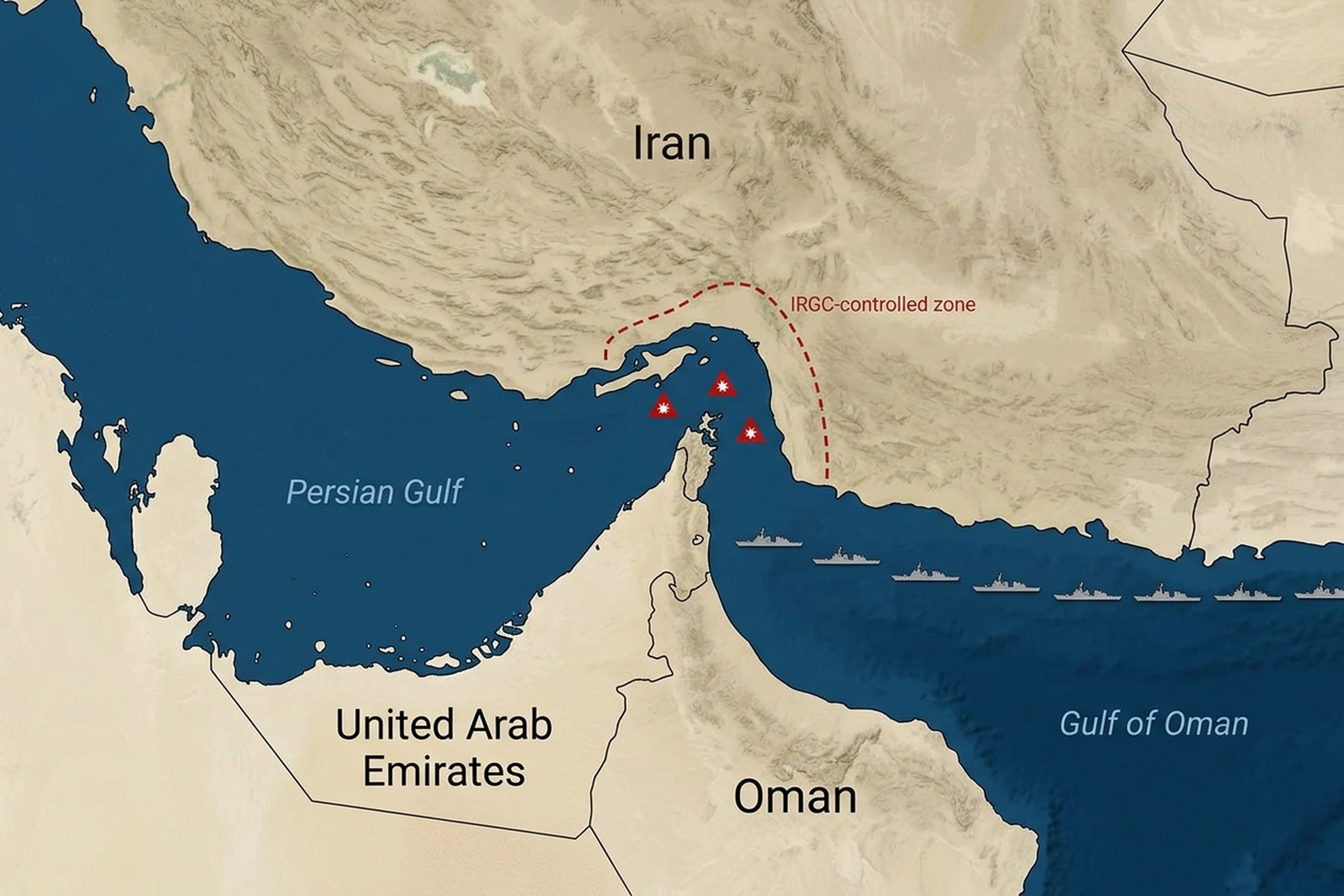
Interactive Map: Strait of Hormuz Crisis Zone
Explore the crisis zone below. Click on markers to see details about mine fields, tanker attack sites, military positions, IRGC checkpoints, and key energy infrastructure.
The June MoU: A Deal About a Deal That Frayed in Weeks
The framework the July escalation just tore up was signed on June 14 in a 14-point memorandum of understanding, brokered with Qatari and Omani mediation after nearly four months of open war between the US, Israel and Iran. It committed Washington to immediate sanctions relief (including the now-revoked oil-sales waiver, initially valid through August 21) and eventual asset unfreezing in exchange for Iranian demilitarization of the Strait of Hormuz and, in a later final agreement, disposal of highly enriched uranium and binding non-proliferation commitments. As one security analyst put it to Newsweek, the June MoU was in effect “a deal about a deal” and always likely to be fragile.
Tehran had signed the memorandum in the aftermath of the death of Supreme Leader Ayatollah Ali Khamenei, killed alongside members of his family in the joint US–Israeli strikes on February 28. Under the framework Iran began, cautiously, to resume oil exports; between June 10 and July 6, roughly a dozen LNG cargoes exited the strait. But Iran also insisted that any commercial vessel using routes not coordinated with Tehran was fair game, keeping the IRGC as the de-facto gatekeeper of the waterway. When those attacks resumed in early July, the US pulled the oil concession that had been the MoU’s biggest carrot.
June 2026: The First Direct US–Iran Strikes
The July escalation followed a shorter but sharper exchange in mid-June, the first direct US–Iran strikes centred squarely on the Strait of Hormuz itself.
Apache Helicopter Downed (June 8)
On Monday, June 8, a US Army AH-64 Apache helicopter went down in the sea near the Strait of Hormuz while patrolling the waterway. President Trump said the following day that the aircraft had been shot down by Iran; two US officials told CBS News that an armed Iranian Shahed drone struck the helicopter overnight. Both crew members were rescued within roughly two hours by an uncrewed US Navy drone boat, believed to be the first combat rescue of its kind, and were reported uninjured.
US Retaliatory Strikes (June 9)
Vowing to “respond to this attack,” Trump ordered strikes that hit Iran on Tuesday night. US Central Command said American forces struck Iranian air-defense systems, ground-control stations, and surveillance radar sites near the Strait of Hormuz, targeting the very assets Iran used to monitor and threaten shipping through the chokepoint.
Iran Strikes Back at Gulf Bases (June 10)
Early Wednesday, Iran’s joint military command answered with attacks on US military bases in Bahrain, Kuwait, and Jordan, widening the confrontation beyond the strait. The tit-for-tat pushed both sides toward the negotiating table that produced the June 14 MoU four days later.
April 2026: Blockade, Ceasefire and Tanker Attacks
US Navy Blockade (April 12–15)
Following the collapse of the first round of peace talks, President Trump ordered a full naval blockade of Iranian ports at the Strait of Hormuz. The blockade became operational within hours. US Central Command reported the blockade was “fully implemented,” with no ships passing through the enforcement zone over a 24-hour period on April 14. Six merchant vessels complied with orders to turn around during the first days of enforcement, though shipping data suggested at least four Iran-linked vessels crossed the waterway despite the blockade. Iran was estimated to be losing $435 million per day from the halt to economic trade.
Peace Talks Collapse (April 12)
On April 12, high-stakes peace talks between the US and Iran collapsed in Islamabad, Pakistan, after 21 hours of marathon negotiations. US Vice President JD Vance, leading the American delegation, announced the failure, stating that no agreement could be reached on key issues including Iran’s 10-point plan for ending the conflict. In response, President Trump threatened to blockade the Strait of Hormuz and warned of further military action. Two empty supertankers attempting to transit the strait made U-turns immediately after the announcement. Iran’s Revolutionary Guard reiterated a “shoot at sight” policy for unauthorized vessels.
The April 8 Ceasefire
A two-week ceasefire between the US and Iran was brokered by Pakistan and officially announced on April 8, the first pause in hostilities since airstrikes began on February 28. Key terms included a 14-day duration, safe passage for vessels coordinated with Iranian forces, and a framework for talks on Iran’s 10-point peace plan (including US asset unfreezing and toll rights in the strait). Compliance was limited from the start: in the first 24 hours after the ceasefire, only 10 vessels transited the strait, including just 4 tankers.
Iran’s Toll Law and Safe Passage Deals
On April 4, Iran’s Parliament Security Committee formally approved a draft bill to impose transit tolls on commercial vessels. The “law of strategic action for peace and development of the Persian Gulf” would charge fees based on vessel type and cargo, with revenues distributed as “war reparations.” Legal experts noted the law violates Article 26 of the UN Convention on the Law of the Sea, which prohibits charges solely for passage through international straits. Iran separately negotiated safe passage deals with China, Russia, India, Iraq, Pakistan and the Philippines; most Western-flagged vessels have avoided the strait entirely.
Tanker Attacks in April
On April 1, the QatarEnergy-owned fuel oil tanker Aqua 1 was struck by an Iranian cruise missile in Qatari territorial waters near Ras Laffan, causing a fire that was later extinguished with no casualties. On April 4, the IRGC claimed a drone strike on the MSC Ishyka, a container ship linked to Mediterranean Shipping Company, though maritime tracking showed the vessel was not actually hit. Those incidents brought the total to 21 confirmed IRGC attacks on merchant ships since the crisis began.
US Mine-Clearing Operations Begin
On April 11, the US military initiated mine-clearing operations in the Strait of Hormuz. Two Navy destroyers, USS Frank E. Petersen (DDG 121) and USS Michael Murphy (DDG 112), transited the strait to “set conditions” for de-mining, according to US Central Command. Operations continued into April 12, with three US officials verifying progress despite IRGC threats. US officials said fewer than 10 mines had been laid by Iran, a lower number than the earlier estimate of “at least 12.”
New IRGC Naval Base on Qeshm Island
On April 9, the IRGC inaugurated a new naval base on Qeshm Island in Hormozgan Province, east of the Strait of Hormuz. The facility includes six buildings and is intended to consolidate IRGC control over the waterway. The move came just one day after the ceasefire was announced, signaling Iran’s intent to maintain its grip on the strait regardless of diplomatic outcomes. Qeshm was one of the Iranian coastal sites CENTCOM struck on July 8.
UN Security Council: China and Russia Veto
On April 7, the UN Security Council voted on a Bahrain-led draft resolution to enhance maritime security and protect shipping in the Strait of Hormuz. The resolution was vetoed by China and Russia. The final tally: 11 in favor, 2 against (China, Russia), and 2 abstentions (Colombia, Pakistan). The UK expressed “deep regret” over the failure, while Iran’s allies framed the resolution as biased Western intervention.
Global Impact
The IEA’s Executive Director Fatih Birol described the disruption as “the largest supply disruption in the history of the global oil market.” It affects 11 million barrels of oil and 140 billion cubic meters of gas in daily global circulation. The impact extends well beyond energy:
- Fertilizers: About a third of global fertilizer trade passes through the strait. Nitrogen fertilizer prices have risen 30–40%, threatening food security.
- Helium: Qatar’s helium exports (critical for chip manufacturing) remain blocked, threatening semiconductor supply chains.
- LNG: Qatar’s Ras Laffan terminal, the world’s largest LNG export facility, is effectively landlocked. Global LNG supply is down roughly 20%.
- Methanol: One-third of global seaborne methanol trade passes through the strait, disrupting chemical manufacturing and plastics production.
- Aluminum, sulfur, graphite: Critical non-energy commodities are also affected, with knock-on effects for the green energy transition.
What Comes Next
As of August 24, the confrontation has shifted from strikes to finance. The US sanctions package lands the same day, Iran has blacklisted ships and moved a transit-fee bill through committee, and the strait is still carrying single-digit crossings.
Three things decide the next week. Whether Gulf states join the US package after Rezaei’s threat to treat them as enemies, whether the Oman channel survives the Albusaidi visit to Tehran on August 25, and whether the sanctions push Iran back toward kinetic escalation after 48 hours with no confirmed attacks in the strait.
The mid-July escalation has pushed the crisis to its most dangerous point yet. Trump declared the June MoU “over” on July 8, and on July 17 Iran said it had suspended its own commitments in turn, leaving no agreed framework in place. The oil-sales waiver wind-down expired on July 17. With both sides now striking civilian infrastructure (water and power plants in Iran and Kuwait), the immediate question is whether Iran follows through on its threat to have the Houthis close the Bab el-Mandeb strait, which would put both of the region’s key oil arteries at risk at once.
Five things are worth watching. First, whether France and Britain’s proposed multinational maritime mission takes shape at the NATO–Gulf ministerial and dilutes the pure US enforcement posture. Second, whether Iran narrows its attacks to non-coordinated shipping (as its foreign ministry suggests) or expands them to Qatari or Saudi cargoes, as the July 7 Al Rekayyat strike did. Third, whether the CENTCOM–IRGC deconfliction channel opened in late June survives an escalation that has now hit both sides’ territory. Fourth, whether the pause on strikes inside Iran survives the IRGC’s July 28 missile salvo and the July 29 US and Saudi strikes in Iraq, and whether the Pakistan, Egypt and Qatar track can bridge the gap the Oman talks failed to close, now that Tehran has set full control of the inbound lane as its price. Fifth, whether the exchange between Saudi Arabia and the Houthis over Hodeidah, Jizan and Yanbu hardens into a sustained second war, which would put the Red Sea workaround out of action at the same time as Hormuz stays shut.
The IEA’s Birol put it simply: the reopening of the Strait of Hormuz remains the “single most important” solution to the global energy crisis. That reopening moved further away on July 28, when Iran rejected Oman’s plan to divide the waterway evenly and set full control of the inbound lane as its price. Hours later the IRGC fired ballistic missiles at US forces in Jordan, and on July 29 US and Saudi forces struck Iran-aligned groups across eastern Iraq.
Against that, the strait has not reopened by a single ship. Iran says it is still in control, the IRGC Navy targeted and stopped three more tankers early on July 29, and Iranian media reported a tanker exploding on a mine on July 26. Fewer than 10 commodity ships a day crossed over the weekend of July 25 to 26.
The side fronts are live too. US and Saudi forces struck Iran-aligned groups across seven Iraqi provinces on July 29, killing at least 20 by the Popular Mobilisation Forces’ count, and the Houthis fired ballistic missiles at the Saudi tanker NCC Ghazal in the Red Sea on July 28. Trump met Netanyahu in the Oval Office on July 28, with no decision announced on the mediators’ proposal.
The escalation stopped short. US strikes resumed on the night of July 29 and the IRGC halted two more tankers on July 31, but Trump cancelled the larger round planned for the weekend of August 1 and said he was giving a deal a chance.
What that deal is worth is now the open question. Trump said on August 3 that talks were “going on right now” and gave Tehran a “last chance,” while Iran’s foreign ministry said no negotiations with Washington are taking place and US officials told CBS News none were scheduled.
By August 5 the answer was closer. Bessent put a deal at “today or tomorrow,” Trump at “tomorrow or the next day,” and Axios reported Washington, Tehran and Muscat aiming for a Wednesday announcement of an interim reopening.
Three things could still sink it. Iran and Oman have not settled the reopening mechanism, the maritime service fees or the security arrangements, and Tehran keeps denying that the United States is a party to the talks at all.
The price of the deal is sanctions relief. Regional officials say the arrangement is conditional on Washington lifting sanctions on Iranian ports, which would unwind the blockade that is currently its main source of leverage.
The pressure now runs through the blockade rather than the air. No new US strikes on Iranian territory were reported from August 3 to 5, while CENTCOM said on August 4 that it had redirected 45 ships and Iranian crude is still not moving.
The corridor is the thing to watch. Baghaei said on August 3 that the temporary route combines the Omani southern lane and the Iranian northern lane, carries traffic both ways, and settles nothing about whether the strait itself reopens.
Its enforcement is the weak point. A cargo ship was struck on that Omani stretch on the night of August 3, and Mohsen Rezaei said US warships on any lane Tehran has not designated would be treated as targets.
Iranian energy infrastructure would be a new threshold. Washington has so far avoided refineries and power plants, according to reporting on the internal debate, for fear Tehran would answer against Gulf energy sites and shock an already strained oil market.
The next move belongs to Tehran’s leadership. Iran says the framework with Oman is finalised and awaiting sign-off at the highest level, so the test is whether that approval arrives and whether ships follow it into the channel.
Two gaps remain unbridged. Tehran still says the arrangement is about routes rather than reopening, and Washington still refuses any Iranian toll or permission regime, which is the difference between a corridor and an open strait.
The Mecca pact is the new variable. If another major attack lands on Saudi soil, the agreement signed on August 7 gives Riyadh a formal route to pull Turkiye and Pakistan into a war that has so far stayed between Washington and Tehran.
The price is now published. Iran’s Supreme National Security Council listed on August 8 what Washington must do before the strait reopens, from ending the war and lifting the blockade to paying compensation and releasing frozen assets, a list no US official has engaged with.
That gap is wider than the corridor. The Oman framework settles where ships sail; Zolghadr’s list settles who pays for the war, which is how the IRGC can call the deal all but done and the waterway shut in the same breath.
The Gulf states are the ones being hit. The missile that struck an ADNOC tanker on August 8 drew a piracy accusation from Abu Dhabi and a rebuke from Doha, and each such strike makes the Mecca pact’s logic more attractive in Riyadh.
Washington’s own clock is running. The Joint Chiefs chairman is reported to be pressing for an off-ramp, the Pentagon has given contractors 21 days to accelerate deliveries, and Bessent is already arguing the strait will be irrelevant within two years.
The instrument has changed. Trump’s August 9 comments put the weight on Iran’s inflation, its ability to pay its troops and the blockade rather than on new strikes, which turns the next phase into a contest of endurance.
The blockade is the clock. CENTCOM’s redirected count went from 49 on August 6 to 53 on August 8 and 55 on August 9 while Iranian crude stayed in port, so each week of stalemate deepens the squeeze without opening the waterway.
The side fronts move fastest. Two waves of Houthi missiles on al-Makha killed at least 18 people on August 9 and 10, a reminder that the war can widen in Yemen even while Washington and Tehran are not shooting at each other.
Reparations now cut both ways. Trump’s August 10 counter-demand, that Iran pay for deaths going back decades, turns the item at the centre of Tehran’s list into a mutual claim, which is harder to settle than a shipping lane.
The economic front is widening faster than the military one. Diesel is the pressure point: US futures jumped 7.4% on August 10, Jazan stays shut until at least August 30, and distillate stocks are at a 30-year seasonal low.
Tehran is arranging itself for a long war. Six new commanders were installed on August 10, Kharg Island has loaded nothing since July 31, and neither side has offered the step that would put ships back through the strait.
The numbers are now part of the argument. Washington says almost 9 million barrels a day are leaving through the strait while Kpler and JPMorgan put seaborne flow at 4 to 5 million, so each side can call the waterway open or shut without being contradicted by its own data.
The inventory clock is the one that matters. The IEA has global stocks down 410 million barrels since February and a 1.8 million barrel a day deficit this quarter, which is the pressure that decides whether a corridor deal arrives before the buffer runs out.
The next escalation is financial. Bessent’s package is due next week and Hegseth says the blockade can run indefinitely, so the contest is whether an economy already cut off from its oil revenue bends before the diplomacy does.
The tankers are the counter-pressure. Two ADNOC vessels on August 13 and an outbound tanker on August 14 show that Tehran can keep raising the cost of every crossing while the Oman text sits unsigned.
The crossing now carries a body count. A crew member was killed aboard an outbound vessel on August 18, the kind of loss that decides whether owners and their insurers will sail any corridor the diplomats draw.
The mediator has become a target as well. Trump’s threat to bomb Oman puts the one channel that has produced a text at risk, and Senate Democrats are preparing a war-powers resolution to take that option off the table.
The route map is the next test. Iran says the map is agreed with Muscat and a joint statement is coming, so the question is whether that document arrives and whether Washington, which rejects any Iranian permission or toll regime, treats it as a reopening at all.
The talking has now stopped on the US side. Trump told his envoys on August 19 to break off contact with Tehran until Iran is ready to deal, leaving the Oman channel as the only live track and no US and Iran table at all.
Pressure is meant to do the work instead. Washington has promised sanctions on a scale it says has never been applied to a country, while Tehran has begun mapping targets outside the region, including US and British sites in Bulgaria and Cyprus.
That promise now has a name. Trump called it an “Economic D-Day” on August 19, and Bessent said on August 20 that the blockade and the sanctions together are meant to collapse the Iranian government, with the detail due at a Monday press conference.
The open question is whether China plays along. Beijing took more than 80% of Iran’s shipped oil last year and answered the appeal by saying sanctions do not solve the problem, which leaves the campaign’s main lever untested.
The second question is what Tehran does with it. The IRGC says any restart would bring more precise and more destructive weapons, and the ship data show most traffic still following Iran’s rules rather than Washington’s.
The third question is which Tehran answers. Pezeshkian argued on August 21 for ending the war while Iran still holds what he calls power and dignity, which is the first time a sitting Iranian president has pushed publicly against the hardliners setting the reopening terms.
The cargo data set the clock. Iran is loading about a seventh of its pre-war crude, more than 40 million barrels are stuck on tankers it cannot deliver, and Kpler reckons the oil it can still send China runs out in roughly five months.
The Iraqi exception is the one to watch. Letting Baghdad’s tankers through on August 22 is the first time Tehran has opened the waterway for anyone since the memorandum lapsed, and it shows the closure is a policy Iran can meter rather than a blockage it cannot lift.