
UNICEF — the United Nations Children’s Fund — is the UN agency dedicated to the rights and wellbeing of every child. Founded in 1946, it works in more than 190 countries and territories, from delivering vaccines and clean water to protecting children in conflicts and emergencies. Here’s what UNICEF does and where it operates, mapped.
Where UNICEF works
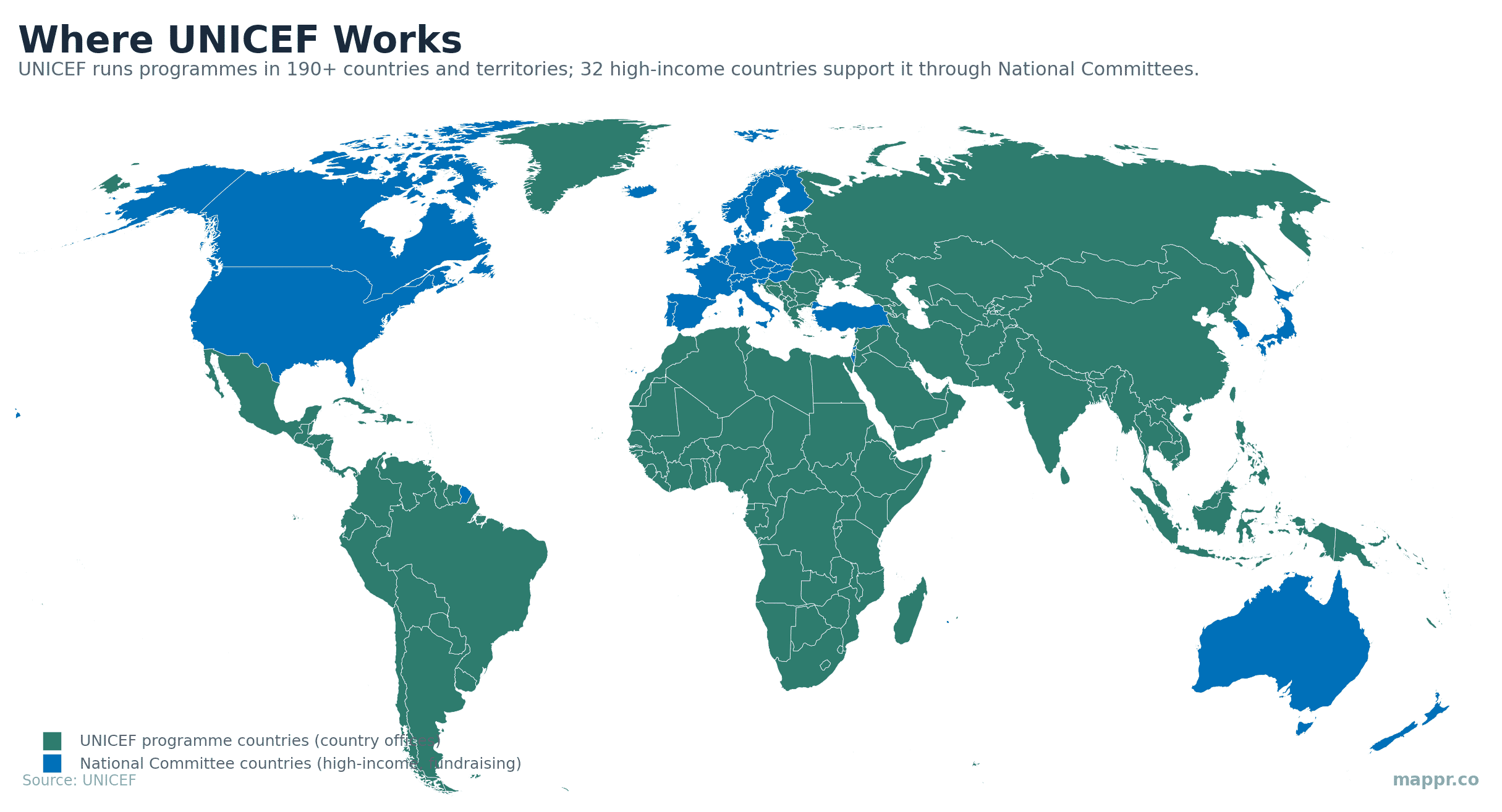
UNICEF runs on-the-ground programmes in over 190 countries and territories — most of the world. In the wealthiest countries it usually doesn’t run aid programmes; instead, 32 high-income countries host a UNICEF National Committee that raises funds, advocates for children’s rights and runs awareness campaigns. As of 2026 the National Committee countries are: Andorra, Australia, Austria, Belgium, Canada, Czechia, Denmark, Finland, France, Germany, Hong Kong, Hungary, Iceland, Ireland, Israel, Italy, Japan, South Korea, Luxembourg, the Netherlands, New Zealand, Norway, Poland, Portugal, Slovakia, Slovenia, Spain, Sweden, Switzerland, Türkiye, the United Kingdom and the United States.
What UNICEF does
- Health & nutrition — immunisation, treating child malnutrition, maternal and newborn care.
- Water, sanitation & hygiene (WASH) — safe water and sanitation for communities and schools.
- Education — getting children into school and keeping them learning, including in crises.
- Child protection — shielding children from violence, exploitation, trafficking and child labour.
- Emergencies — rapid humanitarian response in wars, disasters and disease outbreaks.
The scale is enormous: UNICEF’s Humanitarian Action for Children appeal sought around $9.9 billion for 2025 to reach children caught in crises. The organisation is funded entirely by voluntary contributions from governments, the National Committees, foundations and individuals.
A short history of UNICEF
UNICEF was created by the UN General Assembly in 1946 as the United Nations International Children’s Emergency Fund, to help children devastated by the Second World War. In 1953 it became a permanent part of the UN and was renamed the United Nations Children’s Fund — keeping the original UNICEF acronym. It won the Nobel Peace Prize in 1965 and remains the world’s largest child-focused humanitarian organisation.


