
Key Takeaways
- Women are more obese in most of the world. In 160 of 199 countries, the adult obesity rate is higher for women than for men. Globally about 28% of women are obese versus 20% of men (WHO, 2022).
- The widest gaps are in Southern Africa and the Caribbean. South Africa has the largest gap on record — 46% of women are obese versus just 14% of men, a 32-point difference. Jamaica, St Vincent, Lesotho and Eswatini follow.
- Central and Eastern Europe flips the pattern. In Slovenia, Czechia, Slovakia and Poland, men are notably more obese than women — the clearest exception to the global rule.
- Obesity keeps rising. Worldwide adult obesity has more than doubled since 1990. In 2022 roughly 1 in 8 people — about 890 million — were living with obesity.
- Among major economies, the US ranks highest. About 42% of American women and 39% of American men are obese. Mexico, Saudi Arabia, Egypt and Türkiye also post very high rates, especially among women.
Obesity is not gender-neutral. Across most of the world, women are more likely to be obese than men — but the size of that gap, and even its direction, varies enormously from country to country. Using the latest World Health Organization data (2022), this page maps the obesity gender gap worldwide and shows where the divide between women and men is widest.
Globally, about 28% of women and 20% of men live with obesity (a body mass index of 30 or higher). In 160 of 199 countries with data, women’s obesity rates exceed men’s. The map below shows the gap in percentage points — teal where women are more obese, brown where men are.
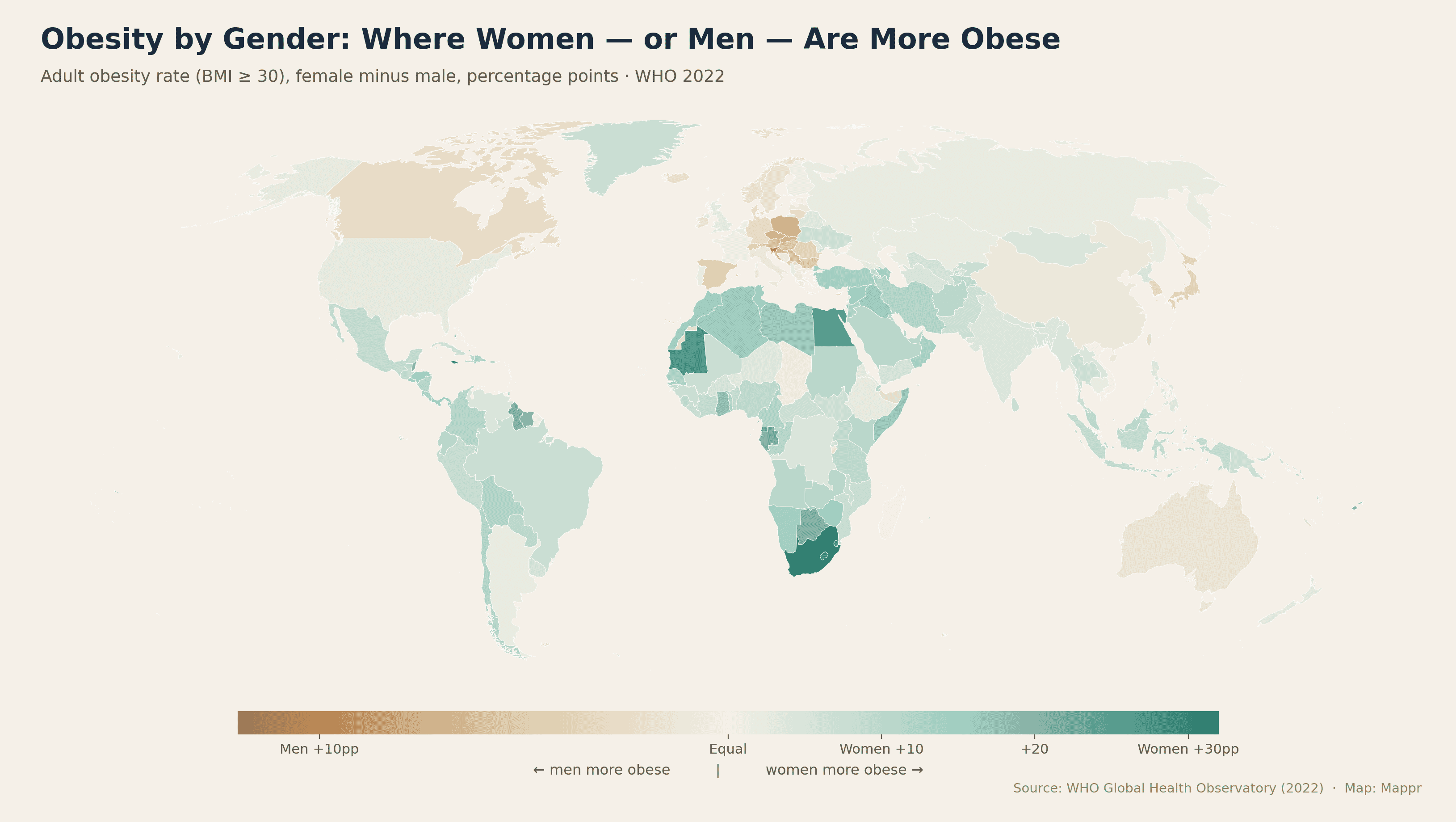
Women carry the higher obesity burden in most countries
The pattern is striking on every continent. Across Africa, the Middle East, South Asia and Latin America, women’s obesity rates run far ahead of men’s. The starkest example is South Africa, where roughly 46% of women are obese compared with just 14% of men — a 32-percentage-point gap. Jamaica, Saint Vincent and the Grenadines, Lesotho, Eswatini and Mauritania all show gaps of 27 points or more. Egypt stands out too, with about 56% of women obese versus 30% of men.
Researchers link these gaps to a mix of biology and society: hormonal differences and pregnancy-related weight retention, lower levels of physical activity among women in some regions, and cultural factors — in parts of Africa and the Pacific, a fuller figure has historically been associated with status and health. Men, meanwhile, are more likely to carry weight as visceral fat and, in many countries, are more physically active through manual work.
Where men are more obese than women
A clear cluster of exceptions runs through Central and Eastern Europe. In Slovenia, men’s obesity rate is about 11 points higher than women’s — the largest male-skewed gap in the world — followed by Czechia, Slovakia, Poland, Serbia, Croatia, Austria and Hungary. A handful of wealthy countries elsewhere, including Germany, Spain, Canada and Japan, also tilt slightly male. In these countries higher alcohol consumption, diets heavy in meat and processed food, and desk-bound work patterns weigh more heavily on men.
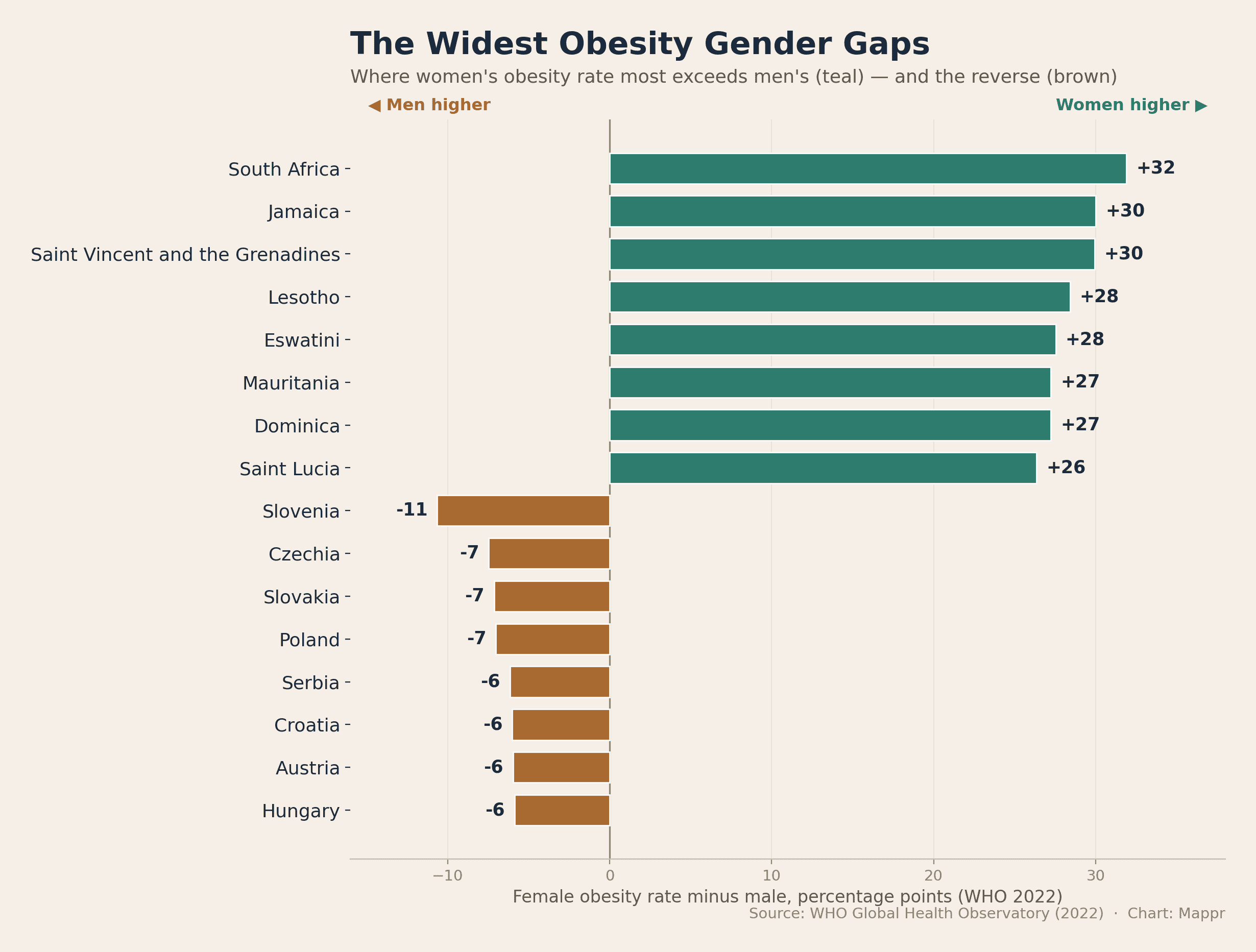
Obesity rates by gender in major countries
Here is the adult obesity rate for women and men in a selection of large economies, ranked by overall obesity. Figures are the WHO’s age-standardized estimates for 2022.
| Country | Women | Men | Higher gender (gap, pp) |
|---|---|---|---|
| Egypt | 55.9% | 30.1% | Women +25.8 |
| United States | 41.7% | 39.2% | Women +2.6 |
| Saudi Arabia | 46.3% | 35.8% | Women +10.5 |
| Mexico | 40.2% | 31.3% | Women +8.9 |
| South Africa | 46.3% | 14.4% | Women +31.9 |
| Australia | 29.0% | 30.6% | Men +1.5 |
| Türkiye | 35.7% | 22.1% | Women +13.6 |
| Brazil | 31.9% | 24.2% | Women +7.7 |
| United Kingdom | 28.4% | 25.6% | Women +2.8 |
| Canada | 24.3% | 27.2% | Men +2.9 |
| Germany | 19.1% | 22.1% | Men +3.0 |
| Russian Federation | 18.9% | 16.6% | Women +2.3 |
| Spain | 13.8% | 18.3% | Men +4.5 |
| Italy | 13.6% | 14.9% | Men +1.3 |
| Nigeria | 17.4% | 8.0% | Women +9.4 |
| France | 12.0% | 11.1% | Women +0.9 |
| China | 7.6% | 8.7% | Men +1.1 |
| South Korea | 5.6% | 8.9% | Men +3.3 |
| India | 9.4% | 5.2% | Women +4.2 |
| Japan | 3.5% | 7.3% | Men +3.8 |
Why obesity differs between men and women
Several forces pull men’s and women’s obesity rates apart. Biology plays a role: women naturally carry a higher proportion of body fat, and hormonal shifts during pregnancy, menopause and across the menstrual cycle can promote fat storage. Economics and culture matter just as much. In many lower- and middle-income countries, obesity rises faster among women as diets shift toward processed food, while women may have fewer opportunities for physical activity. In richer countries the gap often narrows or reverses, with men’s drinking and eating patterns pushing their rates up. None of this is destiny — obesity is largely preventable through diet, activity and access to healthcare.
What is obesity?
Obesity is defined as an abnormal or excessive accumulation of body fat that presents a risk to health. The most common measure is body mass index (BMI) — a person’s weight in kilograms divided by the square of their height in metres. An adult with a BMI of 30 or higher is considered obese; 25 to 30 is classed as overweight. It is a leading risk factor for type 2 diabetes, heart disease, several cancers and other chronic conditions.
Obesity by the numbers (WHO, 2022)
- Worldwide adult obesity has more than doubled since 1990, rising from about 7% to 16% of adults.
- In 2022, around 2.5 billion adults were overweight, including 890 million living with obesity — roughly 1 in 8 people on Earth.
- Adolescent obesity has quadrupled since 1990.
- Most of the world’s population now lives in countries where overweight and obesity kill more people than underweight.
- Obesity is largely preventable — and often reversible — through diet, physical activity and medical support.
For the overall country ranking regardless of gender, see our map of the most obese countries in the world.


