
Key Takeaways
- 4G now reaches about 92% of humanity. A 4G/LTE signal is available to roughly 92% of the world’s population — up from a tiny fraction when these networks first launched around 2010.
- Near-universal in cities, patchier in the countryside. 4G covers 99% of the world’s urban population but only 82% of rural areas — and reaches barely half (about 52%) of people in low-income countries.
- The remaining gap is concentrated in Africa. Sub-Saharan Africa has the widest coverage gap. The Central African Republic, South Sudan and Niger still leave much of their population unreached, while North Korea and Eritrea sit near zero.
- The bigger problem is the ‘usage gap’. Around 3.45 billion people live within reach of a mobile network but still don’t use mobile internet — held back by device cost, digital skills and affordability rather than coverage.
- Attention has shifted to 5G. With 4G now reaching almost everywhere it practically can, operators are racing to roll out 5G and switch off legacy 2G and 3G networks.
LTE — Long-Term Evolution, the technology behind 4G mobile networks — launched commercially in 2009 and quickly became the world’s dominant mobile-broadband standard. When this guide was first written, large parts of the map still had no 4G at all. That has changed dramatically: by the mid-2020s a 4G signal reaches roughly 92% of the world’s population, according to the International Telecommunication Union (ITU).
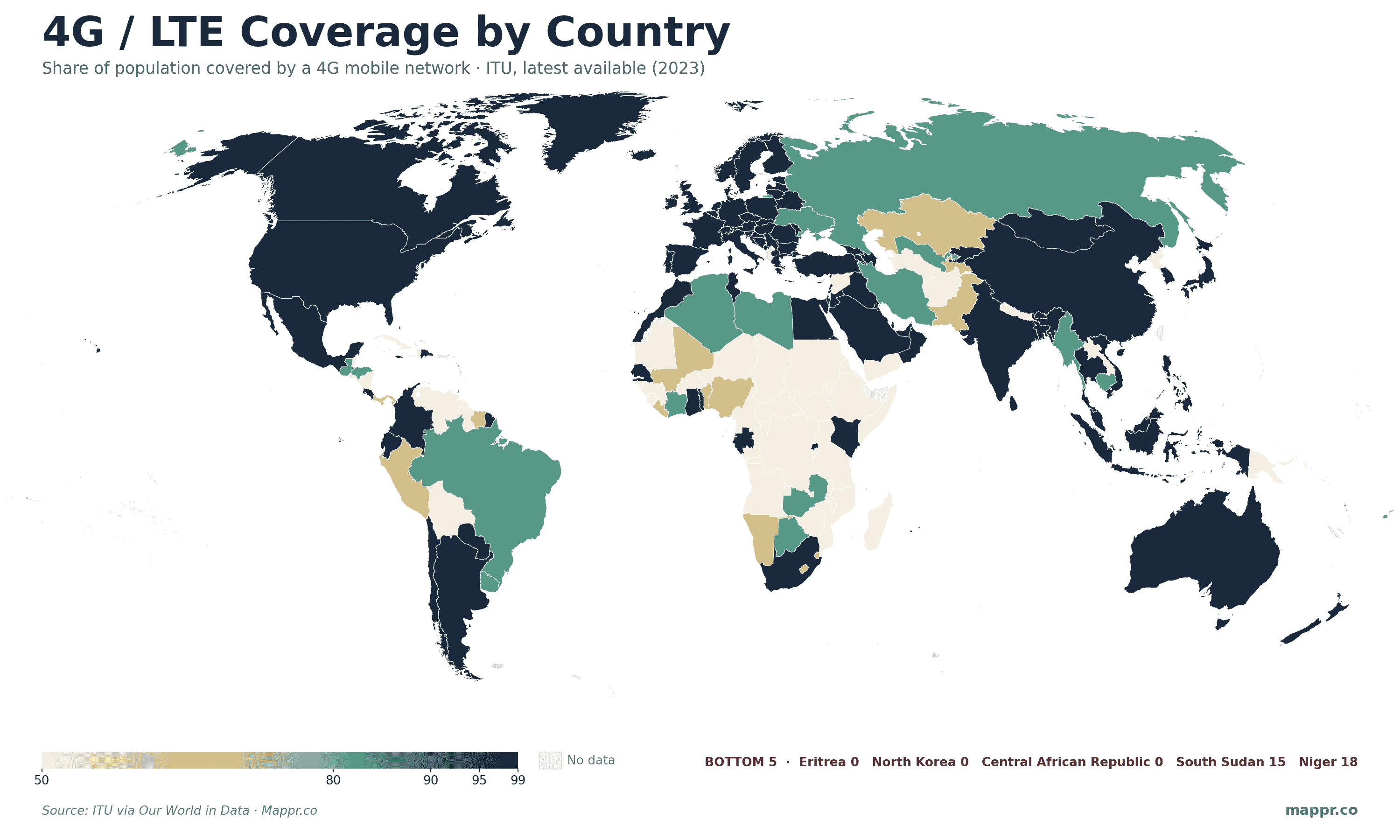
The map below shades every country by the share of its population covered by a 4G/LTE network. Most of the world is now dark — near-total coverage — and the remaining gaps cluster in a familiar band across the Sahel and Central Africa.
How Much of the World Has 4G?
Globally, about 92% of people live within range of a 4G network, and 96% can reach at least a 3G signal. But the headline number hides a sharp urban–rural divide: 4G covers roughly 99% of the world’s urban population versus just 82% of rural areas. The split by income is starker still — in low-income countries, 4G reaches only about 52% of the population, and barely 30% of rural residents there.
Where Coverage Still Lags
The unreached few percent are not spread evenly. Sub-Saharan Africa has by far the widest coverage gap, with about 13% of its population living outside any mobile-broadband signal. The lowest-coverage countries include the Central African Republic, South Sudan and Niger, where conflict, low population density and weak infrastructure make rollout slow and costly. A handful of states sit near zero for political rather than geographic reasons — North Korea, where the public has no open mobile internet, and Eritrea, one of the least-connected countries on Earth.
The Bigger Gap Isn’t Coverage — It’s Usage
Having a signal is no longer the main barrier to getting online. The GSMA estimates that about 3.45 billion people live within reach of a mobile network but still don’t use mobile internet — a group it calls the usage gap. In Sub-Saharan Africa the usage gap is roughly 60%, dwarfing the ~13% coverage gap. The obstacles now are the price of a smartphone, the cost of data, digital skills and relevant local content — not the absence of a tower. Closing the connectivity divide increasingly means tackling affordability and literacy, not just building more network.
Coverage Isn’t the Same as Speed
Coverage only measures whether you can connect — not how good that connection is. On real-world 4G speed, the leaders are wealthy, densely populated tech hubs: South Korea, Singapore, the United Arab Emirates, Norway and the Netherlands routinely top global rankings. Plenty of countries with near-total coverage still deliver only modest speeds because their networks are congested or run on limited spectrum. Unsurprisingly, the fastest 4G markets were also the first to move on to 5G.
From LTE to 5G
Because 4G now reaches almost everywhere it practically can, the frontier has moved on. Operators across North America, East Asia, Europe and the Gulf are pouring investment into 5G, while older 2G and 3G networks are being switched off to free up spectrum. In much of Africa and South Asia, though, 4G is still the technology doing the heavy lifting and is forecast to remain the dominant standard well into the 2030s. And where laying cell towers is uneconomic, satellite services are starting to fill the void — see our map of Starlink availability by country.
Coverage figures are from the ITU (population covered by a 4G network), with per-country values compiled via Our World in Data; the latest available year is used for each country (mostly 2023). Global, urban–rural and income-group figures are from the ITU’s Facts and Figures 2024. Usage-gap figures are from the GSMA’s State of Mobile Internet Connectivity. Coverage indicates the availability of a signal, not actual usage or speed.


