
Key Takeaways
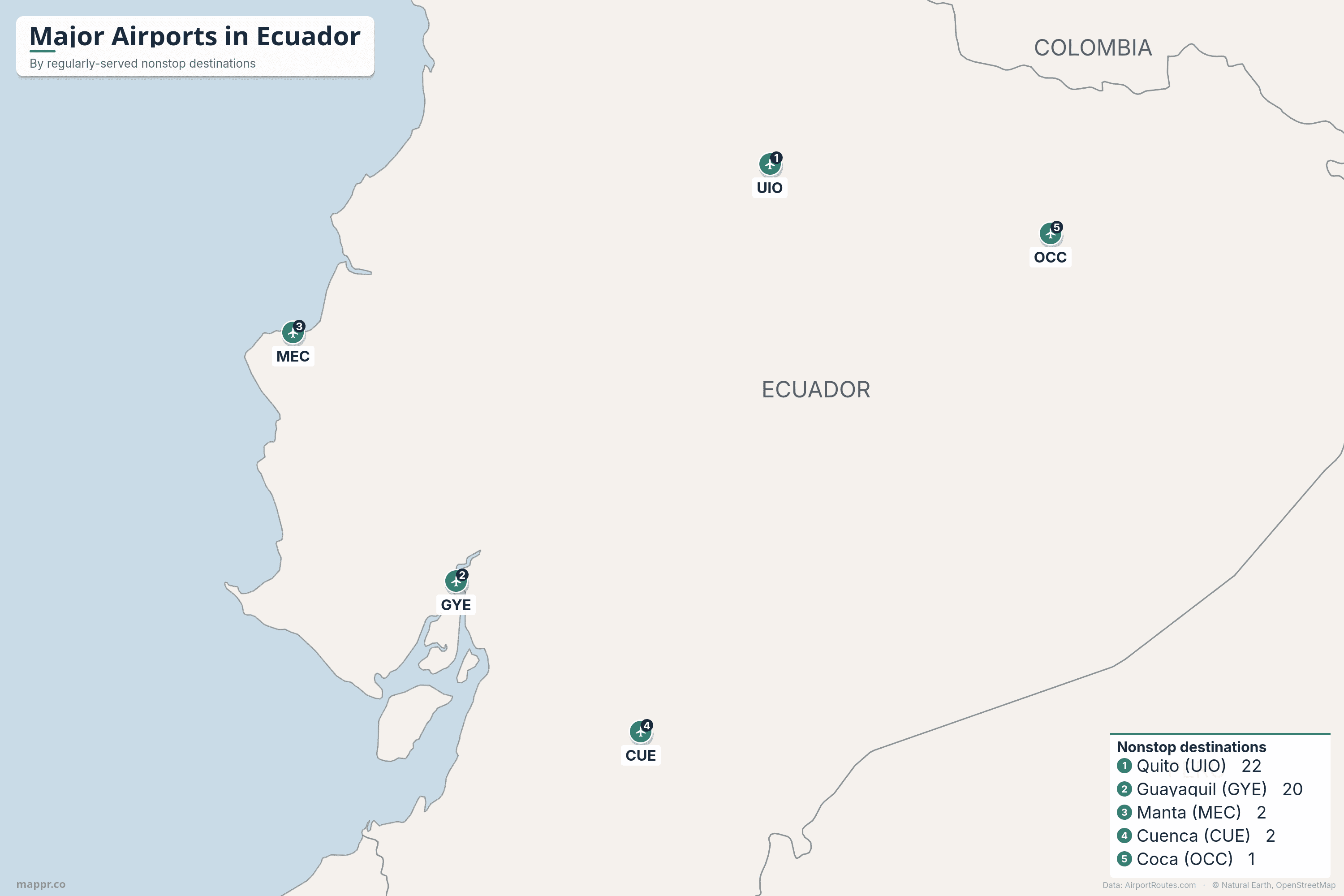
- Quito leads, Guayaquil close behind. Quito's Mariscal Sucre Airport (UIO) serves around 22 regularly-served nonstop destinations and José Joaquín de Olmedo in Guayaquil (GYE) about 20. Together the two cities carry almost all of Ecuador's air traffic.
- A two-hub country. After Quito and Guayaquil, only Manta (2 destinations), Cuenca (2) and the Amazon town of Coca (1) run scheduled service in the route data — five airports in all with regular passenger flights.
- Two gateways to the US. Only Quito and Guayaquil fly nonstop to the United States — Miami, New York, Atlanta, Houston, Fort Lauderdale and Los Angeles — on carriers such as American, Delta, United, JetBlue, Spirit, LATAM and Avianca. Everywhere else connects through these hubs, Bogotá or Panama City.
- The Galápagos fly domestic only. The islands' two airports — Baltra (GPS) and San Cristóbal (SCY) — handle no international flights. Every visitor connects through the mainland, usually Guayaquil, where bags are screened for biosecurity before the hop out to the archipelago.
- High-altitude hubs. Quito's airport sits at about 2,400 m and replaced the city's notoriously cramped in-town airport in 2013; Cuenca's short runway is hemmed in by the Andes at roughly 2,530 m.
Ecuador packs extraordinary geographic variety — a Pacific coast, the Andean highlands, the Amazon basin and the Galápagos Islands — into one of South America’s smallest countries. Its airline map, though, is dominated by just two cities. Quito‘s Mariscal Sucre Airport and Guayaquil’s José Joaquín de Olmedo Airport carry almost all of the country’s flights, while a short tail of regional airports in Manta, Cuenca and the Amazon town of Coca run only a handful of routes. In all, just five Ecuadorian airports currently show regular scheduled passenger service in the route data.
Below we map and rank those airports by the number of nonstop destinations each one serves, drawn from live route data on AirportRoutes. Because the figures come from observed flight data — a large sample rather than a complete published timetable — we treat them as a strong guide to relative connectivity rather than exact, official totals.
Which Ecuadorian airports have direct flights to the US?
Almost all of Ecuador’s international flying happens at Quito and Guayaquil. Quito (UIO) has the widest network in the country, with the majority of its destinations international — reaching the United States, the rest of Latin America and a couple of European hubs (Iberia to Madrid, KLM to Amsterdam). Guayaquil (GYE) is close behind and is the commercial gateway for the coast.
When it comes to the United States specifically, those two airports are the only ones with nonstop service. The data shows Quito linking to Miami, New York, Atlanta, Houston and Los Angeles, and Guayaquil to Miami, New York and Fort Lauderdale — flown by carriers such as American, Delta, United, JetBlue and Spirit, alongside LATAM and Avianca. Copa also connects both cities to its Panama City hub, a popular one-stop routing onward to dozens of US airports.
Manta, Cuenca and Coca have no scheduled US flights at all. Travelers there reach the United States by connecting through Quito, Guayaquil, Bogotá or Panama City. Manta’s single international link is Copa’s service to Panama; Cuenca and Coca are domestic-only.
Ranked
Major Airports in Ecuador by Nonstop Destinations
Ranked by regularly-served nonstop destinations, busiest first.
| Airport | IATA | Nonstop | City / Area |
|---|---|---|---|
| 1. Quito | UIO | 22 | Quito |
| 2. Guayaquil | GYE | 20 | Guayaquil |
| 3. Manta | MEC | 2 | Manta |
| 4. Cuenca | CUE | 2 | Cuenca |
| 5. Coca | OCC | 1 | Coca |
A closer look at Ecuador’s airports
🏔️ Quito (UIO)
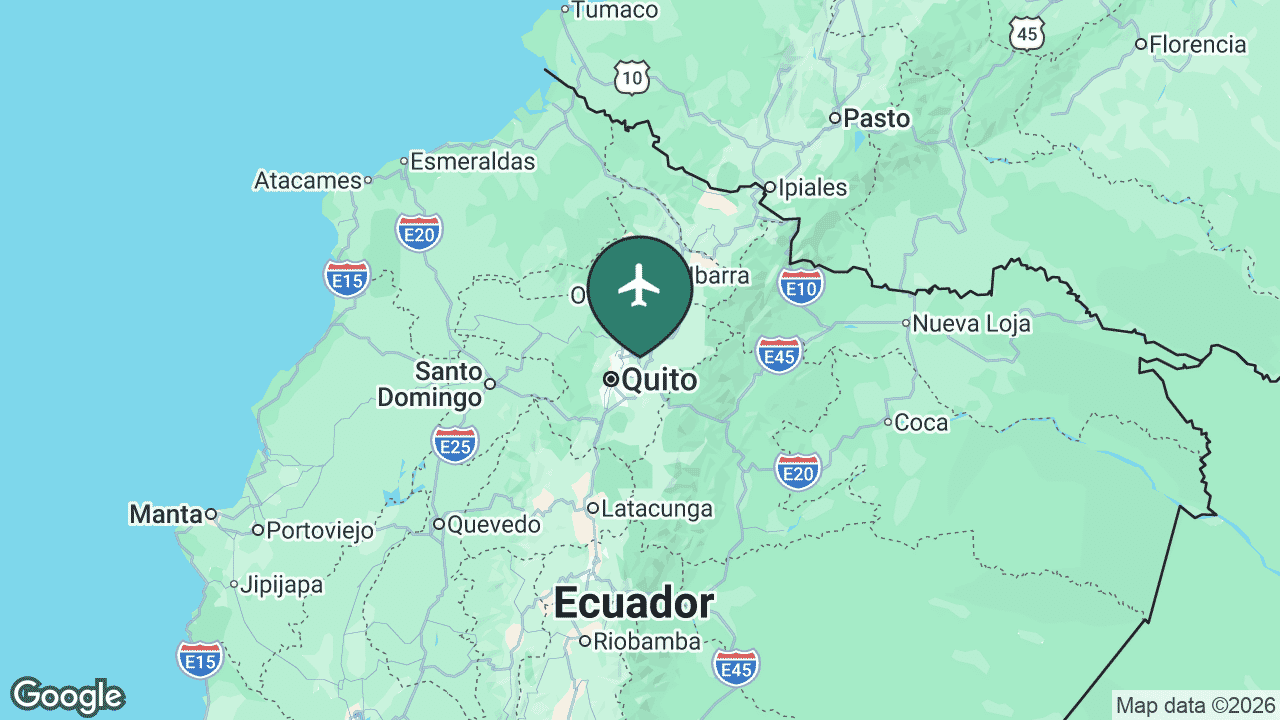
Mariscal Sucre International Airport sits in Tababela, about 18 km east of Quito, and opened in February 2013 to replace the old in-city airport, whose short runway hemmed in by the city and the Andes had made it one of the trickiest approaches in the Americas. At roughly 2,400 m above sea level it is one of the highest-altitude major international airports anywhere, and its long runway lets wide-bodies operate where the old field could not. It is the home base of Avianca Ecuador and LATAM Ecuador and the country’s principal international gateway.
Serving the capital, UIO reaches about 22 regularly-served nonstop destinations, the widest network in Ecuador. Top destinations include Guayaquil, Bogotá, Panama City, Cuenca and Miami.
Main airlines: LATAM, Avianca, Copa Airlines, plus US carriers American, Delta and United. See the full route map for UIO on AirportRoutes →
⚓ Guayaquil (GYE)
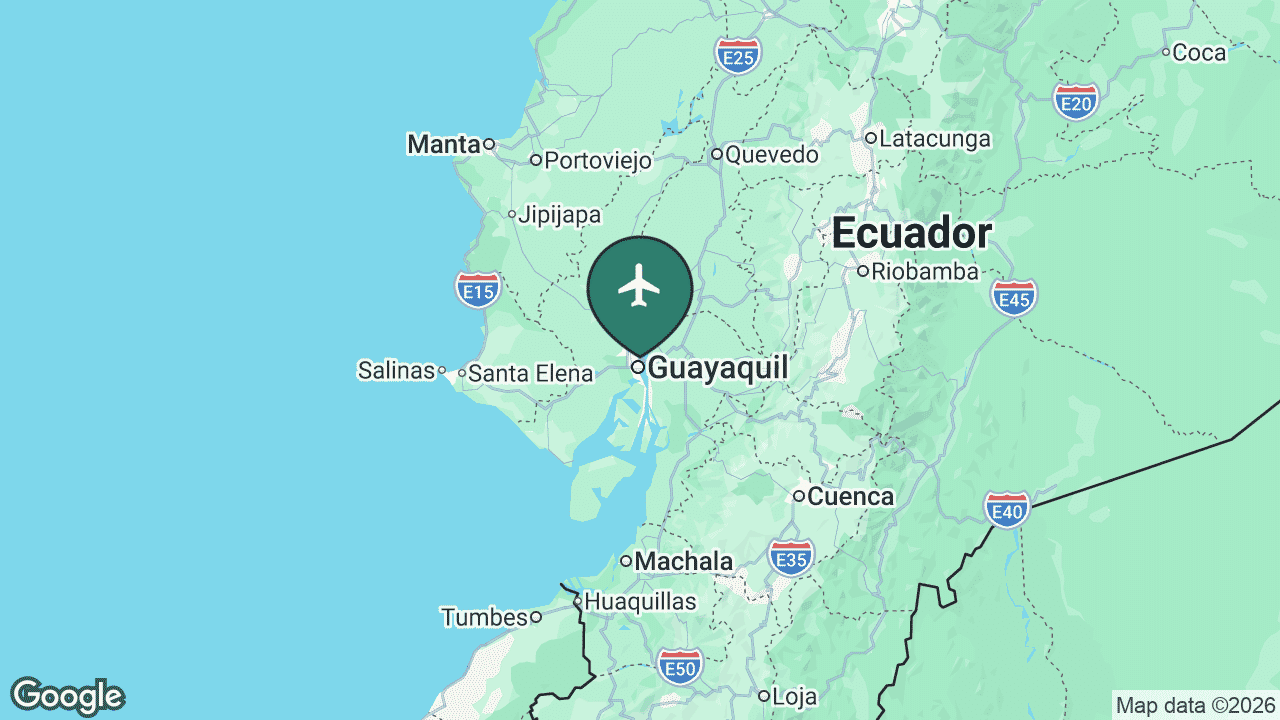
José Joaquín de Olmedo International Airport, named after the poet who became Guayaquil’s first mayor, serves Ecuador’s largest city, its busiest seaport and its main commercial centre on the Pacific coast. It runs a near-identical international network to Quito and is the second of the country’s two US gateways — and, for many travelers, the more convenient one. It is also the main jumping-off point for flights out to the Galápagos.
Serving Guayaquil, GYE reaches about 20 regularly-served nonstop destinations. Top destinations include Quito, Panama City, Bogotá, the Galápagos (Baltra) and New York.
Main airlines: LATAM, Avianca, JetBlue, Copa Airlines. See the full route map for GYE on AirportRoutes →
🏖️ Manta (MEC)
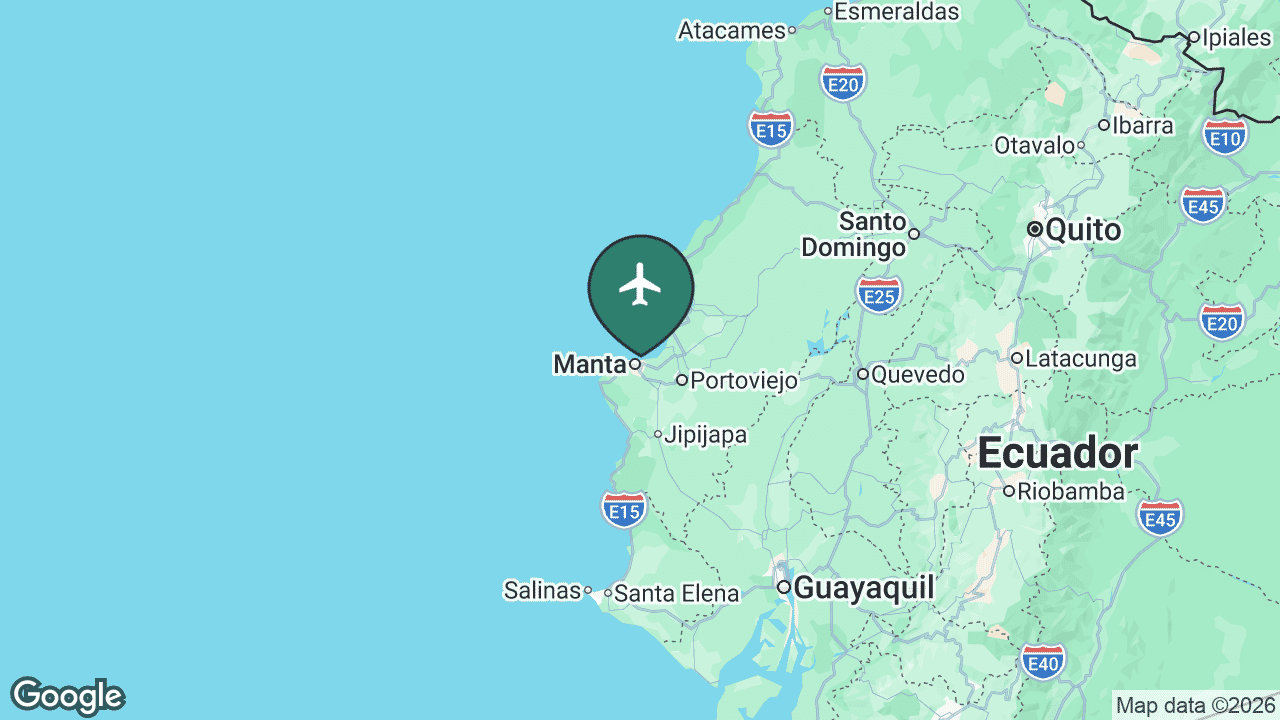
Eloy Alfaro International Airport, named after the Ecuadorian revolutionary president born nearby, serves the coastal city of Manta in Manabí province — a major tuna-fishing port and a popular beach destination. Its network is small: a single international route and a domestic link to the capital. It briefly had bigger ambitions, but today it functions as a modest regional airport.
Serving Manta, MEC reaches about 2 regularly-served nonstop destinations. Its top destinations are Quito and Panama City — the latter, on Copa, its only international service.
Main airlines: Avianca, LATAM, Copa Airlines. See the full route map for MEC on AirportRoutes →
🏛️ Cuenca (CUE)
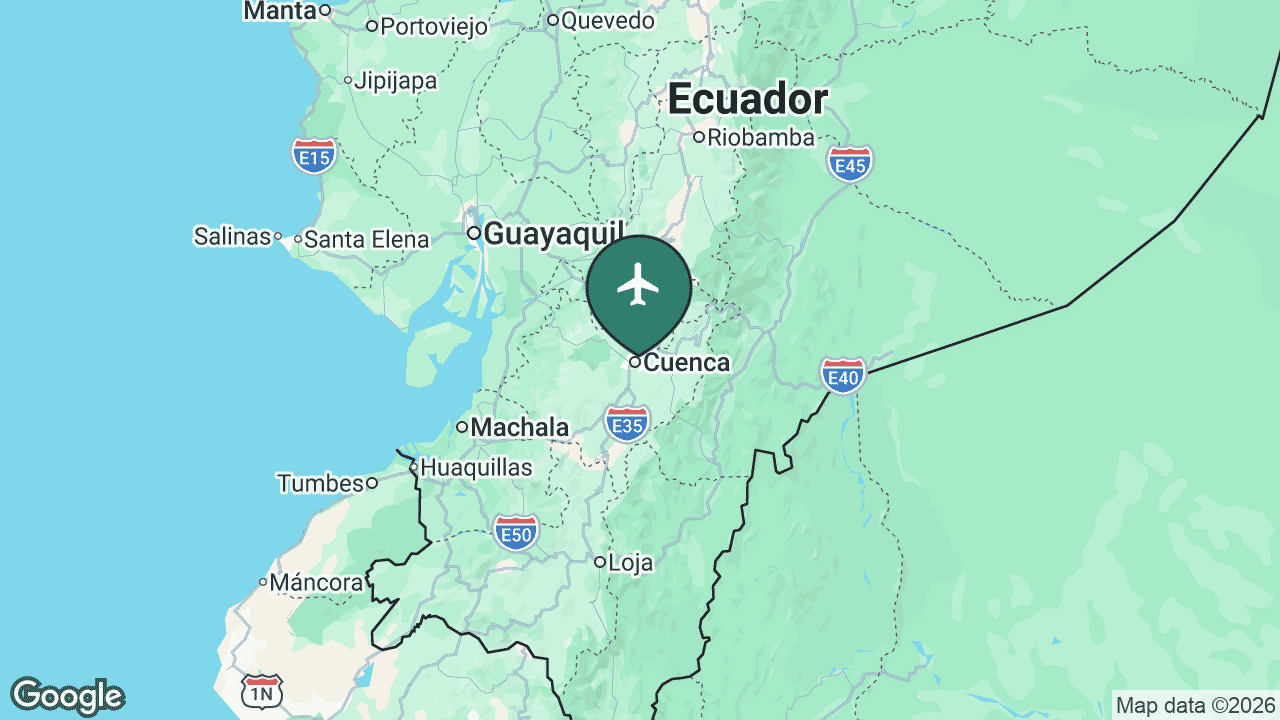
Mariscal Lamar International Airport serves Cuenca, the elegant colonial city in the southern highlands whose historic centre is a UNESCO World Heritage Site and which has become a favourite among North American retirees. Despite the “international” in its name, the airport’s short runway, hemmed in by the Andes at about 2,530 m and sitting right against the city, restricts it to smaller aircraft and, for now, domestic service only.
Serving Cuenca, CUE reaches about 2 regularly-served nonstop destinations — the two big hubs, Quito and Guayaquil.
Main airlines: LATAM, Avianca. See the full route map for CUE on AirportRoutes →
🌳 Coca (OCC)
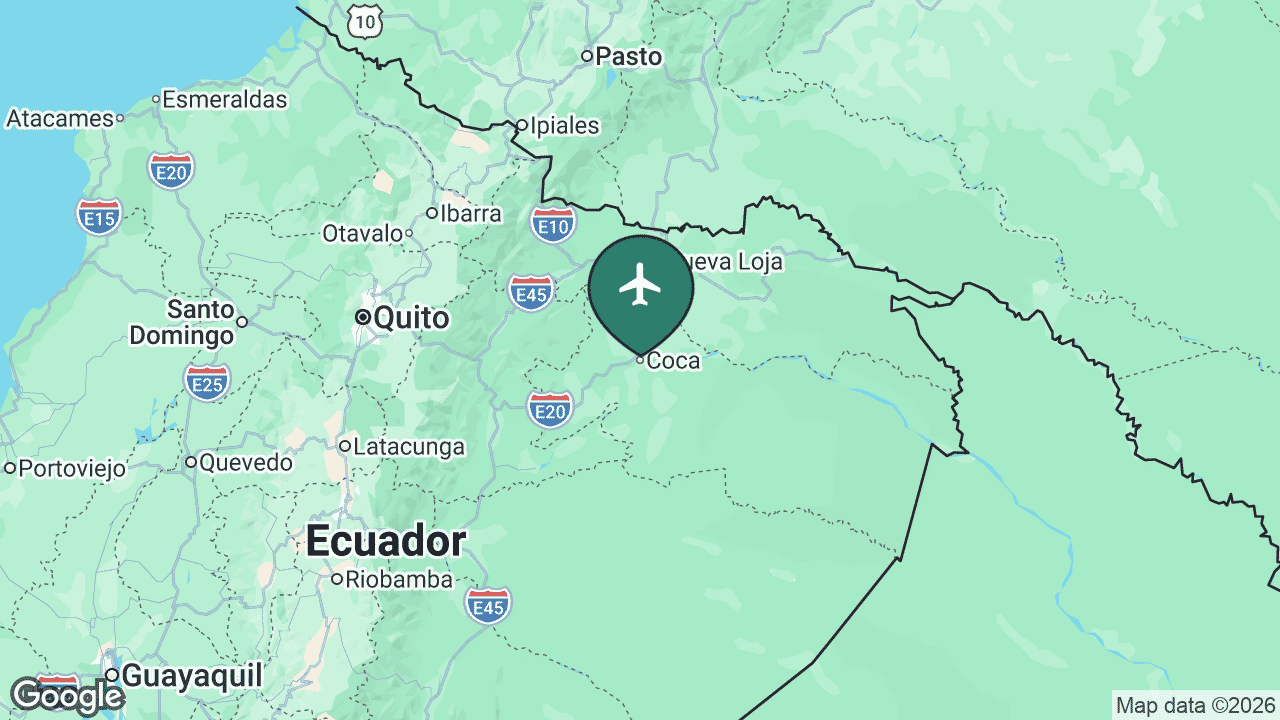
Francisco de Orellana Airport serves Puerto Francisco de Orellana — usually just called Coca — the gateway to Ecuador’s Amazon, or Oriente, in the northeastern province of Orellana. It is the air link for the region’s oil industry and the starting point for river trips down the Napo and into Yasuní National Park and the jungle lodges beyond. Its service is purely domestic.
Serving Coca, OCC reaches a single regularly-served nonstop destination: Quito.
Main airlines: LATAM. See the full route map for OCC on AirportRoutes →
What about the Galápagos Islands?
The Galápagos are Ecuador’s most famous destination, yet they don’t appear in the ranking above — and not because they lack airports. The archipelago has two: Seymour Airport on Baltra (GPS), the main gateway near Santa Cruz, branded the “Galápagos Ecological Airport” and one of the greenest airports in the world, and San Cristóbal Airport (SCY) on the island of the same name. Both handle domestic flights only.
There are no international flights to the Galápagos, by design. To protect the islands’ fragile ecosystem, every visitor transits the mainland — almost always Guayaquil, sometimes Quito — where luggage is screened for biosecurity before the roughly two-hour flight out to the archipelago. Avianca and LATAM operate the routes. Because these airports are purely domestic feeders from the two big hubs, they sit outside this list of internationally-connected airports, even though they are among the busiest tourist gateways in the country.
Ecuador’s other airports
Beyond the five with regular scheduled service, Ecuador has a scattering of smaller airports that run intermittent domestic flights or have lost their commercial service. They include Loja (Camilo Ponce Enríquez Airport) in the far south, Santa Rosa near Machala (Regional General Manuel Serrano Airport) serving the El Oro banana belt, Esmeraldas on the northern coast, and small Amazon and highland fields such as Lago Agrio, Tena and Latacunga, the last best known as a cargo hub for Ecuador’s flower exports. None currently carries the kind of regular passenger network that would place it among the country’s major airports.
Airport rankings, nonstop-destination counts, served cities, airline lists and US/intercontinental connections are drawn from live AirportRoutes route data (observed AeroAPI flight data — a sample, not a complete published schedule; we use the regularly-served figure, which filters one-off observations). Airport history and notable facts are cross-checked against the cited references. The map is a Mappr original.
Primary Data Source:
- AirportRoutes — Major airports & routes, Ecuador – Live route data: per-airport nonstop destinations, served cities, airlines and US/intercontinental connections.
Reference:
- Wikipedia — Mariscal Sucre, José Joaquín de Olmedo, Eloy Alfaro, Mariscal Lamar & Francisco de Orellana airports – Airport history, elevation, terminals and notable facts referenced in the per-airport sections.
- Locator maps — Google Maps / Google Static Maps – Per-airport location maps with airplane markers, generated via Google Static Maps.
Image Sources:
- Map by Mappr – Map of major airports in Ecuador — a Mappr original built from AirportRoutes data and Natural Earth boundaries.
🌍 More maps & data for Ecuador
Browse more: All airports by country


