
Key Takeaways
- Brussels Airport towers over Belgium. Brussels Airport (BRU), at Zaventem, serves around 151 regularly-served nonstop destinations — far more than any other Belgian airport — and is the country’s only intercontinental passenger gateway and the home base of flag carrier Brussels Airlines, part of the Lufthansa Group and Star Alliance.
- Only Brussels flies passengers nonstop to the US. Brussels is the single Belgian airport with scheduled nonstop passenger flights to the United States — New York, Newark, Chicago and Washington — operated by United and Brussels Airlines. From anywhere else in Belgium, a US trip means connecting.
- Liège is a freight giant, not a passenger hub. Liège (LGG) is one of Europe’s biggest cargo airports — a FedEx/TNT hub and Alibaba’s main European gateway. Its long-haul links to Shanghai, Chicago and New York are freighter routes, not scheduled passenger flights; for travellers it offers only a handful of seasonal holiday charters.
- Charleroi is the low-cost powerhouse. Brussels South Charleroi (CRL), about 50 km south of the capital in Wallonia, is a major Ryanair and Wizz Air base with roughly 120 point-to-point European routes — Belgium’s budget gateway, even though it carries the Brussels name.
- Belgium’s neighbours are a short hop away. Tiny, central Belgium is ringed by giant hubs. Amsterdam Schiphol and Paris Charles de Gaulle are quick train rides and pull a lot of Belgium’s long-haul traffic, while Eindhoven and Lille add nearby budget options.
Belgium is small, densely populated and sits at the crossroads of Western Europe — and its aviation map reflects exactly that. Just five airports carry scheduled passenger or significant commercial service, and they split neatly by job: one big international hub, one low-cost giant, a freight powerhouse, and two small coastal and city airports that fill up in the holiday season.
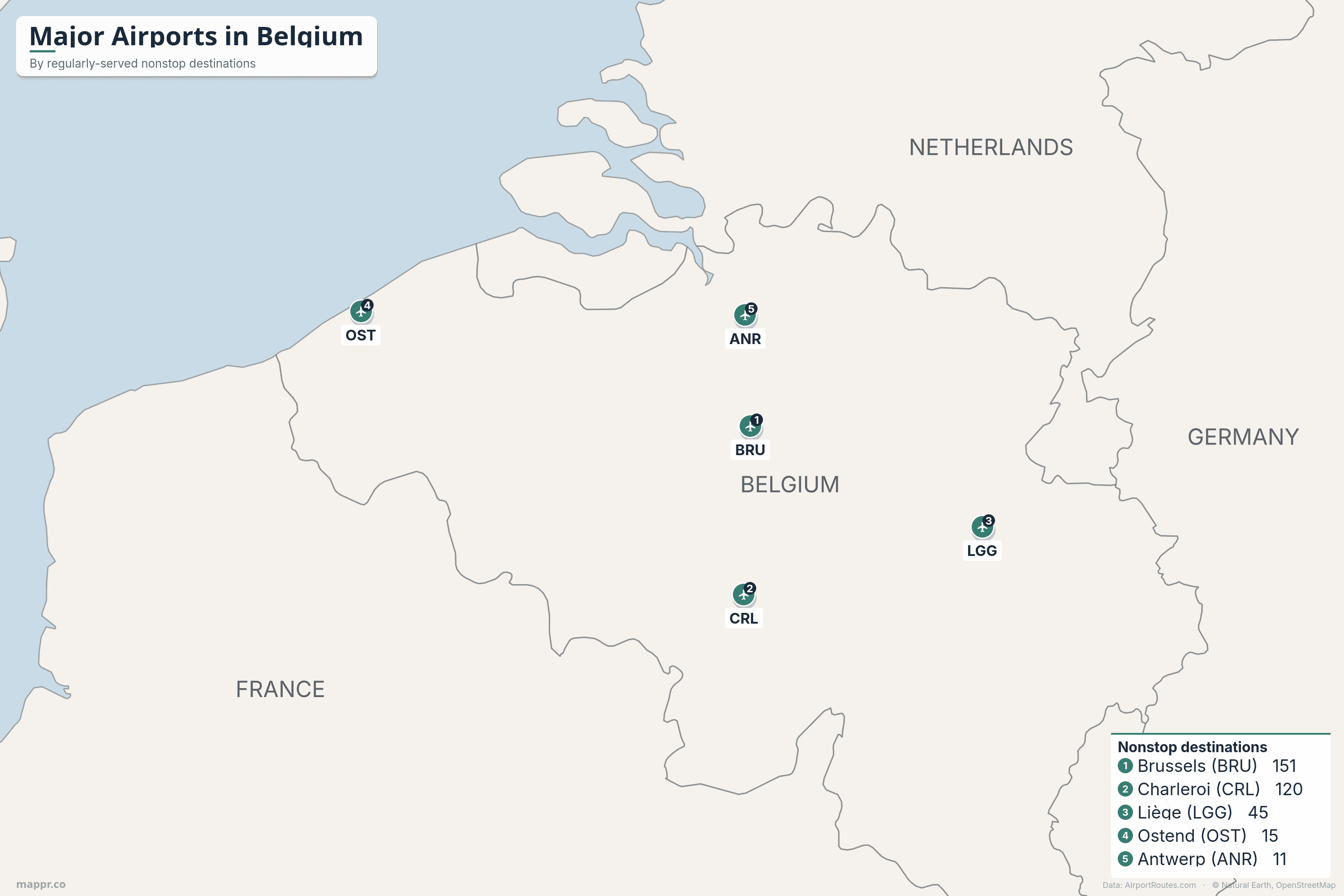
That hub is Brussels Airport (BRU) at Zaventem, Belgium’s only true intercontinental gateway and home of flag carrier Brussels Airlines — part of the Lufthansa Group and a member of Star Alliance. Behind it sit low-cost stronghold Charleroi, the cargo heavyweight Liège, and the leisure airports at Ostend-Bruges and Antwerp. The map and table below rank Belgium’s airports by the number of destinations they serve with regular flights, drawing on live AirportRoutes route data.
Which Belgian airports have direct flights to the US?
Just one — for passengers. Brussels Airport is the only airport in Belgium with scheduled nonstop passenger service to the United States, reaching New York, Newark, Chicago and Washington. The flights are operated by United Airlines and by Brussels Airlines, the country’s Star Alliance flag carrier, with the exact route map shifting a little by season.
It is worth clearing up a common point of confusion: Liège shows up in the data with links to Chicago, New York and Miami, but those are cargo flights, not passenger services — Liège is one of Europe’s largest freight airports (more on that below). Everywhere else in Belgium, a trip to the US means connecting, typically through Brussels itself or via a larger neighbouring hub such as Amsterdam, Paris or Frankfurt.
RANKED BY DESTINATIONS
Belgium’s busiest airports
By regularly-served nonstop destinations (live AirportRoutes data). Brussels and Charleroi lead the field; Liège’s network is overwhelmingly cargo.
| Airport | IATA | Serves | City / region |
|---|---|---|---|
| 1. Brussels Airport | BRU | 151 | Brussels (Zaventem) |
| 2. Brussels South Charleroi | CRL | 120 | Charleroi / Wallonia |
| 3. Liège | LGG | 45 | Liège (mostly cargo) |
| 4. Ostend-Bruges | OST | 15 | Ostend / West Flanders |
| 5. Antwerp | ANR | 11 | Antwerp |
A closer look at Belgium’s airports
✈️ Brussels Airport (BRU)
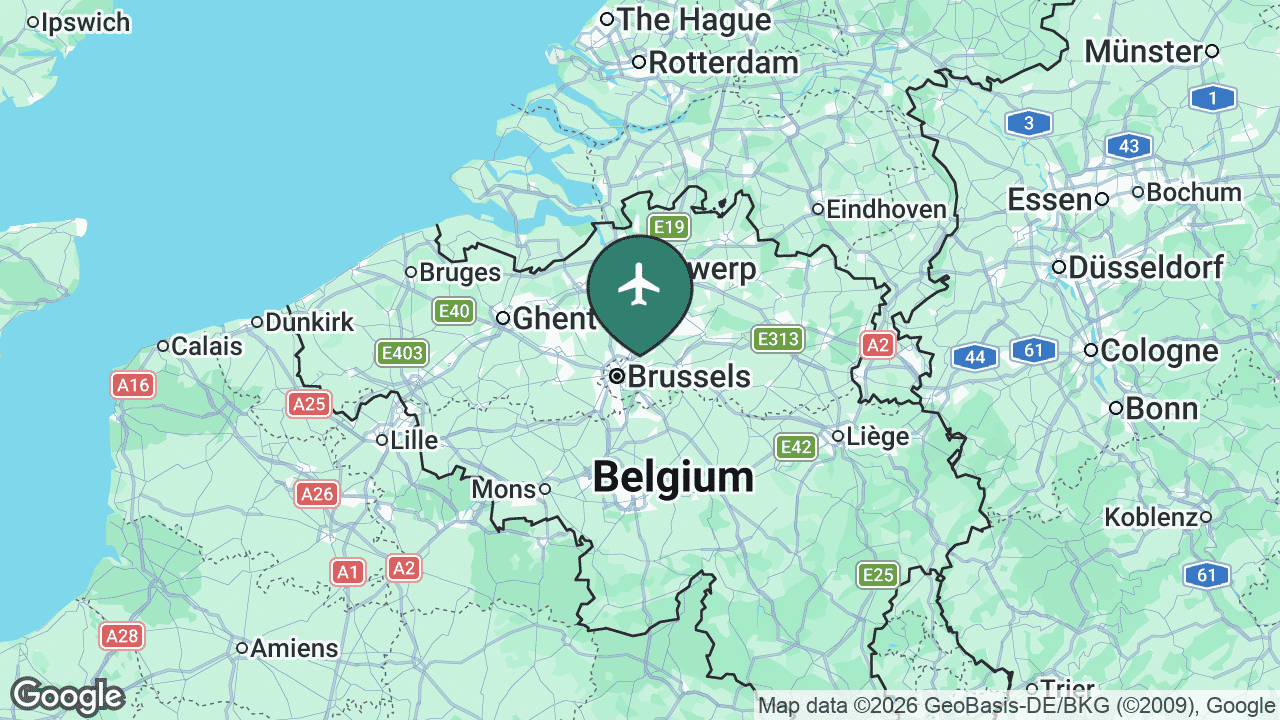
Brussels Airport, in Zaventem about 12 km northeast of the city centre, is Belgium’s largest and busiest airport and its only intercontinental gateway. It is the home base of Brussels Airlines — the Star Alliance flag carrier within the Lufthansa Group — and a major base for Ryanair and TUI fly Belgium.
BRU reaches roughly 151 regularly-served nonstop destinations, including more than 80 intercontinental routes — by far the widest network in the country. It is especially strong on Africa, a legacy of Belgium’s historic ties, with Brussels Airlines flying to cities such as Kinshasa, Kigali and Nairobi alongside the usual European links to Frankfurt, Paris, Amsterdam, Geneva, Lisbon, Munich and Istanbul.
Main airlines: Brussels Airlines, TUI fly Belgium, Ryanair, airBaltic, Transavia and a wide range of international carriers, including United on the US routes. See BRU’s full route map on AirportRoutes →
✈️ Brussels South Charleroi (CRL)
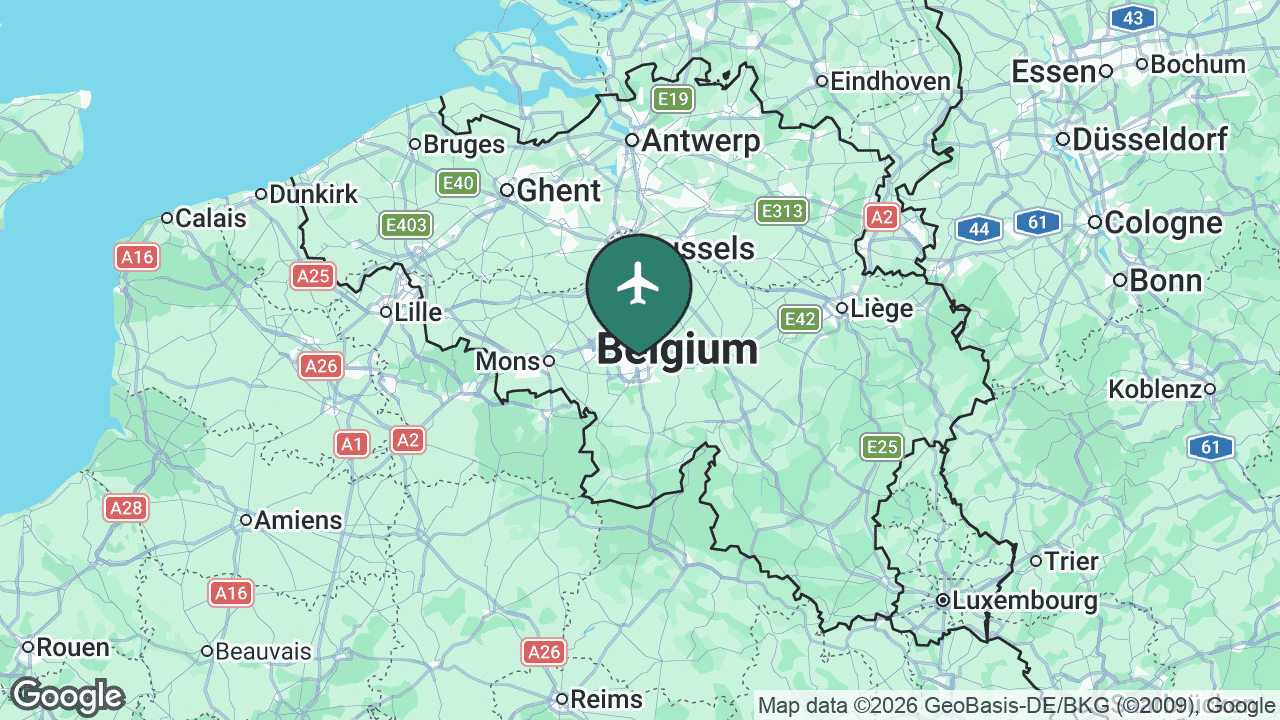
Brussels South Charleroi Airport sits about 50 km south of Brussels, near the Walloon city of Charleroi — well outside the capital, despite the marketing name. It is one of Ryanair’s largest continental bases and a key Wizz Air hub, and it built Belgium’s budget-travel boom almost single-handedly.
CRL serves around 120 regularly-served destinations, an almost entirely point-to-point European leisure network with no scheduled long-haul. Frequent links include Lisbon, Barcelona, Alicante, Marseille, Manchester, Bergamo, Treviso and Istanbul, weighted heavily toward Mediterranean sun routes.
Main airlines: Ryanair and Wizz Air dominate, with Pegasus, Volotea and Air Corsica adding seasonal routes. See CRL’s full route map on AirportRoutes →
✈️ Liège (LGG)
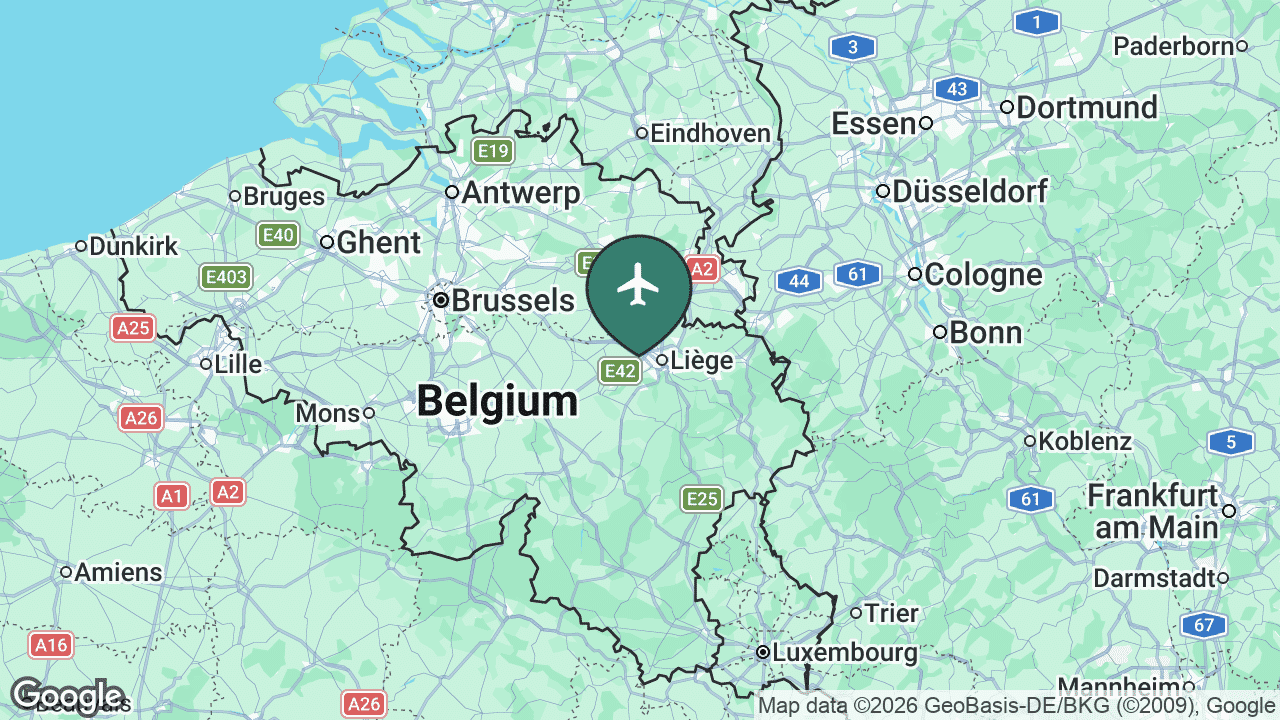
Liège Airport, in the east of the country, is the odd one out on this list: it is fundamentally a cargo airport, not a passenger one. It ranks among the largest freight airports in Europe — a long-time hub for FedEx and TNT, and the main European gateway for Alibaba’s logistics arm, Cainiao — handling well over a million tonnes of freight a year.
That is why its route list reads so exotically: the links to Shanghai, Guangzhou, Chicago, New York, Johannesburg and Riyadh are flown by freighters such as Ethiopian Cargo, Qatar Airways Cargo, Saudia and AeroLogic — not by passenger jets. For travellers, Liège offers only a modest programme of seasonal holiday charters with TUI fly to the Mediterranean and Egypt.
Main airlines: overwhelmingly freight operators (Ethiopian, Qatar, Saudia, Turkish, Bulgaria Air and others), plus TUI fly on the seasonal leisure routes. See LGG’s full route map on AirportRoutes →
✈️ Ostend-Bruges (OST)
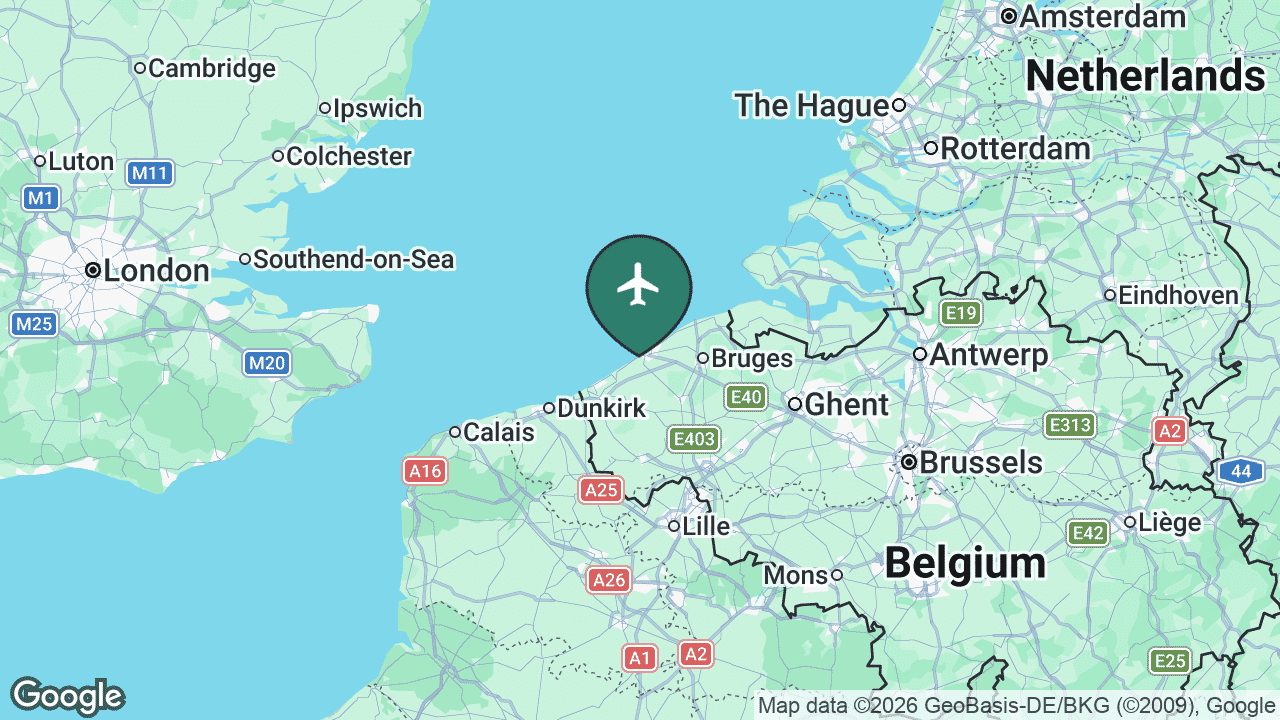
Ostend-Bruges International Airport sits on the North Sea coast in West Flanders, close to both the seaside resort of Ostend and the historic city of Bruges. Like Liège, it has a strong cargo side, but for passengers it works mainly as a holiday-charter airport.
OST serves about 15 regularly-served destinations, dominated by seasonal sun-and-sand routes: Alicante, Malaga, Palma de Mallorca, Tenerife and Gran Canaria in Spain, plus Egyptian holiday spots such as Cairo and Hurghada.
Main airlines: TUI fly leads the leisure programme, with EgyptAir on the Egyptian routes. See OST’s full route map on AirportRoutes →
✈️ Antwerp (ANR)
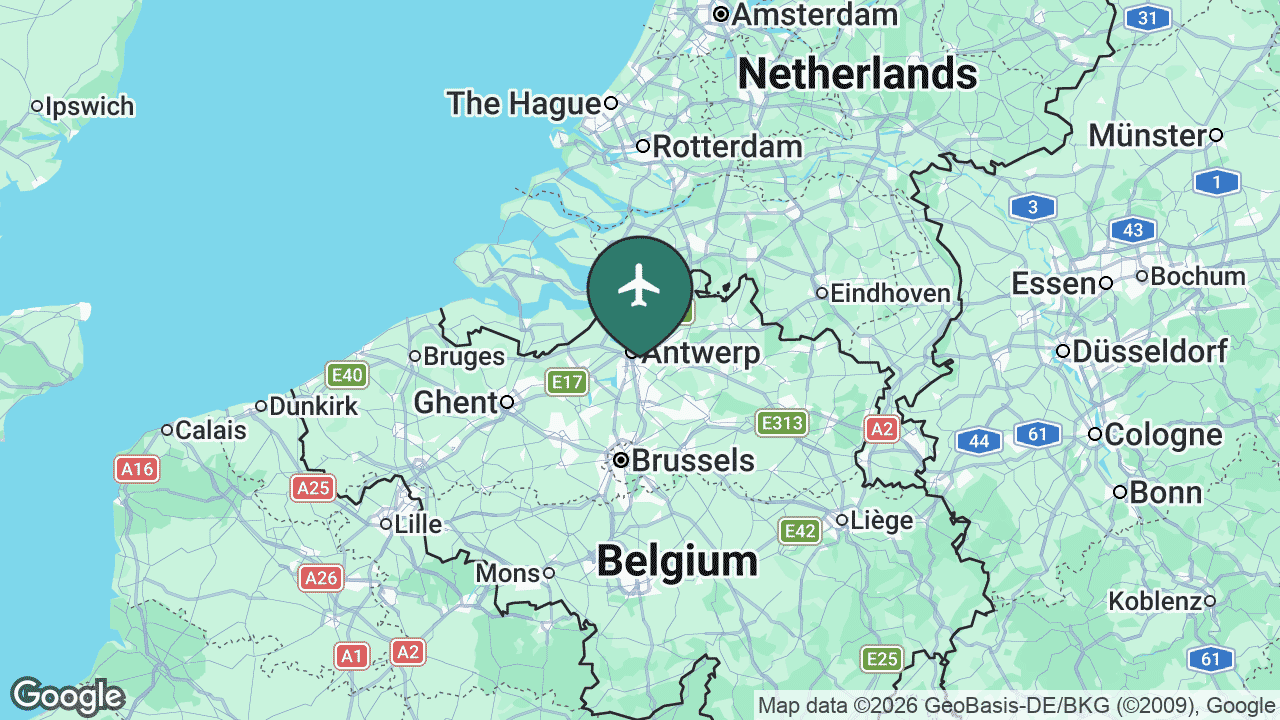
Antwerp International Airport, at Deurne on the edge of the city, is a small but handy city airport serving Belgium’s second-largest urban area and its diamond and port industries. It handles a mix of business aviation and a compact schedule of leisure flights.
ANR serves around 11 regularly-served destinations, a short list of holiday and city routes including Alicante, Malaga, Tenerife, Ibiza, Palma de Mallorca, Antalya and the Italian Alpine gateway of Bolzano.
Main airlines: TUI fly handles most of the leisure flying, with SkyAlps operating the Bolzano link. See ANR’s full route map on AirportRoutes →
What about Amsterdam, Paris and the border airports?
Because Belgium is so small and so central, a surprising share of its air travel actually starts in a neighbouring country. For long-haul flights in particular, Brussels’ network — strong as it is on Africa and Europe — can’t match the giant hubs just up the line, and fast trains make them genuinely competitive.
Amsterdam Schiphol, KLM’s vast intercontinental hub, is around two hours by train from Antwerp or Brussels and is heavily used by Flemish travellers. Paris Charles de Gaulle, Air France’s hub, is reachable in well under two hours on the high-speed Eurostar from Brussels. And for cheap point-to-point flights, Belgians near the borders also use Eindhoven in the Netherlands and Lille in France — both low-cost airports within easy driving distance. Add Cologne/Bonn and Luxembourg for the east, and Belgium effectively shares a much larger airport network than its own five fields suggest.
Airport rankings, nonstop-destination counts, served cities, airline lists and US connections are drawn from live AirportRoutes route data (observed AeroAPI flight data — a sample, not a complete published schedule; we use the regularly-served figure, which filters one-off observations). Airport history and notable facts, including Liège’s cargo role, are cross-checked against the cited references. The maps are Mappr originals.
Primary Data Source:
- AirportRoutes — Major airports & routes, Belgium – Live route data: per-airport nonstop destinations, served cities, airlines and US connections.
References:
- Brussels Airport – Operator of Brussels Airport (Zaventem), Belgium’s main hub and intercontinental gateway.
- Brussels Airlines – Belgium’s Star Alliance flag carrier and the main operator at Brussels Airport.
- Liège Airport – One of Europe’s largest cargo airports; background on its freight role.
- Wikipedia — Brussels, Charleroi, Liège & other Belgian airports – Airport background, passenger and freight figures, and operational history.
- Google Static Maps – Base maps for the per-airport locator images.
🌍 More maps & data for Belgium
Browse more: All airports by country


