
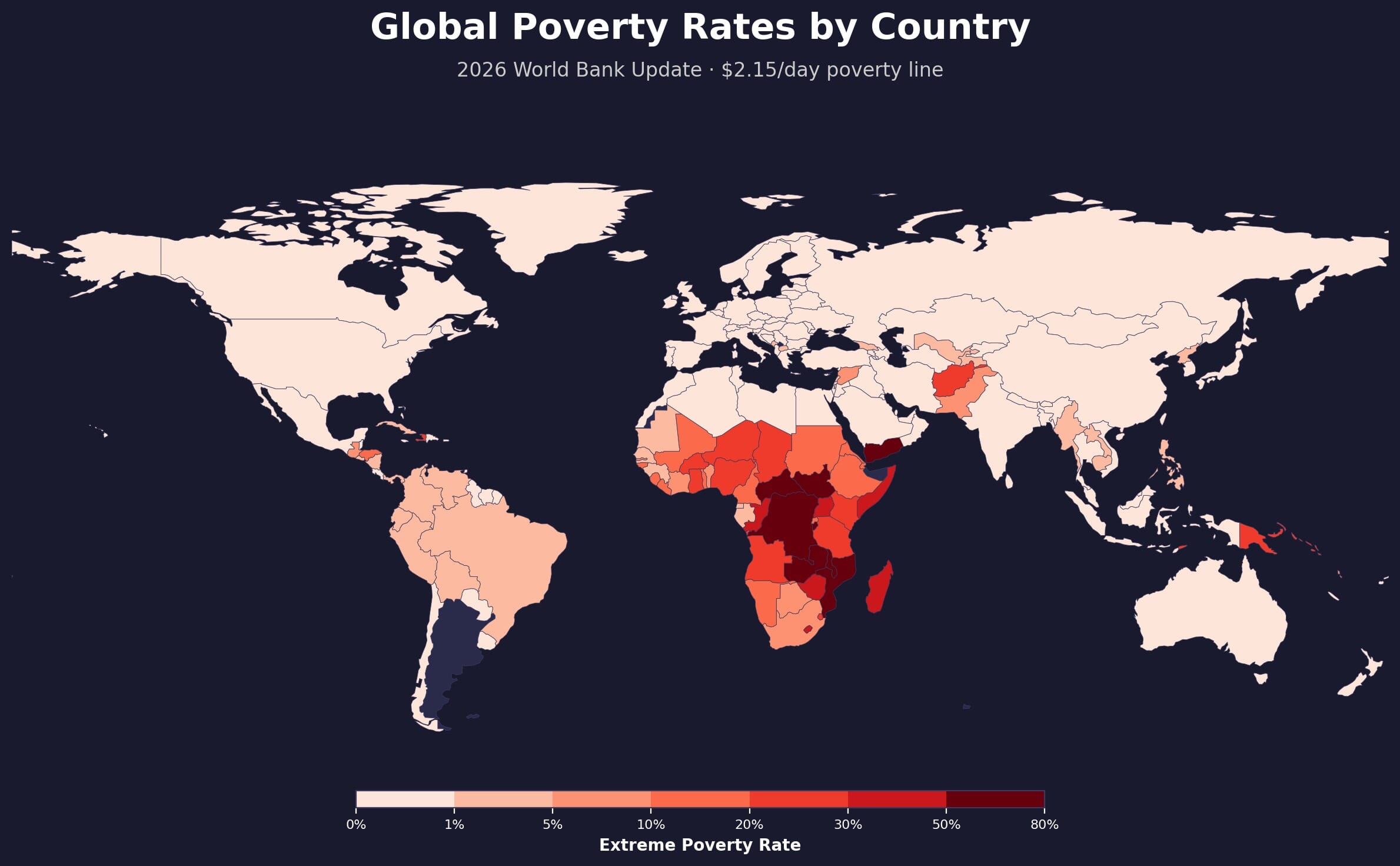
The World Bank’s March 2026 Global Poverty Update reveals that 847 million people still live in extreme poverty—surviving on less than $2.15 per day. While global poverty continues its slow decline, from 10.4% in 2024 to a projected 10.0% in 2026, the geographic concentration of extreme poverty has never been starker: Sub-Saharan Africa accounts for roughly 80% of the world’s extreme poor.
This update, based on the Poverty and Inequality Platform (PIP) version 20260324, incorporates new survey data for 28 countries—including crucial new data for Pakistan that significantly revised Middle East and North Africa regional estimates upward.
Choropleth Map: Extreme Poverty Rates by Country
The map below shows the share of each country’s population living below the international poverty line of $2.15 per day (2021 PPP). The darker the shade of red, the higher the poverty rate.
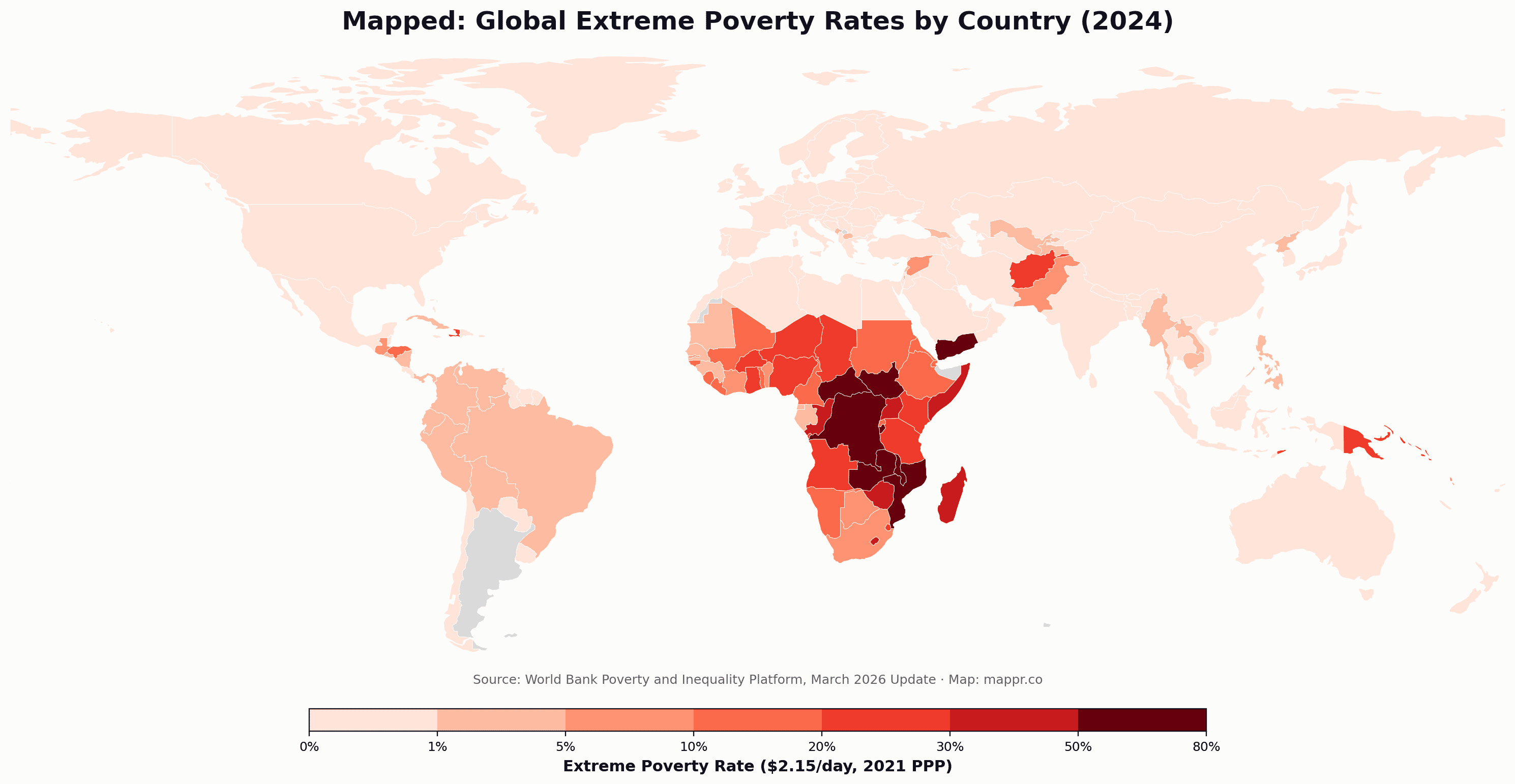
Interactive Map: Explore Poverty Data by Country
Hover over any country to see detailed statistics including the poverty rate, total population, and estimated number of people living in extreme poverty.
The 10 Countries with the Highest Poverty Rates
Nearly all countries with extreme poverty rates above 30% are in Sub-Saharan Africa, with Yemen as the only non-African nation in the top 10. The Democratic Republic of the Congo has the largest absolute number of people in extreme poverty—76.2 million.
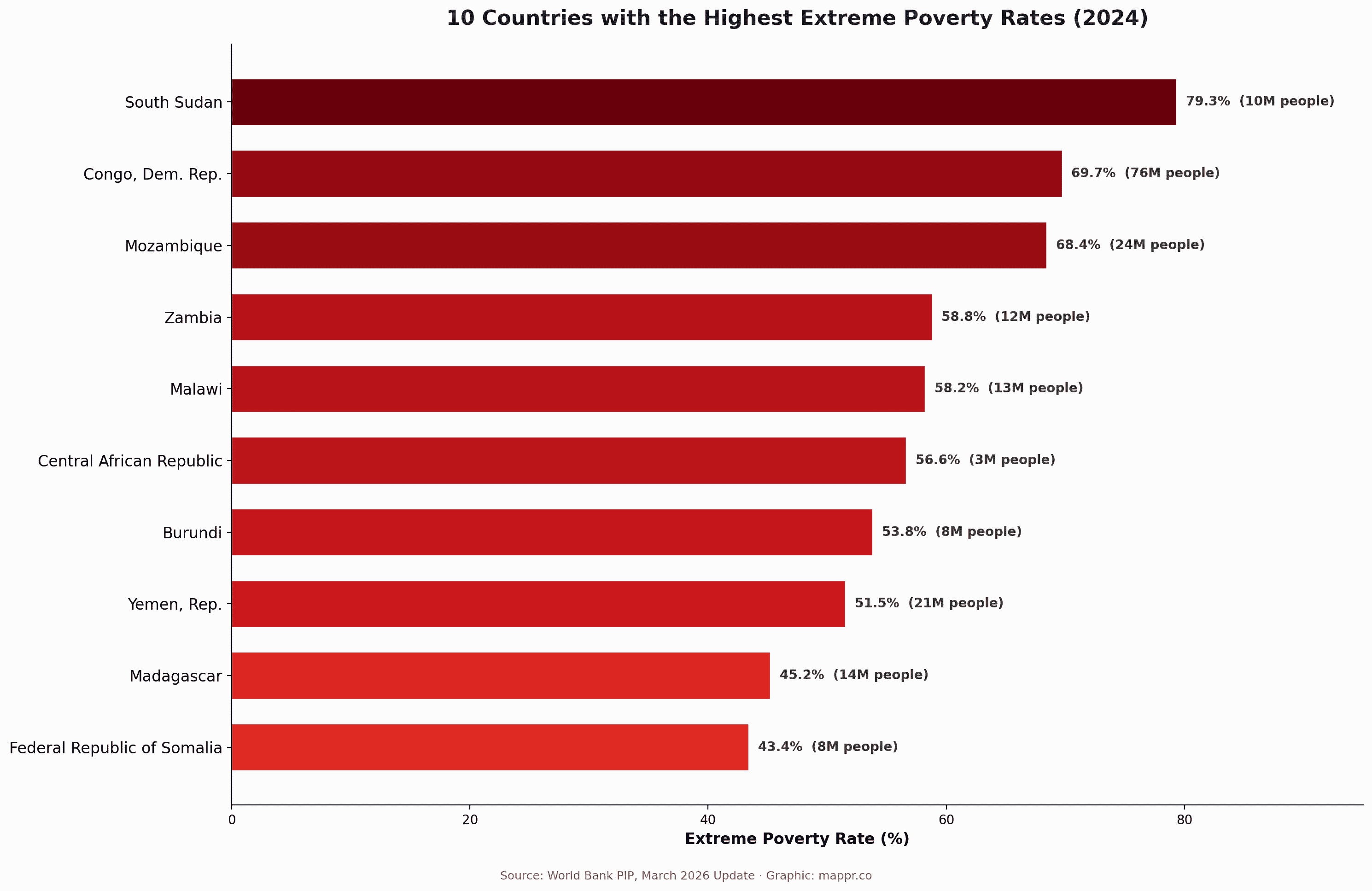
- South Sudan: 79.3% (9.5 million people)
- DR Congo: 69.7% (76.2 million people)
- Mozambique: 68.4% (23.7 million people)
- Zambia: 58.8% (12.5 million people)
- Malawi: 58.2% (12.6 million people)
- Central African Republic: 56.6% (3.0 million people)
- Burundi: 53.8% (7.6 million people)
- Yemen: 51.5% (20.9 million people)
- Madagascar: 45.2% (14.4 million people)
- Somalia: 43.4% (8.2 million people)
Regional Breakdown: A Tale of Two Worlds
The data reveals a dramatic divide between regions. Sub-Saharan Africa accounts for 358 million people in extreme poverty—roughly 80% of the global total—despite having only about 16% of the world’s population. Meanwhile, regions like East Asia, South Asia, and Europe have reduced extreme poverty to below 1%.
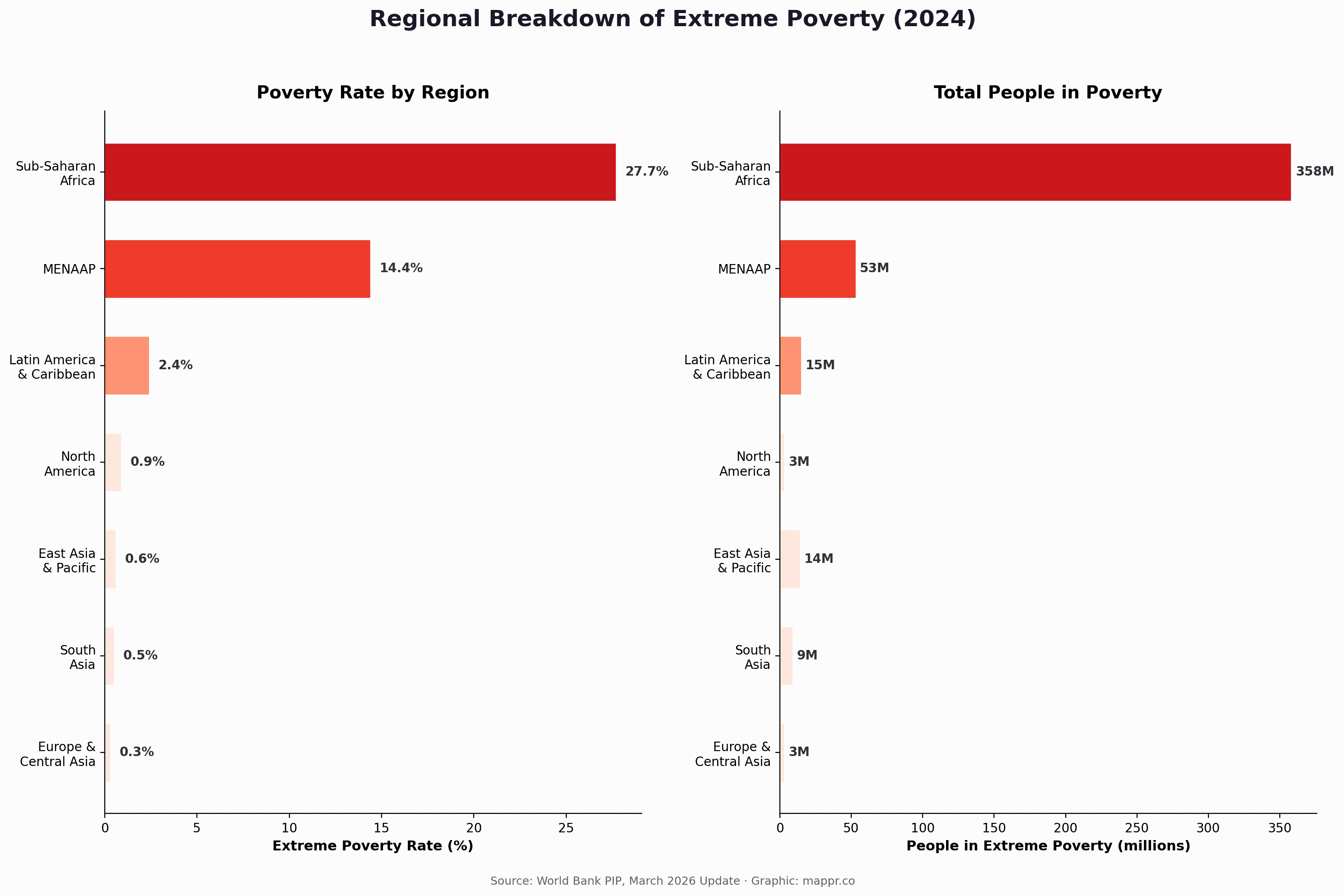
Poverty by Region (2024 Estimates)
- Sub-Saharan Africa: 27.7% — 358 million people
- Middle East, North Africa, Afghanistan & Pakistan (MENAAP): 14.4% — 53 million people
- Latin America & Caribbean: 2.4% — 15 million people
- North America: 0.9% — 3 million people
- East Asia & Pacific: 0.6% — 14 million people
- South Asia: 0.5% — 9 million people
- Europe & Central Asia: 0.3% — 3 million people
Key Findings from the March 2026 Update
📊 Key Takeaways
- 847 million people live in extreme poverty globally (2024)
- Global rate revised slightly upward to 10.4% (from 10.3%)
- Projected to fall to 10.0% by 2026
- New data for 28 countries including Pakistan
- MENAAP is the only region where poverty is rising (11.8% → 14.4%)
- Sub-Saharan Africa won’t reach pre-COVID poverty levels until 2025
🇵🇰 Pakistan Data Reshapes MENAAP Estimates
The most significant revision in this update comes from new survey data for Pakistan. The inclusion of this data pushed the MENAAP region’s extreme poverty rate from 11.8% (September 2025 vintage) to 14.4% in the March 2026 vintage—an increase of 21 million people in the poverty count. The MENAAP region is now the only region where extreme poverty has increased in recent years, driven by crises in Yemen, Afghanistan, and the revised Pakistan estimates.
2026 Nowcasts: Modest Improvement Expected
Based on economic projections from the January 2026 Global Economic Prospects, the World Bank nowcasts global extreme poverty declining from 10.4% in 2024 to 10.0% in 2026. However, these projections were made before recent global trade disruptions and do not account for their potential impact.
Country Profiles: Highest Poverty Rates
🇸🇸 South Sudan — 79.3%
The world’s youngest nation continues to suffer the highest extreme poverty rate globally. Ongoing civil conflict, displacement, and severe food insecurity have left nearly 8 in 10 South Sudanese living below the poverty line. With a population of 11.9 million, approximately 9.5 million people live in extreme poverty.
🇨🇩 DR Congo — 69.7%
Despite vast mineral wealth, the DRC has the largest absolute number of people in extreme poverty of any country: 76.2 million. Conflict in eastern provinces, weak infrastructure, and governance challenges perpetuate poverty across the country’s 109.3 million inhabitants.
🇲🇿 Mozambique — 68.4%
An insurgency in Cabo Delgado province, combined with recurring cyclones and limited economic diversification, keeps 23.7 million Mozambicans in extreme poverty—more than two-thirds of the population.
🇿🇲 Zambia — 58.8%
Zambia‘s copper-dependent economy leaves 12.5 million people in extreme poverty. Severe droughts linked to El Niño have worsened food security, particularly in rural areas where poverty rates are highest.
🇲🇼 Malawi — 58.2%
As one of the world’s least developed countries, Malawi faces extreme poverty affecting 12.6 million of its 21.7 million people. Agriculture employs over 80% of the workforce but remains vulnerable to climate shocks.
🇨🇫 Central African Republic — 56.6%
Decades of conflict and political instability have made CAR one of the poorest countries globally. With 3.0 million of its 5.3 million population in extreme poverty, humanitarian needs remain acute.
🇧🇮 Burundi — 53.8%
One of the world’s most densely populated African nations, Burundi‘s 7.6 million extreme poor face land scarcity, limited industrial development, and food insecurity in a landlocked economy.
🇾🇪 Yemen — 51.5%
The only non-African country in the top 10, Yemen‘s decade-long civil war has devastated its economy and infrastructure. Over 20.9 million Yemenis—more than half the population—live in extreme poverty, making it one of the world’s worst humanitarian crises.
🇲🇬 Madagascar — 45.2%
Madagascar‘s geographic isolation, frequent cyclones, and deforestation contribute to persistent poverty affecting 14.4 million people. The island nation has some of the world’s highest rates of chronic malnutrition.
🇸🇴 Somalia — 43.4%
Three decades of state fragility, Al-Shabaab insurgency, and recurring droughts keep 8.2 million Somalis in extreme poverty. Climate change is exacerbating pastoral and agricultural vulnerability.
Success Stories: Where Poverty Has Been Nearly Eliminated
The map also highlights remarkable progress. Several countries have reduced extreme poverty to near-zero levels over the past three decades:
- China: From 66% in 1990 to under 0.1% — the largest poverty reduction in human history, lifting over 800 million people out of extreme poverty
- Vietnam: From over 50% in 1990 to under 1%
- Indonesia: Reduced from 55% to under 1%
- Bangladesh: Down from 44% to under 1%
- India: Reduced from 46% to under 1%, though the absolute numbers of near-poor remain significant given population size
Why Sub-Saharan Africa Lags Behind
Several structural factors explain why extreme poverty remains concentrated in Sub-Saharan Africa:
- Population growth: Africa’s population is growing faster than poverty reduction efforts, meaning total numbers in poverty can increase even as rates decline
- Conflict and instability: Countries like South Sudan, DRC, and Somalia face ongoing conflicts that destroy economic opportunities
- Climate vulnerability: Droughts, floods, and extreme weather disproportionately affect agricultural livelihoods across the Sahel and East Africa
- Limited economic diversification: Many economies remain dependent on commodity exports and subsistence agriculture
- Infrastructure gaps: Poor transportation, energy, and communication infrastructure limit economic integration and market access
Methodology
The data comes from the World Bank’s Poverty and Inequality Platform (PIP), which harmonizes household survey data from around the world. Key methodological points:
- Poverty line: $2.15 per person per day in 2021 Purchasing Power Parity (PPP) dollars
- Data year: 2024 estimates (with interpolation and extrapolation from most recent surveys)
- Nowcasts: 2026 projections based on GDP growth forecasts from the Global Economic Prospects
- Coverage: 217 countries with national-level data
- Version: 20260324 (March 2026 vintage)
The $2.15/day threshold represents the minimum needed for basic survival, adjusted for differences in purchasing power across countries. It was updated in 2022 from the previous $1.90 line to reflect 2021 PPP rates.


This post uses data from the following sources.
Data Sources:
- World Bank — March 2026 Global Poverty Update – New data and updated poverty numbers for 28 countries
- World Bank Poverty and Inequality Platform (PIP) – Version 20260324 — country-level poverty data
- World Bank — What’s New Document (March 2026) – Technical documentation for the PIP update
- World Bank — Global Economic Prospects, January 2026 – Growth projections used for 2026 nowcasts