
India’s Indira Gandhi National Open University enrolls over 7 million students — more than the entire population of Denmark. That staggering figure leads our ranking of the 20 biggest universities in the world by student enrollment, a list dominated by distance-learning mega-institutions across Asia, the Middle East, and the Americas.
When we talk about the “biggest” universities, we’re measuring total enrollment — including full-time, part-time, and distance learners. These aren’t your typical campus universities; many of the world’s largest institutions use open and distance education to serve millions across continents. Here’s the complete ranking for 2025.
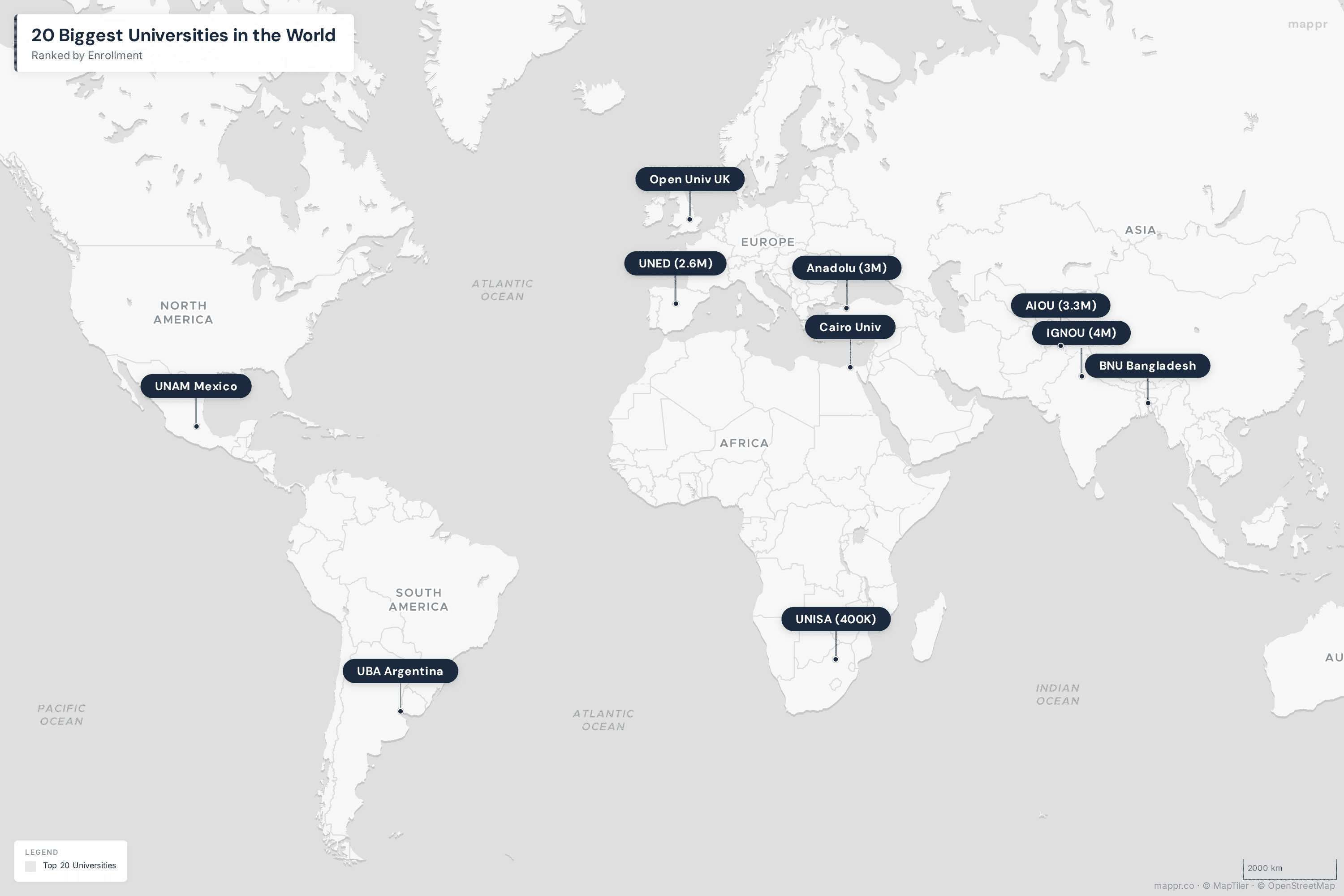
Map: Biggest Universities in the World
Key Takeaways
- IGNOU (India) leads with ~7.1 million students — more than 50× the enrollment of major US universities like Ohio State or UCLA.
- Open and distance universities dominate — 7 of the top 10 are primarily distance-learning institutions, reflecting how technology has democratized higher education.
- Asia accounts for the majority, with universities from India, Bangladesh, Turkey, Pakistan, Iran, Nepal, and Indonesia all in the top 15.
- Four universities enroll over 1 million students each: IGNOU, Bangladesh National University, California Community Colleges, and Anadolu University.
- Traditional campus universities like Universidad de Buenos Aires (315,000) and UNAM Mexico (360,000) also rank among the largest globally.
Complete Rankings: 20 Biggest Universities
| Rank | University | Country | Enrollment | Type | Founded |
|---|---|---|---|---|---|
| 1 | Indira Gandhi National Open University (IGNOU) | 🇮🇳 India | ~7,140,000 | Open/Distance | 1985 |
| 2 | National University, Bangladesh | 🇧🇩 Bangladesh | ~2,097,000 | Affiliating | 1992 |
| 3 | California Community Colleges System | 🇺🇸 United States | ~2,134,000 | Public System | 1967 |
| 4 | Anadolu University | 🇹🇷 Turkey | ~1,974,000 | Open/Distance | 1958 |
| 5 | Allama Iqbal Open University | 🇵🇰 Pakistan | ~1,027,000 | Open/Distance | 1974 |
| 6 | Islamic Azad University | 🇮🇷 Iran | ~1,000,000 | Private | 1982 |
| 7 | Savitribai Phule Pune University | 🇮🇳 India | ~665,000 | Affiliating | 1948 |
| 8 | Bangladesh Open University | 🇧🇩 Bangladesh | ~650,000 | Open/Distance | 1992 |
| 9 | Universitas Terbuka | 🇮🇩 Indonesia | ~646,000 | Open/Distance | 1984 |
| 10 | National Technological Institute of Mexico | 🇲🇽 Mexico | ~620,000 | Public System | 1948 |
| 11 | Tribhuvan University | 🇳🇵 Nepal | ~604,000 | Public | 1959 |
| 12 | University of Mumbai | 🇮🇳 India | ~550,000 | Affiliating | 1857 |
| 13 | Universidad de Buenos Aires | 🇦🇷 Argentina | ~315,000 | Public | 1821 |
| 14 | UNAM | 🇲🇽 Mexico | ~360,000 | Public | 1551 |
| 15 | University of South Africa (UNISA) | 🇿🇦 South Africa | ~300,000 | Open/Distance | 1873 |
| 16 | Cairo University | 🇪🇬 Egypt | ~257,000 | Public | 1908 |
| 17 | National University of Distance Education (UNED) | 🇪🇸 Spain | ~200,000 | Open/Distance | 1972 |
| 18 | The Open University | 🇬🇧 United Kingdom | ~170,000 | Open/Distance | 1969 |
| 19 | University of Delhi | 🇮🇳 India | ~165,000 | Affiliating | 1922 |
| 20 | Sukhothai Thammathirat Open University | 🇹🇭 Thailand | ~150,000 | Open/Distance | 1978 |
1. Indira Gandhi National Open University (IGNOU) 🇮🇳
IGNOU, headquartered in New Delhi, India, is the undisputed largest university in the world with approximately 7.14 million students. Established by an Act of Parliament in 1985, IGNOU was created to democratize higher education in a country where millions lacked access to traditional universities.
The university operates through 67 regional centers and over 3,000 study centers across India and 35 other countries. It offers 338 certificate, diploma, and degree programs. Despite its massive scale, IGNOU maintains accreditation from India’s University Grants Commission and has been recognized by UNESCO for its contribution to distance education.
2. National University, Bangladesh 🇧🇩
The National University of Bangladesh, based in Gazipur near Dhaka, Bangladesh, enrolls approximately 2.1 million students. Unlike distance-learning institutions, it is an affiliating university — meaning it oversees examinations and curricula for over 2,200 affiliated colleges across the country.
Founded in 1992 to manage the explosive growth of Bangladesh’s higher education sector, it serves as the academic umbrella for the majority of undergraduate students in the country. Its sheer scale reflects Bangladesh’s demographic reality — a population of 170 million with rapidly rising educational attainment.
3. California Community Colleges System 🇺🇸
The California Community Colleges system is the largest higher education system in the United States, enrolling over 2.1 million students across 116 colleges and 73 districts. While technically a system rather than a single university, its collective enrollment makes it one of the largest educational institutions on Earth.
The system serves as the primary pathway to higher education for millions of Californians, with many students transferring to the University of California or California State University systems. It offers associate degrees, vocational certificates, and increasingly, bachelor’s degrees in select fields.
4. Anadolu University 🇹🇷
Anadolu University in Eskişehir, Turkey, enrolls approximately 1.97 million students, making it the largest university in Europe by enrollment. Founded in 1958, it pioneered distance education in Turkey through its Open Education Faculty (Açıköğretim Fakültesi), which accounts for the vast majority of its enrollment.
The university also has a significant traditional campus presence with 17 faculties, 9 schools, and 6 institutes serving about 30,000 on-campus students. Its Open Education Faculty was established in 1982 and has since graduated millions of Turkish professionals.
5. Allama Iqbal Open University 🇵🇰
Allama Iqbal Open University (AIOU) in Islamabad, Pakistan, enrolls over 1 million students. Founded in 1974, it was the first open university in Asia and the second in the world (after the UK’s Open University). AIOU uses a combination of print materials, television broadcasts, and online learning to reach students across Pakistan.
The university has been instrumental in improving literacy and education in rural Pakistan, where access to traditional universities is limited. It offers programs from primary education certificates through doctoral degrees.
6. Islamic Azad University 🇮🇷
The Islamic Azad University in Iran is a unique entry — it’s a private, non-profit university system with approximately 1 million students spread across 400+ branches throughout the country. Founded in 1982, it is the largest private university system in the world.
Unlike the distance-learning giants above it, Islamic Azad primarily offers traditional on-campus education. Its branches operate in virtually every city in Iran, making it remarkably accessible. The university offers over 500 fields of study, from engineering to medicine.
7–10. Rising Giants of South and Southeast Asia
Savitribai Phule Pune University (665,000 students) in India is one of the largest affiliating universities in the country, governing over 700 colleges. Bangladesh Open University (650,000) provides distance education across Bangladesh. Universitas Terbuka (646,000) in Indonesia — whose name means “Open University” — serves the archipelago’s vast population. The National Technological Institute of Mexico (620,000) oversees 254 technology-focused institutions across Mexico.
11–15. From Nepal to South Africa
Tribhuvan University (604,000) is the oldest and largest university in Nepal. The University of Mumbai (550,000) is one of India’s most historic institutions, founded in 1857 during the British Raj. UNAM in Mexico City (360,000) is Latin America’s most prestigious university, with a UNESCO World Heritage main campus. The Universidad de Buenos Aires (315,000) offers free tuition to all students. UNISA in South Africa (300,000) is Africa’s largest distance-learning institution.
16–20. Global Reach
Cairo University (257,000) in Egypt is the Arab world’s most prominent university. UNED (200,000) brings distance education to Spain and Spanish-speaking countries. The Open University (170,000) in the UK pioneered the open university model in 1969 and remains Europe’s leading distance-learning institution. University of Delhi (165,000) and Sukhothai Thammathirat Open University (150,000) in Thailand round out the list.
Open Universities vs. Traditional Campuses
A key pattern emerges from this ranking: distance and open universities dominate the top spots. Of the top 20, at least 10 are primarily distance-learning institutions. This reflects a global reality — traditional campus-based education simply cannot scale to serve populations of hundreds of millions in developing countries.
Open universities serve a critical role: they provide affordable, flexible higher education to working adults, rural communities, and those who cannot attend traditional institutions. In countries like India, Pakistan, and Bangladesh, they are the primary vehicle for mass higher education.
Methodology
Rankings are based on total student enrollment including full-time, part-time, online, and distance learners from the most recent available data (2024–2025 academic year). Data is compiled from university official reports, the World Higher Education Database (WHED), and World Population Review. University systems (like California Community Colleges) are included when they operate under a single administrative umbrella.


This post uses data from the following sources.
Data Sources:
- Biggest Colleges in the World by Country 2026 – World Population Review
- Top 10 Largest Universities in the World in 2026 – Yocket
- Top 10 Biggest Universities in the World in 2025 – CEO Reporter






- Busy Street Scene Near IGNOU Entrance in New Delhi, India — © PradeepGaurs/Shutterstock