Key Takeaways
- From nearly 9 people per home to under 2. In Mali the average household has 8.9 members and in Senegal 8.5; in Finland it is 1.96 and in Germany 2.04. The world's homes differ more than four-fold in how many people share them.
- The Sahel lives together, Europe lives alone. Sub-Saharan Africa and parts of the Middle East and Central Asia dominate the large-household map, while in Finland 45% of all households, and in Germany 43%, consist of a single person.
- Households are shrinking almost everywhere. Delayed marriage, falling fertility and rising solo living are pulling household size down on every continent. The US average has fallen from about 3.3 in 1960 to roughly 2.5 today.
- Fresh UN data, August 2026. The numbers come from the UN Population Division's newly released 2026 update of its Households and Living Arrangements database, drawing on more than 1,100 censuses and surveys from 200 countries and areas.
How many people live behind an average front door? The answer says more about a country than almost any single statistic: it compresses fertility, marriage patterns, incomes, housing and the strength of the extended family into one number. The UN Population Division has just published the 2026 update of its global household database, and the range it reveals is enormous: from almost nine people per household in Mali to fewer than two in Finland.
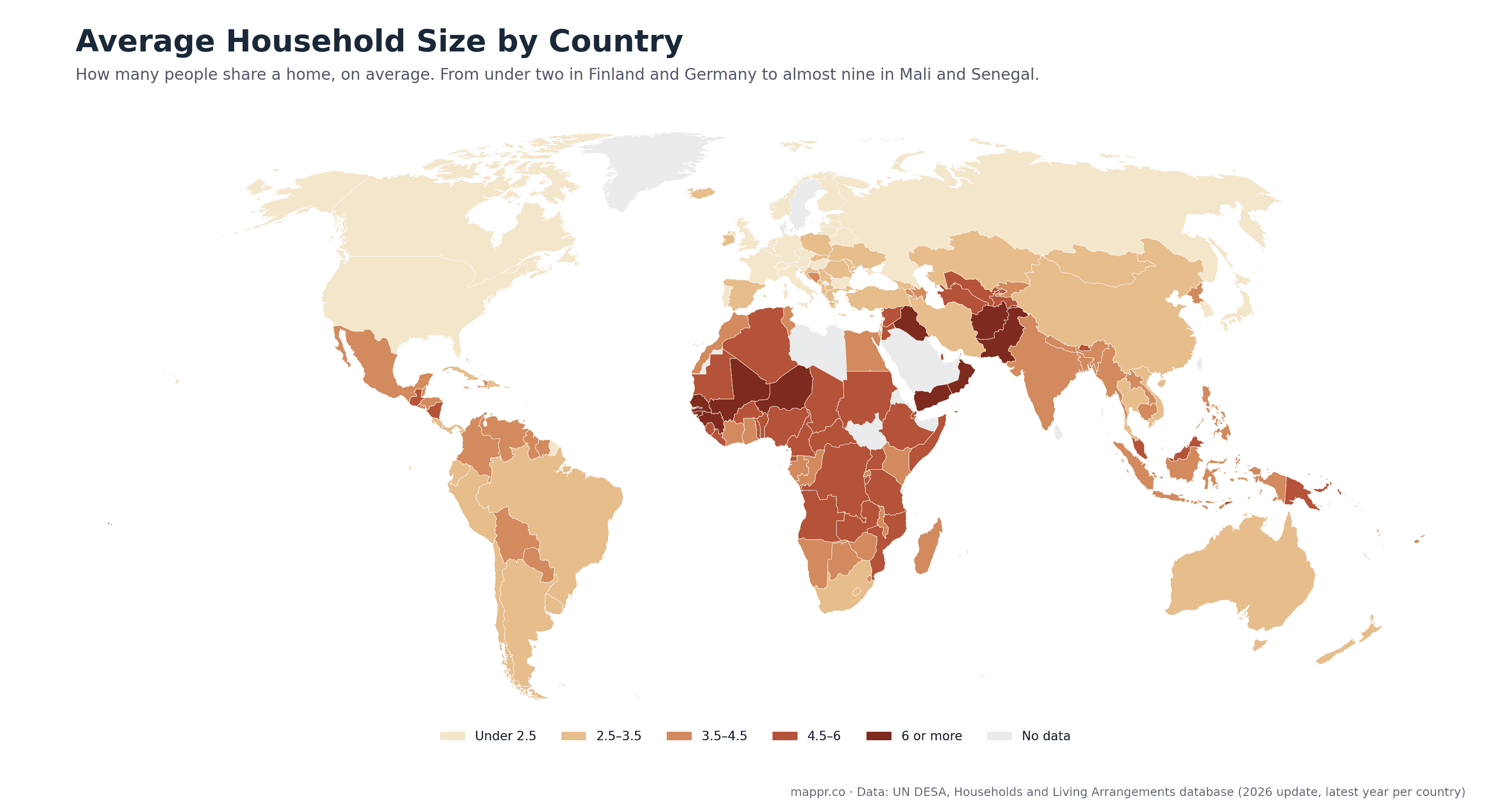
The geography is stark. The world’s biggest households cluster in the Sahel and wider Sub-Saharan Africa, joined by Afghanistan (8.3), Yemen (6.6) and Pakistan (6.8): places where high fertility meets a strong multigenerational family norm, and where grandparents, cousins and married sons commonly share one compound. At the other extreme sits Europe, where the average home now holds barely two people.
The 10 largest households
| # | Country | Avg. household size | Homes with 6+ people | Data year |
|---|---|---|---|---|
| 1 | 🇲🇱 Mali | 8.93 | 67% | 2024 |
| 2 | 🇸🇳 Senegal | 8.45 | 66% | 2023 |
| 3 | 🇦🇫 Afghanistan | 8.26 | 76% | 2023 |
| 4 | 🇬🇲 Gambia | 8.07 | 59% | 2020 |
| 5 | 🇴🇲 Oman | 8.02 | 52% | 2003 |
| 6 | 🇬🇼 Guinea-Bissau | 6.81 | 56% | 2019 |
| 7 | 🇵🇰 Pakistan | 6.80 | 61% | 2013 |
| 8 | 🇼🇸 Samoa | 6.60 | 57% | 2019 |
| 9 | 🇾🇪 Yemen | 6.55 | 58% | 2023 |
| 10 | 🇬🇳 Guinea | 6.39 | 52% | 2021 |
In every country in the top 10, most people live in homes of six or more members. In Mali, two-thirds of all households have at least six people; in Senegal the average compound holds 8.5 people, reflecting polygamous and multigenerational living arrangements that make the household, not the nuclear family, the basic economic unit.
The 10 smallest households
| # | Country | Avg. household size | One-person homes | Data year |
|---|---|---|---|---|
| 1 | 🇫🇮 Finland | 1.96 | 45% | 2021 |
| 2 | 🇩🇪 Germany | 2.04 | 43% | 2022 |
| 3 | 🇲🇨 Monaco | 2.13 | 38% | 2016 |
| 4 | 🇨🇿 Czechia | 2.15 | 39% | 2021 |
| 5 | 🇫🇷 France | 2.15 | 38% | 2020 |
| 6 | 🇧🇾 Belarus | 2.16 | 38% | 2019 |
| 7 | 🇦🇹 Austria | 2.19 | 38% | 2021 |
| 8 | 🇧🇬 Bulgaria | 2.19 | 36% | 2021 |
| 9 | 🇯🇵 Japan | 2.21 | 38% | 2020 |
| 10 | 🇱🇮 Liechtenstein | 2.21 | 36% | 2021 |
The smallest-household list is a map of rich, ageing, urban societies. Finland leads the world in living alone: 45% of its households have exactly one member, with Germany (43%) close behind. Japan, the only Asian country in the bottom 10, shows where the rest of East Asia is heading as it ages. Two Nordic countries are missing from the UN compilation itself, but Eurostat puts Sweden and Denmark at about 2.0 to 2.1, right beside Finland.
The mirror image: who lives alone
Flip the question from “how many share a home” to “who lives alone” and the world map inverts.
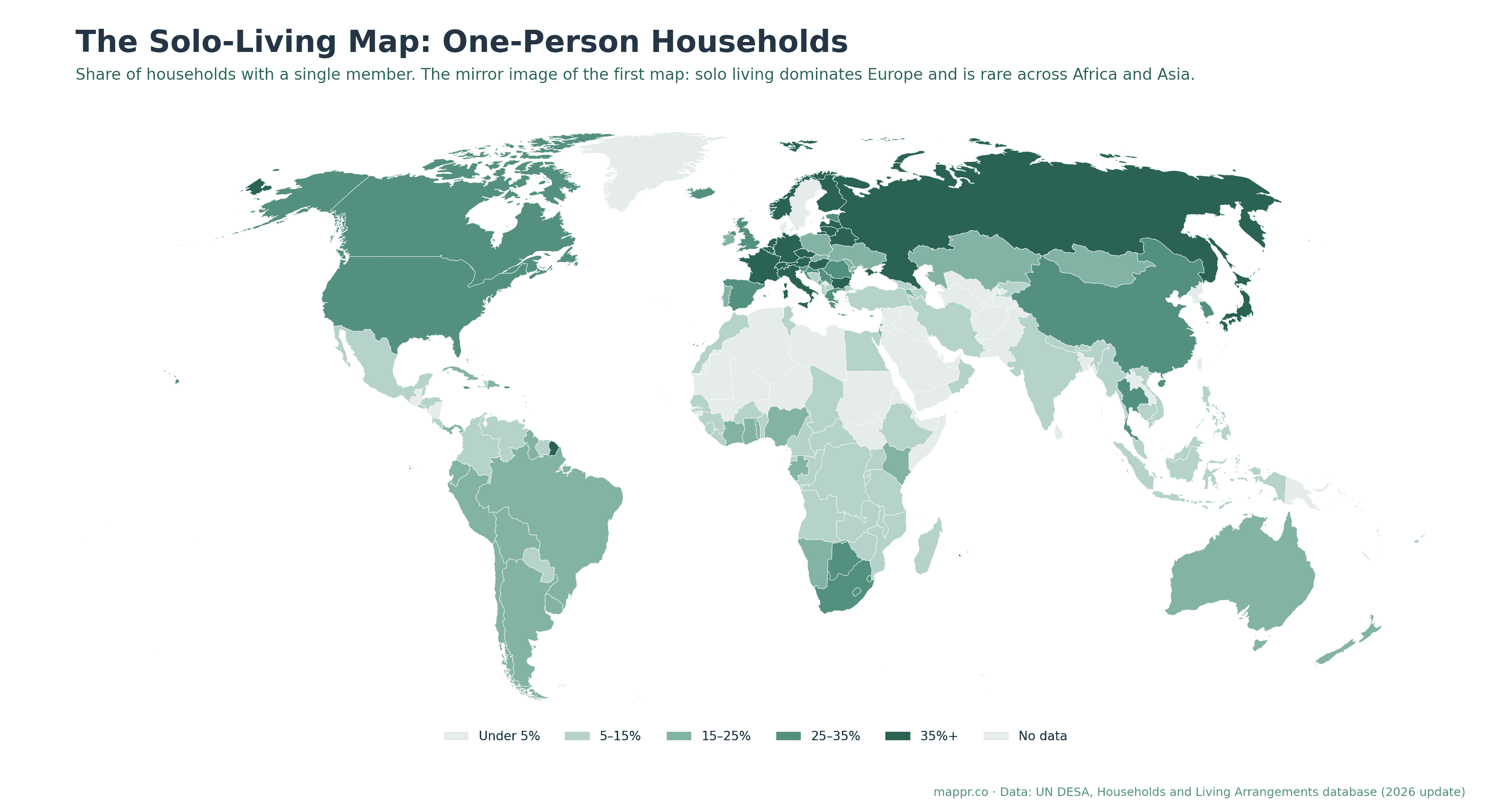
Solo living is essentially a European invention that is going global. Across most of Africa and South Asia, fewer than 5% of households have a single occupant; in Afghanistan it is a rounding error at 0.1%. Across northern and western Europe it is 35 to 45%, and the share keeps rising: it is a function of wealth (you need to afford your own place), longevity (widowed elders staying independent) and choice (delayed partnership, more separation). Russia, Japan and South Korea have joined the club within a generation.
The world’s household is shrinking
The global throughline of the UN’s new data is contraction. Nearly everywhere, households are getting smaller: fertility is falling on every continent, marriage comes later, and solo living rises with income and age. The United States tells the story in one series: about 3.3 people per household in 1960, roughly 2.5 today. Even in the Sahel the direction is the same, only decades behind. The deeper force is the same one behind our maps of fertility rates and population growth: as countries get richer and older, the crowd around the dinner table thins. The map above is, in a sense, a photograph of a world in transition, and the dark patches are simply the places where the household still comes first.