Key Takeaways
- Three-quarters of the world has turned away from the death penalty. 114 countries have abolished it for all crimes, 9 for ordinary crimes, and 23 more never execute in practice. Only 53 countries remain fully retentionist.
- Yet 2025 was the deadliest year since 1981. At least 2,707 recorded executions in 17 countries, up 78% in one year, and that total excludes China's thousands, which are a state secret.
- Iran alone accounted for roughly 80% of recorded executions. At least 2,159 people were executed in Iran in 2025, more than double the year before. Saudi Arabia followed with 356+.
- Lebanon just made history. In August 2026 its parliament abolished the death penalty for all crimes, the first country in the Middle East to do so, converting all existing death sentences to life imprisonment.
Saturday, October 10, is the 24th World Day Against the Death Penalty, under the theme “Stories for Life”. The timing is uncomfortable: the world has never had more abolitionist countries, and yet 2025 was the bloodiest year for executions that Amnesty International has recorded since 1981.
Both things are true at once, and the map explains how: abolition keeps spreading country by country, while a shrinking club of states executes more people than ever. Here is the full picture, mapped.
Three-Quarters of the World Has Turned Away
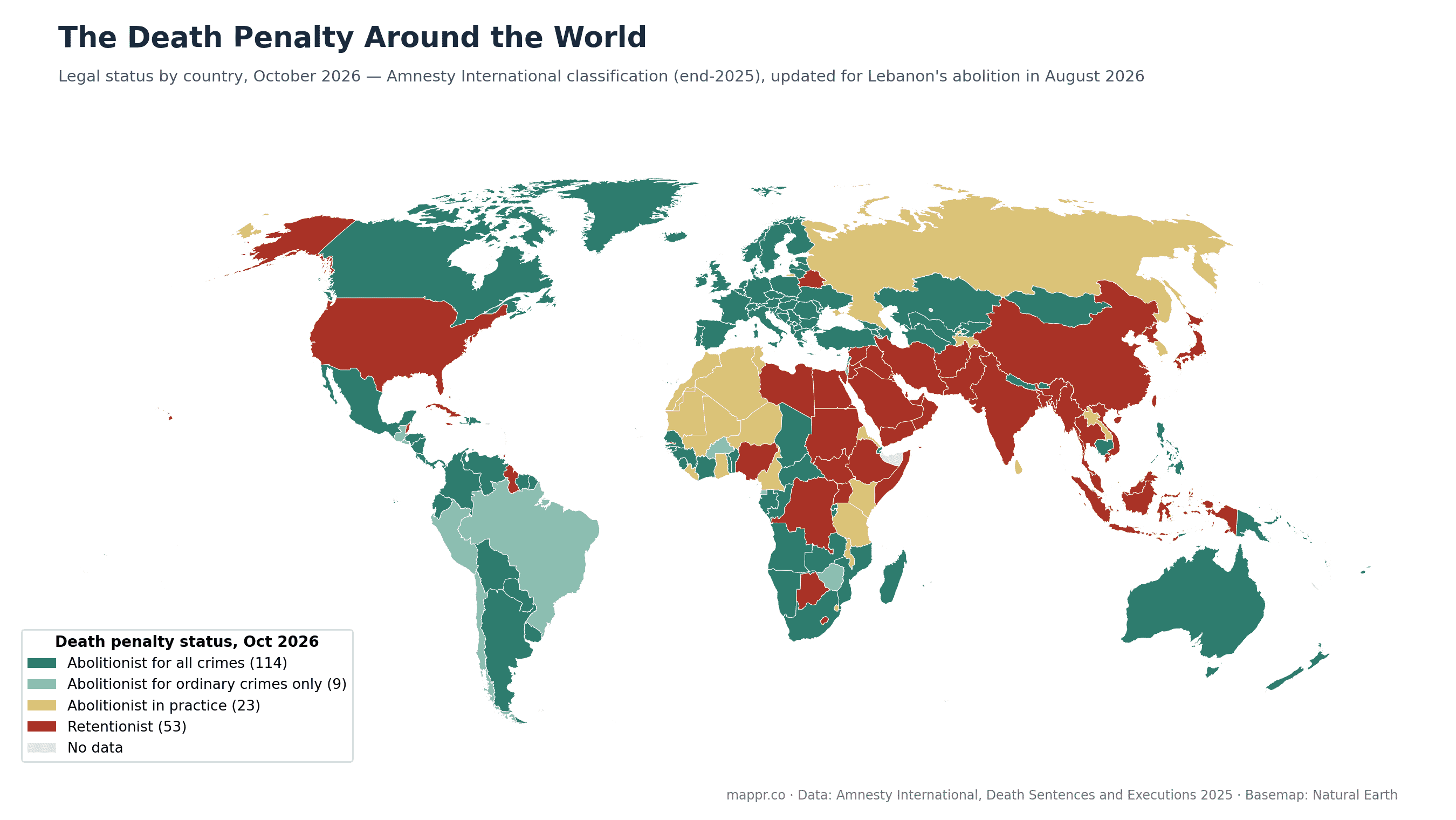
When Amnesty International began campaigning against capital punishment in 1977, just 16 countries had abolished it for all crimes. Today that number is 114. Add the 9 countries that keep it only for exceptional crimes (such as treason in wartime) and the 23 that retain it on paper but have not executed anyone for at least a decade, and 145 of the world’s countries, roughly three-quarters, have abolished the death penalty in law or practice.
The newest member of the club made history: in August 2026, Lebanon’s parliament voted to abolish the death penalty for all crimes, the first country in the Middle East to do so. Law No. 68 replaced capital punishment with life imprisonment and retroactively converted every existing death sentence. Lebanon had not actually executed anyone since 2004, but courts had kept handing down death sentences for two decades.
The map shows the geography plainly. The Americas are almost entirely abolitionist, with the United States the glaring exception. Europe is abolitionist except Belarus, the continent’s last executioner. Sub-Saharan Africa is in the middle of an abolition wave: Ghana, Zambia, Zimbabwe and the Central African Republic have all abolished in recent years. The retentionist core now concentrates in the Middle East, North Africa and Asia.
2025: The Deadliest Year Since 1981
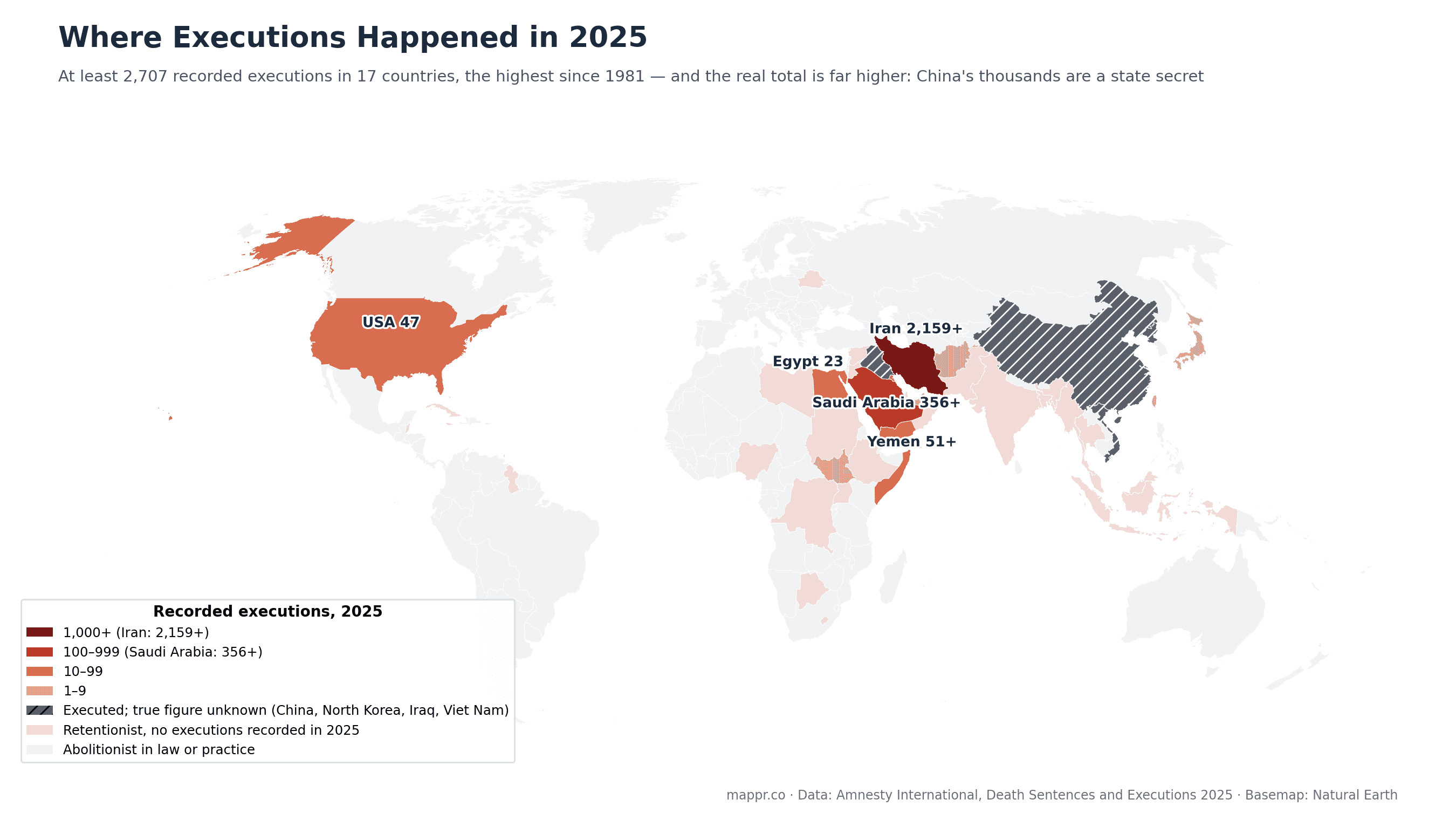
Amnesty recorded at least 2,707 executions in 17 countries in 2025, a 78% jump from 1,518 in 2024 and the highest total since 1981, when it recorded 3,191. The real number is far higher: China, believed to execute thousands every year, treats the figure as a state secret, and North Korea, Viet Nam and Iraq also executed people in numbers no one outside their governments can verify.
The increase has one overwhelming driver. Iran executed at least 2,159 people in 2025, more than double its 2024 total and roughly 80% of all recorded executions worldwide, a surge Amnesty links heavily to drug-related offences and the suppression of dissent. Saudi Arabia followed with at least 356, its highest on record. Courts worldwide also handed down at least 2,334 new death sentences across 48 countries.
Ranked
Recorded executions in 2025
All 17 countries where Amnesty International confirmed executions, plus the four states where executions happened but true figures are unknown.
| Country | Executions 2025 | Status | Note |
|---|---|---|---|
| 🇨🇳 China | 1,000s | Retentionist | State secret; excluded from global total |
| 🇮🇷 Iran | 2,159+ | Retentionist | More than doubled vs 2024; ~80% of recorded total |
| 🇸🇦 Saudi Arabia | 356+ | Retentionist | Highest on record; heavy use for drug offences |
| 🇾🇪 Yemen | 51+ | Retentionist | |
| 🇺🇸 United States | 47 | Retentionist | Most in over a decade |
| 🇪🇬 Egypt | 23 | Retentionist | Up from 13 in 2024 |
| 🇰🇼 Kuwait | 17 | Retentionist | |
| 🇸🇬 Singapore | 17 | Retentionist | Mostly drug offences |
| 🇸🇴 Somalia | 17+ | Retentionist | |
| 🇦🇫 Afghanistan | 6 | Retentionist | Public executions |
| 🇦🇪 UAE | 3 | Retentionist | |
| 🇯🇵 Japan | 1 | Retentionist | |
| 🇸🇸 South Sudan | 1 | Retentionist | |
| 🇹🇼 Taiwan | 1 | Retentionist | |
| 🇰🇵 North Korea / 🇮🇶 Iraq / 🇻🇳 Viet Nam | unknown | Retentionist | Executions confirmed, figures unverifiable |
The American Exception
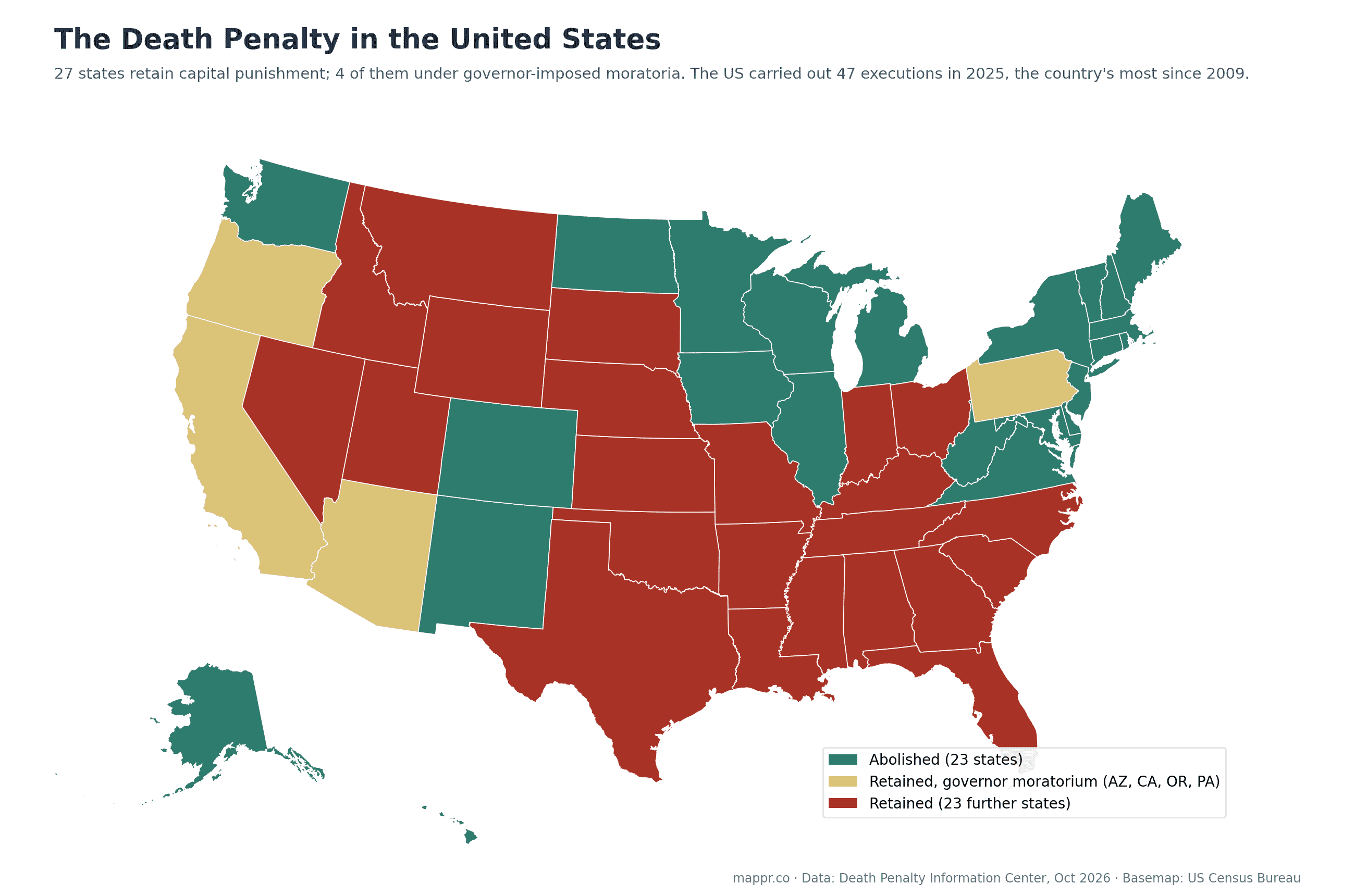
The United States is the only country in the Americas that still executes, and its internal map looks like the world map in miniature. 23 states have abolished capital punishment, most recently Virginia in 2021, the first Southern state to do so. 27 states retain it, though four of those (Arizona, California, Oregon and Pennsylvania) sit under governor-imposed moratoria.
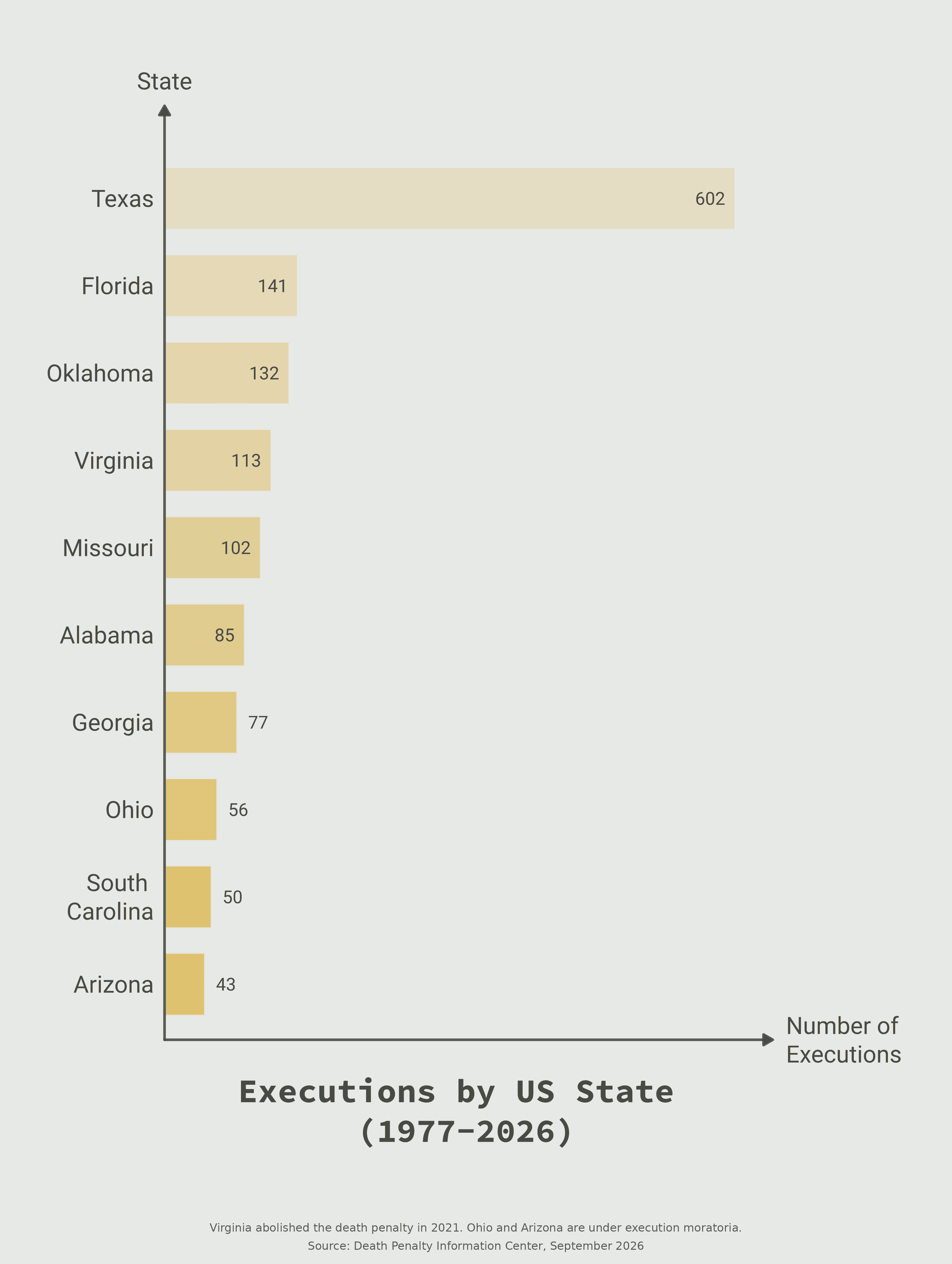
In practice, executions concentrate in a handful of states. Texas alone has carried out 602 of the 1,683 executions of the modern era, more than a third of the national total, with Florida (141) and Oklahoma (132) far behind. Even abolition does not erase the history: Virginia executed 113 people before becoming the first Southern state to abolish in 2021. As of mid-2026, 1,973 people remain on death row nationwide, and at least 203 death-row prisoners have been exonerated since 1973. The country carried out 47 executions in 2025, its most in over a decade, a sharp reversal of the long national decline that had been underway since the 2000s.
Two Trends, One Map
Read together, the maps tell a story of polarization. Each year a country or two joins the abolitionist column, and the trend has never reversed: no country that fully abolished has brought the death penalty back and used it. At the same time, the states that remain committed are executing more, not less: the 2025 surge was driven almost entirely by Iran and Saudi Arabia.
That is exactly the pattern the “Stories for Life” campaign is aimed at: a practice that is disappearing from most of the world’s law books while intensifying where it survives. The map will keep changing; on current form, it only changes in one direction.
Data and reporting for this article come from the following sources: