Key Takeaways
- Dominica, Myanmar and Honduras have been hit hardest over 30 years. The new Climate Risk Index, released at COP31, ranks 178 countries by observed losses from extreme weather between 1996 and 2025: more than 916,000 deaths, 5.5 billion people affected and USD 4.7 trillion in damage from nearly 10,000 events.
- In 2025 alone, Jamaica, Sri Lanka and Spain topped the list. Hurricane Melissa devastated Jamaica, Cyclone Ditwah killed 823 people in Sri Lanka, and a 46-degree heatwave killed almost 3,900 people in Spain.
- Heat is the deadliest hazard, storms the costliest. Heatwaves caused about 70% of 2025's reported disaster deaths and 40% of deaths over 30 years, despite severe underreporting in the Global South. Storms account for 58% of three-decade economic losses.
- This map looks nothing like a wealth or population map. Nine of the ten most affected countries over 30 years are lower- or middle-income states, places that contributed least to climate change. The index records what has already happened, not future risk.
Climate summits argue about the future. The Climate Risk Index measures the past. Released by the Bonn-based think tank Germanwatch on 17 November at COP31 in Antalya, the index ranks countries by the human and economic losses extreme weather has already inflicted: deaths, people affected and economic damage, each counted both in absolute terms and relative to population and GDP.
The 30-year tally is sobering: between 1996 and 2025, nearly 10,000 extreme weather events killed more than 916,000 people, affected around 5.5 billion, and caused over USD 4.7 trillion in direct losses. We mapped who has carried that burden.
The Map: 30 Years of Extreme Weather Damage
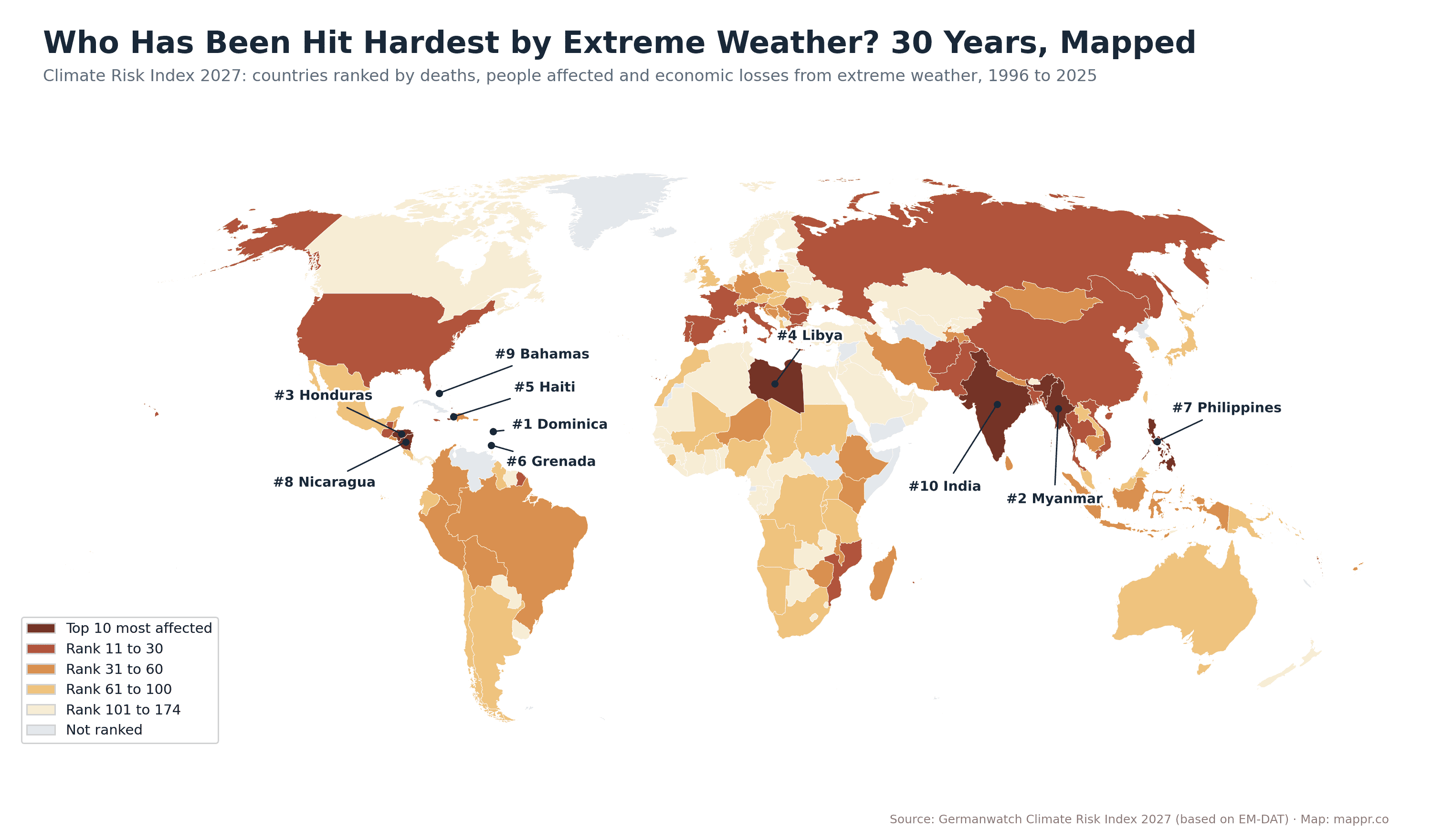
The top of the list is not the big economies, and that is the point. Because the index weighs losses relative to population and GDP alongside absolute numbers, the hardest-hit countries are small, exposed and poor: Dominica, repeatedly flattened by hurricanes, above all Maria in 2017, which cost the island more than twice its GDP; Myanmar, still dominated by Cyclone Nargis’s 2008 toll of about 140,000 dead; and Honduras, which has never fully escaped the shadow of Hurricane Mitch.
Libya ranks 4th on the strength of a single catastrophe: the 2023 Derna dam collapse during Storm Daniel. Haiti, Grenada, the Philippines, Nicaragua and the Bahamas follow, with India closing the top 10, the only large economy in it.
Two Ways to Be a Victim
Germanwatch sorts the most affected countries into two groups. The first is marked by exceptional catastrophes: a Dominica, Grenada or Libya, where one or two monstrous events define decades. The second faces continuous threats: the Philippines and India rank high not because of any single disaster but because extreme weather arrives relentlessly, year after year. Climate science, the report notes, is turning the first category into the second: exceptional catastrophes are becoming the new normal.
The equity finding is blunt: nine of the ten most affected countries over 30 years are lower- or middle-income, the states that contributed least to the emissions driving the damage. That asymmetry is the core argument behind the loss-and-damage fights that ran through COP31, which closes today.
The 30-year ranking
Hit Hardest by Extreme Weather, 1996 to 2025
Climate Risk Index 2027: the 10 most affected countries over three decades
| Country | CRI rank 1996-2025 | Rank in 2025 alone |
|---|---|---|
| Dominica | #1 | #115 |
| Myanmar | #2 | #59 |
| Honduras | #3 | #55 |
| Libya | #4 | #168 |
| Haiti | #5 | #32 |
| Grenada | #6 | #129 |
| Philippines | #7 | #5 |
| Nicaragua | #8 | #143 |
| The Bahamas | #9 | #81 |
| India | #10 | #12 |
Note the right-hand column: being battered for 30 years and being hit this year are different things. Dominica ranked just 115th in 2025, a quiet year for the island, while the Philippines sat in the top 10 on both clocks.
2025 Alone: Melissa, Ditwah and 46°C
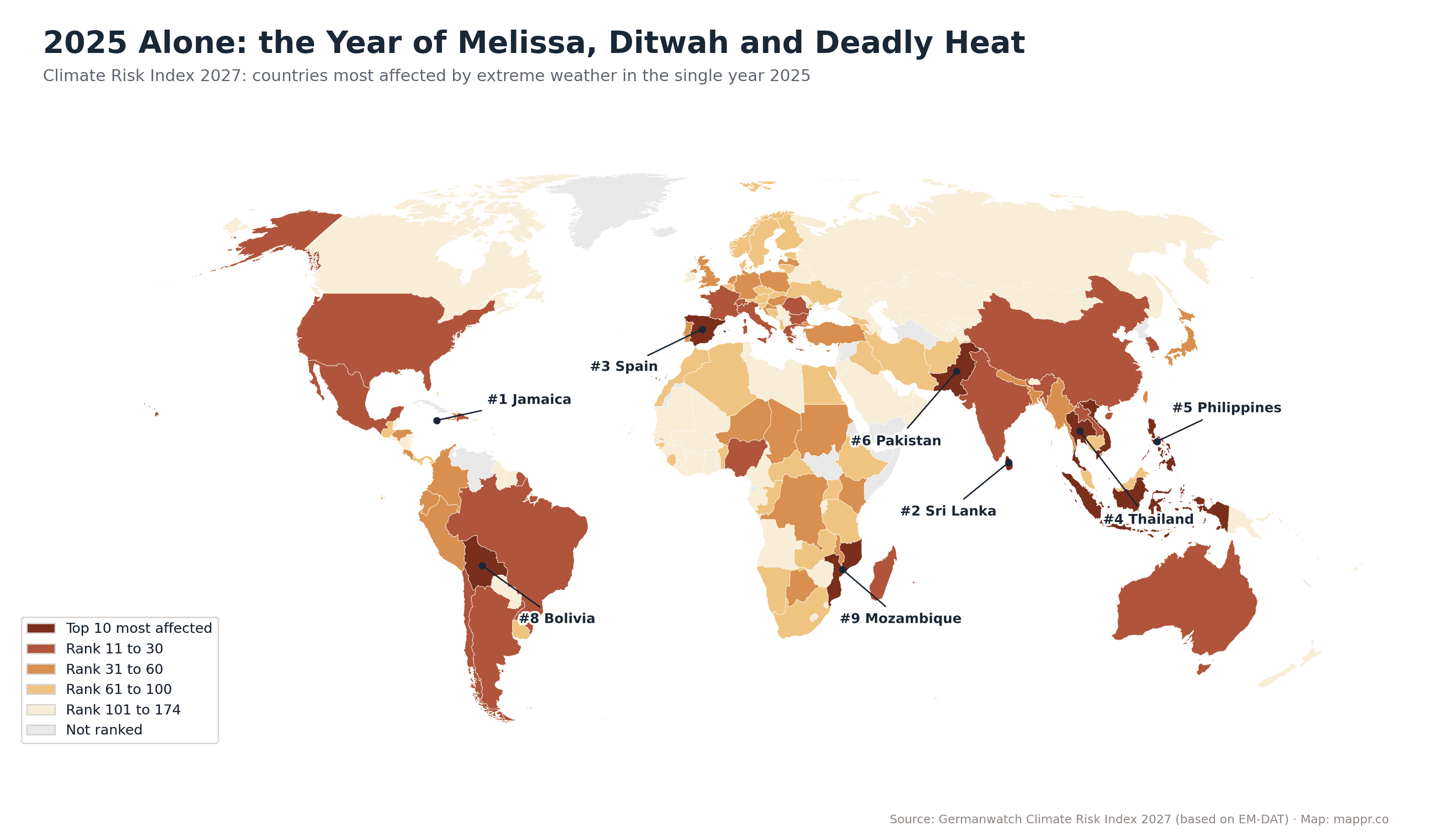
The 2025 layer reads like the year’s news in map form. Jamaica tops it after Hurricane Melissa, a Category 5 storm and among the strongest landfalls ever recorded on the island. Sri Lanka is 2nd after Cyclone Ditwah killed 823 people, affected 1.7 million and caused an estimated USD 4.1 billion in losses, the country’s worst flooding in 20 years. And Spain, 3rd, is the warning to rich countries: a heatwave that reached 46°C killed almost 3,900 people in what was then Spain’s hottest summer on record for the index period.
In total, 2025 saw 367 extreme weather events, nearly 35,000 deaths, more than 100 million people affected and USD 158 billion in losses. Heatwaves alone caused about 70% of the year’s reported disaster deaths, and the report stresses that heat deaths are systematically underreported, especially in sub-Saharan Africa.
The 2025 ranking
The Countries Most Affected in 2025
Climate Risk Index 2027: single-year ranking for 2025
| Country | 2025 rank | What hit them |
|---|---|---|
| Jamaica | #1 | Hurricane Melissa, among the strongest landfalls ever recorded on the island |
| Sri Lanka | #2 | Cyclone Ditwah: 823 deaths, 1.7 million affected, USD 4.1 billion in losses |
| Spain | #3 | 46°C heatwave with almost 3,900 deaths in its hottest CRI-period summer |
| Thailand | #4 | Severe flooding |
| Philippines | #5 | Repeated typhoons and floods |
| Pakistan | #6 | Monsoon flooding |
| Indonesia | #7 | Floods and landslides |
| Bolivia | #8 | Catastrophic floods |
| Mozambique | #9 | Cyclones |
| Vietnam | #10 | Typhoons and floods |
What This Index Is, and What It Is Not
A common mistake is to read the CRI as a forecast. It is the opposite. Germanwatch is explicit that the index records observed, historical losses and does not predict future exposure. For the forward-looking view, the complement is the World Risk Index, which models disaster risk from exposure and vulnerability, and produces a very different map. Read together, one shows where the climate bill has already landed; the other where it is likely to land next.
A second caveat is the data itself. The index is built on EM-DAT, the international disasters database, and inherits its blind spots: impacts in the Global South are underreported, heat deaths most of all. The real inequity is therefore likely larger than the map shows. Press summaries also blur the rankings; for the record, the 30-year top 10 is exactly: Dominica, Myanmar, Honduras, Libya, Haiti, Grenada, Philippines, Nicaragua, Bahamas, India, with India 12th in the 2025 single-year ranking.
Germanwatch’s conclusion for the negotiators leaving Antalya today: adaptation is one of the most cost-effective investments available, and the costs of inaction are already written into three decades of data.