Key Takeaways
- Almost every country has one. More than 170 countries levy a value-added tax (VAT) or goods-and-services tax (GST). It is the workhorse of government revenue almost everywhere, quietly added to the price of nearly everything you buy.
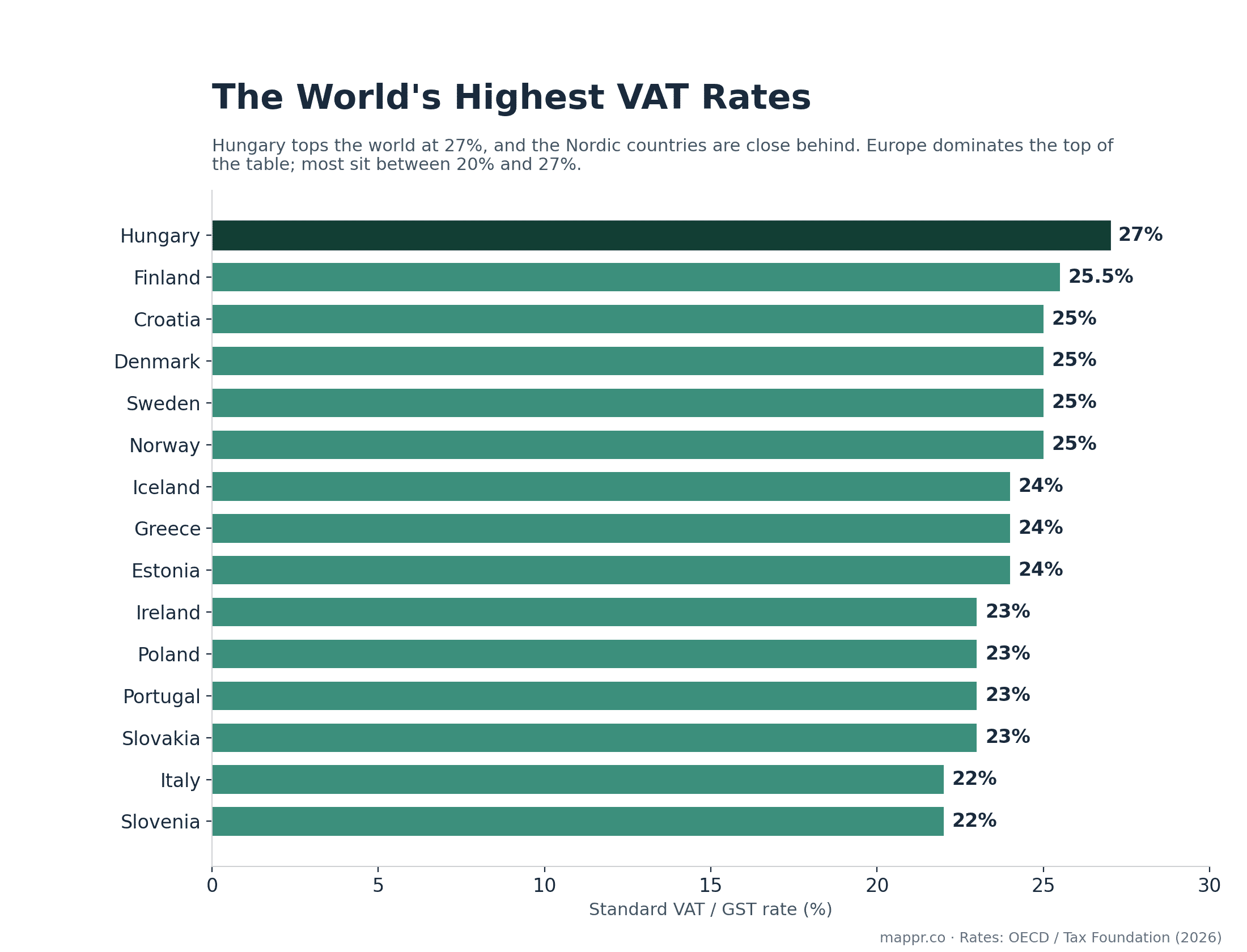
- Hungary charges the most, at 27%. Hungary has the highest standard VAT rate in the world. The Nordic countries follow close behind at 25% to 25.5%, and most of Europe sits between 20% and 27%.
- The United States is the big exception. The US has no national VAT at all. Instead it relies on state and local sales taxes that vary from zero to around 10%, one of the few major economies without a country-wide consumption tax.
- Some places charge little or nothing. Several Gulf states kept consumption taxes very low or non-existent until recently, and a handful of territories still have none. The UAE and Saudi Arabia only introduced VAT in 2018.
- This is the standard rate only. Most countries apply lower reduced rates to essentials like food, medicine and books, so the headline number is the ceiling, not what you pay on everything.
Almost everything you buy has a tax baked into the price, and in most of the world that tax is VAT, or value-added tax (called GST in some countries). More than 170 countries use it. But the rate you pay swings enormously depending on where you are standing at the till. The map below shows the standard rate everywhere it applies.
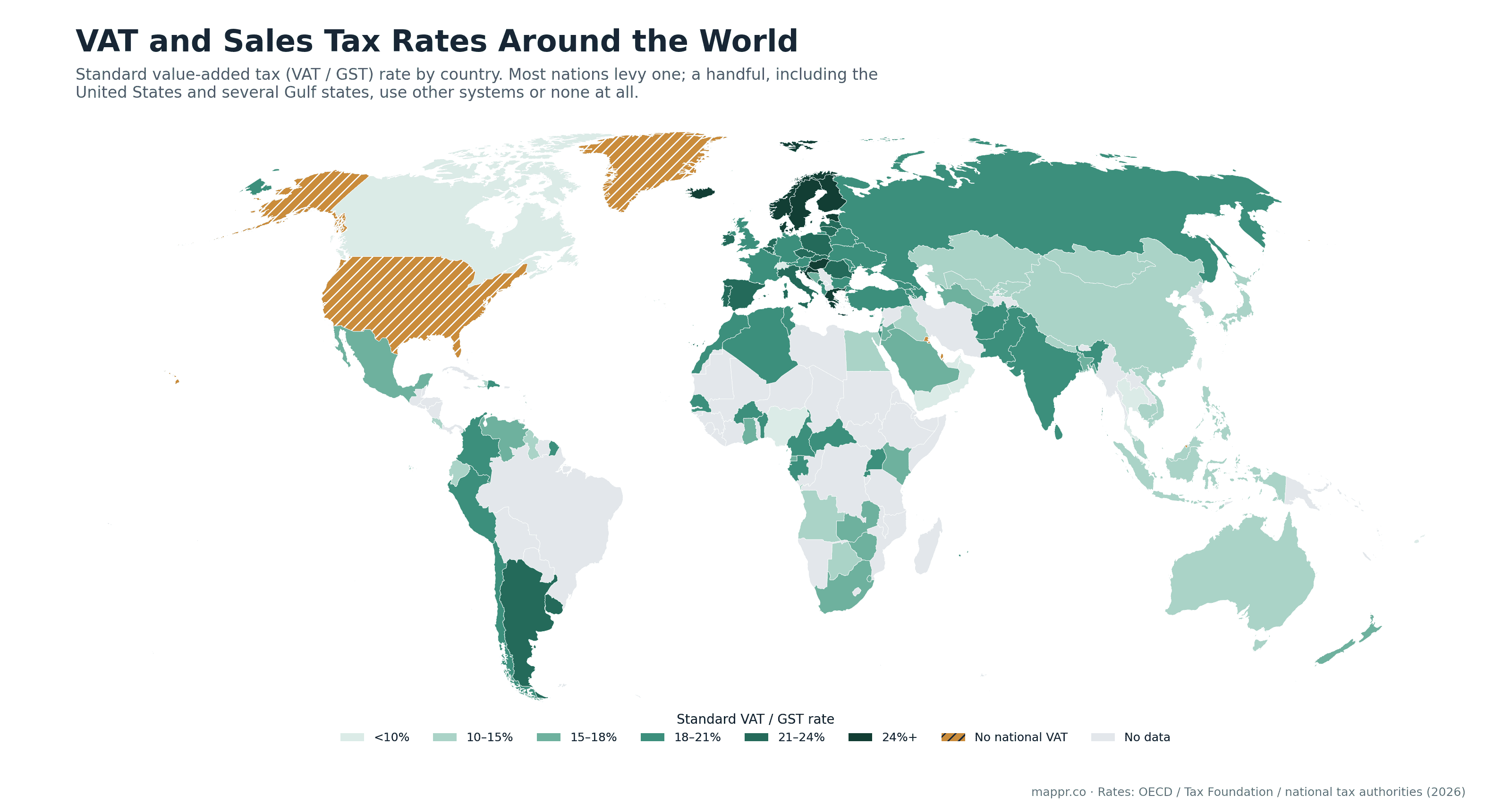
The pattern is clear: Europe taxes consumption hard. Almost the entire continent sits in the top band, and the deeper the green, the higher the rate. Latin America, Africa and much of Asia cluster lower, mostly in the 10% to 18% range. And a few countries, shown hatched, run on a different system entirely.
Who charges the most
Hungary holds the world record for the highest standard VAT rate, at 27%. The Nordic countries are just behind, with Denmark, Sweden and Norway all at 25% and Finland at 25.5%. In practice, every one of the world’s highest-VAT countries is in Europe.
High VAT is one of the ways Europe’s generous welfare states are paid for. A tax on spending is steady and hard to avoid, which makes it attractive to governments even though it falls more heavily, as a share of income, on people who spend most of what they earn.
Who charges little, and who charges nothing
At the other end sits the United States, the only large economy with no national consumption tax. Americans pay state and local sales taxes instead, which range from nothing in a few states to around 10% once city rates are added. It is a genuinely different model, and it is why the US appears hatched on the map rather than shaded.
Several Gulf states also kept consumption taxes very low or absent for decades, funding themselves from oil instead. That is slowly changing: the United Arab Emirates and Saudi Arabia introduced VAT in 2018 (Saudi Arabia later raising its rate to 15%), while Kuwait and Qatar still have none. A scattering of small territories, from Greenland to Hong Kong, likewise charge no VAT at all.
Inside the United States: fifty different systems
With no federal VAT, the US hands consumption taxes to the states, and the result is a patchwork. Forty-five states and Washington DC charge a sales tax; five (Delaware, Montana, New Hampshire, Oregon and Alaska) have no statewide sales tax, though Alaska lets its towns add their own.
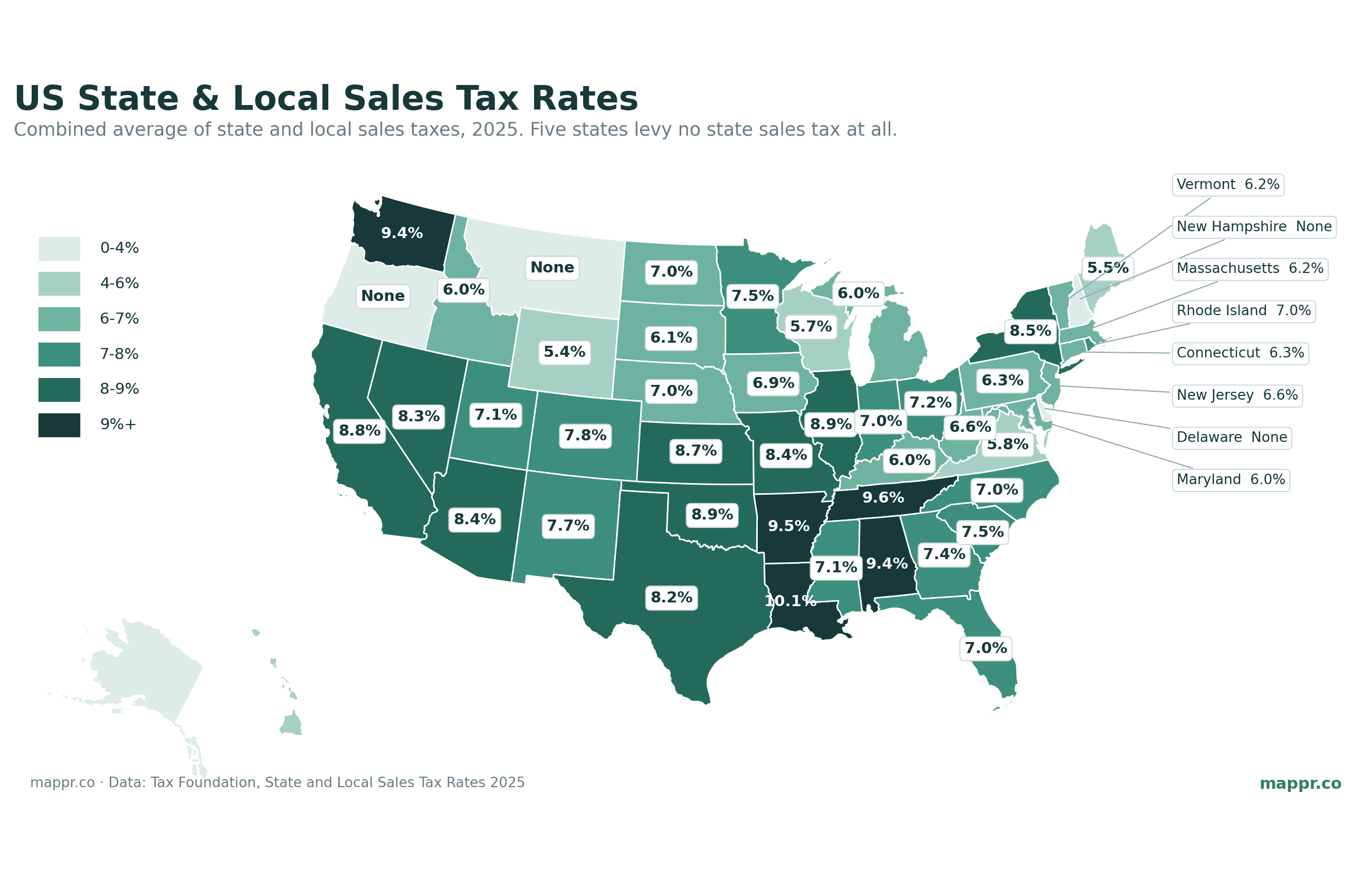
Add up state and average local rates and the spread is wide. Louisiana tops the country at about 10.1%, with Tennessee, Arkansas, Washington and Alabama all close to 9.5%. Shoppers in Delaware or Oregon pay nothing at the register. Unlike VAT, US sales tax is added at the final sale and shown on top of the sticker price, which is why the total at an American checkout is always a little higher than the shelf tag.
A number with an asterisk
One caveat matters. The figure on this map is the standard rate, the default applied to most goods and services. Almost every country also has reduced rates for essentials such as food, medicine, children’s clothing and books, and some items are exempt entirely. So a 27% headline in Hungary does not mean 27% on a loaf of bread. The map shows the ceiling, not the whole story. For more on how governments raise and spend money, see our maps of interest rates and public debt by country.