
Key Takeaways
- A total eclipse crosses Europe on 12 August 2026. The Moon's shadow sweeps from the Arctic across Greenland and Iceland, over the North Atlantic, and into northern Spain at sunset. It is the first total solar eclipse over mainland Europe since 1999.
- Spain's first in over a century. Totality crosses a band of northern and eastern Spain, from Galicia and Asturias through Bilbao, Zaragoza and Valencia. It is the first total solar eclipse visible from mainland Spain since 1905.
- Up to 2 minutes 18 seconds. The longest totality, about 2 minutes 18 seconds, falls over the North Atlantic just off Iceland's west coast. In Spain, totality lasts around one to two minutes.
- In Spain it happens at sunset. The eclipse reaches Spain around 20:30 local time with the Sun very low, only a few degrees above the horizon. You will need a clear view to the west-northwest to see it.
- Madrid and Barcelona just miss out. Both sit just outside the path and see a 99% partial eclipse instead. Much of the rest of Europe, North Africa and the North Atlantic sees a partial eclipse too.
On Wednesday, 12 August 2026, the Moon’s shadow will race across the top of the world and touch down in Europe. It is a total solar eclipse, the first visible from mainland Europe since 1999, and for Spain it is the first in more than a hundred years. The map below traces exactly where the Sun will vanish.
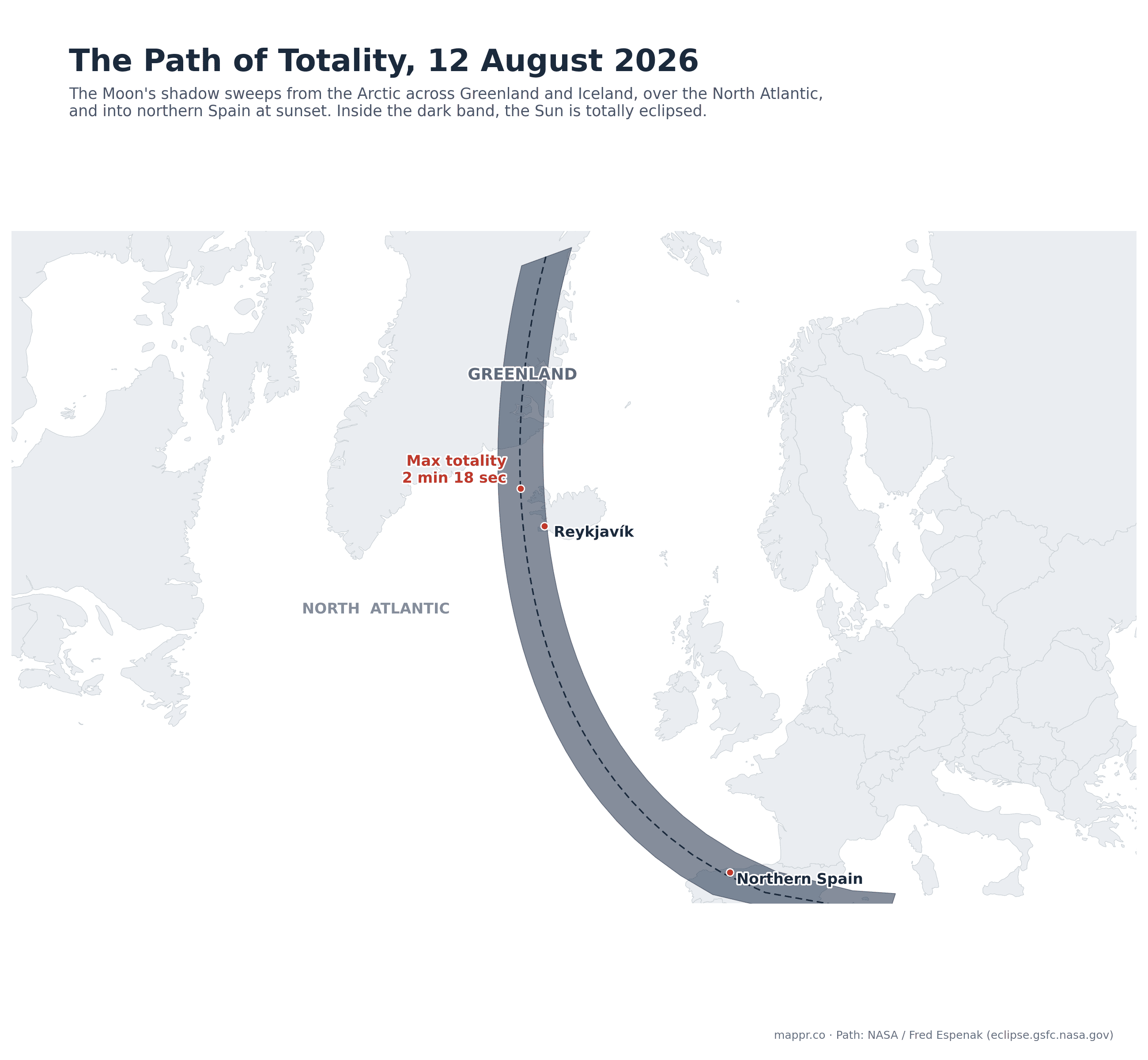
The dark band is the path of totality, the narrow strip, only about 290 kilometres wide, where the Moon completely covers the Sun and day briefly turns to night. Outside it, a partial eclipse is visible across a much larger area. The shadow begins at sunrise over Siberia, sweeps across the Arctic and eastern Greenland, clips western Iceland, and then curves down the North Atlantic before reaching Spain as the Sun sets.
The longest totality, about 2 minutes 18 seconds, falls in the open ocean just off Iceland’s west coast. Reykjavík catches roughly a minute of it in the late afternoon.
Where totality crosses Spain
Spain is the grand finale, and the only major landmass where crowds can watch from cities. Totality carves a band across the north and east of the country.
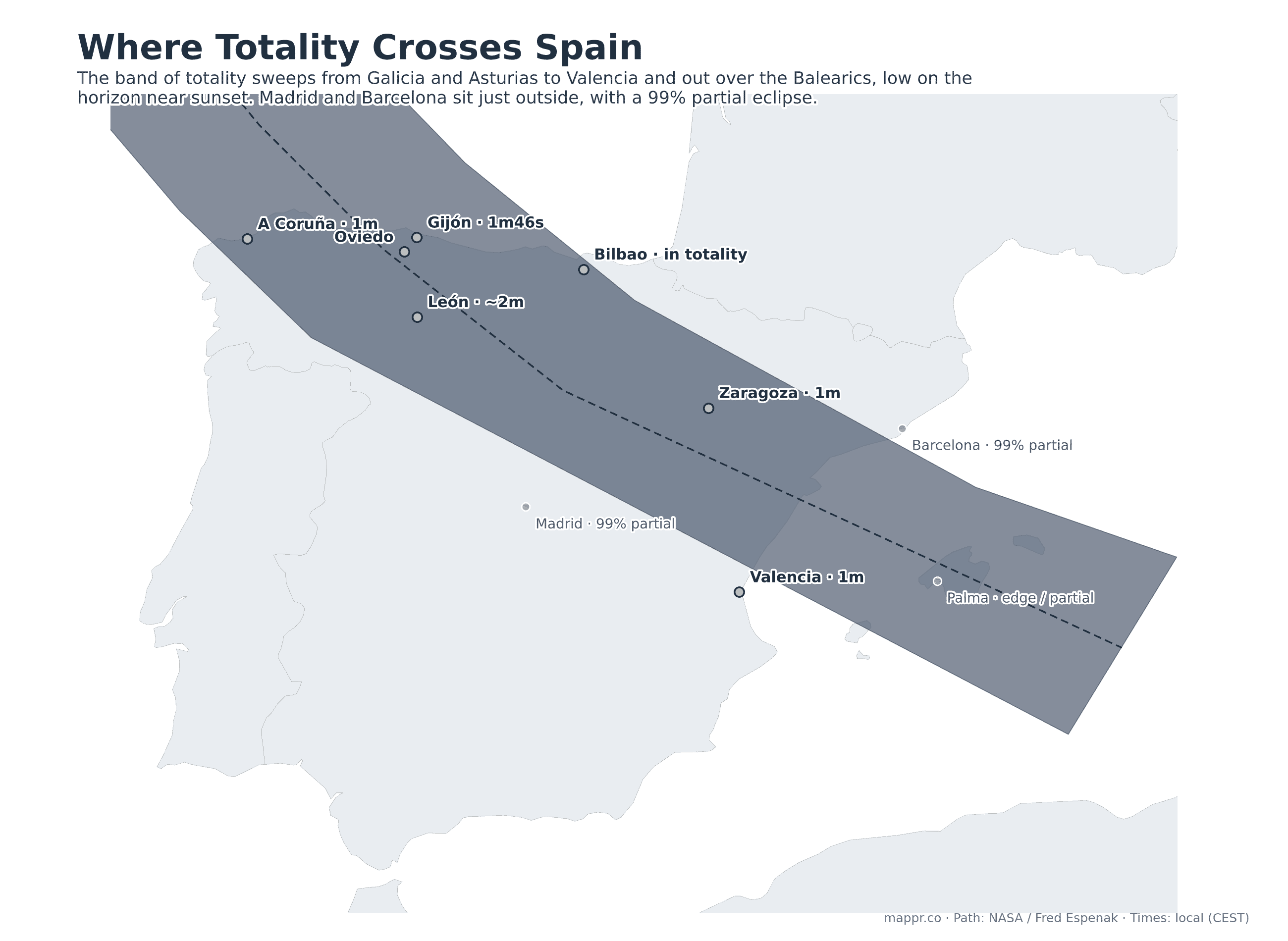
Inside the band sit A Coruña, Gijón, Oviedo, León, Bilbao, Zaragoza and Valencia, before the shadow slips out over the Mediterranean near the Balearic Islands. Madrid and Barcelona just miss it: both sit a few kilometres outside the path and see a 99% partial eclipse instead, which still leaves the Sun as a thin crescent but never fully dark.
There is a catch that makes this eclipse unusual. In Spain it happens at sunset, with the Sun only a few degrees above the horizon, around 10° in Asturias and barely 2 to 3° by the time the shadow reaches the Balearics. You will need an unobstructed view to the west-northwest, over the sea or a low horizon, to catch it.
When to look
Totality reaches Iceland in the late afternoon and Spain in the evening. The table shows local times and how long the total phase lasts in the path.
When to look
Totality along the path
Local times and how long the total phase lasts in cities inside the path. Iceland is on UTC; Spain is on CEST (UTC+2).
| Place | In totality? | Local time | Totality |
|---|---|---|---|
| Reykjavík, Iceland | Yes | 17:48 | ~1 min |
| Gijón, Spain | Yes | 20:26 | 1m 46s |
| León, Spain | Yes | 20:28 | ~2 min |
| Bilbao, Spain | Yes | 20:28 | ~1½ min |
| Zaragoza, Spain | Yes | 20:29 | ~1 min |
| Valencia, Spain | Yes | 20:32 | ~1 min |
| Palma de Mallorca | Edge | 20:31 | near sunset |
| Madrid, Spain | No (99%) | – | partial |
| Barcelona, Spain | No (99%) | – | partial |
The rest of Europe sees a partial eclipse
You do not have to be in the path to see something. A partial eclipse, where the Moon takes a bite out of the Sun, will be visible across almost all of Europe, western North Africa, the far east of North America, Greenland and the North Atlantic. The closer you are to the path, the deeper the bite: France, the British Isles and the rest of Iberia see a large partial, tapering off to the south and east. As with any partial phase, the Sun is never safe to look at with the naked eye.
How to watch it safely
The rules are simple but important. During the partial phases, and everywhere outside the path, you must use certified eclipse glasses or a proper solar filter. Ordinary sunglasses are not enough. Only during the brief moments of total eclipse, when the Sun’s disc is completely hidden, is it safe to look with the naked eye, and only inside the path of totality. Because the eclipse is so low in the sky over Spain, a high vantage point with a clear western horizon will make all the difference.
Spain’s first in over a century
The last time a total solar eclipse crossed mainland Spain was in 1905. This one is also the first of a remarkable run: Spain gets another total eclipse on 2 August 2027, this time across the south, and an annular “ring of fire” eclipse on 26 January 2028. Three major solar eclipses in less than three years is the kind of alignment most countries wait centuries for. For where these things happen next, explore our maps of Spain and Iceland.