Key Takeaways
- Strongest Campi Flegrei quake in 40 years. A magnitude 4.7 earthquake struck the Campi Flegrei volcanic area west of Naples at 7:46 p.m. local time on 31 July 2026, the strongest tremor recorded in the region since continuous instrumental monitoring began. INGV placed the epicentre near the Solfatara crater at Pozzuoli, only about 3 km deep.
- Injuries and travel chaos at peak season. Civil Protection reported 26 people injured. The quake suspended rail service and closed the port of Pozzuoli, cutting ferries to Ischia and Procida at peak season. In the days after, about 300 residents were evacuated and 57 buildings were declared uninhabitable in Pozzuoli.
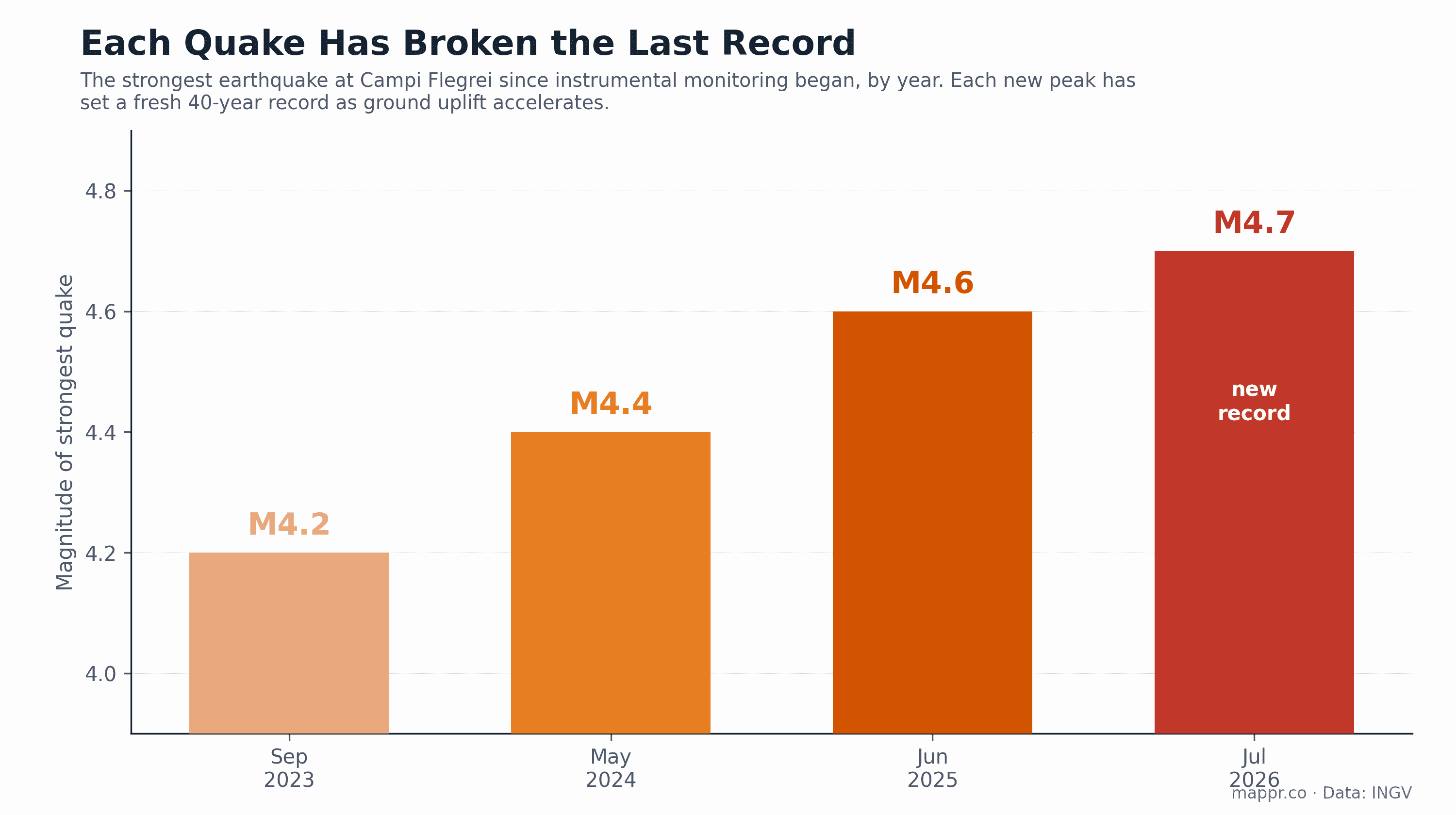
- Each quake keeps breaking the record. The 2025 M4.6 was called the strongest in 40 years; now the 2026 M4.7 has surpassed it. It's the latest step in a rising ladder of record quakes as the caldera's unrest accelerates.
- The ground is literally rising. Campi Flegrei is in an active phase of bradyseism, a slow rise and fall of the ground as fluids and gases move underground. Near Pozzuoli, the surface has lifted more than 140 cm since 2005, and seismicity has climbed alongside it.
- Watched, not predicted. INGV frames the current activity as intensifying unrest and uplift, not an imminent eruption. The reason Campi Flegrei is so closely monitored is not that it is the largest caldera on Earth, but that a metro area of hundreds of thousands of people lives directly on top of it.
A magnitude 4.7 earthquake shook the Campi Flegrei volcanic area on the western edge of Naples on the evening of 31 July 2026, the strongest tremor recorded there in 40 years. It injured 21 people, suspended trains across the Naples network and closed the port of Pozzuoli, stranding ferry passengers bound for Ischia and Procida on one of the busiest travel weekends of the year.
No one was killed, and this was not a volcanic eruption. But it is the latest and largest jolt in a slow-building geological story that sits, quite literally, underneath one of Europe’s great cities. The map below shows where it struck.
Where the earthquake struck
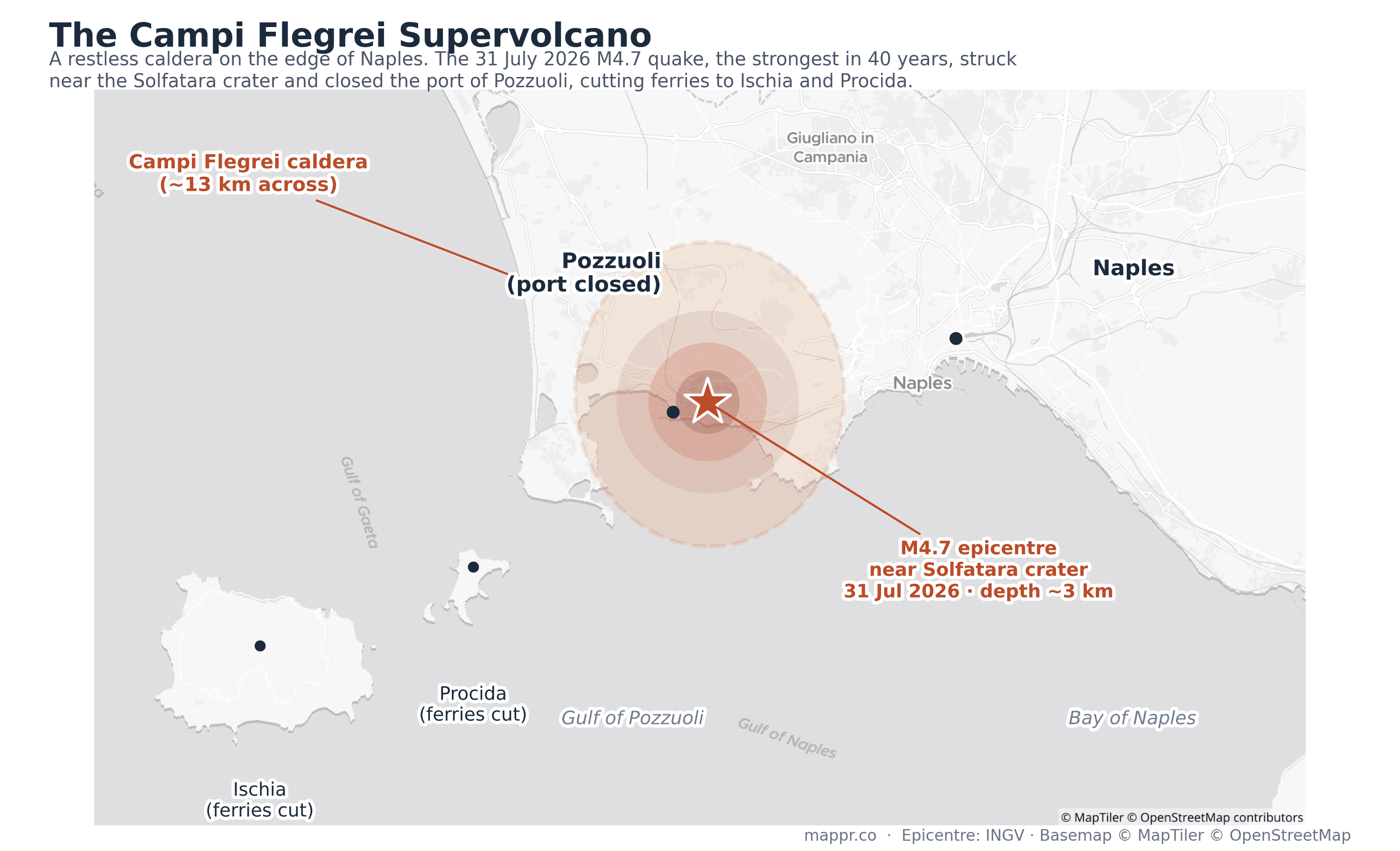
Italy’s National Institute of Geophysics and Volcanology (INGV) placed the epicentre near the Solfatara crater at Pozzuoli, at a shallow depth of roughly 3 km. The quake hit at 7:46 p.m. and was felt sharply across Pozzuoli, Naples and the offshore islands. INGV logged at least ten aftershocks overnight, the largest a magnitude 3.8 in the Gulf of Pozzuoli, within a swarm of more than 30 tremors.
The disruption was immediate. Civil Protection Minister Nello Musumeci confirmed 21 injuries, two of them serious. Rail service across the Naples network was halted for inspections, and the closure of Pozzuoli’s port severed the main ferry link to Ischia and Procida, two islands packed with summer visitors.
The aftermath: a swarm that will not stop
The defining feature of this event is not the single M4.7 shock but the swarm that has followed it: a near-continuous sequence of smaller quakes, exactly the pattern seismologists expect from an accelerating bradyseism phase rather than a one-off tectonic rupture. That is what keeps residents out of their homes even after the strongest shaking has passed.
What Campi Flegrei is
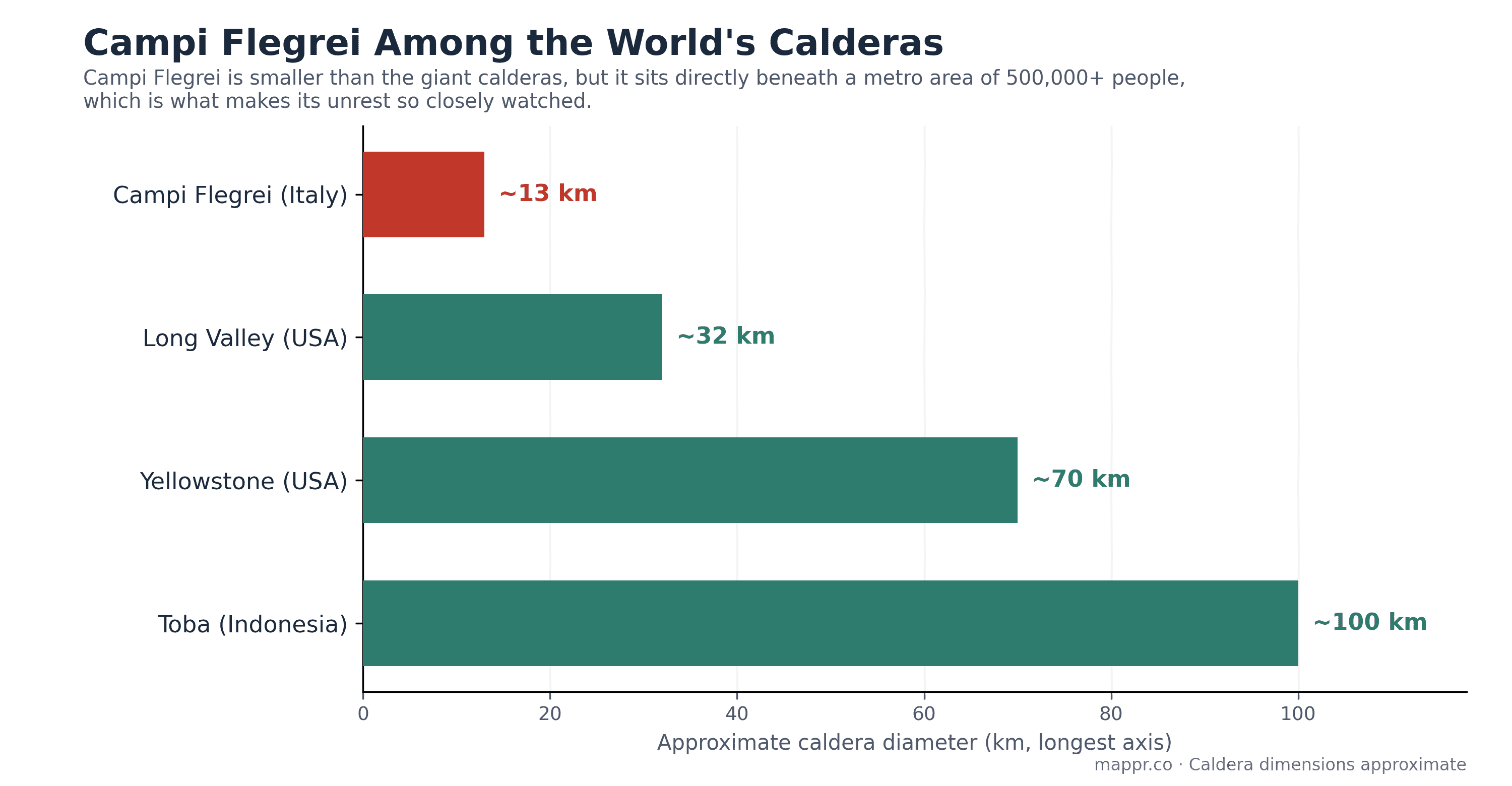
Despite the drama around Vesuvius across the bay, the larger volcanic system here is Campi Flegrei, the “Phlegraean Fields,” a roughly 13-kilometre-wide caldera formed by ancient super-eruptions, much of it now submerged beneath the Gulf of Pozzuoli. It is not a single cone but a broad, restless volcanic depression dotted with craters, steaming vents and the sulphurous Solfatara.
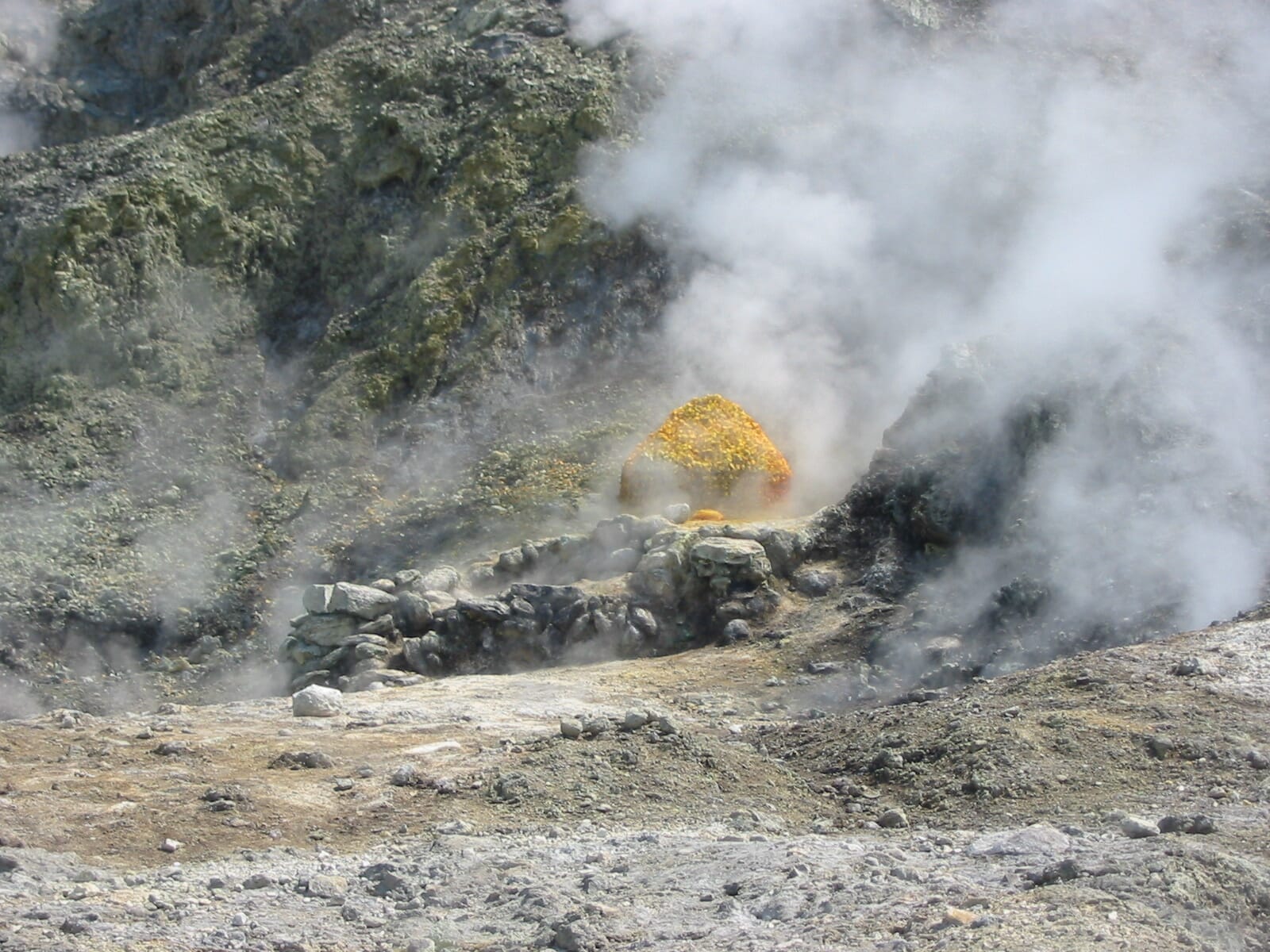
It is often called a “supervolcano” because of the scale of its past eruptions. But in raw size it is modest next to the giants. What makes it exceptional is location: unlike Yellowstone or Toba, Campi Flegrei has a dense city built directly on top of it. Around 500,000 people live inside or beside the caldera, in Pozzuoli and the western suburbs of Naples.
Why each quake keeps breaking the record
The July quake did not come out of nowhere. Campi Flegrei is in an accelerating phase of bradyseism, a slow rising and falling of the ground caused by fluids and gases shifting beneath the surface. Since the current unrest began around 2005, the ground near Pozzuoli has lifted by more than 140 centimetres, and the pace of earthquakes has climbed in step with it.
That is why the record keeps falling. As the chart above shows, the strongest single quake has stepped up almost every year, from about M4.2 in 2023 to M4.4 in 2024, M4.6 in 2025 and now M4.7. Each was described, in its moment, as the strongest in four decades. The uplift stretches and cracks the shallow crust, and a slightly larger shock in a shallow swarm is enough to damage buildings in Pozzuoli, which is why INGV keeps the count running publicly, tremor by tremor.
Is Naples about to erupt?
This is where careful wording matters. INGV and Italy’s Civil Protection describe the current situation as intensifying unrest, uplift and seismicity, not as a forecast of imminent eruption. Rising ground and stronger quakes raise the alert level and the risk of building damage, and they are watched around the clock, but they are not the same as an eruption being predicted. Scientists cannot say when, or whether, this unrest will end in one.
What is clear is that Campi Flegrei is one of the most closely monitored volcanic systems on Earth, precisely because so many people live on it. For now the practical impact is seismic: cracked walls, rattled nerves, and a transport network that stops for inspection every time the ground moves. You can follow global seismic activity, including this region, on our live earthquake map, and see where the biggest shocks in history rank in our guide to the world’s largest earthquakes. We’ll update this page as INGV releases new figures.
Sources: