Key Takeaways
- Two huge quakes, about 32 seconds apart. A magnitude 7.2 foreshock struck Venezuela's Caribbean coast at about 6:04 p.m. local time on 24 June 2026, followed less than a minute later by a magnitude 7.5 mainshock, a rare "doublet," in the words of the USGS.
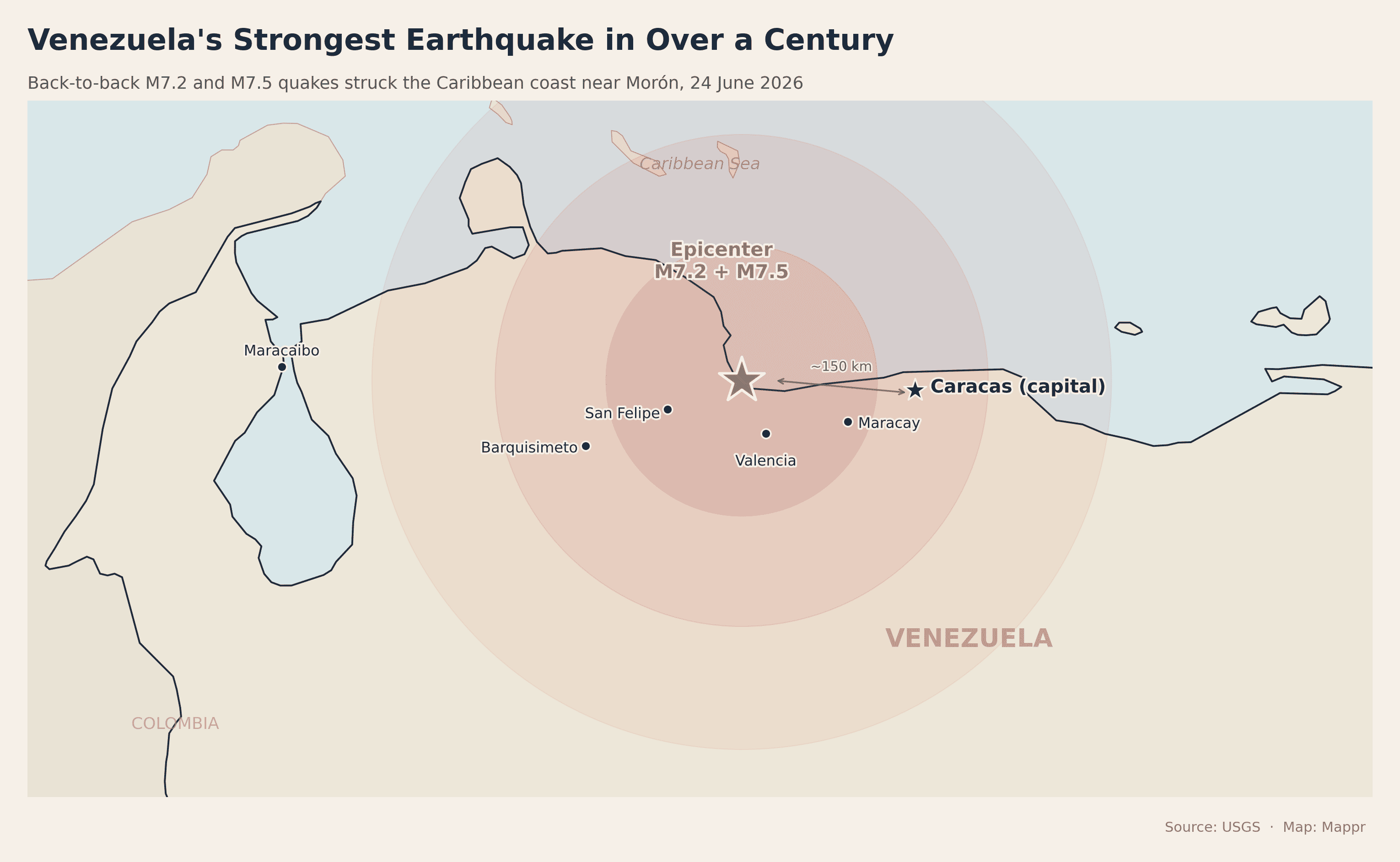
- Mainshock struck at the doorstep of Caracas. USGS revised the locations on 28 July: the M7.5 mainshock ruptured 17 km west of Catia La Mar, off the La Guaira coast, while the M7.2 foreshock sat 20 km east of San Felipe in Yaracuy, roughly 150 km away. Both were only 10 km deep.
- Strongest since 1900. The M7.5 mainshock is the most powerful earthquake to strike Venezuela since a magnitude 7.7 event in 1900, the country's biggest in over a century.
- USGS red alert. The USGS warned that "high casualties and extensive damage are probable," estimating a 44% chance the death toll tops 10,000. Buildings collapsed in Caracas and the main international airport was shut.
- Brief tsunami scare. Tsunami alerts were issued for Puerto Rico, the U.S. and British Virgin Islands and the ABC islands, then withdrawn within about an hour. The shaking was felt as far away as Bogotá, Colombia.
Venezuela was struck by the most powerful earthquake in more than a century on the evening of 24 June 2026, when two enormous tremors, a magnitude 7.2 foreshock and a magnitude 7.5 mainshock, hit the Caribbean coast less than a minute apart. Buildings collapsed in the capital, Caracas, the country’s busiest international airport was shut, and the U.S. Geological Survey warned of “high casualties and extensive damage” across a wide area.
The quakes landed on a national holiday (Venezuela was marking the 1821 Battle of Carabobo), so many people were at home when the ground began to heave. Residents poured into the streets and stayed out for hours, wary of aftershocks. The map below shows where the epicenters sat relative to Caracas and the densely populated cities of the central coast.
Casualties and latest updates
Latest developments
- August 26 (latest): Education minister Héctor Rodríguez says pupils from 91 schools, 11 of them collapsed and the rest structurally damaged, will be reassigned to the school nearest their home when the academic year opens on 14 September. About 900 of Venezuela’s 27,000 schools were affected, most only lightly. 67 schools were turned into shelters and 12 have been cleared, with the government planning 6,000 temporary housing units to move the remaining families out. Fe y Alegría warns that 18,727 young people risk losing access to schooling unless 31 critical buildings are repaired before term begins.
- August 25: The Instituto Aeropuerto Internacional de Maiquetía announces that Simón Bolívar International Airport will resume commercial passenger flights on 1 September, two months after the quakes closed it. Flights run from temporary modular terminals built in the car parks, two for departures and two for arrivals, separating domestic from international traffic, with the international departures hall covering 4,300 square metres across four gates and room for 780 passengers. The first phase runs at about 30% to 35% of pre-quake capacity, roughly eight flights a day. Cargo operations had already restarted on 5 August, and an earlier 24 August target slipped after faults showed up in drills. Passenger traffic has been routed through Valencia and Barcelona in the meantime.
- August 24: The government bulletin raises the confirmed toll to 6,509 killed, up 71 from 6,438, with 226,696 people given medical care and the rescued figure unchanged at 6,462, per National Assembly President Jorge Rodríguez. Brigades have now inspected 60,785 homes: 35,545 habitable, 14,239 restricted and 11,001 high risk. Debris clearance reaches 600,790.70 tonnes, or 28.61% of the total. Permanent homes handed over are unchanged at 335. The medical-care count more than doubled in a week, from 86,358, without explanation, while the injured figure stays frozen at 16,740.
- August 24: Marking two months since the doublet, acting President Delcy Rodríguez says clearance is running under a plan branded Despeje Digno y Seguro, with local crews, international technicians and United Nations specialists. She puts 1,172 people in the 335 new homes and 3,503 more in 1,001 repaired ones, with more than 25,000 people still living in camps. The United States delivered 20 remote-controlled heavy machines for debris removal the previous week. Officials and construction-industry figures now say clearing the rubble alone could take up to a year.
- August 18: A magnitude 4.0 earthquake strikes northwest of La Guaira at 3:07 a.m., 10 km deep, according to Funvisis, in the same coastal strip the June doublet flattened. It is felt strongly across Caracas and is the first widely felt tremor in weeks. Acting President Delcy Rodríguez says the protection system is activated and there are no reports of damage of any kind. International early-warning apps put the magnitude nearer 4.6; Funvisis holds at 4.0.
- August 17: After another week without figures, the government bulletin raises the confirmed toll to 6,438 killed, up 137 from 6,301, with 86,358 people given medical care and the rescued figure unchanged at 6,462, per National Assembly President Jorge Rodríguez. Debris clearance passes 528,222 tonnes, and bodies keep appearing in it. Brigades have now inspected 59,109 homes: 34,680 habitable, 13,733 restricted and 10,696 high risk. Permanent homes handed over rise to 335. The injured count is omitted again, frozen at 16,740 since 1 July, as is the number left homeless.
- August 17: Venevisión announces a Teletón, “Unidos por Venezuela”, for 17 October, the first national fundraiser of its kind in the country since the 2000s. It runs with the Dividendo Voluntario para la Comunidad, the United Way affiliate in Venezuela, and the Unión Radio network, with the national youth and children’s orchestra system taking part. Ernst & Young will audit the donations, which go to direct humanitarian assistance and reconstruction projects.
- August 14: OCHA’s situation report #33 says more than 304,000 people, 57% of them women and girls, have now accessed humanitarian assistance and essential services, up from nearly 212,000 as of 6 August. On national figures, 23.26% of the total rubble has been cleared. The UN response still targets 1.3 million people over six months.
- August 12: The IFRC’s second operation update counts 1,463 aftershocks since 24 June and confirms that the INSARAG-coordinated search-and-rescue teams have concluded their assignment. It logs 2,501 damaged infrastructure assets, 856 affected buildings including 190 collapsed, and more than 400 schools affected. Maiquetía airport is expected to resume commercial cargo flights within weeks, with most international passenger traffic still routed through Valencia. Families who would rather buy on the private market can do so with 80% of the price subsidised and the remaining 20% covered by 25-year bank loans.
- August 11 to 17: IOM’s twenty-second and twenty-third response reports record the completed closure of the Playa Grande camp, leaving four sites under IOM management, and heavy rainfall that damaged drainage and services at César Nieves, Mare Abajo, Campo de Golf and José María Vargas. A Displacement Tracking Matrix sweep of 110 community settlements found 4,733 households and 12,127 people living outside the formal camps in La Guaira, the Capital District, Carabobo and Miranda. Cumulative distributions reach 8,907 tarpaulins, 5,887 kitchen sets, 5,000 buckets, 4,500 jerrycans, 4,217 emergency shelter kits and 2,802 mosquito nets, reaching more than 15,500 people.
- August 9: The Juan Pablo Dos Santos Foundation estimates the quakes left at least 200 people with amputations, about half of them minors. Prosthetics cost USD 3,500 to USD 30,000 each, so the foundation has joined Colombia’s CIREC and the Hospital Ortopédico Infantil to create Fondo Humanitario 77, which aims to raise USD 2 million to fit them.
- August 10: The government bulletin raises the confirmed toll to 6,301 killed, up 176 from 6,125 on 3 August, with 73,356 people treated in hospitals, per National Assembly President Jorge Rodríguez. Damage-assessment brigades have now inspected 53,314 homes: 31,336 habitable, 12,411 restricted and 9,567 high risk. Debris clearance reaches 483,525 tonnes, but the number of permanent homes handed over is unchanged at 287, against Delcy Rodríguez’s pledge of 4,000 by December and more than 10,000 during 2027.
- August 10: The IOM’s twenty-first response report closes the Playa Grande temporary accommodation site and covers five sites it still manages in La Guaira, three of them co-managed with the Norwegian Refugee Council. The José María Vargas Sports Complex hosts 751 people from 202 households, mobile teams have delivered 3,267 consultations there and 2,864 in César Nieves, and 2,244 relief kits went out between 17 July and 7 August across La Guaira, Miranda, the Capital District and Carabobo. Health teams treated a diarrhoeal-disease incident affecting about 20 adults and 12 children in César Nieves.
- August 7: OCHA’s situation report says nearly 212,000 people had accessed humanitarian assistance and essential services as of 6 August. On the last official camp figures, from 26 July, 24,477 people remain in 107 transitional camps with capacity for 28,223: 12,752 in La Guaira, 9,092 in the Distrito Capital, 1,958 in Miranda and 675 in Aragua. The UN and partners are still scaling a response aimed at 1.3 million people over six months.
- August 5: Al Jazeera reports that demolition is now colliding with the search for bodies. The first controlled demolition took place on 30 July in Catia La Mar, and at the OPPE 27 complex, where four towers came down, two sites had been cleared by early August while relatives camped alongside waiting for remains. The government has branded its reconstruction programme Venezuela Renace, with 1,875 homes planned in La Guaira alone.
- August 4: La Guaira governor José Alejandro Terán puts the number of missing in his state at 1,579, the first official missing-persons figure any Venezuelan authority has given since the national count froze at 157 on 25 June. The figure comes from a census of affected families, current to 3 August. The citizen platform Desaparecidos Terremoto Venezuela has logged 82,577 reports covering about 44,418 individuals, of whom 29,518 remain out of contact with relatives and 14,900 have been located. The rights group Provea notes there is still no public official registry behind either set of numbers.
- August 3: The government resumes its official bulletin after a 10-day silence, raising the confirmed toll to 6,125 killed, up from 5,546 on 24 July, with 60,992 people treated in hospitals and the rescued figure unchanged at 6,462. On reconstruction: 43,679 homes assessed, of which 25,325 are habitable, 9,866 restricted and 6,433 high risk, with 287 permanent homes handed over. Debris clearance stands at 346,755 tonnes, about 16.5% of the roughly 1.2 million tonnes the quakes generated.
- August 3: The bulletin’s new format is markedly thinner. El Estímulo notes it no longer reports the injured, families assisted, the number of transitional camps or the people living in them, aftershock counts or state-by-state breakdowns. Independent tallies still put around 24,000 people in temporary camps in Caracas and La Guaira, and no survivors have been found since 2 July.
- July 28: One month on, The New Humanitarian reports from La Guaira and Caracas that nearly 24,000 survivors are living in 107 state-run displacement camps across La Guaira, Caracas, Miranda and Aragua, with thousands more sleeping outside damaged buildings while engineers assess them. No survivors have been found since 2 July, and in parts of La Guaira relatives are camping beside or on top of rescue sites to keep excavators out while they search for their dead. An International Rescue Committee assessment counted just 1,038 healthcare workers serving the 1.77 million people affected in Caracas, Miranda and La Guaira, and PAHO is co-leading an emergency network of 110 organisations with the IRC.
- July 28: Funding, not logistics, is now the binding constraint: the UN’s USD 931 million appeal for Venezuela in 2026 is about 39% funded, leaving a shortfall near USD 566 million, and Caracas has asked the Bank of England to return 31 tonnes of gold worth some USD 4 billion. The government delivered the first 240 permanent homes on 20 July and pledged 4,000 by December, with officials putting the timeframe to relocate and stabilise families at six to eight months. An AtlasIntel/Bloomberg poll of more than 2,500 people found 65.4% disapprove of the government’s disaster response and 45.7% now consider an election more urgent than before.
- July 28: The USGS relocates the M7.5 mainshock. Its reviewed solution places the bigger quake 17 km west of Catia La Mar, off the La Guaira coast at a depth of 10 km, rather than beside the foreshock in the hills to the west. The M7.2 is now placed 20 km east of San Felipe in Yaracuy, roughly 150 km away. The revision answers the question that had puzzled seismologists and residents alike: why La Guaira and Caracas were devastated by a quake supposedly centred 160 km up the coast. The mainshock in fact ruptured on the capital’s doorstep. (USGS catalogue rechecked 13 August 2026.)
- July 24 to 27: The IOM’s seventeenth response report covers the five transitional sites it co-manages in La Guaira, where 4,538 people remain hosted, and logs distribution of 343 tarpaulins, 343 kitchen sets, 343 solar lamps and 618 jerry cans with partner Fundación Vivienda Popular. Coordination advanced on a 20,000-litre-per-day water storage and treatment system at the Campo de Golf site, and mobile teams delivered more than 500 health consultations. An IOM household survey in those sites found 55% of households lost income over the past month and 55% do not feel safe leaving their accommodation.
- July 25: The official toll rises to 5,546 killed and 16,740 injured, per figures from National Assembly President Jorge Rodríguez, with 17,907 people left homeless and 6,462 rescued. Euronews reports 23,122 people in 107 temporary shelters in Caracas and La Guaira, and notes the government stopped updating its missing-persons figure on 25 June at 157 people, while the citizen-run Desaparecidos del Terremoto de Venezuela registry has documented about 29,500 names. Aftershocks now number more than 1,400.
- July 23: The World Bank estimates direct physical damage at USD 19.6 billion, equal to about 18% of Venezuela’s GDP, in a Global Rapid Damage Estimation report. Residential buildings account for 47% of the total, infrastructure 27% and non-residential buildings 26%. La Guaira and the Distrito Capital account for roughly half of all damage, and in La Guaira the Bank estimates one in five homes was destroyed.
- July 22: The confirmed death toll reaches 5,346, per figures from National Assembly President Jorge Rodríguez reported by Agencia EFE, up from 5,278 on 21 July and 5,119 on 18 July, with the injured count unchanged at 16,740 (most now discharged from hospital). About 20,000 people remain in temporary camps in Caracas and La Guaira. The government has begun a rehousing programme led by Rodríguez, handing over the first permanent apartments and pledging to house all displaced families by the end of the year, though aid groups warn shelters still lack reliable clean water and sanitation.
- July 18: The official toll passes 5,000 to 5,119 killed, per National Assembly President Jorge Rodríguez, as the International Monetary Fund releases USD 346 million in emergency financing from Venezuela’s reserve tranche to support the response. USGS and OCHA have now logged more than 1,300 aftershocks, though no significant new tremors have been felt. The UN’s mid-July estimate still puts 40,000 to 50,000 people on missing-persons registries, a figure the government does not confirm.
- July 16: The confirmed death toll rises to 4,829, per figures from National Assembly President Jorge Rodríguez reported on 16 July, with the injured count unchanged at 16,740 and 17,907 people homeless. Three weeks on, families are still searching the rubble for missing relatives, and aid groups warn that crowded shelters have limited access to clean water and adequate sanitation. The UN’s earthquake addendum to its 2026 humanitarian plan seeks an additional USD 298 million over six months for 1.3 million people, lifting total requirements to USD 930 million, but the earthquake appeal remains only about 42% funded (roughly USD 270 million received of USD 640 million sought).
- July 15: The confirmed death toll rises to 4,333, per National Assembly President Jorge Rodríguez, with the injured figure unchanged at 16,740 and about 17,000 people still homeless across more than 80 shelters. With no significant new aftershocks recorded since the initial M7.5 and M7.2 doublet, the emergency is shifting from rescue to reconstruction: the government says distribution of emergency housing will begin next week, and international teams, including a group of Israeli military engineers, are helping draw up a national reconstruction plan.
- July 11: The official death toll passes 4,000 to 4,118 killed and 16,740 injured, per the government’s 11 July communiqué, an increase of more than 400 deaths since 8 July as bodies continue to be recovered from La Guaira and western Caracas. USGS and OCHA have now logged more than 1,000 aftershocks (1,048 as of the 6 July situation report). Aid agencies warn of a deepening public-health crisis: the Associated Press reports surging chronic illness and diarrhoea in quake-hit communities and overcrowded shelters, where more than 12,000 of the estimated 17,800 homeless are housed. The government has appealed for access to billions in frozen overseas assets to fund reconstruction, with the UN Office for Disaster Risk Reduction putting direct damage at USD 37 billion.
- July 8: The official toll climbs to at least 3,685 killed and 16,740 injured, an increase of 150 deaths from Monday per Jorge Rodríguez. Rescue teams have now recovered 6,462 survivors and 17,907 people are homeless, sheltered across 87 temporary sites. The UN Office for Disaster Risk Reduction publishes a preliminary damage assessment of USD 37 billion: USD 24 billion in direct damage to homes, businesses, schools and hospitals, and USD 13 billion in infrastructure losses, of which roughly USD 5 billion is telecommunications. 856 buildings have been logged as damaged and 190 have fully collapsed, with 38 hospitals hit and 1,600 pieces of transport infrastructure affected. International response continues to scale: 30 countries are contributing, deploying around 3,600 rescue workers, 1,000 tonnes of humanitarian supplies and dozens of canine teams. Jamaica has just committed a humanitarian assistance package, and the UK’s Disasters Emergency Committee appeal has crossed £10 million. A forensic pathologist quoted by CNN says the official count is still “not even a third” of what is actually there; independent registries continue to list roughly 50,000 people unaccounted for.
- July 7: The official toll rises to at least 3,535 killed, 16,740 injured and 17,854 homeless, an increase of 193 deaths from Sunday, per National Assembly President Jorge Rodríguez. Growth is slowing but the rescue phase is officially winding down; AP and CNN report that in La Guaira, families are now largely left to recover their dead on their own. About 12,800 people are sheltering across 80 temporary sites in Caracas and La Guaira. Al Jazeera reports that experts are warning of an impending health crisis in the crowded, unsanitary shelters, and there is still no confirmed government figure for the missing.
- July 5 to 6: The official toll jumps to at least 3,342 killed and more than 16,700 injured in an Independence Day announcement by National Assembly President Jorge Rodríguez, up roughly 750 deaths from Friday. The mass-burial phase begins: gravediggers at La Esperanza cemetery in La Guaira bury more than 150 unidentified bodies, and hundreds of coffins line the port of La Guaira, now a temporary morgue after the state’s forensic system was overwhelmed. The UN estimates up to 50,000 people are still unaccounted for, a figure the government does not confirm. Acting President Delcy Rodríguez defends the response amid growing public anger and warns that no social unrest will be tolerated.
- July 4: The official toll holds at at least 2,595 killed and more than 12,000 injured, but the recovery keeps hinting at a higher final count: a forensic pathologist tells CNN the La Guaira morgue operation is receiving around 400 bodies a day, and a non-governmental database still lists more than 38,000 people as missing. The disaster is turning political: acting President Delcy Rodríguez defended her government as her 180-day mandate expired, announcing 11 international field hospitals and a national donation fund, while opposition leader María Corina Machado presses to return to the country. The US military is airlifting aid with a 250-person disaster team and three urban search-and-rescue units, and Israel sent an aid delegation, its first to Venezuela after a 17-year diplomatic freeze.
- July 3: Acting President Delcy Rodríguez raises the official toll to at least 2,595 killed and more than 12,000 injured, an increase of 300 deaths in a single day, while angrily defending the government response against suggestions the real toll is far higher. The UN Development Programme estimates $6.7 billion in direct physical damage, about 6% of GDP, with nearly 800 buildings collapsed and a NASA satellite analysis suggesting some 58,870 buildings may be damaged. In La Guaira the effort has turned to identifying the dead: bodies are preserved in donated cooling containers at the seaport, forensic teams expect up to three months of recovery work, and officials concede mass graves may be needed. An unofficial online registry lists roughly 38,500 people still unaccounted for, down from nearly 60,000, and several officials have been arrested for looting in the disaster zone.
- July 2: The official National Assembly balance climbs to at least 2,295 killed and 11,267 injured as the disaster enters its second week. In a moment of hope, rescuers pulled 43-year-old security guard Hernán Alberto Gil Flores alive after eight days trapped in the basement of a collapsed shopping centre in Catia La Mar, an around-the-clock operation led by Chilean firefighters with teams from the United States, Portugal, Mexico, Costa Rica and El Salvador; in total 6,461 people have been rescued from the rubble. Doctors warn hospitals are close to collapse: 17,026 patients have been treated so far, with medicine shortages and rising infection risk, and CNN reports overflowing morgues and doubts that the official count captures the full toll. Authorities have recorded more than 780 aftershocks, though their frequency and strength are declining.
- July 1: The latest official count rises to at least 1,943 killed and 10,571 injured, with more than 15,800 people displaced. The operation has fully shifted from rescue to recovery. More than 30 countries have now sent over 3,600 rescuers, 1,000 tonnes of humanitarian aid and specialised canine teams, and survivors are still being found: rescuers pulled a 3-year-old boy alive after six days trapped under the rubble. More than 130 aftershocks have now been recorded since the initial quakes. Officials still have not confirmed how many people are missing; civilian registries and UN estimates cite figures above 50,000, which the government disputes.
- June 30: The latest official count from the National Assembly puts the toll at at least 1,719 killed and 5,034 injured, and the New York Times reports the true figure is likely higher. The operation is shifting from rescue to recovery, with authorities and the UN arranging 10,000 body bags, though survivors are still being found: rescuers pulled 21-year-old Aaron Levi alive after 106 hours trapped in a collapsed building in La Guaira, where 189 buildings are confirmed destroyed. A felt magnitude 4.6 aftershock rattled the coast near Caracas during rescue operations. Officials still have not confirmed how many people are missing; civilian-run registries list tens of thousands of names, with the UN citing figures above 50,000 that the government disputes.
- June 29: The official death toll rises to at least 1,450, with more than 3,200 injured and over 12,700 people left homeless. International rescue crews from the United States, Chile, France, Spain, Mexico and El Salvador join the search; one team pulls 60-year-old Belkys Barreto alive from a collapsed building in La Guaira after 86 hours trapped. More than 130 aftershocks have now been recorded, the largest magnitude 4.8.
- June 28: The confirmed death toll rises to at least 1,430, with about 3,200 injured and 3,100 left homeless, according to National Assembly president Jorge Rodríguez. Families have reported tens of thousands of people unaccounted for, and more than 130 aftershocks have been recorded since the initial quakes.
- June 28: The United Nations estimates the disaster caused $6.7 billion in damage, equal to about 6% of Venezuela’s GDP. Aid flights are landing at a partially reopened Caracas airport, soldiers are unloading supplies by helicopter in La Guaira, and shelters are being set up for displaced residents as the search enters its fourth day.
- June 27: The government’s confirmed death toll jumps to around 920, with about 3,360 injured and 172 people still trapped under the rubble. More than 50,000 remain on missing-persons registries. The collapse of two 17-story towers at the Belo Horizonte complex in Catia La Mar, La Guaira, is among the deadliest single sites.
- June 27: The United States pledges $150 million in aid and some sanctions relief, and rescue crews from Mexico, El Salvador and other countries arrive. Residents in La Guaira are still digging by hand amid a shortage of heavy equipment. A weaker magnitude 4.9 aftershock is felt in Caracas and Maracay.
- June 26: Venezuela’s health minister, Carlos Alvarado, says the death toll from the twin earthquakes has climbed to around 235, with about 4,300 injured. Tens of thousands of people remain unaccounted for, with online registries listing more than 50,000 names, though officials expect many to be found safe.
- June 26: Search-and-rescue operations continue for a second full day across La Guaira and Caracas, with international teams now on the ground. Aftershocks persist along the northern coast, and Simón Bolívar International Airport remains closed.
- June 25: The confirmed death toll rises to at least 164, with close to 1,000 injured. La Guaira remains the hardest-hit state. Officials warn the count will keep rising as crews reach collapsed buildings, and some reports describe thousands of people still unaccounted for.
- June 25: More than 20 aftershocks have been felt along the northern coast, across La Guaira, Miranda, Aragua, Carabobo and Falcón. The USGS puts the chance of a magnitude-6 or larger aftershock this week at about 40%.
- June 25: Rescue teams pull survivors from the rubble, with hundreds of rescuers working across La Guaira and Caracas. International search-and-rescue teams begin arriving.
- June 25: The UN, the Red Cross and several Latin American countries pledge aid, including search teams, medical supplies and food. Simón Bolívar International Airport remains closed.
What happened: a rare earthquake “doublet”
According to the USGS catalogue, checked on 13 August, the first quake, a magnitude 7.2, struck at about 6:04 p.m. local time with its epicenter 20 km east of San Felipe, in Yaracuy, at a depth of 10 km.
About 32 seconds later, an even larger magnitude 7.5 tremor ruptured 17 km west of Catia La Mar, off the coast of La Guaira, also 10 km deep. The two epicenters were roughly 150 km apart, and the mainshock sat about 35 km from central Caracas.
Those are revised numbers. The USGS initially placed the mainshock beside the foreshock near Morón and only moved it to the La Guaira coast on 28 July, which is why early reporting described two epicenters a few miles apart.
Seismologists call this kind of near-simultaneous pair a “doublet.” “When the earthquakes are this close together in time, it can be difficult to unravel the exact magnitudes and the exact locations, especially for the second event,” USGS seismologist Paul Earle explained, because the seismograph signals overlap. What is not in doubt is the destructive combination at play here: a very large magnitude and a very shallow depth, directly beneath a populated, heavily built-up coastline.
Damage in Caracas and a red-level alert
On the revised USGS location, the mainshock ruptured just off Catia La Mar, the port district that serves the capital, and Caracas shook violently. Witnesses described walls peeling away from buildings, dust columns rising over neighbourhoods, and furniture spilling into the streets. A branch building of Bancaribe bank collapsed; parts of the capital lost power and cellphone service. Authorities closed the main Simón Bolívar International Airport at Maiquetía after it sustained damage, and cancelled classes.
Maiquetía is coming back in stages. Cargo operations restarted on 5 August, and on 25 August the airport institute announced that commercial passenger flights would resume on 1 September.
They will run from temporary modular terminals built in the car parks: two for departures, two for arrivals, separating domestic from international traffic. The international departures hall covers 4,300 square metres with four gates.
The first phase is set at roughly 30% to 35% of pre-quake capacity, about eight flights a day. Until now most international traffic has been routed through Valencia, 172 km from Caracas, and Barcelona, 313 km away.
The USGS PAGER system issued a red alert, its highest, warning that “high casualties and extensive damage are probable, and the disaster is likely widespread.” Its initial modelling put a 44% probability on the death toll exceeding 10,000, and a 30% chance of more than 100,000 fatalities. Acting President Delcy Rodríguez declared a state of emergency, while interior minister Diosdado Cabello urged people on state television to stay outdoors as aftershocks rattled damaged structures. Acting President Delcy Rodríguez later confirmed an initial toll of at least 32 dead and more than 700 injured, figures expected to rise (see the latest updates above).
A tsunami threat was briefly issued for Puerto Rico, the U.S. and British Virgin Islands, and the ABC islands of Aruba, Curaçao and Bonaire off Venezuela’s coast. It was withdrawn within about an hour. The tremor was felt across much of northern Venezuela and as far away as Bogotá, Colombia.
Venezuela’s strongest quake since 1900
The M7.5 mainshock is the largest earthquake to strike Venezuela since 1900, when a magnitude 7.7 event hit the same Caribbean coast. Powerful earthquakes are comparatively rare here: although Venezuela straddles a major plate boundary, it does not rupture as often as the Pacific coast of Latin America. The chart below sets the 2026 doublet against the country’s most significant past quakes.
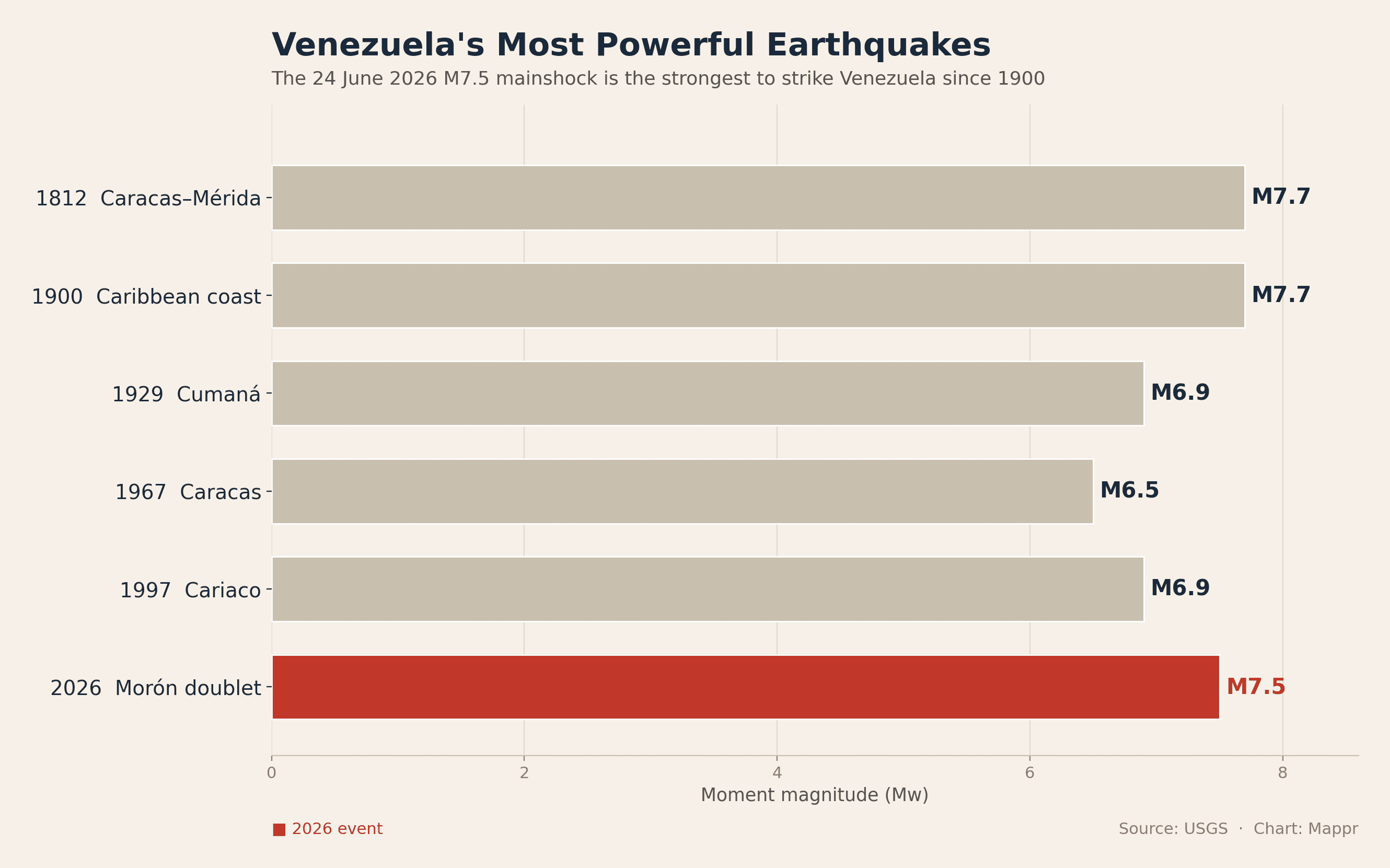
Caracas itself has a grim seismic history. A magnitude 6.5 quake in 1967 killed around 280 people and collapsed apartment blocks in the city; residents who lived through it told reporters this one felt worse. Further back, the catastrophic 1812 earthquake, which also fell on a holiday, destroyed much of Caracas and Mérida and killed an estimated 15,000 to 26,000 people.
Why Venezuela’s coast shakes
Venezuela sits along the boundary where the Caribbean Plate grinds eastward past the South American Plate at roughly two centimetres a year. Rather than one plate diving beneath the other, the two mostly slide horizontally past each other along a system of strike-slip faults (the El Pilar, San Sebastián and Boconó faults) that run across the country’s northern edge. The June 2026 rupture occurred along this coastal fault zone, the same belt responsible for the 1900 and 1812 disasters.
Shallow strike-slip quakes of this size release tremendous energy close to the surface, which is why the shaking was so intense across the central-coast cities of Valencia, Maracay and the capital region.
What comes next
The USGS expected a vigorous aftershock sequence. In the week after the mainshock, forecasters put the chance of a magnitude 6 or larger aftershock at about 40%, and called a magnitude 5 or larger aftershock all but certain.
That held for the smaller shocks: the IFRC counted 1,463 aftershocks as of 12 August, the strongest a magnitude 5.0.
The run of quiet nights ended on 18 August, when a magnitude 4.0 shock northwest of La Guaira woke much of Caracas at 3:07 a.m. It did no damage, but nothing since the doublet has come close to the June rupture, and the danger to a population sleeping outdoors has shifted from shaking to sanitation.
Two months on, the emergency has moved into a long recovery. No survivors have been found since 2 July, and debris clearance had reached 600,790 tonnes, 28.61% of the total, by the 24 August bulletin.
Officials still put the timeframe for relocating and stabilising displaced families at six to eight months. Delcy Rodríguez and construction-industry figures now say clearing the rubble alone could take up to a year.
The missing, and a widening data gap
Venezuela’s national government stopped updating its missing-persons count on 25 June, when it stood at 157 people. On 4 August, La Guaira governor José Alejandro Terán broke that silence for his own state, putting the missing there at 1,579.
It is the first official figure in six weeks, and it comes from a census of affected families rather than a published registry. The rights group Provea says no public record backs it, or the far larger citizen counts.
Those citizen registries tell a different story. Desaparecidos Terremoto Venezuela has logged 82,577 reports covering about 44,418 individuals: 29,518 are still out of contact with relatives and 14,900 have been located. Venezuela Reporta lists 41,301, and the UN’s mid-July estimate ranges from 40,000 to 50,000.
Without a death certificate, families cannot settle inheritances or claim financial help.
The search is now colliding with demolition. Al Jazeera reported on 5 August that controlled demolitions of unstable towers, the first on 30 July in Catia La Mar, are clearing rubble that families believe still holds their relatives.
At the OPPE 27 complex, where four towers came down, two sites had been cleared by early August. Relatives have camped alongside the wreckage, waiting for remains that may already have gone to a dump.
Rebuilding, and the money gap
The government had handed over 335 permanent homes as of its 24 August bulletin, unchanged for a second week, against a pledge of 4,000 by December and more than 10,000 during 2027.
Delcy Rodríguez said on 24 August that those homes shelter 1,172 people, and that a further 1,001 repaired homes house 3,503 more. More than 25,000 people are still living in camps.
A presidential assessment commission tags damaged buildings red, yellow or green. Families who would rather buy on the private market have a parallel route: the state subsidises 80% of the price and local banks lend the remaining 20% over 25 years, the IFRC reported on 12 August.
The World Bank put direct physical damage at USD 19.6 billion on 23 July, about 18% of GDP. The reconstruction programme, branded Venezuela Renace, plans 1,875 new homes in La Guaira alone.
Of 60,785 homes assessed by 24 August, 35,545 were declared habitable, 14,239 restricted and 11,001 high risk. Debris clearance stands at 600,790 tonnes, 28.61% of the total.
Clearance runs under a plan branded Despeje Digno y Seguro, with local crews, international technicians and UN specialists. The United States sent 20 remote-controlled heavy machines for the work in the week before 24 August.
Money is the constraint. The UN’s USD 931 million appeal for Venezuela in 2026 is roughly 39% funded, a shortfall of about USD 566 million, and the UN Office for Disaster Risk Reduction puts total recovery costs at USD 37 billion.
Domestic fundraising is restarting. Venevisión announced on 17 August a Teletón called Unidos por Venezuela for 17 October, run with the Dividendo Voluntario para la Comunidad and Unión Radio, with Ernst & Young auditing the donations.
The IMF has released USD 346 million from Venezuela’s reserve tranche, and Caracas has asked the Bank of England to return 31 tonnes of gold worth some USD 4 billion.
Schools, and a term starting late
Classes restart on 14 September. Education minister Héctor Rodríguez said on 26 August that pupils from 91 schools, 11 of them collapsed and the rest structurally damaged, will be reassigned to whichever school sits closest to their home.
About 900 of Venezuela’s 27,000 schools were affected, most only lightly. Sixty-seven were turned into shelters, 12 of which have since been cleared, and the government plans 6,000 temporary housing units to move the remaining families out.
The Jesuit education network Fe y Alegría warns that 18,727 young people risk losing access to schooling unless 31 critical buildings are repaired before term begins.
We’ll update this map and post as confirmed figures emerge.
Sources: