Gold had a rough 2026. The price fell sharply through the year, sliding around 16% in the second quarter alone, its worst Q2 in over a decade. And yet the world’s central banks kept buying. In the first quarter they added a net 244 tonnes to their vaults, and the buying carried on through the spring.
That is the story this map tells: the price fell, the hoarding did not. Behind it sits a slow, deliberate shift away from the US dollar, accelerated by the 2022 freezing of roughly $300 billion of Russian reserves. Gold, unlike dollars parked abroad, sits outside any other country’s jurisdiction.
The world’s official gold stock now stands at about 36,600 tonnes. Here is where it sits, who holds it as a share of their reserves, and who is still stacking.
Key Takeaways
- The US holds the most, by far. The United States holds about 8,134 tonnes of gold, nearly as much as the next three countries (Germany, Italy and France) combined.
- A ~36,600-tonne global vault. Central banks and the IMF together hold roughly 36,600 tonnes. The top four countries alone hold close to half of it.
- Share of reserves is the real story. The US, Germany, Italy and France keep 65% to 75% of their reserves in gold. Uzbekistan sits at 87% and Kazakhstan at 78%, while China holds only about 9%, leaving huge room to keep buying.
- The price fell, the buying did not. Gold dropped about 16% in Q2 2026, its worst Q2 in 13 years, yet central banks added a net 244 tonnes in Q1 and kept buying into the spring.
- Poland is Europe's most aggressive buyer. Poland has built its reserves to around 582 tonnes and is racing toward a 700-tonne target, part of a wider de-dollarization push.
Which Countries Hold the Most Gold?
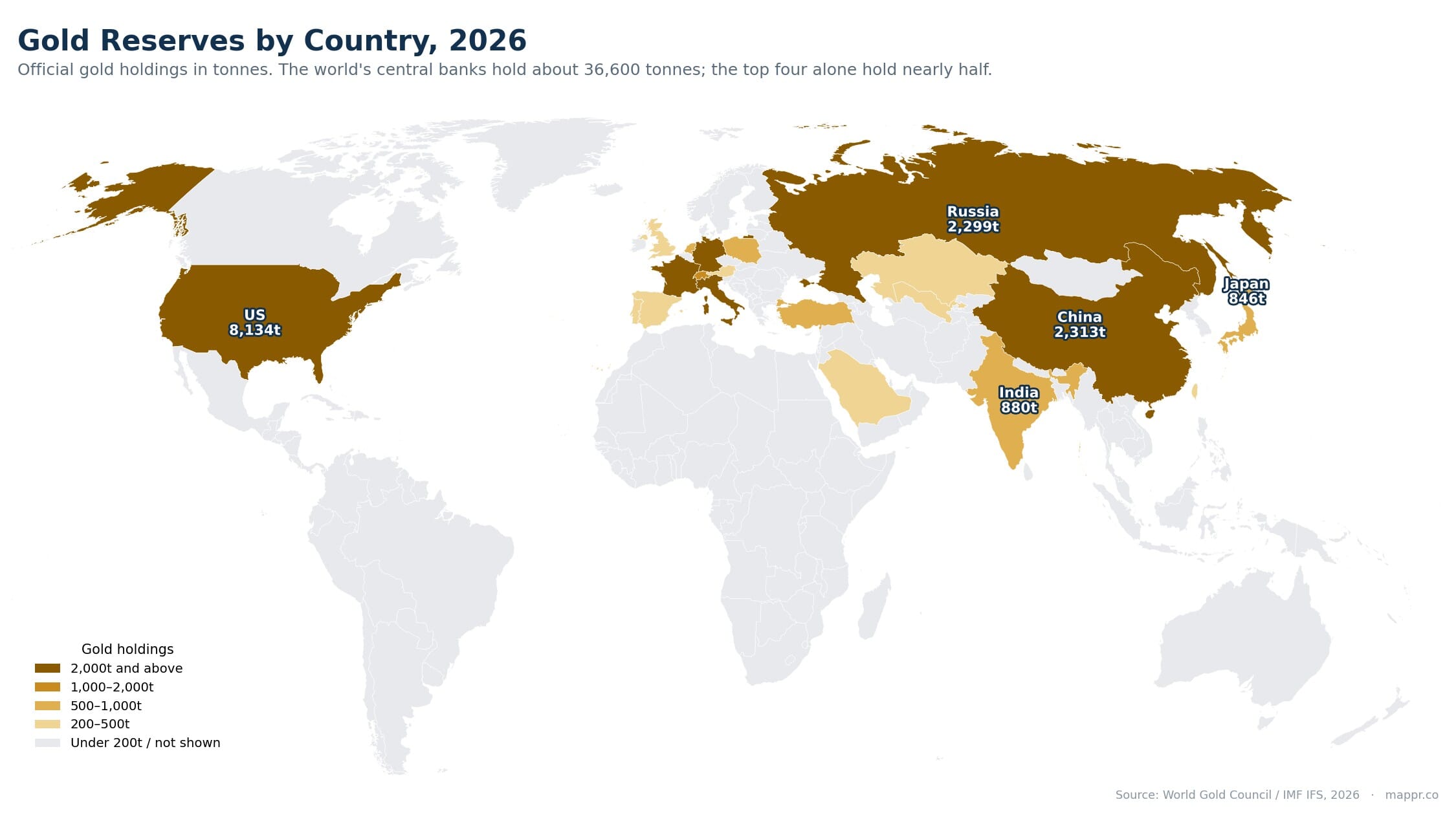
Official gold holdings are strikingly concentrated. The United States alone holds about 8,134 tonnes, most of it at Fort Knox and the New York Fed. Then come three European holders, Germany (3,355t), Italy (2,452t) and France (2,437t), legacies of the postwar Bretton Woods era.
The two giants that have changed the picture are China and Russia, now neck and neck at around 2,300 tonnes each after years of steady buying. Below them, holdings fall away quickly.
| # | Country | Gold (tonnes) | % of reserves |
|---|---|---|---|
| 1 | United States | 8,133 | 75% |
| 2 | Germany | 3,355 | 74% |
| 3 | Italy | 2,452 | 69% |
| 4 | France | 2,437 | 65% |
| 5 | China | 2,313 | 9% |
| 6 | Russia | 2,299 | 30% |
| 7 | Switzerland | 1,040 | 8% |
| 8 | India | 880 | 12% |
| 9 | Japan | 846 | 5% |
| 10 | Turkey | 635 | 44% |
| 11 | Netherlands | 612 | 62% |
| 12 | Poland | 582 | 22% |
| 13 | Taiwan | 424 | 5% |
| 14 | Uzbekistan | 416 | 87% |
| 15 | Portugal | 383 | 74% |
Source: World Gold Council / IMF International Financial Statistics, 2026. Figures are the latest reported holdings.
Who Still Has Room to Buy?
Tonnes only tell half the story. The sharper question is how much of a country’s reserves are already in gold, because that shows who has room to keep buying.
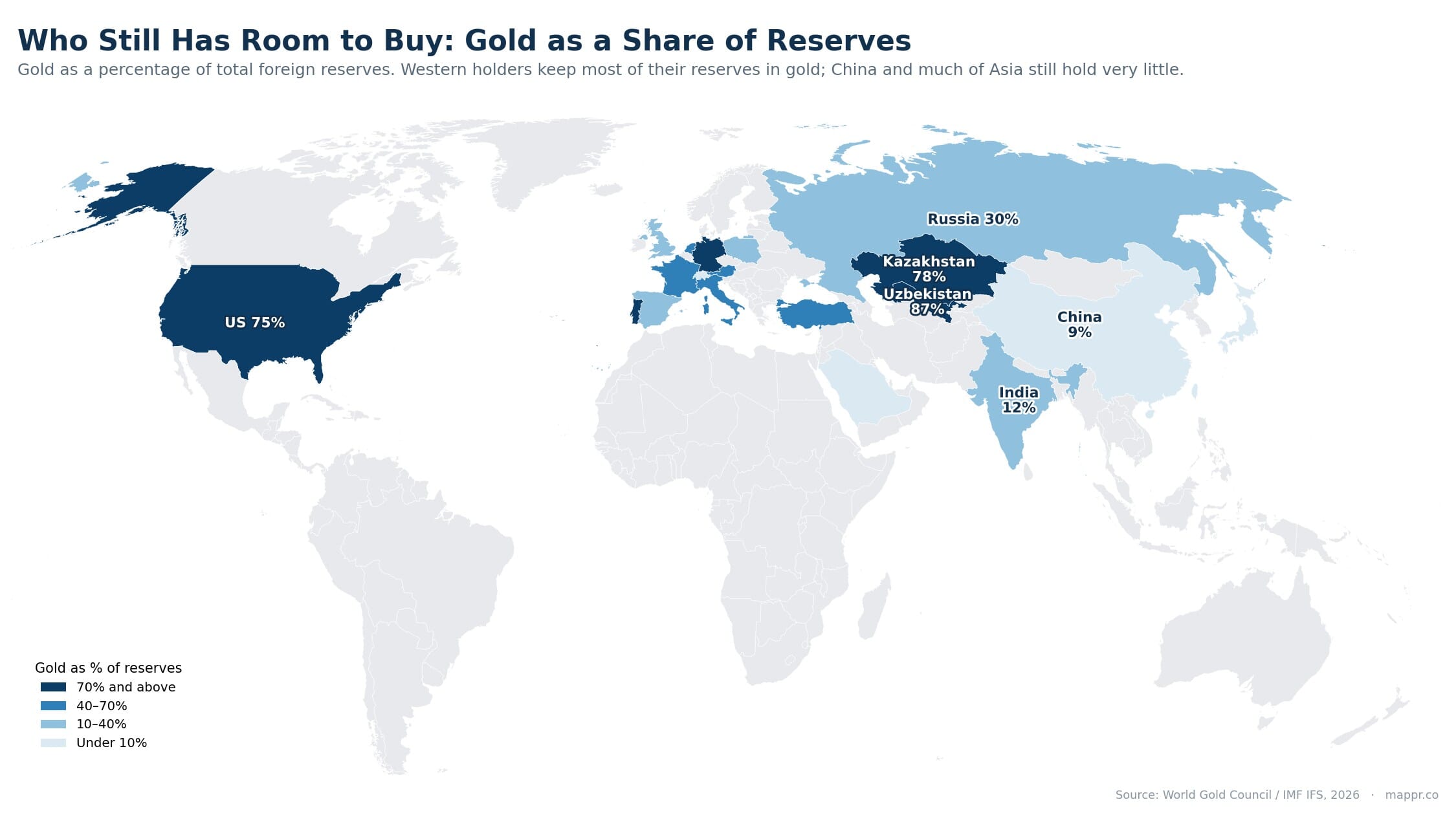
The established Western holders are effectively full: gold makes up 65% to 75% of reserves in the US, Germany, Italy and France. The extreme cases are in Central Asia, with Uzbekistan at about 87% and Kazakhstan at about 78%.
The contrast is China, where gold is still only around 9% of a vast reserve pile, and much of the rest of Asia is similar. That gap is exactly why analysts expect the emerging-market buying to continue: these countries have a long way to go before they look like the West.
The Price Fell, the Hoarding Did Not
A falling gold price in 2026 did not slow the central banks down. The buyers are overwhelmingly emerging economies diversifying away from the dollar, and the list is lengthening as first-time buyers join in.
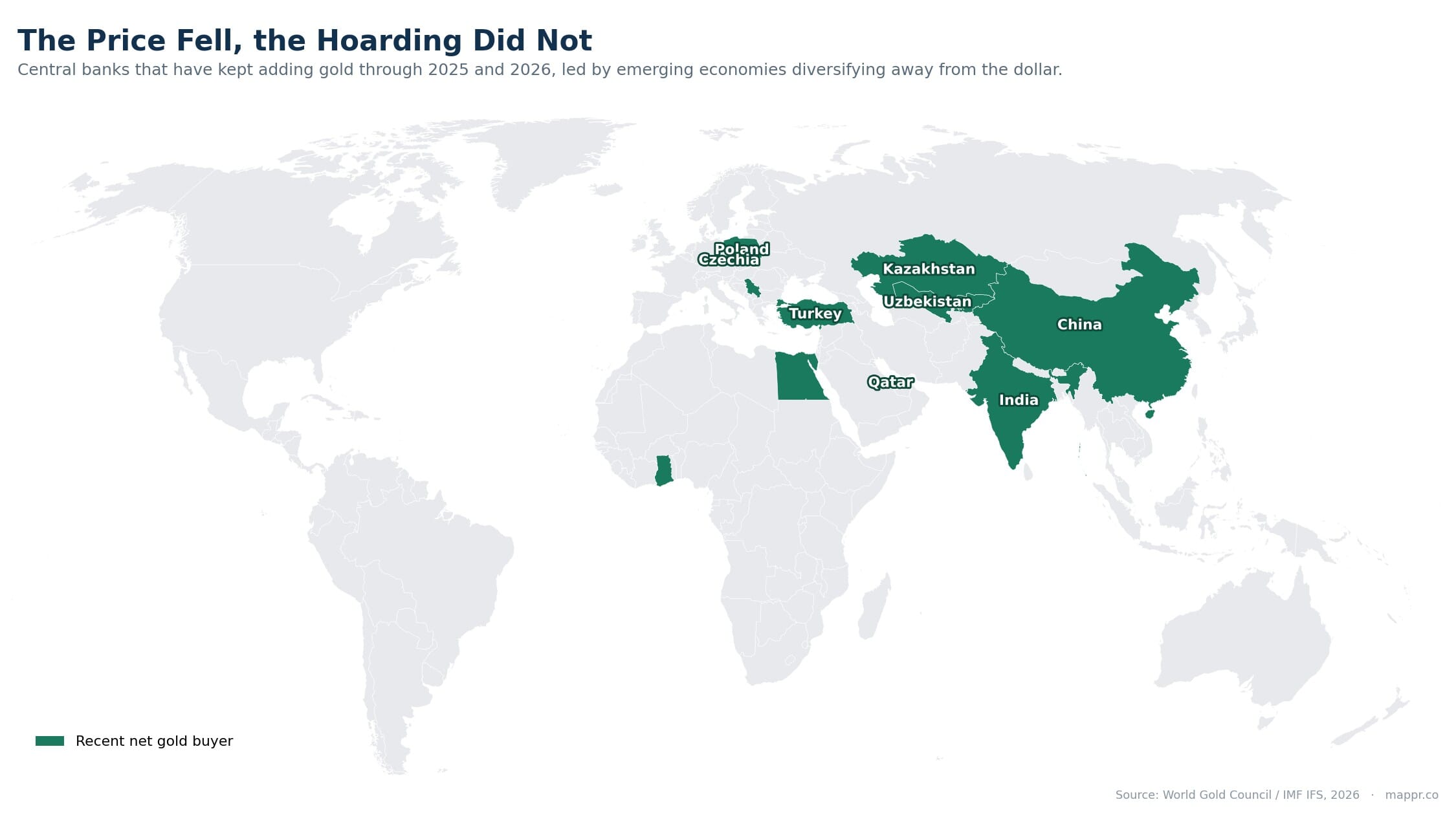
Poland has been Europe’s most aggressive accumulator, pushing toward a 700-tonne target. In the spring of 2026 alone, Poland added around 18 tonnes, Uzbekistan about 9 and Kazakhstan about 7, while China, India and Turkey continued their long-running programmes.
Why Central Banks Are Stacking Gold
The turning point was 2022, when Western governments froze roughly $300 billion of Russia’s foreign reserves. That showed every central bank that dollars and euros held abroad can be switched off. Gold cannot: it sits in your own vault, outside anyone else’s legal reach.
Add persistent inflation worries and a desire to trade in currencies other than the dollar, and the result is the steady, price-insensitive buying the maps above capture. It is less about chasing returns and more about insurance against a dollar-centric system.
Frequently Asked Questions
Which country has the most gold reserves?
The United States, with about 8,134 tonnes, far more than any other country. Germany is a distant second at around 3,355 tonnes.
How much gold do central banks hold in total?
Around 36,600 tonnes of official gold reserves worldwide, held by central banks and the IMF. The top four countries hold close to half of it.
Does China have the most gold?
No. China holds around 2,300 tonnes, similar to Russia, but that is only about 9% of its huge reserves. The United States holds over three times as much.
Why are central banks buying gold?
Mainly to diversify away from the US dollar. After roughly $300 billion of Russian reserves were frozen in 2022, gold’s key appeal is that it sits outside any other country’s jurisdiction.
Did central banks keep buying when gold fell in 2026?
Yes. Even though gold dropped about 16% in the second quarter of 2026, central banks added a net 244 tonnes in the first quarter and kept buying into the spring.
Gold reserves, reserve shares and central-bank buying figures are drawn from the following sources: