The world came agonisingly close to wiping out polio. Cases have fallen more than 99.9% since 1988, and the disease survives in only a handful of places. But in 2026, the year the global eradication campaign had targeted to finish the job, the map still is not blank. On 15 July 2026, the WHO confirmed four new wild-polio cases in Afghanistan in a single week, and vaccine-derived strains are still paralysing children across Africa. This is what the endgame actually looks like.
Key Takeaways
- Only two countries have never stopped wild polio. Afghanistan and Pakistan remain the last endemic reservoirs of wild poliovirus. In 2026, Afghanistan has recorded 11 cases and Pakistan 3, with Afghanistan's four newest confirmed on 15 July.
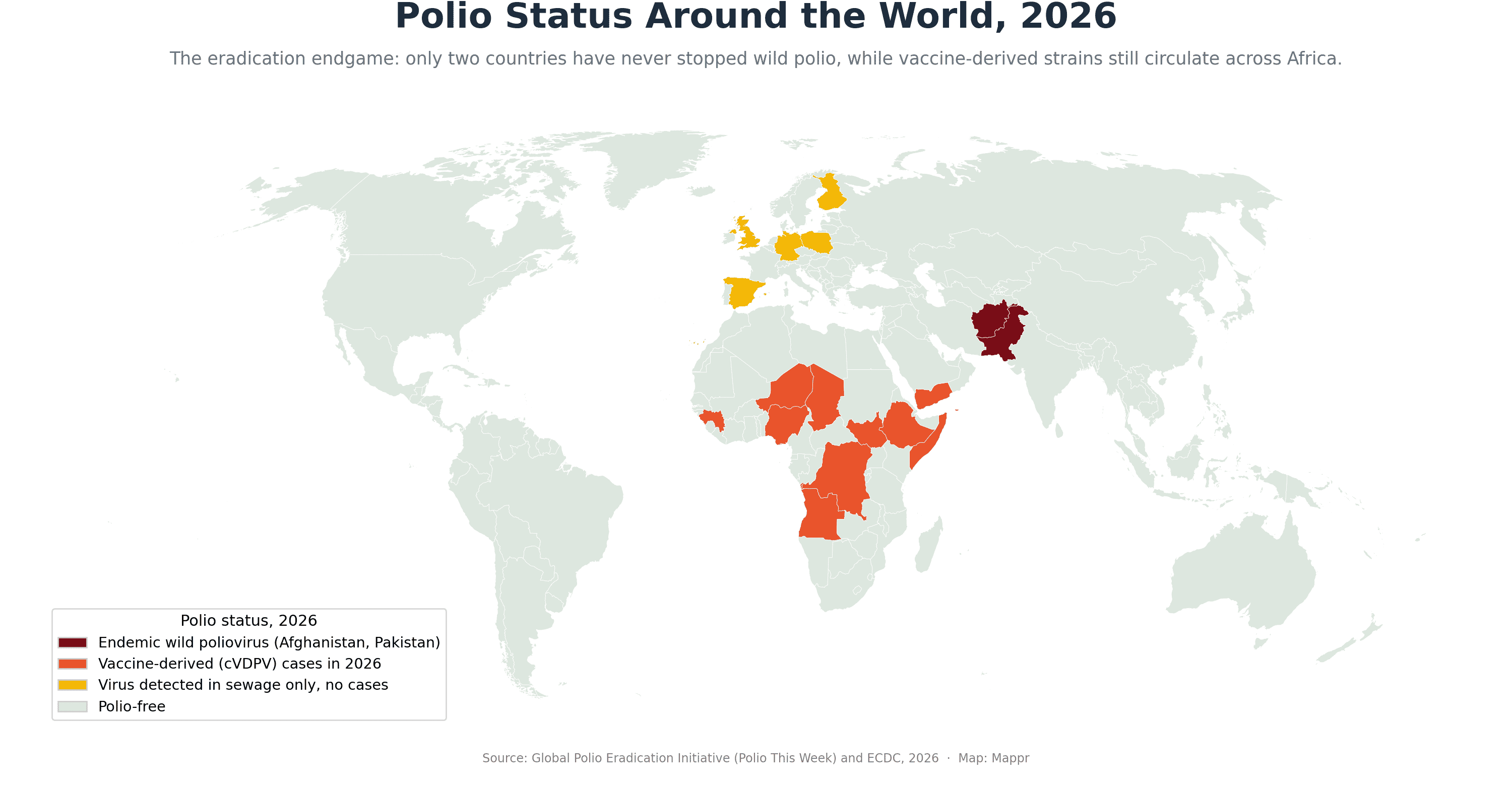
- The bigger problem is vaccine-derived polio. In rare cases the live virus in the oral vaccine can mutate and spread through under-vaccinated communities. This 'circulating vaccine-derived' polio is still paralysing children across ten-plus African and Middle Eastern countries.
- The virus is even turning up in Europe's sewers. No cases, but vaccine-derived poliovirus has been detected in wastewater in the UK, Germany, Spain, Poland and Finland, a sign the virus is quietly circulating far from where anyone falls ill.
- A deadline being missed in real time. 2026 was the year the Global Polio Eradication Initiative targeted to stop all vaccine-derived transmission. It is not going to happen, and this map shows why.
The last two: Afghanistan and Pakistan
Afghanistan and Pakistan are the only two countries on earth where wild poliovirus has never been eliminated. In 2026, Afghanistan has logged 11 cases and Pakistan 3, and the numbers are still climbing: the four newest Afghan cases, confirmed on 15 July, were in Nangarhar (two), Helmand and Herat, alongside a dozen fresh detections of the virus in sewage. The hotspots are Afghanistan’s southern provinces and, across the border, Quetta, Karachi and Khyber Pakhtunkhwa. The single biggest obstacle is access: Taliban restrictions on door-to-door vaccination in Afghanistan have left teams unable to reach many children, and the two countries share a porous border across which the virus moves freely.
| Country | Cases | Type |
|---|---|---|
| 🇦🇫 Afghanistan | 11 | Wild poliovirus type 1 (WPV1) |
| 🇵🇰 Pakistan | 3 | Wild poliovirus type 1 (WPV1) |
The twist most people miss: vaccine-derived polio
Here is the part of the story that surprises people. Most of the polio still paralysing children today does not come from the wild virus at all. It comes, in a roundabout way, from the vaccine. The oral polio vaccine uses a weakened but live virus, and in communities where too few children are immunised, that weakened virus can circulate, mutate over months, and regain the ability to cause paralysis. This is circulating vaccine-derived poliovirus (cVDPV), and in 2026 it is causing cases across a belt of Africa and the Middle East, including Nigeria, Chad, the Democratic Republic of the Congo, Somalia, Yemen, Niger, Ethiopia, Angola, Guinea and South Sudan. It is not a reason to stop vaccinating, it is the opposite: cVDPV only takes hold where vaccination coverage has fallen too low.
Wild vs vaccine-derived Wild poliovirus is the original, naturally occurring virus, now cornered in just two countries. Vaccine-derived poliovirus is a mutated descendant of the weakened virus in the oral vaccine, and it only spreads where immunity is patchy. Both cause the same paralysis. Eradication means stopping both, which is why 2026’s numbers matter. |
Polio in the sewers of Europe
You do not need a single sick child for polio to be present. Across Europe, routine testing of wastewater has picked up vaccine-derived poliovirus in the sewers of the United Kingdom, Germany, Spain, Poland and Finland, with the UK’s most recent detection in January 2026. No one in these countries has been paralysed, and high vaccination rates mean the risk to the public is very low. But the detections are a warning: the virus can travel silently, and a fully polio-free world is the only durable protection. It is why wealthy, long-eradicated countries still watch their sewage closely.
A deadline being missed in real time
The Global Polio Eradication Initiative had set 2026 as the year to stop all circulating vaccine-derived transmission, a milestone on the road to certifying the world polio-free. With Afghan cases rising, cVDPV outbreaks persisting across Africa, and the virus surfacing in European wastewater, that target will be missed. Eradication has always been a war of the last mile, and the last mile runs through exactly the places, conflict zones and under-vaccinated communities, where it is hardest to reach every child. The map has shrunk to a handful of colours. Closing the last of them is proving to be the hardest part of all.