
Key Takeaways
- Nadi is the South Pacific gateway. Nadi International Airport (NAN), on the dry western side of Viti Levu, is Fiji's main international airport and the hub of national carrier Fiji Airways. It is also one of the busiest airports in the South Pacific, connecting Australia, New Zealand and North America to a string of smaller island nations.
- The capital's airport is mostly domestic. Suva, the capital, is served by Nausori International Airport (SUV) about 23 km away on the wet south-eastern coast. Despite the international name, it handles mainly domestic flights plus a couple of regional links to Tuvalu and Nauru. The long-haul traffic goes through Nadi instead.
- Two big islands, three main airports. Fiji's two principal airports both sit on Viti Levu (Nadi in the west, Nausori in the south-east), while Labasa Airport (LBS) serves Vanua Levu, the second-largest island, in the north. A wider network of small airstrips links the outer islands.
- Only Nadi flies nonstop to the US. Fiji Airways flies Nadi nonstop to Los Angeles, San Francisco and Honolulu, making Fiji one of the best-connected South Pacific countries for US travel. A Dallas-Fort Worth route launched in December 2024 but is being suspended from September 2026 on weak demand.
- We rank by regularly-served routes. The figures come from observed route data, a sample rather than a full timetable. Ranking by regularly-served destinations (routes flown often enough to count as scheduled service) gives a truer picture than raw nonstop totals.
Fiji is the aviation crossroads of the South Pacific, and almost all of that traffic flows through one airport: Nadi International Airport, on the sunny western coast of the main island, Viti Levu. Nadi is the hub of the national carrier, Fiji Airways, and the country’s gateway to Australia, New Zealand, North America and a scatter of smaller Pacific island nations. The capital, Suva, has its own international airport at Nausori on the other side of the island, but it carries mostly domestic and regional flights. To the north, on the second-largest island of Vanua Levu, Labasa Airport anchors a domestic network that reaches dozens of smaller island airstrips.
Below we map and rank Fiji’s airports by the number of nonstop destinations each one serves, drawn from live route data on AirportRoutes. We rank by regularly-served destinations, routes flown often enough to count as scheduled service, rather than raw nonstop totals. The figures come from observed flight data (a sample rather than a complete published timetable), so treat them as a guide to relative connectivity, not official totals.
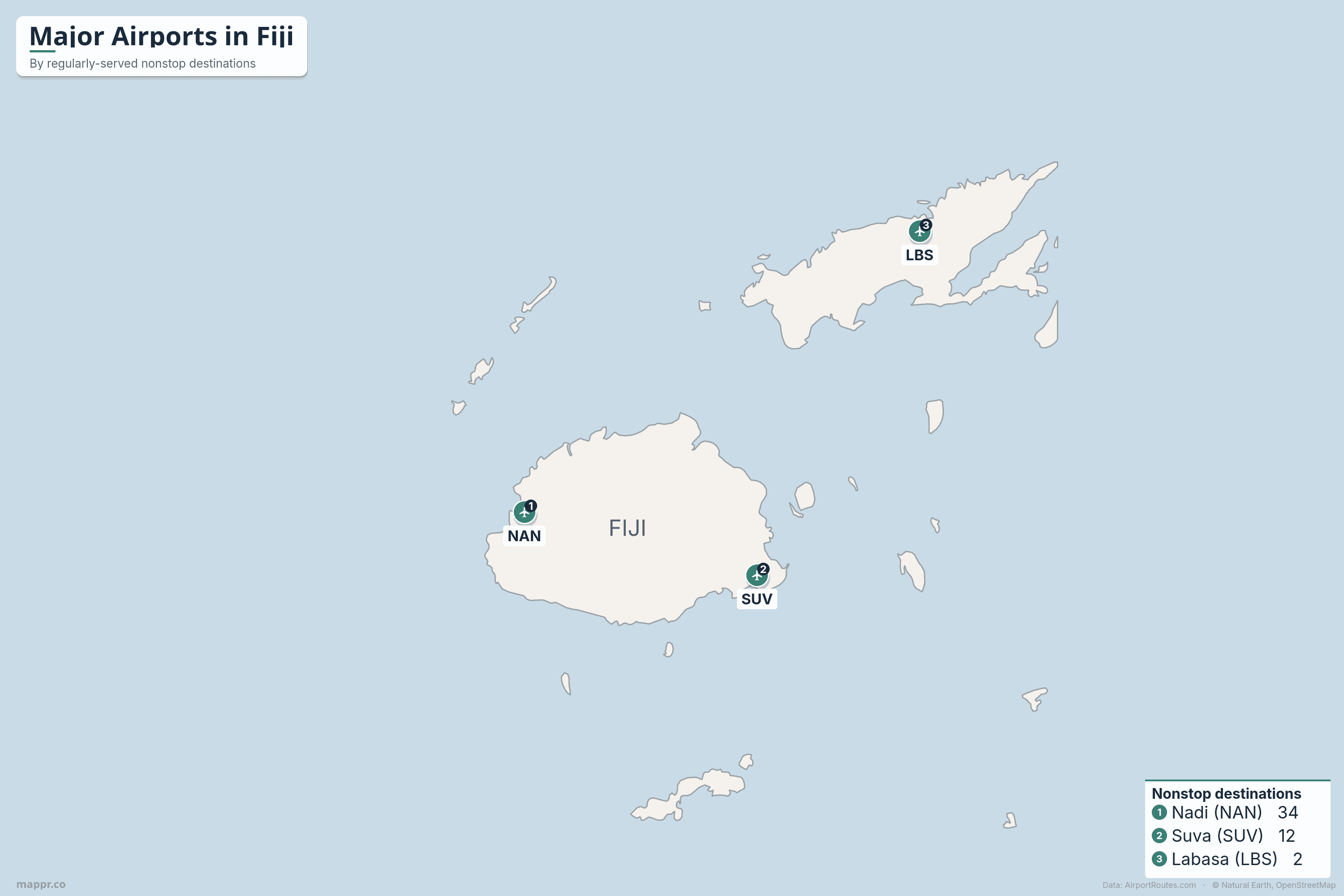
Ranked
Major Airports in Fiji by Nonstop Destinations
Ranked by regularly-served nonstop destinations, busiest first.
| Airport | IATA | Nonstop | Region |
|---|---|---|---|
| 1. Nadi | NAN | 34 | Nadi, Viti Levu (west) |
| 2. Suva | SUV | 12 | Nausori, Viti Levu (south-east) |
| 3. Labasa | LBS | 2 | Labasa, Vanua Levu (north) |
Are there direct flights to the US from Fiji?
Yes, but only from Nadi. Fiji Airways flies its widebody Airbus A350 and A330 fleet nonstop from Nadi to Los Angeles, San Francisco and Honolulu, which makes Fiji one of the best-connected countries in the South Pacific for travel to the United States. The Honolulu link is the airline’s oldest American route, dating back to its 1983 “Project America” launch.
Fiji Airways added its longest-ever route, nonstop Nadi to Dallas-Fort Worth, in December 2024, opening a one-stop gateway to the central US through the American Airlines hub there. That service struggled to fill seats, however, and the airline has announced it will suspend the Dallas route from September 2026, leaving Los Angeles, San Francisco and Honolulu as Fiji’s nonstop US links. Travellers from elsewhere in the country connect through Nadi, since neither Suva nor Labasa has any international long-haul service.
A closer look at Fiji’s airports
✈️ Nadi International Airport (NAN)
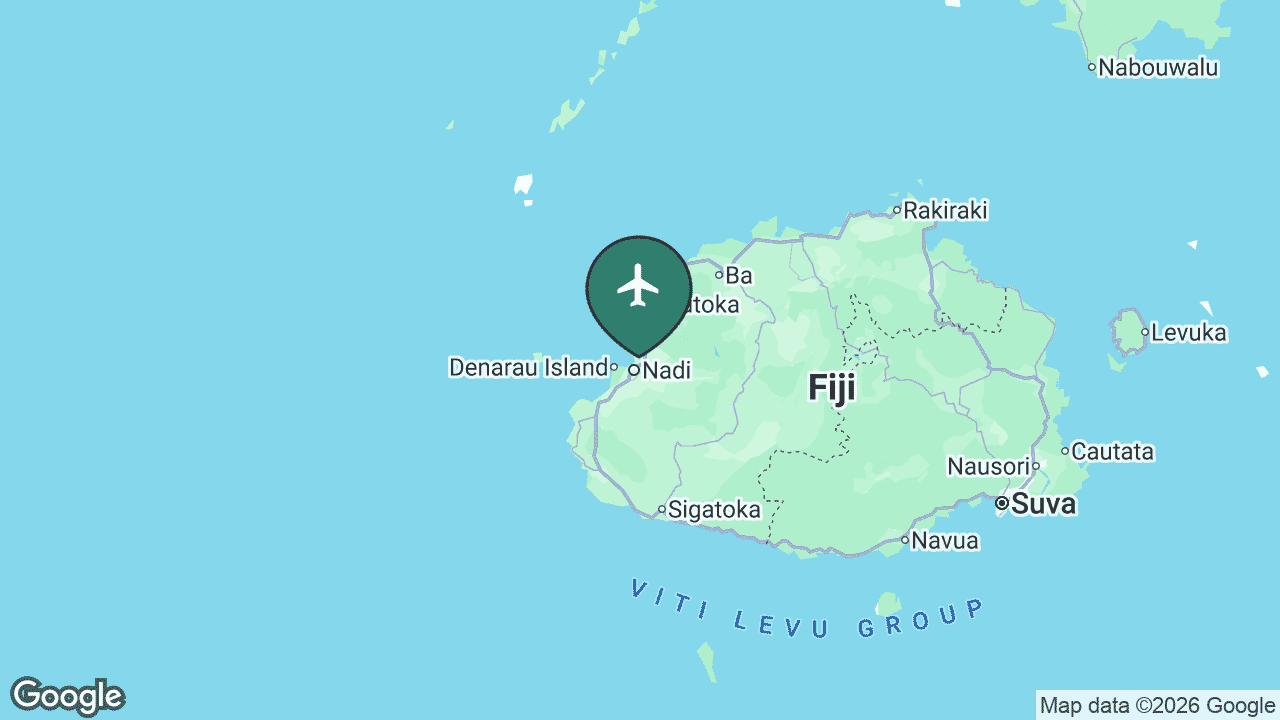
Nadi International Airport sits on the dry, sunny western side of Viti Levu, close to the resort hub of Denarau and the jumping-off points for the Mamanuca and Yasawa island groups. By far the busiest airport in Fiji, it is the home base of Fiji Airways (the former Air Pacific, rebranded in 2013) and the country’s only airport built for long-haul widebody traffic, which is why almost every international flight to Fiji lands here rather than at the capital.
With around 34 regularly-served nonstop destinations, Nadi reaches deep into Australia (Sydney, Melbourne, Brisbane) and New Zealand (Auckland), across to North America, and out to the smaller Pacific nations. Fiji Airways runs Nadi as a regional hub, feeding connections to Tonga, Samoa, Vanuatu, Kiribati, Tuvalu, Nauru and the Solomon Islands, so a single change of plane here opens up much of the South Pacific.
Main airlines: Fiji Airways, Virgin Australia, Jetstar, Air New Zealand and Aircalin. See the full route map on AirportRoutes →
🏛️ Nausori International Airport, Suva (SUV)
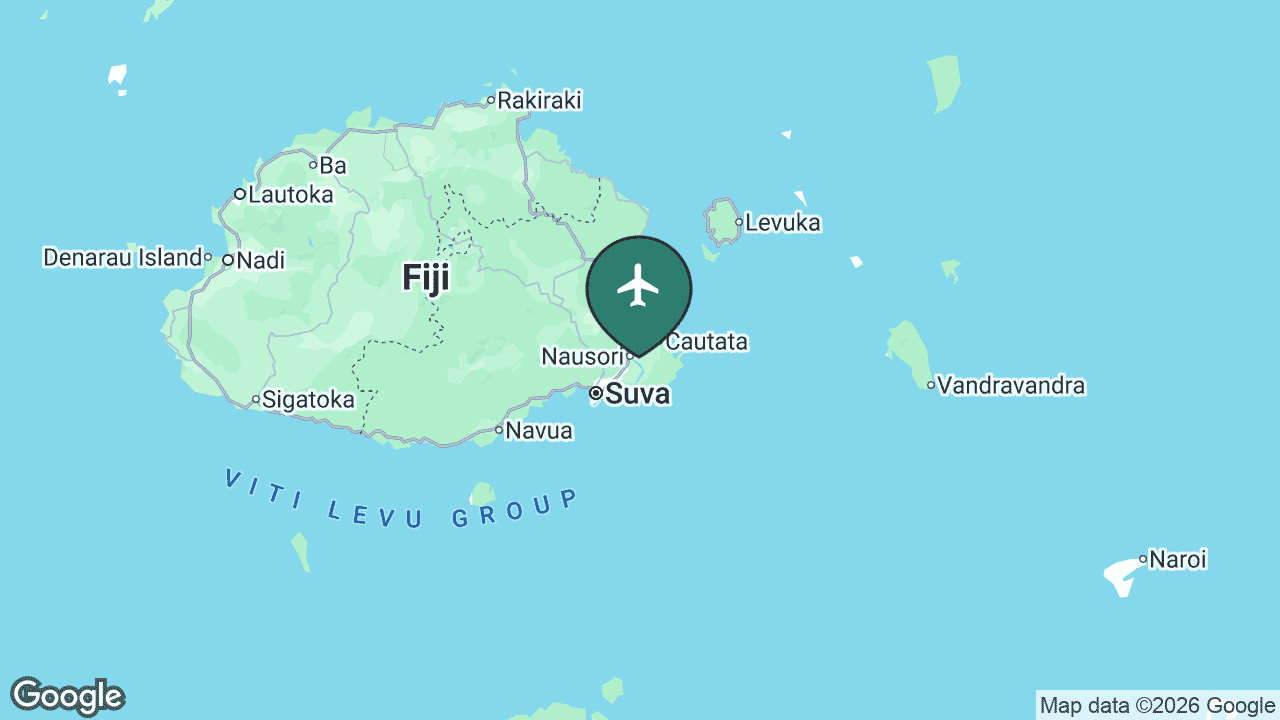
Nausori International Airport serves Suva, Fiji’s capital and largest city, from a site about 23 km to the north-east near the town of Nausori, on the wet, windward south-eastern coast of Viti Levu. Although it carries the “international” label, its shorter runway and rainier weather mean it never took on the long-haul role that went to Nadi. Instead it is the busy heart of Fiji’s domestic network and the government and business airport for the capital.
Suva reaches around 12 regularly-served nonstop destinations, the great majority of them domestic, linking the capital to Nadi, Labasa, Savusavu, Taveuni, Kadavu and other island fields. Its only scheduled international routes are short regional hops to Funafuti in Tuvalu (on Fiji Airways) and to Nauru (on Nauru Airlines), reflecting Suva’s role as a regional administrative centre rather than a tourist gateway.
Main airlines: Fiji Airways and its domestic arm Fiji Link, plus Nauru Airlines. See the full route map on AirportRoutes →
🌴 Labasa Airport (LBS)
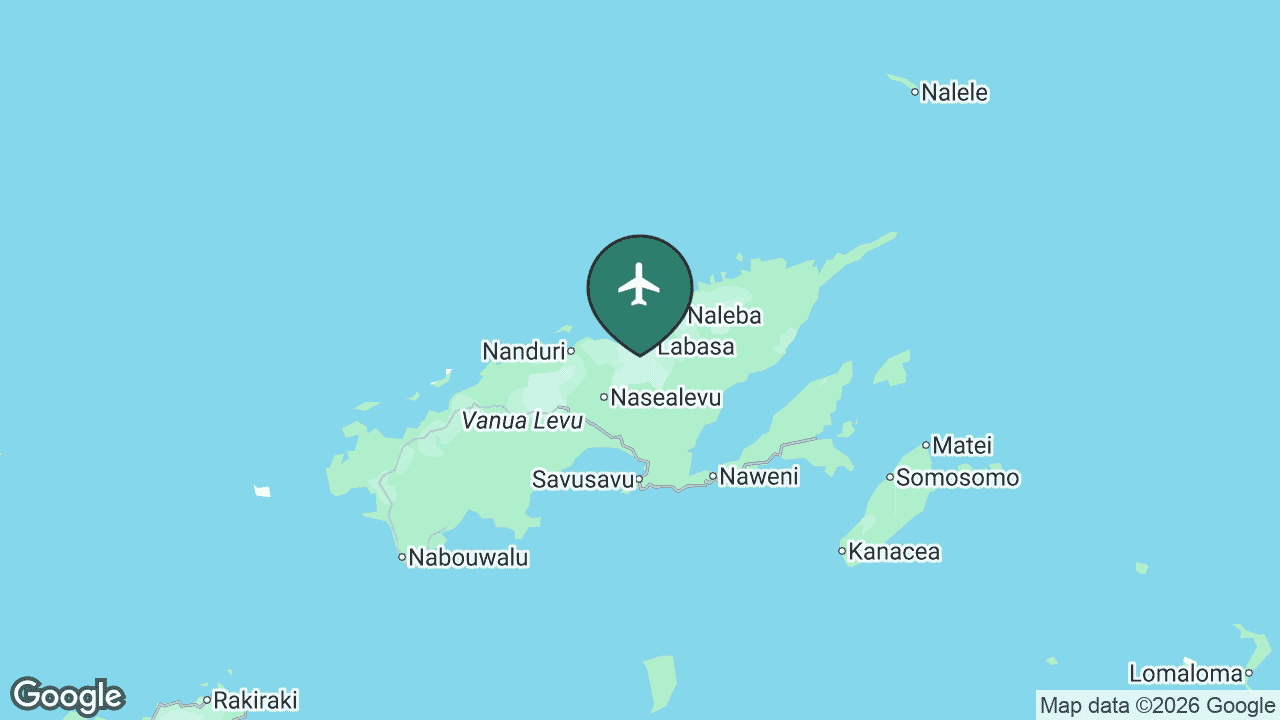
Labasa Airport sits just outside Labasa, the largest town on Vanua Levu, Fiji’s second-biggest island and the centre of its sugar-cane country. The airport is a modest domestic field, the main air link for the north of the country, where road journeys are long and ferries slow.
Labasa reaches just a couple of regularly-served nonstop destinations, short turboprop hops to Suva and Nadi flown by Fiji Link. There are no international flights here: visitors heading for Vanua Levu and the diving around Savusavu typically connect through Nadi or Suva first.
Main airlines: Fiji Airways, through its domestic arm Fiji Link. See the full route map on AirportRoutes →
Why are Fiji’s two international airports on the same island?
It comes down to weather and runways. Suva, the capital, sits on the wet, windward south-eastern corner of Viti Levu, and its airport at Nausori has a relatively short runway boxed in by terrain and frequent rain. Nadi, on the dry leeward west coast, has long enjoyed clearer skies and the room for a long runway, so when Fiji built up its international and tourist traffic it was Nadi, not the capital, that became the long-haul gateway.
The result is an unusual split for a small country: the political capital and the main airport are at opposite ends of the same island, about a four-hour drive apart. Nadi handles the widebodies, the resorts and the US, Australia and New Zealand routes, while Nausori keeps the capital connected by a dense web of domestic flights. Most visitors arrive at Nadi and may never see Suva’s airport at all.
Fiji’s domestic island airports
Beyond the three main airports, Fiji depends on a network of small airstrips to keep its scattered islands connected. Fiji Link and Northern Air fly turboprops and light aircraft to fields such as Taveuni (Matei), Savusavu and Kadavu (Vunisea), plus tiny strips on Koro, Gau, Cicia, Moala and the remote Lau group, and on resort islands like Mana and Malolo Lailai in the Mamanucas. Far to the north, isolated Rotuma has its own occasional service from Suva.
These fields see only a handful of flights and fall outside the sampled route data, but they are how Fijians and visitors actually move between the islands. Together with the inter-island ferries, they turn a country spread across more than 300 islands into a single connected network, with Nadi and Suva acting as the two hubs that feed it.
Airport rankings, nonstop-destination counts, served regions and airline lists are drawn from live AirportRoutes route data (observed AeroAPI flight data, a sample rather than a complete published schedule; we use the regularly-served figure, which filters one-off observations). Airport locations and notable facts are cross-checked against the cited references. The ranked map is a Mappr original.
Primary Data Source:
- AirportRoutes: Major airports and routes, Fiji – Live route data: per-airport nonstop destinations, served cities and airlines.
Reference:
- Wikipedia: Nadi, Nausori and Labasa airports – Airport history, location and notable facts referenced in the per-airport sections.
- Fiji Airways route network – The national carrier's US, Australia, New Zealand and Pacific routes, and the Dallas-Fort Worth launch and suspension.
- Locator maps: Google Maps and Google Static Maps – Per-airport location maps with airplane markers, generated via Google Static Maps.
Image Sources:
- Map by Mappr – Map of major airports in Fiji, a Mappr original built from AirportRoutes data and Natural Earth boundaries.


