
Key Takeaways
- San Pedro Sula is the busiest gateway. Ramón Villeda Morales International Airport (SAP) in San Pedro Sula is Honduras's busiest airport and its main international and business gateway, with around 18 regularly-served nonstop destinations and the widest spread of links to the United States. The industrial Sula valley, not the capital, is the country's aviation centre.
- Roatán flies straight to the US. Juan Manuel Gálvez International Airport (RTB) on Roatán, the largest Bay Island, is the tourism gateway for the Caribbean dive and cruise coast. Unusually for an island its size, it has its own nonstop flights to several US cities plus seasonal Canada service, so visitors can skip the mainland entirely.
- Tegucigalpa's airport moved in 2021. The capital's international flights shifted from the famously tricky Toncontín (TGU) to the new Palmerola International Airport (XPL) at Comayagua, about 80 km north-west, when it opened in 2021. Toncontín now handles mostly domestic and regional flights, while Palmerola is the capital region's modern international airport.
- Three airports fly nonstop to the US. San Pedro Sula, Roatán and Palmerola all offer direct flights to the United States on carriers such as Avianca, United, American, Spirit, Delta and JetBlue. Honduras is one of Central America's better-connected countries for US travel, helped by a large Honduran-American community.
- We rank by regularly-served routes. The figures come from observed route data, a sample rather than a full timetable. Ranking by regularly-served destinations (routes flown often enough to count as scheduled service) gives a truer picture than raw nonstop totals. Brand-new Palmerola is under-counted in the sample, so we use its nonstop figure and flag it.
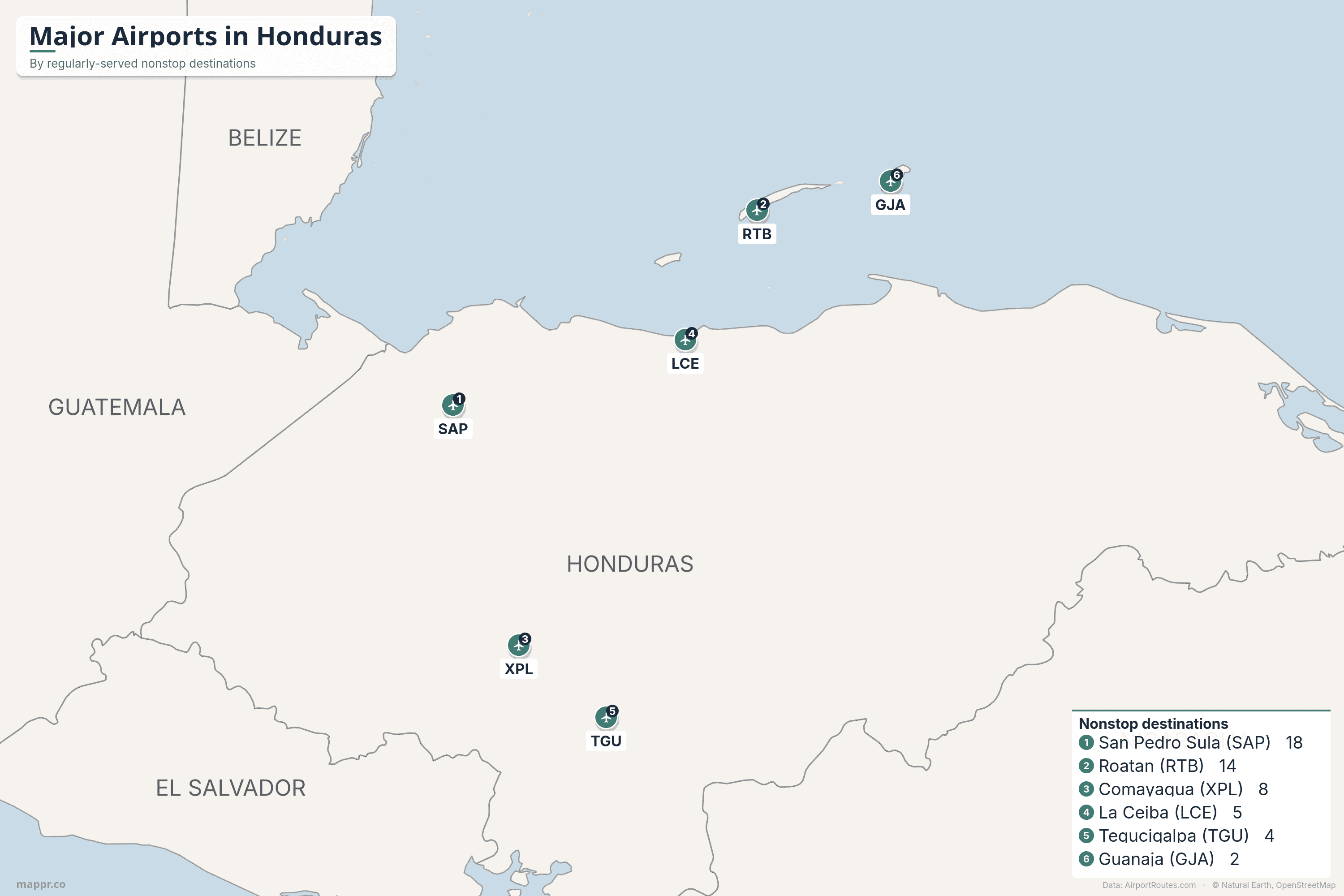
Honduras spreads its air traffic across a handful of airports rather than one dominant hub. The busiest is not in the capital but in the industrial north: Ramón Villeda Morales International Airport in San Pedro Sula, the gateway to the Sula valley and the country’s main link to the United States. Close behind sits Roatán, the Bay Islands tourism airport, which flies nonstop to the US and Canada in its own right. The capital, Tegucigalpa, is now served mainly by the new Palmerola International Airport at Comayagua, which took over the international flights once handled by the famously difficult Toncontín.
Below we map and rank Honduras’s airports by the number of nonstop destinations each one serves, drawn from live route data on AirportRoutes. We rank by regularly-served destinations, routes flown often enough to count as scheduled service, rather than raw nonstop totals. The figures come from observed flight data (a sample rather than a complete published timetable), so treat them as a guide to relative connectivity, not official totals. Palmerola is new enough that the sample barely registers its scheduled flights, so we rank it by its nonstop count and note this below.
Which Honduran airports have direct flights to the US?
Three of them. Unlike many smaller countries that funnel all long-haul traffic through a single hub, Honduras has three airports with nonstop flights to the United States, reflecting strong trade ties and a large Honduran-American community.
San Pedro Sula (SAP) is the main US gateway, with nonstop service to Houston, Miami, Atlanta, New Orleans, Orlando, New York and Newark, and Fort Lauderdale, on carriers including United, Avianca, Spirit Airlines and JetBlue. Roatán (RTB) flies direct to Miami, Houston, Atlanta, Dallas-Fort Worth and Denver, mostly seasonal leisure routes on American, United and Delta that bring divers and cruise passengers straight to the island. Palmerola (XPL), serving the capital, has nonstop links to Miami, Houston, Dallas-Fort Worth and Fort Lauderdale. Honduras has no flag carrier of its own, so these routes are flown by US airlines and by Avianca, which connects the country through its San Salvador hub.
Ranked
Major Airports in Honduras by Nonstop Destinations
Ranked by regularly-served nonstop destinations, busiest first.
| Airport | IATA | Nonstop | Region |
|---|---|---|---|
| 1. San Pedro Sula | SAP | 18 | San Pedro Sula (north-west) |
| 2. Roatán | RTB | 14 | Bay Islands (Caribbean) |
| 3. Palmerola | XPL* | 8 | Comayagua, serves Tegucigalpa |
| 4. La Ceiba | LCE | 5 | La Ceiba (north coast) |
| 5. Tegucigalpa | TGU | 4 | Tegucigalpa (central) |
| 6. Guanaja | GJA | 2 | Bay Islands (Caribbean) |
A closer look at Honduras’s airports
✈️ Ramón Villeda Morales International Airport (SAP)
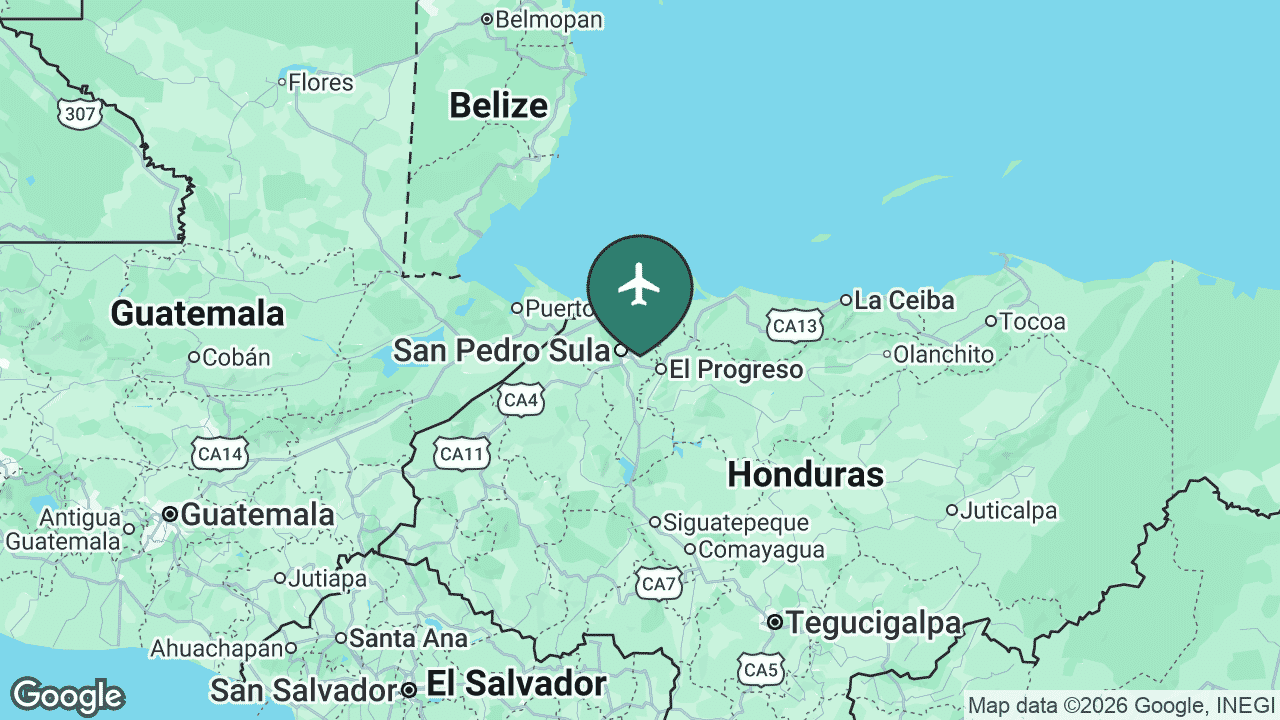
Ramón Villeda Morales International Airport sits at La Mesa, about 15 km east of San Pedro Sula in the department of Cortés, at the heart of the industrial Sula valley. It is the busiest airport in Honduras and the country’s principal international and business gateway, handling more passengers and more US routes than the capital. The airport is named after a former Honduran president and reformer.
With around 18 regularly-served nonstop destinations, SAP combines the widest US network in the country with strong regional links across Central America, to San Salvador, Guatemala City and Panama City, and busy domestic feeders to Roatán, Tegucigalpa and La Ceiba. It is the easiest single point of entry for travellers heading anywhere in Honduras.
Main airlines: United, Avianca, Spirit Airlines, JetBlue, plus domestic carriers CM Airlines and Aerolíneas Sosa. See the full route map on AirportRoutes →
🏝️ Juan Manuel Gálvez International Airport, Roatán (RTB)
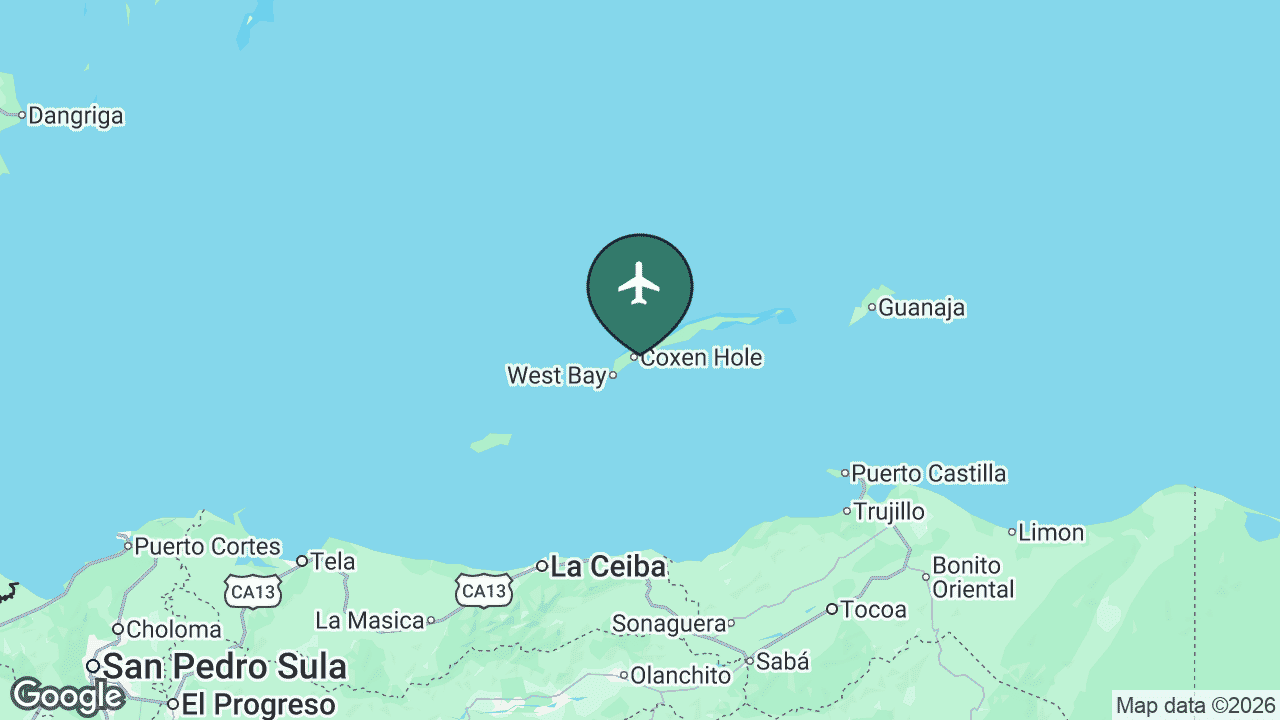
Juan Manuel Gálvez International Airport lies just outside Coxen Hole on Roatán, the largest of the Bay Islands in the Caribbean. It is the tourism gateway to one of the world’s top diving destinations and a growing cruise stop, which is why a relatively small island airport carries so much international traffic.
Roatán reaches around 14 regularly-served nonstop destinations. Most striking is its direct US service: nonstop flights to Miami, Houston, Atlanta, Dallas-Fort Worth and Denver, mainly seasonal leisure routes that let visitors fly straight to the reef without touching the mainland, supplemented by seasonal Canadian charters. Domestic flights link it to La Ceiba, San Pedro Sula and Tegucigalpa.
Main airlines: American Airlines, United, Delta Air Lines, WestJet, plus domestic Aerolíneas Sosa and CM Airlines. See the full route map on AirportRoutes →
🛫 Palmerola International Airport (XPL)
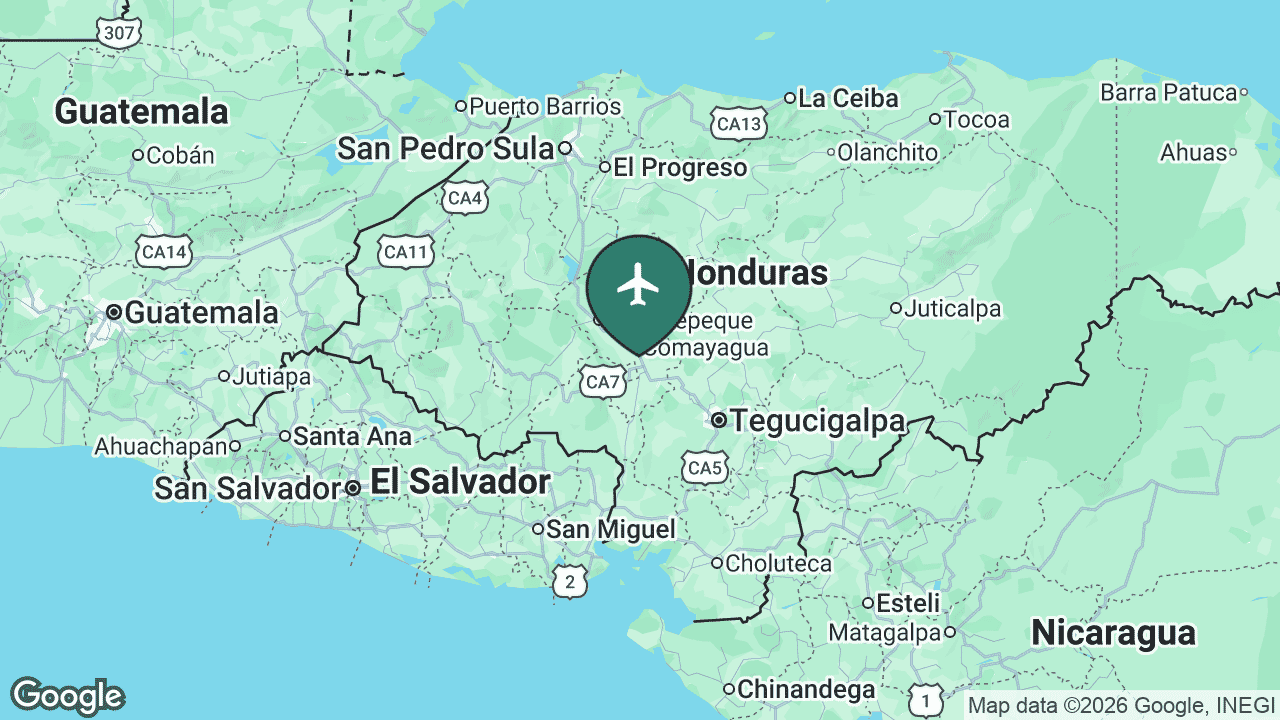
Palmerola International Airport opened in 2021 at Comayagua, about 80 km north-west of Tegucigalpa, sharing the site of the José Enrique Soto Cano Air Base. It was built to replace Toncontín as the capital region’s main commercial airport, giving central Honduras a modern terminal and a long, flat runway free of the mountain-ringed approach that made the old airport so notorious.
Although it carries around eight nonstop destinations, Palmerola is so recent that the sampled route data barely registers its scheduled flights, so we rank it by its nonstop count rather than the regularly-served figure used elsewhere. Its network is firmly international, with nonstop links to Miami, Houston, Dallas-Fort Worth and Fort Lauderdale in the United States, plus regional flights to San Salvador, Panama City and Mexico City and a seasonal connection toward Madrid.
Main airlines: Avianca, American Airlines, United, Spirit Airlines and Copa Airlines. See the full route map on AirportRoutes →
✈️ Goloson International Airport, La Ceiba (LCE)
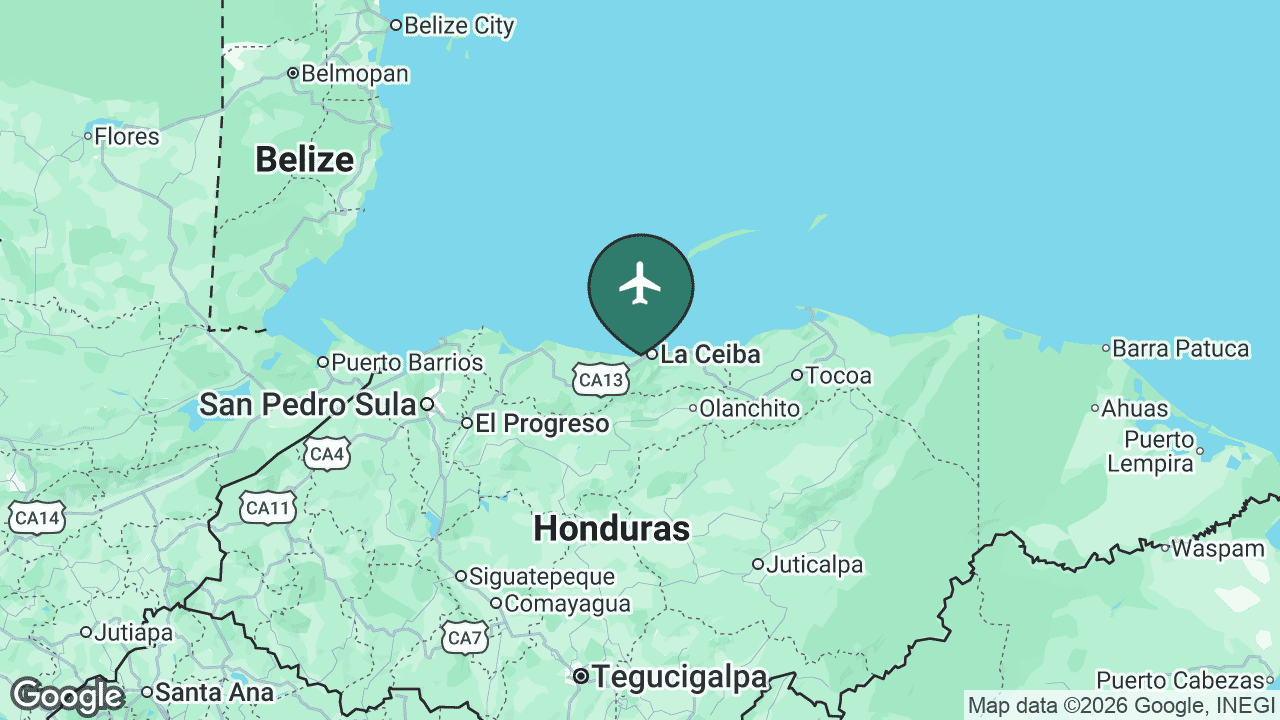
Goloson International Airport sits just west of La Ceiba on the Caribbean coast, in the department of Atlántida. It is the main domestic hub of northern Honduras and the principal stepping stone to the Bay Islands and the remote Mosquitia, with frequent short hops to Roatán, Guanaja and Puerto Lempira.
La Ceiba reaches around five regularly-served nonstop destinations, almost all of them domestic, with the occasional international link such as a connection to the Cayman Islands. It is best thought of as the country’s domestic crossroads rather than an international gateway, a role reinforced by La Ceiba’s reputation as the launch point for trips to the reef and the rainforest.
Main airlines: Aerolíneas Sosa and CM Airlines. See the full route map on AirportRoutes →
🛬 Toncontín International Airport, Tegucigalpa (TGU)
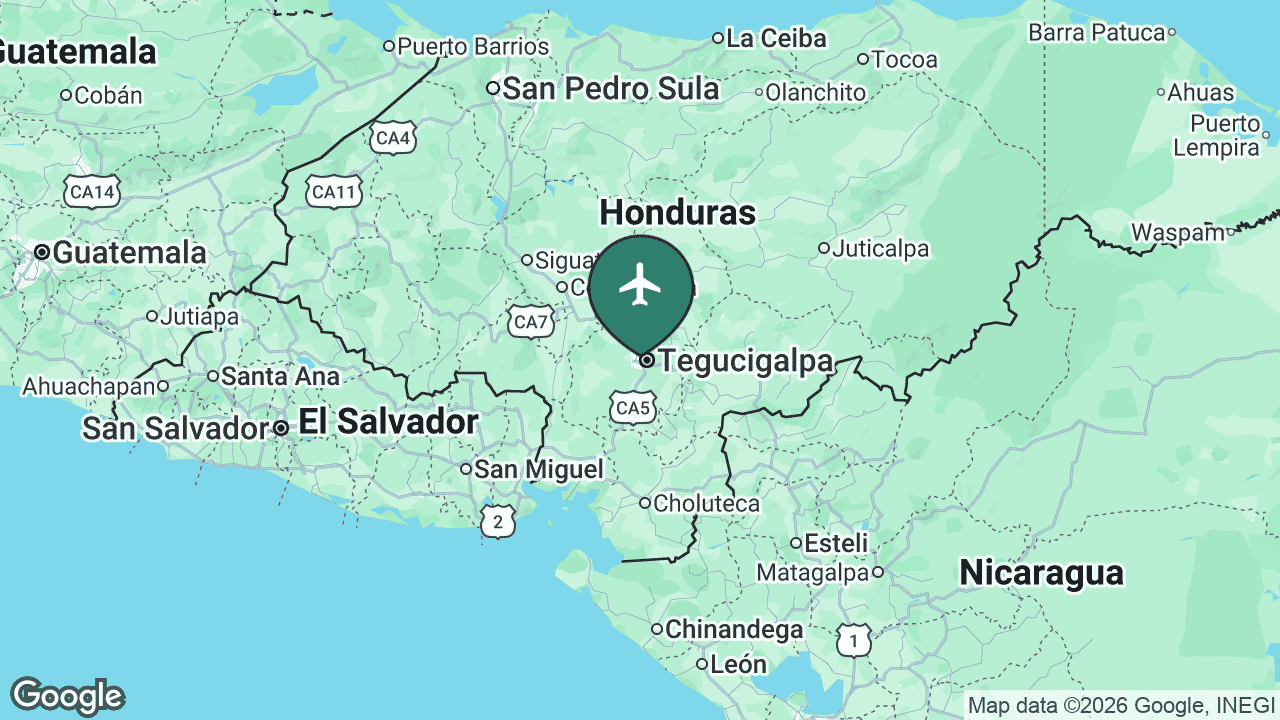
Toncontín International Airport sits inside Tegucigalpa itself, hemmed in by mountains in a narrow valley bowl. For decades it was the capital’s main airport and one of the most famous in the world for the wrong reasons: a short runway and a steep, banking final approach that pilots had to be specially certified to fly made it a regular fixture on lists of the most challenging airports anywhere.
Since Palmerola opened in 2021, Toncontín has stepped back to a mostly domestic and regional role, with around four regularly-served nonstop destinations linking the capital to Roatán, San Pedro Sula, La Ceiba and the Mosquitia. It remains an important city-centre airport for travellers who want to land close to Tegucigalpa rather than at Comayagua.
Main airlines: CM Airlines and Aerolíneas Sosa. See the full route map on AirportRoutes →
🏝️ La Laguna Airport, Guanaja (GJA)
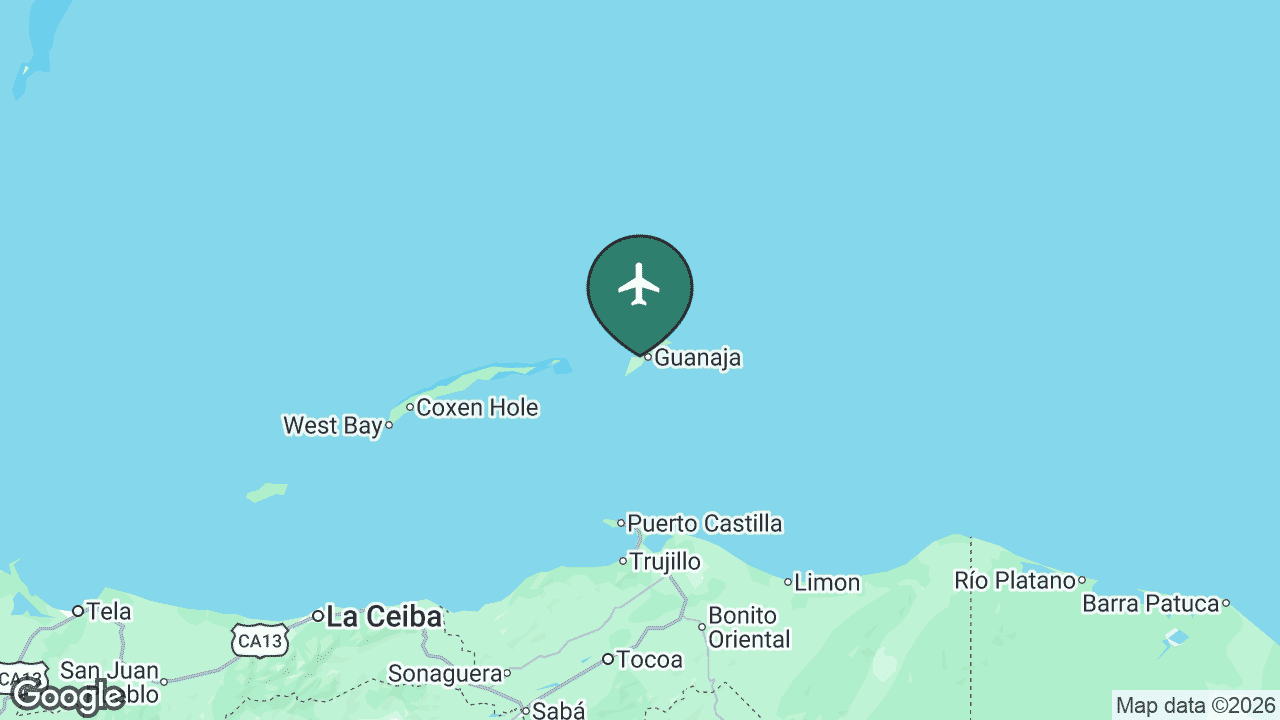
La Laguna Airport serves Guanaja, the easternmost and least developed of the three main Bay Islands. It is a small airstrip with a thin, purely domestic network, the kind of lifeline airport that keeps an island community connected to the mainland.
Guanaja reaches just a couple of regularly-served nonstop destinations, short hops to La Ceiba and Roatán flown by small turboprops. There are no international flights here: visitors heading for Guanaja’s quiet cays and reefs typically connect through La Ceiba or Roatán.
Main airlines: CM Airlines and other Honduran domestic operators. See the full route map on AirportRoutes →
What happened to Tegucigalpa’s airport? Toncontín and Palmerola
For most of the 20th century, the only way to fly to the Honduran capital was into Toncontín, an airport boxed in by the hills of Tegucigalpa. Its short runway and dramatic, steeply banked approach earned it a global reputation as one of the most dangerous airports in commercial service, and it was the site of more than one serious accident.
The long-running answer was Palmerola International Airport, built at Comayagua about 80 km to the north-west on the grounds of the Soto Cano Air Base, which also hosts a long-standing US military presence. When Palmerola opened in 2021, it took over the capital region’s international and main commercial flights, giving central Honduras a safe, modern airport with room to grow. Toncontín was not closed: it kept a mostly domestic and regional schedule for travellers who prefer to land in the city itself. The trade-off is that the capital’s air service is now split between a convenient city airport and a safer, larger one an hour’s drive away, much like cities elsewhere that have moved their main airport out of a cramped urban site.
What about the Bay Islands and smaller airfields?
Beyond the six airports ranked above, Honduras has a scatter of small airfields that keep remote communities and resorts connected. In the Bay Islands, Útila has a short airstrip served by domestic operators, complementing Roatán and Guanaja for travellers island-hopping the reef. On the mainland’s eastern edge, the roadless Mosquitia region relies on small airports such as Puerto Lempira, reached by light aircraft from La Ceiba and Tegucigalpa. These fields fall outside the sampled route data because they see only a few flights, but they are an essential part of how Hondurans and visitors move around a country with rugged terrain and limited roads.
Airport rankings, nonstop-destination counts, served regions and airline lists are drawn from live AirportRoutes route data (observed AeroAPI flight data, a sample rather than a complete published schedule; we use the regularly-served figure, which filters one-off observations, except for the brand-new Palmerola airport, which the sample under-counts). Airport locations and notable facts are cross-checked against the cited references. The ranked map is a Mappr original.
Primary Data Source:
- AirportRoutes: Major airports and routes, Honduras – Live route data: per-airport nonstop destinations, served cities and airlines.
Reference:
- Wikipedia: Airports in Honduras (San Pedro Sula, Roatán, Palmerola, La Ceiba, Toncontín and Guanaja) – Airport history, location and notable facts referenced in the per-airport sections.
- Palmerola International Airport – The 2021 opening of Palmerola and its replacement of Toncontín for the capital's international flights.
- Locator maps: Google Maps and Google Static Maps – Per-airport location maps with airplane markers, generated via Google Static Maps.
Image Sources:
- Map by Mappr – Map of major airports in Honduras, a Mappr original built from AirportRoutes data and Natural Earth boundaries.
🌍 More maps & data for Honduras
Browse more: All airports by country


