Key Takeaways
- Spain are world champions. Spain beat Argentina 1-0 after extra time in the final on 19 July 2026 at MetLife Stadium in New York and New Jersey, with substitute Ferran Torres scoring in the 106th minute. It is Spain's second World Cup title and their first since 2010, won unbeaten.
- The podium: Spain, Argentina, England. Argentina were runners-up, England took third place with a wild 6-4 win over France in the playoff, and France finished fourth. It was the first World Cup where all four semifinalists were past champions.
- 48 teams, 12 groups, 104 matches. This was the first expanded World Cup, jointly hosted by the United States, Canada and Mexico. A record 6.8 million fans attended across 16 stadiums, with the United States hosting 78 of the 104 matches.
- The hosts all reached the last 16, then bowed out. Mexico won Group A and the United States won Group D, while Canada finished second in Group B. All three reached the Round of 32 but none went further: the US lost to Belgium, Mexico to England, and Canada to Morocco.
- Mbappe's Golden Boot, Rodri's Golden Ball. France's Kylian Mbappe won the Golden Boot with 10 goals; Spain's Rodri took the Golden Ball as best player. Among the shocks: Germany went out in the Round of 32 on penalties to Paraguay, and Italy failed to qualify at all.
The 2026 FIFA World Cup is over, and it ended the way the seeding suggested it might: with Spain lifting the trophy. The first 48-team World Cup, jointly hosted by the United States, Canada and Mexico, produced 104 matches, record crowds, a clutch of upsets and, finally, a champion. This is the complete story of the tournament: the final, the bracket, every group, the teams and the venues.
The final: Spain 1-0 Argentina
In front of a sell-out crowd of 80,663 at MetLife Stadium in New Jersey on 19 July 2026, Spain and Argentina played out a tense, goalless 90 minutes before the game was settled in extra time. Substitute Ferran Torres struck in the 106th minute to win it, and Argentina’s night unravelled when Enzo Fernandez was sent off late for a second yellow. There was no penalty shootout. The 1-0 win gave Spain their second World Cup title, their first since 2010, and they finished the tournament unbeaten. Spain’s Rodri was named the tournament’s best player, and goalkeeper Unai Simon took the Golden Glove.
The knockout bracket
The road to the final ran through a dramatic knockout stage. The quarter-finals set up the last four:
Quarter-finals: France 2-0 Morocco · Spain 2-1 Belgium · England 2-1 Norway (after extra time) · Argentina 3-1 Switzerland (after extra time).
Semi-finals: Spain 2-0 France · Argentina 2-1 England.
Third place: England 6-4 France.
Final: Spain 1-0 Argentina (after extra time).
Spain’s road to the title was a steady climb: they beat Portugal 1-0 in the Round of 16, edged Belgium 2-1 in the quarter-final, brushed aside France 2-0 in the semi, and then outlasted Argentina in the final. Elsewhere the shocks came early: Germany crashed out in the Round of 32 on penalties to Paraguay, and all three host nations were eliminated in the Round of 16 despite topping or placing high in their groups.
The group stage: all 12 groups
The expanded format split 48 teams into 12 groups of four. The winner and runner-up of each group advanced automatically, joined by the eight best third-placed teams. The table below shows how every group finished, with the third-placed sides marked according to whether they made it through to the Round of 32.
| Group | Winner | Runner-up | Third place | Fourth |
|---|---|---|---|---|
| Group A | Mexico (host) | South Africa | South Korea (out) | Czechia |
| Group B | Switzerland | Canada (host) | Bosnia & Herzegovina (to R32) | Qatar |
| Group C | Brazil | Morocco | Scotland (out) | Haiti |
| Group D | United States (host) | Australia | Paraguay (to R32) | Turkey |
| Group E | Germany | Ivory Coast | Ecuador (to R32) | Curacao |
| Group F | Netherlands | Japan | Sweden (to R32) | Tunisia |
| Group G | Belgium | Egypt | Iran (out) | New Zealand |
| Group H | Spain | Cape Verde | Uruguay (out) | Saudi Arabia |
| Group I | France | Norway | Senegal (to R32) | Iraq |
| Group J | Argentina | Austria | Algeria (to R32) | Jordan |
| Group K | Colombia | Portugal | DR Congo (to R32) | Uzbekistan |
| Group L | England | Croatia | Ghana (to R32) | Panama |
The eight third-placed teams that squeezed through were Bosnia and Herzegovina, Paraguay, Ecuador, Sweden, Senegal, Algeria, DR Congo and Ghana. South Korea, Scotland, Iran and Uruguay were the third-placed teams who missed out. Among the debutants making their first-ever World Cup appearance were Cape Verde, Curacao, Jordan and Uzbekistan.
The 48 teams that qualified
For the first time, 48 nations reached the finals, from six-time champions and perennial contenders to a handful of first-timers. We mapped every one of them, and where in the world they came from, in a dedicated guide: all 48 countries that qualified for the 2026 World Cup, mapped.
The host stadiums
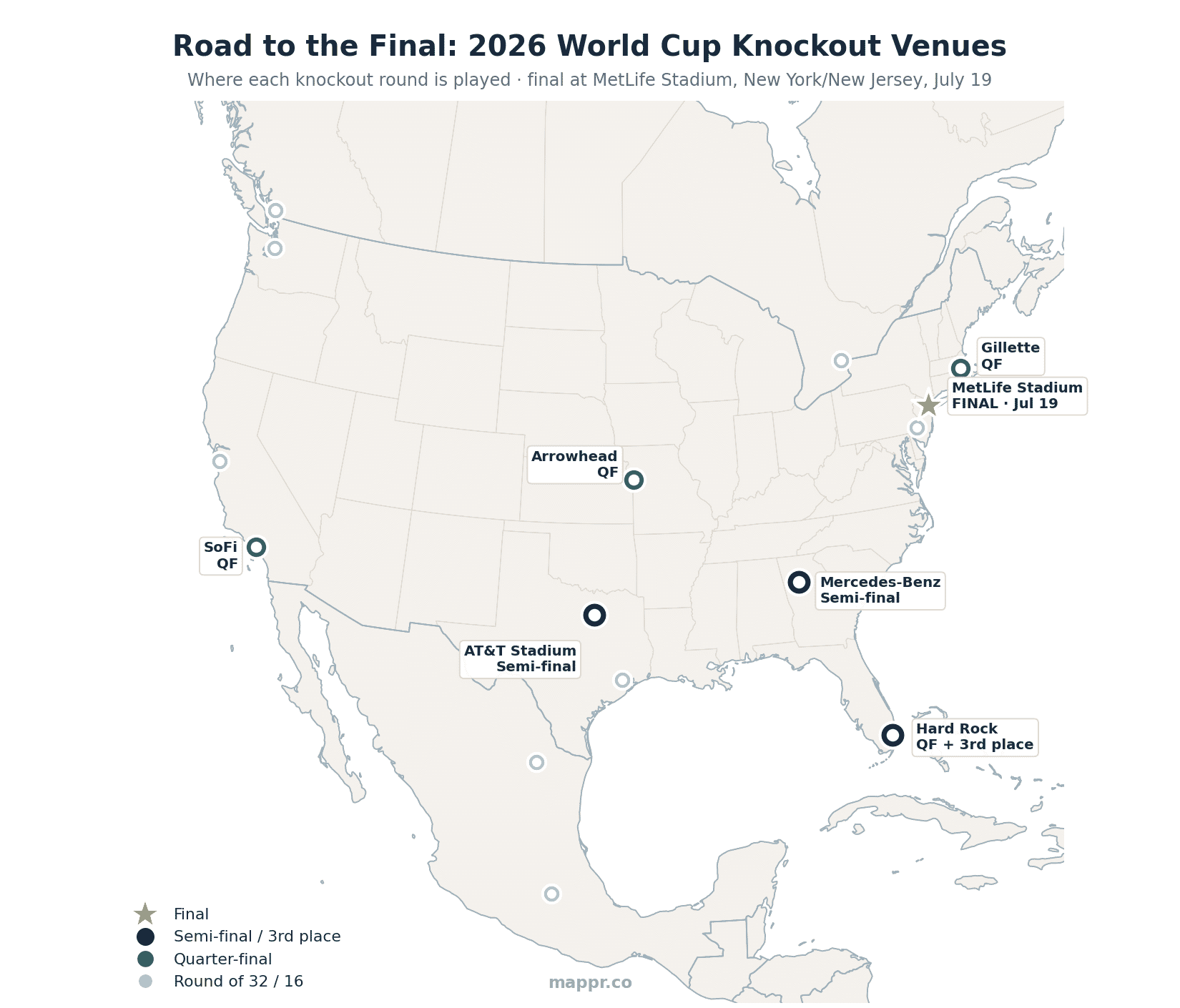
The tournament was played across 16 stadiums in 16 host cities, split between the United States (11 venues), Mexico (3) and Canada (2). The final was held at MetLife Stadium, AT&T Stadium in Arlington hosted the most matches with nine, and Mexico City’s Estadio Azteca became the first stadium to feature at three different World Cups. See them all on our 2026 World Cup host stadiums map.
Golden Boot, Golden Ball and the records
Kylian Mbappe finished as top scorer with 10 goals to claim the Golden Boot, ahead of Lionel Messi (8) and Jude Bellingham (7). Spain’s midfield metronome Rodri won the Golden Ball as the tournament’s outstanding player. Beyond the individual honours, the numbers were historic: a record cumulative attendance of around 6.8 million at roughly 99.7% occupancy, the first 104-match World Cup, and the first time all four semifinalists had previously won the trophy. Notable too were the absentees, with former winners Italy failing to qualify and Germany falling in the Round of 32.
Two years of qualifying and a month of football delivered a worthy champion. Spain, ranked among the favourites throughout, went the distance without losing a game and added a second star to their shirt. The next World Cup, in 2030, will be shared across Morocco, Spain and Portugal, with centenary matches in Uruguay, Argentina and Paraguay.
Results and figures are from the official tournament records and match reports:
Image Sources