
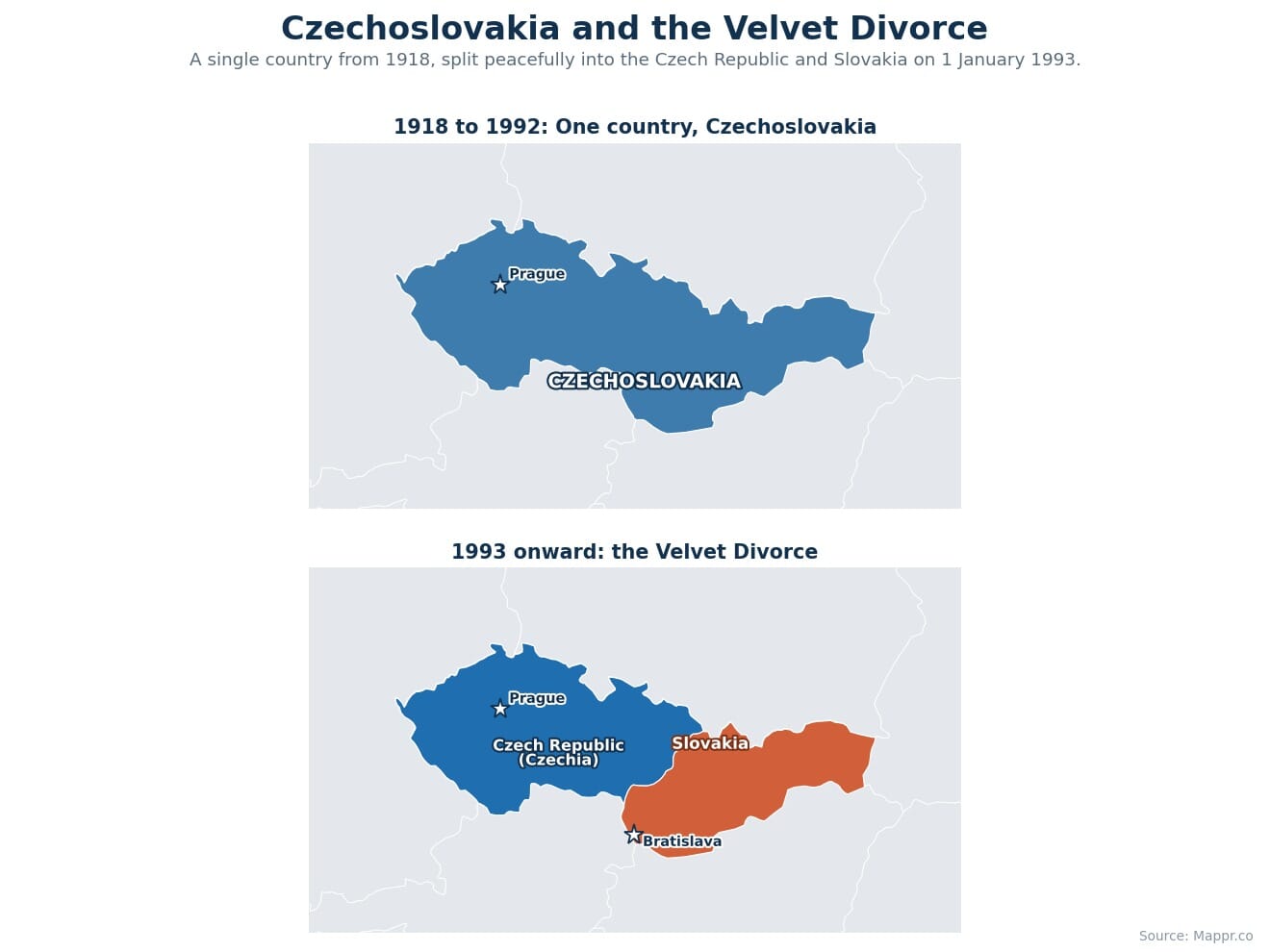
Czechoslovakia was a Central European country that existed from 1918 to 1992. Born from the collapse of Austria-Hungary at the end of the First World War, it united two closely related Slavic peoples, the Czechs and the Slovaks, in a single state.
It was one of the few democracies in interwar Central Europe, was dismembered by Nazi Germany, spent four decades under communist rule, and finally split in two through the peaceful Velvet Divorce, becoming the Czech Republic and Slovakia on 1 January 1993.
Key Takeaways
- Founded in 1918. Czechoslovakia was created in 1918 from the ruins of Austria-Hungary, with Tomáš Garrigue Masaryk as its first president.
- Dismembered at Munich. The 1938 Munich Agreement handed the German-speaking Sudetenland to Nazi Germany; the rest was occupied in March 1939.
- Four decades of communism. A communist coup in 1948 tied the country to the Soviet Union. The 1968 Prague Spring reforms were crushed by a Warsaw Pact invasion.
- The Velvet Revolution, 1989. A peaceful, largely student-led uprising ended communist rule in weeks. Playwright Václav Havel became president in December 1989. No shots were fired.
- The Velvet Divorce, 1993. Czechs and Slovaks agreed to separate peacefully. On 1 January 1993 Czechoslovakia became two countries: the Czech Republic and Slovakia.
The Birth of Czechoslovakia (1918)
The idea of uniting Czechs and Slovaks in one state grew through the 19th century but only became possible after the First World War. As Austria-Hungary collapsed in 1918, Czech and Slovak leaders, led by Tomáš Garrigue Masaryk, agreed to build a shared country. Masaryk and other exiles signed the Pittsburgh Agreement in the United States in 1918, and independence was declared on 28 October 1918.
The new borders were confirmed by the postwar treaties of Versailles, Saint-Germain and Trianon. They left large minorities inside the country, above all around three million Germans in the border region known as the Sudetenland, along with Hungarians and others. Those minority tensions would become the country’s great weakness between the wars.
Munich and Nazi Occupation (1938 to 1945)
In September 1938, Britain and France agreed at the Munich Conference to let Nazi Germany annex the Sudetenland, without Czechoslovakia at the table. President Edvard Beneš resigned. In March 1939 German troops occupied the Czech lands, which became the Protectorate of Bohemia and Moravia, while Slovakia was set up as a separate state aligned with Hitler’s Germany.
In 1942 the senior Nazi administrator Reinhard Heydrich was assassinated by Czechoslovak resistance fighters. In reprisal, the Germans wiped out the village of Lidice, killing the men and deporting the women and children. The country was liberated in 1945 and the republic was restored.
Communist Rule and the Prague Spring (1948 to 1968)
In 1948 the Communist Party, led by Klement Gottwald, seized full power in a coup. Czechoslovakia became a one-party state firmly inside the Soviet bloc and a founding member of the Warsaw Pact in 1955. In 1960 it was renamed the Czechoslovak Socialist Republic.
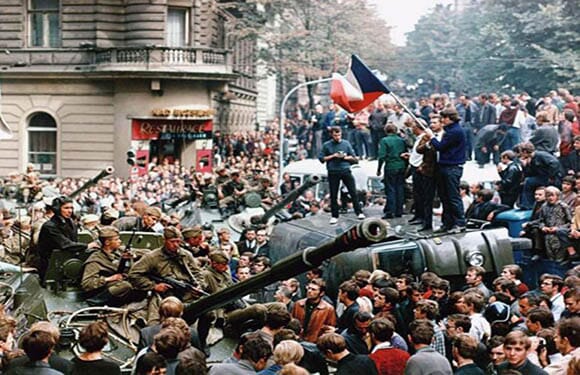
In 1968, reformist leader Alexander Dubček launched the Prague Spring, an attempt to build socialism with a human face. Moscow would not tolerate it. In August 1968, around half a million Warsaw Pact troops invaded the country and crushed the reforms. Under Dubček’s successor Gustáv Husák, a repressive period known as normalisation followed.
The Velvet Revolution (1989)
Opposition simmered for years. In 1977, dissidents including the playwright Václav Havel published Charter 77, a human-rights manifesto, and many were imprisoned for it.
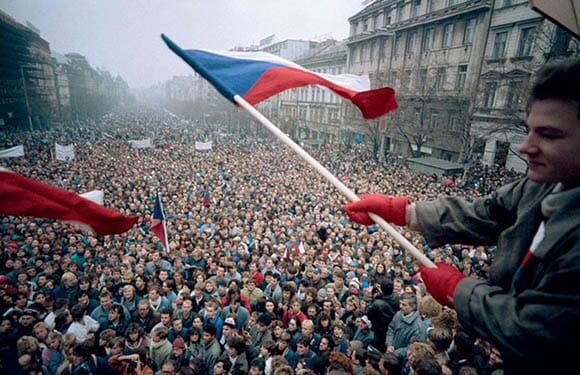
The end came fast. After police beat student protesters on 17 November 1989, huge crowds filled Prague’s Wenceslas Square, growing to hundreds of thousands. A general strike followed. Within weeks the Communist government collapsed. On 29 December 1989, Václav Havel was elected president. The uprising was called the Velvet Revolution because it was almost entirely peaceful, with no shots fired and no tanks in the streets.
The Velvet Divorce (1993)
Free elections and new freedoms soon revived an old question: should Czechs and Slovaks stay together? Slovak leaders wanted more autonomy, and the two sides could not agree on the shape of the federation. Rather than fight, their politicians negotiated a split.
On 1 January 1993, Czechoslovakia peacefully dissolved into two independent countries, the Czech Republic (Czechia) and Slovakia. Because it was so calm and orderly, the separation became known as the Velvet Divorce. Both states later joined the European Union and NATO.
The Czechoslovak Flag
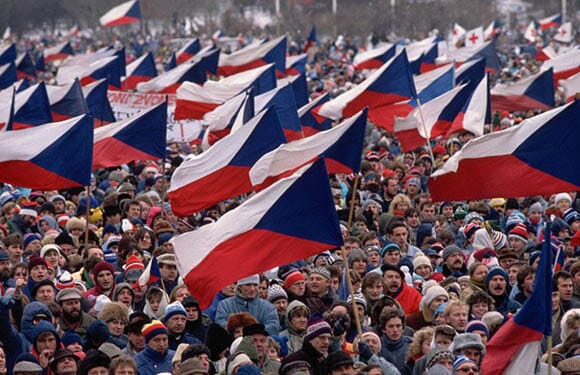
The Czechoslovak flag combined a white stripe over a red stripe, the historic colours of Bohemia, with a blue triangle at the hoist. The plain white-over-red was almost identical to Poland’s flag, so the blue triangle was added to make it distinct. It was adopted on 30 March 1920.
When the country split, Slovakia adopted a new flag, while the Czech Republic kept the old Czechoslovak flag, blue triangle and all, because of its historic ties to the design.
This history was compiled and fact-checked against the following sources:


