
There are countless reasons to visit Mexico: beautiful beaches, world-class food, a rich and complex culture, and warm, welcoming people draw tens of millions of tourists every year. The vast majority have a safe and trouble-free trip.
But it is also true that some parts of Mexico simply are not safe. The presence of powerful drug cartels and uneven law enforcement makes certain states far more dangerous than others, with violent crime and kidnapping the biggest concerns. The good news for 2026 is that the trend is improving: Mexico’s homicides fell sharply in 2025 to their lowest level in years. The risk, though, remains heavily concentrated in a handful of states and cities.
The Most Dangerous States in Mexico
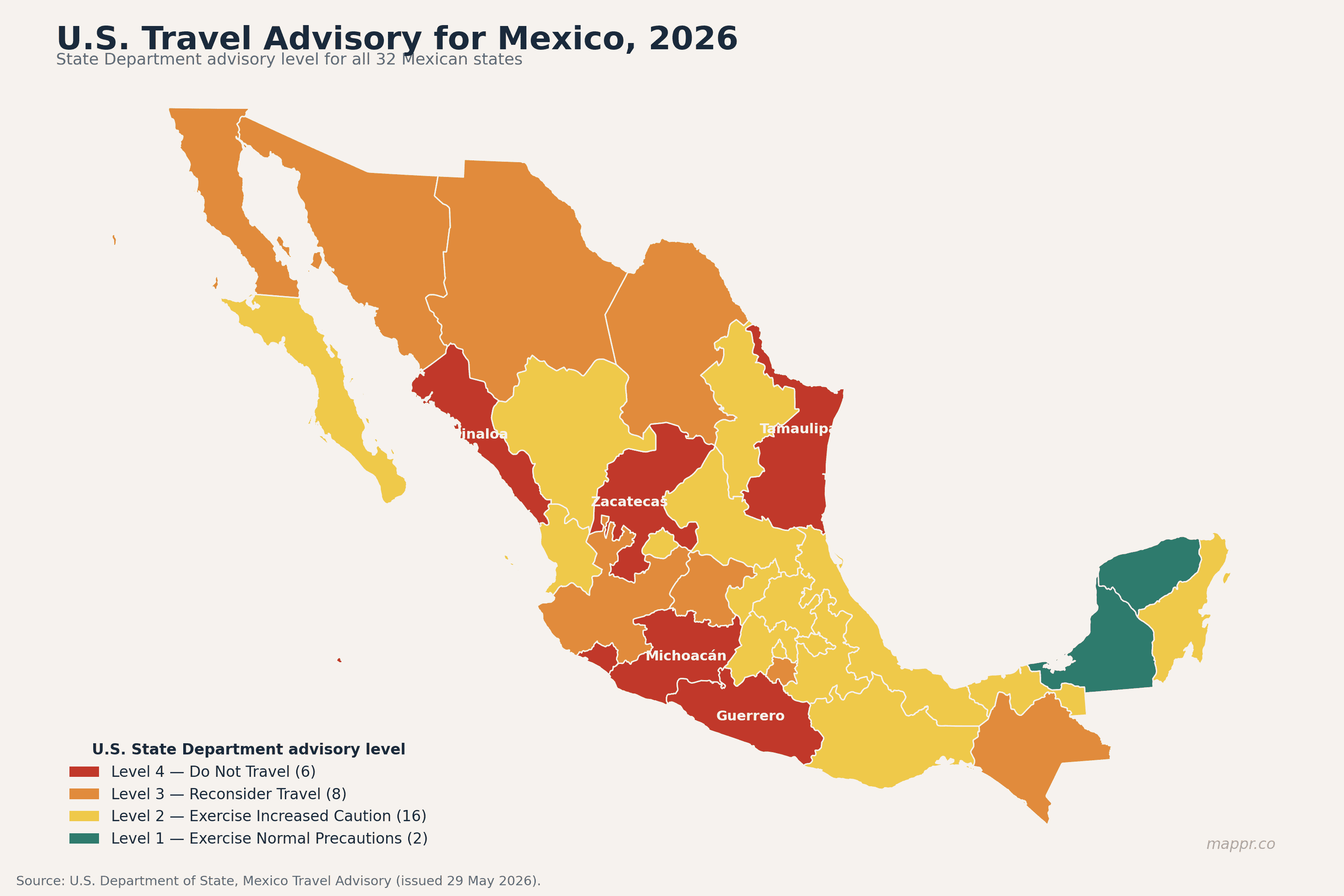
To rank the most dangerous places in Mexico, we use the official travel advisory set by the U.S. Department of State, last updated in May 2026. It sorts all 32 Mexican states into four levels, from Level 1 (“Exercise Normal Precautions”) to Level 4 (“Do Not Travel”). As of 2026, six states carry a “Do Not Travel” warning and eight more are flagged as “Reconsider Travel.” We then look at how those warnings line up with the latest homicide data.
Dangerous Places in Mexico:
6 “Do Not Travel” States
“Do Not Travel” is the most severe of the four advisory levels, reserved for areas with the greatest, potentially life-threatening risks. As of 2026 there are six Mexican states with this designation, one more than in previous years after Zacatecas was added:
- Colima
- Guerrero
- Michoacán
- Sinaloa
- Tamaulipas
- Zacatecas
1. Colima
Colima is the smallest of these states, a sliver of the Pacific coast that is home to the beach resort of Manzanillo. Despite its size, it is the most dangerous state in the country by homicide rate, driven by cartels fighting over Manzanillo, one of Mexico’s busiest ports and a key drug-trafficking gateway. U.S. government employees are barred from the city of Tecomán, the Colima/Michoacán border, and the non-tourist areas of Manzanillo.
2. Guerrero
Guerrero, between Michoacán and Oaxaca, is home to the once-glamorous resort of Acapulco as well as Ixtapa and the colonial town of Taxco. Several armed groups operate independently of the government, setting up roadblocks and targeting travelers. Violent crime and kidnapping are widespread, and the state capital, Chilpancingo, has seen repeated cartel violence. Most of Guerrero is off-limits to U.S. government employees, except parts of Taxco.
3. Michoacán
Michoacán sits between Colima and Guerrero, completing a stretch of three “Do Not Travel” states on the Pacific coast. It is a battleground between the Jalisco New Generation Cartel (CJNG) and local groups, with cities such as Uruapan and Zamora among the most violent in the country. The state is also famous for the Monarch Butterfly Reserve and its Spanish colonial towns, but much of it is restricted for U.S. officials.
4. Sinaloa
Sinaloa is the home of the cartel that shares its name, one of the most powerful trafficking organizations in the world. After the 2024 capture of co-founder Ismael “El Mayo” Zambada, a war erupted between rival factions, and the state capital, Culiacán, became the most violent city in Mexico, with killings more than doubling in 2025. Sinaloa was one of only two states where homicides rose that year. The resort city of Mazatlán is one of the few areas U.S. employees may still visit.
5. Tamaulipas
Tamaulipas lies on the Gulf of Mexico and borders Texas to the north. It keeps its “Do Not Travel” label because of organized crime along the northern border, where kidnapping, carjacking, and armed robbery are common in cities such as Nuevo Laredo, Reynosa, and Matamoros. Notably, its reported homicide rate is now relatively low: the advisory reflects cartel control and kidnapping risk, not the homicide rate alone.
6. Zacatecas
Zacatecas, in north-central Mexico, is the newest addition to the “Do Not Travel” list. This landlocked state became a brutal battleground between the Sinaloa Cartel and CJNG fighting for its highways and smuggling routes, with bodies left on roadsides and mass graves discovered near the capital. Its elevation to Level 4 is the single biggest change to the Mexico advisory in recent years.
8 “Reconsider Travel” States
The “Reconsider Travel” level covers states with “serious risks to safety and security.” As of 2026, eight Mexican states fall into this category:
- Baja California
- Chiapas
- Chihuahua
- Coahuila
- Guanajuato
- Jalisco
- Morelos
- Sonora
Several of these contain Mexico’s most violent cities. Baja California is home to Tijuana, which records more homicides than any other Mexican city in raw numbers. Chihuahua includes Ciudad Juárez, far safer than at its bloody 2010 peak but still dangerous. Guanajuato, with Celaya and Irapuato, posts the highest absolute homicide count of any state, and Sonora’s Ciudad Obregón ranks among the world’s deadliest cities. Chiapas, on the Guatemalan border, was moved up to this level after a cartel turf war flared there. On the brighter side, three states once on this list, Durango, the State of Mexico, and Nayarit, improved enough to be downgraded to Level 2.
How Dangerous Is Mexico in 2026?
It is hard to give a single answer, because danger in Mexico varies enormously by region and by who you are. Young men involved with organized crime make up the overwhelming majority of homicide victims; ordinary tourists are rarely the target. Still, Mexico is more dangerous than many other countries, and it pays to take extra precautions.
The encouraging headline for 2026 is that the violence is easing. After peaking around 2018 and 2019, Mexico recorded roughly 30,000 intentional homicides in 2024, and preliminary figures for 2025 show a drop of about 22 percent, the lowest level since 2017. Homicides fell in 30 of the 32 states; only Sinaloa and Baja California Sur saw increases.
How Many Homicides Are There in Mexico?
As the chart shows, Mexico’s homicide rate is far higher than that of the United States or the United Kingdom, even as it falls. The map below ranks states by reported killings. The numbers come with a caveat: Mexico’s two main sources, the security secretariat (SESNSP) and the statistics agency (INEGI), count homicides differently, so national and state totals vary depending on which you use.
HOMICIDES BY STATE
Where the killings are concentrated
Reported intentional homicides by state, 2024. Guanajuato records the most killings in absolute terms; tiny Colima has by far the highest rate. Yucatán is the safest state in the country.
| State | Homicides | Rate /100k |
|---|---|---|
| 1. Colima | 877 | 121.9 |
| 2. Morelos | 1,324 | 67.4 |
| 3. Baja California | 2,089 | 55.3 |
| 4. Guerrero | 1,893 | 52.5 |
| 5. Chihuahua | 1,995 | 51.2 |
| 6. Guanajuato | 2,553 | 40.4 |
| 7. Sonora | 1,129 | 37.1 |
| 8. Quintana Roo | 569 | 29.7 |
| 9. Tabasco | 707 | 27.9 |
| 10. Sinaloa | 1,011 | 25.4 |
| 11. Michoacán | 1,246 | 25.2 |
| 12. Nuevo León | 1,539 | 25.1 |
| Yucatán (safest) | 44 | 1.9 |
One striking pattern is that the deadliest states are not always the ones with the worst travel warnings. Tamaulipas and Zacatecas both carry “Do Not Travel” advisories yet report relatively modest homicide rates, because the U.S. warnings also weigh kidnapping, extortion, and outright cartel control of territory, not just murders. Conversely, parts of the country with high homicide counts, such as Guanajuato, sit only at “Reconsider Travel.”
The Most Violent Cities in Mexico
Mexico accounts for 17 of the 50 most violent cities in the world in the 2025 ranking by the Citizens’ Council for Public Security (CCSPJP), though that is the fewest in over a decade. Culiacán, in Sinaloa, was the most violent Mexican city, with a homicide rate near 104 per 100,000 after the cartel war there exploded. It was followed by Ciudad Obregón in Sonora (about 91) and the city of Colima (about 83). Tijuana recorded the highest raw number of killings of any Mexican city. Other cities high on the list include Acapulco, Zamora, Manzanillo, Celaya, and Ciudad Juárez. By contrast, Monterrey, one of Mexico’s largest and wealthiest cities, does not appear on the list at all, a reminder that even big metros can be relatively safe.
Is Mexico Safe for Tourists in 2026?
For most visitors, yes. Mexico is among the most-visited countries on earth, and the overwhelming majority of the tens of millions who come each year have no trouble at all. Resorts and established tourist areas are generally safe, and the government often deploys extra security to protect them.
The occasional tourist victim of violent crime is usually either involved in illegal activity or caught as collateral damage in cartel disputes. Sensible precautions go a long way: avoid traveling alone or at night, stay aware of your surroundings, take care at ATMs, and learn a little Spanish. Above all, check the current advisory for any state on your itinerary before you go.
The Safest States in Mexico
Only two states, Yucatán and Campeche, carry no elevated U.S. travel advisory at all. Both sit on the Yucatán Peninsula, a region that was once the heart of the Maya world. Yucatán has been the safest state in Mexico for eight years running, with a homicide rate of under 2 per 100,000, lower than many U.S. states.
Yucatán’s capital, Mérida, known as the “White City,” is routinely called the safest city in Mexico and one of the safest in the Americas. Campeche, its quieter neighbor, has one of the smallest populations of any state and draws visitors to the colonial port of Ciudad del Carmen. Other areas generally considered safe for travelers include Mexico City’s central districts, Querétaro, Oaxaca, Puebla, and the resort zones of Quintana Roo.
FAQs
What is the safest place in Mexico?
Yucatán is the safest state in Mexico, with a homicide rate of under 2 per 100,000 people, more than ten times lower than the national average and the lowest in the country for eight years running. Its capital, Mérida, is consistently ranked the safest city in Mexico and one of the safest in the Americas.
Is it safe to move to Mexico?
Yes, if you plan carefully and choose your location well. Hundreds of thousands of foreigners live safely in places such as Mérida, Mexico City, Querétaro, and Puerto Vallarta. The states and cities under a U.S. “Do Not Travel” advisory should be avoided, and basic safety habits matter wherever you settle.
What is the most dangerous country in Latin America?
By homicide rate, Haiti and Ecuador now lead Latin America, with Ecuador transformed in just a few years from a calm transit country into one of the region’s most violent. Venezuela, long cited as the most dangerous, has fallen back in the rankings. Mexico’s national rate sits well below these leaders.
Is Mexico more dangerous than the US?
On homicide rates, yes: Mexico’s national rate is roughly three times that of the United States. But the gap is narrowing as both countries see killings fall, and the picture is very uneven. The vast majority of homicides in Mexico are tied to organized crime, foreign tourists are rarely the target, and the safest Mexican states are safer than many U.S. states.
Data and references:


All original maps and graphics on this page are © Mappr, free to use under a Creative Commons Attribution–ShareAlike licence (CC BY-SA): use them anywhere, including commercially, as long as you credit Mappr with a link back to Mappr.co. Exception: maps credited to third-party cartographers (for example © Rainer Lesniewski/Shutterstock, noted in the caption) are licensed for display on Mappr only and are not covered by this licence — they may not be downloaded or reused.
- Coastal Cityscape with Beach and Skyscrapers — © Daniel Elizalde S/Shutterstock