
Key Takeaways
- 163 recognize, 29 do not. As of mid-2026, 163 of the 192 other UN member states formally recognize Israel. The 29 that do not are 15 Arab League members, 11 other Muslim-majority states, plus Cuba, North Korea and Venezuela.
- The Gaza war cut ties, not recognition. No country has withdrawn recognition of Israel since October 2023, but Bolivia, Colombia and Nicaragua severed diplomatic relations, Belize suspended them, and Turkey sharply downgraded ties.
- Normalization is stalled but not dead. The Abraham Accords (UAE, Bahrain, Morocco, Sudan, 2020) remain in force, Saudi-Israeli normalization is tied up in US-brokered talks, and Syria's new government has been negotiating a security agreement with Israel since late 2025.
- Recognition of Palestine surged instead. In September 2025 the UK, France, Canada, Australia, Portugal and others recognized the State of Palestine, a landmark shift that now puts the two recognition maps side by side in most diplomatic debates.
Israel’s location in the Middle East, and its very existence, have been a source of controversy and conflict for many years. The country declared its independence more than 70 years ago and is recognized by the United Nations, but 29 UN member states still do not formally recognize Israel.
The history of Israel and the surrounding region is complicated and often tragic, and the war that began in October 2023 has reshaped the country’s diplomatic map yet again. In this post, we look at the current state of international recognition of Israel: which countries formally recognize it, which never have, and which have cut ties since the Gaza war began, along with a brief overview of the state’s history and foreign relations.
Establishment of Israel
Israel’s origins as a state can be traced back to the late 19th century when the Zionist movement emerged. The movement sought to reestablish a Jewish homeland in Palestine, the biblical homeland of the Jews.
Theodor Herzl, often considered the father of modern political Zionism, organized the First Zionist Congress in Basel in 1897, which aimed to promote Jewish migration to Palestine and the formation of a Jewish national home.
During World War I, the British government expressed support for the establishment of a “national home for the Jewish people” in Palestine through the Balfour Declaration in 1917. Britain was granted a mandate over Palestine after the war by the League of Nations in 1922, and Jewish immigration to Palestine increased, leading to tensions between Jewish immigrants and the Arab majority.
The end of World War II brought the horrors of the Holocaust to light, garnering significant international sympathy for the Jews. In response to the growing conflicts between Jews and Arabs in Palestine and post-war pressures, Britain referred the issue of Palestine to the United Nations in 1947.
The UN proposed a partition plan, which recommended dividing Palestine into separate Jewish and Arab states with Jerusalem as an international city.
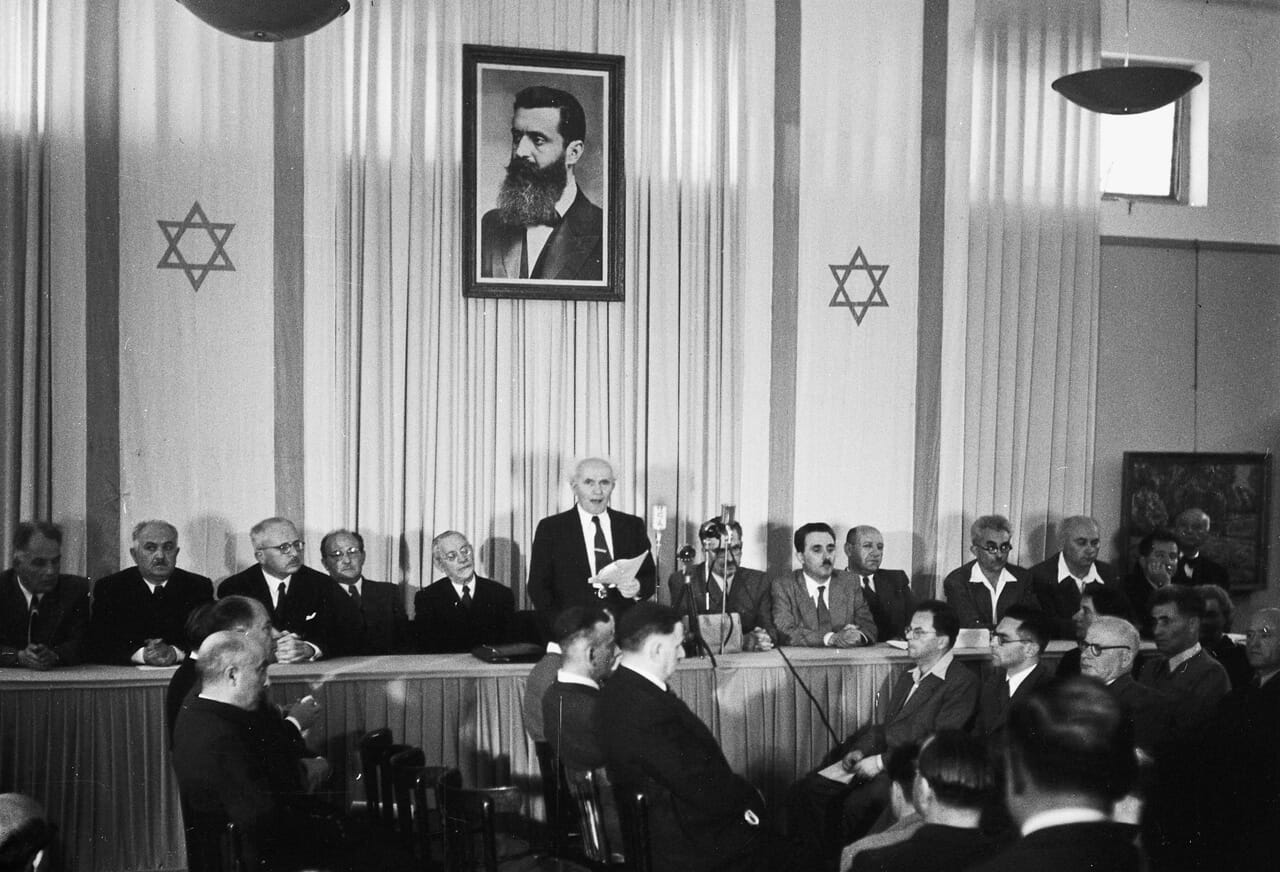
Despite Arab opposition to the partition plan, on May 14, 1948, David Ben-Gurion, the head of the Jewish Agency, proclaimed the establishment of the State of Israel in a declaration of independence.
This declaration was made on the eve of the expiration of the British Mandate.
Initial Recognition
The first two countries to recognize Israel as a state were the United States, which did so just minutes after its declaration of independence, and the Soviet Union.
The next countries to recognize the new nation in the days and weeks that followed included Poland, Czechoslovakia, and Yugoslavia. As of mid-2026, 163 of the 192 other UN member states formally recognize Israel.
After the Declaration
What started as small conflicts between Jewish and Arab communities in the region eventually escalated into full-scale war. After the declaration of independence in May 1948, the armies of five neighboring Arab countries invaded the newly formed state.
Israeli forces managed to hold off invading forces until armistice agreements were reached with Egypt, Jordan, Lebanon, and Syria. The agreements led to the establishment of the Green Line, which served as the de facto border of Israel until 1967.
The war resulted in Israel increasing its territory beyond what was allocated in the UN Partition Plan as well as hundreds of thousands of Israeli and Palestinian refugees. A state of war also persisted between Israel and its neighbors for decades.
UN Membership
Although its initial application for UN membership was denied, a subsequent request made in 1949 after signing armistice agreements led to Israel’s admission into the UN. This gave Israel greater international recognition and the opportunity to voice its positions and concerns on the international stage.
Countries That Do Not Formally Recognize Israel
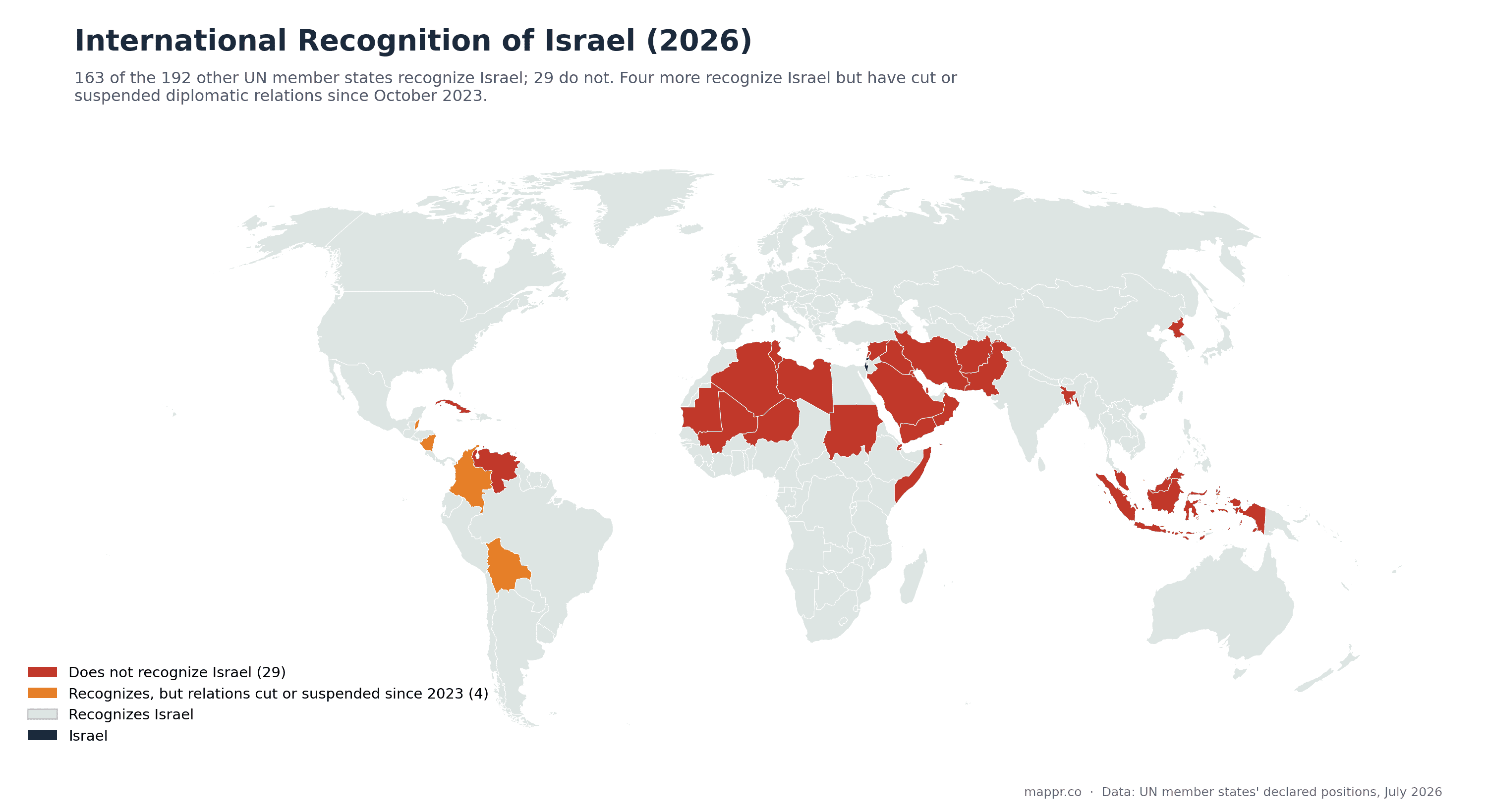
The map above shows the international recognition of Israel as of July 2026. The 29 countries that do not recognize Israel (in red) fall into three groups: 15 members of the Arab League (Algeria, Comoros, Djibouti, Iraq, Kuwait, Lebanon, Libya, Oman, Qatar, Saudi Arabia, Somalia, Sudan, Syria, Tunisia and Yemen), 11 other Muslim-majority states (Afghanistan, Bangladesh, Brunei, Indonesia, Iran, Malaysia, the Maldives, Mali, Mauritania, Niger and Pakistan), and three others: Cuba, North Korea and Venezuela.
In the Americas, Cuba and Venezuela are the only countries that do not recognize Israel. Four more recognize it on paper but pulled back over the Gaza war (in orange on the map): Bolivia, Colombia and Nicaragua severed diplomatic relations between 2023 and 2024, and Belize suspended them.
In the following sections, we’ll take a closer look at specific regions of the world in order to learn more about countries that recognize Israel and those that don’t.
Africa
In Africa, the non-recognizers cluster in the Muslim-majority north and the Horn: Algeria, Libya, Tunisia, Sudan, Somalia, Djibouti, the Comoros, Mali, Mauritania and Niger. Morocco normalized relations with Israel under the 2020 Abraham Accords and maintains them. Sudan also signed the accords, but normalization was never completed and Khartoum still does not formally recognize Israel. Egypt, the first Arab country to make peace with Israel (1979), continues to recognize it.
Arabic Peninsula
The Arabian Peninsula and the wider Middle East remain the core of the non-recognition bloc. Saudi Arabia still does not formally recognize Israel, but normalization has been on and off the table for years: as of July 2026, Washington is openly linking a US-Saudi civil nuclear deal to Saudi recognition of Israel. Riyadh continues to insist on progress toward a Palestinian state first.
The regime in Iran said that Tehran would never “leave the Palestinian cause”. Some of the Iraqi people do not want to recognize Israel because of the Palestinian problem, and some want close relations with Israel because of Israel’s support for the establishment of Kurdistan.
Syria has never recognized the State of Israel, and the two countries have formally been at war since 1948. That said, this is the relationship that has moved the most recently: after the fall of the Assad government in late 2024, Syria’s new leadership under President Ahmed al-Sharaa opened security talks with Israel in September 2025, and in July 2026 al-Sharaa said Damascus is pursuing a security agreement that could open the door to a broader peace deal. Recognition, for now, remains explicitly off the table.
Pakistan and Israel had no problem with each other; but when Israel expanded, Pakistan had to stand with Arab Muslim states, not Israel.
Afghan-Israeli relations are not officially present today, as there is no change in diplomatic relations between the two countries. In the 1980s, Israel became the first country to condemn the Soviet invasion of Afghanistan.
Qatar has commercial ties with Israel.
The United Arab Emirates normalized relations with Israel in 2020 under the umbrella of the Abraham Accords.
Yemen does not have diplomatic relations with Israel, and relations between the two countries are very tense. People with an Israeli passport or any passport and an Israeli stamp cannot enter Yemen.
More about the peninsula…
Oman; Israel and Oman do not have official diplomatic ties, but they remain minimal as tourists from Israel are allowed to visit Oman.
Kuwait; Israel and Kuwaiti countries do not have diplomatic relations. Kuwait is not letting anybody with an Israeli passport enter the country while Israel does not have formal entry or trade restrictions. During the Arab-Israeli wars, Kuwaiti forces fought on the Arab side.
Lebanon; Israeli-Lebanese relations never existed under normal economic or diplomatic conditions; however, Lebanon was the first Arab League country to announce the desire for a ceasefire agreement with Israel in 1949. In the wars between Israel and the Arab League, the border between Lebanon and Israel was the quietest border.
Asia
In Asia, the Muslim-majority nations of Malaysia, Indonesia, Brunei, Bangladesh and the Maldives do not recognize Israel, and the Maldives went further in 2025 by banning travelers on Israeli passports. Bhutan, one of the most recent countries to establish ties, officially recognized Israel in 2020.
Bangladesh; Bangladesh and Israel do not maintain any diplomatic relations, but Bangladesh has a semi-commercial relationship with Israel through the embassies of the US and the European Union.
North Korea; Relations between North Korea and Israel are very unfriendly. North Korea recognizes the sovereignty of Palestinians in all of Israel. Israel sees North Korea and its nuclear missile program as a major threat to global security.
Related Content: International recognition of Kosovo
Trump declares Jerusalem Israeli capital
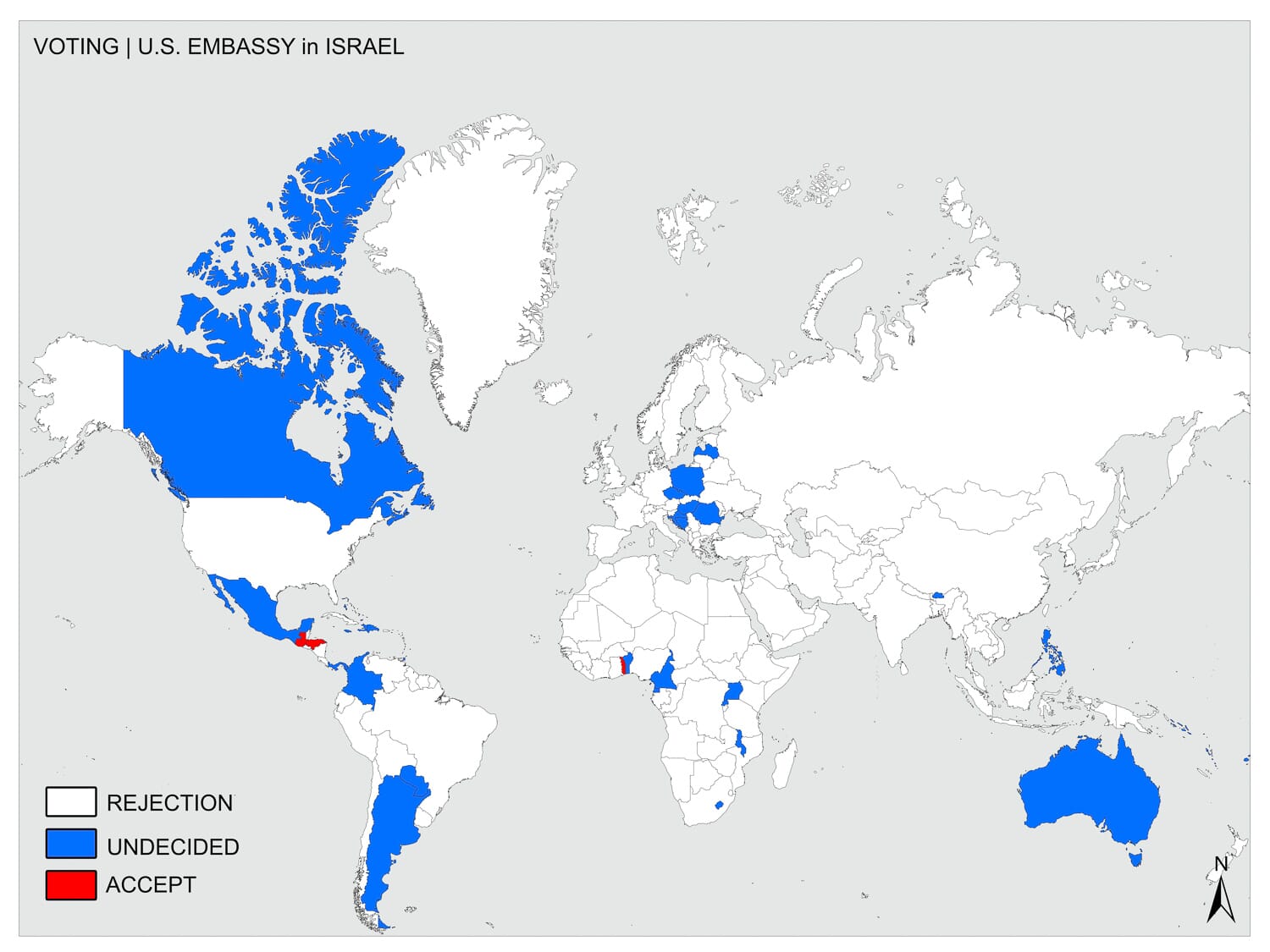
On December 6, 2017, former US President Donald Trump announced US recognition of Jerusalem as the capital of Israel and ordered the relocation of the U.S. Embassy in Israel from Tel Aviv to Jerusalem.
The decision was criticized by the majority of international leaders, including the European Union’s foreign policy chief. A motion condemning the move was proposed in the United Nations Security Council but was vetoed by the United States after a 14-1 vote.
More than 120 countries later condemned the decision at the UN General Assembly.
More Recent Developments
Israel’s relationship with neighboring Palestine and other Arab countries is constantly changing. In this section, we’ll look at some recent developments in the region.
Abraham Accords
In 2020, four different countries decided to normalize their relations with Israel: the UAE, Bahrain, Sudan, and Morocco. These moves, known collectively as the Abraham Accords, marked a historic move towards regional security, peace, and economic opportunities.
Not without criticism, some Palestinian factions saw these agreements as a betrayal of the Palestinian cause. It had previously been the policy of many Arab countries to withhold normalization until the resolution of the Israeli-Palestinian conflict.
The Gaza War and Israel’s Diplomatic Standing (2023–2026)
On October 7, 2023, Hamas and other Palestinian groups launched Operation al-Aqsa Flood, which involved coordinated air and land attacks on multiple Israeli border areas.
The war that followed reshaped Israel’s diplomatic standing more than any event since the Abraham Accords, though in the opposite direction. No country withdrew its recognition of Israel, but Bolivia, Colombia and Nicaragua severed diplomatic relations, Belize suspended them, and Turkey sharply downgraded ties and halted trade.
The bigger shift came on the other recognition map: in September 2025, the United Kingdom, France, Canada, Australia, Portugal and several other Western countries formally recognized the State of Palestine, pushing the number of UN members recognizing Palestine past 150. In February 2026, the foreign ministers of 20 countries jointly condemned Israeli decisions extending control over the West Bank.
At the same time, the normalization track has not died: the Abraham Accords have held throughout the war, Saudi-Israeli normalization remains the stated goal of US diplomacy, and Israeli-Syrian security talks continue. Israel’s recognition map in 2026 is therefore both remarkably stable and under more pressure than at any point in decades. We’ll keep this page updated as positions change.
Sources:


