
The European Organization for Nuclear Research or CERN was founded in 1954 by 12 European countries.
The acronym CERN comes from the initials of the French expansion: Conseil Européen pour la Recherche Nucléaire.
Map of CERN Members
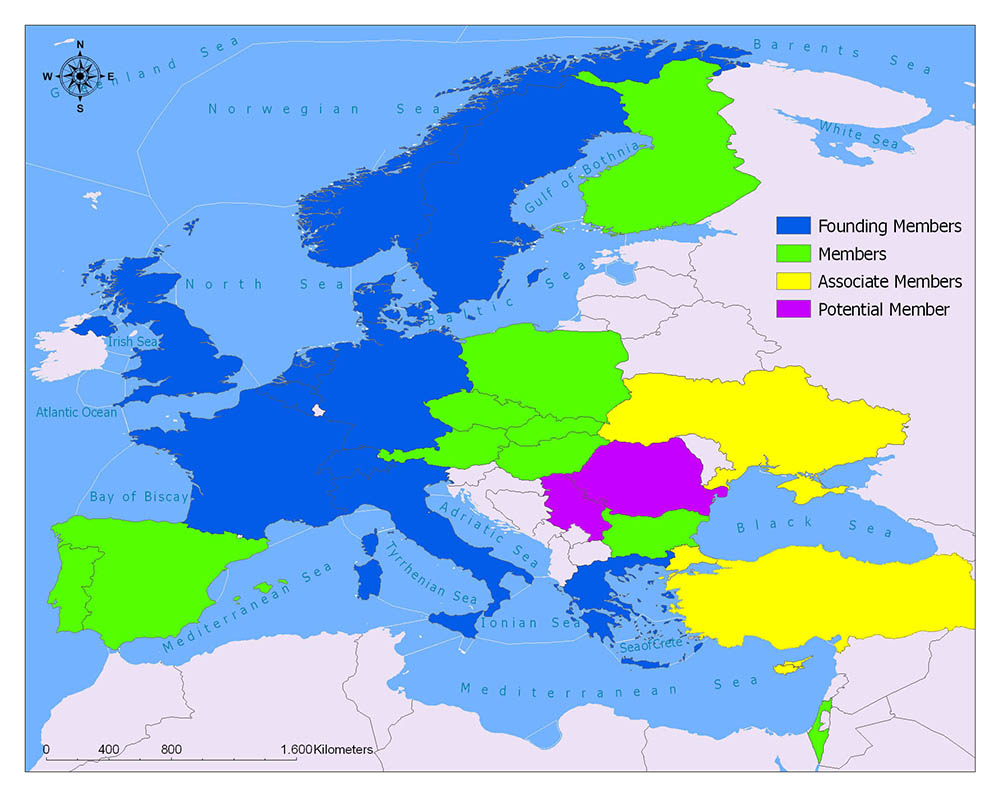
Who founded CERN?
The European countries that contributed to the establishment of the CERN in 1954 and still maintain their partnership are:
- Belgium
- Denmark
- Germany
- France
- Greece
- Italy
- Norway
- Sweden
- Switzerland
- the Netherlands
- the United Kingdom
Where was CERN Established?
This giant center, under the agricultural lands on the border between Switzerland and France, has hundreds of buildings and employs around 2,500 staff members, alongside thousands of visiting researchers.
Of these, about 100 are theoretical physicists, while others are experimental physicists or engineers. CERN’s facilities are used by more than 12,000 scientists from institutes in over 70 countries.
What are CERN’s Achievements?
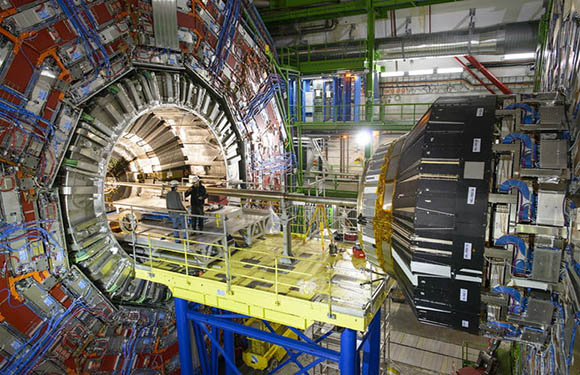
The department where CERN is most popular is the part of the particle accelerators called Large Hadron Collider (LHC). Hereby the protons collide with tremendous heights and an artificial environment close to the universe conditions after the Big Bang.
Also Read: Countries with Nuclear Weapons
The main purpose is to find answers to many questions about the universe, existence, and creation. As predicted, in today’s world, it is impossible for protons to naturally reach that speed (99% of the speed of light). So LHC is a science and engineering monument with everything.
The LHC itself first circulated protons on 10 September 2008, but it builds on decades of earlier CERN machines: the Proton Synchrotron, which first accelerated protons in 1959 and runs at up to 26 GeV, and the Super Proton Synchrotron, which switched on in 1976 and reaches 450 GeV. Experiments on these accelerators discovered new forms of matter, including the W and Z particles.
CERN’s Achievements
- 1973: Scientists found Neutral flow in Gargamelle.
- 1983: Discovery of W and Z particles in UA1 and UA2 experiments.
- 1995: Production of the first anti-hydrogen atoms in the PS210 experiment.
- 1999: Cern scientists found CP symmetry in the NA48 experiment.
- 2010: 38 anti-hydrogen atoms were clamped for one to sixth of a second.
- 2011: The retention time of anti-hydrogen atoms increased to 15 minutes.
- 2012: In Cern, they found A 125 GeV / c2-weighted boson, similar to the Higgs boson.
CERN Members
- Founding Members: Belgium, Denmark, Germany, France, Greece, Italy, Norway, Sweden, Switzerland, Netherlands, United Kingdom, Yugoslavia
- Countries that subsequently joined CERN: Austria (1959), Spain (1961, rejoined 1983), Portugal (1985), Finland (1991), Poland (1991), Hungary (1992), Czech Republic (1993), Slovakia (1993), Bulgaria (1999), Israel (2014), Romania (2016), Serbia (2019), Estonia (2024) and Slovenia (2025) — 25 Member States in total.
- Associate Members: Türkiye (2015), Pakistan (2015), Ukraine (2016), Cyprus (2016, pre-stage to membership), India (2017), Lithuania (2018), Croatia (2019), Latvia (2021), Brazil (2024), Ireland (2025) and Chile (2026).
Sources used for this article:


