
Key Takeaways
- Manila towers over the network. Ninoy Aquino International Airport (NAIA) in Manila serves around 86 regularly-served nonstop destinations — more than twice its nearest rival. It is the main hub of flag carrier Philippine Airlines and of Cebu Pacific, the country's biggest low-cost airline.
- An archipelago that runs on flying. The Philippines is spread across roughly 7,640 islands, so air travel does much of the heavy lifting between regions. Cebu Pacific and Philippine Airlines anchor a busy domestic network, with Cebgo, AirAsia Philippines, Sunlight Air and AirSwift filling in the smaller routes.
- Manila is bursting — relief is coming. NAIA has long run beyond its design capacity. A San Miguel-led consortium took over its operation in 2024 to modernise it, while the brand-new New Manila International Airport in Bulacan and the fast-growing Clark International north of the capital are being built up to absorb the overflow.
- The tourism gateways are airports of their own. Boracay is reached through Caticlan and Kalibo, Palawan through Puerto Princesa, El Nido and Coron/Busuanga, and Bohol through Panglao — leisure-driven airports that punch above their size, with heavy Korean and Chinese charter traffic.
- Cebu is the firm second hub. Mactan-Cebu International is the country's second gateway and the hub for the Visayas and Mindanao, with a celebrated resort-style Terminal 2 and direct links to Korea, Japan, China, Singapore and the Gulf.
- Only Manila flies nonstop to the United States. Despite a huge Filipino-American community, Manila is the sole nonstop gateway to the US — Philippine Airlines flies to Los Angeles, San Francisco, New York, Honolulu and Seattle, and United serves Guam and San Francisco. From elsewhere you connect through Manila or an East-Asian hub.
The Philippines is one of the world’s great archipelagic nations — some 7,640 islands strung between the South China Sea and the Pacific — and that geography makes flying essential rather than optional. Ferries still knit the islands together, but for anything beyond a neighbouring province, air travel is how the country moves. Two carriers dominate: the low-cost giant Cebu Pacific and the flag carrier Philippine Airlines (PAL), joined by Cebu Pacific’s turboprop arm Cebgo, AirAsia Philippines, and the smaller Sunlight Air and AirSwift that specialise in the resort runs.
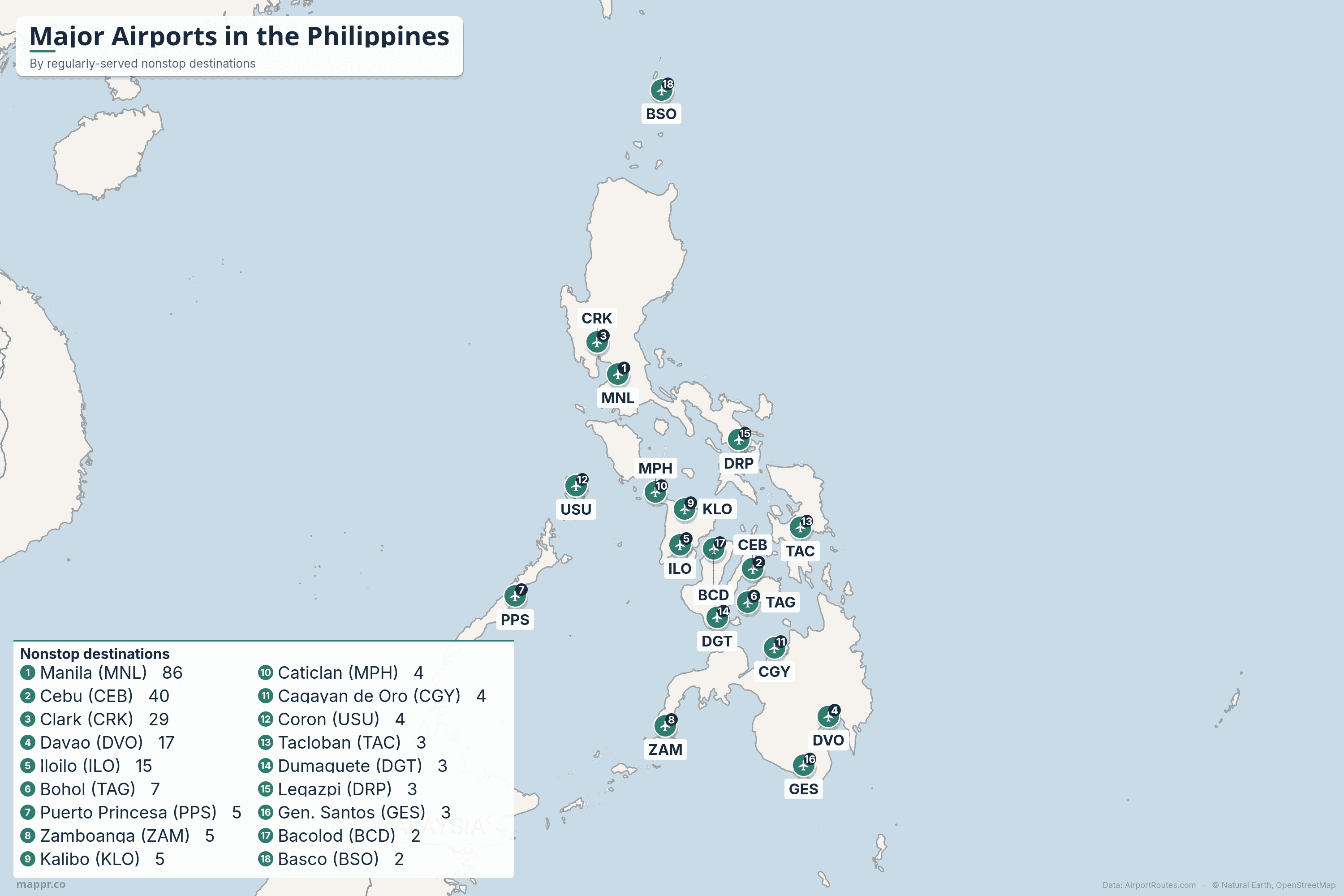
Below we map and rank the country’s airports by the number of nonstop destinations each one serves, drawn from live route data on AirportRoutes. We rank by regularly-served destinations — routes flown often enough to count as scheduled service — rather than raw nonstop totals, which inflate the seasonal and charter-heavy leisure airports. The figures come from observed flight data (a large sample rather than a complete published timetable), so treat them as a guide to relative connectivity, not official totals.
Ranked
Major Airports in the Philippines by Nonstop Destinations
Ranked by regularly-served nonstop destinations, busiest first.
| Airport | IATA | Nonstop | Region |
|---|---|---|---|
| 1. Manila | MNL | 86 | Metro Manila (Luzon) |
| 2. Cebu (Mactan) | CEB | 40 | Cebu (Visayas) |
| 3. Clark | CRK | 29 | Pampanga (Luzon) |
| 4. Davao | DVO | 17 | Davao (Mindanao) |
| 5. Iloilo | ILO | 15 | Panay (Visayas) |
| 6. Bohol-Panglao | TAG | 7 | Bohol (Visayas) |
| 7. Puerto Princesa | PPS | 5 | Palawan |
| 8. Zamboanga | ZAM | 5 | Mindanao |
| 9. Kalibo | KLO | 5 | Panay (Visayas) |
| 10. Caticlan (Boracay) | MPH | 4 | Panay / Boracay |
| 11. Cagayan de Oro | CGY | 4 | Mindanao |
| 12. Busuanga (Coron) | USU | 4 | Palawan |
| 13. Tacloban | TAC | 3 | Leyte (Visayas) |
| 14. Dumaguete | DGT | 3 | Negros (Visayas) |
| 15. Legazpi (Bicol) | DRP | 3 | Bicol (Luzon) |
| 16. General Santos | GES | 3 | Mindanao |
| 17. Bacolod | BCD | 2 | Negros (Visayas) |
| 18. Basco (Batanes) | BSO | 2 | Batanes (Luzon) |
A closer look at the Philippines’ main airports
✈️ Ninoy Aquino International (MNL)
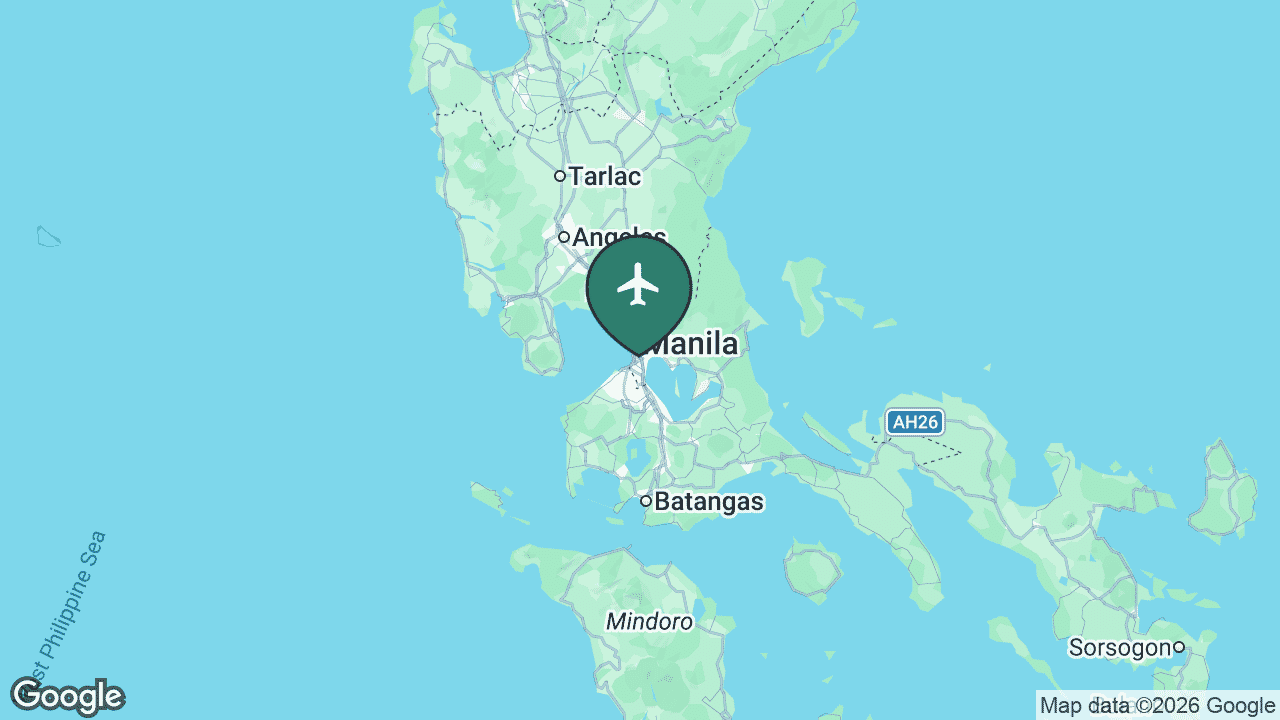
Ninoy Aquino International Airport (NAIA), straddling Pasay and Parañaque in Metro Manila, is the Philippines’ principal gateway and by a wide margin its busiest airport. It is the home base of Philippine Airlines and Cebu Pacific and spreads across four terminals — a layout long criticised for congestion. In 2024 a San Miguel-led consortium took over the airport’s operation under a major rehabilitation programme, and the new New Manila International Airport in Bulacan, north of the city, is being built to eventually relieve it.
Serving Metro Manila and the whole of Luzon, NAIA reaches around 86 regularly-served nonstop destinations — the great majority of the country’s international flying plus a dense domestic web. Top routes include Cebu, Tacloban, Davao, Cagayan de Oro, Legazpi, Caticlan and Iloilo, alongside the long-haul links to North America, the Gulf and East Asia.
Main airlines: Philippine Airlines, Cebu Pacific, Cebgo, AirAsia Philippines. See the full route map for MNL on AirportRoutes →
🛫 Mactan-Cebu International (CEB)
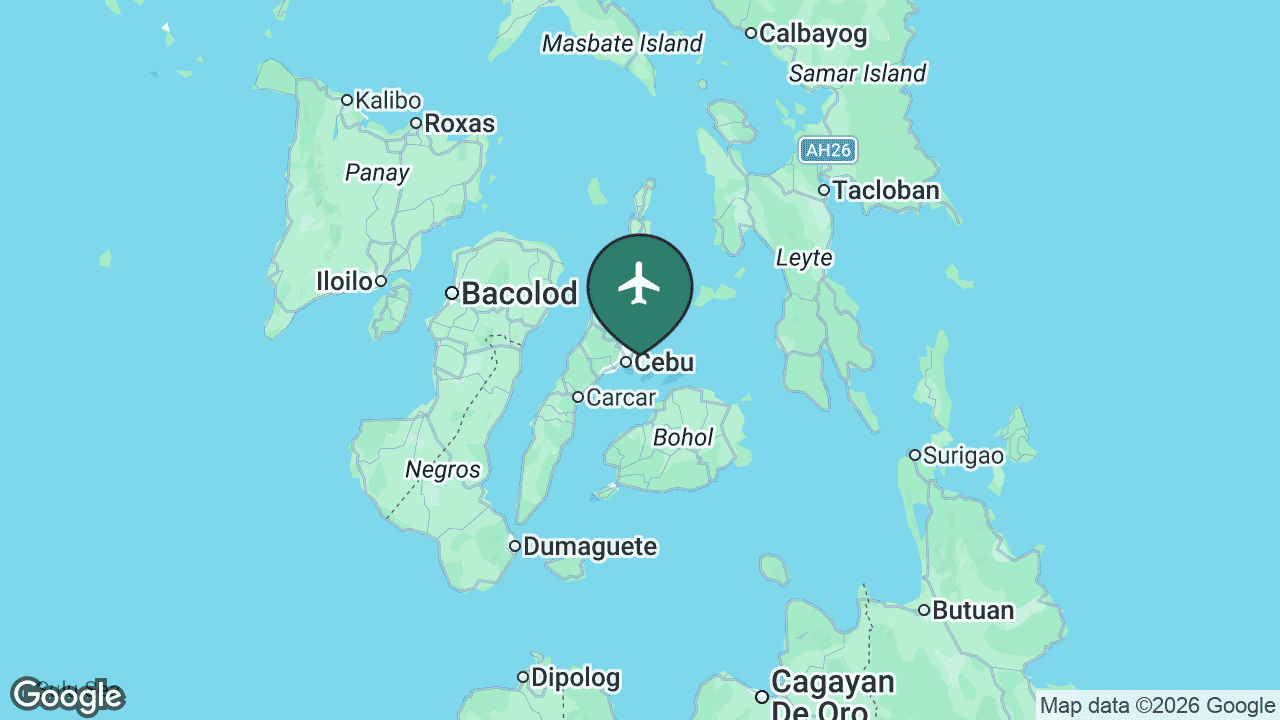
Mactan-Cebu International Airport sits on Mactan Island in Lapu-Lapu City, just across the bridges from Cebu City, and is the country’s second-busiest airport. Its Terminal 2, with sweeping wooden arches and a resort-like feel, has won international design praise and helped position Cebu as a leisure gateway in its own right rather than just a domestic hub.
Serving Cebu and the central Visayas, CEB reaches about 40 regularly-served nonstop destinations, blending a wide domestic network across the Visayas and Mindanao with international links to Korea, Japan, China, Singapore and the Gulf. Top routes include Manila, Siargao, Cagayan de Oro, Davao, Coron and Butuan.
Main airlines: Cebu Pacific, Cebgo, Philippine Airlines, AirAsia Philippines, Sunlight Air. See the full route map for CEB on AirportRoutes →
🛬 Clark International (CRK)
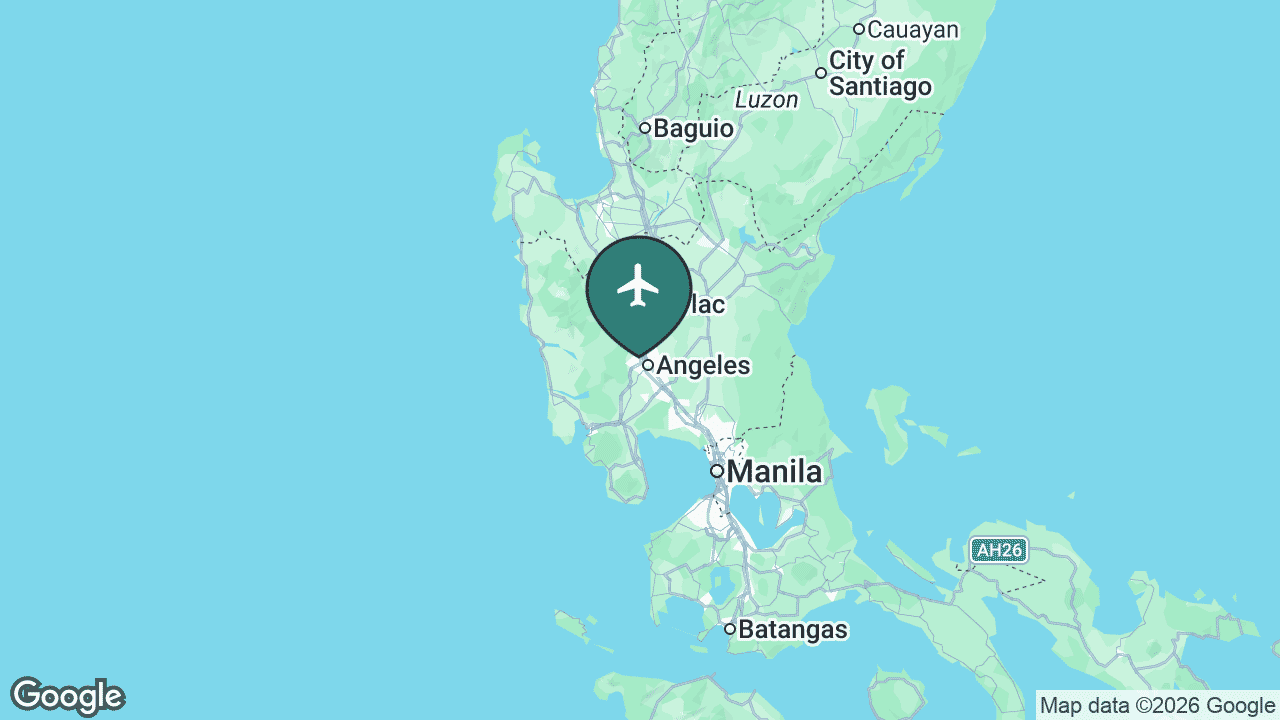
Clark International Airport occupies part of the former US Clark Air Base at Angeles in Pampanga, about 80 km north of Manila. With a modern terminal opened in 2021 and plenty of room to grow, it has become the country’s key relief valve for an overcrowded NAIA — a low-cost and increasingly international gateway for central and northern Luzon.
Serving Pampanga and northern Luzon, Clark reaches around 29 regularly-served nonstop destinations, with a strong domestic spread plus international links into Korea, Hong Kong and mainland China. Top routes include Coron, Siargao, Cebu, El Nido, Caticlan and Seoul.
Main airlines: Cebu Pacific, Cebgo, Philippine Airlines, Sunlight Air, Jin Air. See the full route map for CRK on AirportRoutes →
🌆 Francisco Bangoy International – Davao (DVO)
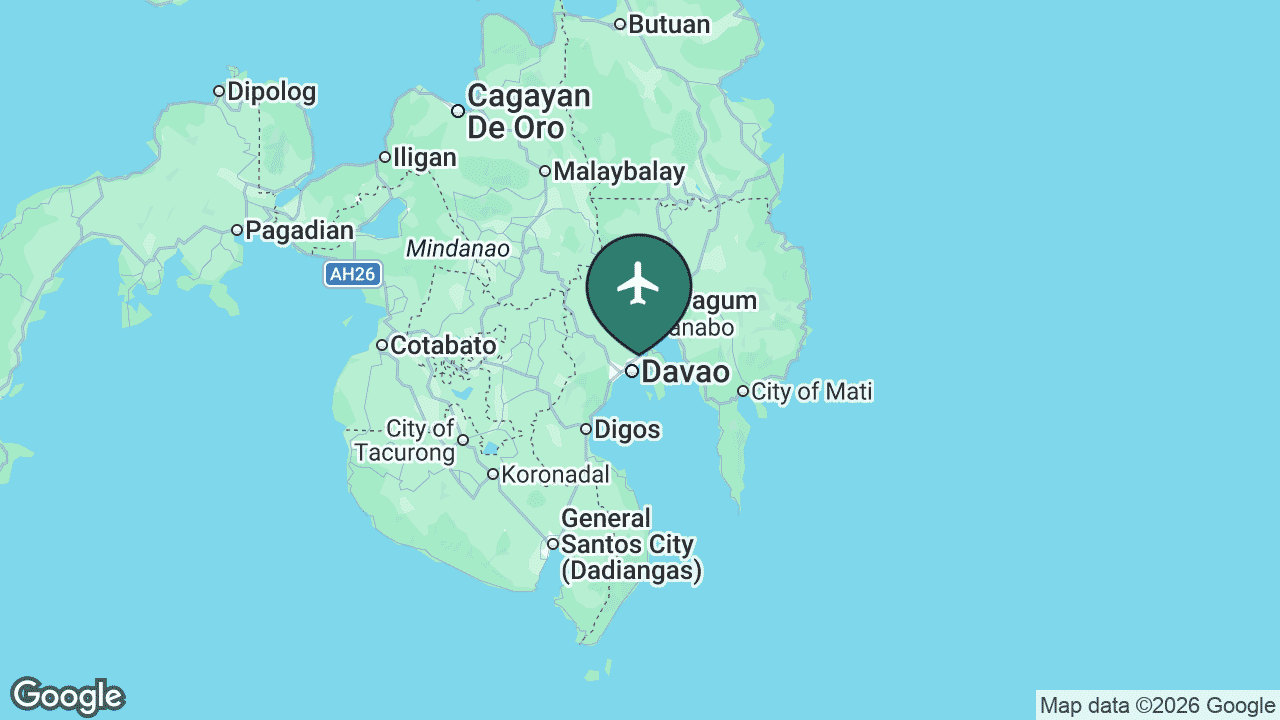
Francisco Bangoy International Airport is the main gateway to Davao City, the largest city on Mindanao and the commercial heart of the island’s south. It anchors the region’s air links and is the busiest airport in Mindanao, with a steady domestic schedule and a handful of international routes.
Serving Davao and southern Mindanao, DVO reaches about 17 regularly-served nonstop destinations, overwhelmingly domestic but with a direct international link to Singapore flown by Scoot. Top routes include Manila, Cebu, Iloilo, Bohol-Panglao and Puerto Princesa.
Main airlines: Cebu Pacific, Philippine Airlines, Cebgo, AirAsia Philippines, Scoot. See the full route map for DVO on AirportRoutes →
🏙️ Iloilo International (ILO)
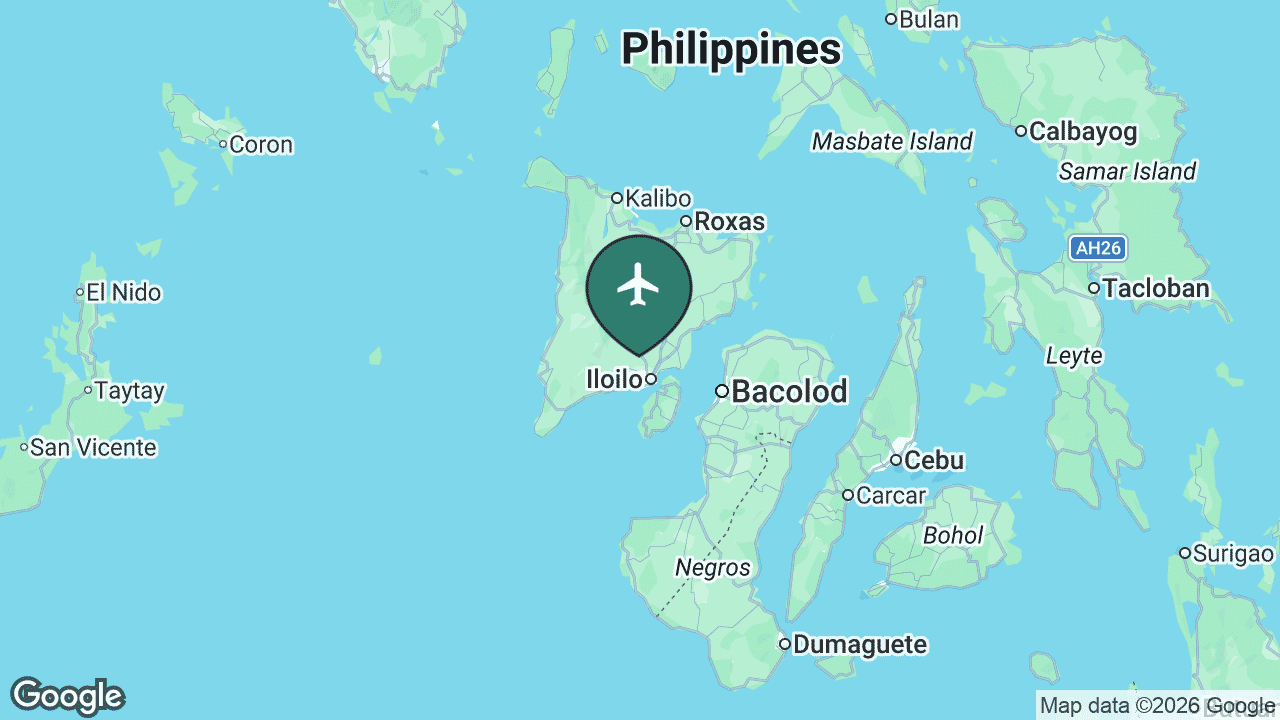
Iloilo International Airport, at Cabatuan northwest of the city, serves Iloilo and the Western Visayas on the island of Panay. A relatively modern field opened in 2007, it is one of the busiest airports outside Manila and Cebu, carrying a mostly domestic network with a few short-haul international links.
Serving Iloilo and Panay, ILO reaches around 15 regularly-served nonstop destinations. Top routes include Manila, Cebu, Davao, Puerto Princesa, Cagayan de Oro and General Santos, plus seasonal links to Singapore and Hong Kong.
Main airlines: Cebu Pacific, AirAsia Philippines, Philippine Airlines, Cebgo. See the full route map for ILO on AirportRoutes →
🐬 Bohol-Panglao International (TAG)
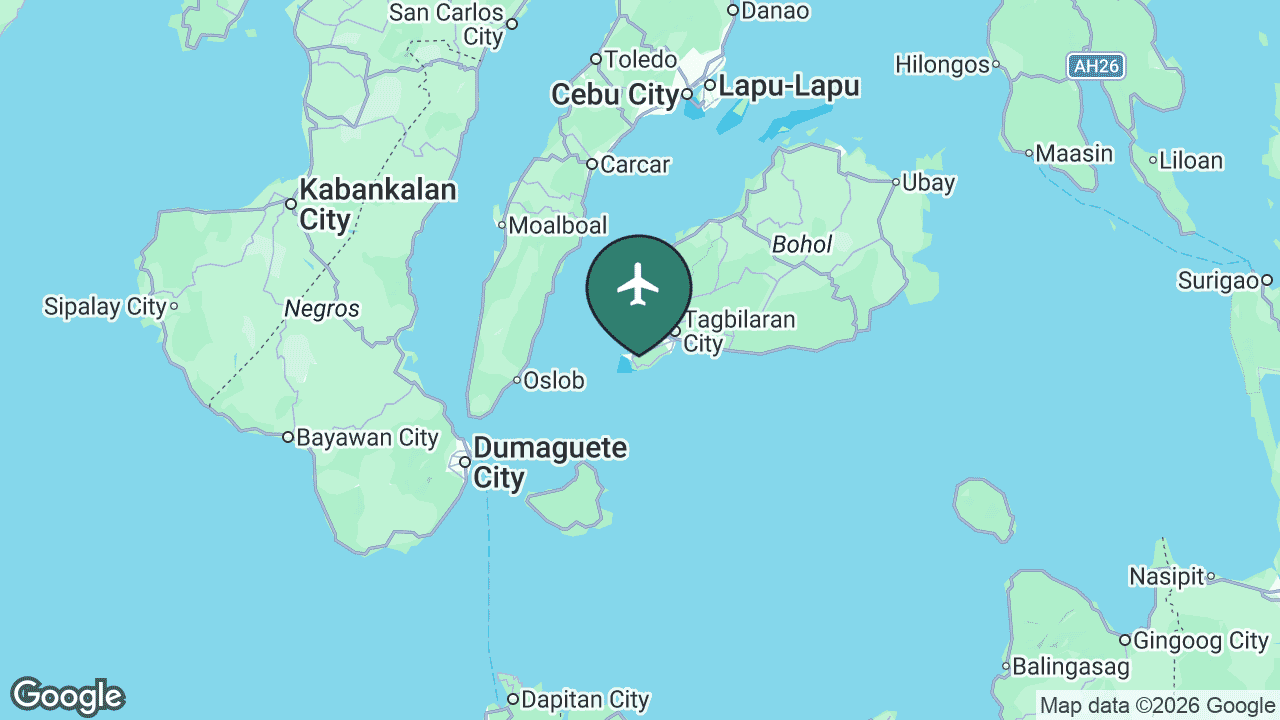
Bohol-Panglao International Airport opened in 2018 on Panglao Island, replacing the old Tagbilaran airfield, and is marketed as the country’s first “green” eco-airport. It is the gateway to one of the Philippines’ top tourism provinces — the Chocolate Hills, the tiny tarsiers, and the diving and white-sand beaches around Alona on Panglao itself.
Serving Bohol, TAG reaches about 7 regularly-served nonstop destinations. Top routes include Manila, Davao and Cebu domestically, plus direct international flights to Seoul, Busan and Chengdu that reflect Bohol’s strong pull with Korean and Chinese holidaymakers.
Main airlines: Cebu Pacific, Philippine Airlines, AirAsia Philippines, plus Korean carriers Jeju Air, Air Busan and Jin Air. See the full route map for TAG on AirportRoutes →
🏝️ Puerto Princesa International (PPS)
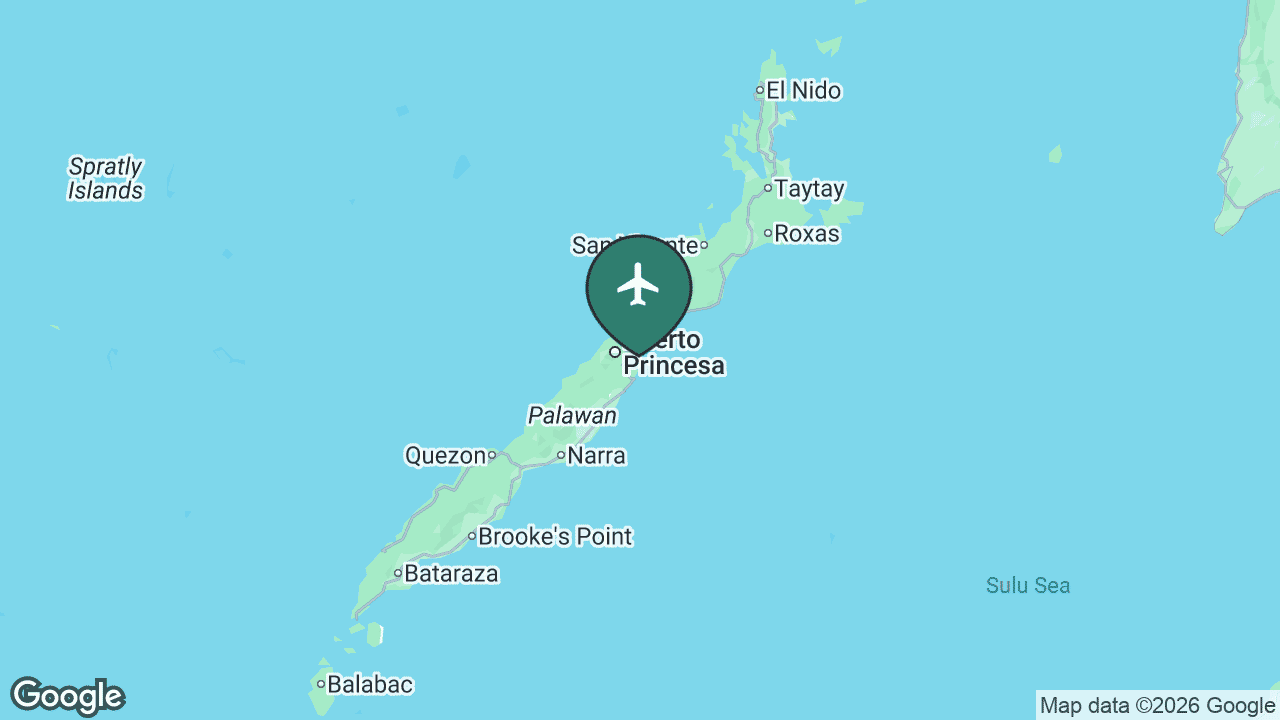
Puerto Princesa International Airport is the main gateway to Palawan, the long, slender island regularly voted among the world’s most beautiful. From here travellers fan out to the city’s UNESCO-listed Underground River and onward to the beaches and lagoons of the south. Its terminal was rebuilt and expanded in 2017.
Serving Palawan, PPS reaches around 5 regularly-served nonstop destinations, almost entirely domestic. Top routes include Manila, Cebu, Iloilo, Davao and Clark.
Main airlines: Cebu Pacific, Philippine Airlines, AirAsia Philippines. See the full route map for PPS on AirportRoutes →
🏖️ Godofredo P. Ramos – Caticlan (MPH)
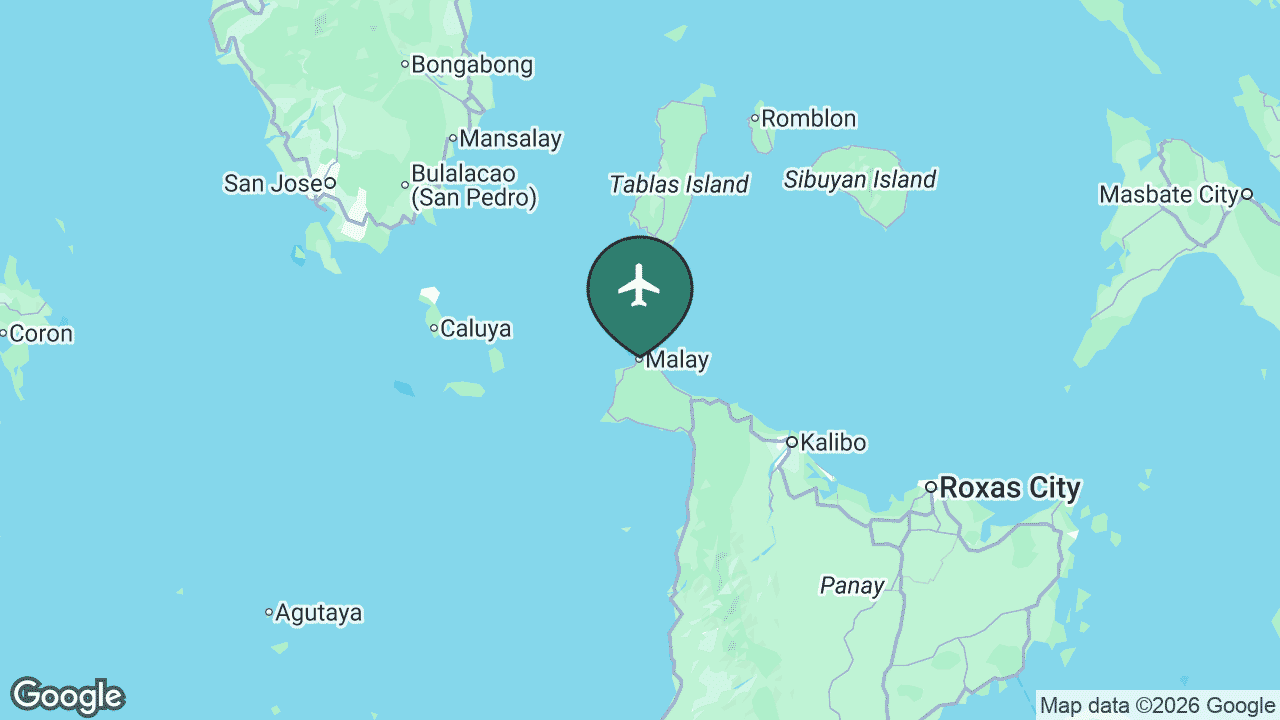
Godofredo P. Ramos Airport — universally known as Caticlan or simply “Boracay Airport” — sits at the northwestern tip of Panay in Malay, Aklan, a short jetty-and-boat hop from the famous white sands of Boracay. It is the closest airport to the island, though its shorter runway limits it to smaller aircraft, so Kalibo handles the bigger jets and international charters.
Serving Boracay, MPH reaches about 4 regularly-served nonstop destinations. Top routes include Manila, Clark, Cebu and Davao, feeding holidaymakers to the island year-round.
Main airlines: Cebu Pacific, Philippine Airlines, AirAsia Philippines. See the full route map for MPH on AirportRoutes →
✈️ Kalibo International (KLO)
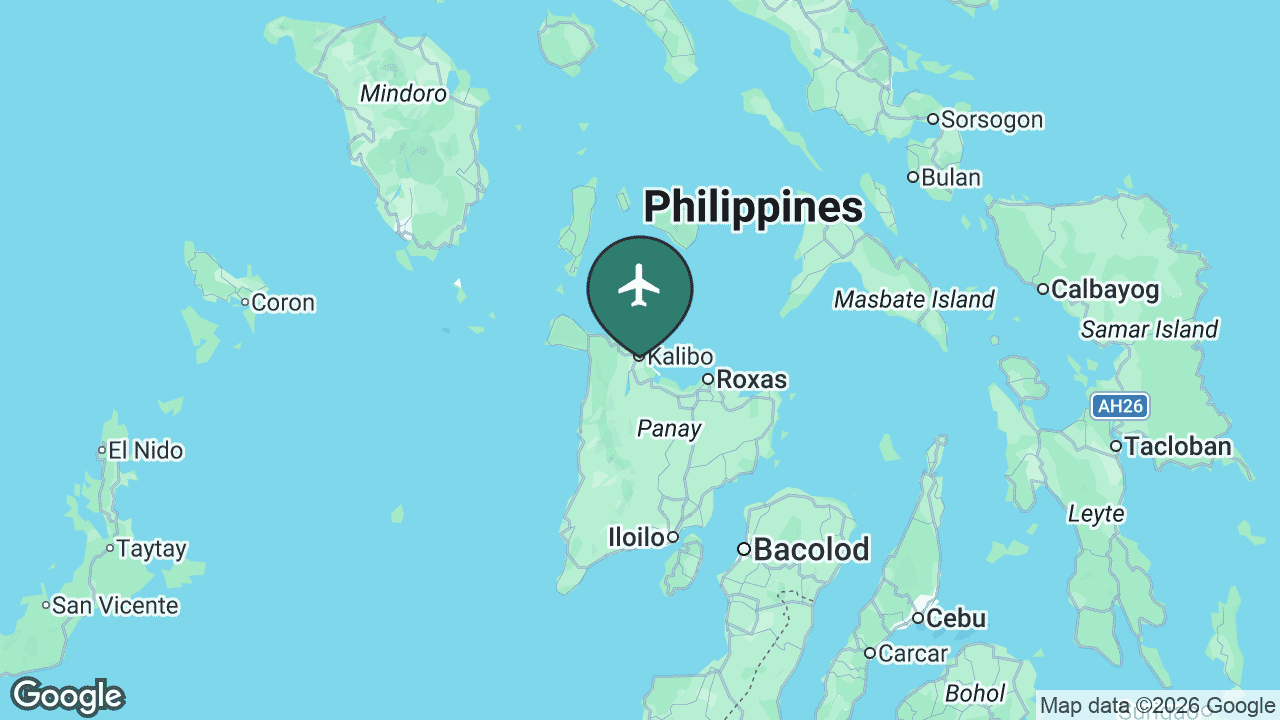
Kalibo International Airport is the larger of Boracay’s two gateways, about 1.5–2 hours away by road and boat from the island. Its longer runway lets it take full-size jets and — crucially — international charter flights, which is why a string of Korean and Chinese cities appear on its schedule even though it is a modest provincial field.
Serving Aklan and Boracay, KLO reaches around 5 regularly-served nonstop destinations. Top routes include Manila and Seoul, plus seasonal Chinese charter links to cities such as Ningbo, Hangzhou and Guilin.
Main airlines: AirAsia Philippines, Cebu Pacific, Philippine Airlines, plus seasonal Korean and Chinese charters. See the full route map for KLO on AirportRoutes →
🛥️ Francisco B. Reyes – Busuanga (USU)
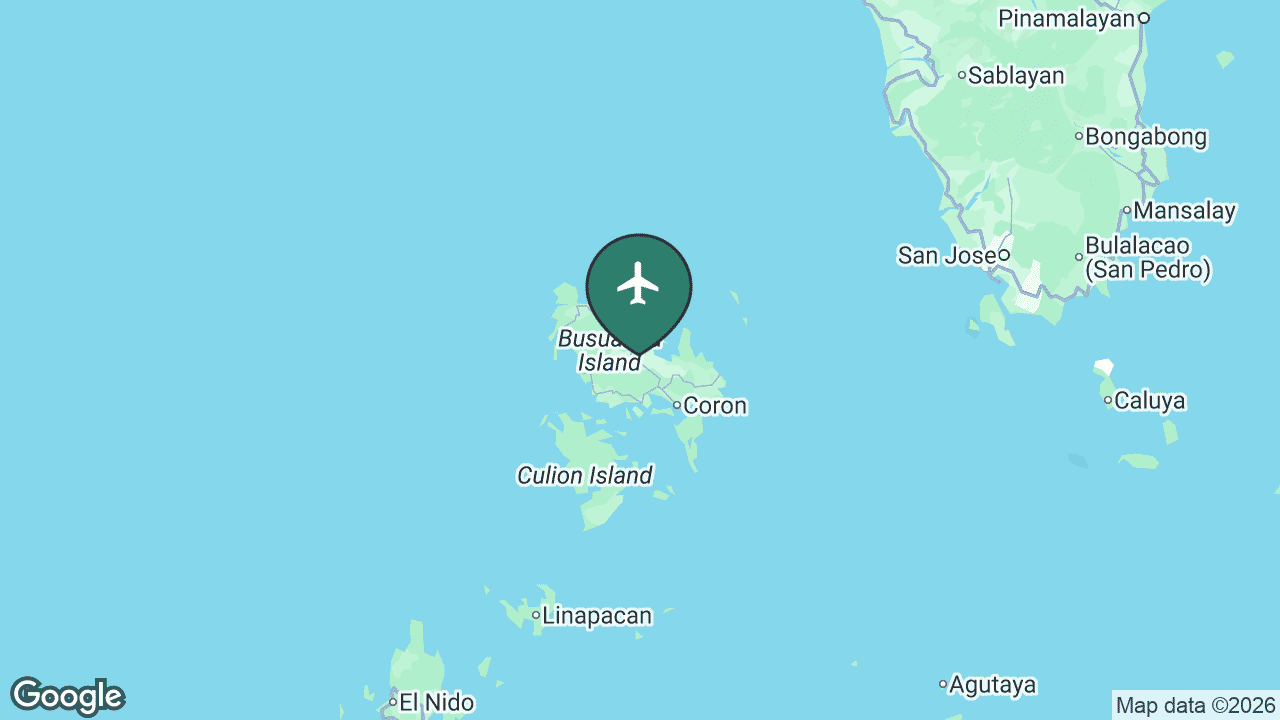
Francisco B. Reyes Airport, on Busuanga Island in northern Palawan, is the gateway to Coron and the Calamian Islands — a magnet for divers exploring the sunken Japanese WWII wrecks and for visitors to the limestone lagoons of Coron and Kayangan Lake. It is a small field served by turboprops and regional jets.
Serving Coron and the Calamianes, USU reaches about 4 regularly-served nonstop destinations. Top routes include Manila, Clark, Cebu and El Nido, the latter flown by the boutique carrier AirSwift.
Main airlines: Cebgo, Philippine Airlines, AirSwift, Sunlight Air. See the full route map for USU on AirportRoutes →
The Philippines’ other regional airports
Beyond the busiest handful, a string of regional airports keeps the rest of the archipelago connected — and several of them out-rank some of the tourist gateways above on scheduled route count. In Mindanao, Zamboanga (ZAM) anchors the far west, Laguindingan (CGY) serves Cagayan de Oro and northern Mindanao, and General Santos (GES) — the country’s tuna capital — covers the south. In the Visayas, Tacloban (TAC) on Leyte, Dumaguete (DGT) on Negros and Bacolod-Silay (BCD) handle their provinces, while Legazpi’s Bicol International (DRP) in southern Luzon sits beneath the near-perfect cone of Mayon Volcano.
The long tail runs from Basco (BSO) in the wind-blown Batanes — the northernmost airport in the country — down through Butuan (BXU), Surigao (SUG), Cotabato (CBO), Dipolog (DPL), Ozamiz (OZC), Pagadian (PAG) and Camiguin (CGM) in Mindanao, to island and coastal strips like Masbate (MBT), Calbayog (CYP), Catarman (CRM), Roxas (RXS), Virac (VRC), Naga (WNP) and San Jose (SJI) on Mindoro. Up north, Laoag (LAO), Tuguegarao (TUG) and Cauayan (CYZ) serve the northern Luzon interior, while Tawi-Tawi (TWT) reaches the far southwestern Sulu archipelago. Most are flown by Cebu Pacific, Cebgo, Philippine Airlines and AirSwift on short domestic hops.
Can you fly nonstop from the Philippines to the United States?
Yes — but only from Manila. Despite one of the largest diaspora populations in the US, the Philippines has just a single nonstop gateway to the American mainland and Pacific. Philippine Airlines flies from NAIA to Los Angeles, San Francisco, New York (JFK), Honolulu and Seattle, and United Airlines serves Guam and San Francisco. No other Philippine airport currently has a scheduled nonstop flight to the United States.
For travellers starting in Cebu, Davao, Clark or the provinces, that means connecting — either via Manila onto a Philippine Airlines or United long-haul flight, or through an East-Asian hub such as Tokyo, Seoul, Taipei or Hong Kong on a single through-ticket. Guam, a US territory just a couple of hours from Manila, also serves as a convenient stepping stone onward to Honolulu and the mainland.
Airport rankings, nonstop-destination counts, served regions, airline lists and connections are drawn from live AirportRoutes route data (observed AeroAPI flight data — a sample, not a complete published schedule; we use the regularly-served figure, which filters one-off observations). Airport history and notable facts are cross-checked against the cited references. The ranked map is a Mappr original.
Primary Data Source:
- AirportRoutes — Major airports & routes, Philippines – Live route data: per-airport nonstop destinations, served cities and airlines.
Reference:
- Wikipedia — Philippine airports (NAIA, Mactan-Cebu, Clark & others) – Airport history, location and notable facts referenced in the per-airport sections.
- Civil Aviation Authority of the Philippines (CAAP) – National aviation regulator and operator of many of the country's regional airports.
- Locator maps — Google Maps / Google Static Maps – Per-airport location maps with airplane markers, generated via Google Static Maps.
Image Sources:
- Map by Mappr – Map of major airports in the Philippines — a Mappr original built from AirportRoutes data and Natural Earth boundaries.
🌍 More maps & data for Philippines
Browse more: All airports by country


