
Key Takeaways
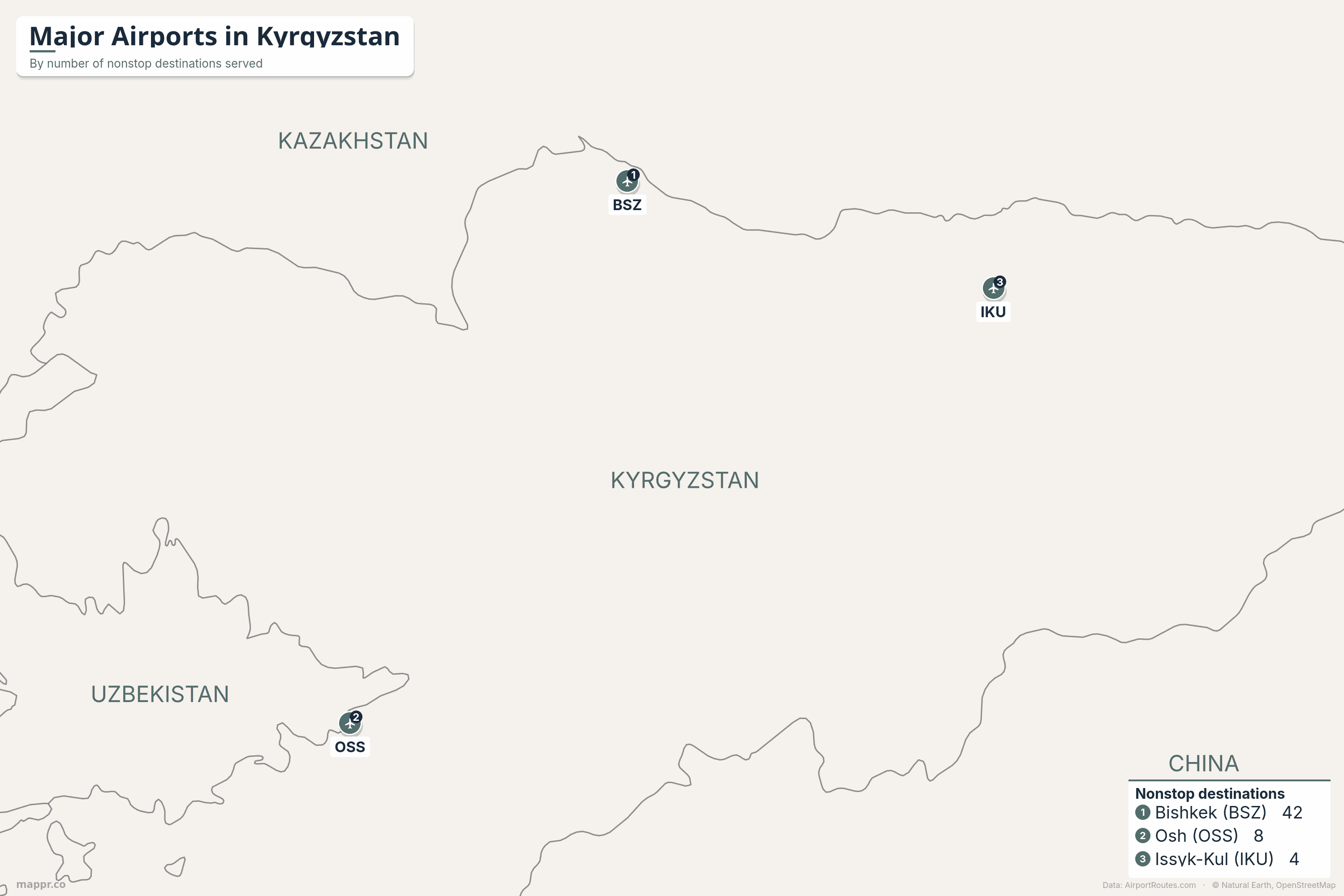
- Manas in Bishkek is the country's main hub. Manas International Airport (BSZ), just outside the capital Bishkek, is by far the busiest airport in Kyrgyzstan, with about 42 nonstop destinations observed in the route data. It is the only airport with real long-haul reach, linking the country to Istanbul, Dubai and Delhi alongside a dense web of Russian cities. Its code changed from the old FRU to BSZ in August 2025.
- Osh is the southern gateway. Osh International Airport (OSS), in the Fergana Valley, is the second city's airport and the main gateway to southern Kyrgyzstan. It shows around 8 nonstop destinations, dominated by Russia but including one of the country's rare scheduled links to China, at Kashgar.
- Issyk-Kul is a seasonal resort airport. Issyk-Kul International Airport (IKU), at Tamchy on the north shore of Lake Issyk-Kul, exists mainly to feed the lake's summer beach resorts. It runs a thin, highly seasonal schedule of around 4 destinations, busiest in the holiday months.
- The route map is built around labour migration to Russia. Almost every Kyrgyz air route points to a Russian city, from Moscow and Saint Petersburg to Novosibirsk, Surgut, Krasnoyarsk and Yekaterinburg, reflecting the very large Kyrgyz migrant-worker population that travels back and forth to Russia for work.
- There are no direct flights to the United States. Kyrgyzstan has no scheduled nonstop service to North America. Travellers connect through a hub such as Istanbul, Dubai, Almaty or Moscow.
Kyrgyzstan, a mountainous, landlocked republic high in the Tian Shan of Central Asia, runs one of the smallest scheduled aviation networks in the region. Only three airports carry regular service. The busiest by a wide margin is Manas International, on the edge of the capital Bishkek; behind it come Osh, the southern capital set in the Fergana Valley, and the small seasonal field at Issyk-Kul, which serves the country’s famous mountain lake. The terrain, almost entirely mountain, and the country’s deep economic ties to Russia shape nearly every route on the map.
Below we map and rank Kyrgyzstan’s airports by the number of nonstop destinations each one serves, drawn from live route data on AirportRoutes. Because this is a small market where the data sample is thin, we rank by total nonstop destinations observed rather than the stricter regularly-served figure (which is too sparse here to separate the airports). Treat the counts as an upper bound and a guide to relative connectivity, not an official timetable.
Can you fly nonstop from Kyrgyzstan to the US?
No. None of Kyrgyzstan’s airports has a scheduled nonstop flight to the United States, and there is no direct service between the country and North America. The network is small, regional and overwhelmingly short and medium-haul, pointing toward Russia, the Gulf, Turkey, India and neighbouring Central Asian states rather than across the world. A nonstop transatlantic route has never had the demand to take hold.
Travellers heading to the US connect through a hub. The most common options are Istanbul on Turkish Airlines, Dubai on flydubai, and Almaty in neighbouring Kazakhstan, where Air Astana offers the widest long-haul reach in the region. A connection through Moscow or Delhi is also possible. From there, the connecting airline’s wider North American network carries passengers onward.
Ranked
Major Airports in Kyrgyzstan by Nonstop Destinations
Ranked by nonstop destinations observed, busiest first.
| Airport | IATA | Nonstop | Region |
|---|---|---|---|
| 1. Manas (Bishkek) | BSZ | 42 | Bishkek (capital) |
| 2. Osh | OSS | 8 | Fergana Valley (south) |
| 3. Issyk-Kul | IKU | 4 | Issyk-Kul Region (Tamchy) |
A closer look at Kyrgyzstan’s airports
✈️ Manas International Airport (BSZ)
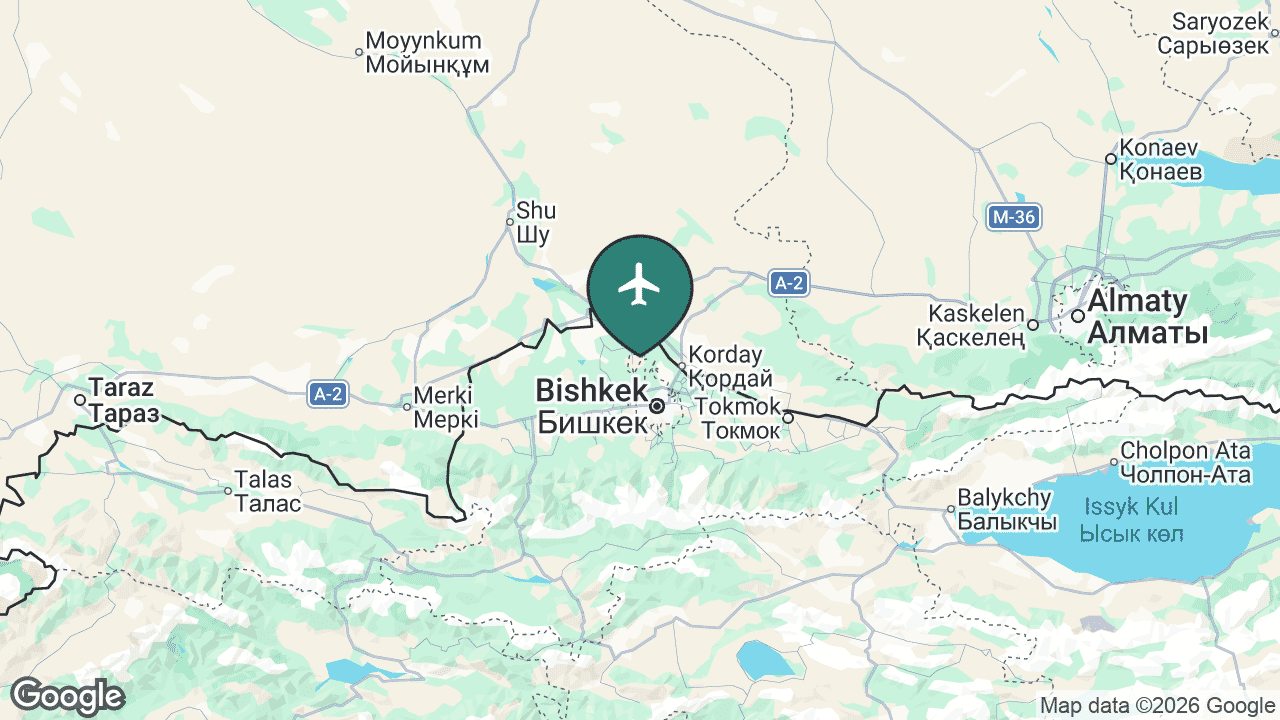
Manas International sits about 25 kilometres northwest of Bishkek and is, by a wide margin, the busiest airport in Kyrgyzstan. It handles almost all of the country’s international, government and connecting traffic, and is the base for its largest home carriers. A long-running modernisation, led since 2025 by the China Road and Bridge Corporation, is expanding the terminal to handle future growth.
Serving the capital region, Manas reaches around 42 nonstop destinations in the route data. The bulk of its network points to Russia, with frequent flights to Moscow, Novosibirsk, Surgut, Krasnoyarsk and other cities that carry Kyrgyz workers back and forth. Beyond that, its most important links run to Istanbul, Dubai and Delhi, making it the one airport where most of Kyrgyzstan’s wider connections begin.
The airport has an unusual recent history. From 2001 to 2014 it hosted the US-led Transit Center at Manas, a key logistics hub for coalition operations in Afghanistan, before it was handed back to Kyrgyz authorities. Note too that the airport’s IATA code changed from the Soviet-era FRU (after Frunze, the old name of Bishkek) to BSZ in August 2025, so older tickets and booking systems may still show the former code.
Main airlines: Aero Nomad Airlines, Avia Traffic Company, Asman Airlines, Turkish Airlines, Pegasus Airlines, flydubai, Aeroflot and other Russian carriers. See the full route map on AirportRoutes →
🛫 Osh International Airport (OSS)
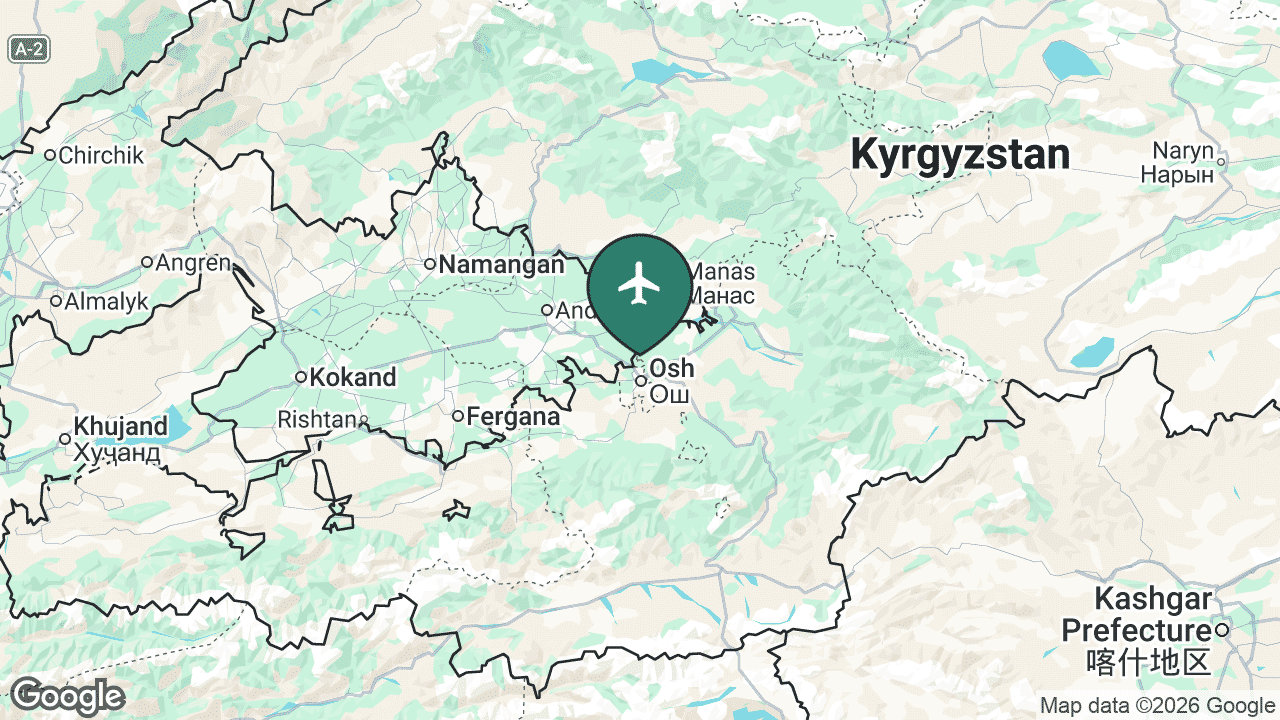
Osh International serves Kyrgyzstan’s second city, in the south of the country, set in the densely populated Fergana Valley close to the Uzbek border. Separated from Bishkek by high mountain ranges, the south has long looked partly toward its own horizons, and Osh gives the region its own direct air links rather than routing everything through the capital. The Bishkek to Osh hop is the country’s main domestic route.
OSS reaches around 8 nonstop destinations. Like Manas it is dominated by Russia, with regular flights to Moscow, Yekaterinburg, Krasnoyarsk, Saint Petersburg and Irkutsk carrying migrant workers from the populous south. Unusually, it also offers a direct link across the mountains to Kashgar in western China, one of Kyrgyzstan’s few scheduled connections to the country, alongside service to Istanbul.
Main airlines: Ural Airlines, Avia Traffic Company, Asman Airlines, Pegasus Airlines and other regional carriers. See the full route map on AirportRoutes →
🏖️ Issyk-Kul International Airport (IKU)
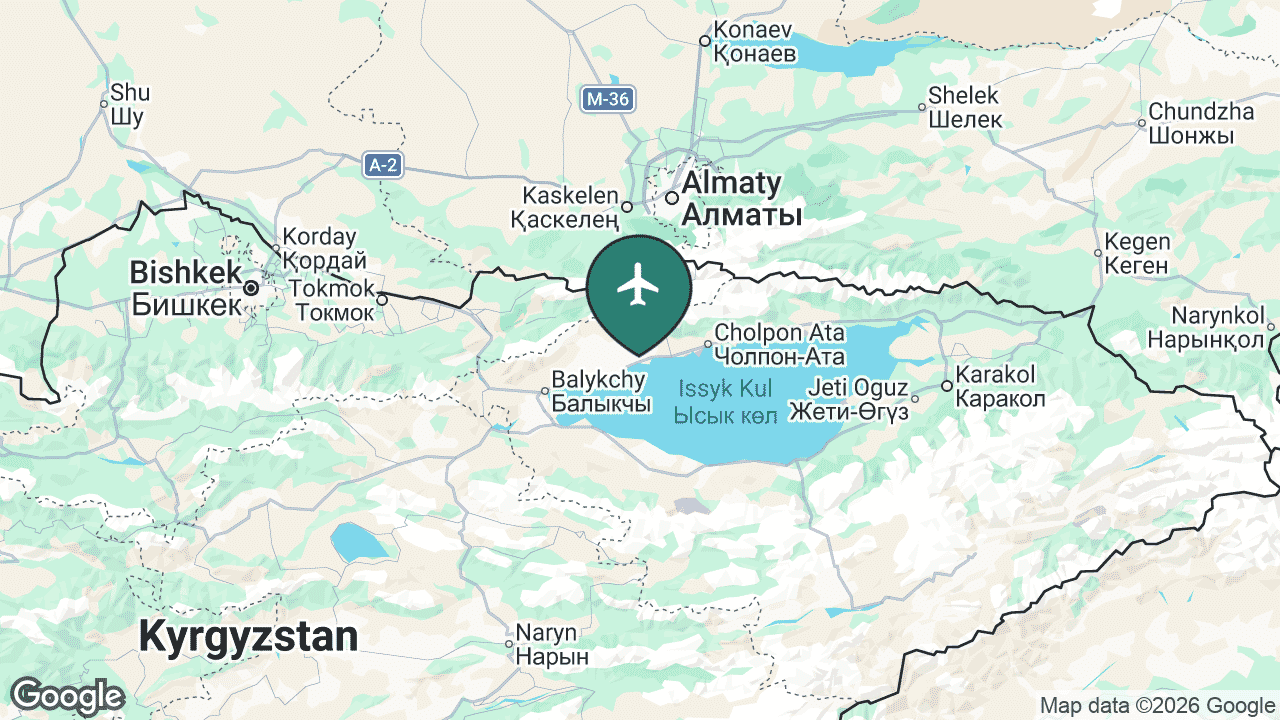
Issyk-Kul International, also known as Tamchy Airport, sits on the north shore of Lake Issyk-Kul, the vast high-altitude lake that is Central Asia’s premier summer holiday destination. The airport exists chiefly to feed the beach resorts around Cholpon-Ata, and its fortunes rise and fall with the tourist season rather than year-round business demand.
IKU shows around 4 nonstop destinations in the data, a deliberately thin and seasonal schedule. Its links combine domestic flights, including to Osh, with seasonal connections to Tashkent, Almaty and Russian cities such as Novosibirsk that bring holidaymakers to the lake. The small Kyrgyz carrier Tez Jet anchors much of this service, which thickens in summer and fades in the colder months.
Main airlines: Tez Jet Airlines and seasonal charter operators. See the full route map on AirportRoutes →
What about Almaty and Tashkent?
Like several small Central Asian countries, Kyrgyzstan leans on bigger neighbours’ hubs for long-haul reach it cannot supply itself. Almaty, about four hours by road from Bishkek across the Kazakh border, is the natural intercontinental gateway for northern Kyrgyzstan: it is the home hub of Air Astana, the region’s most internationally connected carrier, with the widest network to Europe and Asia. For the south, Tashkent in Uzbekistan offers another well-connected option a short hop from the Fergana Valley. Many Kyrgyz travellers bound for distant destinations begin their journey by crossing one of these borders.
Why almost every route points to Russia
Look at the destination list of any Kyrgyz airport and the same pattern repeats: Moscow, Saint Petersburg, Novosibirsk, Surgut, Krasnoyarsk, Yekaterinburg, Irkutsk. Kyrgyzstan is one of the most remittance-dependent countries in the world, and money sent home by Kyrgyz citizens working in Russia is worth a large share of the national economy. Hundreds of thousands of people travel back and forth each year for seasonal and longer-term work, and the airlines have built their networks around them. That demand is what sustains so many direct flights to Russian cities from airports that otherwise have very little scheduled service.
It also explains the carriers. The country’s own private airlines, Aero Nomad Airlines (formerly Air Manas), Avia Traffic Company, Asman Airlines and Tez Jet, fly the regional and migrant routes alongside a rotating cast of Russian operators such as Ural Airlines, S7 and Aeroflot, while Turkish Airlines, Pegasus and flydubai handle the links to Turkey and the Gulf. There is no traditional flag carrier; the old Soviet-era Kyrgyzstan Airlines is long gone, and the private operators have filled the gap. A notable change came in June 2026, when the European Union lifted its long-standing ban on Kyrgyz airlines under the EU Air Safety List, clearing them to fly to Europe for the first time in around two decades and potentially opening new western routes.
A handful of smaller domestic airfields round out the picture. Fields at Jalal-Abad, Batken, Karakol and Kazarman see sporadic, weather-dependent flights on small Kyrgyz carriers, knitting together remote mountain communities that the road network struggles to reach. These services are thin and irregular, so they do not show up in the route data, but for the valleys they serve the occasional flight remains a valuable link to Bishkek and the south.
Airport rankings, nonstop-destination counts, served regions and airline lists are drawn from live AirportRoutes route data (observed AeroAPI flight data, a sample rather than a complete published schedule). Because the regularly-served filter is too sparse for this small market, the rankings use total nonstop destinations observed, treated as an upper bound. Airport locations and notable facts are cross-checked against the cited references. The ranked map is a Mappr original.
Primary Data Source:
- AirportRoutes: Major airports and routes, Kyrgyzstan – Live route data: per-airport nonstop destinations, served cities and airlines.
References:
- Wikipedia: Manas, Osh and Tamchy (Issyk-Kul) airports – Airport history, location, the FRU to BSZ code change, the former Transit Center at Manas and other facts referenced in the per-airport sections.
- European Commission: EU Air Safety List – Background on the EU ban on Kyrgyz carriers and its lifting in June 2026.
- Locator maps: Google Maps and Google Static Maps – Per-airport location maps with airplane markers, generated via Google Static Maps.
Image Sources:
- Map by Mappr – Map of major airports in Kyrgyzstan, a Mappr original built from AirportRoutes data and Natural Earth boundaries.
🌍 More maps & data for Kyrgyzstan
Browse more: All airports by country


