Key Takeaways
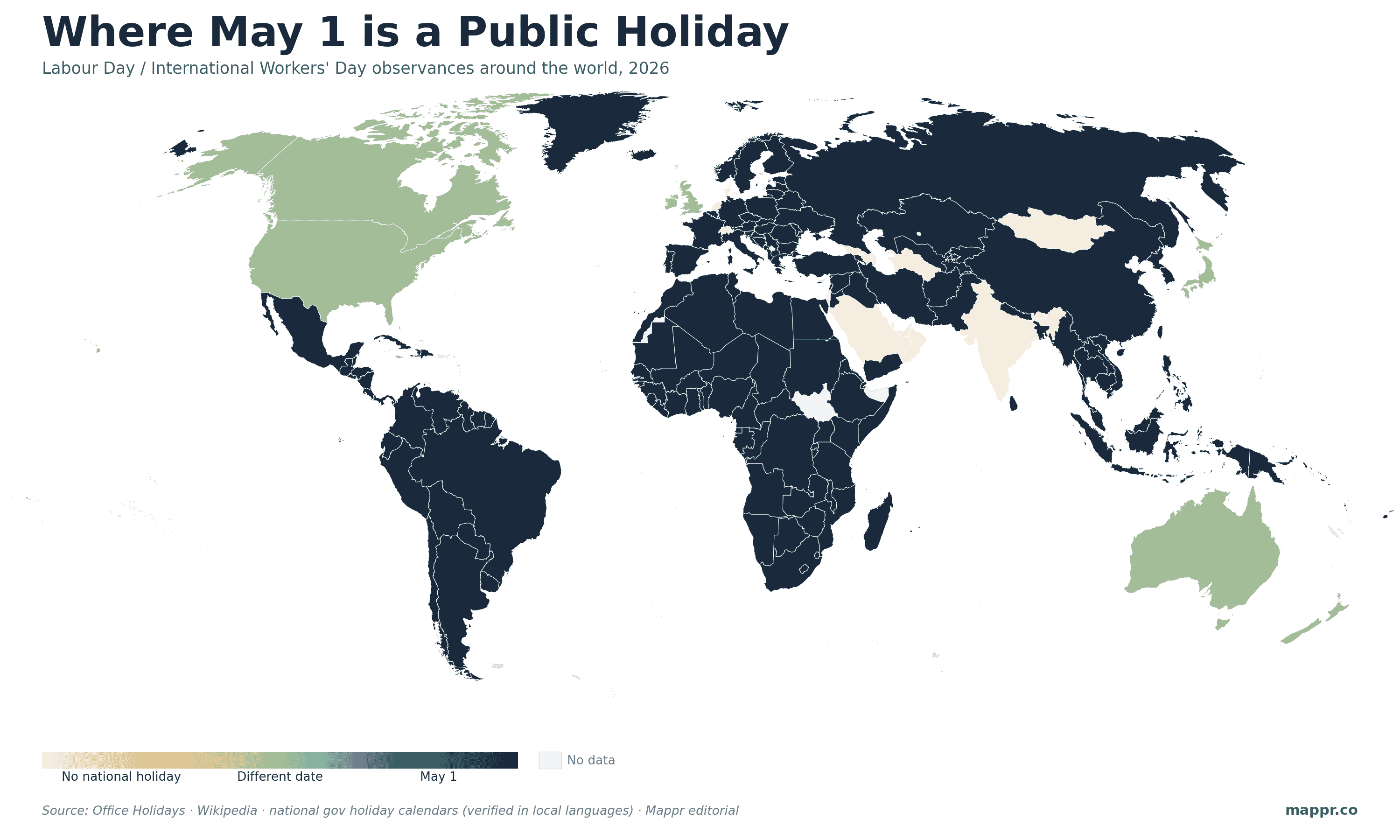
- Most-shared workday off on Earth. May 1 is a public holiday in 171 of the 199 countries and territories we mapped — making International Workers' Day the planet's single most synchronized non-religious holiday.
- 12 countries observe Labour Day on a different date. Most notably the USA and Canada (1st Monday of September), the UK and Ireland (1st Monday of May), Australia and New Zealand (state-by-state, or 4th Monday of October), Japan (November 23), and three Caribbean nations with their own labor-history dates.
- 16 countries have no national Labour Day holiday at all. Israel, the Netherlands, Denmark, Switzerland and India (sub-national only), Bhutan, Brunei, Mongolia, three South-Caucasus and Central-Asian states (Azerbaijan, Georgia, Turkmenistan), and most Gulf monarchies (Saudi Arabia, UAE, Qatar, Oman, Kuwait — but not Bahrain).
- South Korea joins the May 1 club in 2026. In March 2026, South Korea's National Assembly amended the Public Holidays Act to make May 1 a full legal public holiday for all citizens. Previously it was paid leave only for workers under the 1958 Worker's Day Act, while public officials worked.
If you woke up to a quiet street and a closed bank this morning, you’re in the global majority. May 1 is the world’s most-shared public holiday — a day off in 171 of the 199 countries and territories we mapped, from Lima to Lagos to Vladivostok. International Workers’ Day, May Day, Labour Day, Día del Trabajador, Tag der Arbeit — the names change, but the principle is the same: factories close, banks shutter, parades fill city squares, and the labor movement reminds itself that the eight-hour day was won, not given.
The conspicuous holdouts split into two groups. Twelve countries observe a Labour Day, but on a date other than May 1 — the United States and Canada celebrate on the first Monday of September; the United Kingdom and Ireland mark a Bank Holiday on the first Monday of May (but not May 1 itself); Australia’s date varies by state; New Zealand observes Labour Day on the fourth Monday of October; Japan honors workers in late November; and three Caribbean nations commemorate their own labor-rights milestones on dates linked to local strikes and riots.
Sixteen countries go further: they have no national Labour Day public holiday at all. Israel, the Netherlands, and Denmark each have informal labor commemorations (union parades, trade-union half-days) but no statutory holiday. Switzerland’s May 1 is a regional holiday in 17 of 26 cantons but not at the federal level. India treats May 1 as Maharashtra Day in eight states but not at the central-government level. The Gulf monarchies — Saudi Arabia, the UAE, Qatar, Oman, and Kuwait — generally don’t observe Labour Day in any form (Bahrain is the Gulf exception, recognising May 1 since 1980). Bhutan, Brunei, and Mongolia have no equivalent holiday on the calendar. And three post-Soviet states — Azerbaijan, Georgia, and Turkmenistan — quietly removed May 1 from their official non-working-days lists in the post-1991 calendar reforms.
One country joined the May 1 club this year: South Korea. In March 2026, the National Assembly passed a bipartisan amendment to the Public Holidays Act, designating Labour Day a full legal public holiday for all citizens — public officials, teachers, and platform-economy workers included — for the first time since the 1958 Worker’s Day Act granted paid leave to workers under the Labor Standards Act but excluded everyone else.
This post maps where May 1 stands in 2026 and unpacks why some economies chose a different date — and why a handful chose no date at all.
A Holiday Born From the Eight-Hour Movement
The May 1 date is American in origin, even though most Americans no longer associate the day with their own labor history. On May 1, 1886, an estimated 300,000 workers across the United States walked off the job in a coordinated strike for the eight-hour day. Three days later, on May 4, a peaceful rally in Chicago’s Haymarket Square ended in a bombing that killed seven police officers and at least four civilians. The “Haymarket affair” became a touchstone for the international labor movement — and a political liability at home.
In July 1889, the Second International — a federation of socialist and labor parties meeting in Paris — declared May 1 the date for an international demonstration in support of the eight-hour day, explicitly invoking Haymarket. The first coordinated May Day demonstrations followed in 1890, drawing hundreds of thousands across Europe and the Americas. Within a generation, May 1 had been adopted as a public holiday by socialist, communist, and social-democratic governments across the European continent and, eventually, by post-colonial states in Africa, Asia, and Latin America.
By the second half of the 20th century, May 1 had become the most globally synchronized non-religious public holiday in human history — observed under names ranging from Labour Day (UK English) to International Workers’ Day (English in international contexts) to Día Internacional de los Trabajadores (Spanish), Festa dei Lavoratori (Italian), Tag der Arbeit (German), and Праздник весны и труда (Russian: “Spring and Labor Day”).
The 12 Countries That Observe Labour Day on a Different Date
Twelve countries — most of them in the Anglosphere or Anglosphere-adjacent — observe a labor or workers’ holiday on a date other than May 1.
| Country | Holiday Name | Date | Notes |
|---|---|---|---|
| 🇺🇸 United States | Labor Day | 1st Monday of September | Federal holiday since 1894 (Pullman Strike era) |
| 🇨🇦 Canada | Labour Day | 1st Monday of September | Federal holiday since 1894 (parallels US) |
| 🇬🇧 United Kingdom | Early May Bank Holiday | 1st Monday of May | Established 1978 — close to but not May 1 |
| 🇮🇪 Ireland | May Day Bank Holiday | 1st Monday of May | Public holiday since 1994 |
| 🇦🇺 Australia | Labour Day | Varies by state | March (Vic, Tas, WA), May (Qld, NT), October (NSW, ACT, SA) |
| 🇳🇿 New Zealand | Labour Day | 4th Monday of October | Commemorates the 1890 eight-hour-day victory |
| 🇯🇵 Japan | Labor Thanksgiving Day | November 23 | Kinrō Kansha no Hi — descended from Niiname-sai harvest festival |
| 🇧🇸 Bahamas | Labour Day | 1st Friday of June | Commemorates the 1942 Burma Road riots |
| 🇯🇲 Jamaica | Labour Day | May 23 | Commemorates the 1938 Frome riots |
| 🇹🇹 Trinidad & Tobago | Labour Day | June 19 | Commemorates the 1937 oilfield strikes |
| 🇦🇬 Antigua & Barbuda | Labour Day | 1st Monday of May | Close to but not May 1 |
| 🇰🇳 Saint Kitts & Nevis | Labour Day | 1st Monday of May | Close to but not May 1 |
The 16 Countries With No National Labour Day Holiday
Beyond the twelve countries that simply moved the date, sixteen more have no national Labour Day public holiday at all. The reasons vary — religious calendars that don’t align with May, labor traditions that won statutory paid leave instead of a state holiday, federal-versus-cantonal divisions of authority, royal calendars built around national-day commemoration rather than worker mobilisation, or simply a political history in which the labor movement never had the leverage to force a date onto the calendar.
| Country | Status of May 1 | Notes |
|---|---|---|
| 🇮🇱 Israel | Working day | No equivalent state holiday; Histadrut union historically marks May Day informally |
| 🇳🇱 Netherlands | Working day | Trade-union parades, but May 1 is not a public holiday and never has been |
| 🇩🇰 Denmark | Working day | Half-day for some unionised workers under collective bargaining; not a public holiday |
| 🇨🇭 Switzerland | Regional only | Cantonal holiday in 17 of 26 cantons (Zurich, Basel, Geneva, Bern observe it); not a federal holiday |
| 🇮🇳 India | State-level only | Maharashtra Day in 8 states (Maharashtra, Gujarat, Kerala, Karnataka, Tamil Nadu, Telangana, Manipur, Bihar); not a central-government Gazetted Holiday — that day’s central holiday is Buddha Purnima |
| 🇸🇦 Saudi Arabia | Working day | No Labour Day in any form on the Saudi calendar |
| 🇦🇪 UAE | Working day | Not a federal public holiday in the Emirates |
| 🇶🇦 Qatar | Working day | Not observed; National Day (Dec 18) is the principal civic holiday |
| 🇴🇲 Oman | Working day | Not observed; National Day (Nov 18) anchors the Omani holiday calendar |
| 🇰🇼 Kuwait | Working day | Not observed; Bahrain is the Gulf exception, having recognised May 1 since 1980 |
| 🇧🇹 Bhutan | Working day | Royal/Buddhist calendar built around Driglam Namzha cultural observances; no equivalent labor holiday |
| 🇧🇳 Brunei | Working day | Sultanate calendar centred on Islamic dates and the Sultan’s birthday; no labor holiday |
| 🇲🇳 Mongolia | Working day | Calendar dropped most Soviet-era holidays after 1991; centres on Naadam (July 11–13), Tsagaan Sar, and Independence Day instead |
| 🇦🇿 Azerbaijan | Working day | May 1 removed from official non-working-days list; May calendar centres on Victory Day (May 9) and Independence Day (May 28) |
| 🇬🇪 Georgia | Working day | Not on the 18-holiday official calendar; May calendar centres on Holy Cross Day (May 12), Family Sanctity Day (May 17), and Independence Day (May 26) |
| 🇹🇲 Turkmenistan | Working day | Niyazov-era calendar reforms replaced May 1 with Constitution and State Flag Day on May 18 |
🇰🇷 South Korea Joined the May 1 Club This Year
South Korea is the most recent country to add May 1 to its official public-holiday calendar — and the change took effect just this year. From March 2026, the National Assembly passed a bipartisan amendment to the Public Holidays Act (공휴일에 관한 법률) that elevates 근로자의 날 (“Worker’s Day”) from a paid-leave entitlement under the 1958 Worker’s Day Act to a full legal public holiday for all citizens.
The previous arrangement had been an unusual asymmetry. Under the 1958 Act, May 1 was a paid day off only for workers covered by the Labor Standards Act. Public officials, teachers, and so-called “special-employed” workers (delivery drivers, gig-economy workers, freelancers) were excluded — they continued to work while their privately-employed counterparts had the day off. The 2026 amendment closes that gap: from this year forward, banks, post offices, courts, schools, and government offices all close on May 1 alongside the private sector. Rare bipartisan piece of labor legislation in modern Korea.
Why the United States and Canada Chose September
The most counterintuitive fact about May 1 is that the United States — the country whose 1886 strike inspired the date — does not observe it. The reason is essentially political.
By the 1890s, the May 1 commemoration had become tightly associated with European socialism, anarchism, and the radical wing of the American labor movement. The Haymarket bombing’s surviving organizers had been tried and executed; their memorial gatherings on May 1 drew large crowds and made the date politically toxic for mainstream politicians. The American Federation of Labor’s more conservative leadership pushed for a federal holiday that would honor labor without invoking Haymarket — a date already informally celebrated in New York since the 1880s, the first Monday of September.
The decisive moment came during the 1894 Pullman Strike, when President Grover Cleveland sent federal troops to break a nationwide railroad strike. The intervention killed dozens of workers, badly damaged Cleveland’s standing with labor, and made some symbolic concession politically necessary. Six days after troops were withdrawn, Cleveland signed the bill establishing Labor Day as a federal holiday on the first Monday of September. Canada followed in the same year, having been celebrating an informal “Labour Day” parade in Toronto since 1872.
The result is that the United States and Canada quietly mark labor’s contribution at the end of summer, three thousand miles and four months removed from the May 1 date their own workers helped create.
Other Notable Cases
🇬🇧 United Kingdom and 🇮🇪 Ireland: First Monday, Not May 1
The UK only granted statutory recognition to a workers’ bank holiday in 1978, late by European standards, and chose the first Monday of May rather than May 1 to keep the holiday floating to a long weekend regardless of the calendar. Ireland followed in 1994 with the same first-Monday arrangement. In both countries the day is functionally a Labour-adjacent bank holiday rather than a politically charged commemoration; trade union marches still happen, but the day off itself is largely treated as the start of the spring long-weekend season.
🇦🇺 Australia: A State-by-State Patchwork
Australia’s Labour Day reflects the country’s federal structure: each state and territory sets its own date. Victoria and Tasmania observe Labour Day in March; Queensland and the Northern Territory observe it on the first Monday of May (the first Monday after May 1, not May 1 itself); Western Australia observes it on the first Monday of March; New South Wales, the ACT, and South Australia observe it on the first Monday of October. The dates trace to whichever 19th-century eight-hour-day victory each colony commemorated locally — a reminder that Australia’s labor movement won the eight-hour day independently and earlier than the US (Stonemasons in Melbourne secured it in 1856).
🇯🇵 Japan: Kinrō Kansha no Hi (Labor Thanksgiving)
Japan’s workers’ holiday is on November 23 and is one of the older holidays in the modern Japanese calendar, descended from the imperial Niiname-sai rice harvest festival recorded in the 7th-century Nihon Shoki. The post-war 1948 Public Holiday Law renamed it Kinrō Kansha no Hi (勤労感謝の日, “Labor Thanksgiving Day”) and broadened its meaning from “thanks for the harvest” to “thanks for labor and production” — a deliberate secularization that preserved the date while updating the meaning. May 1 itself is widely observed as Mēdē (メーデー) by Japanese unions, but it is not a public holiday — though Constitution Memorial Day (May 3) and Greenery Day (May 4) sit nearby on the calendar and combine with Children’s Day (May 5) to form Japan’s “Golden Week.”
🇮🇳 India: Maharashtra Day, Not a Central Holiday
India is the largest country on the map shaded as having no national Labour Day. May 1 is an important regional holiday — observed under various names as Maharashtra Day (Maharashtra), Gujarat Day (Gujarat), Kamgar Din (most northern states’ trade-union version), and so on — in eight Indian states. But it is not a Gazetted Holiday on the central government’s calendar; the central government’s May holiday is Buddha Purnima (the celebration of the Buddha’s birth, enlightenment, and death), which falls in May or early June each year. The split tracks the federal-vs-state division of holiday authority: India’s central government is responsible for declaring its own gazetted closures, while each state declares its own additional regional days. May 1 made it onto eight state lists but never the union list.
🇨🇭 Switzerland: Cantonal, Not Federal
Switzerland is a special case. Tag der Arbeit on May 1 is a holiday in 17 of the country’s 26 cantons — including all the major urban ones (Zurich, Basel-Stadt, Basel-Land, Geneva, Bern, Lucerne, Zug, Schaffhausen) and significant chunks of the German- and Italian-speaking population. But it is not a federal holiday: federal offices remain open, and nine cantons (mostly the rural Catholic ones in central Switzerland) treat May 1 as a regular working day. For the world map, this is closest to “no national holiday” — a Swiss employee in Lucerne or Schwyz works on May 1, while one in Zurich or Geneva does not.
🇧🇸 🇯🇲 🇹🇹 Caribbean Exceptions: Local Commemoration Dates
The three Anglophone Caribbean nations that don’t observe May 1 each chose a date tied to a defining local labor incident. Jamaica’s Labour Day on May 23 commemorates the 1938 Frome sugar-estate riots, when workers on the Tate & Lyle estate struck for higher wages and were fired upon by police — a decisive moment in the formation of the country’s modern trade-union movement. Trinidad & Tobago’s Labour Day on June 19 marks the 1937 oilfield strikes that mobilized petroleum workers across the colony. The Bahamas’ Labour Day on the first Friday of June commemorates the 1942 Burma Road riots, sparked by a wage dispute among workers building a US wartime airfield. Antigua & Barbuda and Saint Kitts & Nevis observe Labour Day on the first Monday of May rather than May 1 itself, again to fix it as a long weekend.
🇮🇱 🇳🇱 🇩🇰 Israel, Netherlands, and Denmark: No Holiday At All
The three European-or-European-aligned countries with no Labour Day public holiday share a pattern: a powerful labor movement that secured workers’ rights through other channels rather than through a calendar holiday. Israel’s Histadrut federation organized May Day rallies during the labor-Zionist era of the 1930s through 1970s, but May 1 was never enshrined in the holiday calendar set by the 1951 Hours of Work and Rest Law. The Netherlands’ May 1 has long been a parade day for Dutch unions and the Labour Party (PvdA), but never a statutory holiday — Dutch workers got generous statutory leave (24 days in 2026, plus eleven public holidays) without it. Denmark’s May 1 is a half-day at workplaces under collective bargaining agreements covering most unionised sectors, but it is not a public holiday: the Danish Folkeskole runs, banks are open, and post offices deliver.
🇸🇦 🇦🇪 🇶🇦 🇴🇲 🇰🇼 The Gulf States: Outside the Tradition
Most of the Gulf monarchies — Saudi Arabia, the UAE, Qatar, Oman, and Kuwait — do not observe May 1 in any form. The reasons are historical: there was no large 19th- or early-20th-century industrial-labor movement in any of these states (oil only became a major sector after WWII), the calendar of state holidays anchors on Islamic religious dates and the country’s own founding/national day, and the labor force has long been dominated by non-citizen migrant workers without political representation. Bahrain is the Gulf exception: it has recognised May 1 as a public holiday since 1980, reflecting Bahrain’s longer trade-union tradition and the influence of pre-1979 Iranian labor culture across the Persian Gulf.
🇧🇹 🇧🇳 🇲🇳 Bhutan, Brunei, and Mongolia: Calendars Built on Other Anchors
Three Asian countries lack a Labour Day not because of any explicit rejection of the international workers’ holiday, but because their public-holiday calendars were never structured around it. Bhutan’s calendar is built around the Royal Family’s anniversaries and Buddhist religious observances (Losar, the King’s Birthday, the National Day on December 17). Brunei’s calendar is similarly anchored on Islamic dates plus the Sultan’s birthday (July 15) and National Day (February 23). Mongolia’s post-1991 calendar dropped most Soviet-era holidays in favour of pre-Soviet national observances — chiefly Tsagaan Sar (Lunar New Year) and the three-day Naadam festival (July 11–13). May 1 didn’t survive the cull.
🇦🇿 🇬🇪 🇹🇲 Three Post-Soviet Calendar Reforms
Three former Soviet republics dropped May 1 from their official non-working-days list during the post-1991 calendar reforms. Azerbaijan’s May calendar now anchors on Victory Day (May 9) and Republic Day (May 28); Georgia’s centres on Holy Cross Day (May 12), Family Sanctity Day (May 17), and Independence Day (May 26); Turkmenistan replaced May 1 with Constitution and State Flag Day on May 18 during the Niyazov-era national-symbolism reforms. The other Central Asian and Caucasus republics (Russia, Belarus, Ukraine, Kazakhstan, Uzbekistan, Kyrgyzstan, Tajikistan, Armenia, Moldova) all retained May 1.
🇰🇷 South Korea: New to the Club in 2026
South Korea joined the list of full May 1 observers in March 2026 — see the dedicated section above. The country sat in an unusual middle ground from 1958 to 2026: paid leave for private-sector workers, normal working day for public officials.
What’s in a Name: Labour, Workers’, or May Day?
The same date carries different names depending on country and political tradition:
- International Workers’ Day — the official UN-recognized name, used in English-language international contexts
- Labour Day / Labor Day — used in most English-speaking and Anglophone-influenced calendars
- May Day — the colloquial name in the UK and Ireland; older than the labor holiday and originally a spring festival
- Día Internacional de los Trabajadores — Spanish-speaking Latin America, also Día del Trabajo in Mexico
- Tag der Arbeit — Germany, Austria, Liechtenstein
- Festa dei Lavoratori — Italy
- Праздник Весны и Труда (“Spring and Labor Day”) — Russia (formally renamed from “International Workers’ Day” in 1992)
- 劳动节 (Láodòng Jié) — China; followed by a multi-day “Golden Week” public-holiday extension
- عيد العمال (ʿĪd al-ʿummāl) — much of the Arabic-speaking world (where the holiday is observed)
- 근로자의 날 (Geunrojaui Nal, “Worker’s Day”) — South Korea; full public holiday from 2026
- Vappu — Finland, where May 1 is celebrated as a hybrid of student carnival and Walpurgis Night
The Bottom Line
The map of where May 1 is a public holiday is, in effect, a map of which labor traditions a country chose to inherit — and, more recently, which to extend. The vast majority — Europe (excluding the Netherlands and Denmark), Latin America, post-colonial Africa, the post-Soviet space (except the Caucasus oddities and Turkmenistan), China, Southeast Asia, the Arab world (excluding the Gulf monarchies) — adopted the Second International’s 1889 declaration and never reversed course. The English-speaking world mostly didn’t, choosing dates tied to local commemorations or, in the American case, deliberately distancing the holiday from its Haymarket origins. Japan kept the harvest festival and updated its meaning. The Gulf states stayed outside the tradition entirely. India treats it as a regional holiday but not a national one. And a small group of countries with strong labor movements — Israel, the Netherlands, Denmark, Switzerland — secured workers’ rights through other channels and never enshrined the date.
2026 is also the first year the calendar moved in the other direction: South Korea added May 1 to its list of universal public holidays after seven decades of partial-only observance. For the 171 countries shaded navy on the map above, today is closed banks, parades, and a long-weekend cookout. For the rest — there’s still a workers’ day on the calendar somewhere, just not necessarily today.