
From the mango groves of India to the cloudberry bogs of Norway, every national fruit tells a story of culture, climate, and identity. Across the globe, around 50 countries have designated — officially or culturally — a single fruit as their national symbol. These choices reveal fascinating connections between a nation’s history, its landscape, and the crops that have shaped its people for centuries.
🔑 Key takeaways:
- 🥭 Mango is #1 — shared by India, Pakistan, the Philippines, and Haiti, making it the world’s most popular national fruit
- 🍎 Apple is the runner-up — claimed by Germany, Austria, Poland, Ireland, Canada, and the UK (though UK also claims raspberry)
- Pomegranate unites three nations — Afghanistan, Azerbaijan, and Iran all revere this ancient fruit
- Asia dominates with 23 countries designating national fruits — more than all other continents combined
- Turkmenistan loves watermelon so much it celebrates an annual Watermelon Day national holiday
- Jamaica’s ackee is technically toxic if eaten unripe — yet it’s the star of the national dish
- Most unique pick: Norway’s cloudberry, an Arctic berry that only grows in frozen bogs above the 60th parallel
Maps: National Fruits by Region
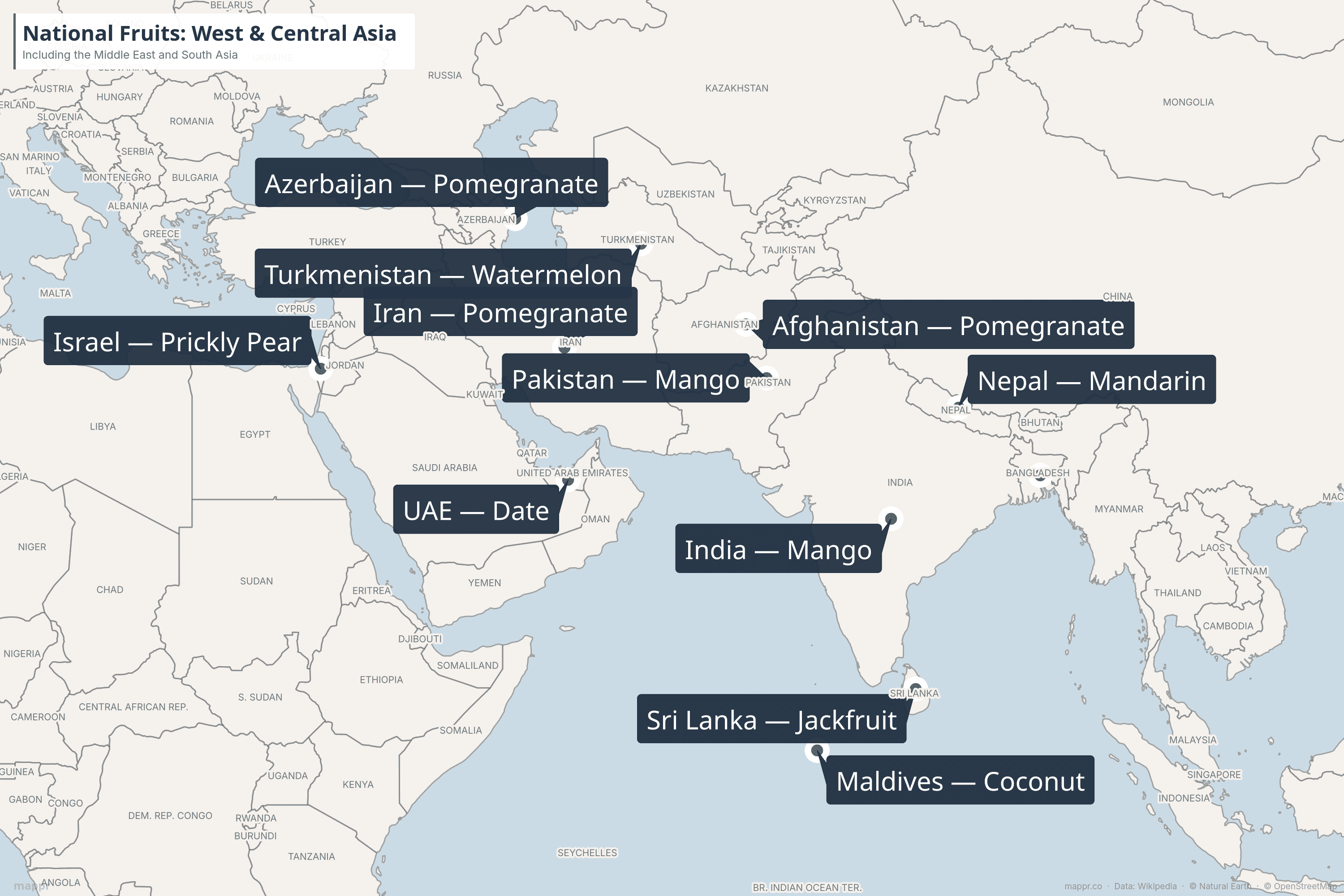
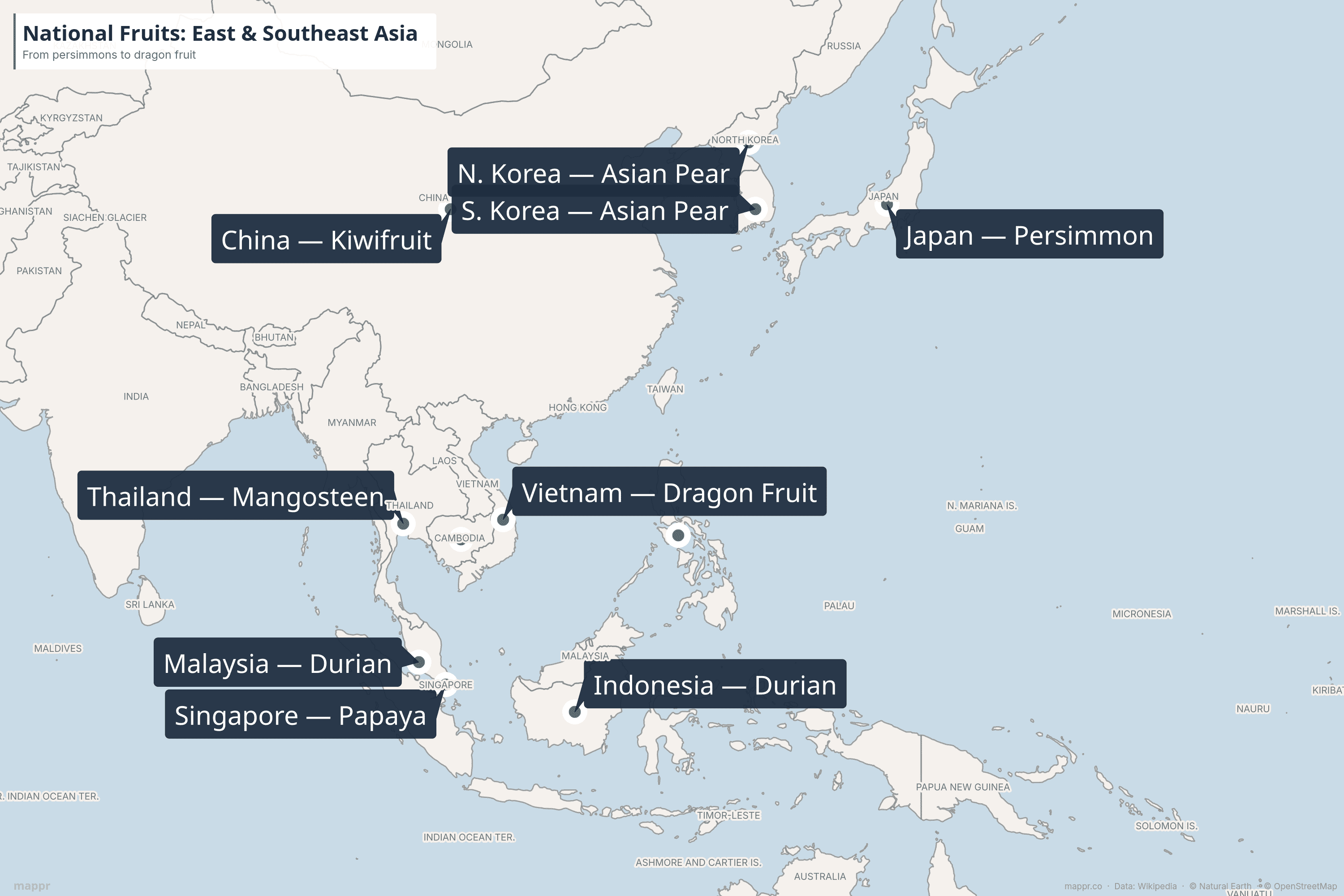
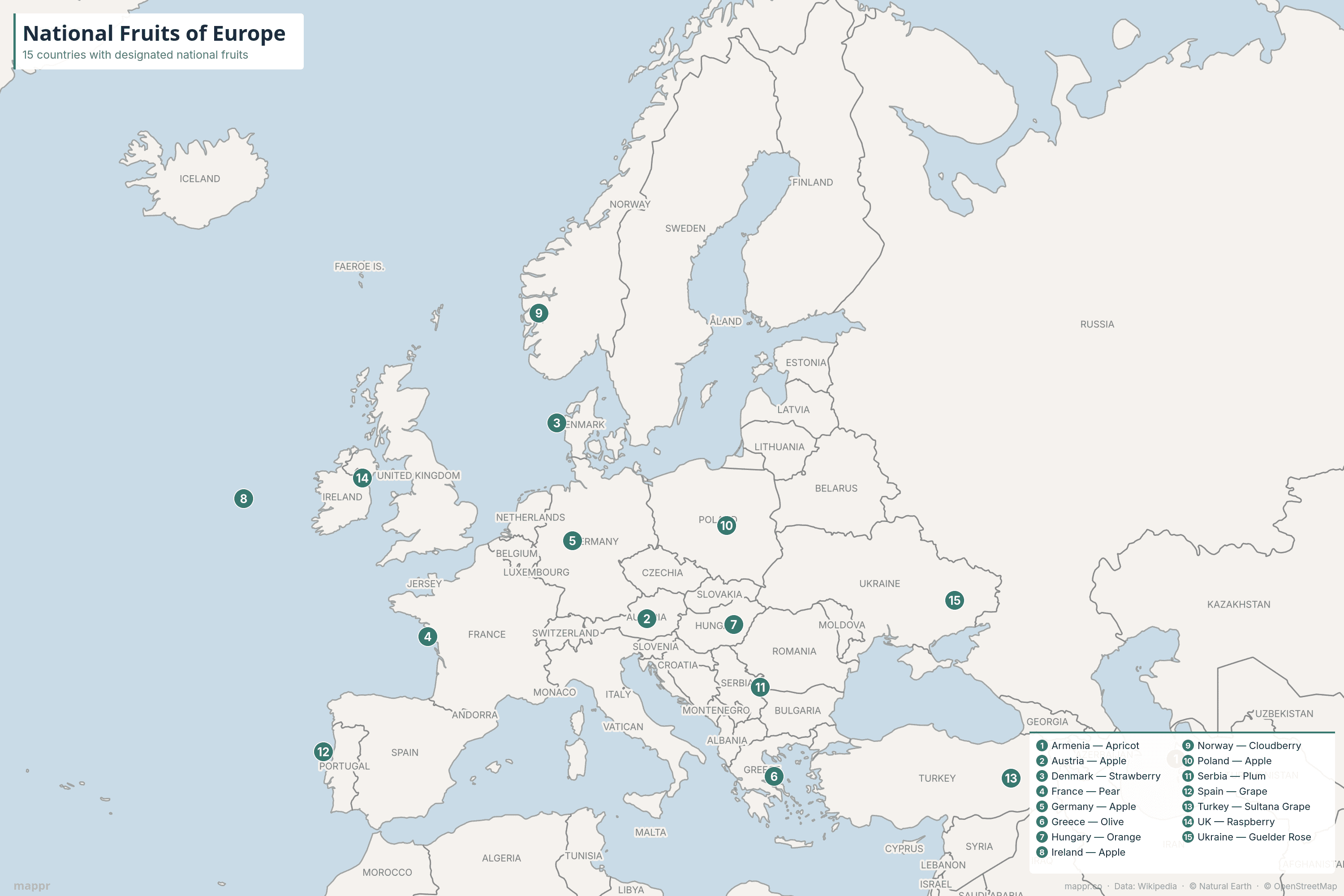
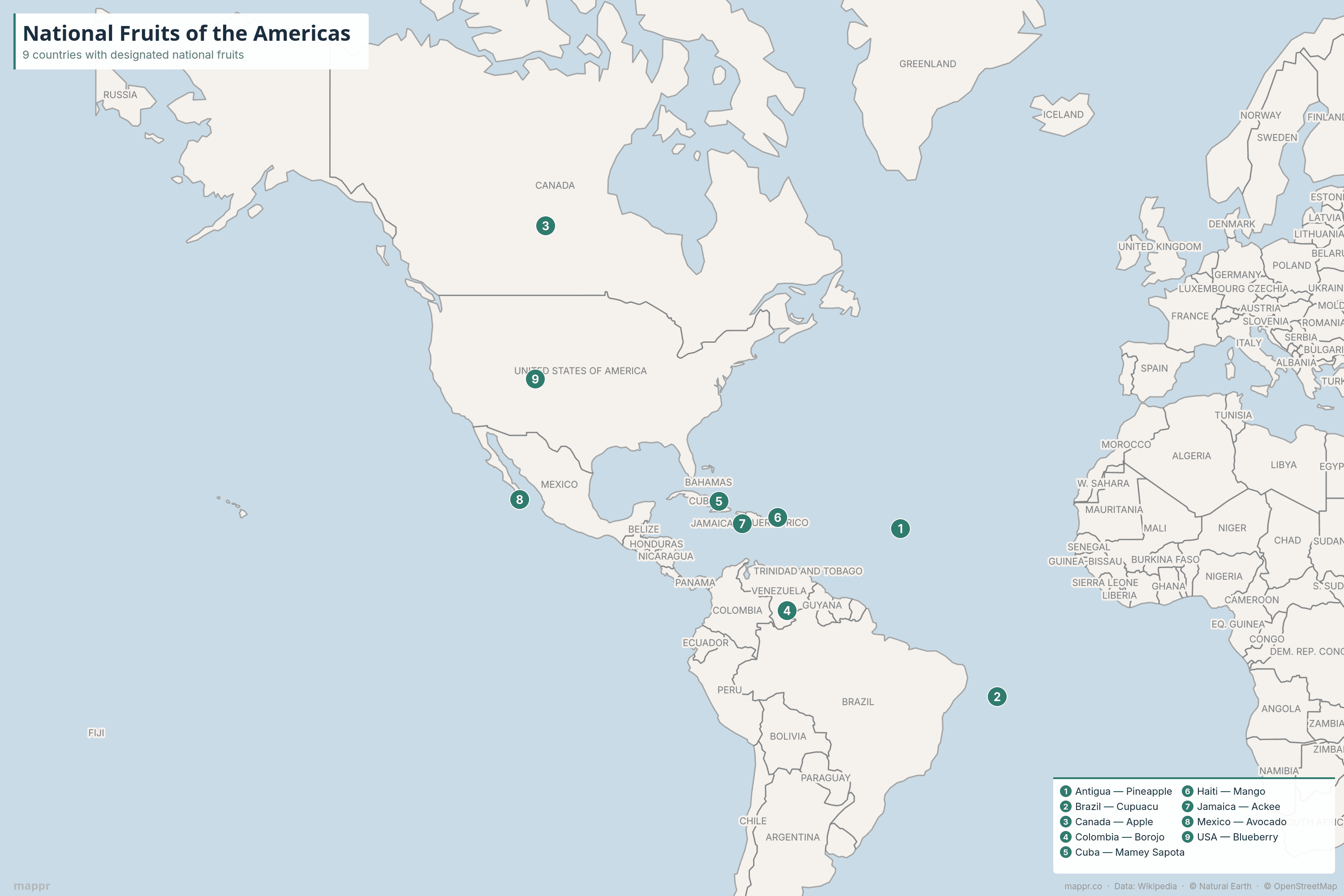
With 50 countries spanning every continent, a single world map gets crowded fast. These regional maps let you explore each area in detail. Click any map to zoom in.
West & Central Asia
East & Southeast Asia
Europe
Americas
Africa
Oceania
Summary Table: All National Fruits
| Country | National Fruit | Scientific Name | Status |
|---|---|---|---|
| 🇦🇫 Afghanistan | Pomegranate | Punica granatum | Official |
| 🇦🇬 Antigua & Barbuda | Pineapple | Ananas comosus | Official |
| 🇦🇲 Armenia | Apricot | Prunus armeniaca | Cultural |
| 🇦🇹 Austria | Apple | Malus domestica | Cultural |
| 🇦🇺 Australia | Riberry | Syzygium luehmannii | Cultural |
| 🇦🇿 Azerbaijan | Pomegranate | Punica granatum | Cultural |
| 🇧🇩 Bangladesh | Jackfruit | Artocarpus heterophyllus | Official |
| 🇧🇷 Brazil | Cupuaçu | Theobroma grandiflorum | Cultural |
| 🇨🇦 Canada | McIntosh Apple | Malus domestica | Unofficial |
| 🇨🇫 Central African Republic | Banana | Musa acuminata | Cultural |
| 🇨🇳 China | Kiwifruit | Actinidia chinensis | Cultural |
| 🇨🇴 Colombia | Borojó | Alibertia patinoi | Cultural |
| 🇨🇺 Cuba | Mamey Sapota | Pouteria sapota | Cultural |
| 🇩🇰 Denmark | Strawberry | Fragaria × ananassa | Cultural |
| 🇫🇷 France | Pear | Pyrus communis | Cultural |
| 🇩🇪 Germany | Apple | Malus domestica | Cultural |
| 🇬🇷 Greece | Olive | Olea europaea | Cultural |
| 🇭🇹 Haiti | Mango | Mangifera indica | Cultural |
| 🇭🇺 Hungary | Orange | Citrus sinensis | Cultural |
| 🇮🇳 India | Mango | Mangifera indica | Official |
| 🇮🇩 Indonesia | Durian | Durio zibethinus | Unofficial |
| 🇮🇷 Iran | Pomegranate | Punica granatum | Cultural |
| 🇮🇪 Ireland | Apple | Malus domestica | Cultural |
| 🇮🇱 Israel | Prickly Pear | Opuntia | Cultural |
| 🇯🇲 Jamaica | Ackee | Blighia sapida | Official |
| 🇯🇵 Japan | Persimmon | Diospyros kaki | Cultural |
| 🇰🇭 Cambodia | Chicken Egg Banana | Musa aromatica | Official |
| 🇲🇾 Malaysia | Durian | Durio zibethinus | Cultural |
| 🇲🇻 Maldives | Coconut | Cocos nucifera | Cultural |
| 🇲🇽 Mexico | Avocado | Persea americana | Cultural |
| 🇳🇵 Nepal | Mandarin Orange | Citrus reticulata | Official |
| 🇳🇿 New Zealand | Kiwifruit | Actinidia deliciosa | Cultural |
| 🇰🇵 North Korea | Asian Pear | Pyrus pyrifolia | Cultural |
| 🇳🇴 Norway | Cloudberry | Rubus chamaemorus | Cultural |
| 🇵🇰 Pakistan | Mango | Mangifera indica | Cultural |
| 🇵🇭 Philippines | Mango | Mangifera indica | Official |
| 🇵🇱 Poland | Apple | Malus Mill. | Cultural |
| 🇷🇸 Serbia | Plum | Prunus domestica | Cultural |
| 🇸🇬 Singapore | Papaya | Carica papaya | Cultural |
| 🇰🇷 South Korea | Asian Pear | Pyrus pyrifolia | Cultural |
| 🇪🇸 Spain | Grape | Vitis vinifera | Cultural |
| 🇱🇰 Sri Lanka | Jackfruit | Artocarpus heterophyllus | Cultural |
| 🇹🇭 Thailand | Mangosteen | Garcinia mangostana | Cultural |
| 🇹🇷 Turkey | Sultana Grape | Vitis vinifera | Cultural |
| 🇹🇲 Turkmenistan | Watermelon | Citrullus lanatus | Official |
| 🇺🇦 Ukraine | Guelder Rose | Viburnum opulus | Cultural |
| 🇦🇪 UAE | Date | Phoenix dactylifera | Cultural |
| 🇬🇧 United Kingdom | Raspberry | Rubus idaeus | Cultural |
| 🇺🇸 United States | Blueberry | Vaccinium corymbosum | Unofficial |
| 🇻🇳 Vietnam | Dragon Fruit | Hylocereus undatus | Cultural |
🌏 Asia (23 Countries)
Asia claims the lion’s share of national fruits, with 23 countries across the continent choosing a fruit as their symbol. The tropical climate of South and Southeast Asia makes this region an extraordinary hotspot of fruit biodiversity — and fruit culture.
🇮🇳 India — Mango
Fruit: Mango (Mangifera indica)
Status: Official national fruit since 1950
The mango is the undisputed “King of Fruits” in India, and for good reason. India produces over 40% of the world’s mangoes, growing more than 1,000 named varieties — from the buttery Alphonso to the fiber-rich Langra. Mangoes have been cultivated on the Indian subcontinent for over 5,000 years, appearing in ancient Sanskrit literature, Buddhist texts, and Mughal garden designs. The fruit is deeply woven into festivals (it’s essential during summer celebrations), religious offerings, and even diplomatic gifts — Indian prime ministers have historically sent crates of premium Alphonso mangoes to world leaders.
🇵🇰 Pakistan — Mango
Fruit: Mango (Mangifera indica)
Status: Cultural symbol (Guava is the unofficial winter fruit)
Pakistan is the world’s sixth-largest mango producer, and the Sindhri and Chaunsa varieties are considered among the finest on Earth. Mango season (May–August) is a cultural event — families gather for mango feasts, mango desserts dominate restaurant menus, and the fruit is the centerpiece of summer socializing. Pakistan and India share this national fruit, a rare common thread between the two rivals.
🇵🇭 Philippines — Mango
Fruit: Mango (Mangifera indica) — specifically the Carabao (Manila) mango
Status: Official national fruit
The Philippine Carabao mango once held the Guinness World Record for sweetest mango. Grown primarily on the island of Guimaras, this variety has a creamy, almost custard-like flesh with no fibrous strings. The Philippines exports dried mangoes worldwide, and the fruit appears in everything from shakes to the popular mango float dessert. It was declared the national fruit for its economic importance and its role as a culinary ambassador for the country.
🇧🇩 Bangladesh — Jackfruit
Fruit: Jackfruit (Artocarpus heterophyllus)
Status: Official national fruit
The jackfruit is the largest tree-borne fruit in the world, with individual specimens reaching up to 55 kg (120 lbs). In Bangladesh, jackfruit trees grow in virtually every village, providing food, timber, and shade. The ripe fruit is sweet and fragrant; unripe, it’s cooked as a vegetable in curries. Bangladesh chose jackfruit because of its ubiquity and its role as a critical food source for the rural poor — it’s sometimes called the “poor man’s fruit” for its affordability and nutrition.
🇱🇰 Sri Lanka — Jackfruit
Fruit: Jackfruit (Artocarpus heterophyllus)
Status: Widely recognized cultural symbol
Sri Lanka shares the jackfruit with Bangladesh, and the fruit is equally beloved here. Known locally as “kos”, jackfruit is central to Sri Lankan cuisine — the tender young fruit is used in curries, while ripe segments are eaten fresh or turned into preserves. The wood of the jackfruit tree is also prized for furniture-making and is used to craft traditional drums.
🇦🇫 Afghanistan — Pomegranate
Fruit: Pomegranate (Punica granatum)
Status: Official national symbol
Afghan pomegranates, particularly the Kandahari variety, are renowned worldwide for their deep ruby color and exceptional sweetness. Pomegranate cultivation in Afghanistan dates back thousands of years, and the fruit appears in Persian poetry, wedding ceremonies, and medicine. The Kandahar region alone produces an estimated 600,000 tonnes annually, and Afghan pomegranates are exported to India, Pakistan, and the UAE. The fruit symbolizes prosperity and abundance in Afghan culture.
🇦🇿 Azerbaijan — Pomegranate
Fruit: Pomegranate (Punica granatum)
Status: Cultural symbol
Azerbaijan calls itself the “Land of Fire”, but it could just as easily be the “Land of Pomegranates.” The Goychay district hosts an annual Pomegranate Festival every November, celebrating the harvest with tastings, competitions, and folk performances. The fruit features prominently in Azerbaijani cuisine — pomegranate syrup (narsharab) is drizzled over grilled meats and fish. The pomegranate motif appears across Azerbaijani art, carpets, and architecture.
🇮🇷 Iran — Pomegranate
Fruit: Pomegranate (Punica granatum)
Status: Ancient cultural symbol
Iran is one of the oldest centers of pomegranate cultivation in the world. The fruit has been a symbol of fertility, immortality, and abundance in Persian culture for over 4,000 years, appearing in Zoroastrian rituals, Nowruz (Persian New Year) celebrations, and classical poetry by Rumi and Hafiz. Iran remains one of the world’s top pomegranate producers, with the Saveh and Ferdows regions renowned for premium varieties.
🇲🇾 Malaysia — Durian
Fruit: Durian (Durio zibethinus)
Status: Cultural symbol
The durian — often called the “King of Fruits” in Southeast Asia — is as divisive as it is beloved. Its custard-like flesh has a rich, complex flavor that devotees describe as divine, while its pungent aroma has earned it bans from hotels, airports, and public transit across Asia. Malaysia’s Musang King variety commands premium prices (up to $50 per fruit), and “durian tourism” draws visitors from China and Singapore to Malaysian orchards during season. The iconic Esplanade concert hall in Singapore was designed to resemble a durian.
🇮🇩 Indonesia — Durian
Fruit: Durian (Durio zibethinus)
Status: Unofficial but iconic
Indonesia is the world’s largest producer of durian, growing dozens of regional varieties across Sumatra, Kalimantan, and Java. While Malaysia’s Musang King gets the international headlines, Indonesian durians like Monthong and Petruk have passionate local followings. The fruit is central to Indonesian food culture — eaten fresh, fermented into tempoyak, or processed into candies, ice cream, and even durian-flavored coffee.
🇹🇭 Thailand — Mangosteen
Fruit: Mangosteen (Garcinia mangostana)
Status: Cultural symbol — “Queen of Fruits”
If durian is the King, then mangosteen is the Queen of Fruits. Thailand is the world’s largest exporter of mangosteens, and the fruit’s snow-white, juicy segments hidden inside a thick purple rind are considered one of nature’s most perfect flavors — sweet, tangy, and floral. Legend has it that Queen Victoria offered a bounty to anyone who could deliver fresh mangosteens to her court, as the fruit didn’t survive the long sea voyage from Asia to Britain.
🇰🇭 Cambodia — Chicken Egg Banana
Fruit: Chicken Egg Banana (Musa aromatica)
Status: Official (Royal Decree)
Cambodia designated this small, sweet banana variety as its national fruit by Royal Decree. Named for its egg-like shape and golden color, the Chicken Egg Banana (chek pong moan in Khmer) has an aromatic, honey-sweet flavor. While bananas are staples across Southeast Asia, this specific variety is particularly prized in Cambodia for offerings at Buddhist temples and as a symbol of prosperity.
🇻🇳 Vietnam — Dragon Fruit
Fruit: Dragon Fruit / Pitaya (Hylocereus undatus)
Status: Major export symbol
Vietnam is the world’s largest exporter of dragon fruit, and the stunning pink-skinned, white-fleshed fruit has become synonymous with Vietnamese agriculture. Grown primarily in Bình Thuận province, dragon fruit transformed this once-arid region into one of Vietnam’s wealthiest agricultural zones. The cactus fruit thrives in the hot, dry climate and has become Vietnam’s most valuable fruit export, shipped to China, the US, and Europe.
🇨🇳 China — Kiwifruit
Fruit: Fuzzy Kiwifruit (Actinidia chinensis var. deliciosa)
Status: Cultural recognition (Jujube also recognized)
While New Zealand made the kiwifruit famous, the fruit originated in China — specifically in the Yangtze River valley, where it grew wild for millennia. Chinese farmers call it mihoutao (macaque peach). Seeds were taken to New Zealand in 1904, where the fruit was commercialized and rebranded. Today, China is the world’s largest kiwifruit producer by a wide margin, reclaiming the fruit that was always theirs.
🇯🇵 Japan — Persimmon
Fruit: Japanese Persimmon (Diospyros kaki)
Status: Cultural symbol of autumn
The persimmon, or kaki, is the quintessential fruit of Japanese autumn. Its bright orange color against fall foliage is one of Japan’s most iconic seasonal scenes. Persimmons appear in Japanese art dating back centuries, from woodblock prints to haiku (the poet Shiki’s famous verse: “I eat a persimmon / and a bell starts ringing / at Hōryūji temple”). The dried variety, hoshigaki, is a traditional delicacy requiring weeks of careful hand-drying.
🇰🇷 South Korea — Asian Pear
Fruit: Asian Pear (Pyrus pyrifolia)
Status: Major crop and cultural symbol
Korean pears (bae) are large, crisp, and juicy — more like apples in texture than the soft European pear. They’re a premium gift fruit in Korean culture, often presented in beautifully wrapped boxes during Chuseok (harvest festival) and Lunar New Year. Korean pears are also essential in the kitchen: grated pear is the secret ingredient in Korean BBQ marinades, tenderizing meat while adding subtle sweetness.
🇰🇵 North Korea — Asian Pear
Fruit: Asian Pear (Pyrus pyrifolia)
Status: Cultural symbol
North Korea shares the Asian pear with its southern neighbor — one of the few cultural symbols the divided peninsula still has in common. The city of Naju in the Korean Peninsula has been famous for pear cultivation since the Joseon Dynasty. Despite political division, the pear remains a unifying agricultural heritage for both Koreas.
🇳🇵 Nepal — Mandarin Orange
Fruit: Mandarin Orange (Citrus reticulata)
Status: Official since 2024
Nepal officially designated the mandarin orange as its national fruit in 2024. Grown in the mid-hills at elevations between 750–1,400 meters, Nepali mandarins are prized for their sweetness and aroma. The fruit is a critical cash crop for hill farmers, and the annual harvest season transforms local markets into fragrant orange bazaars. Mandarin cultivation supports roughly 200,000 farming families across Nepal’s middle hills.
🇮🇱 Israel — Sabra (Prickly Pear)
Fruit: Sabra / Prickly Pear Cactus Fruit (Opuntia)
Status: Cultural symbol
The prickly pear — thorny on the outside, sweet on the inside — has become the defining metaphor for Israeli-born Jews, who are commonly called “sabras.” The cactus fruit grows wild across the Israeli landscape, thriving in the arid climate. Its symbolism captures the national character: tough and resilient on the exterior, warm and generous within. Prickly pear cacti also serve as living markers of destroyed Palestinian villages, their long-lasting hedgerows outliving the structures they once bordered.
🇦🇪 United Arab Emirates — Date
Fruit: Date (Phoenix dactylifera)
Status: Cultural and economic importance
The date palm is the tree of life in Arabian culture. The UAE has over 42 million date palms — one of the highest concentrations in the world — and the country produces over 300 varieties. Dates are central to Ramadan traditions (the fast is broken with dates), hospitality (offered to guests with Arabic coffee), and national identity. The date palm appears on the UAE’s coat of arms, currency, and stamps.
🇹🇲 Turkmenistan — Watermelon
Fruit: Watermelon (Citrullus lanatus)
Status: Official — has its own national holiday
Turkmenistan’s love for watermelon is unmatched anywhere on Earth. The country celebrates Watermelon Day on the second Sunday of August, a national holiday featuring watermelon tastings, competitions, music, and cultural performances. The Turkmen watermelon, particularly varieties from the Dashoguz region, are celebrated for their exceptional sweetness. Former president Gurbanguly Berdimuhamedow once declared Turkmen watermelons “the source of health and energy,” and the holiday was formally established to honor this beloved fruit.
🇲🇻 Maldives — Coconut
Fruit: Coconut (Cocos nucifera)
Status: Essential to island economy
On the Maldives’ 1,192 low-lying coral islands, the coconut palm is nothing short of a lifeline. Every part is used: the fruit for drinking water and cooking, the flesh for oil, the husk for rope and fuel, the fronds for thatching and weaving. Coconut palms provide shade, prevent coastal erosion, and generate income through copra exports. The palm appears on the Maldivian coat of arms, and raa (toddy tapped from the palm’s flower) is the islands’ traditional drink.
🇸🇬 Singapore — Papaya
Fruit: Papaya (Carica papaya)
Status: Cultural association
Papaya has long been associated with Singapore’s multicultural food heritage. The tropical fruit grows easily in Singapore’s equatorial climate and appears across the city-state’s diverse cuisines — in Malay rujak (spicy fruit salad), Chinese soups, and Indian chutneys. While Singapore is perhaps better known for its durian obsession, the humble papaya remains the fruit most commonly grown in home gardens and community plots across the island.
🌍 Europe (15 Countries)
Europe’s national fruits tend toward the temperate — apples, pears, berries, and stone fruits dominate. But the continent also boasts some surprises, from Norway’s Arctic cloudberry to Greece’s ancient olive.
🇦🇲 Armenia — Apricot
Fruit: Apricot (Prunus armeniaca)
Status: National symbol
The apricot’s scientific name literally means “Armenian plum” — a testament to Armenia’s ancient association with this golden fruit. The apricot is so central to Armenian identity that its warm orange color features on the Armenian flag (the bottom stripe). Armenian apricot orchards, especially in the Ararat Valley, produce some of the world’s most flavorful varieties. The fruit features in Armenian brandy, dried fruit exports, and the traditional instrument duduk, which is carved from apricot wood.
🇩🇪 Germany — Apple
Fruit: Apple (Malus domestica)
Status: Cultural symbol
Germany is one of Europe’s largest apple producers, and the fruit is deeply embedded in German culture — from Apfelstrudel to Apfelwein (apple wine), the specialty of Frankfurt’s Sachsenhausen district. The historic “Altes Land” (Old Land) region near Hamburg is Europe’s largest contiguous fruit orchard, with over 18 million apple trees. Germany cultivates hundreds of heritage varieties, and the apple remains the country’s most consumed fruit by a wide margin.
🇦🇹 Austria — Apple
Fruit: Apple (Malus domestica)
Status: Cultural symbol
Austria’s Styria region is famous for its apple orchards and produces the prized Steirischer Apfel. Austrian apple culture centers on cider, strudel, and the traditional Most (apple must) of the Alpine regions. The country cultivates over 1,000 apple varieties, many preserved by dedicated heritage orchardists.
🇵🇱 Poland — Apple
Fruit: Apple (Malus Mill.)
Status: Cultural and economic importance
Poland is the largest apple producer in the European Union and one of the top five globally, harvesting over 4 million tonnes annually. When Russia banned Polish food imports in 2014, the country rallied around the hashtag #jedzjablka (“eat apples”), turning apple consumption into a patriotic act. Polish apples are now exported across Europe, Asia, and beyond.
🇮🇪 Ireland — Apple
Fruit: Apple — specifically Cox’s Orange Pippin (Malus domestica)
Status: Cultural symbol
Ireland’s association with apples runs deep — the Armagh region in Northern Ireland is known as the “Orchard of Ireland,” with apple cultivation dating back to the arrival of Cistercian monks in the 12th century. The Cox’s Orange Pippin, with its complex, aromatic flavor, is the most celebrated variety. Irish cider-making has experienced a renaissance in recent years, with craft producers reviving heritage apple varieties.
🇬🇷 Greece — Olive
Fruit: Olive (Olea europaea)
Status: Ancient cultural significance
The olive is arguably the most historically significant fruit in Western civilization. In ancient Athens, the olive tree was sacred to the goddess Athena, and cutting down an olive tree was punishable by death. Greece has an estimated 120 million olive trees — about 11 trees for every citizen — and olive oil is the backbone of the Mediterranean diet. Some olive trees on Crete are estimated to be over 3,000 years old and still producing fruit.
🇪🇸 Spain — Grape
Fruit: Grape (Vitis vinifera)
Status: Cultural symbol
Spain has the largest area of vineyard in the world — over 1 million hectares — and produces more wine grapes than any other nation except France and Italy. The grape is central to one of Spain’s most famous traditions: on New Year’s Eve, Spaniards eat 12 grapes at midnight (one per clock chime), each representing a wish for the coming year. With over 400 grape varietals cultivated, from Tempranillo to Albariño, the grape is deeply woven into Spanish identity.
🇹🇷 Turkey — Sultana Grape
Fruit: Sultana Grape (Vitis vinifera)
Status: Cultural and economic importance
Turkey is the world’s largest producer of raisins and sultanas, and the Sultana grape — named after the Ottoman Sultans — is the country’s grape of choice. The Aegean region, particularly around Manisa and Izmir, produces the bulk of Turkey’s dried grape output. Turkey’s grape heritage stretches back to ancient Anatolia, one of the cradles of viticulture.
🇫🇷 France — Pear
Fruit: Pear (Pyrus communis)
Status: Cultural symbol
While France is renowned for wine (grapes), its national fruit is the pear. France developed many of the world’s most popular pear varieties, including Williams’ Bon Chrétien (Bartlett) and Conférence. The pear features prominently in French cuisine — Poire Belle Hélène (poached pear with chocolate), tarte aux poires, and the celebrated pear brandy Poire Williams. The Loire Valley and Provence are France’s premier pear-growing regions.
🇷🇸 Serbia — Plum
Fruit: Plum (Prunus domestica)
Status: Cultural symbol
Serbia is the world’s second-largest plum producer, and plums are as Serbian as it gets. The national drink, šljivovica (plum brandy), is a cornerstone of Serbian hospitality — no celebration, feast, or family gathering is complete without it. With over 70 million plum trees, Serbia has roughly 10 trees per citizen. The saying goes: “A true Serb is born, married, and buried under a plum tree.”
🇳🇴 Norway — Cloudberry
Fruit: Cloudberry (Rubus chamaemorus)
Status: National treasure
The cloudberry is one of the world’s most exclusive and elusive fruits. It grows only in Arctic and subarctic bogs above the 60th parallel, ripening for just 2–3 weeks in late summer. Norwegians call it molte or “Arctic gold,” and foraging spots are closely guarded family secrets — in some areas, it’s illegal to pick cloudberries on someone else’s land. The golden, honey-flavored berries are served with cream as a prized dessert (multekrem) and appear on the Norwegian 1-krone coin design.
🇩🇰 Denmark — Strawberry
Fruit: Strawberry (Fragaria × ananassa)
Status: Cultural symbol
Danish strawberries are synonymous with midsummer celebrations. The Danish summer strawberry season (June–July) is a cultural event, with roadside stands appearing across the countryside. Danish jordbær are considered some of Europe’s finest due to the cool climate and long daylight hours, which develop intense flavor and natural sweetness. Strawberries with cream are the classic Danish summer dessert.
🇺🇦 Ukraine — Guelder Rose
Fruit: Guelder Rose / Water Elder berry (Viburnum opulus)
Status: National symbol in folklore
The guelder rose (kalyna) is one of Ukraine’s most important national symbols, appearing in folk songs, embroidery, poetry, and wedding traditions for centuries. Its clusters of bright red berries symbolize beauty, love, and the Ukrainian homeland. The kalyna features in the beloved folk song “Oi u luzi chervona kalyna” (Oh, the Red Kalyna in the Meadow), which became an anthem of Ukrainian resistance. The berries are used to make traditional preserves, syrups, and medicinal teas.
🇭🇺 Hungary — Orange
Fruit: Orange (Citrus sinensis)
Status: Cultural designation
Hungary’s choice of the orange as its national fruit is perhaps the most surprising on this list, given the country’s continental climate. The association dates to the Hungarian tradition of citrus greenhouses (narancsházak) in aristocratic estates during the 17th–19th centuries, when oranges were precious luxury items. The orange is celebrated in the famous Christmas market tradition of giving oranges as gifts, symbolizing prosperity and good fortune.
🇬🇧 United Kingdom — Raspberry
Fruit: Raspberry (Rubus idaeus)
Status: Cultural symbol (Apple also claimed)
While some sources cite the apple, the raspberry has a strong claim as Britain’s national fruit. Scotland is one of the world’s premier raspberry-growing regions, with the Tayside area (around Dundee) once producing 90% of Europe’s raspberries. British raspberry varieties like Glen Ample and Tulameen are celebrated for their intense flavor. Raspberries are essential to classic British desserts — from Eton mess to summer pudding and raspberry fool.
🌎 Americas (9 Countries)
The Americas showcase an incredible range of national fruits, from globally ubiquitous crops like avocado and pineapple to exotic rainforest species most of the world has never heard of.
🇲🇽 Mexico — Avocado
Fruit: Avocado (Persea americana)
Status: Cultural and economic cornerstone
Mexico is the world’s largest avocado producer, growing over 2 million tonnes annually — and the fruit originated here. Archaeological evidence shows avocados were consumed in the Tehuacan Valley as early as 10,000 BC. The word “avocado” comes from the Nahuatl (Aztec) word ahuacatl. Today, the state of Michoacán produces over 80% of Mexico’s avocados, and the crop has become so valuable it’s sometimes called “green gold”. Guacamole, of course, is the national preparation.
🇯🇲 Jamaica — Ackee
Fruit: Ackee (Blighia sapida)
Status: Official national fruit
Ackee is unlike any other national fruit on this list — it’s toxic when unripe (containing hypoglycin A, which can cause “Jamaican vomiting sickness”) and is cooked and eaten as a savory dish rather than a sweet fruit. Paired with saltfish, ackee and saltfish is Jamaica’s national dish. The fruit was brought to the Caribbean from West Africa on slave ships in the 18th century and is named after Captain William Bligh (of Mutiny on the Bounty fame), who brought specimens to England’s Kew Gardens.
🇧🇷 Brazil — Cupuaçu
Fruit: Cupuaçu (Theobroma grandiflorum)
Status: Cultural symbol
Cupuaçu is a relative of cacao (they share the Theobroma genus, meaning “food of the gods”) native to the Amazon rainforest. Its creamy white pulp has a complex flavor described as a mix of chocolate, pineapple, and pear. Brazilians use it to make juice, ice cream, candies, and cosmetics. The fat from cupuaçu seeds (cupulate) has been touted as a potential chocolate alternative. It’s a quintessentially Amazonian fruit that represents Brazil’s extraordinary biodiversity.
🇨🇴 Colombia — Borojó
Fruit: Borojó (Alibertia patinoi)
Status: Cultural symbol
Borojó is a dense, chocolate-brown rainforest fruit native to Colombia’s Chocó region, one of the wettest and most biodiverse places on Earth. The fruit has an intense, tangy flavor and is traditionally consumed as a thick juice blended with milk and sugar. In Colombian folk medicine, borojó is renowned as an energy booster and aphrodisiac — it’s sometimes called “the Viagra of the jungle.” The indigenous Emberá people have cultivated it for centuries.
🇨🇺 Cuba — Mamey Sapota
Fruit: Mamey Sapota (Pouteria sapota)
Status: Traditional Cuban fruit
The mamey sapota has salmon-pink flesh with a sweet, creamy flavor often compared to sweet potato mixed with almond and honey. It’s the star ingredient in Cuba’s beloved batido de mamey (mamey milkshake) and is also used in ice cream and pastries. The fruit was cultivated by the pre-Columbian Maya and Aztec civilizations and remains deeply tied to Cuban and Caribbean food culture.
🇭🇹 Haiti — Mango
Fruit: Mango (Mangifera indica) — specifically the “Madame Francique” variety
Status: Cultural symbol
Haiti’s Madame Francique (or “Francique”) mango is one of the most prized mango varieties in the Western Hemisphere, known for its fiberless, buttery flesh and balanced sweetness. Haiti is the only Caribbean country that exports significant quantities of mangoes to the United States. The mango is both a critical food source and one of Haiti’s few successful export crops, providing income to thousands of smallholder farmers.
🇦🇬 Antigua and Barbuda — Pineapple
Fruit: Pineapple (Ananas comosus)
Status: Official symbol
The pineapple has been cultivated in the Caribbean since pre-Columbian times and was one of the first New World fruits encountered by European explorers. In Antigua and Barbuda, the “Antigua Black” pineapple is a prized local variety — smaller and sweeter than commercial types, with exceptionally tender flesh. Pineapples appear on the national coat of arms as a symbol of the islands’ agricultural heritage.
🇨🇦 Canada — McIntosh Apple
Fruit: McIntosh Apple (Malus domestica)
Status: Unofficial but iconic
The McIntosh apple was discovered in 1811 by John McIntosh on his farm in Dundela, Ontario — a single chance seedling that became one of North America’s most famous apple varieties. The “Mac” is characterized by its tart flavor, tender flesh, and distinctive aroma. It’s so iconic that Apple Inc. named its Macintosh computer line after it (with a deliberate spelling change). Though newer varieties have overtaken it commercially, the McIntosh remains a Canadian heritage symbol.
🇺🇸 United States — Blueberry
Fruit: Blueberry (Vaccinium corymbosum)
Status: Unofficial but widely recognized
The blueberry is one of the only commercially cultivated fruits native to North America. Indigenous peoples consumed wild blueberries for thousands of years before European contact, using them in pemmican (a concentrated food staple). Commercial blueberry cultivation was pioneered by Elizabeth White and Frederick Coville in New Jersey in 1916. Today, the US produces over 300 million pounds annually, with Maine, Michigan, and the Pacific Northwest leading production. July is National Blueberry Month.
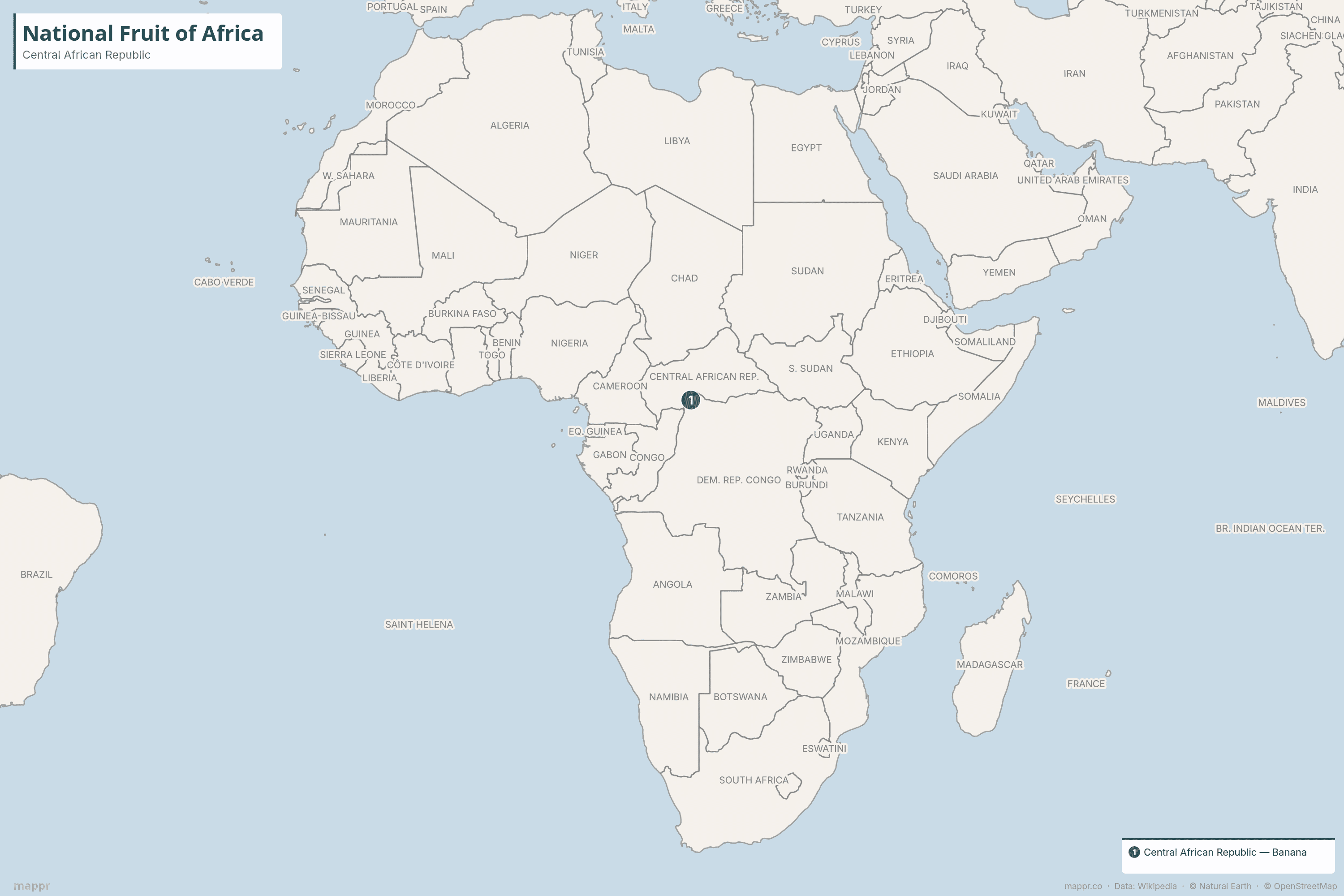
🌍 Africa (1 Country)
Africa has surprisingly few officially designated national fruits, despite being home to extraordinary fruit biodiversity. The banana is the sole clearly recognized national fruit on the continent.
🇨🇫 Central African Republic — Banana
Fruit: Banana (Musa acuminata)
Status: Staple crop and cultural symbol
In the Central African Republic, the banana is both a dietary staple and an economic lifeline. Plantains and cooking bananas form the foundation of the national diet, often prepared as gozo (pounded plantain paste) or fried. The banana plant is also valued for its leaves (used as natural wrapping and plates), its fiber, and its ability to grow year-round in the country’s tropical climate. While many African nations depend heavily on specific fruits, the CAR is one of the few to formally recognize one.
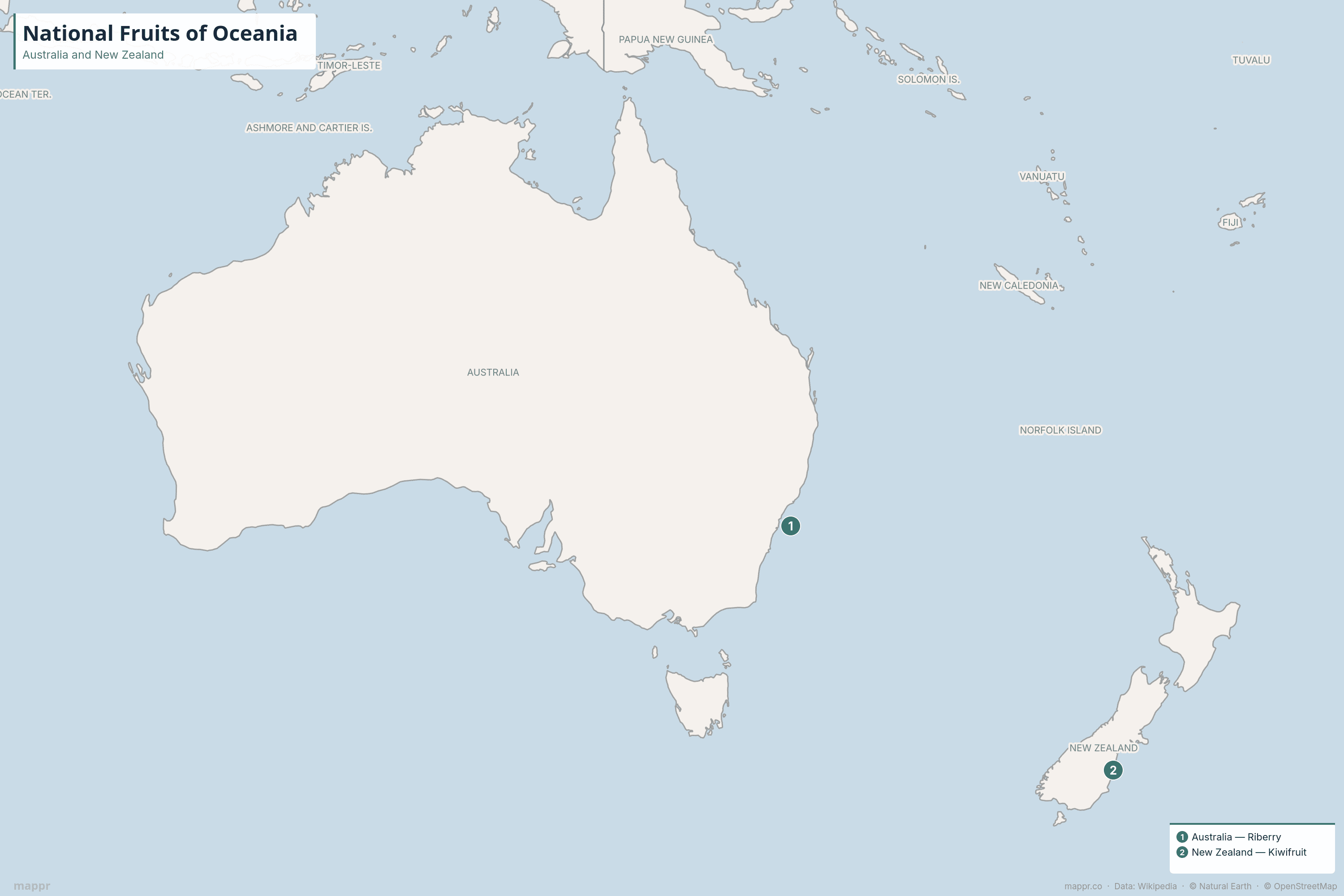
🌏 Oceania (2 Countries)
Oceania’s two entries showcase contrasting fruit stories — one native, one adopted.
🇳🇿 New Zealand — Kiwifruit
Fruit: Kiwifruit (Actinidia deliciosa)
Status: Cultural and economic icon
The kiwifruit is perhaps the greatest fruit rebranding success story in history. Originally from China (where it was called “yang tao” or Chinese gooseberry), seeds were brought to New Zealand in 1904. Kiwi growers renamed it “kiwifruit” in 1959 for marketing purposes — and it worked spectacularly. New Zealand’s cooperative Zespri is now the world’s largest marketer of kiwifruit, and the fruit has become so synonymous with the country that New Zealanders themselves are nicknamed “Kiwis.” The Bay of Plenty region produces the bulk of the crop.
🇦🇺 Australia — Riberry
Fruit: Riberry (Syzygium luehmannii)
Status: Cultural recognition (native bush fruit)
The riberry is a native Australian bush food — a small, bright pink, pear-shaped berry with a tart, clove-like flavor. It’s part of the growing “bush tucker” movement that celebrates indigenous Australian ingredients. Riberries grow wild in the subtropical rainforests of Queensland and New South Wales and have been consumed by Aboriginal Australians for thousands of years. Today, they’re used by high-end Australian restaurants and appear in jams, sauces, and gin infusions. While not as commercially famous as some national fruits, the riberry represents Australia’s unique native food heritage.
Fun Facts & Surprising Connections
- The King and Queen: In Southeast Asia, durian is the “King of Fruits” and mangosteen is the “Queen.” They even ripen in the same season — Thais traditionally eat mangosteen after durian to “cool” the body.
- Kiwi confusion: Both China and New Zealand claim the kiwifruit — China grew it for centuries, but NZ commercialized and named it. China is now the world’s largest producer, having reclaimed the fruit NZ made famous.
- One fruit, four nations: Mango is shared by India, Pakistan, the Philippines, and Haiti — the most of any national fruit.
- The deadly national fruit: Jamaica’s ackee is the only national fruit that can kill you if eaten unripe. Despite this, it’s the star of the national dish.
- Koreas united by fruit: Despite being technically at war, both North and South Korea share the Asian pear as their national fruit.
- Watermelon Day: Turkmenistan is the only country with a national holiday dedicated to its national fruit.
- Apple computer, apple fruit: Canada’s McIntosh apple inspired the name of the Apple Macintosh — and by extension, much of Apple Inc.’s product naming.
- Scientific name flex: Armenia is the only country whose national fruit’s scientific name (Prunus armeniaca) literally contains the country’s name.
- Olive immortality: Some olive trees in Greece are over 3,000 years old — and still producing fruit. The olive tree at Vouves, Crete, is an estimated 3,000–4,000 years old.
Methodology
This compilation draws from official government designations, widely recognized cultural associations, and cross-referenced encyclopedic sources. “Official” status means a government decree or law formally designates the fruit; “Cultural” or “Unofficial” means the fruit is widely recognized as a national symbol through tradition, cultural significance, or popular consensus without formal legislation. Data was compiled from Wikipedia, Grokipedia, Geocountries.com, and supplementary government sources.
Last updated: April 2026.
This post uses data from the following sources.
Primary Sources:
- List of national fruits – Wikipedia
- List of national fruits – Simple English Wikipedia
- National Fruits by Country – Geocountries
- List of national fruits – Grokipedia
Supplementary:
- FAO – World Food and Agriculture Statistical Yearbook – Food and Agriculture Organization of the United Nations


