Key Takeaways
- Sweden flipped, by the same knife-edge margin. The centre-left bloc won 176 seats to the right's 173, the exact mirror image of 2022's result. Magdalena Andersson is in pole position to return as prime minister.
- The Sweden Democrats fell to third. SD dropped from 20.5% to 17.5%, overtaken again by the Moderates. The party that spent the campaign demanding cabinet seats instead delivered the right bloc's defeat.
- The Liberals' great escape. Polling at 2-3% a week before the vote, the Liberals finished at 5.4%, comfortably over the 4% threshold, a surge of tactical votes that still wasn't enough to save the bloc.
- S largest everywhere, again. The Social Democrats topped the poll in every county, strongest in Norrbotten at 36.1%, repeating their all-21-counties sweep on our maps below. Turnout was 79.9%.
Sweden has voted, and flipped. In the election of 13 September 2026, the centre-left bloc led by Magdalena Andersson‘s Social Democrats took 176 of the Riksdag’s 349 seats against 173 for the governing right, precisely inverting the 2022 result. Below: the full result, how the system produced it, and the county maps of the two Swedens that faced off. (Figures are the preliminary count with ~95% of districts reported; the final tally lands this week.)
The state of the race
| Party | 2022 | Result 2026 | Seats | Profile |
|---|---|---|---|---|
| 🌹 Social Democrats (S) | 30.3% | 28.1% | 100 | Centre-left, Magdalena Andersson |
| 🔵 Moderates (M) | 19.1% | 19.9% | 70 | Centre-right, PM Ulf Kristersson |
| 🌼 Sweden Democrats (SD) | 20.5% | 17.5% | 62 | National-conservative, Jimmie Åkesson |
| 🟥 Left Party (V) | 6.8% | 8.2% | 29 | Left |
| 🍀 Centre Party (C) | 6.7% | 7.1% | 25 | Liberal-agrarian |
| ✝️ Christian Democrats (KD) | 5.3% | 6.2% | 22 | Christian-democratic, Ebba Busch |
| 🌿 Greens (MP) | 5.1% | 6.1% | 22 | Green |
| 🕊️ Liberals (L) | 4.6% | 5.4% | 19 | Liberal, Simona Mohamsson |
The Social Democrats under former PM Magdalena Andersson remain Sweden’s largest party by a wide margin and lead every poll. With a week to go, the pollsters disagree about how close it is: Novus puts the opposition bloc (S, Left, Greens and Centre) just 2.6 points ahead of PM Ulf Kristersson‘s governing constellation (50.3% to 47.7%), while SVT/Verian still sees a gap of around 8 points. What they agree on is the direction: the Social Democrats have slid late (as low as 25.8% in Novus, their weakest of the campaign), the Sweden Democrats have climbed to around 20-21% and second place, and the race is tightening by the week. Even Andersson concedes the narrowing is ‘no surprise’. Swedish elections have a habit of finishing closer than the summer polls, and this one is following the script.
How the system works (and why 4% is the magic number)
Sweden’s 349 Riksdag seats are allocated by proportional representation across 29 constituencies, with national adjustment seats that make the final result almost perfectly proportional. The catch is the 4% national threshold: a party below it gets nothing, and every vote for it effectively vanishes from the bloc arithmetic. That is why all eyes are on the Liberals, polling around 2.2%: if one of the government’s own parties drops out of parliament, Kristersson’s path to a majority narrows sharply. SD leader Jimmie Åkesson has even told right-wing voters to abandon the Liberals if they poll below 3.5% close to election day, a tactical call his Christian Democrat colleague Ebba Busch publicly rejected. A government’s survival may hinge on tactical votes lent to its smallest member.
The map: where each side wins
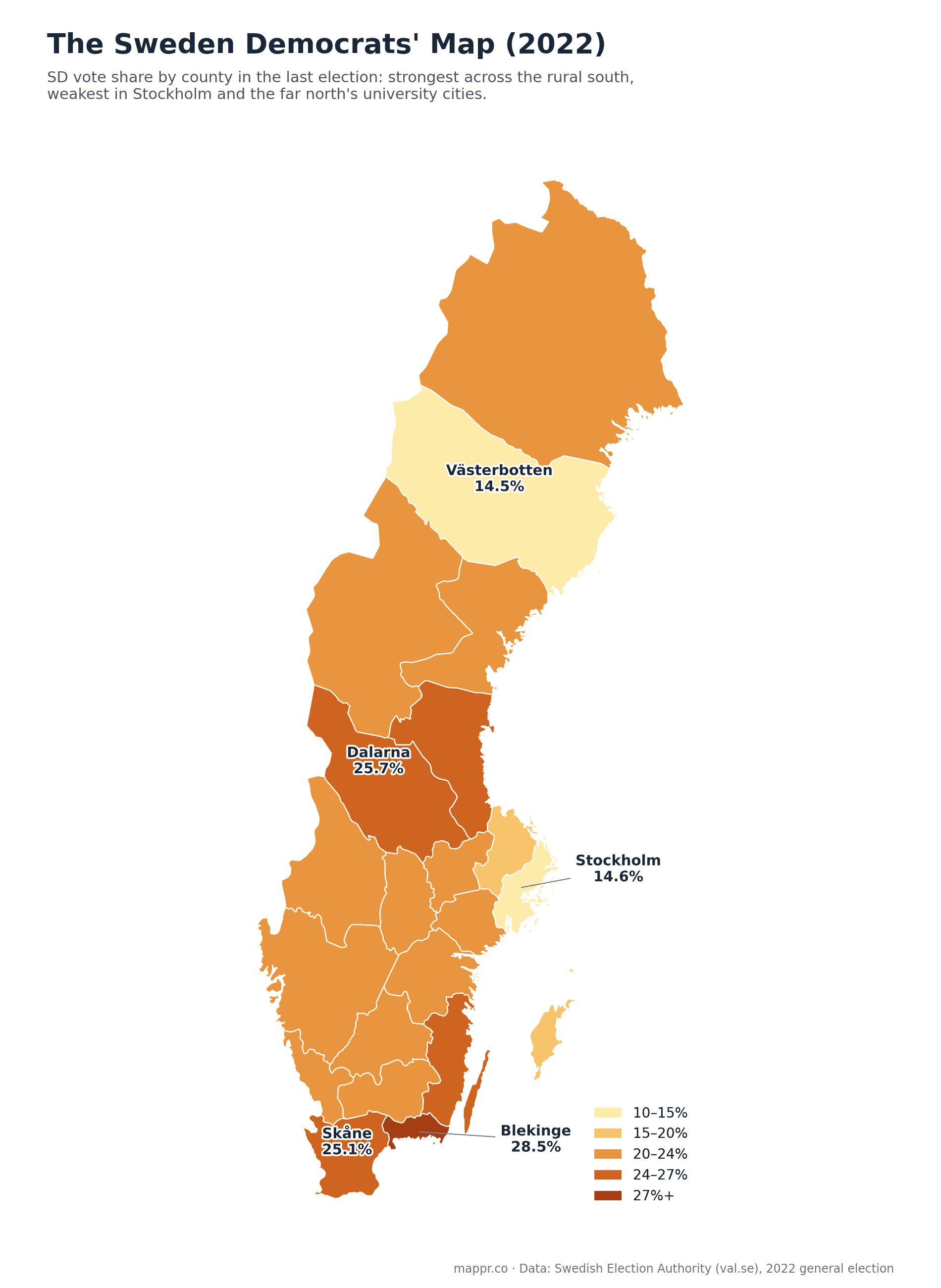
The Sweden Democrats’ geography is southern and rural. Their 2022 strongholds ran across Skåne and the neighbouring counties, peaking in Blekinge (28.5%), at constituency level they were the outright largest party in parts of Skåne, and stayed weakest in metropolitan Stockholm and the far-northern university belt. It is the classic European pattern: national-conservative strength where industry thinned out and distances to services grew.
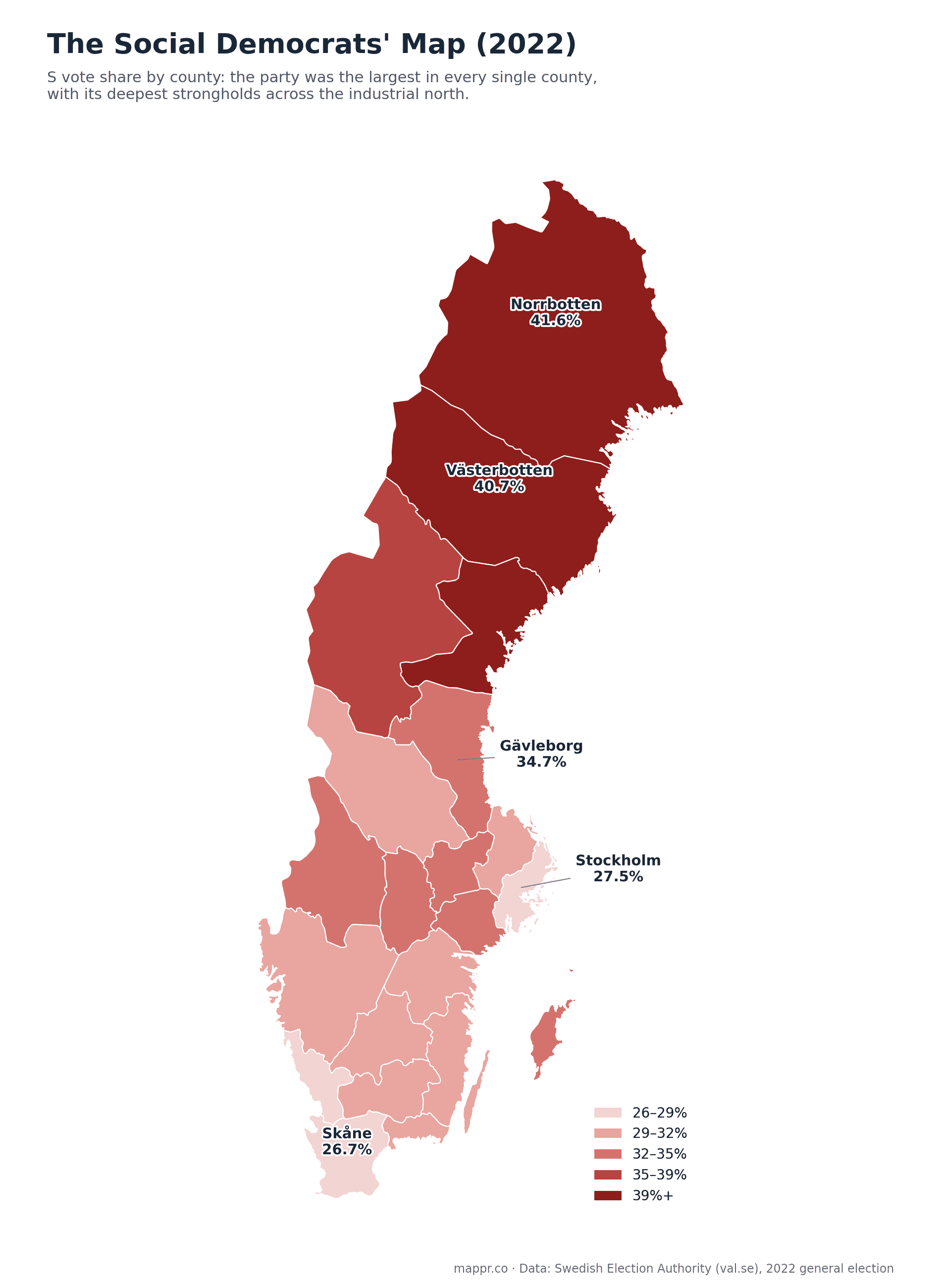
The Social Democrats’ map is the mirror image: in 2022 they finished as the largest party in every single county, but their deepest red runs through the industrial north, Norrbotten (41.6%) and Västerbotten (40.7%), where the party’s century-old alliance with organised labour still holds, now reinforced by the green-industry boom in the far north. Their weakest counties are exactly where SD is strongest: Skåne (26.7%) and the affluent Stockholm belt.
The Sweden Democrats question
The campaign’s defining issue is not left versus right on paper, it is what a right-bloc victory would mean for SD’s role. Since 2022 the party has supported the government under the Tidö Agreement while holding no ministries, an arrangement that gave it influence over migration and crime policy without cabinet accountability. Åkesson has made clear that this time SD expects government posts, and the question of whether he himself could become a minister divides his partners: parts of the Moderates and Christian Democrats could live with it, while the Liberals have treated it as a red line, one more reason their survival above 4% matters. On the other side, Andersson has kept her own coalition question vague: her likely partners span from the post-communist Left to the centre-right-leaning Centre Party, who agree on little beyond opposing SD.
How it was decided
The three numbers we said would decide it, did. The Liberals survived: after months below the threshold, tactical votes lifted them to 5.4% and 19 seats, without which the right’s defeat would have been a rout. SD finished third, not second: at 17.5% they lost a fifth of their 2022 support, and with it the leverage behind their cabinet demands; the voters answered the campaign’s central question themselves. And the bloc margin landed at 176 to 173, as thin as the 2022 edition it reversed. Andersson now faces her own arithmetic: her 176 spans the post-communist Left to the centre-right Centre Party, who agree on little beyond opposing SD. Sweden has traded one wafer-thin, contradictory majority for another, and government formation talks begin immediately. We will update once a government is formed and the final count is certified.
Sources: