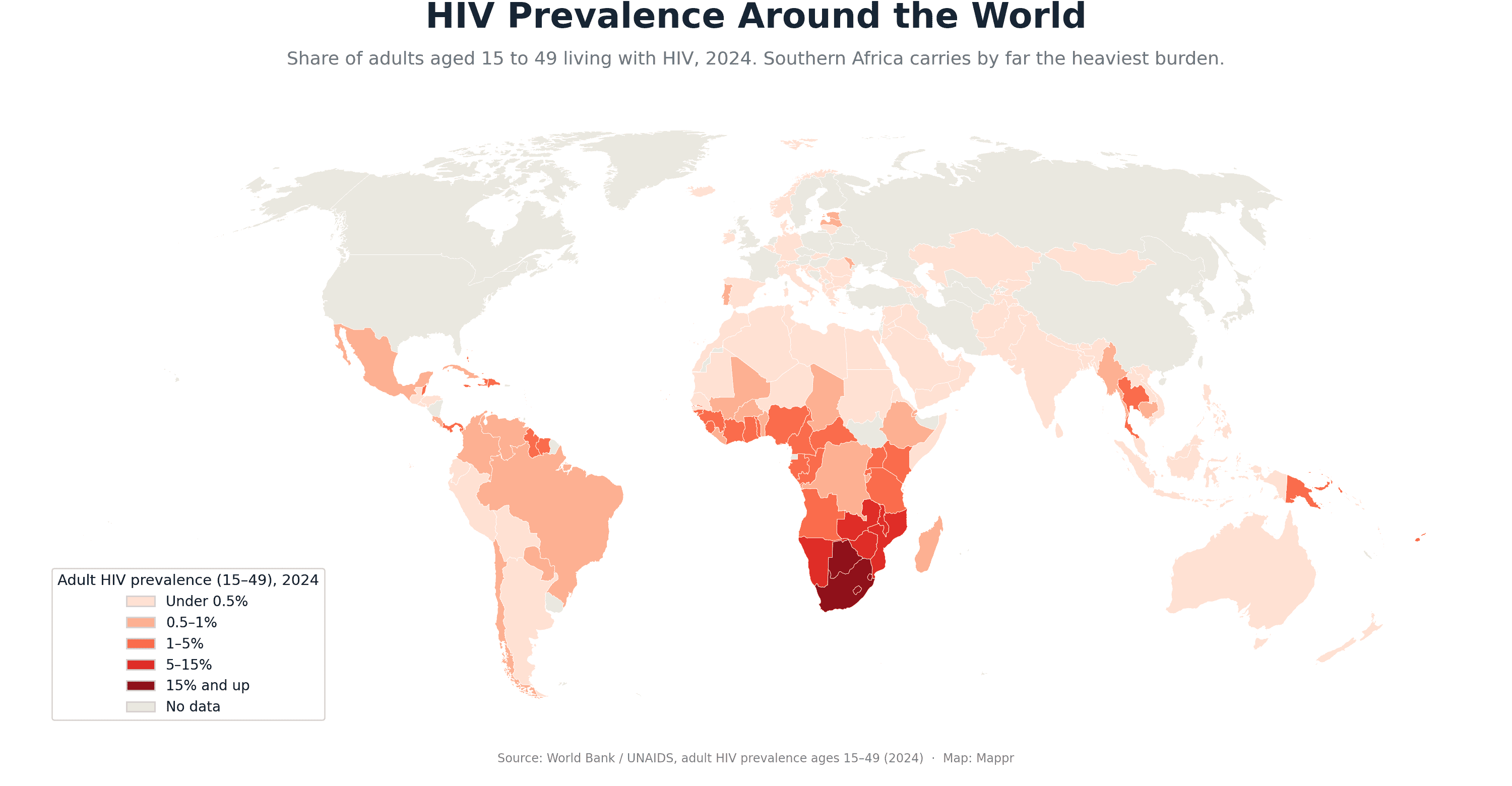
In late July 2026 the world’s HIV researchers, clinicians, activists and health ministers gather in Rio de Janeiro for AIDS 2026, the 26th International AIDS Conference, held from 26 to 31 July under the theme “Rethink. Rebuild. Rise.” They arrive at an anxious moment. After two decades of hard-won progress against the epidemic, a sudden collapse in international funding threatens to unravel it. This is the map behind the headlines: where HIV hits hardest, where the fight is being won, and the one region where it is being lost.
Globally, UNAIDS estimates that about 40.9 million people were living with HIV in 2025, with roughly 1.3 million new infections and around 600,000 AIDS-related deaths. Both figures are a fraction of what they once were: new infections are more than 60% below their mid-1990s peak, and annual deaths have fallen roughly 70% since 2004. But the burden is spread very unevenly, as the map shows.
Key Takeaways
- About 40.9 million people live with HIV. UNAIDS counts roughly 40.9 million people living with HIV worldwide, with about 1.3 million new infections and around 600,000 AIDS-related deaths in 2025. New infections are more than 60% below their mid-1990s peak.
- Southern Africa carries the heaviest burden. Eswatini has the world's highest adult HIV prevalence at 23.4%, followed by South Africa (17.2%), Lesotho (17.1%) and Botswana (15.7%). South Africa alone is home to about 7.8 million people living with HIV.
- One region is still going the wrong way. AIDS deaths are falling almost everywhere, but Eastern Europe and Central Asia is the only region where they are still rising, and a growing share of new infections is now outside southern Africa.
- A funding cliff hangs over 2026. The sharp US pullback from PEPFAR, the programme credited with saving more than 26 million lives since 2003, is the dominant HIV story of the year and threatens hard-won progress.
- The world's response meets in Rio. AIDS 2026, the 26th International AIDS Conference, runs in Rio de Janeiro from 26 to 31 July 2026 under the theme “Rethink. Rebuild. Rise.”, with the funding crisis top of the agenda.
The geography of HIV: southern Africa’s heavy burden
HIV is a global epidemic, but its weight falls overwhelmingly on eastern and southern Africa. Eswatini has the highest adult prevalence in the world: 23.4% of people aged 15 to 49 are living with HIV, close to one in four adults. South Africa (17.2%), Lesotho (17.1%) and Botswana (15.7%) follow, with Mozambique, Zimbabwe, Zambia and Namibia all above 9%. Outside this cluster, prevalence drops sharply: most of Asia, Europe and the Americas sit below 1%.
Prevalence is not the same as headcount
A prevalence map and a headcount map tell different stories. Prevalence is the share of adults infected. The raw number of people living with HIV depends on population size too. South Africa tops both: about 7.8 million people, the most of any country, and a very high rate. But the next-largest populations of people with HIV include countries where prevalence is comparatively low: Mozambique (about 2.5 million), India (about 2.2 million, at well under 1% prevalence), Nigeria (about 2.0 million) and Tanzania (about 1.8 million). India and Nigeria illustrate the point: a low percentage of a very large population still means millions of people.
The 2026 story: a funding cliff
The dominant HIV story of 2026 is not the virus but the money. The United States, through PEPFAR (the President’s Emergency Plan for AIDS Relief), has been the backbone of the global response for two decades, credited with saving more than 26 million lives since 2003. A sharp US pullback that began in 2025, cutting funding for HIV surveillance, laboratory networks and health workers, has thrown treatment and prevention programmes across Africa into uncertainty. Modelling presented ahead of the Rio conference warns that sustained cuts could reverse years of progress and cost hundreds of thousands of lives.
Funding exposure The countries with the highest prevalence are also, in many cases, the most dependent on external funding for testing, treatment and prevention. Eswatini, Lesotho, Mozambique, Zambia and Malawi have historically relied on PEPFAR and the Global Fund for a large share of their HIV budgets, which is why a donor pullback lands hardest exactly where the burden is heaviest. |
Progress, and the one region going backwards
For most of the world the trend is downward. Since 2010, new infections have fallen sharply across eastern and southern Africa, and treatment has turned HIV from a death sentence into a manageable condition for those who can access it. The glaring exception is Eastern Europe and Central Asia, the only region where AIDS-related deaths are still rising, driven by injecting-drug transmission, stigma and gaps in treatment. A growing share of the world’s new infections now occurs outside southern Africa, a sign the epidemic’s centre of gravity is slowly shifting.
The 95-95-95 targets UNAIDS set a global goal for 2025: that 95% of people living with HIV know their status, 95% of those diagnosed are on treatment, and 95% of those on treatment are virally suppressed (meaning they cannot transmit the virus). Several countries, including Botswana, Eswatini, Rwanda and Zimbabwe, have already met all three. The funding crisis puts that final push at risk just as the finish line comes into view. |
The full ranking
| # | Country | Adult prevalence (15–49) |
|---|---|---|
| 1 | 🇸🇿 Eswatini | 23.4% |
| 2 | 🇿🇦 South Africa | 17.2% |
| 3 | 🇱🇸 Lesotho | 17.1% |
| 4 | 🇧🇼 Botswana | 15.7% |
| 5 | 🇲🇿 Mozambique | 11.5% |
| 6 | 🇿🇼 Zimbabwe | 9.8% |
| 7 | 🇿🇲 Zambia | 9.4% |
| 8 | 🇳🇦 Namibia | 9.0% |
| 9 | 🇲🇼 Malawi | 6.2% |
| 10 | 🇺🇬 Uganda | 4.9% |
| 11 | 🇹🇿 Tanzania | 3.5% |
| 12 | 🇨🇬 Congo (Rep.) | 3.2% |
| 13 | 🇰🇪 Kenya | 3.0% |
| 14 | 🇬🇦 Gabon | 2.8% |
| 15 | 🇨🇲 Cameroon | 2.5% |
The bottom line
The science of HIV has never been stronger: a person on effective treatment can live a normal lifespan and cannot pass the virus on. What is fragile in 2026 is not the medicine but the money and the political will to deliver it. As delegates gather in Rio, the map is a reminder of the stakes: a global epidemic that has been pushed into retreat almost everywhere, and could be pushed further, or allowed to rebound, depending on choices made this year.