Key Takeaways
- H5N1 is now on every continent. Highly pathogenic avian influenza reached Antarctica in the 2023–24 austral summer and mainland Australia in 2026, meaning the virus has now been detected on all seven continents. Australia stopped counting individual birds on 12 August 2026 and now counts confirmed events: 690 of them as of 4pm AEST on 6 October 2026, across seven jurisdictions after the Jervis Bay Territory recorded its first case. The mammal list keeps growing: South Australia has confirmed three long-nosed fur seals, a common dolphin, a red fox and, between 13 and 21 September, five endangered Australian sea lions: one at Seal Bay on Kangaroo Island and four on the Pages islands. Victoria's first mammal case was a red fox at Torquay on 4 September. Bird-to-bird spread is established and the country has accepted that the virus can no longer be eradicated from wildlife. WOAH logged outbreaks in 43 countries in poultry and 53 in wild birds in the 2025–26 wave alone.
- 1,507 poultry outbreaks this wave. Between October 2025 and May 2026, WOAH recorded 1,507 HPAI outbreaks in poultry and 7,098 in wild birds. The wave peaked in November 2025, and roughly 2.16 million birds died or were culled in May 2026 alone, the bulk of them in Europe.
- The jump to cattle keeps spreading. H5N1 has infected more than 1,000 US dairy herds across 17 to 19 states since 2024, and in early 2026 a dairy cow in the Netherlands became the first cattle case outside North America.
- 1,003 human cases, 479 deaths since 2003. The WHO has confirmed 1,003 human H5N1 cases in 25 countries between 2003 and 6 September 2026, of which 479 were fatal, a case-fatality rate of 47.8%. Cambodia is the current hotspot, with a sixth case of 2026 announced on 27 September, and the United States has recorded 71 mostly mild cases since 2024.
- Pandemic risk is rising but not here yet. There is still no sustained human-to-human transmission, and public-health agencies rate the risk to the general public as low. But scientists warn the sheer scale of animal infection gives the virus more chances than ever to adapt.
Bird flu has quietly become one of the largest animal-disease events ever recorded. The strain behind it, a highly pathogenic avian influenza virus known as H5N1, has spread from poultry farms into wild birds, marine mammals, dairy cattle and, in a growing trickle of cases, people. In the 2025–26 season it reached mainland Australia and Antarctica, meaning the virus has now been detected on every continent on Earth.
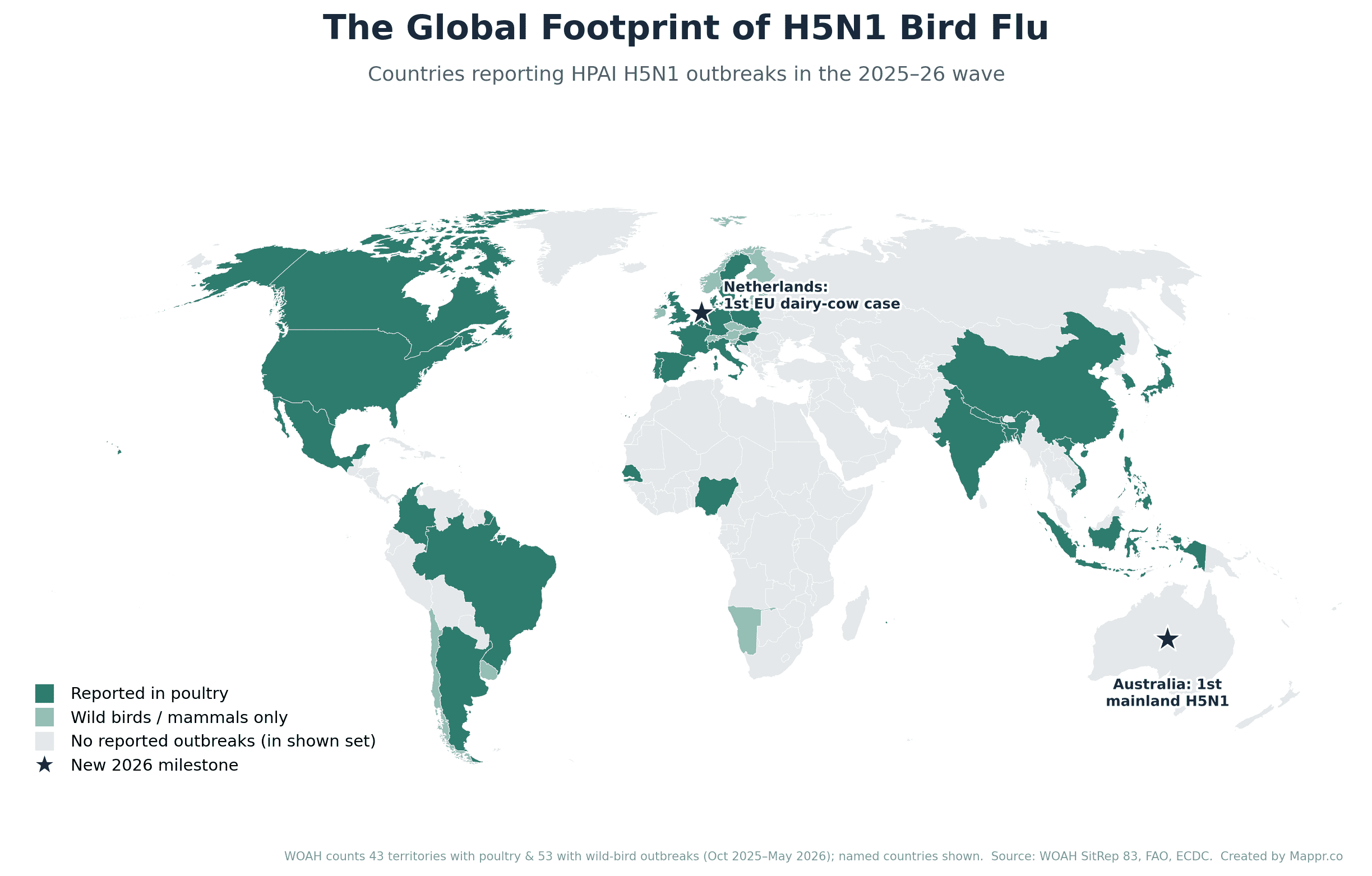
This is the map we have not drawn before: not a single human outbreak, but an animal-health emergency playing out across dozens of countries at once. The map below shows where H5N1 was reported in the current wave, with the new frontiers it crossed in 2026 marked.
What H5N1 is, and why 2026 is different
H5N1 is a subtype of influenza A that is highly pathogenic in birds, meaning it kills domestic poultry quickly and in large numbers. It has circulated since the late 1990s, but the version driving the current crisis, a lineage called 2.3.4.4b, behaves differently from its predecessors. Instead of flaring up in poultry each winter and fading, it now persists year-round in wild birds, which carry it along migratory flyways to every corner of the planet.
That shift matters because wild birds are impossible to vaccinate, cull or contain. Once the virus established itself in wild populations, it gained a permanent reservoir from which it can spill back into farms, and increasingly into mammals. What was once a seasonal farming problem has become a standing feature of the global environment.
The global footprint: where bird flu is now
The scale of the current wave is hard to overstate. Between October 2025 and May 2026, the World Organisation for Animal Health (WOAH) recorded 1,507 HPAI outbreaks in poultry across 43 countries and a further 7,098 outbreaks in wild birds across 53 countries and territories.
The wave peaked in November 2025, and even in the quieter month of May 2026 roughly 2.16 million birds died or were culled, the bulk of them in Europe.
The host range is the other measure of scale. FAO data cited in early October 2026 puts the running count at about 613 bird species and 112 mammal species known to have been infected.
The losses concentrate in a handful of large poultry producers. The United States has lost more than 168 million birds since the outbreak began in 2022, across all 50 states. In the current European season, Poland was the hardest hit with about 9.26 million birds affected on 130 farms, while Germany culled more than a million birds and saw thousands of wild cranes die. France and the Netherlands round out the worst-affected European producers. For historical scale, WOAH counts more than 633 million poultry lost worldwide between 2005 and 2024, with a single-year peak of 146 million in 2022.
The geography of the wave shifts with the seasons. European poultry outbreaks thinned over the northern summer and the active front moved to the Southern Hemisphere, but the northern season reopened on 1 October and both hemispheres are now reporting at once.
Australia, which recorded its first cases in June 2026, has been the fastest-moving part of the story. Detections rose from 28 on 30 July to 101 by 5 August and 236 by the evening of 11 August.
That trajectory has not slowed. By 20 August South Australia alone had 177 confirmed cases and three mass mortality events on offshore islands, and Tasmania had become the sixth Australian jurisdiction to report the virus.
On the new event-based count Australia reached 298 confirmed events by 23 August and 318 by 26 August 2026. South Australia carried 194 of them, Victoria 94, New South Wales 11, Western Australia 10, Tasmania eight and Queensland one.
The count has climbed steeply since. As of 4pm AEST on 2 September 2026 the federal agriculture department listed 468 confirmed events nationally, 150 more than a week earlier.
The state split published on 3 September puts South Australia on 263 events, Victoria on 148, Tasmania on 25, New South Wales on 20, Western Australia on 10 and Queensland on two.
The national total kept climbing through the first week of September. As of 4pm AEST on 8 September 2026 the federal agriculture department listed 502 confirmed events, 34 more than six days earlier.
It has not levelled off. The count reached 521 events on 11 September and 572 events as of 4pm AEST on 16 September 2026, a gain of 70 in eight days.
The climb continued into the following week. The federal agriculture department listed 621 confirmed events as of 4pm AEST on 21 September 2026, 49 more in five days.
South Australia carries 318 of those events, Victoria 190, New South Wales 56, Tasmania 44, Western Australia 10 and Queensland two. The Jervis Bay Territory accounts for the remaining one.
The climb carried on through the last week of September. The federal agriculture department listed 666 confirmed events as of 4pm AEST on 28 September 2026, 45 more in seven days.
South Australia now holds 321 of them, Victoria 220, New South Wales 67, Tasmania 45, Western Australia 10 and Queensland two, with the Jervis Bay Territory still on one.
Growth had slowed from the late-August surge, when the switch to in-state laboratory confirmation cleared a backlog, then ran at roughly nine events a day in mid-September. The pace eased to about six a day over the last week of the month.
October opened slower still. The federal agriculture department listed 676 confirmed events on 1 October and 690 as of 4pm AEST on 6 October 2026, a gain of 24 in eight days, or about three a day.
The state split published for 5 October, when the national total stood at 686, puts South Australia on 325 events, Victoria on 234, New South Wales on 68, Tasmania on 46, Western Australia on 10 and Queensland on two. The Jervis Bay Territory is still on one.
Victoria is now the fastest-moving jurisdiction, adding 14 events in the eight days to 5 October against South Australia’s four. H5 has been found in all six Australian states, with the Northern Territory the only mainland jurisdiction still clear.
There is still no detection in poultry or the wider agriculture industry anywhere in Australia.
Part of that jump is procedural. From 28 August South Australia could confirm routine cases in its own laboratory rather than waiting on CSIRO, and 46 events cleared in a single day.
There is still no detection in poultry or the wider agriculture system anywhere in Australia, and the risk to human health is still rated low.
Farms are being defended anyway. Victoria has extended its temporary poultry housing requirement by another 28 days, until at least 16 October 2026.
It covers flocks of 50 or more birds in southern local government areas, including metropolitan Melbourne, which must be kept away from wild birds and their droppings. There are still no movement restrictions on poultry.
The outbreak is reshaping farm policy too. On 26 September Victoria pushed back tighter poultry welfare standards by 12 months, to mid-2027, so producers can concentrate on disease preparation. The standards are part of a national plan to phase out conventional laying cages by 2036.
New Zealand, which followed in July 2026, has stayed quiet by comparison: three detections in total, the most recent on 21 August, and no sign of mass wildlife mortality.
The northern wave is restarting
Autumn migration has reopened the other front. Since 1 September 2026 the United States has confirmed seven H5N1 detections in commercial poultry, clustered in the turkey belt of North Dakota, South Dakota, Minnesota and Idaho.
The largest were commercial turkey operations in McPherson County, South Dakota (61,300 birds), Turner County, South Dakota (43,800), LaMoure County, North Dakota (41,600) and Wright County, Minnesota (29,800).
The US season has escalated since. In the 30-day window to 5 October 2026 the USDA had confirmed H5N1 in 21 flocks, 14 commercial and seven backyard, affecting about 620,000 birds.
Minnesota accounts for 11 of those flocks and 338,650 of the birds, eight commercial and three backyard. It raises more turkeys than anywhere else in the country. The Dakotas add another 176,900 birds between them, with Iowa, Indiana and Kansas also in the count.
On state Board of Animal Health figures the largest Minnesota sites this autumn are turkey farms in Kandiyohi County (61,111 birds, confirmed 16 September), Big Stone County (55,318, confirmed 15 September) and Becker County (44,352, confirmed 10 September).
Stearns County has now had three cases in a single month, the latest 7,200 meat turkeys confirmed on 28 September. Wild-bird detections have spiked with the duck season, including 20 hunter-harvested blue-winged teal in Kansas.
Stearns County has since been hit twice more, at commercial turkey facilities holding 77,200 and 31,200 birds. Minnesota’s wild-bird picture has turned sharply too, with at least 40 detections in ten days, most of them in the Minneapolis-St Paul metro area.
Those included mallards, Canada geese and three bald eagles. The virus also reached a commercial duck meat breeding operation in Jay County, Indiana, where 24,300 birds were affected, the first duck operation of the autumn.
Wisconsin logged another case on 6 October 2026, a backyard poultry flock in Racine County that has been depopulated and kept out of the food system. It follows the Barron County commercial farm earlier in the season.
Wisconsin is back in the count too, with about 79,100 birds at a commercial farm in Barron County, its first poultry case since the late-winter cluster.
Backyard flocks are being hit too. Iowa confirmed H5N1 in a multi-species backyard flock in Boone County on 22 September 2026, the state’s seventh detection of the year.
Two Idaho dairy herds also tested positive earlier in the month, part of 88 US cattle detections so far in 2026.
Canada is back in the count
Canada’s poultry outbreaks have restarted as well. A commercial flock in the rural municipality of De Salaberry, Manitoba, confirmed on 10 September, ended a gap of nearly four months since the country’s previous case on 16 May.
Manitoba then logged five more infected commercial farms, at Rhineland, Rockwood, Cartier, Bifrost-Riverton and Woodlands, two confirmed on 21 September and three on 22 September. A seventh provincial case for 2026, again at Bifrost-Riverton, was confirmed on 29 September.
Alberta followed on 26 September, when the Canadian Food Inspection Agency reported a commercial flock in the County of Vermilion River, the province’s first case since May. About 551,000 Manitoba birds have died or been culled since December 2021.
Britain loses its disease-free status
Europe’s season has reopened as well. Great Britain lost its freedom from highly pathogenic avian influenza on 2 October 2026, when H5N5 was confirmed in backyard poultry at Ness on the Isle of Lewis in Scotland.
It is the first United Kingdom outbreak of the 2026-27 season, which began on 1 October, and it carries trade consequences. A 3 km protection zone and a 10 km surveillance zone were imposed around the premises.
The 2025-26 season ran to 100 confirmed highly pathogenic cases across the United Kingdom: 79 in England, nine in Scotland, seven in Wales and five in Northern Ireland. England has recorded none so far this season, and no housing order is yet in force.
The new frontiers of 2026
Three developments in 2026 pushed the virus into genuinely new territory, and they are the milestones marked on the map above.
Australia recorded its first mainland H5N1. Having kept the 2.3.4.4b lineage out for years, Australia confirmed the virus in wild seabirds in Western Australia in June 2026. By 8pm AEST on 11 August 2026 the federal agriculture department counted 236 confirmed detections in wild birds, up from 101 on 5 August, and still none in poultry or the wider agriculture industry.
The tally is climbing daily. On 3 August it stood at 78 across five jurisdictions: 58 in South Australia, 10 in Western Australia, seven in Victoria, two in New South Wales and one in Queensland. Two days later it had passed 100.
It has roughly doubled twice since. The 11 August count of 236 breaks down as 163 in South Australia, 58 in Victoria, 10 in Western Australia, four in New South Wales and one in Queensland.
The raw tally has now been retired. From 12 August 2026 the department stopped counting individual birds and switched to counting confirmed events, where one event may involve a single bird or hundreds.
The reason was arithmetic: hotline reports of sick or dead birds had run roughly thirteen times ahead of completed investigations. On the new basis Australia had 219 confirmed events in wild birds as of 4pm AEST on 14 August 2026, a figure that folds in every individual detection reported before the change.
Combined with detections on the sub-Antarctic Heard Island, that made Australia the last inhabited continent to be reached. On 29 July the outbreak crossed a second threshold: Agriculture Minister Julie Collins confirmed the virus is now spreading locally between Australian birds.
The national laboratory had linked seven cases in greater crested terns in South Australia to spread between birds rather than separate arrivals. Australia has since accepted that H5 bird flu is no longer technically feasible to eradicate in wildlife.
As chief veterinary officer Beth Cookson put it, once the virus is widespread in wild bird populations “it will not be possible to avoid losses in susceptible wildlife”. There is still no evidence of mass mortalities on the mainland, and Collins says the poultry industry remains unaffected.
On 30 July the spread reached a fifth state. Preliminary testing found H5 bird flu in a single greater crested tern at Portland, Victoria, with CSIRO’s Geelong laboratory running confirmatory genetic tests, and Victoria activated its State Emergency Animal Disease Response Plan.
Victoria had seven confirmed cases on 5 August, all greater crested terns: five at Portland and two at Nelson Bay. The state laboratory AgriBio flagged 33 further suspect cases that day, among them 30 greater crested terns, a gull and an inconclusive magpie, all sent to CSIRO for confirmation.
The magpie came back positive. CSIRO confirmed it on 6 August alongside a further 15 Victorian detections, making it Australia’s first H5 case in a land bird rather than a seabird.
Victoria has since reached 58 confirmed cases. On 13 August the state reported an infected wild bird at Mildura, well inland, adding to known clusters in south-west Victoria, the Great Ocean Road region, Gippsland and Melbourne’s south-east.
The state crossed another line on 18 August. Agriculture Victoria confirmed three further detections: a little penguin on Phillip Island, the state’s first case in a penguin, plus crested terns at Lakes Entrance and at Dromana on the Mornington Peninsula.
Lakes Entrance puts the virus in East Gippsland, well east of the original south-west cluster. Victoria still reports no detections in poultry or other animals, and the risk to human health there remains low.
Australia recorded its first mass mortality event. Aerial surveillance found 49 dead and 35 sick greater crested terns on Baudin Rocks, an islet about 5 km off the South Australian coast near Cape Jaffa. Testing announced on 3 August confirmed H5N1 in sampled carcasses.
Officials expect worse. Agriculture Minister Julie Collins said Australians should expect to see more spread and larger numbers now, and Environment Minister Murray Watt warned there will be more mass mortality events because wild birds cannot be stopped from flying.
South Australia’s chief veterinary officer Skye Fruean called the event unusual and significant, and said the situation appears to be escalating quite rapidly. There are still no detections in poultry, and the risk to human health is still rated low.
Three much larger events followed. On 20 August Premier Peter Malinauskas told the South Australian parliament that surveillance teams had found more than 1,000 dead crested terns across Troubridge Island off the Yorke Peninsula and the two Pages islands off Kangaroo Island.
The deaths were detected on 19 August and the birds are presumed to have died of H5N1. Malinauskas called it a significant escalation, and said the state was also investigating a suspected case in a little penguin from Kangaroo Island.
South Australia had 177 confirmed cases as of 20 August. No mass mortality has been reported in mammals, and there is still no detection in poultry or livestock.
Tasmania is the sixth jurisdiction
Tasmania recorded its first case on 13 August, a brown skua at Burgess Cove in Rocky Cape National Park in the state’s north-west, confirmed by CSIRO.
A week later the state was at 11 confirmed cases, spread across King Island, Rocky Cape, Burnie and Sulphur Creek. On 20 August a surveillance team found 28 dead little penguins and three dead crested terns at the Port of Grassy on King Island.
Those carcasses are still being tested, so this is not yet a confirmed mass mortality event. Premier Jeremy Rockliff said more teams were being sent to the island to expand surveillance and carcass collection.
The King Island toll has since grown to 51 dead little penguins, most of them around the Port of Grassy. Only two carcasses were fresh enough to test: one came back positive, the other inconclusive.
NRE Tasmania still does not class the Grassy deaths as a mass mortality event, because it cannot attribute all 51 deaths to the virus. Department secretary Jason Jacobi put the longer view plainly on 22 August: the virus is here to stay.
Jacobi warned the outbreak is likely to arrive in waves over months and years, with quiet spells broken by sudden spikes in deaths. Tasmania’s vaccination effort is focused on captive-bred orange-bellied parrots rather than wild penguins.
King Island then got worse. On 28 August the state government said it was assessing about 100 dead little penguins at Stokes Point on the island’s southern tip, a second cluster separate from the Port of Grassy deaths.
Those carcasses were too decayed to test, so the cause is formally unestablished even though the site has been described as a mass mortality event. Tasmania’s confirmed event count has since risen to 25.
By 3 September the virus was statewide. New detections landed at Beaumaris and Triabunna on the east coast, Acton Park near Hobart and Marrawah in the far north-west, taking Tasmania to 54 individual detections across those 25 events.
The Triabunna bird was a forest raven, the state’s first case in that species. Tasmania has now stopped publishing individual case counts and will report new locations instead, since repeat testing in known-infected areas inflates the tally without telling you much.
Vaccination started on 1 September, aimed at the critically endangered orange-bellied parrot. About 350 captive birds are to get two doses each between now and February, with 50 done on the first day.
Vaccinated parrots will be released at Melaleuca in Tasmania’s remote south-west to join the wild population. There are still no detections in Tasmanian poultry and no confirmed mass mortality event in the state.
The virus reaches Australia’s mammals
Attention has turned to marine mammals. A dead seal pup found at Warrnambool on Victoria’s south-west coast was sent for testing in early August, and a positive bird detection was recorded near the endangered Australian sea lion colony at Seal Bay in South Australia.
That worry became fact on 23 August. CSIRO’s Australian Centre for Disease Preparedness confirmed H5 bird flu in a long-nosed fur seal found dead at Beachport in South Australia’s south-east, the first confirmed mammal case anywhere in Australia.
The seal was found with no sign of injury and reported to the emergency animal disease hotline by a member of the public on 19 August. Agriculture Minister Julie Collins said it was not unexpected to start seeing infection in other wildlife where wild birds are heavily infected.
Australia has roughly 13,000 sea lions, about 85% of them in South Australia. University of Adelaide wildlife veterinarian Wayne Boardman expects a high mortality event, pointing to the 30,000 sea lions killed by H5N1 in South America.
A day after the Beachport result, a second fur seal was reported as a suspected case at the Pages Conservation Park, the two islets off Kangaroo Island where more than 1,000 terns died. Samples went to Geelong for confirmatory testing.
The Pages hold one of the largest and most stable Australian sea lion colonies, a species now down to fewer than 10,000 mature adults. Jack Gough of the Invasive Species Council warned that if the virus gets into sea lions, this could be an extinction-level event.
South Australia’s environment minister Emily Bourke called the spread incredibly concerning, pointing to seal die-offs overseas. At that point no H5 detection had been confirmed in an Australian sea lion. That changed in September.
Two more mammal species followed within days. On 28 August CSIRO confirmed H5 in a red fox found at Osborne in metropolitan Adelaide, the third mammal detection in Australia and the first in a land mammal.
Chief veterinary officer Beth Cookson called it concerning but not unexpected, noting that scavenging carnivores are infected elsewhere in the world and that those cases are treated as isolated spillovers from birds. There is no evidence of mammal-to-mammal transmission in Australia.
The same day South Australia reported H5N1 in a common dolphin found dead at Goolwa on the Fleurieu Peninsula, the first cetacean case in the country. State chief vet Skye Fruean said the animal had probably eaten or closely encountered an infected wild bird.
Victoria joined the list on 4 September. Acting chief veterinary officer Cameron Bell confirmed H5 in a red fox found at Torquay on the Surf Coast, the state’s first mammal detection and the fourth in Australia.
A dolphin found dead at Lorne, further along the Great Ocean Road, is a suspected case awaiting confirmation. Bell said wild foxes and other scavenging pests have not generally been shown to spread the virus onward.
Victoria had by then recorded 212 confirmed positive bird cases from 892 investigations since 20 June. Chief biodiversity officer James Todd called the marine mammal detections unsurprising and expects more as the spring breeding season starts.
The sea lion everyone feared for is now infected
The worst case arrived on 13 September 2026. Emily Bourke confirmed H5 bird flu in an endangered Australian sea lion at the Seal Bay colony on Kangaroo Island, the first case anywhere in the species.
The animal had been under care after surviving a shark attack. As Bourke put it, it was not the shark that killed the sea lion, it was the bird flu.
The species is down to fewer than 12,000 animals and was already declining by about 2% a year. Roughly 85% of them live in South Australia, which makes Seal Bay one of the most exposed colonies in the country.
Managers have pulled visitors back. Seal Bay tours now run on the boardwalk rather than the beach, feral cats are being trapped as possible vectors, and the state is weighing a trial of an experimental vaccine pending federal approval.
South Australia has now confirmed the virus in three long-nosed fur seals, a common dolphin, a red fox and five Australian sea lions. A number of little penguins in the state have also tested positive, among them one at Victor Harbor.
The species list keeps widening. An Australian pelican found at Edithburgh on the Yorke Peninsula tested positive on 14 September, the first pelican detection in the country, one of five events the state confirmed that day.
Then the breeding colonies were hit. On 21 September the state confirmed H5 in four more sea lions, three adults and a pup, on the North Page and South Page islands off Kangaroo Island.
Twelve dead sea lions were found at that site and ten were fresh enough to test. About 900 greater crested terns were found dead on the same islands, while two dead sea lions from Liguanea Island off the Eyre Peninsula tested negative.
That takes the confirmed sea lion toll to five in nine days. Emily Bourke said the state was pulling every lever possible to show it was willing, able and capable of taking part in a national vaccine program.
South Australia is now seeking federal approval for a vaccine trial in mammals. A bird vaccine trial has been running at Cleland Wildlife Park since August, with more than 150 doses given so far.
The mammal vaccine is American and experimental. It is built on an H5N2 cattle vaccine and is being trialled on monk seals in Hawaii and California, and importing it needs federal sign-off plus animal ethics review.
Epidemiologist Adrian Esterman says that means months, with no guarantee it protects marine mammals. Canberra meanwhile launched a six-week public campaign, “Bird flu: Know what to do”, in Hobart on 27 September, telling people not to touch sick or dead birds.
On 13 August the Threatened Species Scientific Committee warned the virus could drive unavoidable and potentially catastrophic declines in susceptible Australian species, and urged harder action on feral predators and habitat loss so populations enter the wave with more resilience.
Vaccinating the birds that can be reached
With eradication off the table, the response has shifted to protecting what can be protected. On 11 August the federal government put about $2 million behind roughly 1,500 vaccine vials for a first phase aimed at vulnerable species in zoos and managed collections, with threatened black cockatoos named as a likely next target.
Agriculture Minister Julie Collins framed it bluntly: “We can’t stop the virus spreading amongst wild birds. We can take action to protect the species most at risk.” Chief veterinary officer Beth Cookson said broad-scale vaccination in the wild is “not practical or feasible”.
Victoria has now attempted the biggest exception to that rule. Vaccination of little penguins began on the evening of 17 August at Phillip Island, days after a penguin there died of H5, and extends to the St Kilda breakwater colony in Melbourne.
The target is more than 5,000 birds, which the state calls the largest vaccination effort ever attempted in a wild population. Little penguins are flightless and return to the same burrow each night, which makes them unusually catchable.
Victoria’s chief biodiversity officer James Todd called the scale unprecedented, and flagged the hard part: the vaccine works best in two doses, and wild animals rarely come back for the second. The Phillip Island colony holds about 40,000 birds in the breeding season.
The rollout passed its first milestone on 24 August, with about 1,000 penguins given a first dose. Roughly 10,000 doses are needed to finish the two-shot course, with second doses due three to four weeks after the first.
Phillip Island Nature Parks chief executive Catherine Basterfield called it the first mass vaccination program of this scale in the world. Worst-case modelling suggests an outbreak could kill 8,000 to 16,000 of the island’s penguins.
Progress has been slow. By 1 September the tally was still a little over 1,000 birds, roughly a fifth of the Penguin Parade population, and local reporting said the rollout had paused for about two weeks because fewer penguins were coming ashore to be caught.
Victoria is now weighing a blunter option. Chief biodiversity officer James Todd said on 27 September the state might consider an emergency extraction, pulling threatened birds out of the wild into captivity ahead of the virus.
Officials have identified nearly 100 bird species as exposed, among them black swans and brolgas. Only about 50 brolgas are left in northern Victoria and southern New South Wales. Twenty-three Australian species have been hit so far.
New South Wales joins the vaccination push
New South Wales announced its own rollout on 28 August, starting with insurance populations held at Taronga Zoo: little penguins plus Carnaby’s and red-tailed black cockatoos.
Manly’s little penguin colony and Barunguba Montague Island are the wild colonies in scope. Environment Minister Penny Sharpe was blunt about the limits, saying no government policy can stop the virus spreading through wild bird populations.
The state has gone from 20 confirmed events in early September to 67 as of 28 September, most of them on the South Coast. On 3 September a greater crested tern found at Port Kembla breakwater became the Wollongong region’s second case.
The virus reached Sydney a day later. On 4 September the state government confirmed H5 in a greater crested tern at Warriewood on the Northern Beaches, the city’s first case, announced alongside a further tern at Port Kembla.
The same release confirmed a Hutton’s shearwater at Corindi near Coffs Harbour, the first shearwater detection in New South Wales and the furthest north the virus has been found in the state.
There is no sign of mass mortality anywhere in New South Wales. The chief veterinary officer has recommended, but not ordered, that poultry be housed, and there are no detections in commercial flocks or captive birds.
A seventh jurisdiction has since joined the list. H5 was confirmed in a greater crested tern at Booderee National Park in the Jervis Bay Territory, on the New South Wales south coast, which the federal count reports under the Australian Capital Territory.
New Zealand followed days later. On 15 July it confirmed its first case, a brown skua recovered from Petone Beach in Wellington, and on 17 July a second, a swamp harrier found in the Wairarapa.
A third case followed on 21 August: a northern giant petrel found dead on a remote Cape Palliser beach in the Wairarapa. There is still no detection in poultry and no evidence of mass wildlife mortality.
Officials there are already planning for the virus to stay. MPI chief veterinary officer Mary van Andel says it is likely to become endemic in New Zealand within a matter of months. The Department of Conservation is vaccinating about 300 core breeding birds from five endangered species, among them the kakapo, takahe and shore plover.
H5N1 reached a European cow. In early 2026, a dairy cow in the northern Netherlands tested positive for H5N1 antibodies, the first cattle infection anywhere outside North America. Investigators traced it to a farm cat, an unsettling reminder of how easily the virus now moves between species.
The virus is now in Antarctica. Following its arrival in the far south during the 2023–24 season, H5N1 has been confirmed in Antarctic skuas, terns, seals and other wildlife, completing its spread to all seven continents and threatening some of the most isolated animal populations on Earth.
The sub-Antarctic toll is now measurable. Drone-survey results published by the Australian Antarctic Program on 18 June 2026 estimate that about 13,000 of roughly 17,000 southern elephant seal pups died on Heard Island, an average mortality of 76% in the final surveys and 97% in one breeding area.
Six species there tested positive for H5N1 clade 2.3.4.4b, including king and gentoo penguins and Antarctic fur seals, with several hundred dead adult king penguins recorded by January 2026. Genetic analysis points to the virus arriving around August 2025 with wildlife from the French Crozet Islands, about 1,800 km away.
Australia pulls its team off Macquarie Island
H5N1 has not reached Macquarie Island yet. On 28 August the environment department said it would temporarily withdraw all 24 scientists, tradespeople and support staff from the research station anyway, about 1,500 km south-east of Tasmania.
The stated reason is psychosocial risk. Expert assessment rates a significant mortality event during the coming elephant seal breeding season as likely, and the department judged that watching it unfold could expose expeditioners to prolonged psychological stress.
The icebreaker RSV Nuyina will collect them in October, before the breeding peak. It is the first time the Australian Antarctic Program has emptied a station on wellbeing grounds, and it removes the people who would otherwise have documented the outbreak.
The jump to cattle
The most worrying twist of this outbreak is that H5N1 learned to infect cattle. Since the first US dairy detection in March 2024, the virus has spread to more than 1,000 dairy herds across 17 to 19 states, with California the epicenter after hundreds of affected herds pushed the state to declare an emergency. The virus spreads through milking equipment and raw milk, which carries very high viral loads, and it has jumped from cattle to farm workers and barn cats.
Every mammalian host is a concern because mammals share more of our biology than birds do. Each infection is a fresh opportunity for the virus to acquire the mutations it would need to spread efficiently between people. The Dutch cow shows that cattle infection is no longer a North American anomaly.
The first US mink farm outbreak
Cattle are no longer the only farmed mammal in the picture. The USDA confirmed H5N1 in seven captive American mink in Utah on 17 August 2026, the first documented infection of farmed mink in the United States.
State records released in September show the farm expects to lose about 80% of its animals. Utah officials decided against a quarantine, partly because they could not work out what would justify lifting one, and the farm’s size and location are still withheld.
Mink matter more than their numbers suggest. Their upper respiratory tract resembles ours, so the mutations that help the virus spread in mink are exactly the ones virologists worry about. Wisconsin, with about 32 mink farms producing over half of US pelts, is watching closely.
The wild mammal record keeps filling in too. Researchers reported in early October that three dead polar bears found in Alaska in 2023 and 2024 tested positive for H5 clade 2.3.4.4b.
The same study offers a rare piece of good news: population immunity in those bears appears to be building, which may spare the species a wider demographic hit.
Human cases: who has been infected
For all its spread in animals, H5N1 still infects people only rarely, and almost always after close contact with sick birds or livestock. But when it does, it can be deadly.
Between 2003 and 6 September 2026 the WHO confirmed 1,003 human cases across 25 countries, of which 479 were fatal, a case-fatality rate of 47.8%. Ten of those cases and two of the deaths fall in 2026.
The map below sizes each country by its cumulative case count and colours it by how lethal those cases were.
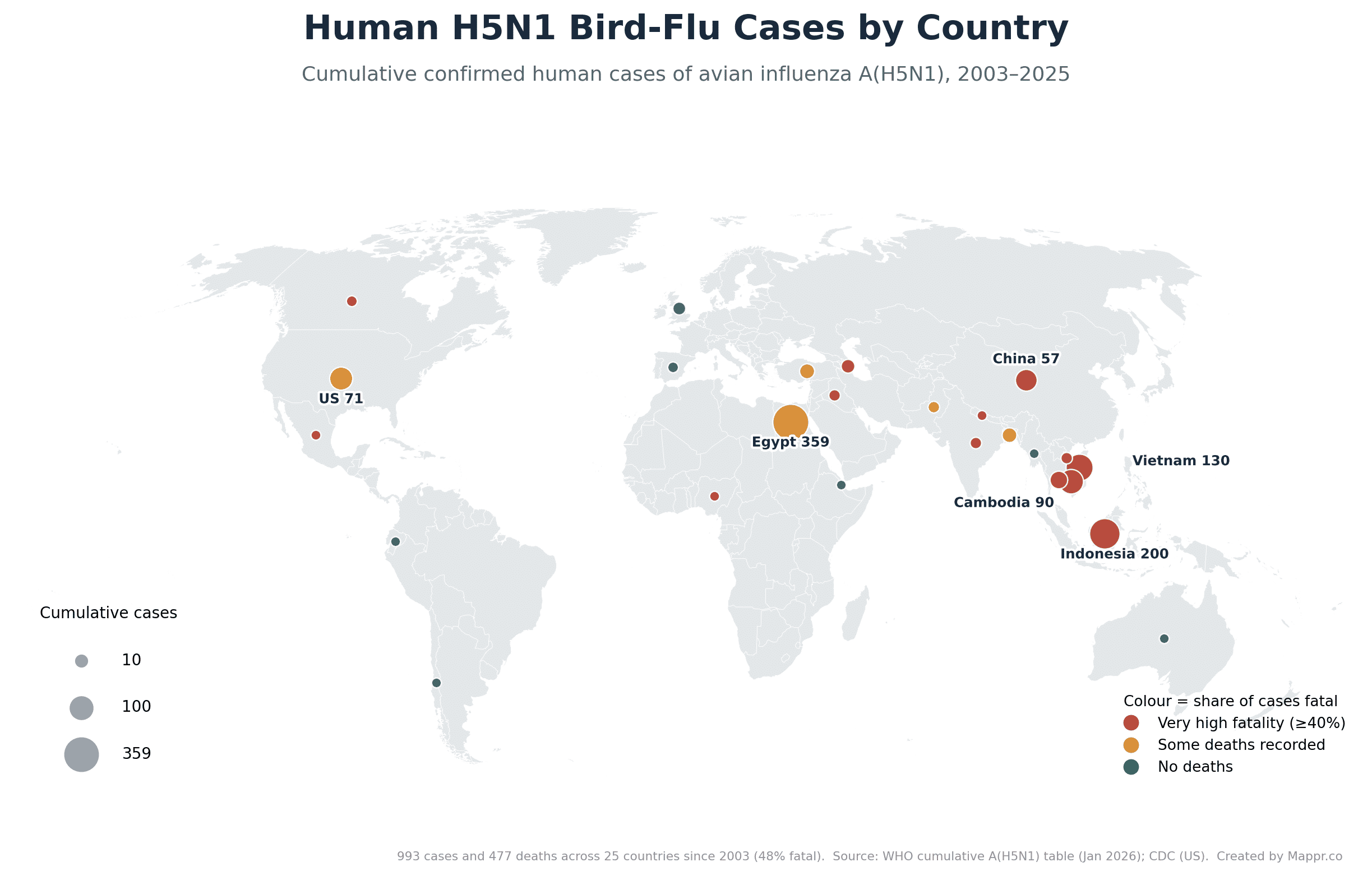
Egypt, Indonesia and Vietnam account for most of the historical total, a legacy of the mid-2000s poultry epidemics in Asia and North Africa. The pattern of the last two years looks different.
Cambodia is the current hotspot: WHO counts 18 Cambodian cases and nine deaths in 2025, then five cases with one death to 6 September 2026, most tied to backyard poultry. The country’s cumulative total stands at 95 cases and 53 deaths.
A sixth Cambodian case of 2026 landed after that cut-off. On 27 September the health ministry confirmed H5N1 in a 49-year-old man from Oddar Meanchey province who had handled sick and dead chickens on his farm, and who is in hospital isolation.
The United States, by contrast, has recorded 71 cases since 2024 that were overwhelmingly mild, mostly among dairy and poultry workers, with a single death, in Louisiana in January 2025.
2003–2026
The countries where bird flu has infected people
Cumulative confirmed human cases of avian influenza A(H5N1), the ten most-affected countries.
| Country | Cases | Deaths | Fatal |
|---|---|---|---|
| Egypt | 359 | 120 | 33% |
| Indonesia | 200 | 168 | 84% |
| Vietnam | 130 | 65 | 50% |
| Cambodia | 95 | 53 | 56% |
| United States | 71 | 1 | 1% |
| China | 57 | 32 | 56% |
| Thailand | 25 | 17 | 68% |
| Bangladesh | 15 | 2 | 13% |
| Türkiye | 12 | 4 | 33% |
| Azerbaijan | 8 | 5 | 62% |
Could this become a human pandemic?
The honest answer is that no one knows, and that uncertainty is the point. The critical threshold, sustained human-to-human transmission, has not been crossed. Public-health agencies including the CDC still rate the risk to the general public as low, and the mild US cases are reassuring on that front.
What has changed is the sheer volume of the virus in the environment. Every infected flock, herd or wild bird is another roll of the dice. As Ed Hutchinson, a virologist at the University of Glasgow, put it in early 2026, the virus is now “raging around the world, and there is no feasible containment method other than just watching it infect huge populations of animals.” The more animals it infects, the more chances it has to adapt, which is why scientists watch the cattle outbreak so closely.
The bottom line
H5N1 in 2026 is a pandemic already, just not a human one. It is an animal-health catastrophe of unprecedented reach: on all seven continents, in more than 50 countries in a single season, in poultry, wild birds, seals, cats and cattle. For most people the day-to-day risk remains low, and the sensible precautions are simple: avoid touching sick or dead birds, and do not drink raw milk.
But the map is a warning. A virus this widespread, this lethal in the people it does infect, and now this comfortable in mammals, deserves the close attention it is getting. The next map worth watching is the one that would show human-to-human spread. So far, that map is blank, and the goal of global surveillance is to keep it that way.
Data and references (latest available as of 8 October 2026):
Image Sources