
Key Takeaways
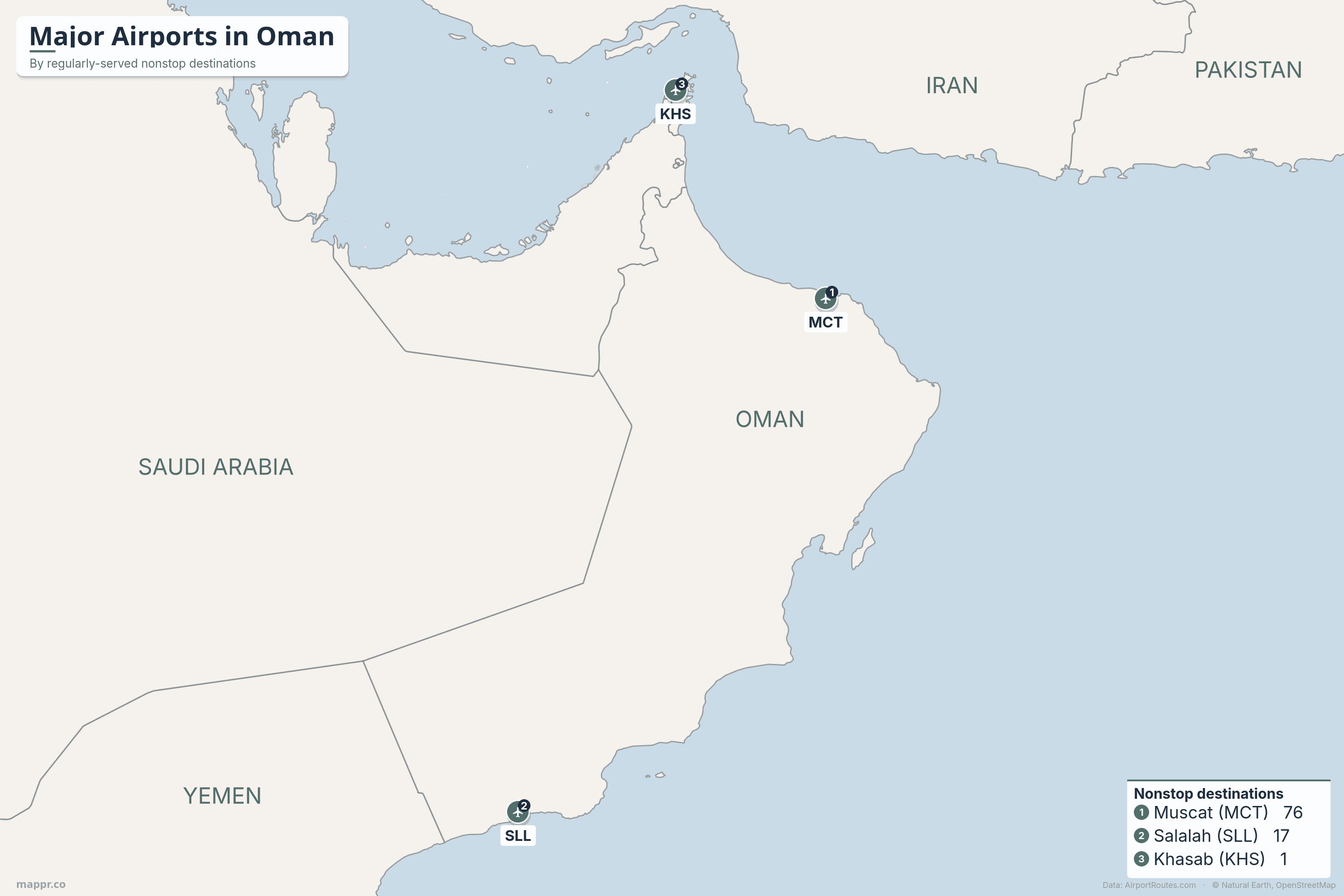
- Muscat dominates Oman’s air network. Muscat International (MCT) serves around 76 regularly-served nonstop destinations, far more than any other airport in Oman, and is the home base of flag carrier Oman Air and low-cost SalamAir. It handles almost all of the country’s international traffic, weighted heavily toward the Gulf and the Indian subcontinent.
- Salalah is the seasonal second city. Salalah Airport (SLL) reaches about 17 destinations, serving the southern Dhofar region. Its traffic swells during the kharif, the summer monsoon that turns the Dhofar hills green and draws Gulf tourists, and it picks up seasonal European charter flights alongside the usual Gulf links.
- Khasab is a domestic lifeline in an exclave. Khasab Airport (KHS) runs just one regularly-served route, a domestic Oman Air hop to Muscat. It sits on the Musandam Peninsula, an Omani exclave cut off from the rest of the country by the United Arab Emirates, overlooking the Strait of Hormuz.
- We rank by regularly-served routes, not raw counts. The figures come from observed route data, a sample rather than a full timetable. Ranking by regularly-served destinations (routes flown often enough to count as scheduled service) gives a truer picture of connectivity than raw nonstop totals.
- There are no direct flights to the United States. Oman has no scheduled nonstop service to North America, and Oman Air does not fly the route nonstop. Travellers connect through a Gulf hub such as Doha, Dubai or Abu Dhabi, or through Istanbul or a European gateway.
Oman runs a compact, hub-and-spoke aviation network shaped by geography, oil and a tourism push beyond the capital. Its busiest airport sits in Muscat, home of the flag carrier Oman Air and the low-cost airline SalamAir, and it handles nearly all of the Sultanate’s international traffic. Behind it sit just two more airports with scheduled service: Salalah, the gateway to the green monsoon hills of the southern Dhofar region, and Khasab, a tiny field on the Musandam Peninsula, an Omani exclave separated from the rest of the country by the United Arab Emirates. Almost all of Oman’s air traffic points toward the Gulf and the Indian subcontinent.
Below we map and rank Oman’s airports by the number of nonstop destinations each one serves, drawn from live route data on AirportRoutes. We rank by regularly-served destinations, routes flown often enough to count as scheduled service, rather than raw nonstop totals, which can overstate one-off and seasonal flying. The figures come from observed flight data (a large sample rather than a complete published timetable), so treat them as a guide to relative connectivity, not official totals.
Can you fly nonstop from Oman to the US?
No. None of Oman’s airports has a scheduled nonstop flight to the United States, and there is no direct service between Oman and North America. Oman Air, the flag carrier, sells one-stop itineraries to New York but does not fly the route nonstop, and the rest of the country’s airlines are regional and short to medium-haul. With most Omani traffic pointed at the Gulf and South Asia, a nonstop transatlantic route has never had the demand to take hold.
Travellers heading to the US connect through a hub. The most common options are the big Gulf gateways, Doha on Qatar Airways, Dubai on Emirates or flydubai, and Abu Dhabi on Etihad, all a short hop from Muscat and offering wide North American coverage. A one-stop connection through Istanbul on Turkish Airlines, or through a European gateway such as Frankfurt or London on Oman Air, is also possible.
Ranked
Major Airports in Oman by Nonstop Destinations
Ranked by regularly-served nonstop destinations, busiest first.
| Airport | IATA | Nonstop | Region |
|---|---|---|---|
| 1. Muscat | MCT | 76 | Muscat (main hub) |
| 2. Salalah | SLL | 17 | Dhofar / south |
| 3. Khasab | KHS | 1 | Musandam (domestic) |
A closer look at Oman’s airports
✈️ Muscat International Airport (MCT)
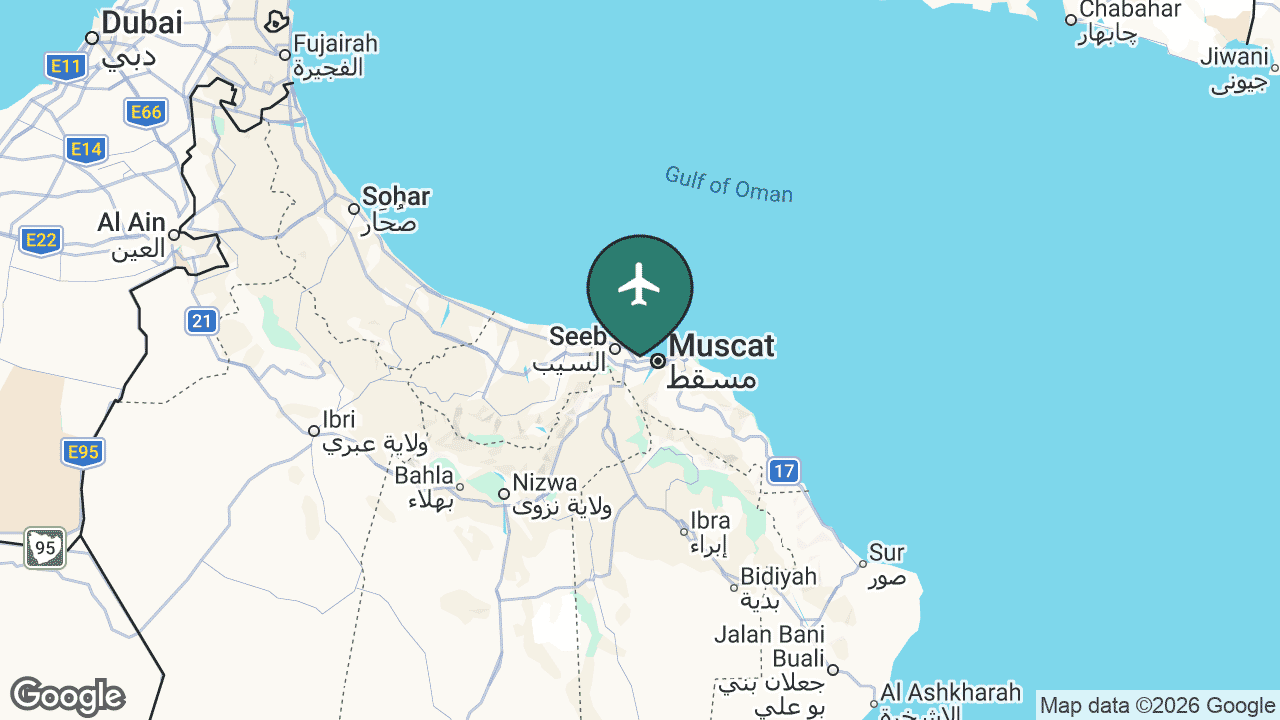
Muscat International sits on the coast at Seeb, west of the capital, and is by far the busiest airport in Oman. It is the home base of Oman Air, the flag carrier, and SalamAir, the country’s low-cost airline, and it handles almost all of the Sultanate’s scheduled and connecting traffic. A large new passenger terminal opened in 2018, giving the airport room to grow as Oman pushes tourism and trade.
Serving the capital region, MCT reaches around 76 regularly-served nonstop destinations. Its busiest links run to the Gulf, including Dubai, Doha, Jeddah, Riyadh and Manama, and to the Indian subcontinent, with heavy traffic to cities such as Kochi, Mumbai, Karachi and Dhaka that reflects Oman’s large South Asian workforce. Oman Air adds longer-haul routes to Bangkok and to Europe, and there are domestic hops to Salalah and Khasab.
Main airlines: Oman Air, SalamAir, Air India, Pakistan International Airlines, IndiGo, US-Bangla Airlines. See the full route map on AirportRoutes →
🌴 Salalah Airport (SLL)
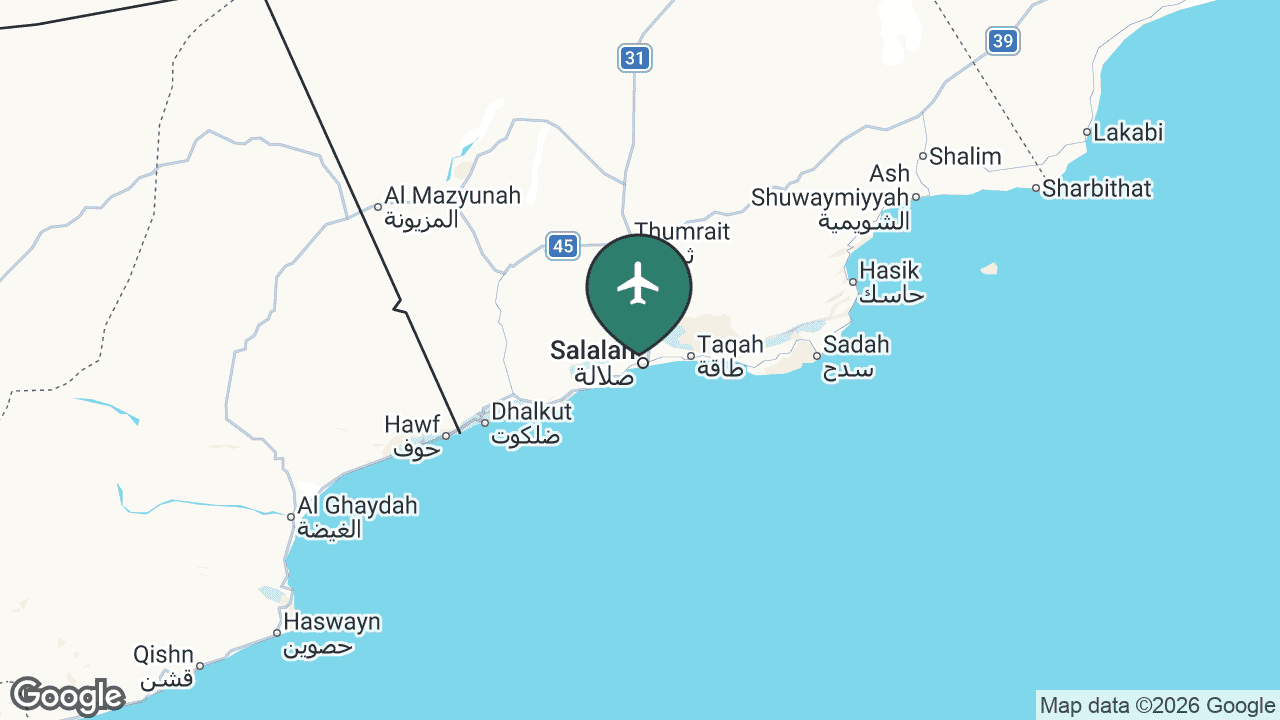
Salalah Airport serves Oman’s second city and the capital of the southern Dhofar region, the frankincense coast that has traded with India and East Africa for millennia. The airport was rebuilt and reopened with a modern terminal in 2015, part of a wider effort to spread aviation and tourism beyond Muscat.
SLL reaches around 17 regularly-served destinations. Much of its traffic is seasonal: during the kharif, the summer monsoon that turns the Dhofar hills lush and green from June to September, the airport fills with Gulf tourists escaping the heat. Its network mixes a domestic link to Muscat with Gulf cities such as Sharjah, Dubai, Abu Dhabi, Doha and Kuwait, plus a thin line of seasonal European charter flights to destinations like Prague and Zurich.
Main airlines: SalamAir, Air Arabia, Oman Air, Air India, Flynas, Neos. See the full route map on AirportRoutes →
🏔️ Khasab Airport (KHS)
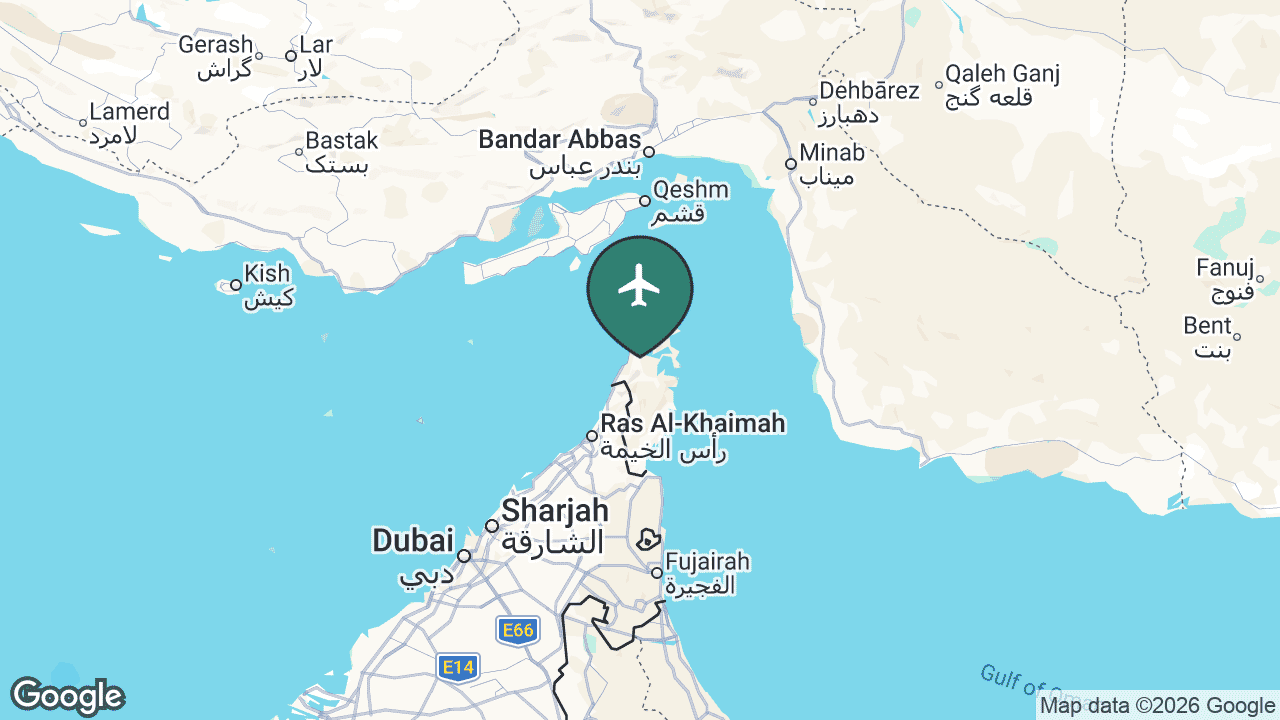
Khasab Airport sits at the northern tip of the Musandam Peninsula, an Omani exclave physically separated from the rest of the country by the United Arab Emirates and overlooking the Strait of Hormuz, the world’s most important oil-shipping chokepoint. The dramatic fjord-like inlets, or khors, that surround the town have earned the area the nickname the “Norway of Arabia”.
The airport runs a single regularly-served route, a domestic Oman Air flight to Muscat, making it more of a lifeline than a network airport. Because the rest of Oman can only be reached overland through the UAE, that one short flight is the quickest direct link between Musandam and the Omani mainland. Tiny in scale, the airport is outsized in strategic position.
Main airlines: Oman Air. See the full route map on AirportRoutes →
What about Dubai and Abu Dhabi?
Oman’s small size and its long border with the United Arab Emirates mean many travellers lean on the giant UAE hubs next door. Dubai (DXB), the base of Emirates and flydubai, and Abu Dhabi (AUH), home of Etihad, are a short flight or drive from northern Oman and offer the long-haul and transatlantic connections Oman’s own airports do not. The Musandam exclave around Khasab is itself reached overland only through the UAE, which makes the neighbouring airports a natural gateway for the far north.
For destinations beyond the Gulf, especially North America, Australia and much of the Americas, most journeys from Oman connect through one of these mega-hubs or through Doha on Qatar Airways. Muscat is a comfortable point-to-point and regional airport, but for the widest global reach the big neighbours still do the heavy lifting.
Airport rankings, nonstop-destination counts, served regions and airline lists are drawn from live AirportRoutes route data (observed AeroAPI flight data, a sample rather than a complete published schedule; we use the regularly-served figure, which filters one-off observations). Airport locations and notable facts are cross-checked against the cited references. The ranked map is a Mappr original.
Primary Data Source:
- AirportRoutes: Major airports and routes, Oman – Live route data: per-airport nonstop destinations, served cities and airlines.
References:
- Wikipedia: Omani airports (Muscat, Salalah and Khasab) – Airport history, location, status and notable facts referenced in the per-airport sections.
- Locator maps: Google Maps / Google Static Maps – Per-airport location maps with airplane markers, generated via Google Static Maps.
Image Sources:
- Map by Mappr – Map of major airports in Oman, a Mappr original built from AirportRoutes data and Natural Earth boundaries.


