Still DR Congo’s largest and deadliest Ebola outbreak, and the second-largest anywhere behind only the 2014–2016 West Africa epidemic. Case-fatality is 48.4% and the WHO PHEIC remains in effect.
💀 The death toll passed 4,000 on 2 October. DR Congo’s health ministry put the outbreak at 8,300 confirmed cases and 4,018 deaths, 140 days after it was declared.
🇨🇩 On the ECDC’s more detailed count to 29 September, DR Congo stood at 8,224 confirmed cases and 3,982 deaths, with 2,121 recoveries and 851 patients in isolation.
⚠️ WHO says the epidemic is far from over and on track to surpass the 2014-2016 West Africa outbreak, which killed more than 11,000 people.
🗺️ The count is 63 of 167 health zones across seven provinces. Dungu in Haut-Uélé, on the South Sudan border, is the newest addition, alongside Bulu in Sud-Ubangi.
📉 Ituri is coming down. WHO put confirmed cases there down about 26% over the 21 days to 22 September, and Haut-Uélé down about 15%, the first sustained provincial declines of the outbreak.
WHO is cautious about it, calling the progress real but fragile on 23 September and warning this is not the moment to relax attention or reduce support.
🔎 Detection is the weak point. WHO says one in three new infections is now found only after the person has died in the community, outside any treatment centre.
⚠️ North Kivu runs the other way. Confirmed cases there rose about 73% over the 21 days to 22 September, and it now supplies roughly a third of new confirmations.
Its case-fatality ratio is close to 60%, well above the national 48.4%. South Kivu, by contrast, has had no new confirmed case since late May.
Ituri still carries the outbreak, at 6,032 cases and 2,764 deaths on 23 September. North Kivu follows at 1,480 cases and 884 deaths, a case-fatality ratio of 59.7%.
✅ Seven health zones have now passed 42 days without a new confirmed case, the two-incubation-period threshold WHO uses to close out a chain, on ministry figures to 22 September.
💉 Vaccines: 3,771 people had received Ervebo by 17 September, 3,063 in Tshopo and 708 in Bas-Uélé. On 19 September MSF and Epicentre launched the BRAVO effectiveness study in Bunia, extending vaccination into Ituri and North Kivu.
🇺🇬 Uganda: outbreak over since 28 July 2026, after 20 confirmed cases, 18 recoveries and 2 deaths. France and Germany have also closed out their imported cases.
Pressure points: contact follow-up slipped to 74.7% on 26 September against a 95% target, and about 30,000 people are on contact lists where an outbreak this size would generate some 420,000.
Children under five are dying at more than 60%, against about 40% in adults. Health-worker deaths have now passed 50.
🔥 The response is losing facilities. An Ebola transit centre at the Kigonze displacement site outside Bunia burned down on the evening of Tuesday 29 September, during a military weapons search that sent thousands of the site’s roughly 19,000 residents fleeing.
🚨 Attacks are mounting too. Marie-Celestin Karondwa, a local party official who promoted outbreak awareness on the radio, was beaten to death at his home in Butembo on Sunday 27 September and the house was set on fire.
This page is updated daily.
Key Takeaways
- DRC's 17th Ebola outbreak in 50 years. DRC declared its 17th Ebola outbreak on 15 May 2026, a Bundibugyo virus outbreak in Ituri Province. By 2 October DR Congo's health ministry counted 8,300 confirmed cases and 4,018 deaths, a case-fatality ratio of 48.4%, making it the <strong>largest Ebola outbreak ever recorded in DRC</strong> and the second-largest anywhere, ahead of the 2018–2020 epidemic (3,317 confirmed cases) and behind only the 2014–2016 West Africa outbreak. The Africa CDC says it has killed five times more people in its first three months than previous outbreaks had by the same stage.
- WHO declared a global health emergency on 16 May. The Director-General's PHEIC declaration is the highest-level alert under International Health Regulations — only the 8th time it's been invoked since 2005.
- Uganda declared Ebola-free on 28 July. Uganda's Ministry of Health declared its outbreak over on 28 July 2026, after 20 confirmed cases, 18 recoveries and 2 deaths. The virus also reached Europe through imported cases: two patients were airlifted from DRC to Berlin's Charité (May and 13 July), and France confirmed an imported case on 24 June.
- No licensed vaccine for the Bundibugyo strain. Existing Ebola vaccines (Ervebo, Mvabea-Zabdeno) target the Zaire strain, and Bundibugyo virus has caused only two prior outbreaks (2007 Uganda, 2012 DRC). On 7 August 2026 the WHO's vaccine advisory group recommended testing Ervebo against Bundibugyo in a Phase 3 trial, drawing on Gavi's 500,000-dose stockpile. On 20 August the WHO allocated 70,000 Ervebo doses to DR Congo, 20,000 for the trial and 50,000 for frontline and health workers, the first 16,250 doses reached Kinshasa on 21 August, and vaccination of frontline workers began in Kisangani on 27 August. By 17 September the campaign had vaccinated 3,771 people, 3,063 of them in Tshopo and 708 in Bas-Uélé. On 19 September MSF and its research centre Epicentre launched BRAVO, a study of Ervebo effectiveness in 20,000 frontline workers in Ituri and North Kivu, which also took vaccination into the Ituri epicentre. WHO said on 2 September that efficacy trials of Ervebo and two Bundibugyo-specific candidates should begin in October or November.
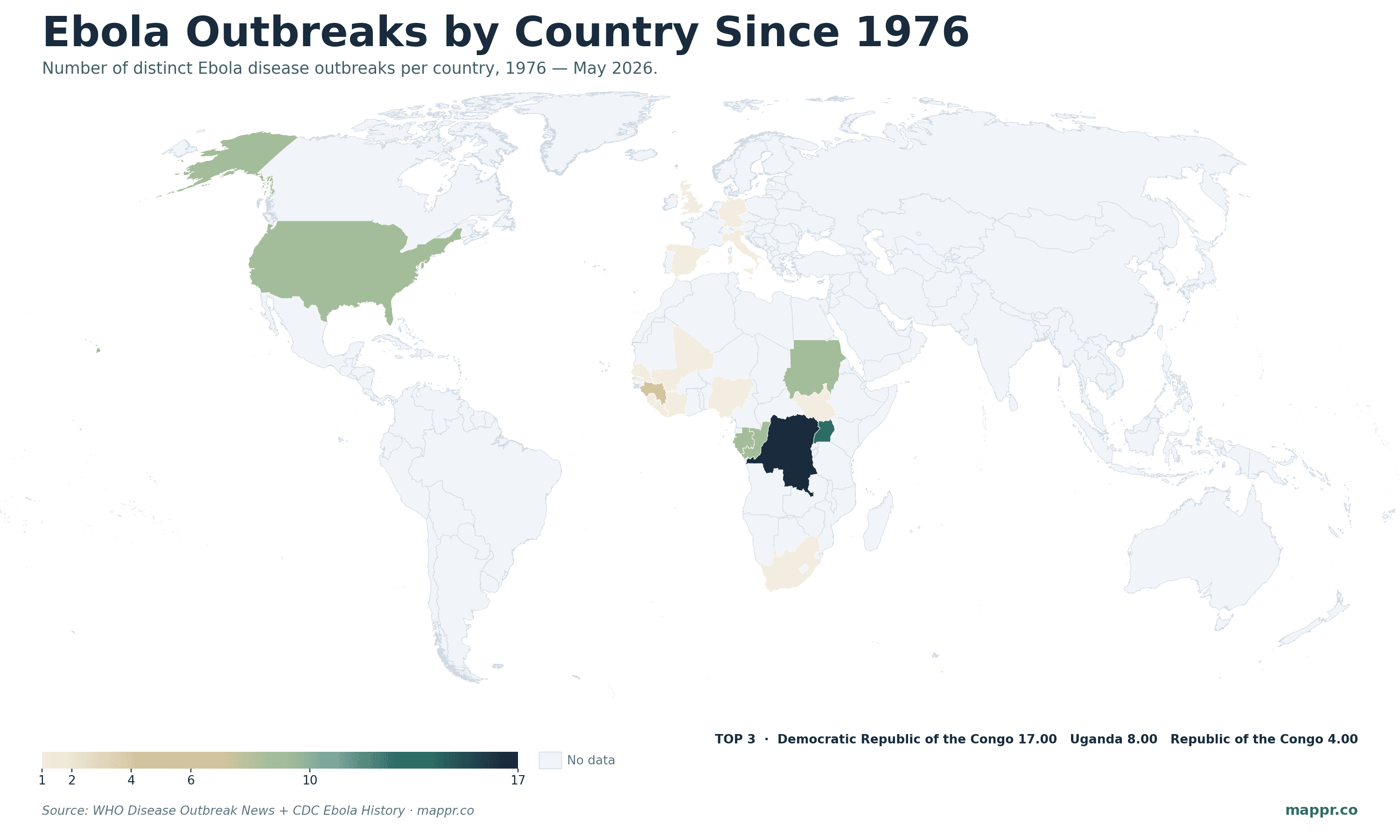
- 35,000+ cases globally since 1976. Roughly 80% from the 2014–2016 West Africa outbreak (Sierra Leone, Liberia, Guinea). DRC has now had 17 separate outbreaks — more than any other country.
On 16 May 2026, the World Health Organization declared the new Ebola outbreak in the Democratic Republic of the Congo a Public Health Emergency of International Concern (PHEIC) — the highest-level alert under the International Health Regulations and only the eighth such declaration since the framework’s modern adoption in 2005. The trigger: an outbreak of Bundibugyo virus disease in eastern DRC’s Ituri Province, with cross-border spread to Uganda and the first known intercontinental medical evacuation already underway.
Latest figures (2 October 2026): DR Congo’s health ministry puts the outbreak at 8,300 confirmed cases and 4,018 deaths, a case-fatality ratio of 48.4%. The confirmed death toll passed 4,000 that day.
The ECDC’s more detailed count to 29 September records 8,224 confirmed cases and 3,982 deaths, with 2,121 recoveries, 851 patients hospitalised in isolation and contact follow-up back up to 78.7% from 74.7% a week earlier.
Uganda’s 20 cases and 2 deaths and the single imported case in France are all closed out, so DR Congo now carries the entire active outbreak on its own.
It crossed 8,000 confirmed cases on 26 September and 4,000 confirmed deaths on 2 October, six days apart.
That makes it the largest Ebola outbreak ever recorded in DR Congo, past the 2018–2020 epidemic’s 3,317 confirmed cases, and the second-largest anywhere. The week to 16 August remains the worst of the outbreak, at 640 confirmed cases and 367 deaths.
The following week brought the first sign of a slowdown. WHO AFRO’s situation report 15 recorded 563 confirmed cases and 302 deaths in the week to 23 August, the first week-on-week fall of the outbreak.
It did not hold. DR Congo went from 6,186 confirmed cases on 31 August to 7,022 on 10 September, and the outbreak reached a seventh province the same day.
It is now DR Congo’s deadliest Ebola outbreak as well as its largest. The death toll passed the 2,299 deaths of the 2018–2020 epidemic in mid-August, and WHO AFRO put the case-fatality ratio at 47.4% in the week to 16 August.
Daily increments are still large, but smaller. The most recent 24-hour count, to 23 September, added 70 confirmed cases and 20 deaths, against 80 cases and 49 deaths on 10 September.
Those 70 cases were spread across five provinces: 31 in Ituri, 31 in North Kivu, six in Haut-Uélé, one in Bas-Uélé and one in Tshopo. Ituri and North Kivu are now contributing in equal measure.
The UN described the spread as exponential through August. By mid-September the national epidemic curve was trending down, with the reproduction number reported at 0.9.
By 26 September 2,070 people had recovered. The confirmed death toll passed 2,000 on 9 August, 86 days after the outbreak was declared, passed 2,500 by 22 August and passed 3,000 on 31 August.
It has kept climbing since. The toll passed 3,500 in the week to 16 September, 3,700 by 21 September and 4,000 on 2 October, when the health ministry reported 4,018 deaths.
The count is now 63 of 167 health zones affected across seven provinces: Ituri, North Kivu, South Kivu, Haut-Uélé, Tshopo, Bas-Uélé and, since 10 September, Sud-Ubangi. The denominator grew with Sud-Ubangi’s 16 zones.
The two most recent additions both sit on international borders. Bulu, in Sud-Ubangi, faces the Central African Republic, and Dungu, in Haut-Uélé, faces South Sudan.
Six zones were added in the week to 26 August: Ganga and Viadana in Bas-Uélé, Biena, Manguredjipa and Mutwanga in North Kivu, and Tshopo health zone in Tshopo province.
One more followed on 4 September: Kayna, in North Kivu, the 61st affected health zone and the first addition in nine days.
The Curve Starts to Bend, Unevenly
Mid-September brought the first real change in direction. On 15 September DR Congo’s health minister said the epidemic is under control, though not over: daily confirmations are down from about 120 at the peak to about 80, and daily deaths from about 50 to about 30.
He put the reproduction number at 0.9. Below 1 means each infection is passing to fewer than one other person on average, the arithmetic of an epidemic that is shrinking rather than growing.
Ten health zones have gone quiet. Six passed 42 days without a new confirmed case by 15 September, the two-incubation-period threshold WHO uses to close out a chain, and four more passed 21 days.
That still leaves most of the map active. Of the 62 zones affected at that point, 52 were reporting active transmission.
WHO is not calling a peak. “It is too early to affirm with certainty that we have surpassed the peak,” said WHO epidemiologist Olivier le Polain on 15 September, adding that national trends hide wide variation between provinces.
Tedros Adhanom Ghebreyesus was more specific on 16 September: “We are now starting to see encouraging signs that we are gaining ground in the most affected parts of Ituri province. Transmission is going down.”
Then the caveat: “But make no mistake, the epidemic continues to grow and continues to kill.” Maria Van Kerkhove, WHO’s director for epidemic and pandemic management, called for cautious optimism and realism “about the road that’s ahead of us”.
North Kivu Runs the Other Way
The national average hides an outlier. Over the 21 days to 22 September, confirmed cases fell about 26% in Ituri and about 15% in Haut-Uélé, while North Kivu rose about 73%.
North Kivu’s share has kept growing. MSF puts the province at nearly 40% of all newly confirmed cases nationwide in early October, up from 24% at the end of August.
Al Jazeera put its 21-day total at 567 confirmed cases on 25 September, against 868 in Ituri, a province with four times the caseload.
Tedros described the province as “many outbreaks in many places”, a function of its size and of chains scattered across health zones rather than concentrated in one epicentre.
South Kivu is the counterweight: no new confirmed case there since late May. Tshopo and Haut-Uélé are reporting only sporadic local transmission.
On a single-day view Ituri still supplies the most cases. Of 71 new confirmations in the 24 hours to 16 September, 41 were in Ituri, 27 in North Kivu, two in Haut-Uélé and one in Tshopo, alongside 32 deaths.
Sud-Ubangi: the First Case in Western DR Congo
On 10 September the outbreak jumped to a seventh province. Sud-Ubangi, in the north-west, confirmed its first case in Bulu health zone, the 62nd affected zone and the first anywhere in western DR Congo.
The patient was a 23-year-old man who died in the town of Gwaka. He had travelled for about three weeks from South Kivu through Rwanda and Uganda, then into Ituri, Tshopo and Mongala, part of the journey by boat down the Congo River.
That matters for geography as much as arithmetic. Sud-Ubangi borders the Central African Republic and the Republic of the Congo, and the WHO has warned the outbreak could spread from DR Congo into the Central African Republic and South Sudan.
“It worries me,” said Jean-Jacques Mbungani, a lawmaker for the province and a former health minister. “Our province borders Congo-Brazzaville and the Central African Republic. We fear it may spread regionally.”
Ituri remains the epicentre, with 6,250 confirmed cases and 2,885 deaths across 28 of its 36 health zones on ECDC figures to 29 September. North Kivu follows on 1,570 cases and 931 deaths across 16 of its 34 zones.
Then come Haut-Uélé (344 cases, 144 deaths, 7 zones), Tshopo (45 cases, 16 deaths, 7 zones), Bas-Uélé (10 cases, 4 deaths, 3 zones), South Kivu (3 cases, 1 death, 1 zone) and Sud-Ubangi (2 cases, 1 death, 1 zone), on ECDC figures to 29 September.
North Kivu is the deadliest province in proportional terms: 931 deaths against 1,570 confirmed cases on 29 September, a ratio of 59.3% against a national 48.4%. It crossed 1,000 confirmed cases on 5 September.
North Kivu is also where the outbreak is now growing fastest. Its weekly case count nearly doubled in the two weeks to 16 September, from about 100 to more than 200, at a point when Ituri was coming down.
WHO puts that down to the size of the province and to chains of transmission scattered across health zones rather than concentrated in one epicentre.
Bas-Uélé became the sixth affected province on 13 August, when a case imported from Haut-Uélé was identified in the provincial capital Buta and later died. Gombari in Haut-Uélé and Bafwasende in Tshopo were added in the first week of August.
Contact follow-up has been volatile. It dipped to 74.7% on 26 September from 87.8% on 18 September, then recovered to 78.7% by 29 September, still short of the 95% the WHO considers necessary to break transmission chains.
Some 851 patients are hospitalised in isolation, up from 773 three days earlier.
The larger gap is upstream. WHO recorded 32,342 contacts requiring follow-up on 23 September and reached 26,980 of them that day, but an outbreak of this size would be expected to generate roughly 420,000 contacts in total.
On 2 August the WHO said the outbreak is intensifying at an “exceptional” pace, with sustained transmission and continued increases in cases and deaths. It named insecurity, population displacement and cross-border movement as the main obstacles to the response.
The risk ratings have not moved with the case curve. WHO’s Disease Outbreak News of 10 September still rates the national risk in DR Congo as very high, the risk to countries sharing a border as high, and the regional and global risk as low.
DON617 describes sustained community transmission and significant geographic expansion, with 51 of the 61 health zones then affected reporting cases in the preceding 21 days.
The IHR Emergency Committee met for a second time on 18 August and the outbreak remains a Public Health Emergency of International Concern. Tedros told the committee the epidemic “is far from being under control” and that it “had a big head start, and we are still playing catch-up”.
The committee’s full report, published on 28 August, records that 11 of its 12 members backed keeping the PHEIC in place, while stopping short of calling the epidemic a pandemic emergency.
It also warns that modelling suggests true infections may run three to four times the reported count, and that roughly 1,000 treatment beds are available against an estimated need for 3,000.
WHO is now recruiting motorbike riders as surveillance and response officers, on the grounds that they reach communities and roads the formal response keeps missing.
Strikes by unpaid health workers, misinformation and traditional burial practices are slowing the response further, on top of the insecurity in Ituri and North Kivu.
Health workers are being hit hard. More than 50 have now died, up from 45 against 158 confirmed infections as of 21 August, and an MSF staff member infected in late September was flown to the Netherlands on a special medical flight.
Recoveries have passed 2,000: 2,121 in DR Congo on ECDC figures to 29 September, plus 18 in Uganda.
The virus has reached Europe three times. Two patients were medically evacuated from DR Congo to Berlin’s Charité, in May and again on 13 July, and France confirmed an imported case on 24 June. The ECDC rates the risk to people living in the EU or EEA as very low.
This is the 17th Ebola outbreak in the DRC since the virus was identified in the country in 1976 — the highest count of any nation. The map below shows the geography of all known Ebola outbreaks since then, with the DRC at the centre.

The Current Outbreak: A Timeline
- 24 April 2026 — A health worker in Bunia, Ituri Province, develops fever, vomiting, intense malaise, and signs of haemorrhagic illness. He dies at a medical centre in Bunia. Index case, retrospectively.
- 5 May 2026 — WHO receives an alert about an unknown high-mortality illness in Mongbwalu Health Zone, Ituri. Four healthcare workers have died within four days.
- 13 May 2026 — Rapid response teams complete in-depth investigations in Mongbwalu and Rwampara health zones. Initial Ebola Xpert testing on 20 Rwampara samples is negative; samples sent to Kinshasa for full PCR.
- 15 May 2026 — DRC’s national reference laboratory (Institut National de la Recherche Biomédicale) confirms Orthoebolavirus bundibugyoense by PCR and genomic sequencing. DRC Ministry of Public Health officially declares the country’s 17th Ebola outbreak.
- 15 May 2026 — Uganda’s Ministry of Health confirms a Bundibugyo virus case in an elderly man admitted to a Kampala private hospital on 11 May; he died on 14 May. His body was returned to DRC the same day.
- 16 May 2026 — A second imported case is confirmed in Kampala. The WHO Director-General, following IHR consultation, declares Ebola in DRC and Uganda a PHEIC.
- 18 May 2026 — The US CDC, DHS, and federal partners implement enhanced traveller screening and entry restrictions.
- 29 May 2026 — Case totals climb to 125 confirmed and 906 suspected cases, with 223 suspected deaths; the Africa CDC reports more than 1,000 suspected cases in DRC alone, and WHO’s Director-General travels to the outbreak epicentre.
- 2 June 2026 — Confirmed cases reach 378 (363 in DRC, 15 in Uganda) with 63 confirmed deaths as transmission accelerates across Ituri.
- 17 June 2026 — The outbreak reaches 856 confirmed cases and 198 confirmed deaths; Ituri Province accounts for 767 cases, with spread into North Kivu and South Kivu.
- 24 June 2026: France confirms an imported Ebola case, the outbreak’s second to reach Europe after the May evacuation to Germany.
- 27 June 2026: Cumulative totals pass 1,294 confirmed cases and 362 confirmed deaths across DRC and Uganda, then the third-largest Ebola outbreak on record; Ituri Province remains the epicentre (about 1,165 cases).
- 26 July 2026: Cumulative totals reach about 3,221 confirmed cases and 1,407 deaths (case-fatality ~44%). WHO says the outbreak is still expanding, with suspected cases in previously unaffected provinces, and the US CDC confirms an American citizen in the DRC has tested positive.
- 31 July 2026: Congolese officials report 3,532 confirmed cases and 1,556 deaths across five provinces, and the outbreak overtakes DRC’s 2018–2020 epidemic (about 3,470 cases) to become the world’s second-largest Ebola outbreak ever recorded, behind only the 2014–2016 West Africa epidemic. The Africa CDC calls it the fastest-spreading Ebola outbreak on record; the WFP’s acting chief says “the world needs to pay much more attention.”
- 28 July 2026: Uganda’s Ministry of Health declares the country’s Ebola outbreak over, 42 days after the last patient was discharged on 16 June. Uganda recorded 20 confirmed cases, 18 recoveries and 2 deaths; 15 cases were imported from DR Congo and 5 were Ugandan health workers infected while treating patients.
- 30 July 2026: WHO Disease Outbreak News reports 3,626 confirmed cases and 1,589 deaths across DR Congo, Uganda and France, and confirms this is now the largest Ebola outbreak ever recorded in DR Congo, past the 2018–2020 epidemic’s 3,317 confirmed cases. The outbreak covers 49 health zones in five provinces; week 30 was the worst yet at 567 cases and 296 deaths. Health-worker infections reach 151, with 44 deaths.
- 2 August 2026: The WHO warns the epidemic is intensifying at an “exceptional” pace and calls for a major scale-up of the response, citing insecurity, displacement and cross-border movement.
- 4–5 August 2026: WHO Director-General Tedros Adhanom Ghebreyesus, Africa CDC’s Jean Kaseya and WHO Africa’s Mohamed Janabi lead a joint mission to Uganda, Bunia and Kinshasa. As of 4 August DR Congo has 3,973 confirmed cases, 1,801 deaths and 776 recoveries across 51 health zones; contact follow-up is at 75% against a 95% target, and the North Kivu treatment centre is at 139% occupancy.
- 5 August 2026: President Félix-Antoine Tshisekedi orders a six-month, village-centred response plan with free healthcare in Ituri and North Kivu. The United States announces $242 million, taking mobilised international funding past $420 million.
- 7 August 2026: DR Congo passes 4,000 confirmed cases, reaching 4,053 cases and 1,850 deaths as of 5 August across 53 health zones, with Gombari (Haut-Uélé) and Bafwasende (Tshopo) newly affected. The WHO’s vaccine advisory group recommends putting Ervebo into a Phase 3 trial against Bundibugyo virus, supplied from Gavi’s 500,000-dose stockpile.
- 9 August 2026: The confirmed death toll passes 2,000, 86 days after the outbreak was declared. Epidemiological week 32, to 9 August, becomes the worst yet with 579 confirmed cases and 304 deaths.
- 12 August 2026: WHO says it is on the verge of submitting the Ervebo Phase 3 trial protocol to DRC regulatory and ethics committees. Contacts of confirmed cases will be randomised individually to vaccine or placebo rather than vaccinated in rings. The PARTNERS therapeutics trial has enrolled more than 100 confirmed cases across three treatment facilities in Ituri.
- 13 August 2026: Bas-Uélé becomes the sixth affected province after a case imported from Haut-Uélé is identified in Buta and dies. The outbreak now spans 54 health zones.
- 14 August 2026: WHO Disease Outbreak News 2026-DON615 reports 4,665 confirmed cases and 2,184 deaths in DR Congo as of 12 August, a case-fatality rate of 46.8%, with 965 recoveries, 634 patients hospitalised in isolation and contact follow-up at 84.2%. Ituri accounts for 85% of confirmed cases and health-worker infections reach 155, with 45 deaths.
- 16 August 2026: WHO AFRO weekly situation report 14 records a further 640 confirmed cases and 367 deaths in the week to 16 August, the worst week of the outbreak so far, with the case-fatality ratio at 47.4%.
- 17 August 2026: The death toll passes the 2,299 deaths of the 2018–2020 epidemic, making this DR Congo’s deadliest Ebola outbreak as well as its largest. UN News reports 4,945 confirmed cases and 2,325 deaths, roughly one death every 30 minutes, and a $54.5 million OCHA allocation.
- 18 August 2026: The IHR Emergency Committee meets for a second time and the outbreak remains a PHEIC. Tedros says the epidemic “is far from being under control” and “had a big head start, and we are still playing catch-up”, with almost 5,000 people infected, more than 2,300 dead and 55 health zones affected.
- 20 August 2026: WHO allocates 70,000 doses of Ervebo to DR Congo, 20,000 for the Phase 3 trial against Bundibugyo virus and 50,000 for frontline and health workers, with Gavi funding $7 million for shipping and $6 million for vaccination. WHO’s rapid risk assessment v4 keeps the national risk at very high and the regional risk at high.
- 21 August 2026: The first 16,250 Ervebo doses arrive in Kinshasa, with further shipments expected the following week.
- 22 August 2026: DR Congo stands at 5,290 confirmed cases and 2,516 deaths as of 20 August per the ECDC, a case-fatality rate of about 47.5%, with 1,152 recoveries, 837 patients hospitalised and 56 of 151 health zones affected. The UN says infections are spreading exponentially.
- 23 August 2026: WHO AFRO weekly situation report 15 records 563 confirmed cases and 302 deaths in the week to 23 August, down from 640 and 367 the week before and the first week-on-week fall of the outbreak. Cumulative totals reach 5,584 confirmed cases and 2,680 deaths across 57 health zones, with Viadana (Bas-Uélé) and Mutwanga (North Kivu) newly affected.
- 25 August 2026: Tedros Adhanom Ghebreyesus, Mohamed Janabi and Jean Kaseya publish a joint commentary saying the deadliest Bundibugyo outbreak on record can still be stopped, but that the response must scale two to three times. They cite 158 health workers infected and 45 dead as of 21 August, and note that health zones in northern Ituri and South Kivu have interrupted transmission.
- 26–27 August 2026: WHO closes out the international arm of the outbreak, listing the 42-day monitoring periods for both Uganda and France as complete on 27 August.
- 27 August 2026: DR Congo begins Ervebo vaccination of frontline workers, launched by Health Minister Roger Kamba in Kisangani under a compassionate-use framework, starting in Tshopo, Bas-Uélé and Haut-Uélé.
- 28 August 2026: WHO Disease Outbreak News 2026-DON616 reports 5,794 confirmed cases and 2,786 deaths as of 26 August, a case-fatality ratio of 48.1%, with 1,293 recoveries, 843 patients hospitalised, contact follow-up at 82.3% and 60 of 151 health zones affected. The IHR Emergency Committee’s meeting report, published the same day, keeps the PHEIC in place, records 11 of 12 members in favour, and warns true infections may run three to four times the reported count against roughly 1,000 treatment beds for an estimated need of 3,000.
- 31 August 2026: DR Congo’s confirmed death toll passes 3,000. INSP situation report 109 records 6,186 confirmed cases and 3,007 deaths, a case-fatality ratio of 48.6%, with 1,409 recoveries and 830 patients in isolation.
- 1 September 2026: MSF publishes a Lancet commentary arguing children must get timely access to paediatric formulations in the post-exposure prophylaxis trials of the oral antiviral obeldesivir. MSF now has more than 1,700 staff, nine treatment centres across five provinces and over 480 beds, with more than 2,770 admissions by 30 August.
- 2 September 2026: WHO says efficacy trials of three vaccines, Ervebo plus Bundibugyo-specific candidates from Moderna and the University of Oxford, should begin in October or November. The AP reports the outbreak shows no signs of slowing as deaths top 3,000.
- 4 September 2026: Kayna health zone in North Kivu becomes the 61st affected, the first addition since 26 August. INSP puts DR Congo at 6,522 confirmed cases.
- 5 September 2026: INSP situation report 114 records 6,604 confirmed cases and 3,175 deaths, a case-fatality ratio of 48.1%, with 1,548 recoveries, 851 patients in isolation, contact follow-up at 85.7% and 61 of 151 health zones across six provinces. North Kivu passes 1,000 confirmed cases at a 65.9% case-fatality ratio, and Ervebo vaccination reaches Buta in Bas-Uélé, where 500 frontline workers are vaccinated before the local stock runs out.
- 10 September 2026: WHO Disease Outbreak News 2026-DON617 reports 6,757 confirmed cases and 3,267 deaths in DR Congo as of 7 September, 6,778 cases in total with Uganda and France, a case-fatality ratio of 48.3%, 1,611 recoveries and contact follow-up at 85.3%. It records 2,007 people vaccinated with Ervebo by 6 September across six health zones in Tshopo, Bas-Uélé and Ituri.
- 10 September 2026: Sud-Ubangi becomes the seventh affected province and the first in western DR Congo, after a 23-year-old man dies in Gwaka, Bulu health zone, having travelled from South Kivu through Rwanda, Uganda, Ituri, Tshopo and Mongala over about three weeks. DR Congo passes 7,000 confirmed cases the same day: the INSP report published on 11 September records 7,022 cases and 3,398 deaths, a case-fatality ratio of 48.4%, with 1,671 recoveries, 837 patients in isolation, 80 new cases and 49 deaths in 24 hours, and 62 of 151 health zones affected. North Kivu treatment centres are at 141.4% occupancy.
- 13 September 2026: Three cases are confirmed inside Savo camp in Djugu territory, Ituri, a displacement site holding about 70,000 people.
- 14 September 2026: Health teams in Bule, in Ituri’s Fataki health zone, report daily community deaths, repeated difficulty securing bodies for safe burial, and a single ambulance that cannot run after dark. They ask for a transit or treatment site in Bule.
- 15 September 2026: DR Congo’s health minister says the epidemic is under control but not over. Daily confirmations are down from about 120 at the peak to about 80 and daily deaths from about 50 to about 30, with the reproduction number at 0.9. Six health zones pass 42 days without a new confirmed case and four more pass 21 days, though 52 of the 62 affected zones still have active transmission. WHO epidemiologist Olivier le Polain says it is too early to be certain the peak has passed; UN Ebola coordinator Julien Harneis warns that relaxing pressure now would let the epidemic hit back hard.
- 16 September 2026: Tedros Adhanom Ghebreyesus reports transmission going down in the most affected parts of Ituri, but says the epidemic continues to grow and continues to kill. North Kivu’s weekly case count has nearly doubled in two weeks, from about 100 to more than 200, and he describes the province as many outbreaks in many places. South Kivu has had no new confirmed case since late May. ECDC records 7,475 confirmed cases and 3,605 deaths in DR Congo as of 16 September, with 71 new cases and 32 deaths in 24 hours: 41 in Ituri, 27 in North Kivu, two in Haut-Uélé and one in Tshopo.
- 17 September 2026: DR Congo passes 7,500 confirmed cases, at 7,541 cases, 3,639 deaths and 1,823 recoveries. Ervebo vaccination reaches 3,771 people, 3,063 in Tshopo and 708 in Bas-Uélé.
- 19 September 2026: MSF and Epicentre launch the BRAVO study at the WHO training centre in Bunia, following 20,000 frontline workers in Ituri and North Kivu for nine to 12 months to measure how well Ervebo protects against Bundibugyo virus. Partners include the Ministry of Health, Africa CDC and the INRB. The government describes it as the expansion of vaccination into Ituri.
- 20 September 2026: INSP figures for 18 September put DR Congo at 7,614 confirmed cases and 3,676 deaths, a case-fatality ratio of 48.3%, with 1,864 recoveries, 909 patients in isolation, contact follow-up at 87.8% and 63 of 151 health zones across seven provinces. Screening covers 97% of 281,145 travellers at entry points and community mobilisation has reached more than 110,000 people.
- 21 September 2026: INSP records 7,733 confirmed cases and 3,732 deaths across seven provinces and 63 health zones, with 1,935 recoveries and 839 patients in isolation. The confirmed death toll passes 3,700.
- 23 September 2026: WHO quantifies the split between provinces. Over the preceding 21 days confirmed cases fall about 26% in Ituri and about 15% in Haut-Uélé, but rise about 73% in North Kivu. WHO says one in three new infections is identified only after the person has died in the community, and that children under five are dying at more than 60% against about 40% in adults. The response now runs 49 treatment centres with close to 1,400 beds and 25 laboratories.
- 25 September 2026: WHO Disease Outbreak News 2026-DON618 and the ECDC report 7,890 confirmed cases and 3,799 deaths in DR Congo as of 23 September, a case-fatality ratio of 48.1%, with 1,966 recoveries, 893 patients in isolation, contact follow-up at 83.4% and 63 of 167 health zones across seven provinces. Two zones have been added since the previous Disease Outbreak News: Bulu in Sud-Ubangi, on the Central African Republic border, and Dungu in Haut-Uélé, on the South Sudan border. Risk stays very high nationally, high for bordering countries and low regionally and globally.
- 26 September 2026: DR Congo passes 8,000 confirmed cases. The INSP situation report for 26 September, reported on 28 September, records 8,067 confirmed cases and 3,901 deaths, a case-fatality ratio of 48.4%, with 2,070 recoveries, 773 patients in isolation and contact follow-up down to 74.7%.
- 27 September 2026: DR Congo’s health ministry reports a globally favourable trend, with new cases, deaths, test positivity and the reproduction number all falling, in a situation report published on 26 September. Seven health zones have now passed 42 days without a new confirmed case, contact tracing stands at 78.3% across the 55 affected zones on ministry figures, and Sud-Ubangi records its second confirmed case on 22 September.
- 27 September 2026: Marie-Celestin Karondwa, a local party official who promoted Ebola awareness on the radio, is beaten to death at his home in Butembo, North Kivu, and the house is set on fire.
- 28 September 2026: MSF reports that 34% of confirmed patients are being treated in non-specialised health facilities, because dedicated Ebola treatment centres are full and diagnosis comes late. All 29 beds at its Butembo treatment centre near Kitatumba hospital are occupied, and the city opens two more centres, taking the total to four.
- 29 September 2026: An Ebola transit centre at the Kigonze displacement site outside Bunia burns down in the evening, during a military search for weapons and suspected armed-group members that sends thousands of the site’s roughly 19,000 residents fleeing. UN senior Ebola coordinator Julien Harneis says that losing a centre means losing capacity and investment, and that insecurity is also disrupting sample transport and patient transfers.
- 29 September 2026: ECDC figures put DR Congo at 8,224 confirmed cases and 3,982 deaths, a case-fatality ratio of 48.4%, with 2,121 recoveries, 851 patients in isolation, contact follow-up recovered to 78.7% and 63 of 167 health zones across seven provinces. Ituri stands at 6,250 cases and 2,885 deaths, North Kivu at 1,570 and 931.
- 2 October 2026: DR Congo’s confirmed death toll passes 4,000. Health ministry figures reported that day give 8,300 confirmed cases and 4,018 deaths across seven provinces, 140 days after the outbreak was declared, with more than 50 health workers dead and more than 2,000 patients recovered. WHO says the epidemic is far from over and on track to surpass the 2014-2016 West Africa outbreak. MSF puts North Kivu at nearly 40% of all newly confirmed cases nationwide, up from 24% at the end of August.
The Response: A Village-Centred Reset
WHO Director-General Tedros Adhanom Ghebreyesus, Africa CDC’s Jean Kaseya and WHO Africa’s Mohamed Janabi ran a joint high-level mission to Uganda, Bunia and Kinshasa on 4 and 5 August, drawing on Uganda’s containment experience. Their call afterwards was for an urgent, community-led scale-up.
The operational numbers behind that call are stark. Contact follow-up was running at 75% against a 95% target, 674 people were under care, and the treatment centre in North Kivu was at 139% occupancy.
Some of that has moved, and not all in the same direction. Contact follow-up was back at 78.7% on 29 September, after dipping to 74.7% on 26 September from 87.8% on 18 September, with 851 patients in isolation.
The hardware is largely in place. The response now runs 49 Ebola treatment centres with close to 1,400 beds and 25 laboratories, on WHO figures given on 23 September.
Finding cases is where it fails. WHO’s regional emergencies director said one in three new infections is identified only after the person has died in the community, outside any treatment centre.
The case curve has started to bend. Daily confirmations ran at 86 on 31 August, 80 on 10 September, 71 on 16 September and 70 on 23 September.
That is not the same as winning. The cumulative count passed 8,000 on 26 September and the death toll passed 4,000 on 2 October, and WHO’s assessment that week was that the epidemic is far from over.
WHO also warned it is on track to surpass the 2014-2016 West Africa outbreak, which killed more than 11,000 people and remains the largest on record.
On 5 August President Félix-Antoine Tshisekedi convened a crisis meeting and ordered a six-month, village-centred plan: communities co-leading alerts, free healthcare across Ituri and North Kivu, timely salaries and risk allowances for health workers, and one response plan on one budget.
Money has followed. Partners have mobilised more than $420 million, including $242 million announced by the United States on 5 August. OCHA has since released a further $54.5 million to accelerate the DR Congo response and prepare neighbouring countries.
Gavi has committed $7 million to ship the Ervebo doses and $6 million for vaccination in high-risk areas. The International Medical Corps opened the country’s largest treatment facility, 100 beds, in early August, taking capacity to roughly 900 beds.
Capacity is unevenly distributed, and North Kivu is the pinch point. On 10 September its treatment centres were at 141.4% occupancy, with 311 patients in isolation, up from 115% and 253 patients five days earlier.
MSF is blunter about the gap. It says the disease is still spreading at an alarming and unprecedented rate, and that 90% of patients arriving at treatment centres had never been on a contact list.
It is also the largest non-governmental responder on the ground: more than 1,700 staff, nine Ebola treatment centres across five provinces and over 480 beds, with more than 2,770 admissions by 30 August. On 1 September it argued in The Lancet that children need timely access to paediatric formulations in the post-exposure prophylaxis trials of the antiviral obeldesivir.
On 25 August, Tedros, WHO Africa’s Mohamed Janabi and Africa CDC’s Jean Kaseya argued in a joint commentary that the deadliest Bundibugyo outbreak on record can still be stopped, but that the response needs scaling by two to three times across every pillar.
Their evidence that it is controllable: Uganda closed out its chain of cases, and several health zones in northern Ituri and South Kivu have interrupted transmission.
Insecurity Starts Taking Back Ground
The response is now losing assets it took months to build. An Ebola transit centre at the Kigonze displacement site, on the outskirts of Bunia in Ituri, burned down on the evening of Tuesday 29 September.
Soldiers had entered the camp searching for weapons and suspected members of armed groups, and gunfire sent thousands of its roughly 19,000 residents fleeing.
“It’s been a huge struggle to create Ebola transit centres,” said Julien Harneis, the UN’s senior Ebola coordinator in DR Congo. “When we lose a centre, that means we lose capacity, we lose investment.”
The same insecurity has disrupted laboratory sample transport, blocked patient transfers and pushed some organisations to suspend activities in affected health zones, on UN figures.
The hostility is also personal. Marie-Celestin Karondwa, a local party official who promoted outbreak awareness on the radio, was beaten to death at his home in Butembo on Sunday 27 September and his house was set on fire.
Health workers in Bunia have been protesting August and September wage arrears, carrying signs reading “No money, no data!”
Beds are short where the cases now are. MSF says 34% of confirmed patients were being treated in non-specialised health facilities as of 28 September, because dedicated treatment centres are full and diagnosis comes late.
Butembo shows what that looks like. All 29 beds at the MSF treatment centre near Kitatumba hospital were full in late September, and city authorities opened two more centres that week, taking the city’s total to four.
A high-level review is due this month. President Félix-Antoine Tshisekedi, Tedros Adhanom Ghebreyesus and Africa CDC’s Jean Kaseya are set to meet in October to assess two months of the intensified response and decide what else is needed.
Who Is Bearing the Burden
The burden is falling heavily on children. More than 300 have died, and children make up nearly a quarter of confirmed cases but almost a third of deaths, on UN figures published on 7 August.
Age is the sharpest divider. WHO said on 23 September that children under five are dying at more than 60%, against about 40% among adults, because their symptoms are harder to spot and diagnose early.
Ituri is carrying a displacement crisis on top of the outbreak: close to a million people there have been displaced by conflict, about 80% of them women and children. Maternal deaths have almost doubled since the outbreak began.
Fear is also keeping people away from care. Use of health services in the hardest-hit areas has fallen by more than 40% in recent months, while some 13,000 community workers have reached over 2.4 million people with prevention information.
The displacement camps are now in it too. On 13 September DR Congo confirmed three cases inside Savo camp in Djugu territory, Ituri, which shelters roughly 70,000 people.
Residents describe conditions that make containment close to impossible. “The people here live in truly inhumane conditions,” said Emmanuel Ndalo of the camp’s displaced persons committee. “There are no bathrooms or places to wash hands.”
Burials remain the other weak point. Health teams in Bule, in Ituri’s Fataki health zone, reported on 14 September that several community deaths are recorded daily and that they struggle to secure bodies, take samples and arrange safe burials.
They have one ambulance, and insecurity keeps it off the road after dark, so patients who arrive in the evening wait until morning for transfer to Fataki. Local officials are asking for a transit or treatment site in Bule itself.
Where the Outbreak Started — and Why It Spread
The current epicentre is Mongbwalu Health Zone in Ituri Province, a high-traffic mining area in eastern DRC. WHO’s epidemiologists believe most early cases originated there, then migrated to Rwampara and Bunia health zones in search of medical care — bringing the virus into population centres with imperfect infection control.
Three features make Ituri a particularly high-risk launch point for regional spread:
- Mining and commercial traffic — Mongbwalu is a regional gold-mining hub with extensive informal labour movement.
- Cross-border proximity — Ituri shares borders with Uganda and South Sudan; Bunia HZ is less than 500 km from the Ugandan border. Two imported Uganda cases in less than a week confirm this concern.
- Insecurity — Active armed groups in parts of Ituri have limited the rapid-response team’s ability to identify and follow up contacts. As of 15 May, 65 contacts had been listed, 15 high-risk, but several had become symptomatic and died before they could be isolated.
The Outbreak Spreads Beyond DRC
The outbreak has crossed borders three times so far, all through the movement of patients and aid workers rather than local transmission abroad. Uganda’s own chain of cases has now been closed out, and the ECDC rates the risk to people living in the EU or EEA as very low.
- 🇺🇬 Uganda: outbreak declared over on 28 July 2026. Uganda recorded 20 confirmed cases, 18 recoveries and 2 deaths. Fifteen cases were imported from DR Congo and five were Ugandan health workers infected while caring for patients. The Ministry of Health declared the country Ebola-free 42 days after the last patient was discharged on 16 June, crediting rapid laboratory testing, genome sequencing and digital contact tracing.
- 🇩🇪 Germany — 1 evacuated American case at Berlin’s Charité. Peter Stafford, a US missionary doctor who has worked at Nyankunde Hospital in eastern DRC since 2019, contracted Bundibugyo virus while treating Ebola patients. He was airlifted to Berlin-Brandenburg airport on 19 May 2026 and transferred under police convoy to Charité’s specialised isolation ward (the same unit that treated patients during the 2014–2016 West Africa outbreak). Six high-risk contacts will be monitored in Germany and the Czech Republic. This is the first known Ebola medical evacuation to Europe in the current outbreak. A second US citizen, a humanitarian worker in DR Congo, tested positive on 10 July and was medically evacuated to Germany on 13 July 2026, bringing the number of patients treated in Germany to two.
- 🇺🇸 United States — enhanced screening, no cases. CDC, DHS, and partner agencies implemented Title-42-style entry restrictions on 18 May for travellers from DRC and Uganda. Departure-airport screening, on-arrival temperature checks, and 21-day post-arrival monitoring are now standard for entries from the affected region. No US-soil cases have been reported.
The American patient’s evacuation puts a fact often missed in headlines into sharp relief: Ebola containment depends as much on the global health workforce as on local capacity. Stafford was one of the international clinicians sustaining frontline care at Nyankunde Hospital — the same kind of role that, during the 2014–2016 West Africa outbreak, saw infections among foreign medical workers in MSF, the US Public Health Service, and Spanish and Italian missionary hospitals. The Charité has handled four previous Ebola patient evacuations across the 2014–2016 and 2018–2020 outbreaks; the unit’s protocols are well-established, and the patient prognosis (the Bundibugyo strain’s case-fatality is roughly 30–40%, lower than Zaire ebolavirus) is comparatively favourable with intensive supportive care.
WHO’s Director-General used the word “serious concern” on 19 May to describe the trajectory. WHO’s DRC representative told reporters there is “significant uncertainty” about how far the virus has actually spread — contact tracing in Ituri is being run under conditions of active insecurity and intermittent road closures, and several listed contacts have died before they could be isolated, suggesting transmission chains are longer than the confirmed case count implies.
What Bundibugyo Virus Is
Ebola is not a single virus. The genus Orthoebolavirus contains six recognised species, of which four are known to cause disease in humans. The most-studied — and the target of all licensed vaccines — is Zaire ebolavirus (EBOV), which causes the highest case-fatality rates (up to 90% untreated) and has driven the largest outbreaks, including the 2014–2016 West Africa epidemic and the 2018–2020 DRC outbreak.
The current outbreak is Bundibugyo virus (BDBV), the rarest of the four human-pathogenic species. Discovered in 2007 during an outbreak in western Uganda’s Bundibugyo District, it has caused only two prior outbreaks — Bundibugyo District 2007 (149 cases) and Isiro Health Zone, DRC, 2012 (52 cases). Case-fatality is around 30–40%, lower than Zaire ebolavirus but still extremely high.
Critically, the two licensed Ebola vaccines — Ervebo (rVSV-ZEBOV) and the Mvabea/Zabdeno two-dose regimen — both target Zaire ebolavirus. Cross-protection against Bundibugyo virus has not been clinically established. The two monoclonal antibody treatments (Inmazeb and Ebanga) also target Zaire-specific epitopes. Standard Ebola medical countermeasures may not work against this strain; the response is relying on classic outbreak containment (case isolation, contact tracing, safe burials) rather than vaccination.
Ervebo Heads Into a Phase 3 Trial
That may be about to change. On 7 August 2026 the WHO’s technical advisory group on candidate vaccine prioritisation recommended that Ervebo be prioritised for a Phase 3 trial during this outbreak, a shift from the earlier assessment that Zaire-strain vaccines had no established role here.
The evidence is thin but real: across animal studies, three of four non-human primates vaccinated with Ervebo survived a Bundibugyo challenge, against one of four unvaccinated controls. Gavi’s global stockpile holds 500,000 doses, some already pre-positioned in DR Congo.
Roughly 55,000 frontline workers in Ituri and North Kivu had already received Ervebo in earlier preventive campaigns against Zaire ebolavirus. Separately, a Bundibugyo-specific candidate entered Phase 1 testing in the UK on 24 July, with a second trial starting in Canada.
On 18 August the WHO said two vaccines designed specifically against Bundibugyo virus are now in human trials for the first time. Hundreds of thousands of doses of the Oxford candidate have already been manufactured in India.
On 12 August the WHO said it was on the verge of submitting the trial protocol to DRC regulatory and ethics committees. The design randomises individual contacts of confirmed cases to Ervebo or placebo, which the WHO considers more efficient than the ring vaccination used in past outbreaks.
The doses are now moving. On 20 August the WHO allocated 70,000 Ervebo doses from the global stockpile to DR Congo: 20,000 for the Phase 3 trial against Bundibugyo virus and 50,000 for frontline and health workers.
The first 16,250 doses landed in Kinshasa on the evening of 21 August, with more expected the following week. Health Minister Samuel Roger Kamba noted the vaccine had been used on a very large scale during the 2018–2020 outbreak, though that was against the Zaire strain.
Vaccination began on 27 August. Kamba launched the frontline-worker campaign in Kisangani, capital of Tshopo province, under a compassionate-use framework, with the first rounds in Tshopo, Bas-Uélé and Haut-Uélé.
By 5 September the campaign had reached Buta, in Bas-Uélé, where 500 frontline and incident-management staff were vaccinated. That emptied the local stock, and vaccination there is suspended until a resupply arrives from Kisangani.
The totals are still small, but they are moving. DR Congo reported 3,771 people vaccinated by 17 September, 3,063 of them in Tshopo and 708 in Bas-Uélé, up from 2,007 on 6 September.
Doses still go to health and frontline workers only, inside research protocols.
Safety so far looks unremarkable: 104 minor adverse events following immunisation have been reported, and no serious ones.
“We have decided to use the Ervebo vaccine to protect first those who are on the front line,” Kamba said. WHO stresses it is still unknown whether Ervebo protects against Bundibugyo virus in humans, which is why the doses are paired with data collection and the trial.
Timing has slipped. On 2 September the WHO said efficacy trials of three vaccines, Ervebo plus Bundibugyo-specific candidates from Moderna and the University of Oxford, should begin in October or November. Tedros has been blunt that nobody yet knows whether Ervebo works against Bundibugyo virus in humans.
MSF Launches the BRAVO Effectiveness Study
On 19 September MSF and Epicentre, its epidemiological research centre, launched BRAVO, a study of how well Ervebo actually works against Bundibugyo virus in the field. It was launched at the WHO-run health-worker training centre in Bunia.
The design is large and pragmatic: 20,000 frontline workers in Ituri and North Kivu, three months of vaccination followed by at least six months of follow-up, nine to 12 months in all.
The partners are the Ministry of Health, Africa CDC and the Congolese Institut National de Recherche Biomédicale. The Congolese government described the launch as the expansion of vaccination into Ituri, the epicentre.
“Although ERVEBO was not originally developed to protect against Bundibugyo, preliminary data suggest that it may offer some degree of protection,” said Dr Guyguy Manangama, an epidemiologist and MSF deputy director of operations.
Therapeutics are further along. The PARTNERS trial, running at three treatment facilities in Ituri, has enrolled more than 100 confirmed cases.
Ebola Cases Worldwide Since 1976
Since Ebola was first identified in 1976 in what is now the DRC, roughly 35,000 cases have been recorded across 19 countries — but the distribution is extremely skewed. The 2014–2016 West Africa outbreak alone accounts for about 80% of the cumulative case total, with three countries (Sierra Leone, Liberia, Guinea) carrying most of it.
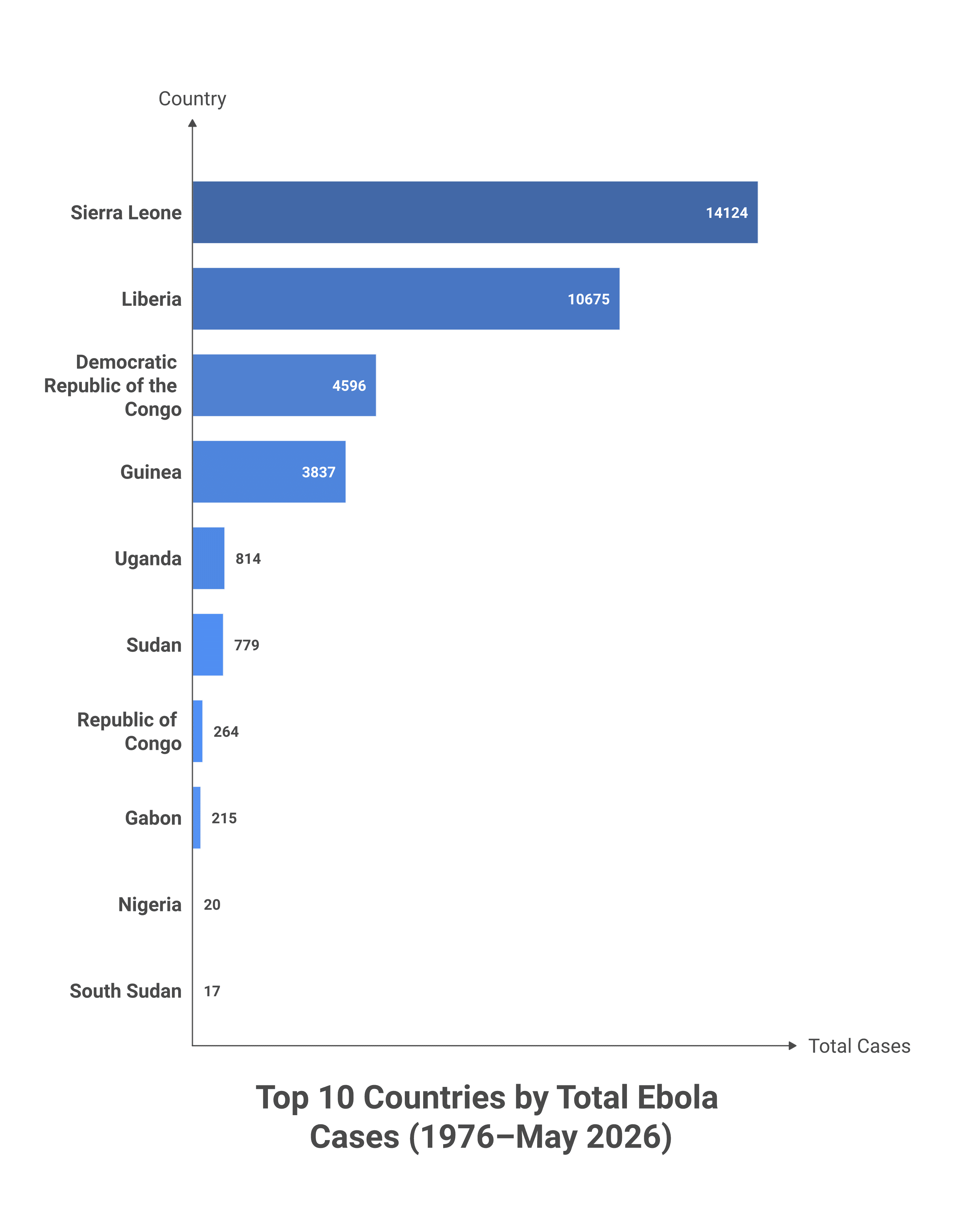
Outbreak history · 1976–2026
Ebola outbreaks by country
Reported outbreaks, cumulative cases, and deaths across every affected country since the virus was first identified. 2026 figures include the ongoing DRC and Uganda outbreaks.
| Country | Outbreaks | Cases | Deaths | Years |
|---|---|---|---|---|
| Democratic Republic of the Congo | 17 | 4,596 | 2,738 | 1976–2026 (2026 outbreak not yet folded in; see live totals above) |
| Uganda | 8 | 814 | 322 | 2000–2026 |
| Sierra Leone | 1 | 14,124 | 3,956 | 2014–2016 |
| Liberia | 1 | 10,675 | 4,809 | 2014–2016 |
| Guinea | 2 | 3,837 | 2,545 | 2014–2021 |
| Sudan | 4 | 779 | 432 | 1976–2004 |
| Republic of the Congo | 4 | 264 | 211 | 2001–2005 |
| Gabon | 4 | 215 | 165 | 1994–2002 |
| Nigeria | 1 | 20 | 8 | 2014 |
| South Sudan | 1 | 17 | 7 | 2004 |
| Mali | 1 | 8 | 6 | 2014 |
| South Africa | 1 | 2 | 1 | 1996 (import from Gabon) |
| Ivory Coast | 1 | 1 | 0 | 1994 (Taï Forest virus) |
| Senegal | 1 | 1 | 0 | 2014 (import) |
| United States | 4 | 11 | 2 | 1989–2015 (imports + Reston strain in macaques) |
| United Kingdom · Spain · Italy · Germany | 1each | 1each | 0 | 2014–2015 (healthcare-worker imports) |