
The Warsaw Pact was the military alliance of the communist Eastern Bloc during the Cold War. Led by the Soviet Union, it bound the countries of Eastern and Central Europe into a single command and stood as the counterweight to NATO for more than three decades.
It was signed in 1955 and dissolved in 1991. Officially called the Treaty of Friendship, Cooperation and Mutual Assistance, it is remembered less for defending its members than for keeping them in line, as Soviet tanks twice rolled in to crush reform, in Hungary and in Czechoslovakia.
Key Takeaways
- Signed in 1955, dissolved in 1991. The Warsaw Pact was created on 14 May 1955 and formally dissolved on 1 July 1991, lasting the length of the Cold War standoff in Europe.
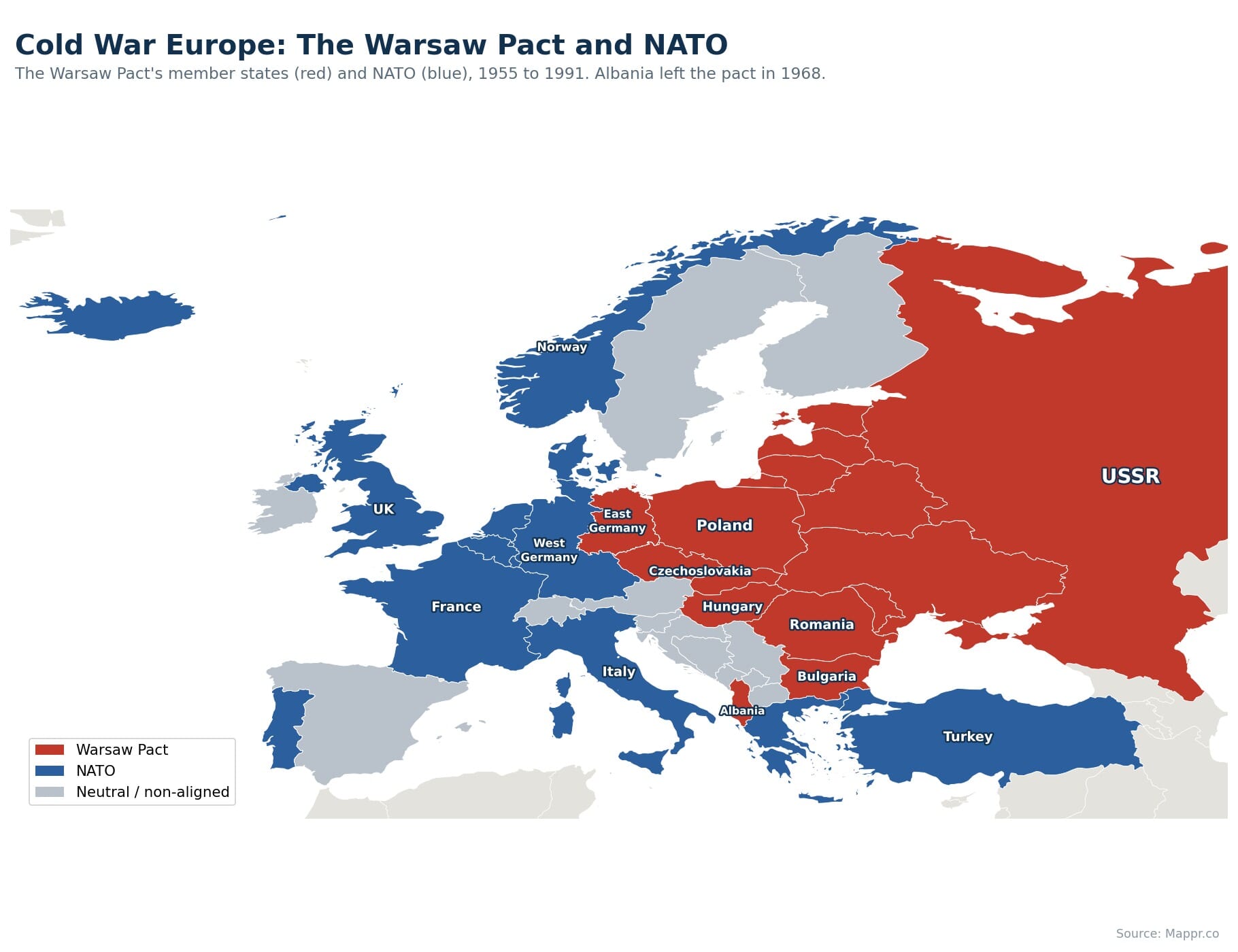
- It had eight members. The Soviet Union, Poland, East Germany, Czechoslovakia, Hungary, Romania, Bulgaria and Albania. Albania left in 1968 and East Germany left in 1990.
- A response to NATO. It was formed days after West Germany joined NATO, and the Soviet Union used it to keep a unified military command and station troops across the Eastern Bloc.
- Used to crush dissent. Soviet and allied forces invaded Hungary in 1956 and Czechoslovakia in 1968 to put down reform movements within the bloc.
- Its members later joined NATO. After the Cold War, most former members switched sides, joining NATO in 1999 and 2004.
Why the Warsaw Pact Was Formed
The trigger was Germany. On 9 May 1955, West Germany was admitted to NATO and allowed to rearm, a decade after the Second World War. For the Soviet Union, a rearmed West Germany inside a Western alliance was exactly the threat it feared.
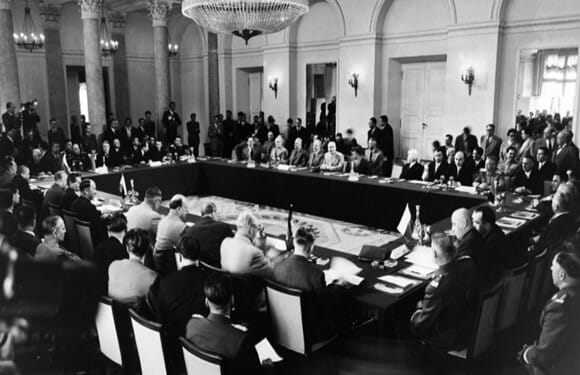
Just five days later, on 14 May 1955, the Soviet Union and seven Eastern European states signed the Warsaw Pact in the Polish capital. On paper it promised mutual defence, much like NATO. In practice it formalised Soviet military control over the Eastern Bloc.
The Members of the Warsaw Pact
The pact had eight member states:
- The Soviet Union
- Poland
- East Germany (the German Democratic Republic)
- Czechoslovakia
- Hungary
- Romania
- Bulgaria
- Albania
Two members left before the end. Albania stopped taking part in 1961 as it sided with China in the Soviet-Chinese split, and formally withdrew in 1968. East Germany left in 1990 when it reunified with West Germany.
How the Pact Worked
The Warsaw Pact was run from Moscow. Its top body was the Political Consultative Committee, which brought together the leaders of the member states, but real authority lay with the Soviet Union.
The alliance had a unified military command, always headed by a Soviet marshal, and Soviet troops were stationed across the member countries. On paper the combined forces of the pact outnumbered NATO in troops and tanks. In reality, the same command structure gave Moscow the means to keep its allies in line.
1956: The Hungarian Uprising
The pact’s first crisis came in 1956. In Hungary, a popular uprising demanded an end to Stalinist rule and a move toward democracy. The reformist prime minister, Imre Nagy, went so far as to announce that Hungary would leave the Warsaw Pact.
The Soviet response was overwhelming. In November 1956, Soviet tanks rolled into Budapest and crushed the revolt within days. Around 2,500 to 3,000 Hungarians were killed, and Nagy was later executed. It was a brutal signal that leaving the bloc would not be allowed.
1968: The Invasion of Czechoslovakia
The second crisis came in 1968. In Czechoslovakia, the reformist leader Alexander Dubček loosened censorship and promised what he called socialism with a human face, a period known as the Prague Spring.
In August 1968, around half a million Warsaw Pact troops from the Soviet Union, Poland, Hungary, Bulgaria and East Germany invaded and ended the reforms. Romania refused to take part and condemned the invasion. The crackdown became the model for the Brezhnev Doctrine, the idea that Moscow could intervene anywhere in the bloc to protect communist rule.
The End of the Warsaw Pact
The pact fell apart with communism itself. The revolutions of 1989 swept away the communist governments of Eastern Europe, and the alliance lost its purpose.
East Germany left in October 1990 on reunification. The military structures were dissolved on 31 March 1991, and the Warsaw Pact was formally ended on 1 July 1991. In one of history’s sharper turns, most of its former members then joined the alliance they had been built to oppose: NATO, with Poland, the Czech Republic and Hungary joining in 1999, and Bulgaria, Romania, Slovakia, Slovenia and the Baltic states in 2004.


