Key Takeaways
- Developing countries owe a record $9.4 trillion abroad. The external debt of low- and middle-income countries rose 5.5% in 2025, the fastest increase since 2021, according to the World Bank's International Debt Report 2026.
- They owe China about $144 billion in official loans. That makes China the largest bilateral lender to developing countries, ahead of Japan ($112 billion). Counting loans from Chinese state-owned banks, the total owed to Chinese creditors is about $165 billion.
- Pakistan owes China the most: $22.4 billion. Angola ($12.7 billion), Sri Lanka ($8.8 billion) and Ethiopia ($7.5 billion) follow. Measured as a share of external debt, the most exposed are smaller countries such as Equatorial Guinea, Djibouti and Laos.
- Viral 'debt to China' maps often mix very different numbers. Some versions put the total at over $1 trillion by adding loans to Russia, Venezuela and energy-backed deals. The World Bank's official figure for developing-country borrowers is much smaller.
Developing countries have never owed more to the rest of the world. According to the World Bank’s International Debt Report 2026, published on 5 November, the external debt of low- and middle-income countries reached a record $9.4 trillion at the end of 2025, up 5.5% in a single year, the fastest rise since 2021.
Who those countries owe matters as much as how much. Over the past two decades China has become the largest government lender to the developing world, and maps of “who owes China” circulate widely online, often with wildly different numbers. We mapped both: the total external debt of every developing country the World Bank tracks, and how much of it is owed to Chinese creditors.
The Map: Who Owes the Most?
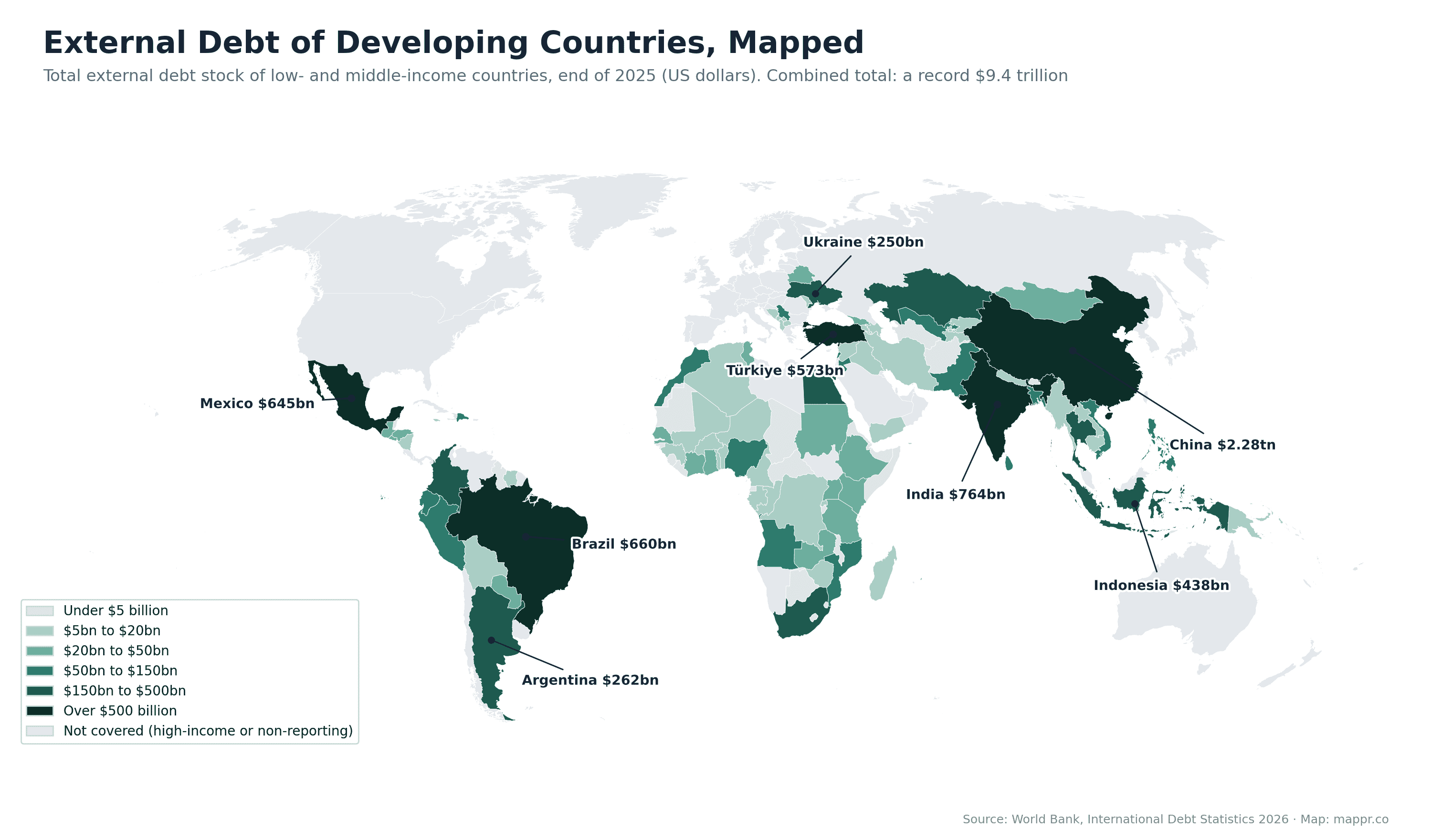
In absolute dollars, the biggest debtors are the biggest emerging economies. China itself tops the list with $2.28 trillion of external debt, much of it short-term trade credit, followed by India ($764 billion), Brazil ($660 billion), Mexico ($645 billion) and Türkiye ($573 billion). For economies of that size, these sums are manageable.
The danger lies elsewhere. Debt grew fastest among the poorest countries: the external debt of countries eligible for the World Bank’s concessional IDA lending rose 8.1% to $1.3 trillion. Debt service across all developing countries rose for a fifth straight year to $1.4 trillion, and between 2022 and 2025 developing countries paid $436 billion more in debt service than they received in new financing.
The biggest debtors
Developing Countries With the Most External Debt
Total external debt stock, end of 2025 (US dollars)
| Country | External debt | Owed to China |
|---|---|---|
| China | $2.28tn | n/a |
| India | $763.5bn | $0.0bn |
| Brazil | $659.8bn | $2.9bn |
| Mexico | $645.0bn | $0.0bn |
| Türkiye | $572.8bn | $2.2bn |
| Indonesia | $438.1bn | $1.4bn |
| Argentina | $261.7bn | $3.1bn |
| Colombia | $256.0bn | $0.0bn |
| Ukraine | $250.3bn | $1.0bn |
| Thailand | $208.9bn | $0.0bn |
| South Africa | $206.3bn | $1.9bn |
| Kazakhstan | $183.1bn | $2.0bn |
Who Owes China?
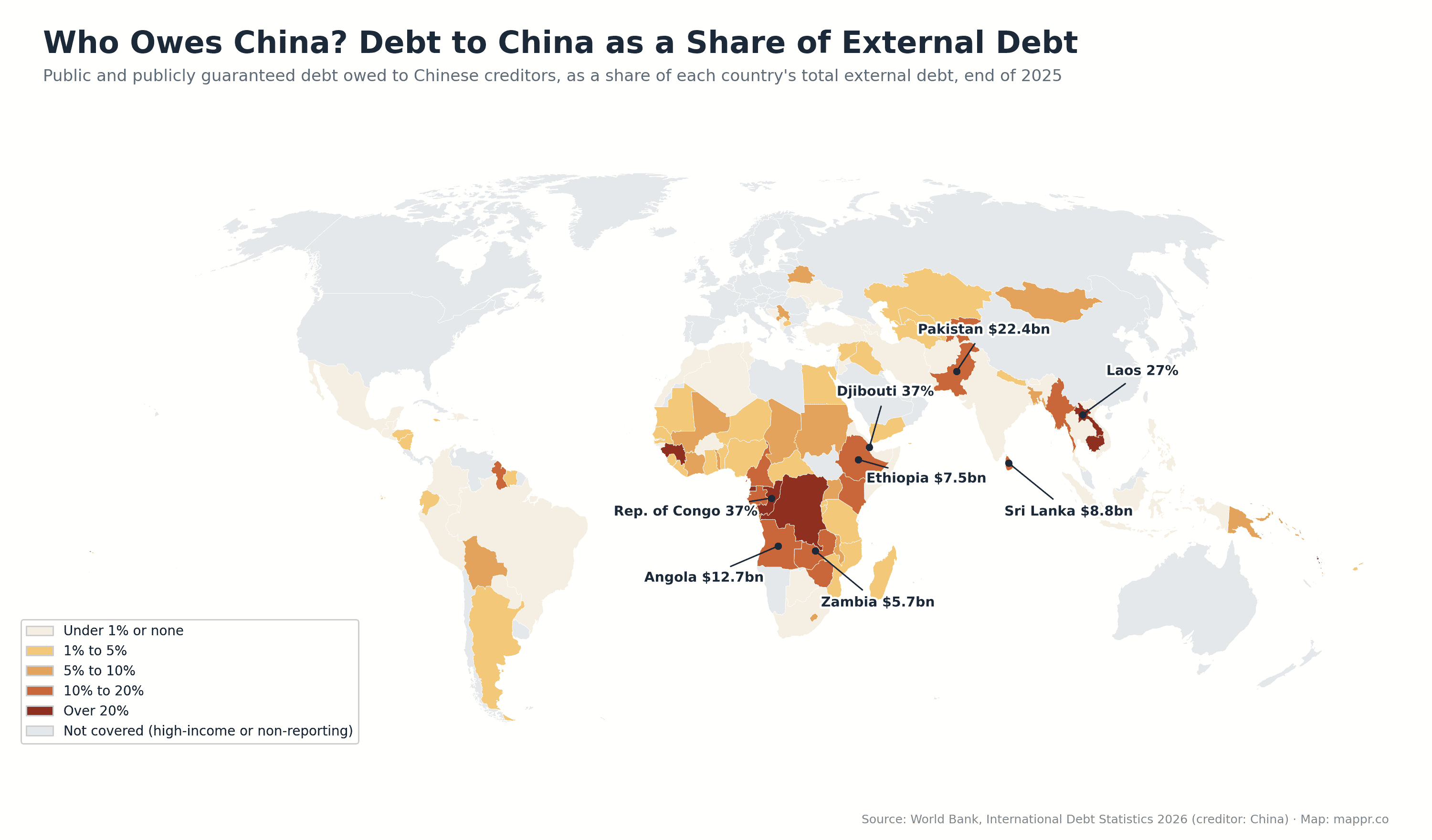
At the end of 2025, developing countries owed about $144 billion in official bilateral loans to the Chinese government and its policy banks, making China their largest bilateral creditor, ahead of Japan (about $112 billion). Add loans from Chinese state-owned commercial banks to public borrowers, and the total owed to Chinese creditors rises to about $165 billion.
Pakistan owes the most by far: $22.4 billion, about 17% of its external debt, much of it tied to the China-Pakistan Economic Corridor. Angola ($12.7 billion, mostly oil-backed loans from Chinese banks), Sri Lanka ($8.8 billion) and Ethiopia ($7.5 billion) follow. Sri Lanka, Zambia and Ethiopia have all been through debt defaults or restructurings in which China was a key creditor at the negotiating table.
China's biggest borrowers
The Countries That Owe China the Most
Public and publicly guaranteed debt owed to Chinese creditors, end of 2025
| Country | Owed to China | Share of external debt |
|---|---|---|
| Pakistan | $22.4bn | 17% |
| Angola | $12.6bn | 20% |
| Sri Lanka | $8.8bn | 15% |
| Ethiopia | $7.5bn | 19% |
| Egypt | $7.1bn | 4% |
| Bangladesh | $6.5bn | 6% |
| Nigeria | $5.7bn | 4% |
| Zambia | $5.7bn | 20% |
| Laos | $5.3bn | 27% |
| Kenya | $4.9bn | 11% |
| Cambodia | $4.0bn | 20% |
| Uzbekistan | $4.0bn | 5% |
| Cote d'Ivoire | $4.0bn | 9% |
| DR Congo | $3.5bn | 23% |
| Serbia | $3.2bn | 5% |
Small Countries, Big Exposure
Measured as a share of external debt rather than in dollars, the map shifts to smaller economies. In Equatorial Guinea, around two-thirds of external debt is owed to China. In Djibouti and the Republic of the Congo, it is more than a third, and in Laos, home of the Chinese-built Laos-China Railway, it is 27%. Guinea, DR Congo, Cambodia, the Maldives, Angola and Zambia all owe China around a fifth of their external debt or more.
For these countries, a single creditor’s decisions on new lending, refinancing or debt relief can shape the whole economy, which is why China’s role in debt restructurings has become one of the central questions in development finance.
Why Viral ‘Debt to China’ Maps Disagree
If you have seen a map claiming the world owes China more than a trillion dollars, it is probably not wrong, just measuring something else. Broader estimates count Chinese loans to Russia, Venezuela and Iran, energy-for-loans deals and lending to state companies that never appear in official debt statistics. AidData and other researchers argue that much Chinese lending is hidden this way.
The World Bank figures used here are narrower but official: debt reported by borrowing governments themselves, for low- and middle-income countries only. They are the right baseline for comparing countries, and the reason the totals on this page are far smaller than the most-shared online versions.
Sources: