
The Arab world spans a vast region from North Africa to the Persian Gulf, encompassing 22 nations with dramatically different economic profiles. While Gulf states enjoy some of the highest GDP per capita figures in the world, other Arab nations face significant economic challenges. Using IMF World Economic Outlook (April 2026) data, here are the top 10 richest Arab countries in 2026, ranked by GDP per capita at Purchasing Power Parity (PPP). [Requires re-pulling ALL per-capita PPP figures for the 21+ listed countries from the April 2026 edition: both tables, key-findings bullets, all 10 detail-section headings/values, methodology paragraph, ‘Last updated’ line, and the sources block (edition name October 2025 → April 2026, same schema).]
Key findings:
- 🇶🇦 Qatar leads the Arab world at $122,283 — also the richest country in the Middle East
- The 6 Gulf Cooperation Council (GCC) states sweep the top 6 positions, all above $42,000
- A massive wealth gap exists: Qatar’s GDP per capita is 73x that of Yemen ($1,674)
- 🇪🇬 Egypt ($21,759) and 🇩🇿 Algeria ($18,509) are the wealthiest non-Gulf Arab nations
- Oil wealth remains the primary driver, but diversification efforts are reshaping Gulf economies
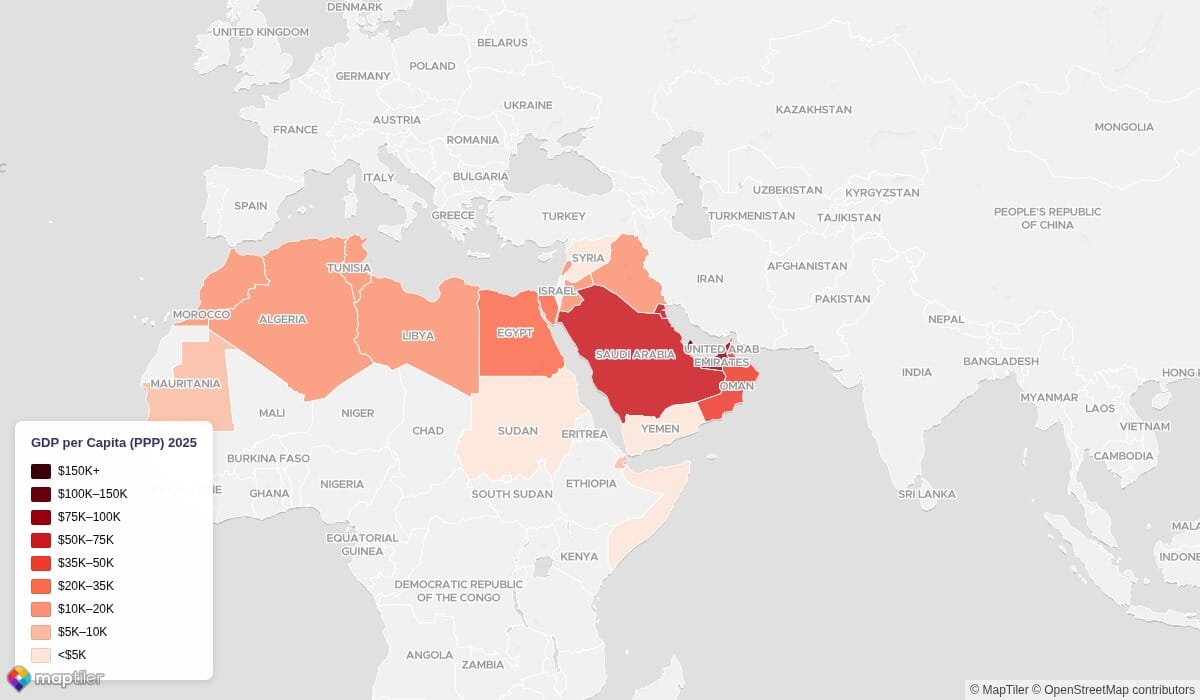
Map: GDP per Capita (PPP) in the Arab World, 2025
Explore the economic landscape of the Arab world. The dramatic color contrast between Gulf states and other Arab nations reflects the enormous wealth disparity in the region.
Top 10 Richest Arab Countries (2025)
| Rank | Country | GDP per Capita (PPP) |
|---|---|---|
| 1 | 🇶🇦 Qatar | $122,283 |
| 2 | 🇦🇪 United Arab Emirates | $84,403 |
| 3 | 🇸🇦 Saudi Arabia | $74,668 |
| 4 | 🇧🇭 Bahrain | $69,271 |
| 5 | 🇰🇼 Kuwait | $52,866 |
| 6 | 🇴🇲 Oman | $42,211 |
| 7 | 🇱🇾 Libya | $17,931 |
| 8 | 🇪🇬 Egypt | $21,759 |
| 9 | 🇩🇿 Algeria | $18,509 |
| 10 | 🇮🇶 Iraq | $15,391 |
Complete Arab World Rankings
Either add Palestine (IMF code WBG, ‘West Bank and Gaza’) as a row during the data refresh, or reword to ‘here are 21 Arab League member states ranked…’ noting the omission.| Rank | Country | GDP per Capita (PPP) |
|---|---|---|
| 1 | 🇶🇦 Qatar | $122,283 |
| 2 | 🇦🇪 United Arab Emirates | $84,403 |
| 3 | 🇸🇦 Saudi Arabia | $74,668 |
| 4 | 🇧🇭 Bahrain | $69,271 |
| 5 | 🇰🇼 Kuwait | $52,866 |
| 6 | 🇴🇲 Oman | $42,211 |
| 7 | 🇱🇾 Libya | $17,931 |
| 8 | 🇪🇬 Egypt | $21,759 |
| 9 | 🇩🇿 Algeria | $18,509 |
| 10 | 🇮🇶 Iraq | $15,391 |
| 11 | 🇹🇳 Tunisia | $14,983 |
| 12 | 🇱🇧 Lebanon | $11,816 |
| 13 | 🇯🇴 Jordan | $11,511 |
| 14 | 🇲🇦 Morocco | $11,437 |
| 15 | 🇩🇯 Djibouti | $9,408 |
| 16 | 🇲🇷 Mauritania | $8,775 |
| 17 | 🇸🇾 Syria | $4,650 |
| 18 | 🇰🇲 Comoros | $4,015 |
| 19 | 🇸🇩 Sudan | $2,419 |
| 20 | 🇸🇴 Somalia | $1,898 |
| 21 | 🇾🇪 Yemen | $1,674 |
Detailed Analysis: The Richest Arab Nations
1. 🇶🇦 Qatar — $122,283
Qatar is the richest Arab country and one of the wealthiest nations in the world. Its economic power comes primarily from the North Field, the world’s largest natural gas field, which makes Qatar the world’s top LNG exporter. With a population of just 2.9 million (only ~380,000 Qatari citizens), the wealth is concentrated among a small population. The Qatar Investment Authority manages over $450 billion globally, and the country continues to diversify into sports (World Cup 2022 legacy), media (Al Jazeera), and education (Qatar Foundation).
2. 🇦🇪 United Arab Emirates — $84,403
The UAE is the most diversified economy in the Arab world. While Abu Dhabi sits on 6% of global oil reserves, Dubai has built itself into a world-class hub for tourism, trade, aviation (Emirates airline), real estate, and finance. The UAE attracted over 17 million tourists in 2024, and free zones like DIFC and JAFZA have made it the Middle East’s primary business destination. With massive sovereign wealth (ADIA alone manages $900B+), the UAE’s economic future extends well beyond oil.
3. 🇸🇦 Saudi Arabia — $74,668
Saudi Arabia, the world’s largest oil exporter, is pursuing the most ambitious economic transformation in the region through Vision 2030. Mega-projects include NEOM (a $500 billion futuristic city), The Line (a 170km linear city), and the Red Sea tourism project. The Public Investment Fund (PIF) now manages over $930 billion, investing in everything from Lucid Motors to Newcastle United. Saudi Arabia’s admission to BRICS+ reflects its growing geopolitical influence.
4. 🇧🇭 Bahrain — $69,271
The smallest Arab country by area, Bahrain was the first Gulf state to discover oil (1932) and the first to seriously diversify. Today, financial services, manufacturing, and logistics are major economic drivers. Bahrain hosts the region’s premier banking center and is a hub for Islamic finance. Its Formula One Grand Prix and proximity to Saudi Arabia (via the King Fahad Causeway) support a thriving tourism and entertainment sector.
5. 🇰🇼 Kuwait — $52,866
Kuwait sits on approximately 7% of the world’s proven oil reserves, giving its 4.3 million residents considerable wealth. The Kuwait Investment Authority, one of the world’s oldest sovereign wealth funds (established 1953), manages over $800 billion. While economic diversification has been slower than in the UAE or Saudi Arabia, Kuwait’s New Kuwait 2035 vision aims to develop tourism, finance, and logistics.
6. 🇴🇲 Oman — $42,211
Oman offers a different model of Gulf development, emphasizing sustainability and cultural preservation alongside economic growth. Under Sultan Haitham’s Oman Vision 2040, the country is investing in tourism (leveraging its stunning natural landscapes), fisheries, mining, and logistics (the Port of Duqm). Oman has successfully positioned itself as a neutral diplomatic player in the region.
7. 🇪🇬 Egypt — $21,759
Egypt is the Arab world’s most populous nation (over 105 million) and the largest non-Gulf Arab economy. While its GDP per capita is modest compared to Gulf states, Egypt’s total GDP exceeds $350 billion. The Suez Canal remains a vital revenue source, earning over $9 billion annually. Egypt is investing heavily in infrastructure, including a new administrative capital east of Cairo, and the government’s reform program has attracted significant foreign investment.
8. 🇩🇿 Algeria — $18,509
Algeria is Africa’s largest country by area and holds some of the continent’s largest oil and gas reserves. Hydrocarbons still account for roughly 20% of GDP and 85% of exports. With a population of 46 million, Algeria’s per-capita wealth is moderate, but recent reforms aim to attract foreign investment and diversify the economy. Natural gas exports to Europe have gained new importance following the energy crisis.
9. 🇱🇾 Libya — $17,931
Libya holds Africa’s largest proven oil reserves, which give it a higher per-capita GDP than its population size might suggest. However, political instability since 2011 has severely disrupted oil production and economic development. When production stabilizes, Libya’s 7 million people benefit from significant oil revenues, but ongoing conflict continues to limit the country’s economic potential.
10. 🇮🇶 Iraq — $15,391
Iraq holds the world’s fifth-largest proven oil reserves, producing roughly 4.5 million barrels per day. With a population of 43 million, the per-capita figure is moderate despite massive oil wealth. Iraq’s economy remains heavily dependent on oil (accounting for about 90% of government revenue), and corruption, infrastructure deficits, and security challenges continue to impede broader economic development.
Methodology
All GDP per capita figures are based on Purchasing Power Parity (PPP) in international dollars, as projected by the IMF World Economic Outlook (October 2025). PPP adjusts for differences in the cost of living between countries, making it a more meaningful measure of actual living standards than nominal GDP per capita. Last updated: March 2026. Data reflects IMF WEO October 2025 projections for the year 2025.
This post uses data from the following sources.
Data Sources:
- IMF World Economic Outlook Database (October 2025) – International Monetary Fund
- IMF DataMapper – GDP per capita, PPP – International Monetary Fund
Also read: Richest Countries in the World | Richest Countries in Europe | Richest Countries in Asia


