
Which countries are the hottest on the planet? The list below ranks the world’s hottest nations by average annual temperature, using the World Bank’s current 1991–2020 climate normal. These are not summer highs but year-round averages across each country, which is why a steady tropical island can rank alongside a scorching desert.
The biggest change from older rankings is at the very top: on the latest data, Burkina Faso has edged past Mali to become the hottest country in the world, though the two are so close they are best thought of as co-leaders. West Africa’s Sahel dominates the top of the table, joined by a cluster of low-lying Pacific and Indian Ocean island nations and the desert states of the Persian Gulf.
Key Takeaways
- Burkina Faso is now the hottest country. On the current 1991–2020 climate baseline, Burkina Faso edges out Mali with a mean annual temperature near 30.4 °C (86.7 °F). The two are effectively co-leaders and swap places depending on the dataset.
- West Africa's Sahel dominates. Burkina Faso, Mali, Senegal, Mauritania, Niger, Gambia and Guinea-Bissau all rank in the top 15. The Sahel, the belt just south of the Sahara, is the hottest inhabited region on Earth.
- Tiny islands run surprisingly hot. Tuvalu, the Maldives, the Marshall Islands, Palau, Nauru and Kiribati all make the list. Low-lying atolls have no cool highlands, so their averages track the warm tropical ocean around them.
- The Gulf states feature too. The UAE, Qatar and Bahrain all rank in the top 20, with brutal desert summers that regularly top 45–50 °C (113–122 °F).
- These are yearly averages, not summer highs. The figures are mean annual temperatures from the World Bank / CRU 1991–2020 normal. Summer peaks in these countries are far higher; the ranking reflects sustained year-round heat.
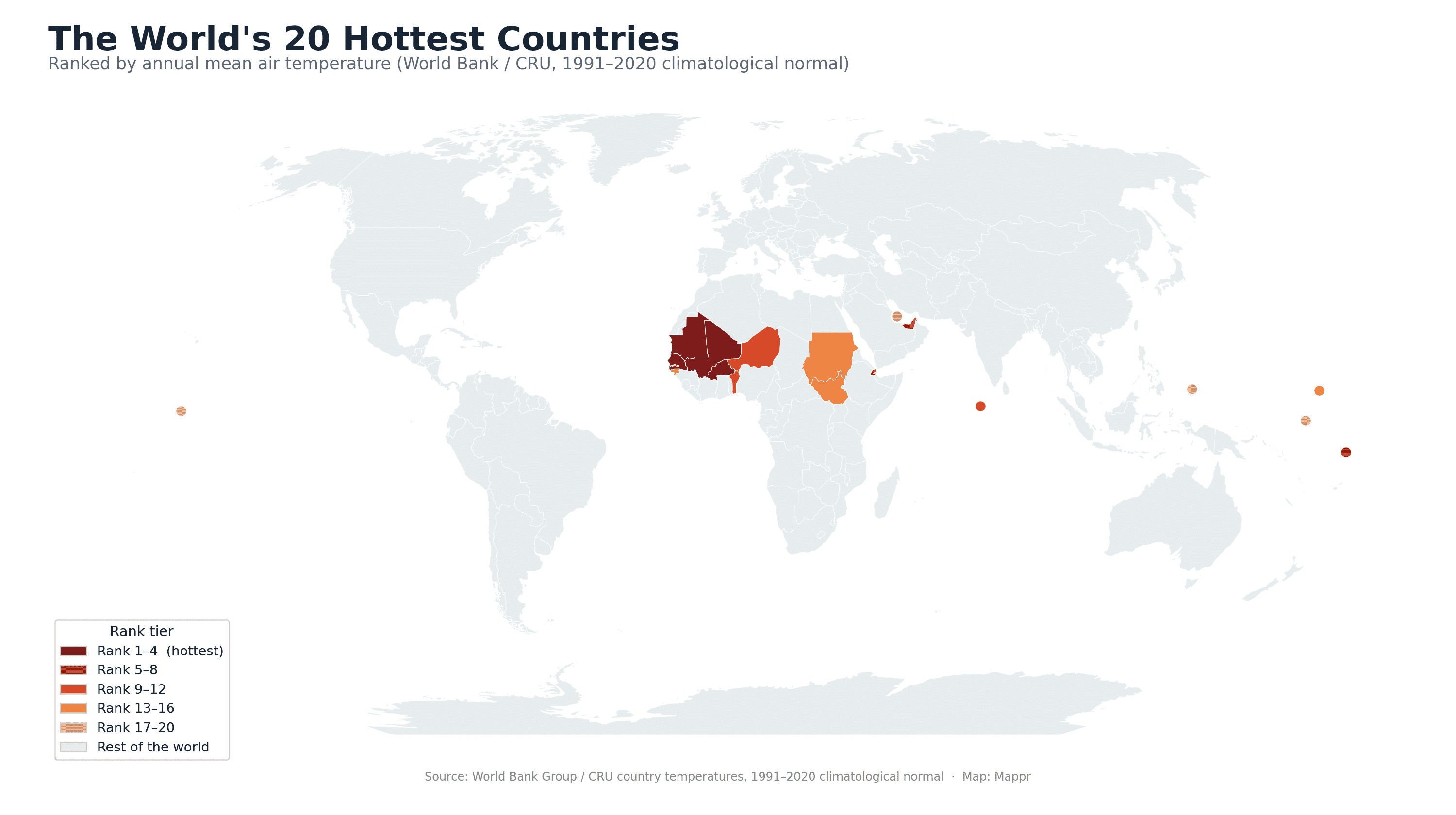
Let’s go through the twenty hottest countries in the world, starting with the hottest. Remember, the temperatures below are annual averages, not peak summer readings.
1. Burkina Faso
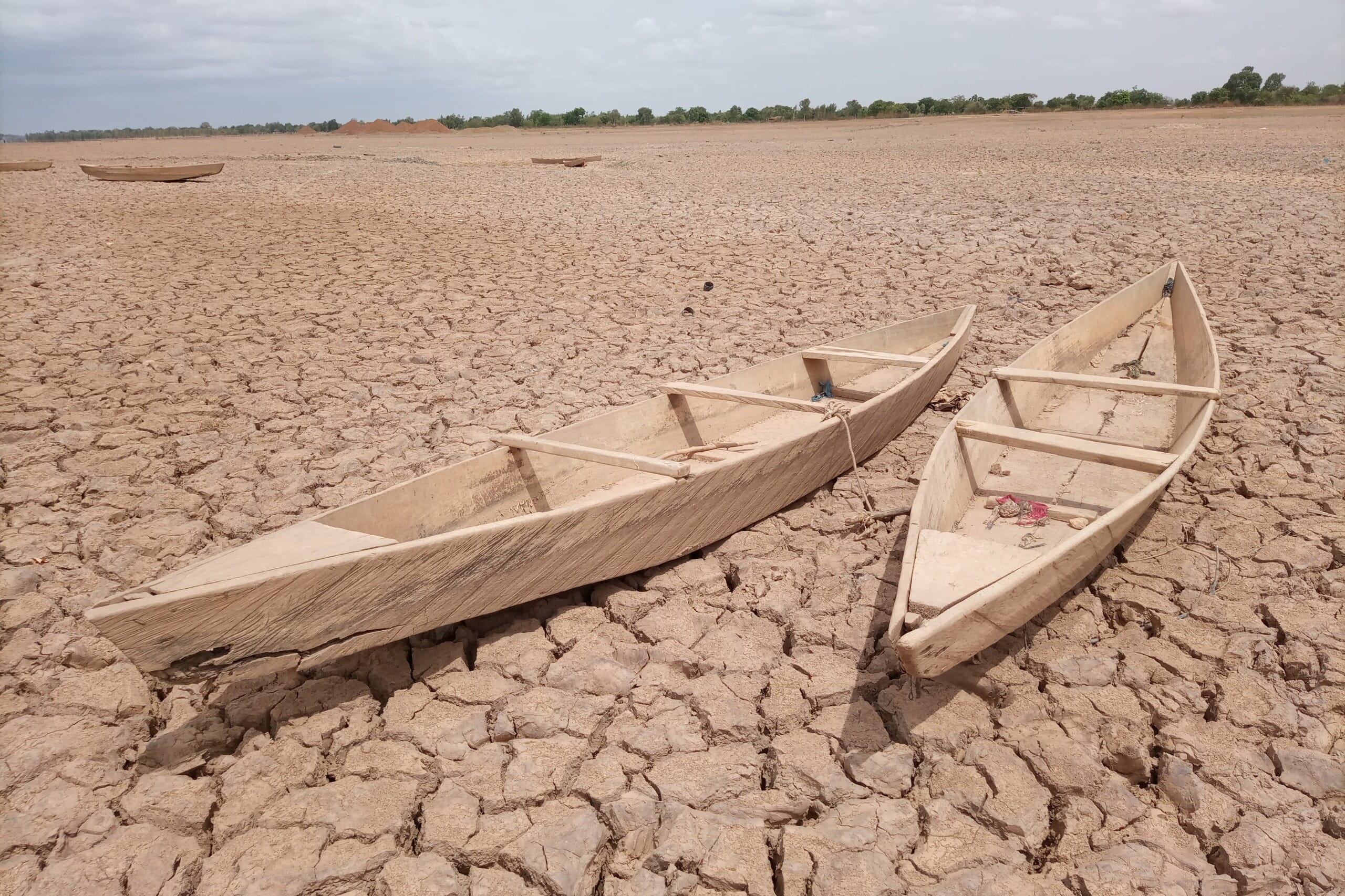
Average annual temperature: 30.40 °C (86.72 °F)
On the current World Bank climatology (the 1991–2020 average), Burkina Faso is the hottest country on Earth, with a mean annual temperature of about 30.4 °C (86.7 °F). This landlocked West African nation sits squarely in the Sahel, the hot belt between the Sahara and the wetter tropics to the south.
Burkina Faso and Mali are effectively co-leaders: Burkina Faso’s headline figure sits a little above Mali’s, but the two swap places depending on the exact dataset and baseline used. Either way, the Sahel is the hottest inhabited region on the planet.
2. Mali
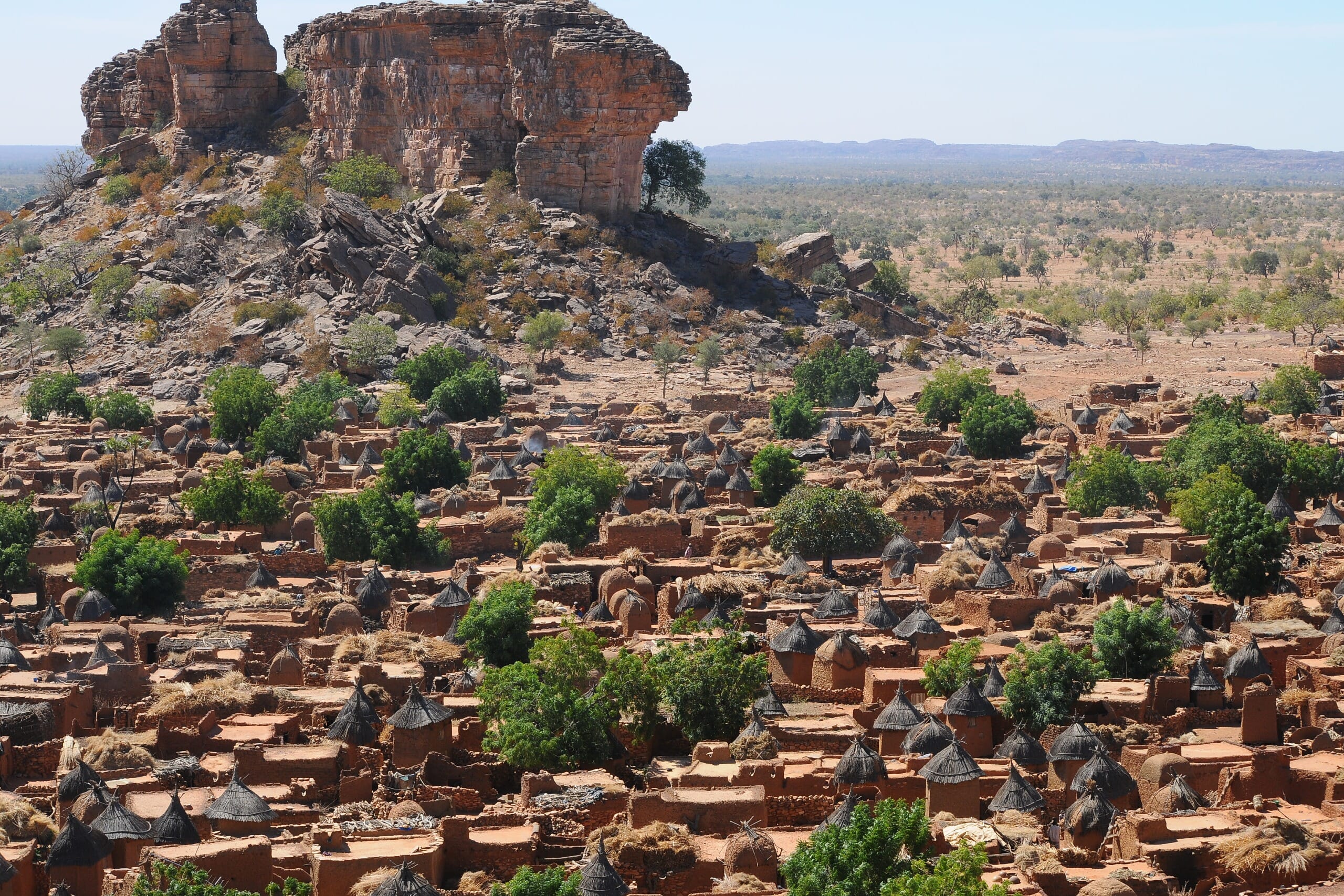
Average annual temperature: 29.21 °C (84.58 °F)
Mali is a fraction behind its neighbour at around 29.2 °C (84.6 °F), and on older baselines it held the number-one spot outright. Much of the country lies in the Sahara or the Sahel, where daytime highs routinely soar and there is little to cool the air.
Mali’s north is true desert, while the south is Sahelian savanna. Averaged across the year and the whole territory, few countries come close to this level of sustained heat.
3. Senegal
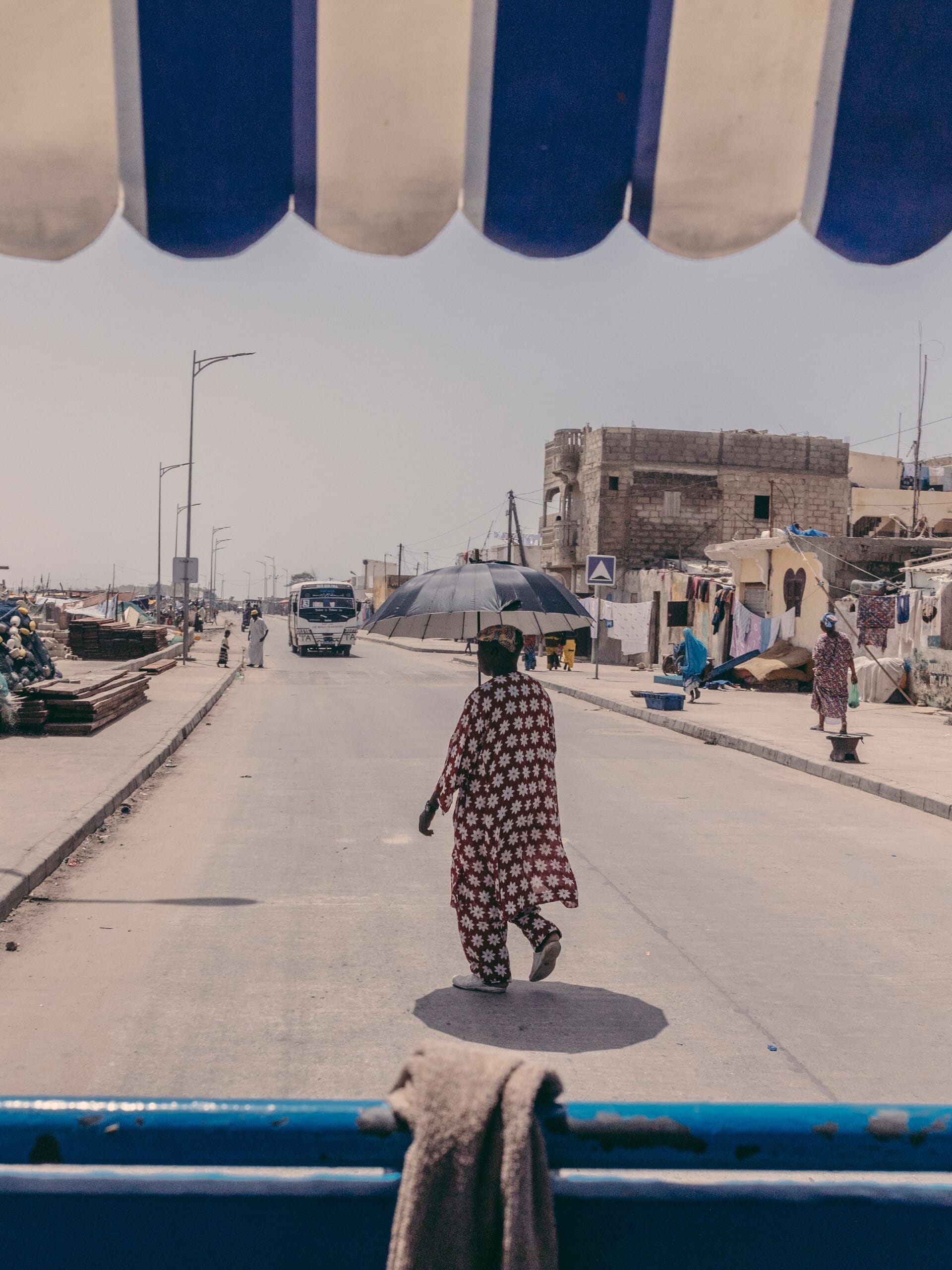
Average annual temperature: 28.90 °C (84.02 °F)
Senegal ranks third at about 28.9 °C (84.0 °F). It has both an Atlantic coastline and a hot, dry interior, and it is the interior that pushes the national average so high.
Coastal Dakar is tempered by ocean breezes, but inland regions bake under the same Saharan air masses that heat the rest of the Sahel.
4. Mauritania
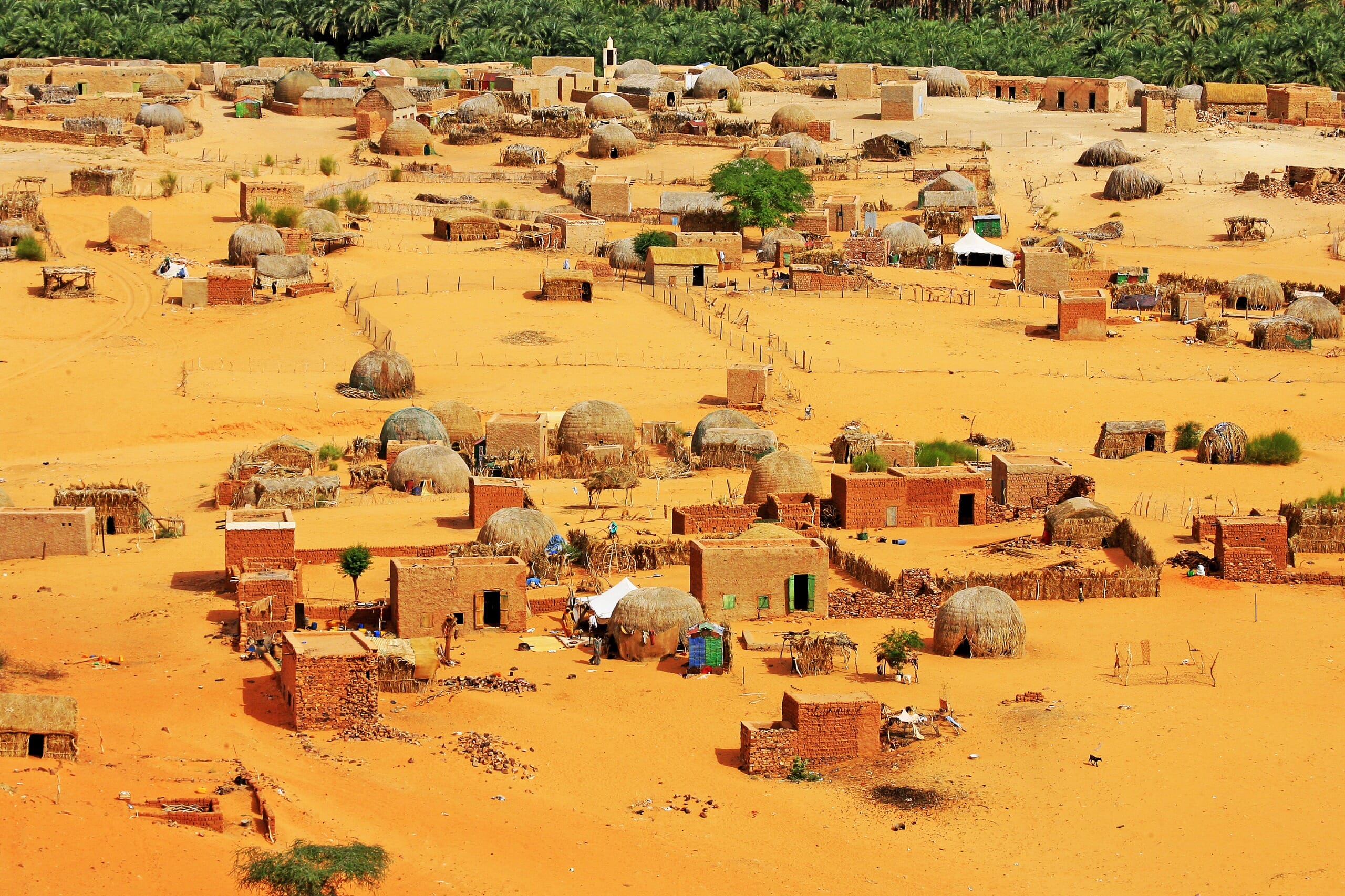
Average annual temperature: 28.82 °C (83.88 °F)
Mauritania is almost entirely covered by the Sahara, so its high average temperature of roughly 28.8 °C (83.9 °F) is no surprise. It climbs on the current baseline into the global top five.
With most of the population concentrated near the coast and along the Senegal River, the vast desert interior dominates the country’s climate.
5. Tuvalu
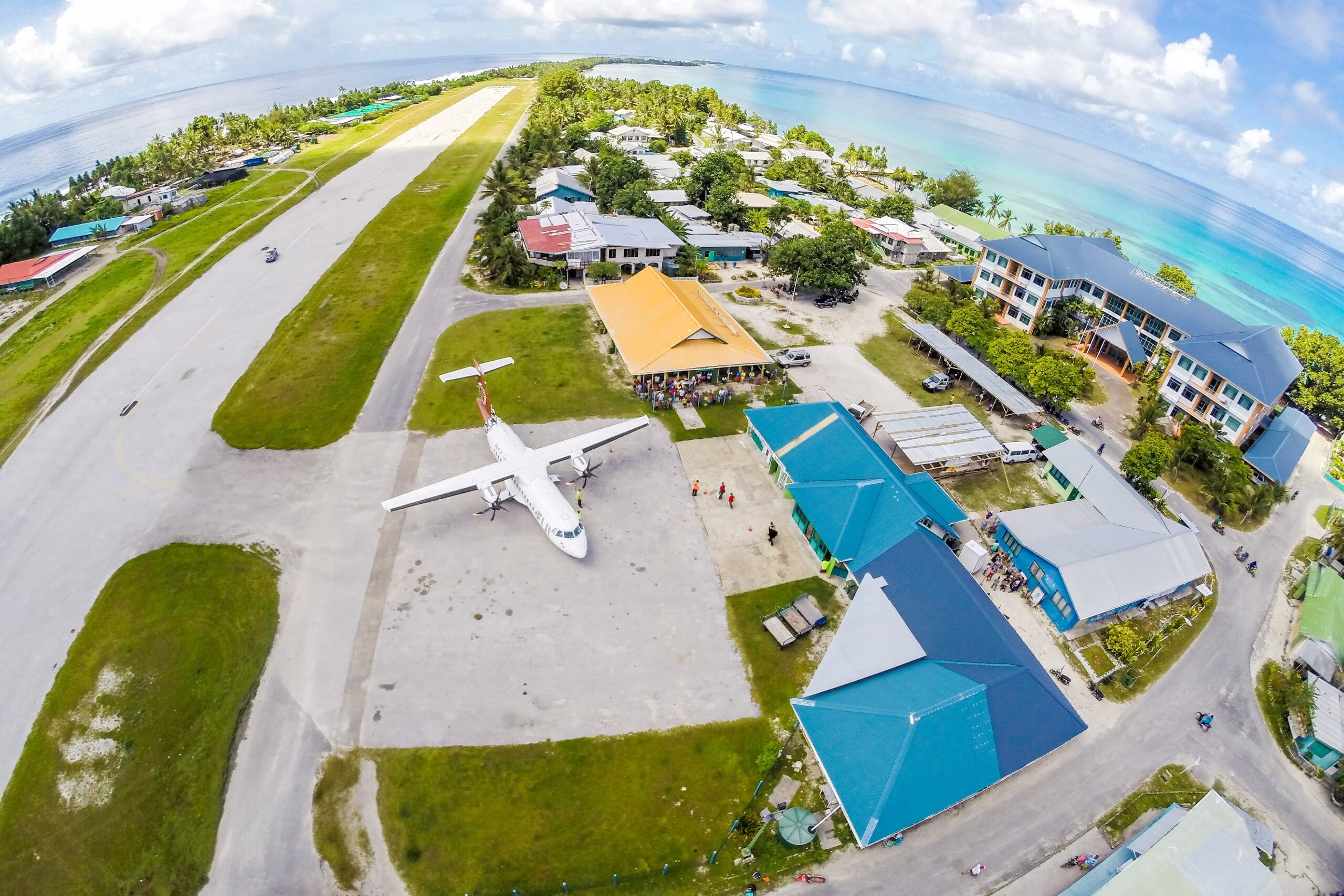
Average annual temperature: 28.62 °C (83.52 °F)
Tuvalu is the first non-African country on the list, at around 28.6 °C (83.5 °F). This tiny Pacific nation of low-lying atolls has a warm, remarkably stable oceanic climate.
Because Tuvalu is so small and flat, its national average sits close to the temperature of the surrounding tropical ocean, with little seasonal variation and no cool highlands to pull it down.
6. Djibouti
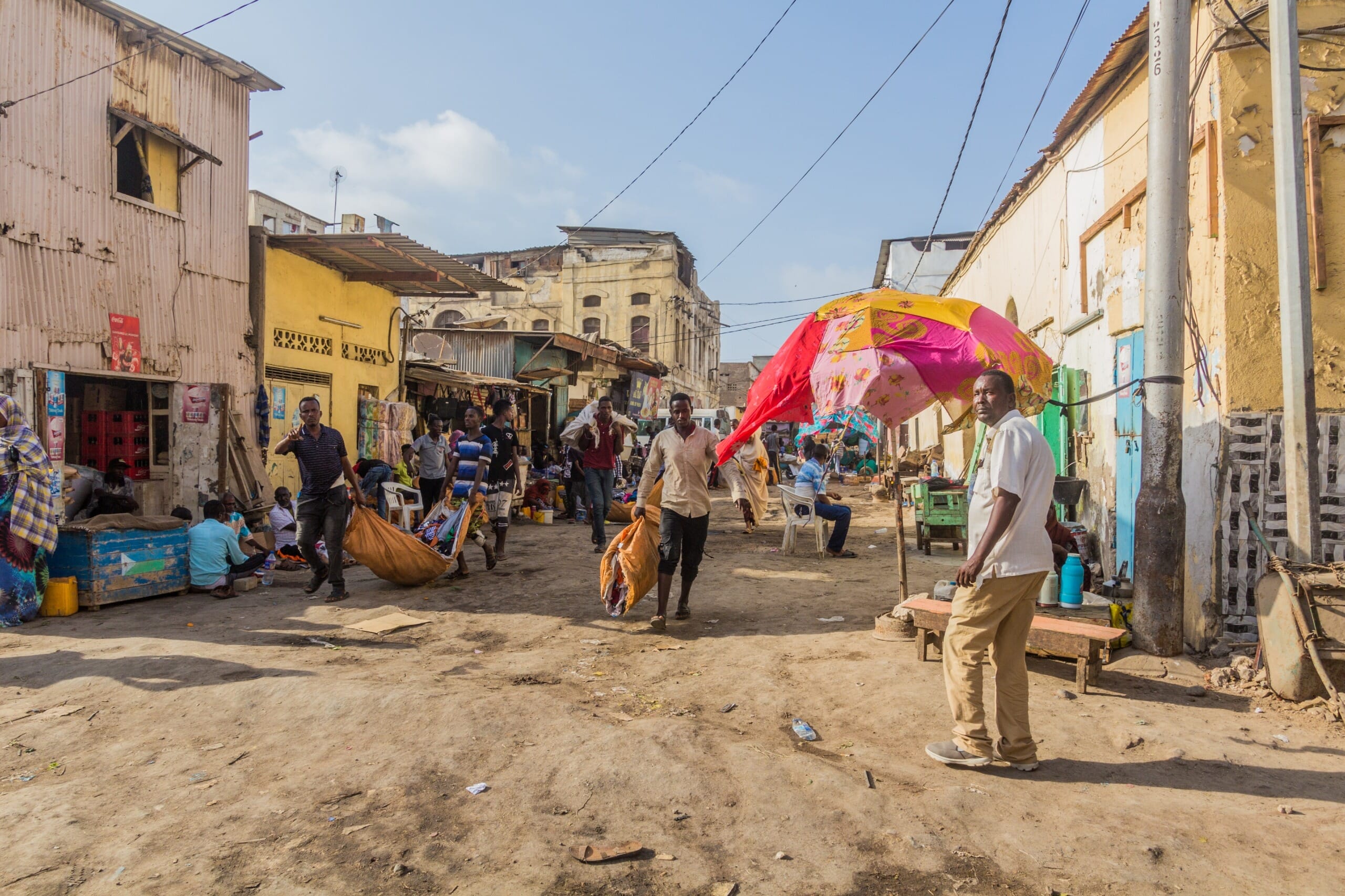
Average annual temperature: 28.49 °C (83.28 °F)
Djibouti, on the Horn of Africa beside the Red Sea, averages about 28.5 °C (83.3 °F). You might expect the coast to bring relief, but the surrounding desert and the hot waters of the Red Sea keep temperatures extreme.
Djibouti’s low-lying, arid terrain and its position near the equator combine to make it one of the hottest countries anywhere.
7. Gambia
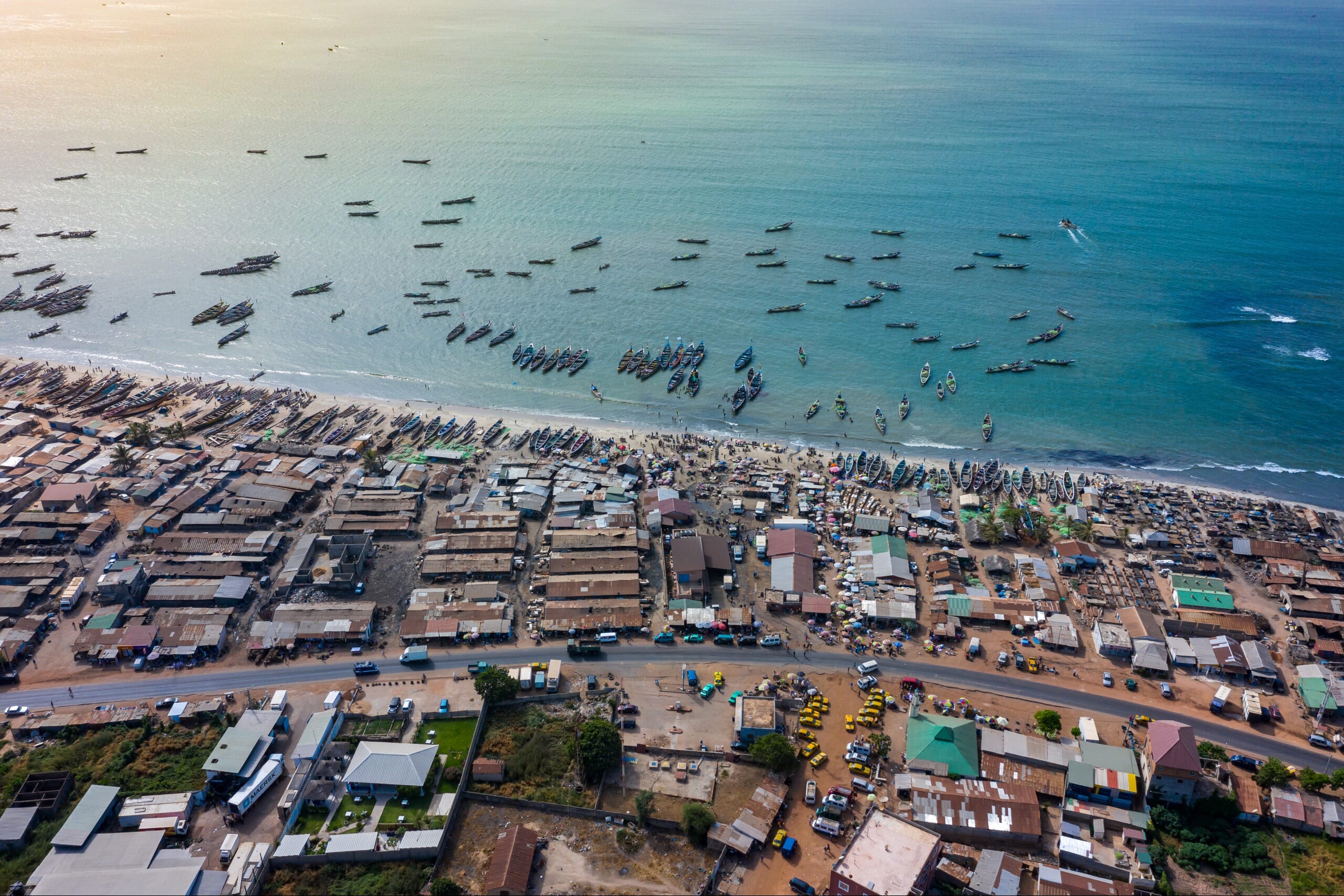
Average annual temperature: 28.38 °C (83.08 °F)
The Gambia, a narrow country wrapped around its namesake river in West Africa, averages roughly 28.4 °C (83.1 °F). Like its neighbours it sits in the path of hot Saharan air.
Its small size and low elevation mean there is little geographic variety to moderate the heat, so the whole country runs hot year-round.
8. United Arab Emirates
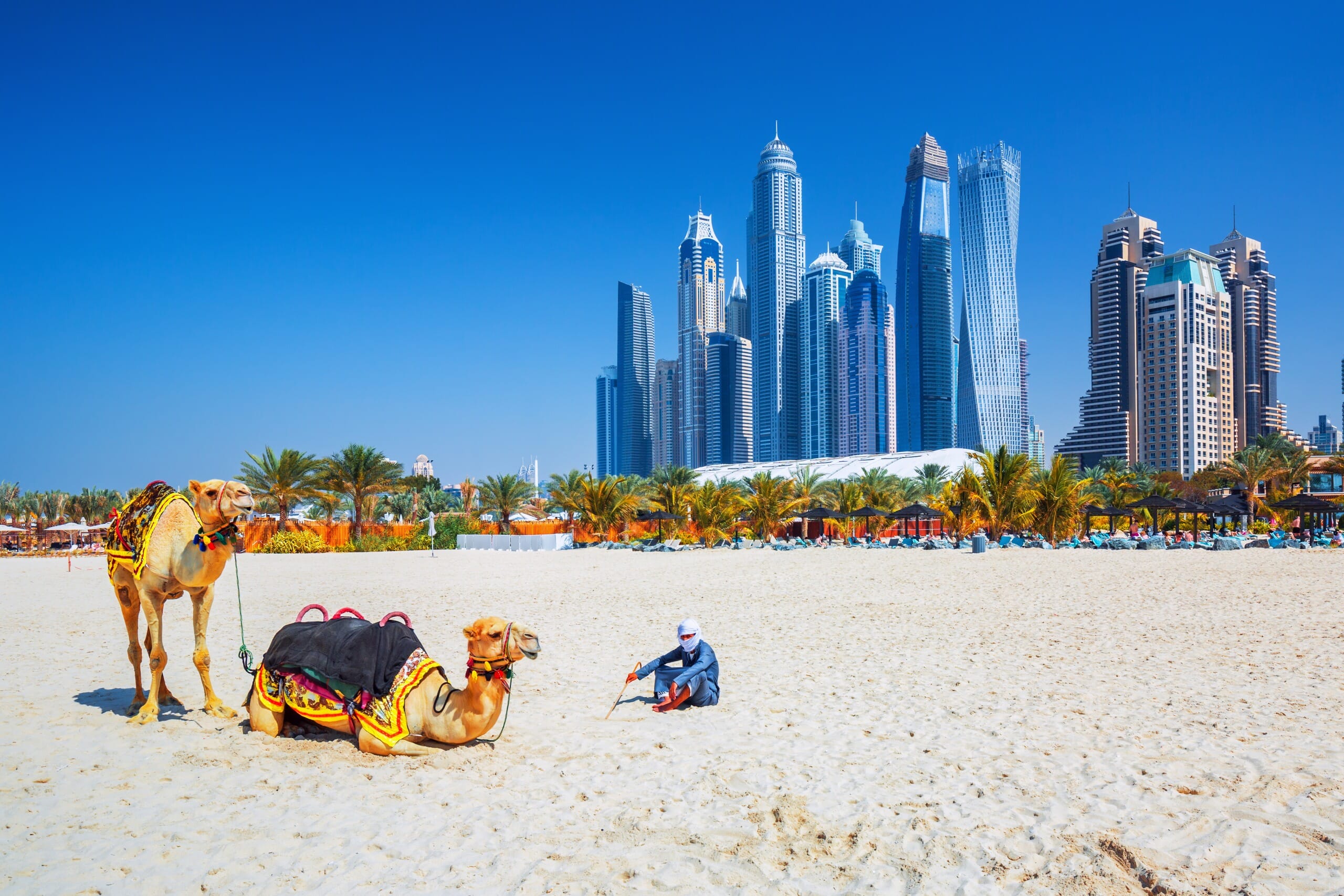
Average annual temperature: 28.17 °C (82.71 °F)
The United Arab Emirates is the hottest of the Gulf states on this list, at about 28.2 °C (82.7 °F). Its desert geography and long, brutal summers push the annual average well up.
Summer temperatures in the UAE regularly exceed 45 °C (113 °F), and high humidity along the coast makes the heat feel even more intense.
9. Maldives

Average annual temperature: 28.11 °C (82.60 °F)
The Maldives enters the top ten at around 28.1 °C (82.6 °F). Like Tuvalu, this Indian Ocean nation is made up of small, low coral islands surrounded by warm tropical water.
With almost no land rising more than a couple of metres above sea level, the Maldives has no cooler interior, so its temperature tracks the warm ocean all year.
10. Niger
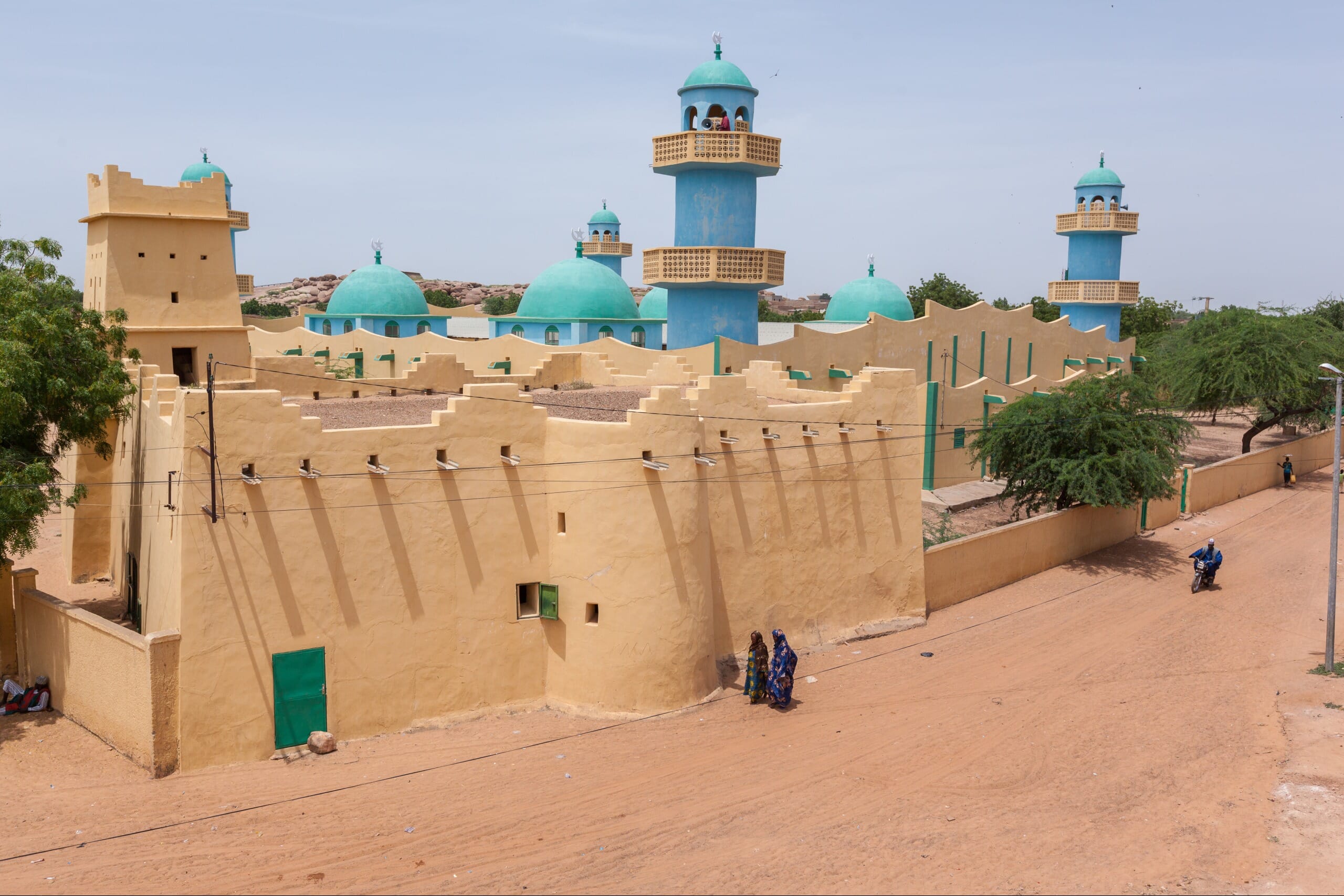
Average annual temperature: 28.04 °C (82.47 °F)
Niger averages about 28.0 °C (82.5 °F), split between an arid Saharan north and a Sahelian south. It is one of the hottest and driest countries in the world.
Much of Niger receives very little rainfall, and the desert sun keeps the national average firmly among the highest on the planet.
11. Benin
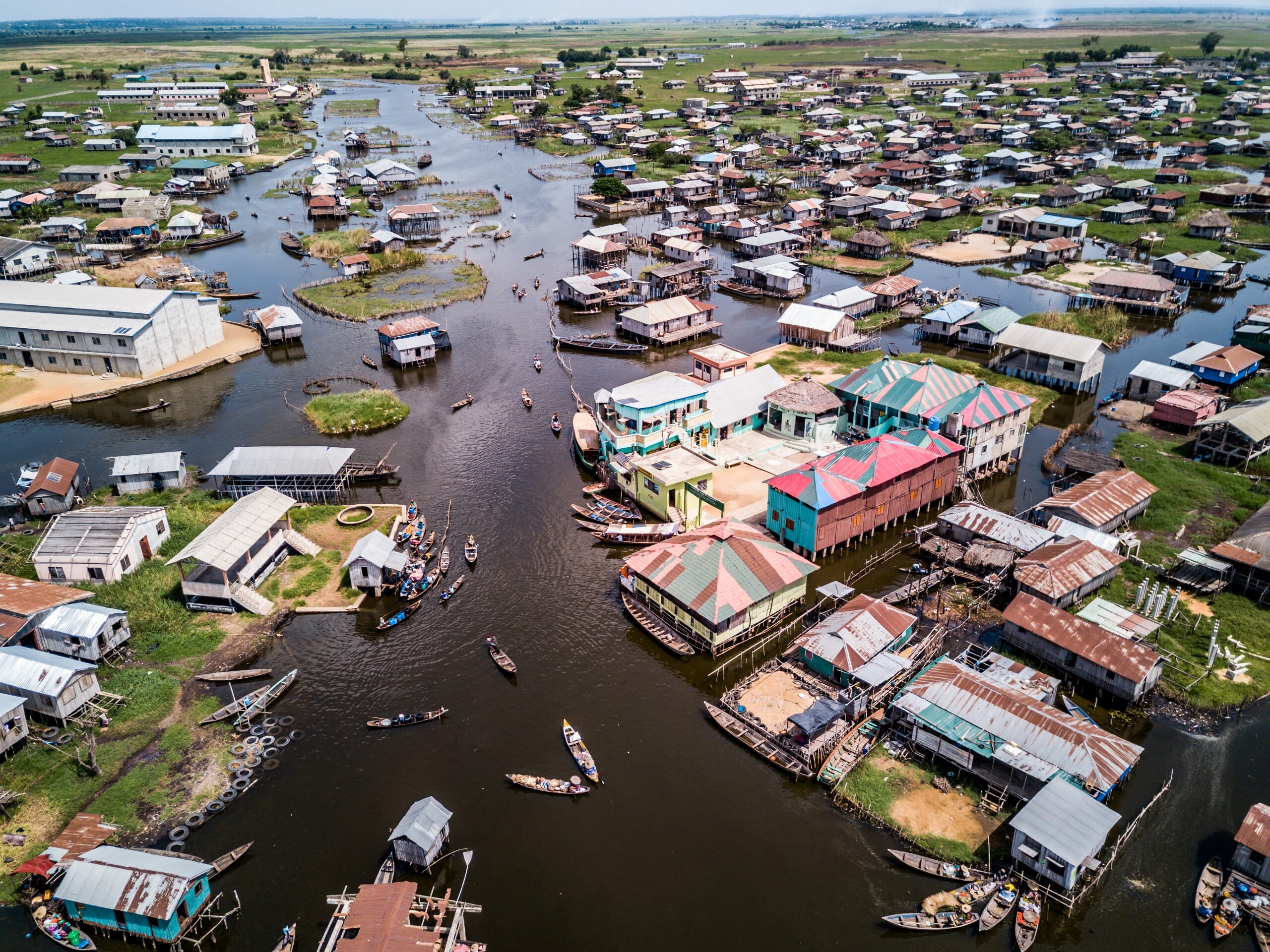
Average annual temperature: 28.02 °C (82.44 °F)
Benin, on the West African coast, has an average temperature of roughly 28.0 °C (82.4 °F). It shares the hot, humid conditions typical of the Gulf of Guinea.
Even its coastline offers little relief: the warm, moist air of the tropics keeps Benin hot and sticky for most of the year.
12. Qatar
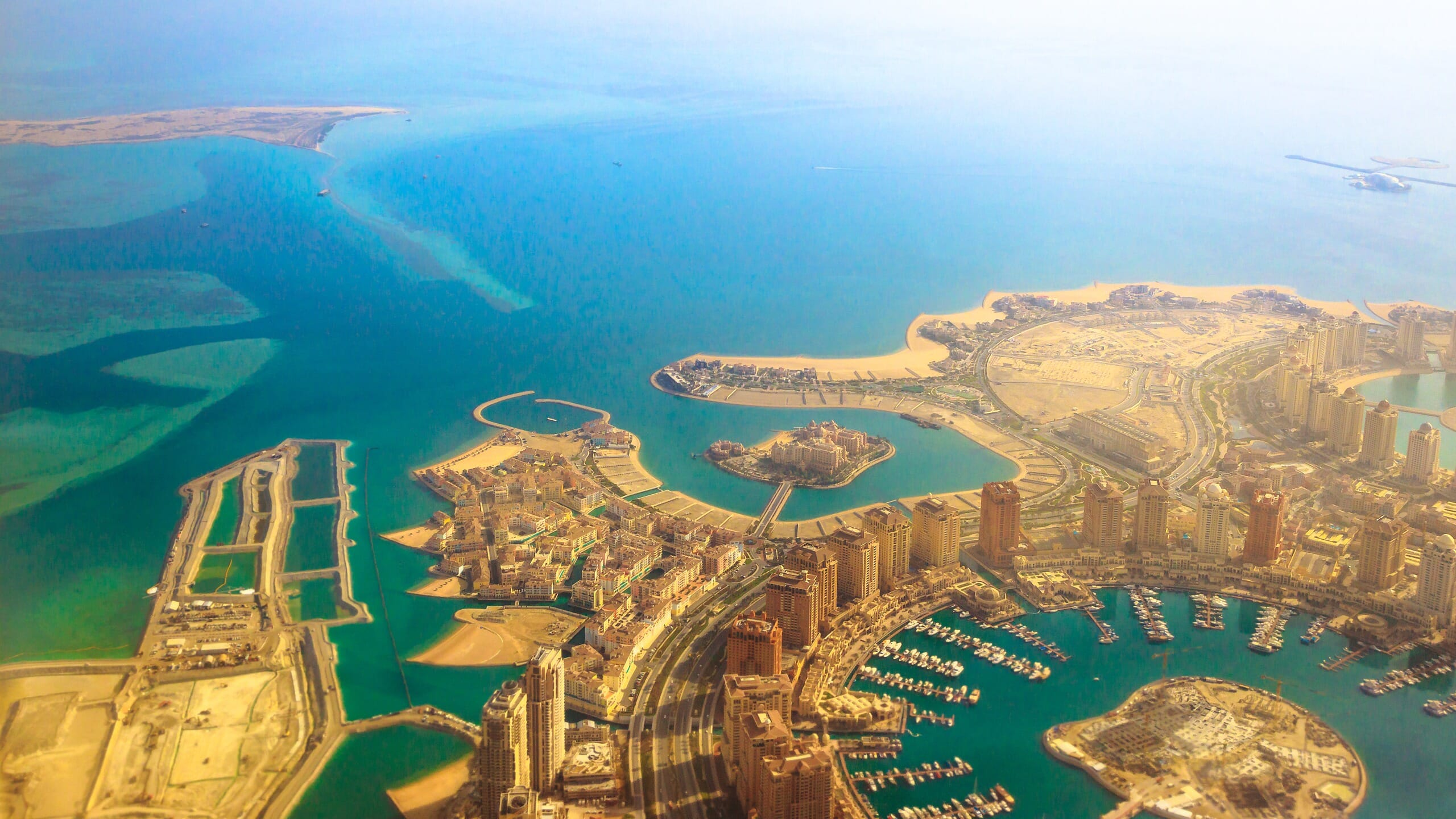
Average annual temperature: 28.02 °C (82.44 °F)
Qatar ties with Benin at about 28.0 °C (82.4 °F). This Gulf peninsula has a harsh desert climate and has recorded summer temperatures above 50 °C (122 °F).
Qatar’s flat, sandy terrain and Gulf humidity make its summers among the most punishing anywhere, which is a big part of why its yearly average is so high.
13. Marshall Islands

Average annual temperature: 28.01 °C (82.42 °F)
The Marshall Islands, a scattering of atolls in the central Pacific, average around 28.0 °C (82.4 °F). This is another small island nation whose climate is governed by the warm ocean around it.
Consistent trade winds and tropical seas give the Marshall Islands a hot, humid and very steady climate throughout the year.
14. Guinea-Bissau

Average annual temperature: 27.98 °C (82.36 °F)
Guinea-Bissau in West Africa averages about 28.0 °C (82.4 °F). Low-lying and tropical, it combines coastal humidity with the heat of the wider Sahel region to its north.
Its mangrove-lined coast and flat interior share the same warm, wet-and-dry tropical climate that keeps much of West Africa near the top of this list.
15. South Sudan
Average annual temperature: 27.97 °C (82.35 °F)
South Sudan, the world’s youngest country, averages roughly 28.0 °C (82.3 °F). Landlocked in East Africa, it has a hot tropical climate across its plains and wetlands.
Long dry seasons and high sun keep South Sudan consistently hot, and sparse weather-station coverage means its true average may be even higher than recorded.
16. Sudan
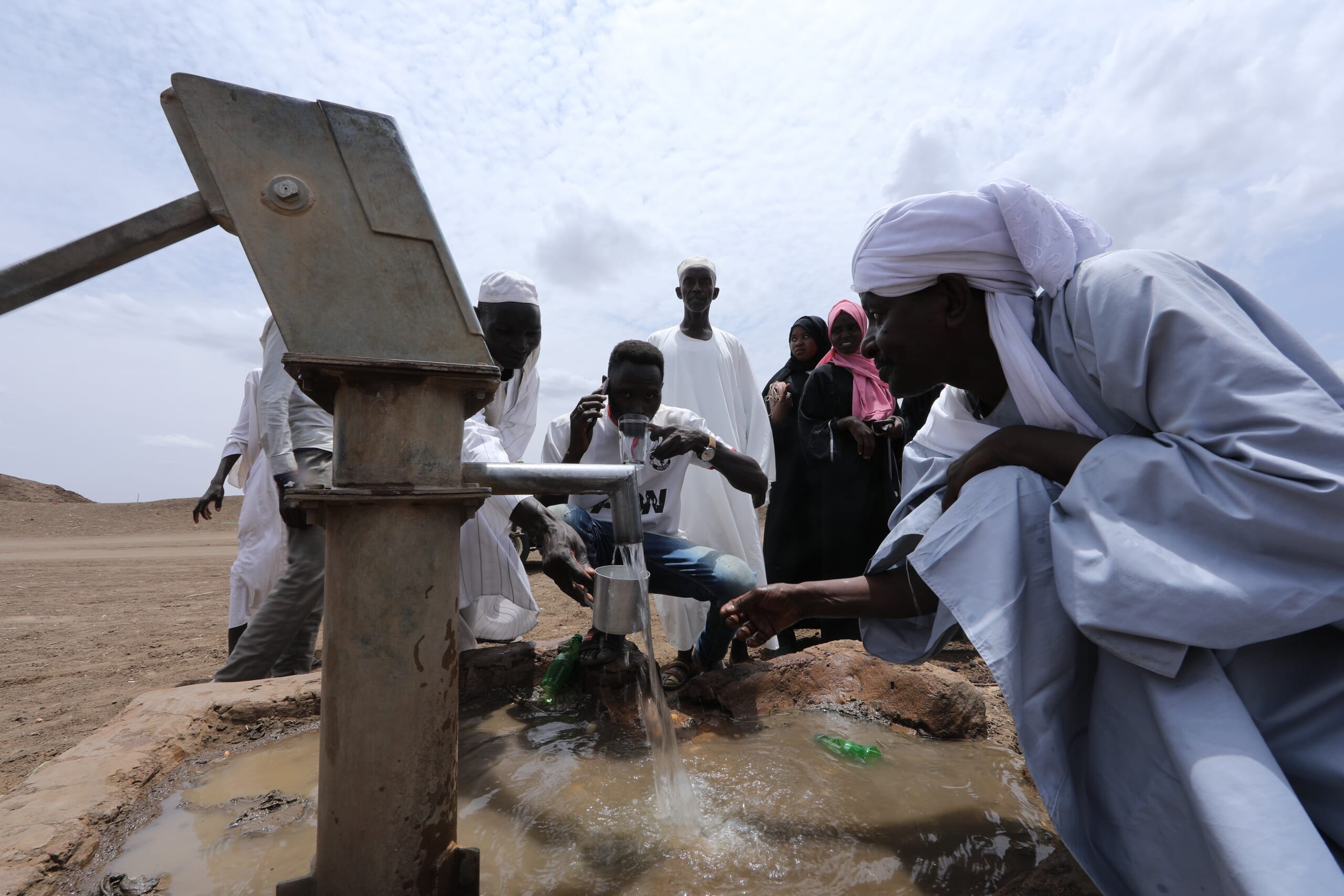
Average annual temperature: 27.95 °C (82.31 °F)
Sudan averages about 28.0 °C (82.3 °F), spanning the Sahara in the north and tropical zones in the south. Its capital, Khartoum, is one of the hottest major cities on Earth.
The desert north drives Sudan’s national average sky-high, with little rainfall and relentless sun for much of the year.
17. Palau
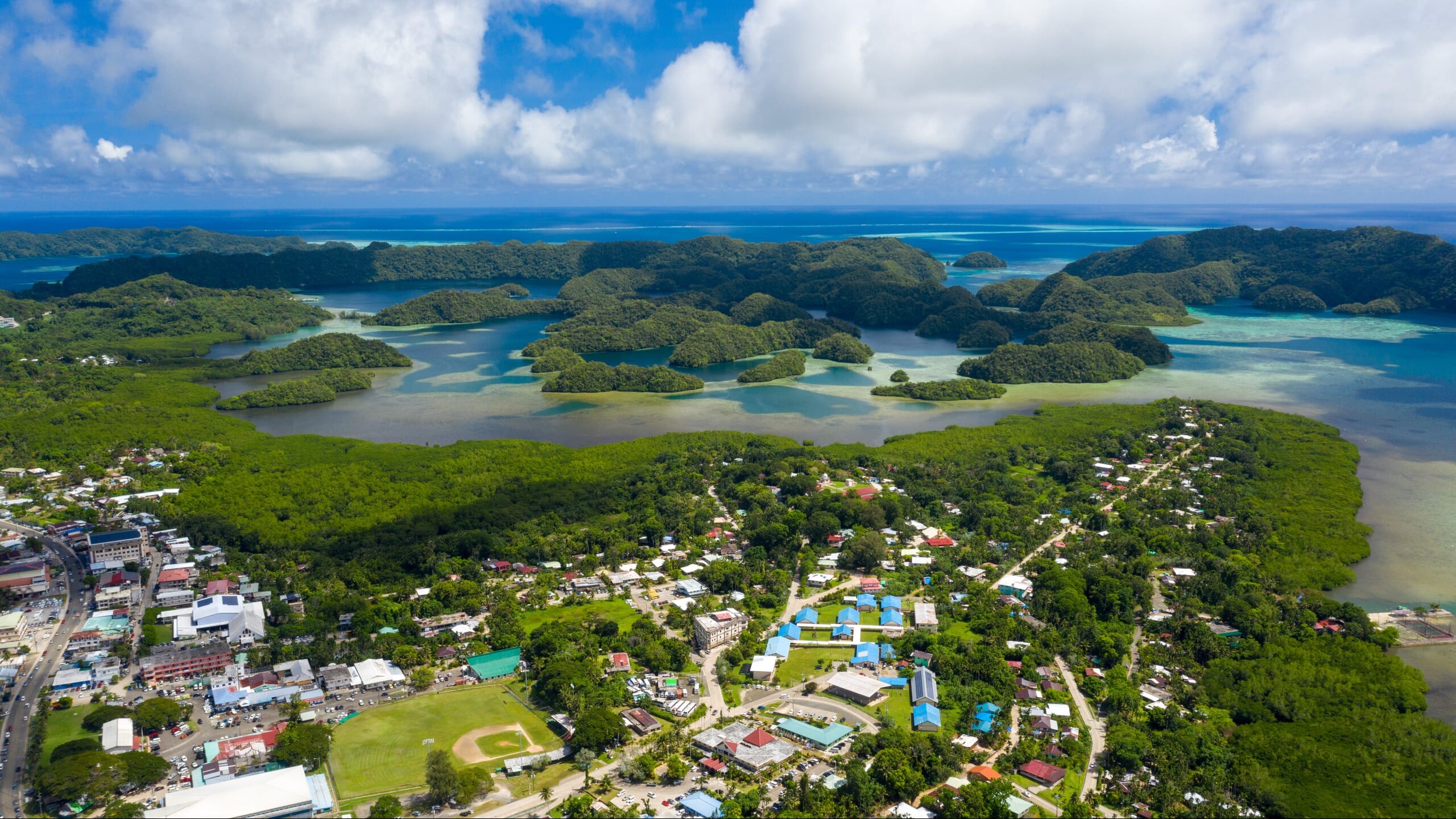
Average annual temperature: 27.90 °C (82.22 °F)
Palau, an archipelago in the western Pacific, averages around 27.9 °C (82.2 °F). Like the other Pacific island nations on this list, it enjoys a warm, stable tropical climate.
Surrounded by warm ocean and close to the equator, Palau sees little temperature variation from month to month.
18. Nauru
Average annual temperature: 27.83 °C (82.09 °F)
Nauru, one of the world’s smallest countries, averages about 27.8 °C (82.1 °F). This single raised-coral island sits just south of the equator in the Pacific.
With almost no elevation and open ocean on every side, Nauru’s temperature stays close to that of the surrounding sea all year long.
19. Kiribati
Average annual temperature: 27.77 °C (81.99 °F)
Kiribati, a vast spread of atolls straddling the equator, averages roughly 27.8 °C (82.0 °F). Its islands are scattered across a huge area of the central Pacific.
Sitting almost exactly on the equator, Kiribati has one of the most constant climates on Earth, hot and humid every single month.
20. Bahrain

Average annual temperature: 27.69 °C (81.84 °F)
Bahrain, a small Gulf island nation, rounds out the top twenty at about 27.7 °C (81.8 °F). Its desert climate brings very hot, humid summers and mild winters.
Bahrain’s low, flat terrain and its position in the Persian Gulf leave it exposed to the same intense heat that grips the rest of the region.
Wrapping Up
Those are the twenty hottest countries in the world by average annual temperature. Africa dominates the list, and West Africa’s Sahel region in particular has the highest concentration of extreme-heat countries anywhere. Low-lying island nations in the Pacific and Indian Oceans make a strong showing too, kept warm year-round by the tropical seas that surround them, along with the desert states of the Persian Gulf.
As the climate warms, these averages are creeping upward, but the geography of global heat has stayed remarkably consistent: the Sahel, the tropics and the Gulf remain the hottest places for people to live on Earth. For the opposite extreme, see our map of the coldest countries in the world.
Data and references:


