
⚠️ Airspace advisory (June 2026): Syria’s airspace is currently under a “Do Not Fly” advisory, reflecting an ongoing risk to civil aviation from periodic Israeli airstrikes on Iranian- and Hezbollah-linked targets and the chance of misidentification by air-defence systems. Many international carriers have suspended or rerouted flights, so the routes and schedules below may not reflect live operations. Always check current status before booking. Source: safeairspace.net.
Key Takeaways
- Damascus is Syria’s main gateway. Damascus International (DAM), about 25 km southeast of the capital, serves roughly 19 regularly-served nonstop destinations. It is the home base of flag carrier Syrian Air and the hub for almost all of the country’s international traffic.
- Aleppo is the northern hub. Aleppo International (ALP), in Syria’s second city, serves around 8 regularly-served destinations. Badly damaged during the war and closed for years, it has reopened to international flights and is the only other Syrian airport with a meaningful scheduled network.
- A network rebuilding after the war. After more than a decade of civil war and the December 2024 fall of the Assad regime, Syrian aviation is concentrated and regional. Around a dozen airlines resumed flights in 2026, with most links reaching the Gulf, the Levant and Turkey: Amman, Istanbul, Dubai, Sharjah, Doha, Riyadh and Jeddah.
- No nonstop flights to the US. Neither airport has scheduled nonstop service to the United States. Travelers connect through a larger hub such as Istanbul, Doha, Dubai or Amman.
- Check airspace status before booking. Syria sits under a “Do Not Fly” airspace advisory, and schedules can change at short notice. Confirm that your flight is operating before you travel.
Syria sits at the crossroads of the eastern Mediterranean and the Middle East, with a population of more than 20 million. After more than a decade of civil war, its commercial-aviation map is small and highly concentrated: only two airports carry a meaningful schedule of passenger flights, and almost all of the international traffic runs through the capital.
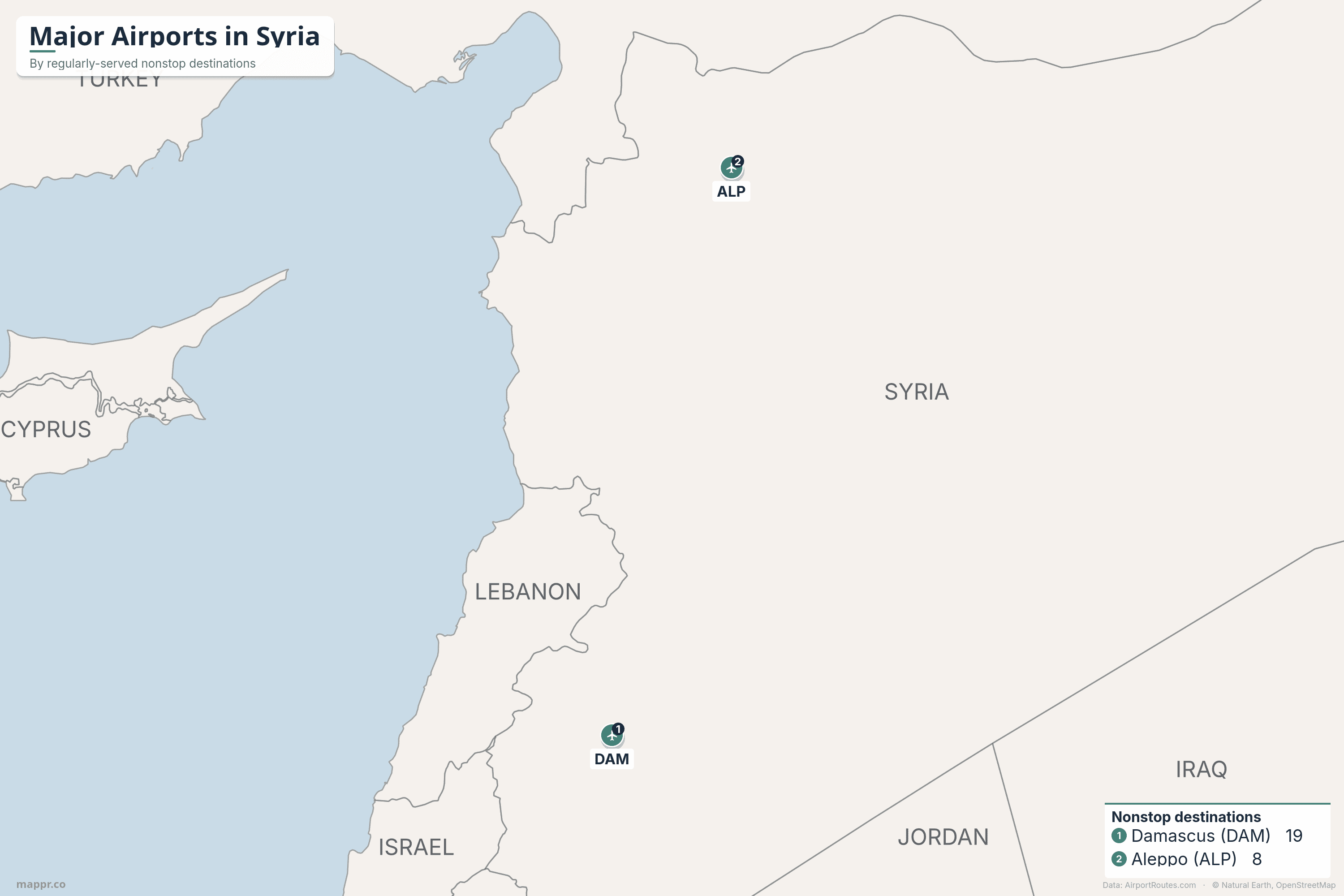
That airport is Damascus International (DAM), the home of flag carrier Syrian Air. The other is Aleppo International (ALP), serving Syria’s second city in the north. Following the December 2024 fall of the Assad regime, Syria’s airspace and airports have been gradually reopening, and a wave of international carriers returned through 2025 and 2026. The map and table below rank Syria’s airports by the number of destinations they serve with regular flights, drawing on live AirportRoutes route data.
Are there direct flights from Syria to the US?
No. Neither Damascus nor Aleppo has scheduled nonstop service to the United States, and no carrier currently flies between Syria and North America without a stop. Years of conflict and sanctions kept Syria off the global long-haul map, and the country’s links still reach the Gulf, the Levant and Turkey rather than the Americas.
To reach the US from Syria, travelers connect through a larger hub. The most common routings go via Istanbul (Turkish Airlines), Doha (Qatar Airways), Dubai (flydubai and Emirates) or Amman (Royal Jordanian), where onward transatlantic flights connect to cities across the United States. Because Syria sits under an active airspace advisory, it is always worth checking current operating status before you book.
RANKED BY DESTINATIONS
Syria’s airports with scheduled service
By regularly-served nonstop destinations (live AirportRoutes data). Damascus International leads; Aleppo International is the only other airport with a meaningful scheduled network.
| Airport | IATA | Serves | City / region |
|---|---|---|---|
| 1. Damascus International (Damascus) | DAM | 19 | Damascus |
| 2. Aleppo International (Aleppo) | ALP | 8 | Aleppo |
A closer look at Syria’s airports
✈️ Damascus International, Damascus (DAM)
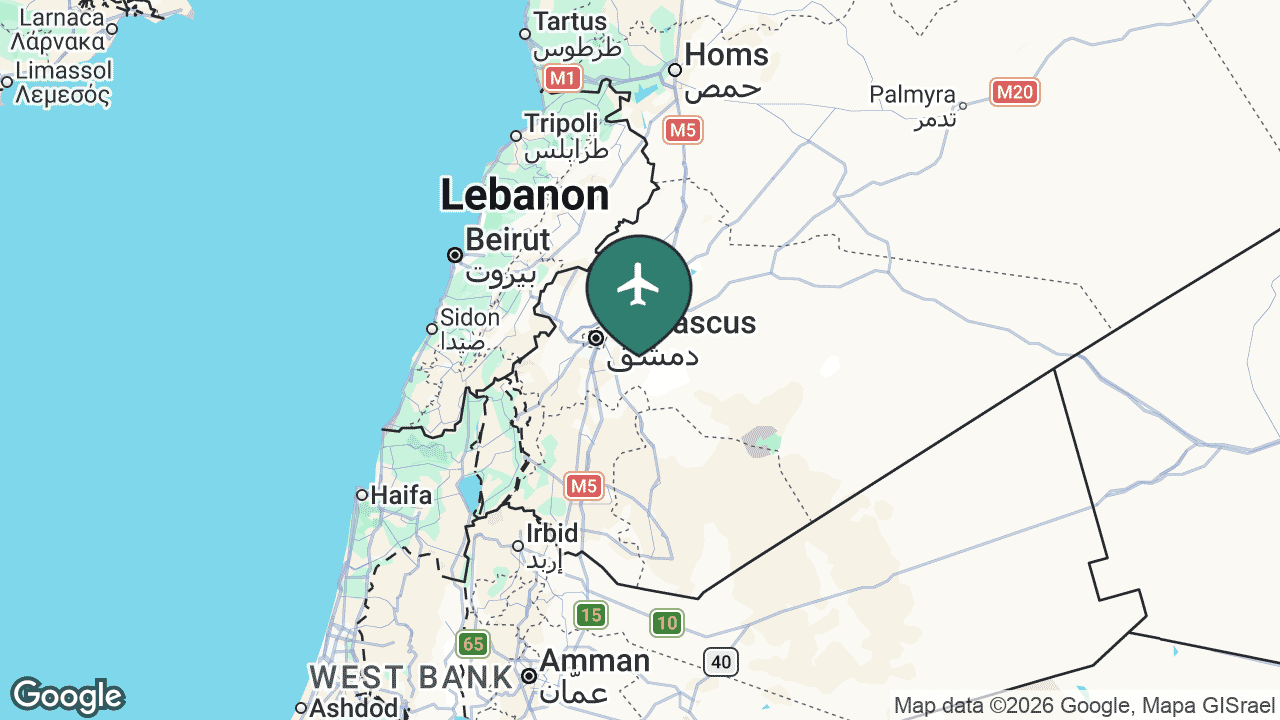
Damascus International, which opened in the 1970s, sits about 25 km southeast of the capital and is Syria’s flagship airport and the home base of Syrian Air (Syrian Arab Airlines). Through the civil war it remained the government’s main air link to the outside world, and its runways were hit by Israeli airstrikes on several occasions. Since the fall of the Assad regime in late 2024 it has reopened to international traffic, with carrier after carrier returning through 2025 and 2026.
DAM reaches about 19 regularly-served nonstop destinations, by far the widest network in Syria. Frequent links run to the Gulf, including Kuwait City, Sharjah, Dubai, Doha, Riyadh and Jeddah, alongside Amman and Istanbul. The recovery has been rapid: by mid-2026 roughly a dozen airlines were operating to Syria, and Damascus was once again at the centre of the country’s air map.
Main airlines: Syrian Air and Fly Cham (the Syrian-Emirati carrier that succeeded Cham Wings in 2025) on the home side, plus returning international operators Qatar Airways, Turkish Airlines, flydubai, Air Arabia, flynas, flyadeal, Royal Jordanian and AJet. See DAM’s full route map on AirportRoutes →
✈️ Aleppo International, Aleppo (ALP)
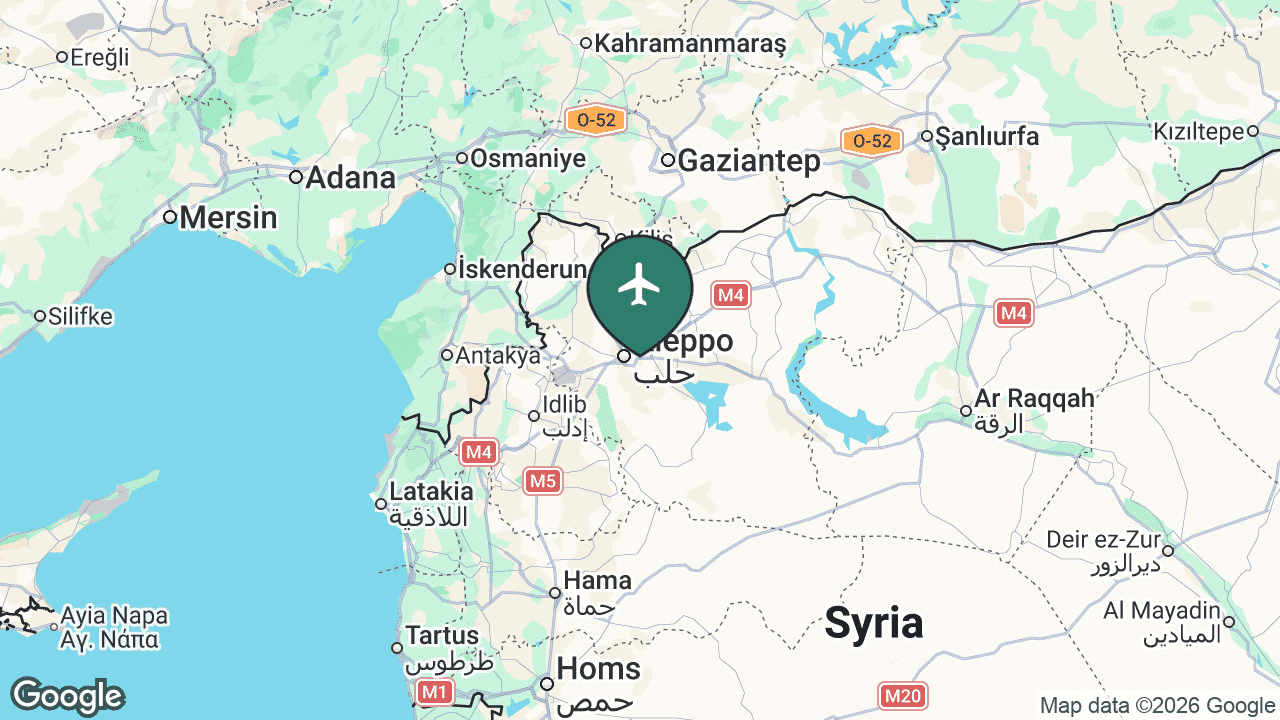
Aleppo International serves Aleppo, Syria’s second city and historic commercial capital, in the north of the country near the Turkish border. The airport sat on the front lines during the long battle for Aleppo and was closed or barely operational for years. It has since reopened, and the resumption of scheduled international flights has made it the country’s clear number-two gateway once again.
ALP serves around 8 regularly-served destinations, the second-widest network in Syria. Its links lean toward the Levant, Turkey and the Gulf, with flights to Amman, Istanbul, Sharjah and Doha, plus shorter regional hops to Erbil in northern Iraq and Yerevan in Armenia, a nod to Aleppo’s long-standing Armenian community.
Main airlines: Fly Cham, Syrian Air, Turkish Airlines, AJet, Royal Jordanian and Qatar Airways. See ALP’s full route map on AirportRoutes →
Syria’s other airports
Beyond Damascus and Aleppo, Syria has several more airports, but years of war have left most of them with little or no scheduled international service, so they fall outside the route sample above:
- Latakia International (LTK), on the Mediterranean coast, shares its site with the Russian-operated Hmeimim air base and has seen only limited civilian service.
- Qamishli (KAC), in the Kurdish-administered northeast, kept a lifeline domestic link to Damascus through much of the war and is the main airport for that corner of the country.
- Deir ez-Zor and Palmyra (Tadmur) in the east were heavily damaged during the conflict and have effectively no scheduled passenger flights.
Airport rankings, nonstop-destination counts, served cities and airline lists are drawn from live AirportRoutes route data (observed AeroAPI flight data, a sample rather than a complete published schedule; we use the regularly-served figure, which filters one-off observations and is still recovering as carriers return). Airport history, operators and current carriers are cross-checked against the cited references, and the airspace advisory reflects published guidance at the time of writing. The maps are Mappr originals.
Primary Data Source:
- AirportRoutes: Major airports and routes, Syria – Live route data: per-airport nonstop destinations, served cities and airlines.
References:
- Safe Airspace: conflict-zone advisories – Crowd-sourced summary of airspace risk advisories, including Syria (Damascus FIR).
- Wikipedia: Damascus and Aleppo international airports – Airport background, history, operators and current airlines and destinations.
- Google Static Maps – Base maps for the per-airport locator images.
🌍 More maps & data for Syria
Browse more: All airports by country


