
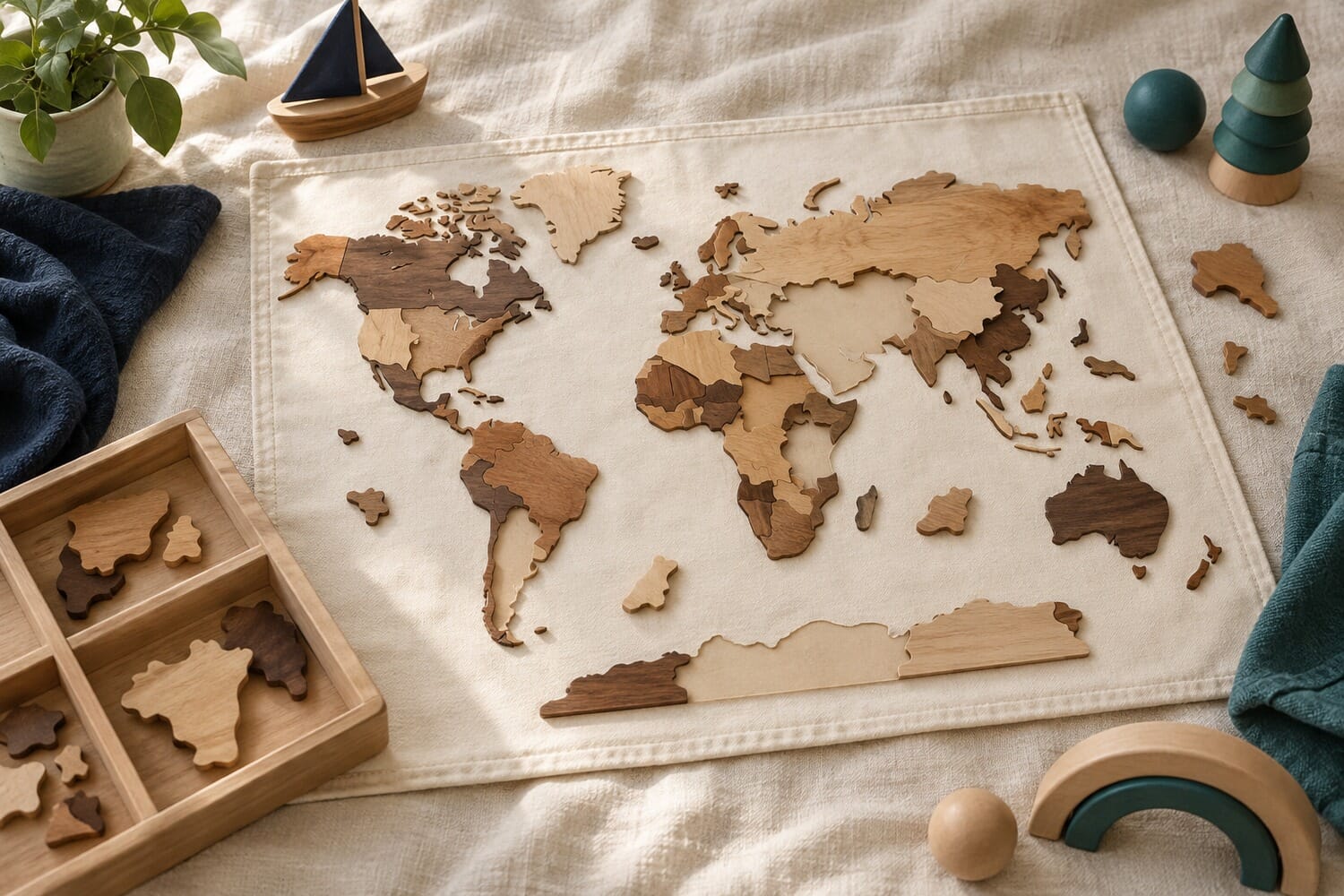
World map puzzles do something screens cannot: they put geography directly into a child’s hands. Picking up a puzzle piece shaped like Brazil or snapping Australia into place beside the Pacific Ocean builds spatial awareness in a way that swiping through an app never will. The tactile feedback, the trial-and-error of finding where each country fits, and the satisfaction of completing a full map all reinforce learning that sticks.
We researched and compared dozens of world map puzzles across Amazon, analyzing ratings, review feedback, piece counts, materials, and age suitability to select the 10 best options available right now. The picks below cover everything from chunky 24-piece floor puzzles for preschoolers to detailed 200-piece jigsaws for older kids, plus wooden puzzles, foam puzzles, and shaped-piece designs that teach geography in different ways.
We may earn a commission when you purchase through links on this page. This does not influence our editorial selections. Learn more.
1. Momo & Nashi World Map Puzzle
- Best for: Overall pick – best balance of quality, price, and educational value
- Age range: 4-8 years
- Pieces: 75
- Size: 23.6 x 17.3 inches
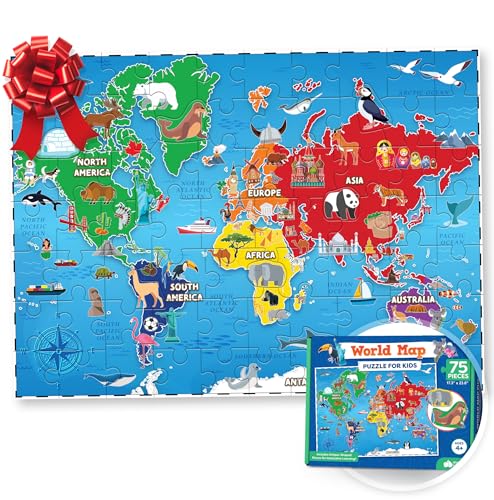
The Momo & Nashi World Map Puzzle earns the top spot with nearly 4,000 Amazon ratings and a 4.5-star average, making it one of the most popular world map puzzles for kids on the platform. The 75-piece count hits a sweet spot: complex enough to challenge a five-year-old, but not so overwhelming that younger kids lose interest halfway through.
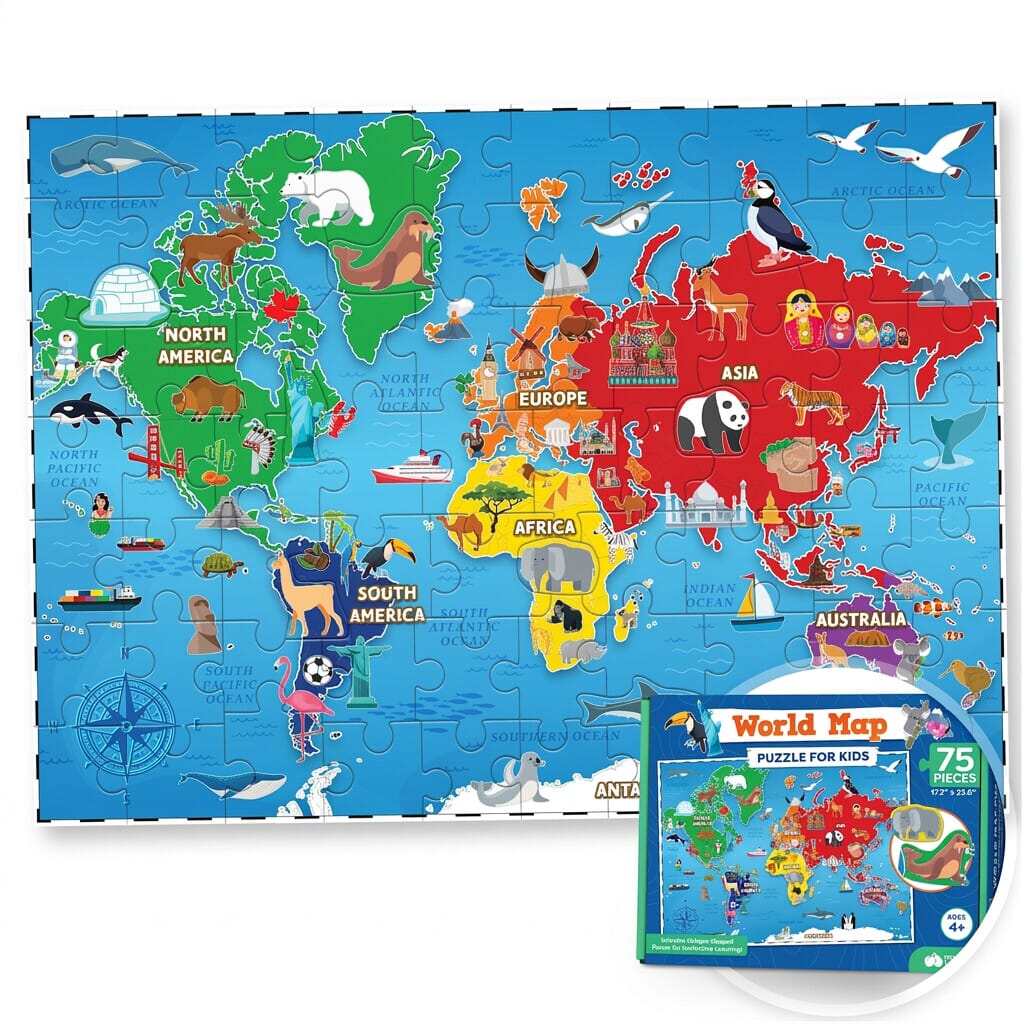
Each piece is made from 2mm chipboard, which is noticeably thicker than the flimsy cardboard found in cheaper puzzles. The pieces hold up well to repeated assembly and the inevitable rough handling from young kids. The printed map labels continents, major countries, and oceans clearly, and the colorful illustrations of animals and landmarks across each region give children conversation starters about different parts of the world.
Parent reviews consistently highlight how this puzzle doubles as a geography lesson without feeling like schoolwork. The reinforced packaging box with a carrying handle also makes storage and transport easy, which is a practical detail that many competitors skip.
Pros
- Nearly 4,000 ratings with strong 4.5-star average
- Thick 2mm chipboard pieces are durable and easy to grip
- 75 pieces – ideal difficulty for ages 4-8
- Affordable price point under $17
Cons
- Not all countries are individually labeled
- Pieces are standard rectangular cuts, not country-shaped
2. Melissa & Doug World Map Floor Puzzle
- Best for: Younger kids who need large, chunky pieces
- Age range: 6+ years (works for 3+ with help)
- Pieces: 33
- Size: 2 x 3 feet when assembled


The Melissa & Doug World Map Floor Puzzle is a trusted name in children’s toys for good reason. With over 2,400 ratings and the backing of one of the most recognized toy brands in North America, this 33-piece jumbo puzzle delivers exactly what parents expect: big, sturdy pieces that young children can actually handle.
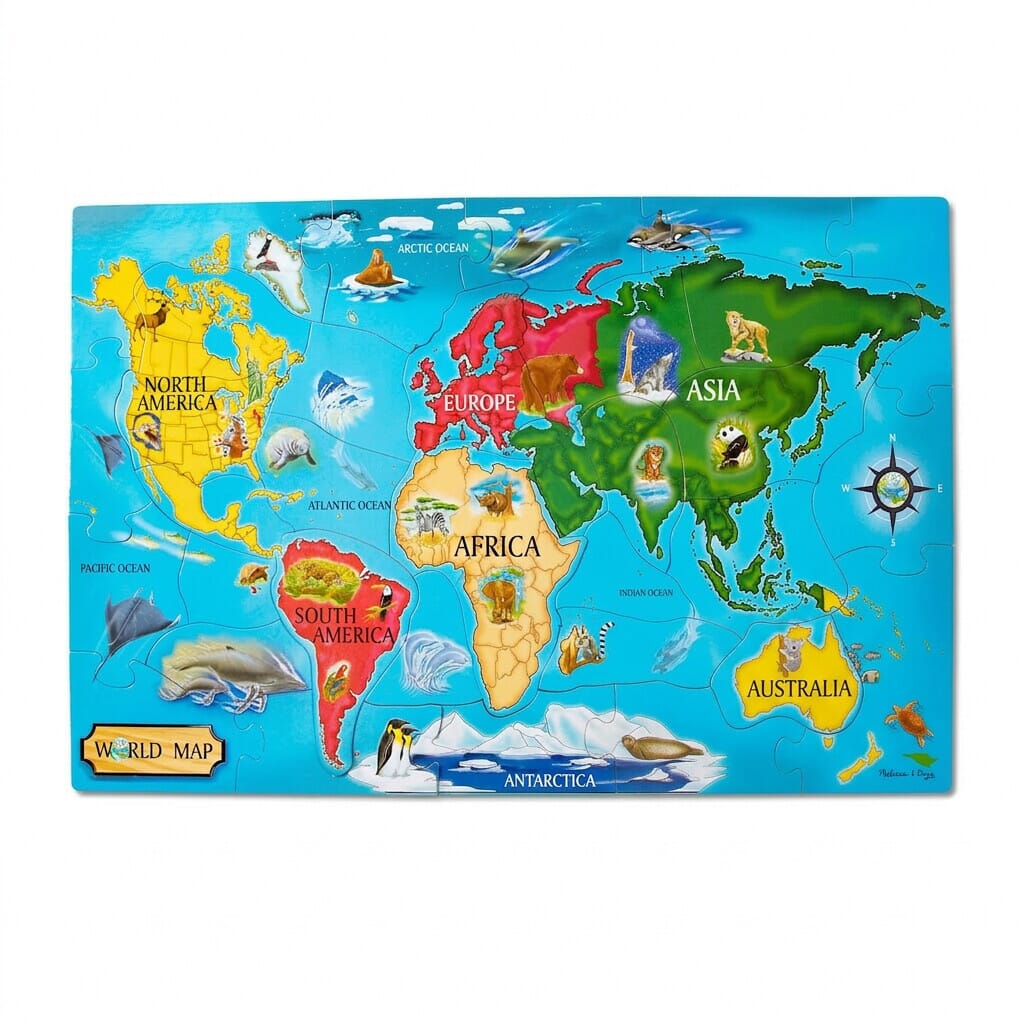
The assembled puzzle stretches 2 by 3 feet across the floor, which makes it a genuinely impressive visual for kids. Each piece is extra-thick and features an easy-to-clean surface, so spills and sticky fingers are not a permanent disaster. The illustrations show continents alongside their native animals, turning assembly into a mini zoology lesson on top of the geography.
While the 33-piece count means older kids (8+) will breeze through it, this is exactly the right challenge level for children aged 3-6 who are just developing their spatial reasoning skills. It is also a strong option for classrooms and waiting rooms where durability matters more than complexity.
Pros
- Trusted Melissa & Doug brand with 2,400+ reviews
- Extra-thick, easy-to-clean pieces
- Large 2 x 3 foot assembled size
- Animal illustrations add educational value
Cons
- Only 33 pieces – too easy for kids over 7
- Map detail is limited compared to higher piece-count puzzles
3. Mideer World Map Puzzle
- Best for: Beautiful illustrations with landmarks and cultural details
- Age range: 4-8 years
- Pieces: 100
- Size: 15.7 x 29.9 inches
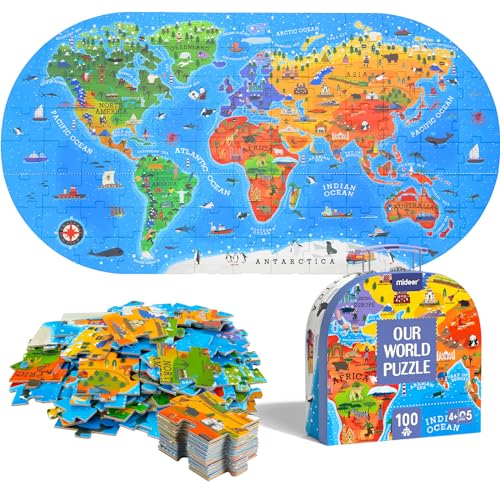
The Mideer World Map Puzzle stands out primarily for its artwork. Where most world map puzzles use simple, flat illustrations, this one features richly detailed scenes across each continent: landmarks like the Eiffel Tower and Great Wall of China, native animals, traditional clothing, and cultural icons are woven into the design. The result is a puzzle that children actually want to look at after they finish assembling it.
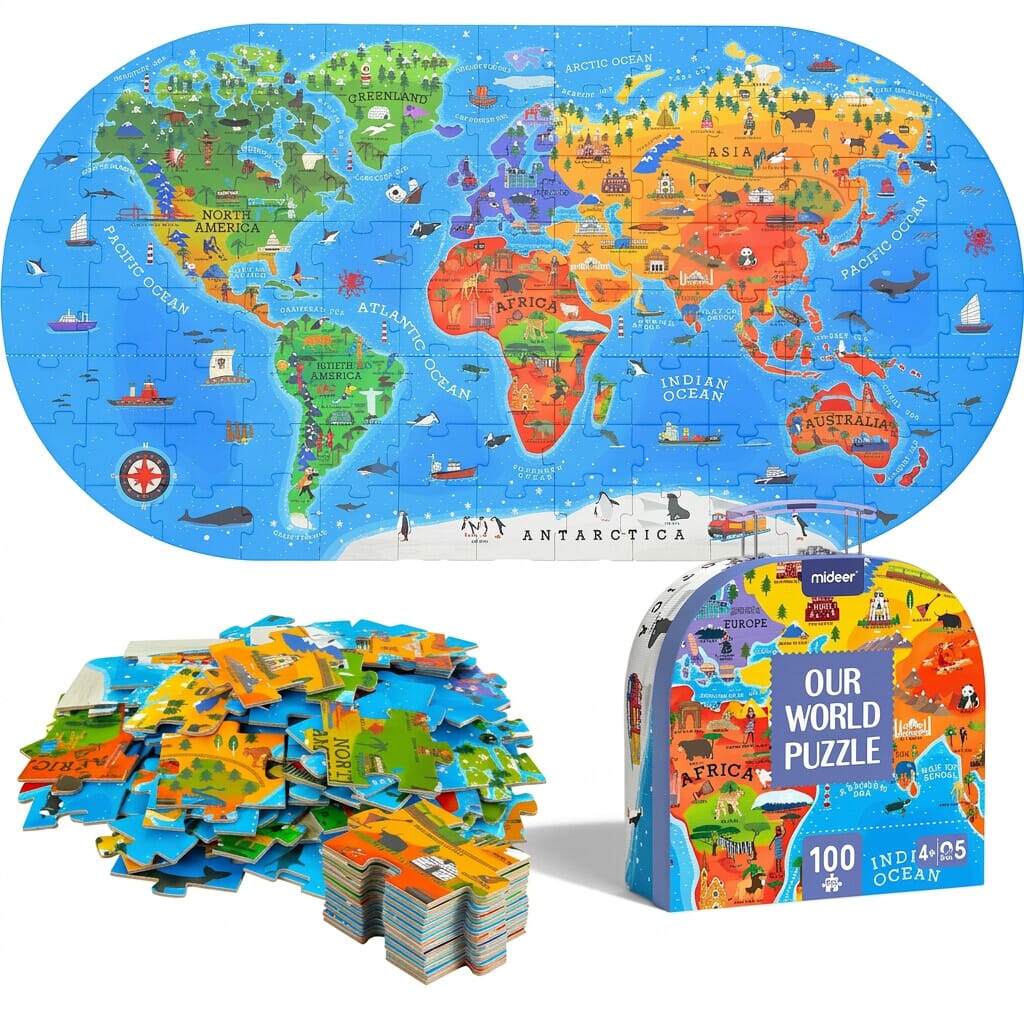
The 100-piece count places this in the mid-range for difficulty, suitable for children who have outgrown simpler 24 or 33-piece puzzles but are not ready for 200+ pieces. Each piece is made from eco-friendly 2mm paperboard that feels sturdy and smooth, with no burrs or rough edges. The premium gift box with its buckle closure is a genuinely nice touch for gift-giving.
Covering 43 countries and 49 landmarks, this puzzle packs more geographic detail per piece than most competitors. It works particularly well as a wall display or educational poster once completed, thanks to the vibrant color palette and detailed illustrations.
Pros
- Stunning illustrations with landmarks and cultural details
- Eco-friendly 2mm paperboard with smooth finish
- Premium gift box packaging
- 43 countries and 49 landmarks labeled
Cons
- Smaller assembled size than some floor puzzles
- Higher price point than simpler alternatives
4. Imagimake Mapology World Map Puzzle
- Best for: Interactive learning with country flags and capitals
- Age range: 5-13 years
- Pieces: 75 country-shaped pieces + 3 foam frames
- Size: 22.8 x 13 inches
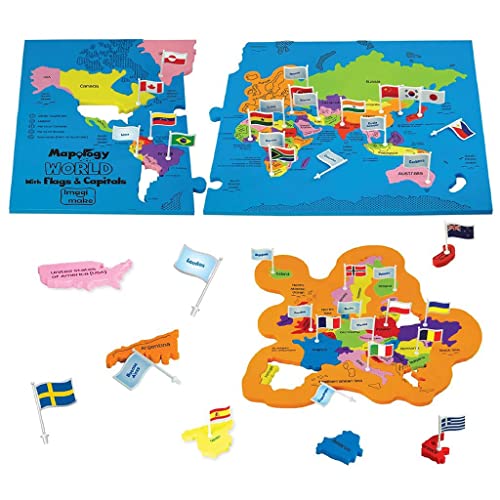
With over 13,000 ratings, the Imagimake Mapology World Map Puzzle is the most-reviewed world map puzzle on Amazon by a wide margin. What separates it from standard jigsaw puzzles is the format: instead of interlocking cardboard pieces, this set uses foam frames where each country is a removable, country-shaped piece. Children lift out India, place France, and snap in Japan, learning the actual shapes and locations of countries in the process.
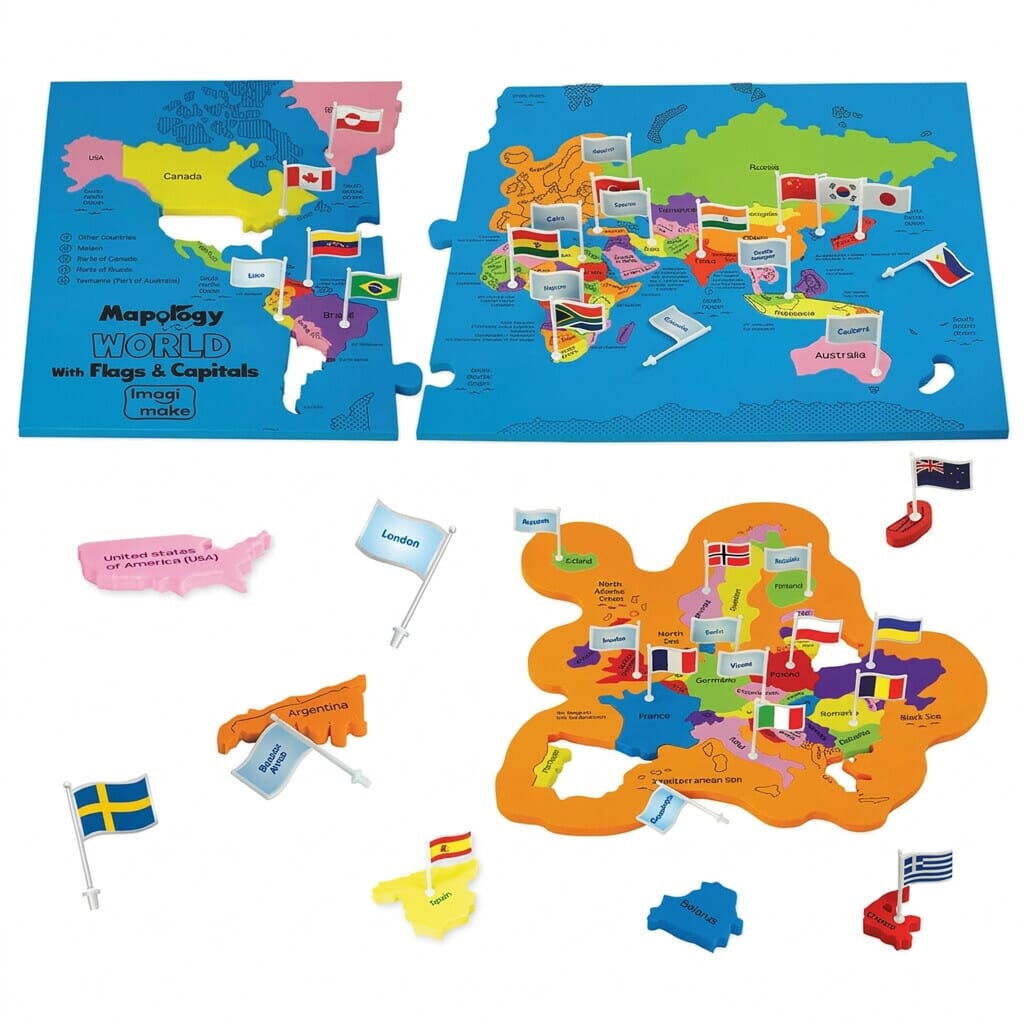
The set includes three separate foam puzzle frames covering different world regions, plus flags and capitals printed on each piece. This makes it one of the most information-dense geography puzzles available. The foam material is lightweight, durable, and safe for younger children who might still put things in their mouths.
The wide age range (5-13) is notable. Younger kids focus on fitting the shapes into the right slots, while older children can quiz themselves on capitals and flags. It functions as a puzzle, a reference tool, and a geography quiz all in one package. The only trade-off is the foam material, which some parents find less premium-feeling than thick cardboard.
Pros
- 13,000+ ratings – most reviewed world map puzzle on Amazon
- Country-shaped pieces teach actual geography
- Includes flags, capitals, and landmarks
- Wide 5-13 age range with layered learning
Cons
- Foam material feels less premium than cardboard
- Small countries can be fiddly for younger kids
5. Ravensburger World Landmarks Map 200-Piece Puzzle
- Best for: Kids 8+ learning world geography through monuments
- Pieces: 200
- Recommended age: 8 years and up
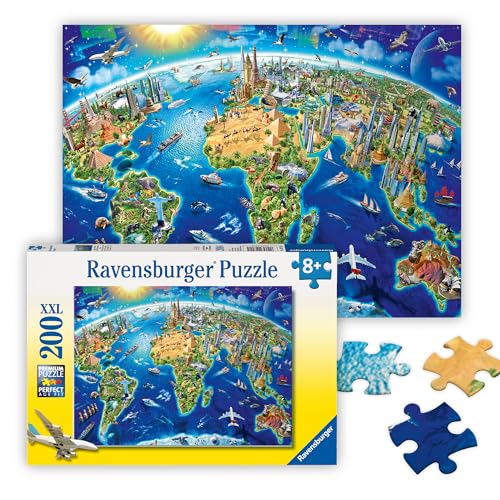
The Ravensburger World Landmarks Map Puzzle keeps the clean 200-piece format that’s been a kids-puzzle sweet spot for years — long enough to feel like an accomplishment, short enough to finish in an afternoon. The new twist is the image: instead of a plain political map, the surface is a colorful world map overlaid with more than 40 iconic monuments, from the Eiffel Tower to the Great Wall of China.
That visual hook turns the puzzle into a geography conversation. Kids asking “what’s that building?” learn where cities sit relative to continents, and parents get a natural prompt for follow-up stories about each landmark. It’s the kind of puzzle that gets rebuilt multiple times — something the standard “countries only” map can’t quite claim.
Craftsmanship is classic Ravensburger: thick, glare-free cardboard with the company’s signature precision-cut pieces that snap together without frustration. A strong pick as a 7-year-old’s birthday gift or a rainy-Saturday project.
Pros
- Landmark-rich map image keeps kids engaged across multiple builds
- Classic 200-piece count — substantial but finishable in a session
- Precision cutting and glare-free finish from Ravensburger
- Double-duty: geography + art/history teaching moments
- Strong review base (1,300+ ratings, 4.7★)
Cons
- 8+ age guide is realistic — younger kids will struggle
- Landmark art means less pure cartographic detail than a plain political map
- No accompanying reference sheet for the landmarks (minor nitpick)
6. Jumbo Floor Puzzle World Map
- Best for: Large floor puzzle with landmark icons
- Age range: 3-8 years
- Pieces: 48
- Size: 35.4 x 23.5 inches
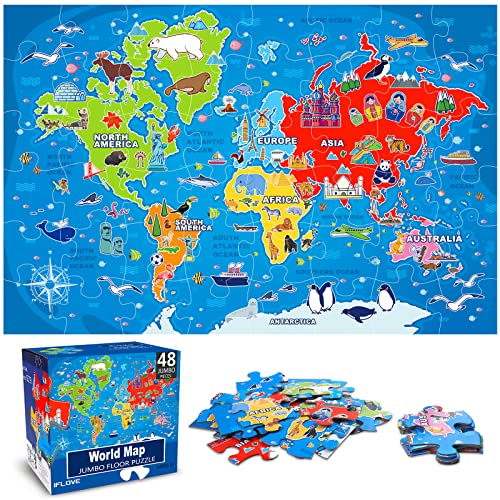
The Jumbo Floor Puzzle World Map earns its name: at 35.4 by 23.5 inches, it spreads across a significant portion of the floor, creating a map large enough that children can literally walk around and point to different continents. With a 4.8-star rating from over 700 reviews, it is the highest-rated puzzle in this roundup.
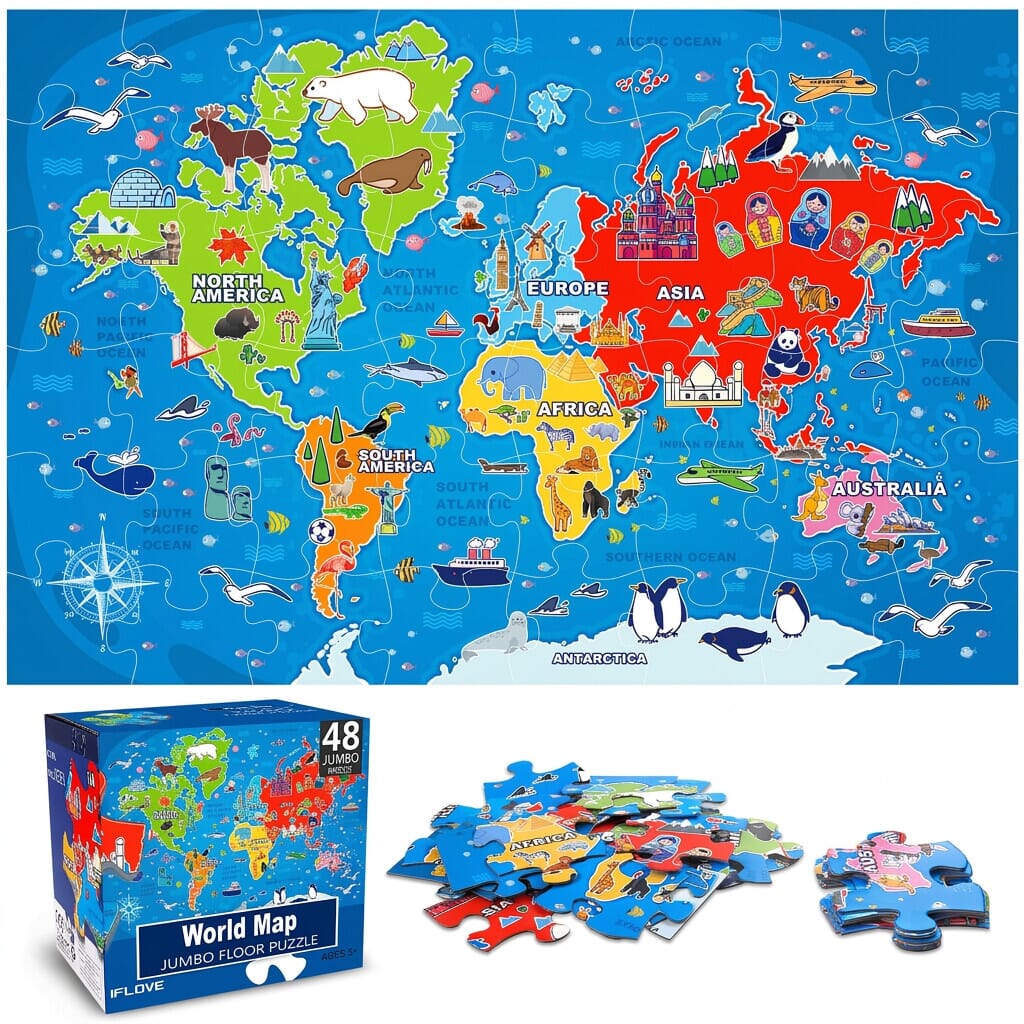
Each continent and country features unique landmark icons highlighting famous structures and natural wonders, from the Statue of Liberty to the Great Barrier Reef. The extra-thick cardboard pieces are built to survive repeated use by young children, and the 48-piece count keeps the challenge manageable for kids as young as three (with a little help).
The large assembled size makes this particularly effective for group play, family game nights, and classroom use. Multiple children can work on different sections simultaneously, turning puzzle time into a collaborative geography session. It is also one of the best options for visual learners who benefit from seeing geography at a bigger scale.
Pros
- Highest rated in roundup at 4.8 stars
- Large 35.4 x 23.5 inch size for floor play
- Landmark icons across every continent
- Extra-thick cardboard for durability
Cons
- Requires significant floor space
- 48 pieces may be too easy for kids over 6
7. eeBoo World Map 100 Piece Puzzle
- Best for: Eco-conscious families who want sustainable materials
- Age range: 5+ years
- Pieces: 100
- Size: 18 x 24 inches

The eeBoo World Map 100 Piece Puzzle is the pick for environmentally conscious families. Every component, from the puzzle pieces to the packaging, uses recycled paper and FSC-certified materials printed with vegetable-based inks. eeBoo is a woman-owned, mother-run company that has built its reputation on combining sustainability with genuinely beautiful design.
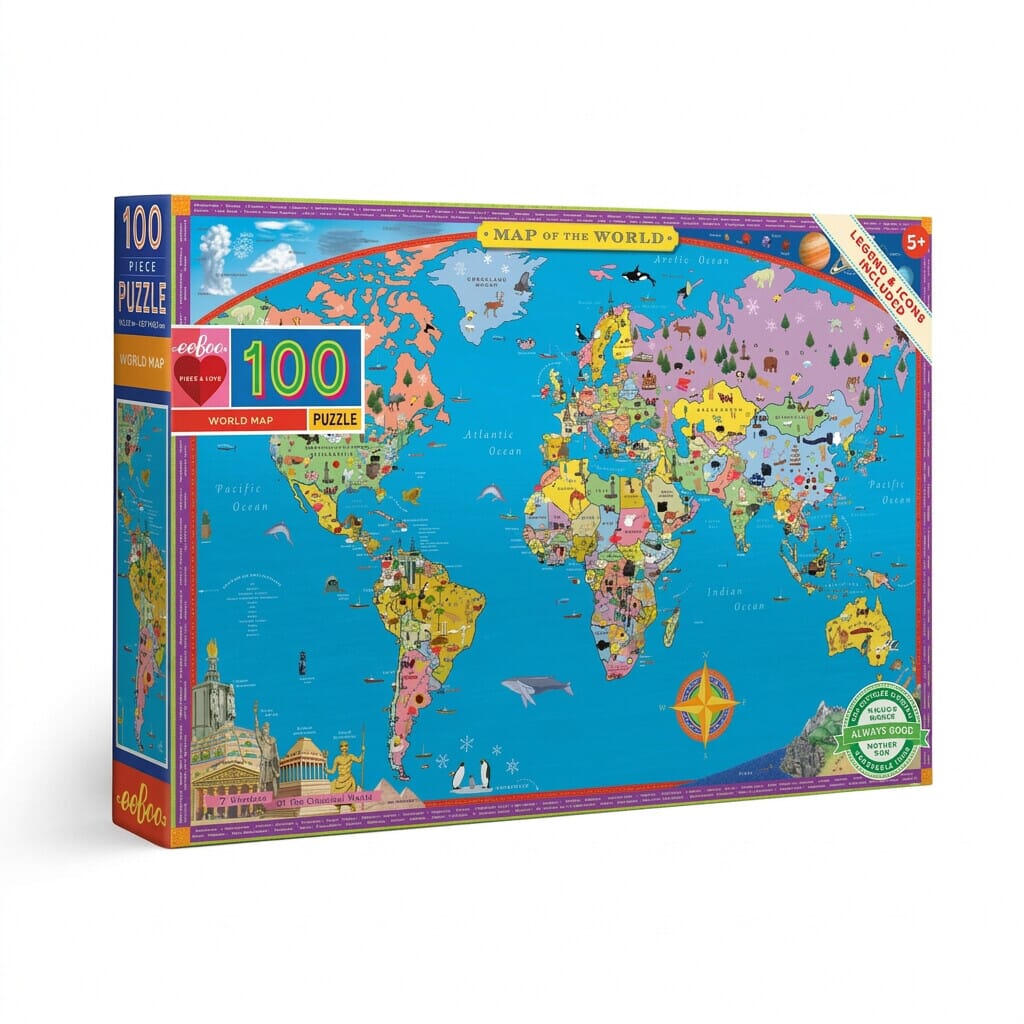
The 100-piece puzzle features original artwork from a well-known illustrator, giving it a distinct, hand-drawn aesthetic that feels more like art than a mass-produced toy. Countries, oceans, landmarks, and animals are all illustrated with care, and the included glossary adds an extra educational layer that most competitors skip. The glossy, double-coated pieces are sturdy and dust-free.
With a 4.7-star rating from over 600 reviews, the quality speaks for itself. The 100-piece count provides solid challenge for kids aged 5 and up, and the 18 x 24 inch assembled size is large enough to display as a finished piece. If sustainability matters to your household and you want a puzzle that looks good on a shelf, this is the one.
Pros
- Recycled, FSC-certified materials with vegetable-based inks
- Original hand-drawn artwork – visually distinct
- Includes educational glossary
- 4.7-star rating from 600+ reviews
Cons
- Artistic style may not appeal to kids who prefer realistic maps
- Glossy finish can cause minor glare under bright light
8. GeoToys GeoPuzzle World
- Best for: Learning country shapes with geographically accurate pieces
- Age range: 4+ years
- Pieces: 68
- Size: 24 x 12.5 inches
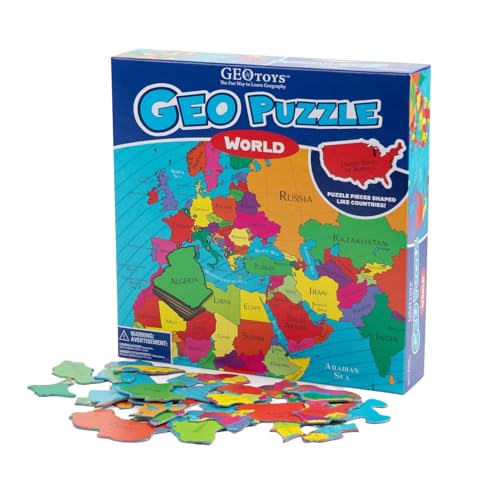
The GeoToys GeoPuzzle World takes a fundamentally different approach to teaching geography: every puzzle piece is shaped like an actual country or group of countries. Instead of fitting generic rectangular pieces into a grid, children pick up a piece shaped like Australia and place it where Australia belongs on the map. This builds a far stronger mental connection between a country’s shape and its location.
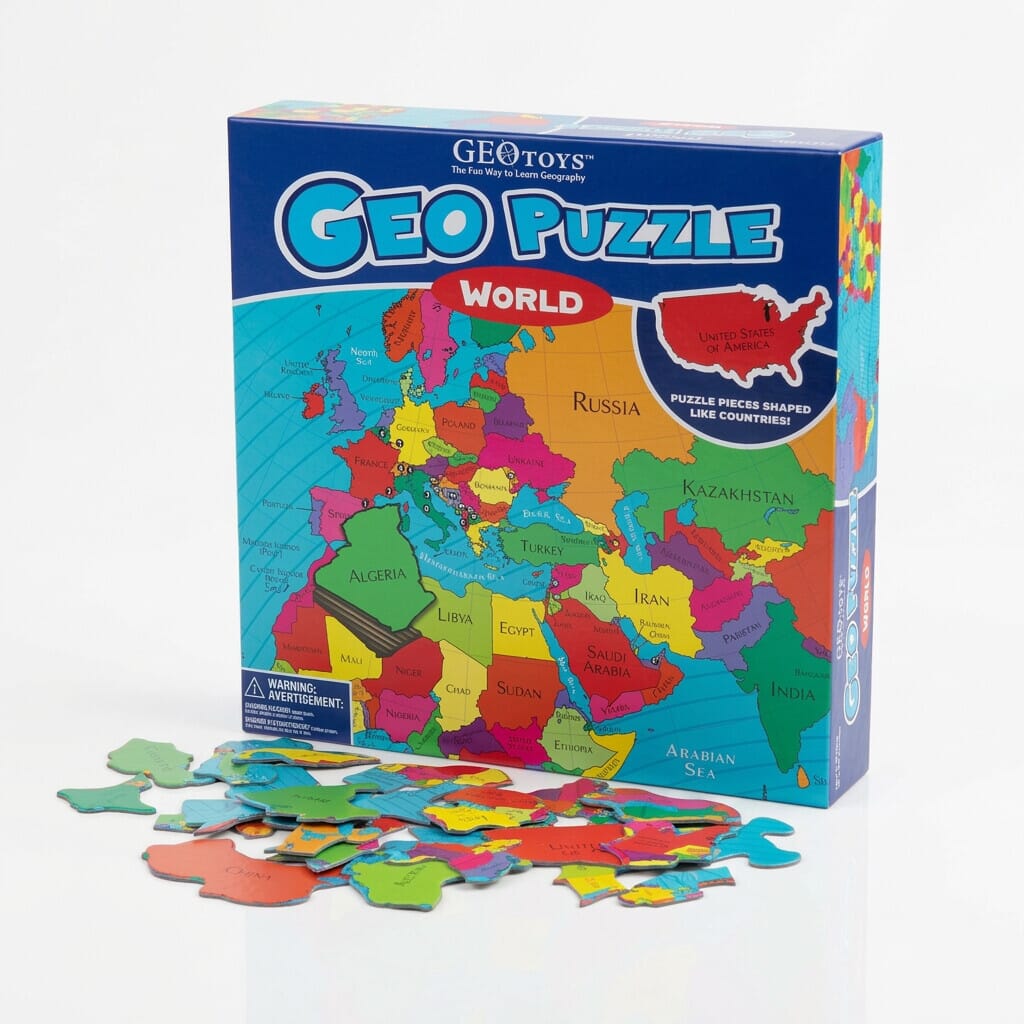
With nearly 3,000 ratings and a 4.5-star average, the GeoPuzzle has proven its staying power. The color-coded continents make initial assembly easier for beginners, while the country shapes provide ongoing educational value. Larger countries like Canada and Russia are single pieces, while smaller nations are grouped into multi-country pieces to keep the total count manageable.
The 68-piece count sits comfortably in the middle range, appropriate for kids aged 4 and up. The 24 x 12.5 inch assembled size is compact enough for a table but detailed enough to show meaningful geography. GeoToys also makes region-specific versions (Europe, Asia, Africa) for families who want to dive deeper into specific continents.
Pros
- Country-shaped pieces are uniquely educational
- Nearly 3,000 ratings with solid 4.5-star average
- Color-coded continents aid beginners
- Regional versions available for deeper learning
Cons
- Smaller countries are grouped into multi-country pieces
- Flat map projection distorts sizes of some countries
9. Petit Collage Floor Puzzle, Our World
- Best for: Preschoolers aged 3+ who need big, simple pieces
- Age range: 3+ years
- Pieces: 24
- Size: 18 x 24 inches
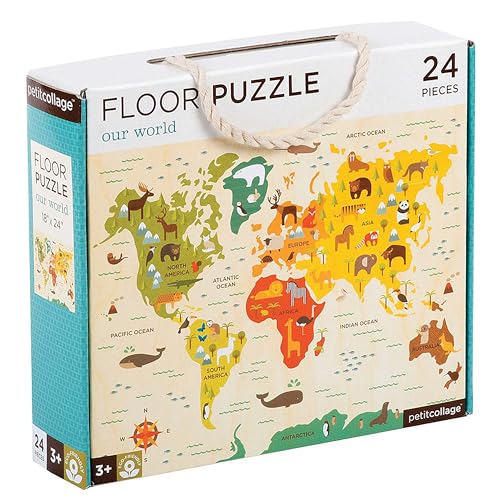
The Petit Collage Our World Floor Puzzle is purpose-built for the youngest puzzlers. At just 24 pieces, it is the simplest puzzle in this roundup, and that is exactly the point. For children aged 3 and up who are assembling their first real puzzle, these large, sturdy pieces are sized perfectly for small hands and developing motor skills.
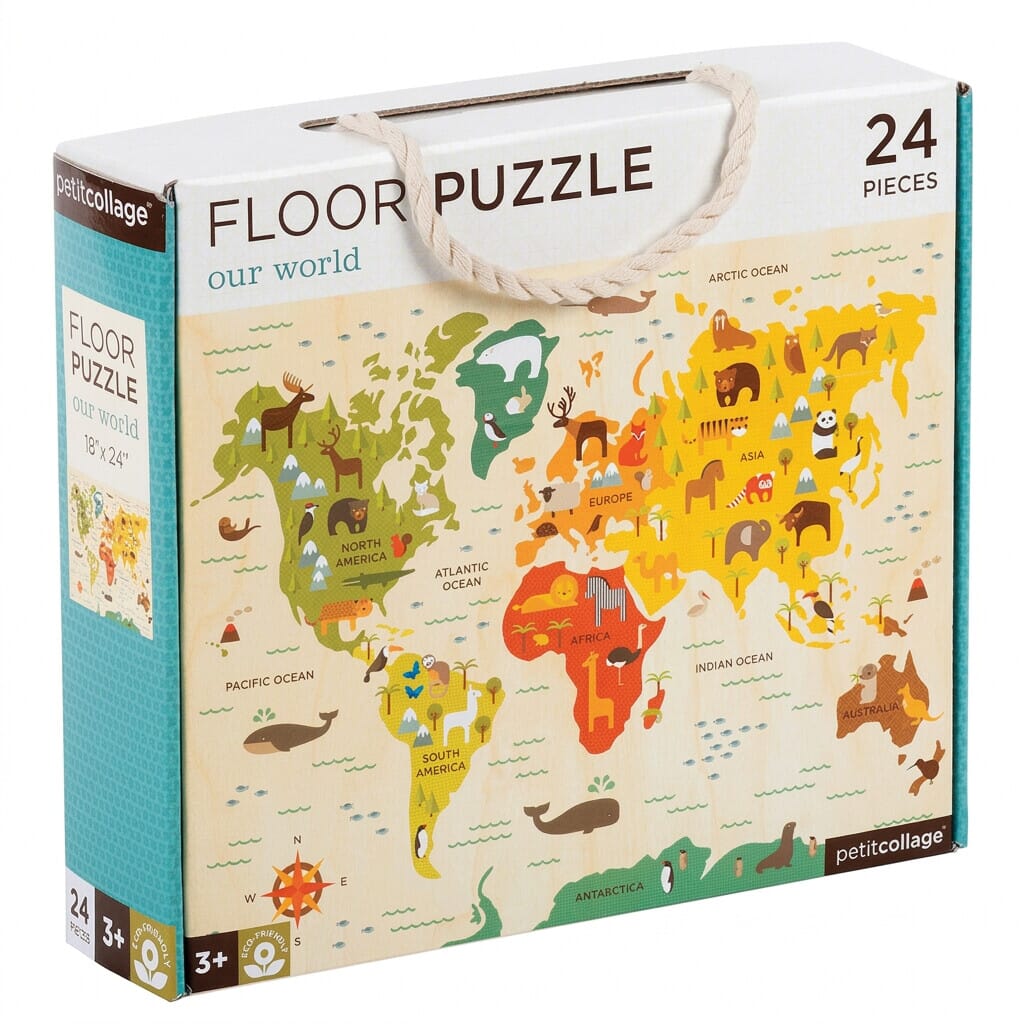
Petit Collage matches the eco-friendly credentials of eeBoo, using recycled paper and non-toxic, vegetable-based inks. The bright, bold illustration style is modern and appealing, with enough detail to spark conversations about different continents and animals without overwhelming a three-year-old. The keepsake carrying box with its soft cotton rope handle is a nice practical detail for storage and travel.
With a 4.7-star rating from over 260 reviews, parents consistently praise the quality and age-appropriateness. This is not the puzzle for a geography deep-dive, but it is the right starting point for introducing very young children to the concept of continents and oceans in a format they can actually complete independently.
Pros
- Perfect difficulty for ages 3-5
- Large pieces sized for small hands
- Eco-friendly recycled materials and vegetable inks
- Keepsake box with cotton rope handle
Cons
- Only 24 pieces – outgrown quickly by age 5
- Limited geographic detail
10. Montessori Mama World Map Wooden Puzzle
- Best for: Montessori-style learning with a durable wooden board
- Age range: 3-6 years
- Pieces: Wooden continent pieces
- Size: 14.8 x 10 inches
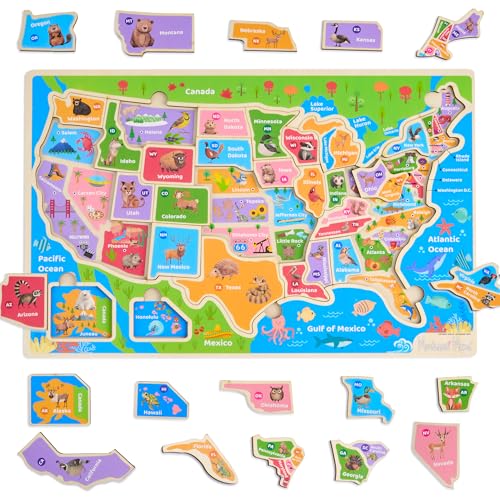
The Montessori Mama World Map Wooden Puzzle brings a completely different material to the table. While every other puzzle in this roundup uses cardboard, chipboard, or foam, this one is made entirely from wood. The result is a puzzle that feels substantial, lasts for years, and aligns with the Montessori philosophy of using natural materials in children’s learning environments.
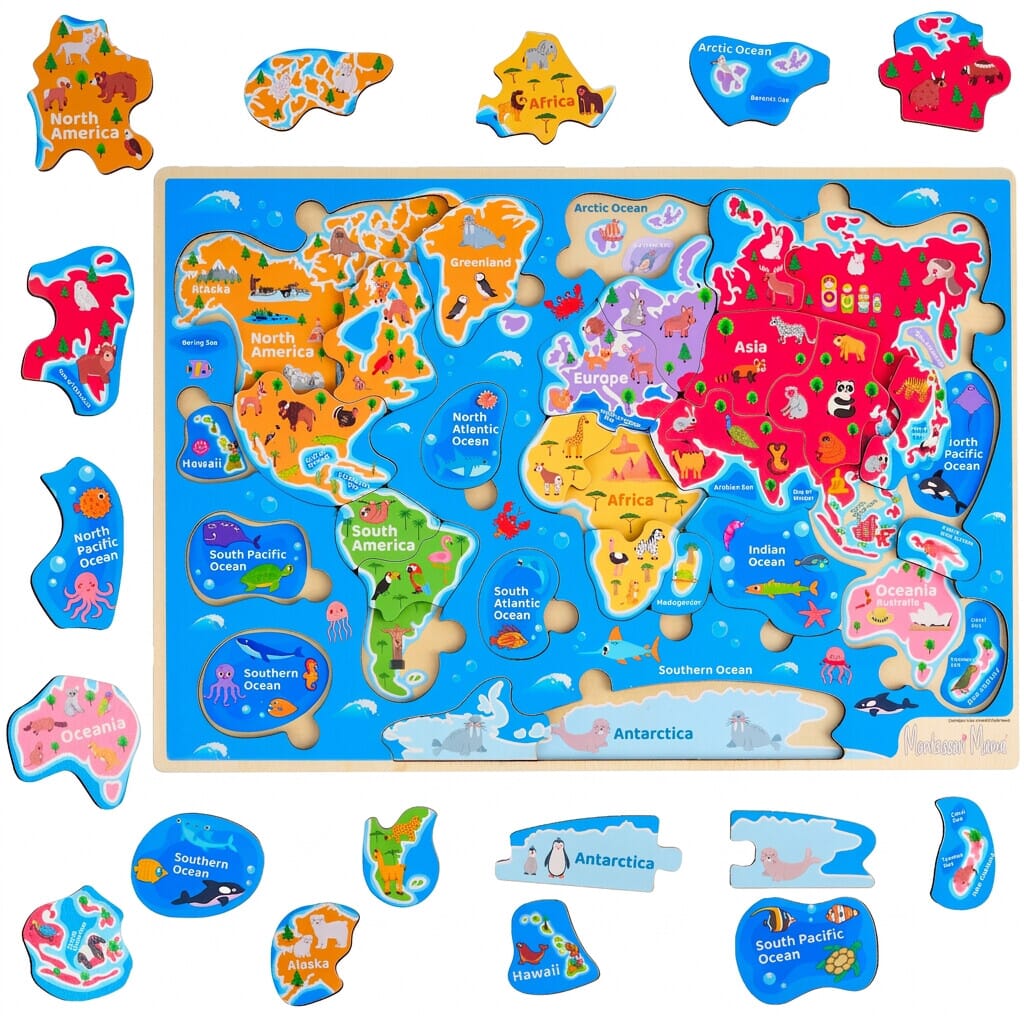
Each wooden piece represents a continent or ocean, and the board underneath features illustrations of landmarks, animals, and marine life from around the world. The Montessori approach means the focus is on sensory learning: the weight and texture of the wooden pieces create a tactile experience that reinforces the geographic concepts being taught.
With a 4.6-star rating and nearly 350 reviews, this is a newer entry that is quickly gaining traction. The 14.8 x 10 inch size is compact and perfect for a desk, shelf, or Montessori-style low table. The wooden construction also means it survives drops, rough handling, and the general chaos of toddler play far better than any cardboard alternative.
Pros
- Durable wooden construction outlasts cardboard puzzles
- Aligns with Montessori learning philosophy
- Beautiful illustrations of landmarks and animals
- Compact size fits on desks and shelves
Cons
- Fewer pieces and less geographic detail than cardboard puzzles
- Smaller assembled size limits wall display potential
How to Choose the Right World Map Puzzle
With so many options available, narrowing down the right world map puzzle comes down to a few key factors. Here is what to consider before buying.
Age and Piece Count
This is the single most important factor. A puzzle that is too hard leads to frustration; one that is too easy gets abandoned after one session. As a general guide: 24-33 pieces for ages 3-4, 48-75 pieces for ages 4-6, 100 pieces for ages 5-7, and 200 pieces for ages 8 and up. Some children develop puzzle skills faster than others, so use these as starting points rather than rigid rules.
Material and Durability
Cardboard puzzles are the most common and affordable, but quality varies enormously. Look for pieces that are at least 2mm thick – anything thinner bends and creases quickly. Wooden puzzles like the Montessori Mama option are the most durable but typically have fewer pieces. Foam puzzles (like the Imagimake Mapology) offer a middle ground: lightweight, safe for younger kids, and resistant to bending.
Educational Value
Some puzzles simply show a map, while others actively teach geography. Country-shaped pieces (GeoToys, Imagimake) teach the physical shapes and locations of nations. Puzzles with labeled landmarks, flags, and capitals (Mideer, Imagimake) add layers of information. Consider what you want your child to learn: basic continent awareness, country locations, or cultural geography. Puzzles with included glossaries or reference materials (eeBoo) extend the learning beyond assembly time.
Size and Storage
Floor puzzles (Melissa & Doug, Jumbo Floor Puzzle) can span 2-3 feet and require dedicated floor space. Table puzzles (Ravensburger, eeBoo) are more compact but still need a clear surface. Wooden board puzzles (Montessori Mama) are the most space-efficient since they store flat on a shelf. Think about where the puzzle will be assembled and stored before buying.
Frequently Asked Questions
What age is appropriate for a world map puzzle?
Most world map puzzles are designed for children aged 3 and up. For ages 3-4, look for puzzles with 24-33 large pieces. Children aged 5-7 can handle 48-100 pieces, while kids 8 and older are ready for 200-piece puzzles. The key is matching the piece count to your child’s current ability level and working up from there.
Are world map puzzles educational?
Yes. Beyond basic geography (continents, countries, oceans), world map puzzles develop spatial reasoning, problem-solving skills, fine motor coordination, and pattern recognition. Puzzles with country-shaped pieces, flags, or landmarks add additional layers of geographic and cultural knowledge. Research consistently shows that hands-on spatial activities like puzzles build skills that transfer to math and science learning.
What is the difference between a floor puzzle and a regular jigsaw puzzle?
Floor puzzles have larger, thicker pieces designed to be assembled on the floor rather than a table. They typically have fewer pieces (24-48) and assemble to a larger size (2-3 feet). Regular jigsaw puzzles have smaller, thinner pieces, higher piece counts (100-200+), and assemble to a smaller overall size. Floor puzzles are generally better for younger children, while jigsaw puzzles suit ages 5 and up.
How do I preserve a completed world map puzzle?
To display a finished puzzle, use puzzle glue (also called puzzle saver) to coat the surface, then mount it on foam board or frame it. Alternatively, some families use clear contact paper on both sides. For puzzles that will be reassembled, store pieces in the original box or a zip-lock bag to prevent loss. Wooden puzzles can be left assembled on a shelf as a display piece.
Which world map puzzle is best for a classroom?
For classroom use, prioritize durability, ease of cleanup, and group-friendly sizing. The Jumbo Floor Puzzle (48 pieces, large size) works well for younger classrooms where multiple students can collaborate. The Imagimake Mapology is better for older students since the country-shaped pieces double as a geography quiz tool.
Conclusion
The best world map puzzle depends on the child’s age, interests, and how deep you want the geography lesson to go. For most families, the Momo & Nashi World Map Puzzle offers the best combination of quality, educational value, and price at under $17 with nearly 4,000 positive ratings.
For younger children (ages 3-5), start with the Petit Collage Our World Floor Puzzle or the Melissa & Doug World Map Floor Puzzle, both of which feature large pieces designed for small hands. The Montessori Mama Wooden Puzzle is another strong choice for this age group, especially for Montessori households.
Kids aged 5-8 have the widest selection. The Mideer World Map Puzzle stands out for its beautiful illustrations, while the Imagimake Mapology delivers the most interactive learning experience with country-shaped pieces, flags, and capitals. The eeBoo World Map Puzzle is the right pick for eco-conscious families, and the GeoToys GeoPuzzle teaches country shapes in a way no standard jigsaw can match.
For older kids ready for a serious challenge, the Ravensburger The World 200 Piece Puzzle offers premium quality and genuine difficulty. And for group play or classroom settings, the Jumbo Floor Puzzle provides the largest assembled size with the highest rating in this roundup.
Pair any of these puzzles with a globe for kids for a more complete geography learning setup, or add a geography board game for competitive learning once puzzle time is over. For wall decor that reinforces map knowledge daily, check our picks for the best world map wall art.


Last update on 2026-10-22 / Affiliate links / Images from Amazon Product Advertising API