Key Takeaways
- 2025 was the deadliest year on record for the press. CPJ counted <strong>129 journalists and media workers killed</strong> in 2025, the highest total since records began in 1992, and the second consecutive record year. Israel was responsible for roughly two-thirds of those deaths.
- Mexico tops the decade map. UNESCO's Observatory records <strong>121 journalists killed in Mexico</strong> between January 2016 and October 2026, ahead of Palestine (86), Afghanistan (61) and Pakistan (46).
- 85% of killings go unpunished. Of all UNESCO-recorded killings from 2006 to 2024, only about <strong>1 in 7 cases has been judicially resolved</strong>. In Syria, Palestine, India, Yemen and Ukraine the recorded impunity rate is 100%.
- The UN marks impunity on 2 November. The <strong>International Day to End Impunity for Crimes against Journalists</strong> exists precisely because prosecuting the killers remains the exception, not the rule.
On 2 November, UNESCO marks the International Day to End Impunity for Crimes against Journalists. This year the date lands with unusual weight.
The Committee to Protect Journalists (CPJ) recorded 129 journalists and media workers killed in 2025, the deadliest year since its records began in 1992, and the second record-breaking year in a row. Roughly two-thirds of those deaths were caused by Israel, almost all of them Palestinian journalists killed in Gaza.
But the body count is only half the story. The other half is what happens afterwards: in 85% of journalist killings worldwide, nobody is ever held to account, according to UNESCO. We mapped both layers, country by country.
A Decade of Journalist Killings, Mapped
The map below shows every killing of a journalist or media worker recorded by the UNESCO Observatory of Killed Journalists between January 2016 and October 2026: 830 deaths across 74 countries.
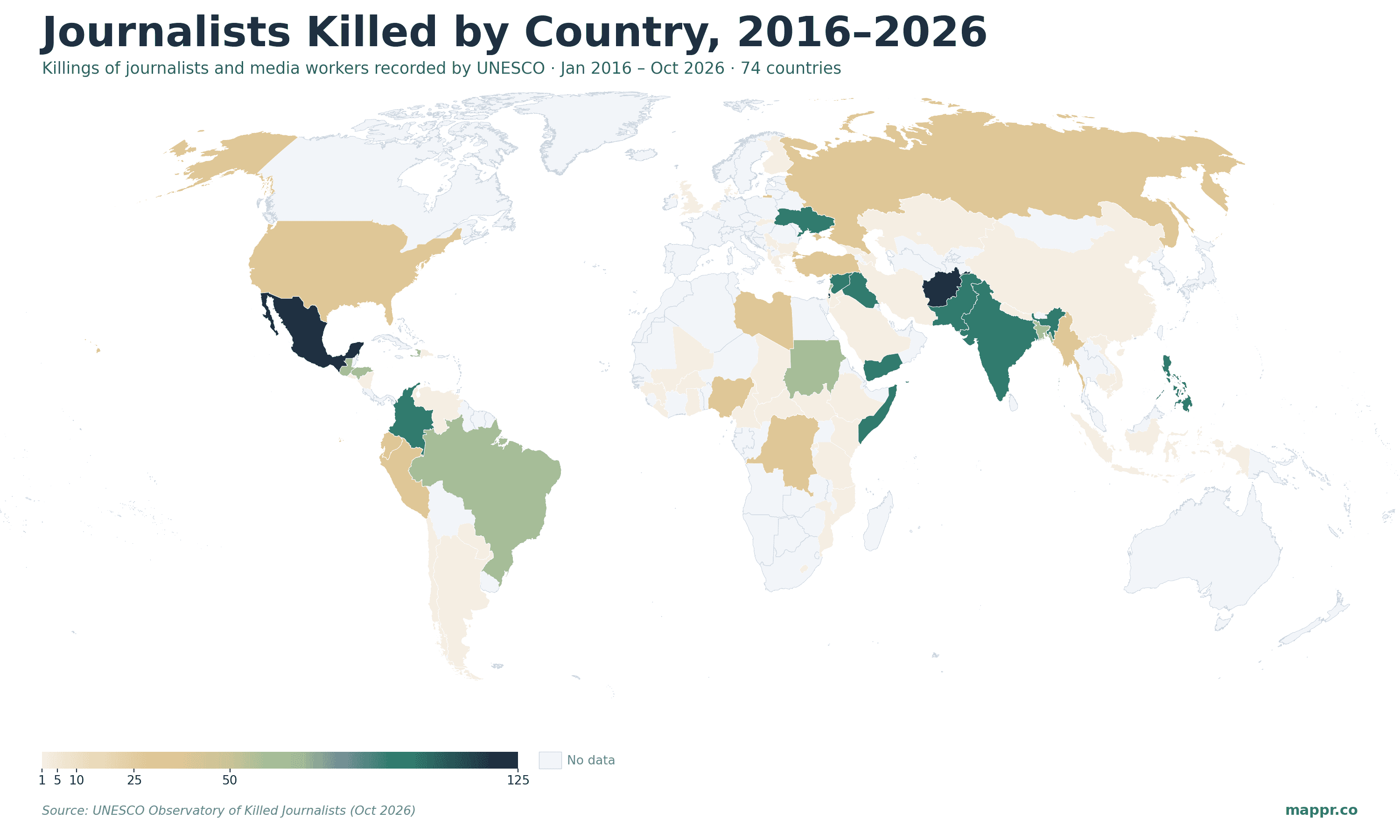
Two things stand out. First, the deadliest places for the press are no longer only war zones: Mexico, a country at peace, leads the decade with 121 killings. Second, the danger is overwhelmingly local. 94% of the journalists killed since 2016 were covering their own country, not parachuting in from abroad.
The Deadliest Countries for Journalists
The table pairs each country’s decade death toll with its impunity rate: the share of UNESCO-recorded cases from 2006–2024 that remain judicially unresolved as of October 2026.
UNESCO Observatory · Oct 2026
Journalists Killed and Impunity, by Country
Killings recorded by UNESCO, Jan 2016 – Oct 2026 · impunity = % of 2006–2024 cases still unresolved
| Country | Killed 2016–2026 | Impunity rate |
|---|---|---|
| Mexico | 121 | 84% |
| Palestine | 86 | 100% |
| Afghanistan | 61 | 86% |
| Pakistan | 46 | 98% |
| Syria | 43 | 100% |
| Yemen | 38 | 100% |
| India | 36 | 100% |
| Philippines | 30 | 84% |
| Ukraine | 28 | 100% |
| Somalia | 27 | 73% |
| Iraq | 26 | 99% |
| Colombia | 25 | 82% |
| Guatemala | 23 | 79% |
| Brazil | 19 | 68% |
| Bangladesh | 18 | 88% |
The Impunity Map: Where Killers Walk Free
Killing the messenger is bad enough. The second map shows the killer statistic: in most of the world, murdering a journalist carries effectively no legal consequence.
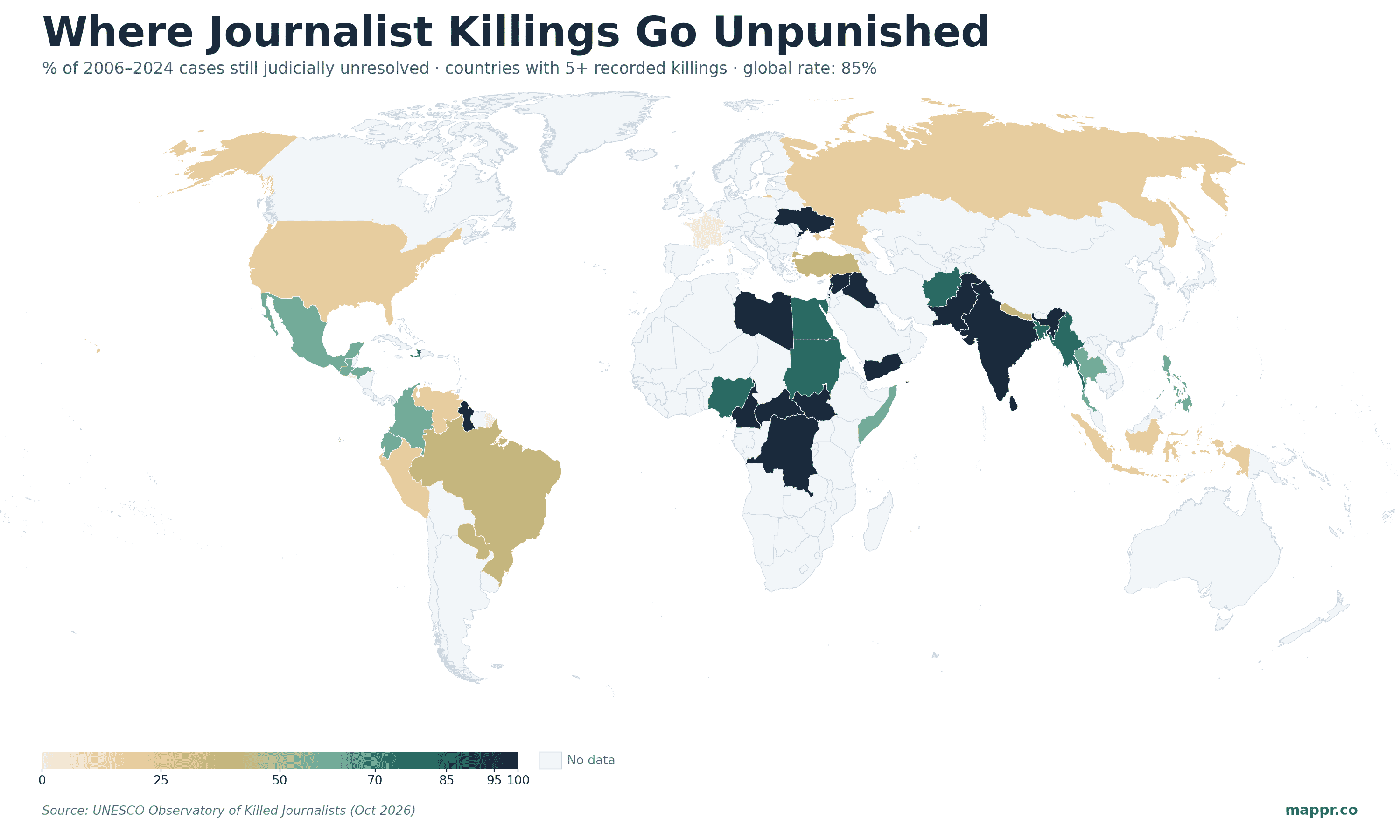
Globally, 85% of cases since 2006 remain judicially unresolved. A whole group of countries sits at a recorded 100%: Syria, Palestine, India, Yemen, Ukraine, Libya, Lebanon and the Democratic Republic of the Congo have not resolved a single recorded case from that period.
The outliers are telling. Russia shows a 25% impunity rate, one of the lowest among high-casualty countries, though convictions there have often reached triggermen rather than masterminds. France sits at 0%, largely because the Charlie Hebdo attackers were prosecuted. And Somalia (73%) and Brazil (68%) prove that even difficult jurisdictions can convict when there is political will.
Country by Country: Where It’s Worst
🇵🇸 Palestine
No place on Earth is currently deadlier for the press. UNESCO has recorded 86 journalists killed in Palestine since 2016, 82 of them since 7 October 2023. CPJ’s broader casualty count for the Gaza war puts the toll at more than 260 journalists and media workers killed across Gaza, the wider region and the conflicts it ignited.
The recorded impunity rate is 100%. Not one UNESCO-recorded killing of a journalist in Palestine has been judicially resolved.
🇲🇽 Mexico
Mexico is the decade’s grim champion among countries not at war: 121 journalists killed since 2016, overwhelmingly local reporters covering crime, corruption and politics in their own states. Cartel violence and collusion between criminal groups and local officials make the motive hard to separate from the institution meant to investigate it.
Mexico’s impunity rate of 84% actually beats the global average slightly, thanks to a dedicated federal prosecutor’s office for crimes against journalists. It is nowhere near enough: Mexico also leads the 2026 count with 8 killings so far.
🇦🇫 Afghanistan
61 journalists killed since 2016, most during the war years and the Taliban takeover. Since 2021 the killings have slowed, replaced by detentions, bans and exile. The impunity rate stands at 86%, and with the current authorities in charge, the unresolved cases are likely to stay that way.
🇵🇰 Pakistan
Pakistan records 46 killings since 2016 and one of the world’s worst impunity rates at 98%: just 2 of 96 recorded cases from 2006–2024 have been resolved. Journalists covering the military, intelligence services or Baloch and tribal-area politics face the greatest risk.
🇺🇦 Ukraine
28 journalists killed since 2016, the large majority after Russia’s full-scale invasion in February 2022. Many died while reporting from the front line or in missile and drone strikes. The recorded impunity rate is 100%, a reminder that wartime cases, where the perpetrator is a foreign military, are structurally almost impossible to prosecute.
🇮🇶 Iraq
Iraq’s decade count (26) understates its position: over the full 2006–2024 window it is the single largest caseload in the UNESCO database, 170 recorded killings, dating back to the sectarian war and the ISIS years. Two cases have been resolved. That is a 99% impunity rate on the largest body of cases anywhere.
🇨🇴 Colombia
Colombia shows the Latin American pattern in miniature: 25 killings since 2016, concentrated on local radio and community journalists in regions where armed groups fight over coca routes. Its impunity rate of 82% reflects decades of pressure from Colombian press-freedom groups, which have pushed landmark cases through the courts.
🇸🇩 Sudan
The civil war that erupted in 2023 has made Sudan one of the fastest-deteriorating countries on the map: 15 killings since 2016, most of them since the fighting began, with a 90% impunity rate. With the state itself at war, there is no functioning avenue for justice at all.
2025 Broke the Record. 2026 Is Not Letting Up.
The yearly trend line is moving the wrong way. UNESCO’s own count rose from 55 killings in 2021 to 88 in 2022, 85 in 2024 and 96 in 2025. CPJ, which also counts media support workers and applies different verification criteria, put 2025 at 129 dead, the worst year it has ever documented.
2026 is already running hot. By late October, UNESCO had recorded 30 killings, led by Mexico (8) and Lebanon (6), with Gaza, Haiti and Guatemala close behind. Verification lags mean that number will rise as cases are confirmed.
A note on methodology: UNESCO counts killings it has formally condemned after verification; CPJ counts journalists and media workers whose deaths are confirmed as work-related, including a broader set of Gaza casualties. Both point the same direction.
Why Impunity Is the Real Story
A killing silences one journalist. An unpunished killing silences the newsroom that survives them: colleagues self-censor, beats go uncovered, sources dry up. That is why UNESCO built an entire UN day around impunity rather than the killings themselves.
The data shows the problem is not unsolvable. Where institutions pursue cases, in Brazil, Somalia, Colombia, even Mexico’s federal prosecutor, impunity rates fall measurably below the global average. Where they don’t, the map stays dark. On 2 November, that gap between 85% and zero is the whole argument.
Sources: