
How Much is Gasoline in Europe Today?
Compare gasoline prices across the European Union with this table, sorted by price and converted to US dollars per gallon for easy comparison with American fuel costs.
📅 Last updated: November 05, 2026 · Data from: November 02, 2026 · Source: European Commission Oil Bulletin. Updated every Thursday.
| Country | €/Liter | €/Gallon | $/Gallon |
|---|---|---|---|
| Denmark | €2.50 | €9.46 | $10.66 |
| Netherlands | €2.28 | €8.63 | $9.72 |
| Finland | €2.21 | €8.37 | $9.43 |
| France | €2.16 | €8.18 | $9.21 |
| Germany | €2.13 | €8.06 | $9.08 |
| Greece | €2.12 | €8.03 | $9.04 |
| Portugal | €2.01 | €7.61 | $8.57 |
| Italy | €2.00 | €7.57 | $8.53 |
| Ireland | €1.97 | €7.46 | $8.40 |
| Belgium | €1.91 | €7.23 | $8.15 |
| Romania | €1.88 | €7.12 | $8.02 |
| Latvia | €1.87 | €7.08 | $7.98 |
| Lithuania | €1.87 | €7.08 | $7.98 |
| Estonia | €1.86 | €7.04 | $7.93 |
| Slovakia | €1.78 | €6.74 | $7.59 |
| Czechia | €1.77 | €6.70 | $7.55 |
| Luxembourg | €1.76 | €6.66 | $7.51 |
| Austria | €1.75 | €6.62 | $7.46 |
| Croatia | €1.75 | €6.62 | $7.46 |
| Hungary | €1.75 | €6.62 | $7.46 |
| Spain | €1.73 | €6.55 | $7.38 |
| Cyprus | €1.72 | €6.51 | $7.34 |
| Slovenia | €1.68 | €6.36 | $7.17 |
| Bulgaria | €1.60 | €6.06 | $6.82 |
| Sweden | €1.55 | €5.87 | $6.61 |
| Poland | €1.46 | €5.53 | $6.23 |
| Malta | €1.34 | €5.07 | $5.72 |
Liter prices from the European Commission Oil Bulletin (EUR). Gallon = 3.785 L. USD column applies today’s ECB EUR→USD reference rate of 1.1267.
Euro-Super 95 (Gasoline/Fuel) prices in the 27 EU Countries. Source: European Commission.
Fuel Prices in Europe Maps
Static Map: Gasoline Prices in the EU

Europe’s fuel map traces a familiar economic fault line: the richer, more heavily taxed north pays, while the Mediterranean and east discount. Denmark anchors the top at €2.50 per litre ($10.66/gal), with the Netherlands, Finland, France and Germany clustered just below the $9/gal mark. Follow the price gradient south and east and the picture softens — Poland sits at €1.46/L ($6.23/gal), Malta at just €1.34/L ($5.72/gal). The spread between extremes is wide enough to shape cross-border driving habits, and the pressure feeding the whole curve this autumn is global: Brent has traded around $90 a barrel after the October disruption at the Strait of Hormuz, with Europe absorbing most of the mark-up at the pump.
- Nordic premium: Denmark ($10.66/gal) and Finland ($9.43/gal) illustrate how high excise duties and VAT amplify every move in the crude benchmark.
- Core west: France, Germany and the Netherlands sit within fifty cents of one another per gallon — a tightly correlated bloc of large consumers.
- Eastern discount: Poland and Malta remain the EU’s cheapest pumps, trailing the bloc average by more than $1.70/gal.
Interactive Map: Gasoline Prices in the EU
Click on any EU country on the map below to view gasoline prices per liter (EUR) and per gallon (USD):
Within the single market, drivers pay strikingly different prices for essentially the same molecule. The EU simple average is €1.87 per litre, or $7.96 per gallon at today’s ECB rate of 1.1267 dollars to the euro. Malta, at €1.34/L ($5.72/gal), is the cheapest country in the bloc; Denmark, at €2.50/L ($10.66/gal), the dearest. The difference — some $4.94 per gallon — is almost entirely a story of excise duties, VAT and distribution costs rather than of the crude itself.
Above $9.00 per gallon
- Denmark — €2.50/L ($10.66/gal)
- Netherlands — €2.28/L ($9.72/gal)
- Finland — €2.21/L ($9.43/gal)
- France — €2.16/L ($9.21/gal)
- Germany — €2.13/L ($9.08/gal)
- Greece — €2.12/L ($9.04/gal)
$8.00 to $8.99 per gallon
- Portugal — €2.01/L ($8.57/gal)
- Italy — €2.00/L ($8.53/gal)
- Ireland — €1.97/L ($8.40/gal)
- Belgium — €1.91/L ($8.15/gal)
- Romania — €1.88/L ($8.02/gal)
$7.00 to $7.99 per gallon
- Latvia — €1.87/L ($7.98/gal)
- Lithuania — €1.87/L ($7.98/gal)
- Estonia — €1.86/L ($7.93/gal)
- Slovakia — €1.78/L ($7.59/gal)
- Czechia — €1.77/L ($7.55/gal)
- Luxembourg — €1.76/L ($7.51/gal)
- Austria — €1.75/L ($7.46/gal)
- Croatia — €1.75/L ($7.46/gal)
- Hungary — €1.75/L ($7.46/gal)
- Spain — €1.73/L ($7.38/gal)
- Cyprus — €1.72/L ($7.34/gal)
- Slovenia — €1.68/L ($7.17/gal)
$6.00 to $6.99 per gallon
- Bulgaria — €1.60/L ($6.82/gal)
- Sweden — €1.55/L ($6.61/gal)
- Poland — €1.46/L ($6.23/gal)
Below $6.00 per gallon
- Malta — €1.34/L ($5.72/gal)
Across the 27 member states, prices run from a low of $5.72/gal in Malta to a high of $10.66/gal in Denmark — a near-twofold gap inside a single customs union. Excise duties and VAT, which account for a large share of the European pump price, explain most of it; the rest is a matter of logistics, refining margins and currency.
EU-Average Gasoline Price Trends

The 52-week picture is one of sharp climb and uneasy plateau. The EU benchmark bottomed at €1.590 per litre on 22 December 2025 and peaked at €2.104 on 28 September 2026, a 32% swing inside nine months. Prices are up 19.07% year on year, though the last month has brought mild relief: the four-week change is -3.88% and the latest week registered -1.28%. The autumn climb coincided with the mining of the Strait of Hormuz by Iran’s Revolutionary Guard, which throttled flows through the world’s most important oil chokepoint and pushed Brent to roughly $90 a barrel. A modest OPEC+ output increase of 188,000 barrels a day from August has steadied rather than reversed the pressure, while partial outages at Italy’s Saras refinery and drone damage to Russian processing capacity have widened wholesale gasoline spreads. Excise duties and VAT, which sit on top of every litre sold, magnify each move in the underlying crude.
- Range: €1.590/L (22 Dec 2025) to €2.104/L (28 Sep 2026); current average €1.929/L.
- Momentum: -1.28% week on week, -3.88% over four weeks, +1.21% over twelve weeks, +19.07% year on year.
- Volatility: A €0.51 peak-to-trough swing in under a year, driven mostly by geopolitical supply shocks rather than demand.
Source: European Commission Oil Bulletin.
Historical Maps: 2017 and 2021
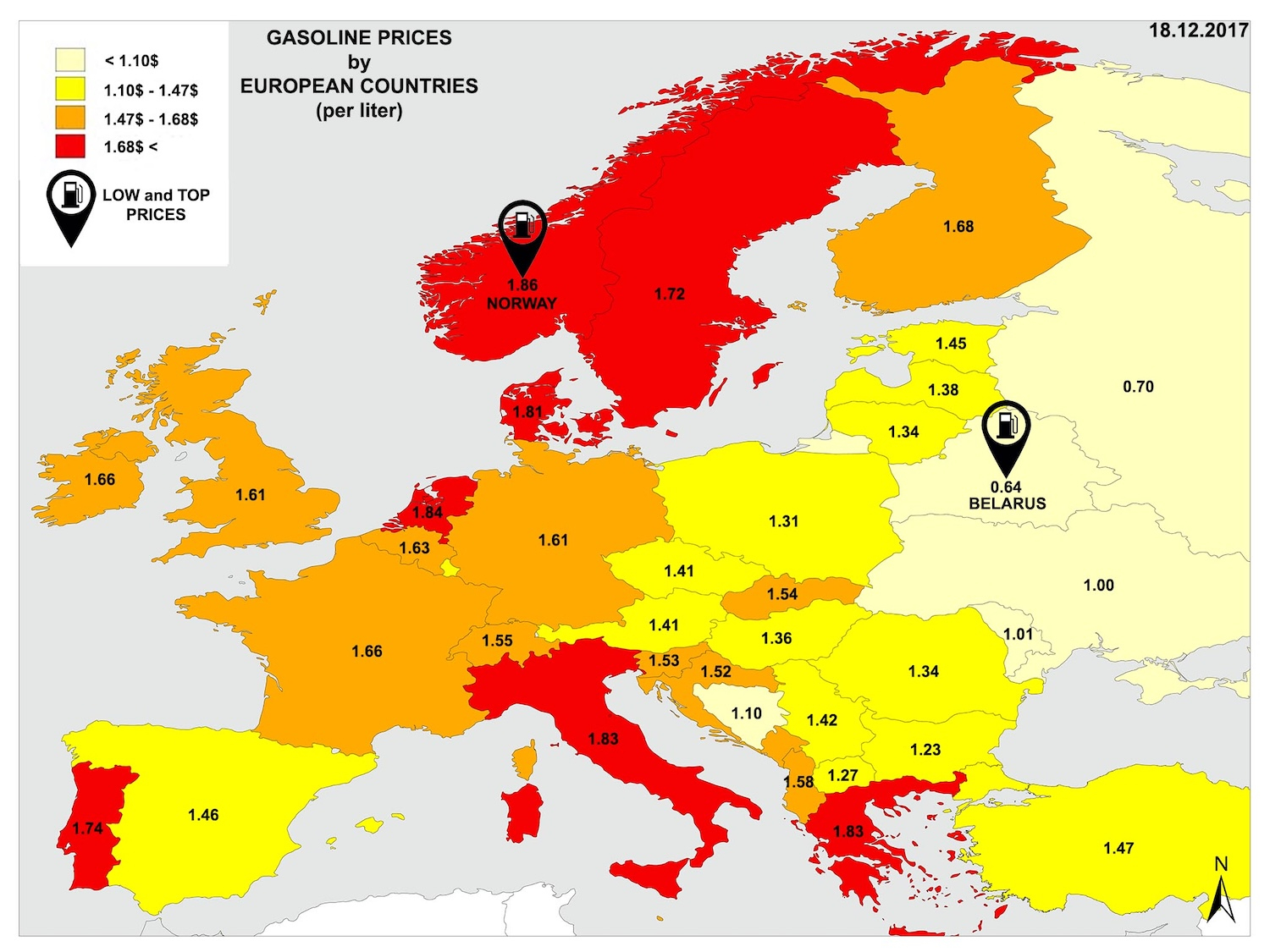
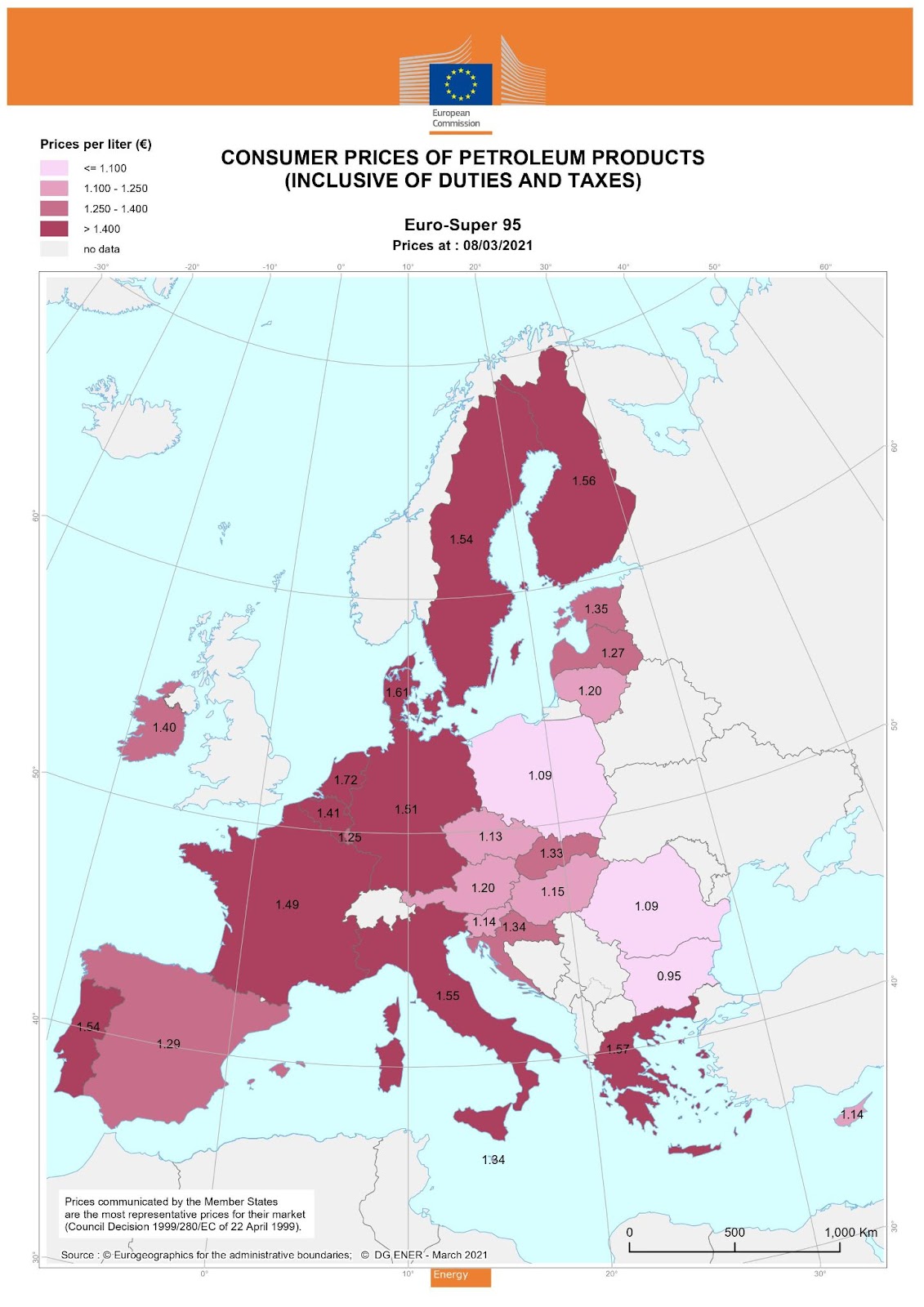
December 2017 — the pre-pandemic baseline
The 2017 map captured a Europe where the simple average gasoline price sat around $1.42 per liter ($5.38 per gallon) — less than half of where the EU-27 average stands today. The dispersion across the continent was already wide. Norway ($1.86/L) and Italy ($1.84/L) topped the table, both driven by some of the highest excise + VAT loadings in Europe. The Netherlands, Sweden and Greece filled out the rest of the expensive cluster, all over $1.65 per liter.
At the cheap end, Belarus ($0.64/L), Russia ($0.70/L) and Kazakhstan ($0.63/L) sold gasoline at a third of Norwegian prices — subsidised, oil-producing, and outside the EU’s tax-and-tariff architecture. Inside the EU, the eastern flank (Poland, Romania, Bulgaria) sat between $1.10 and $1.25, reflecting lower excise duties and lighter VAT regimes than their western neighbours.
March 2021 — after the pandemic shock
Three years later the picture shifted but the geography stayed familiar. The EU average climbed to €1.36 per liter as economies reopened and Brent crude recovered from its April 2020 trough. The Netherlands (€1.72) and Greece (€1.57) led the expensive end, with Italy, Finland and Sweden close behind. The eastern budget tier held: Bulgaria (€0.95), Poland (€1.09) and Romania (€1.11) remained the cheapest forecourts in the bloc.
By 2021 a structural pattern had become unmistakable. The north-western EU — high excise, high VAT, high household income — ran ~50% above the eastern flank. The Mediterranean middle (Spain, Portugal, Italy) sat above the eastern band but below the north, balancing higher tourist-season demand against lower disposable income.
2017 to today — what changed
Three structural forces explain the rise from the 2017 baseline:
- Excise + VAT increases. Several EU members tightened fuel taxation in the late 2010s to fund green-transition budgets. The Netherlands raised excise on petrol by ~€0.10/L between 2018 and 2024; Germany’s CO2 levy on transport fuels began in 2021 and ratcheted annually.
- The Russian-supply shock. Sanctions following the February 2022 invasion of Ukraine removed Russian crude and refined-product imports from western European refining baselines, forcing a re-routing through Middle Eastern and US Gulf Coast suppliers at higher delivered cost.
- EUR weakness against the dollar. Oil is priced in USD; a weaker euro means more euros per barrel even when the dollar price stays flat. The EUR/USD rate has spent most of 2022–2026 in a range that adds 8–15 % to euro-denominated pump prices versus the 2017–2019 baseline.
The eastern–western spread has actually widened since 2017. Where Norway used to be roughly 3× the price of Belarus, the modern Netherlands-to-Malta spread runs about $4.50/gallon — a wider absolute gap, narrower in percentage terms, but more visible to an American comparing US prices to Europe.


