Key Takeaways
- The worst West Nile season in 22 years. The 2026 US West Nile virus season is running at levels not seen since the record 2003 outbreak, tracking at roughly five times the usual pace for this point in the summer.
- 181 cases across 29 states, and climbing. As of 11 August, the CDC had logged 181 human cases in 29 jurisdictions, with 11 deaths. A week earlier the count was far lower, and the case count is rising every week.
- Arizona is the epicenter. Arizona alone has 73 cases, more than a third of the national total, concentrated in Maricopa County (metro Phoenix), which has recorded most of the season's deaths.
- Most cases are the severe form. About 71% of this year's cases are neuroinvasive, the dangerous form that attacks the brain and spinal cord and can cause meningitis, encephalitis and lasting damage.
- The peak is still ahead. West Nile transmission usually peaks in late August and September, so the worst weeks of the 2026 season have probably not arrived yet.
The United States is having its worst West Nile virus season in more than two decades. The mosquito-borne virus, which most summers causes a scatter of cases across the country, is spreading unusually fast in 2026, and the weeks it hits hardest have not even arrived yet. The map below shows where it has struck so far.
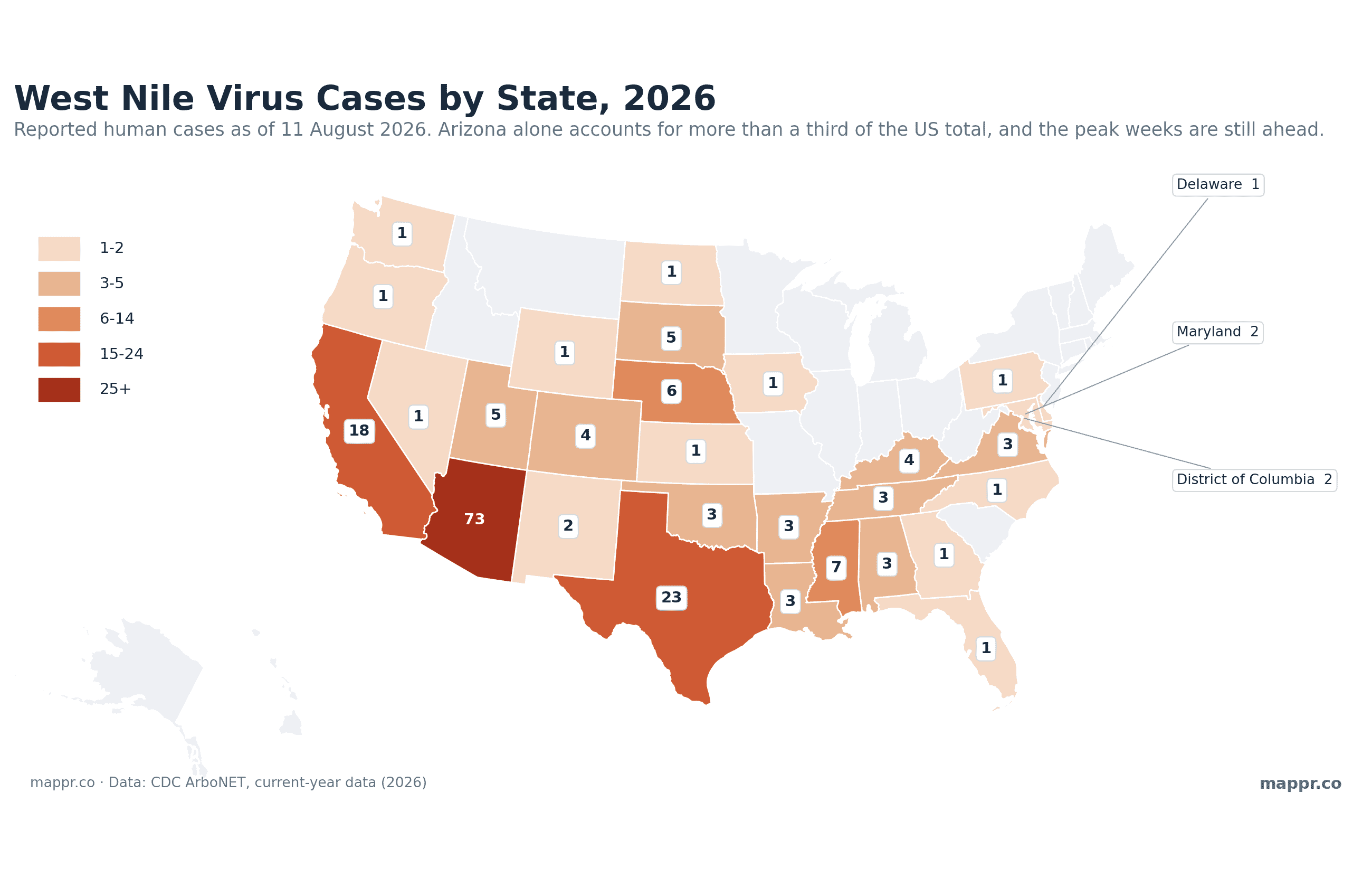
Cases have turned up in 29 states and jurisdictions, but the outbreak is heavily lopsided. One state stands apart from all the others.
Arizona is the epicenter
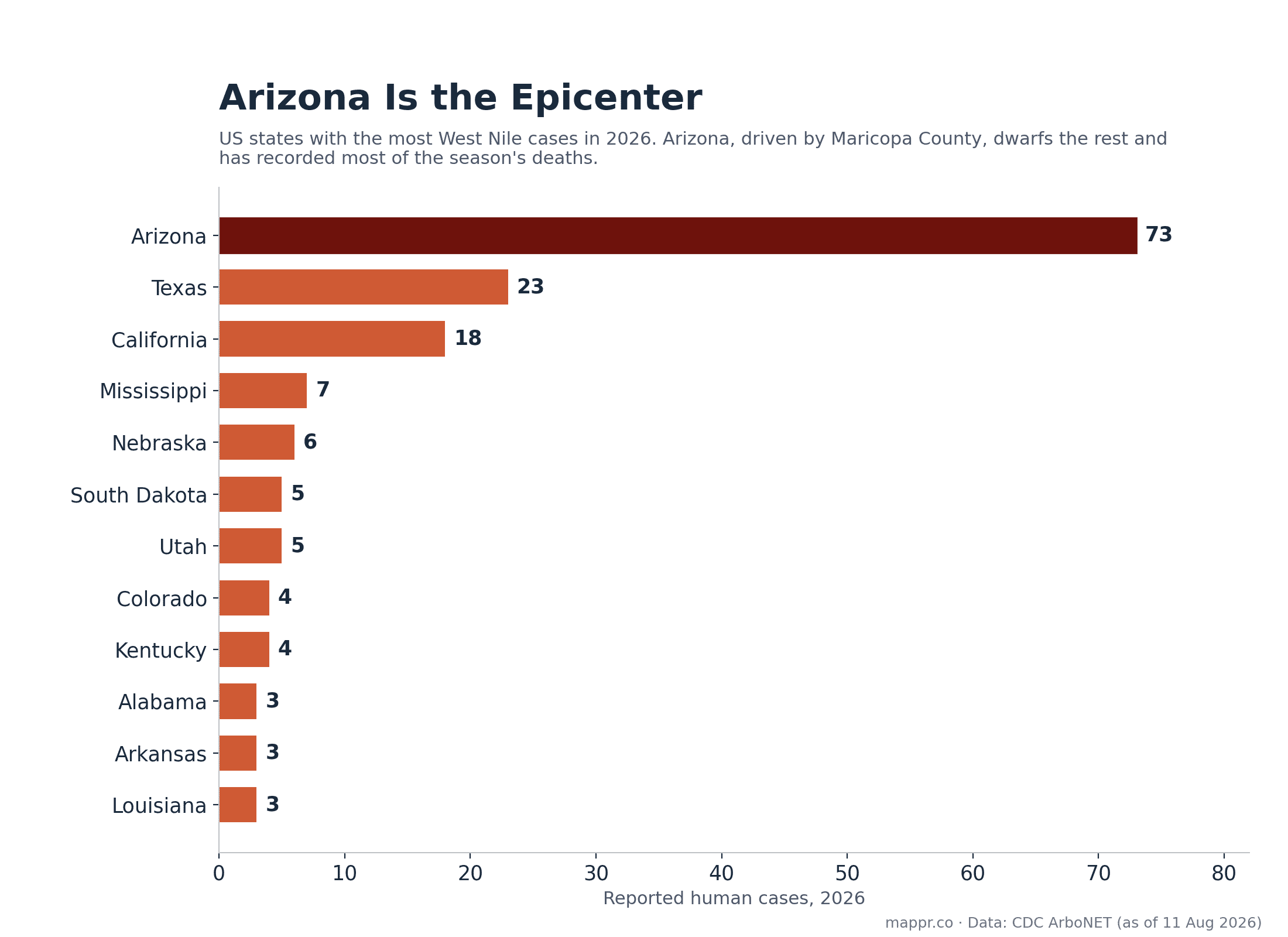
Arizona has recorded 73 cases on its own, more than a third of the entire national total and more than the next two states combined. Almost all of it is in Maricopa County, the sprawling desert metro around Phoenix, which has also seen most of the season’s deaths. Texas (23) and California (18) follow, with the rest of the country reporting only a handful of cases each so far.
Why 2026 is different
Two things make this season alarming. The first is pace: the CDC says 2026 is running at about five times the usual number of cases for mid-August, on a curve resembling 2003, the biggest West Nile outbreak the country has ever seen.
The second is severity. Roughly 71% of this year’s cases are neuroinvasive, the serious form in which the virus reaches the brain and spinal cord, causing meningitis or encephalitis. That share is unusually high, and neuroinvasive West Nile can be fatal or leave survivors with lasting neurological damage. There is no vaccine and no specific treatment for people; care is supportive only.
The peak is still ahead
Perhaps the most sobering part is the calendar. West Nile is carried by Culex mosquitoes whose numbers, and the virus they carry, typically peak in late August and September. That means the 2026 season, already the worst in 22 years by this measure, has probably not yet reached its most dangerous stretch.
The advice from health officials is simple and unchanged: use an EPA-registered insect repellent, wear long sleeves around dawn and dusk when Culex mosquitoes are most active, and drain any standing water where they breed. With World Mosquito Day falling on 20 August, it is a timely reminder that the deadliest animal to humans is still the mosquito. For other outbreaks we are tracking, see our maps of the US measles outbreak and global dengue.