
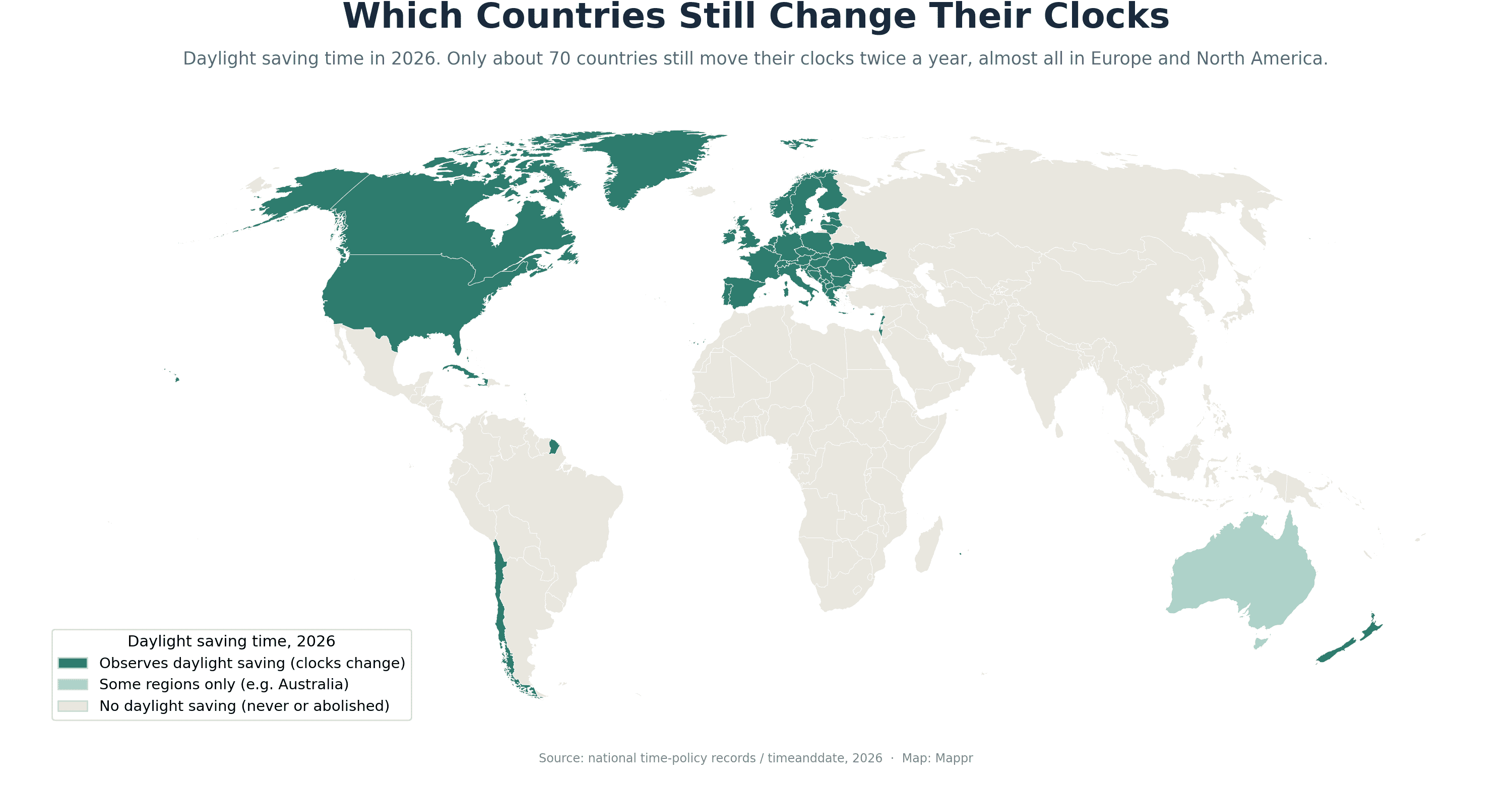
Twice a year, hundreds of millions of people dutifully move their clocks forward or back, then spend a week feeling slightly off. But that ritual is far less universal than it feels. On 15 July 2026, the US House of Representatives voted 308 to 117 to pass the Sunshine Protection Act, a bill to end the twice-yearly clock change and make daylight saving time permanent. If it clears the Senate, the United States would join a long and growing list of countries walking away from the switch. The map shows just how much of the world already has.
Key Takeaways
- Most of the world does not change its clocks. Only about 70 of the world's roughly 195 countries still observe daylight saving time in 2026, and they are concentrated almost entirely in Europe and North America. Most of Africa, Asia and the Middle East never adopted it.
- The US just voted to stop the clock change. On 15 July 2026 the US House of Representatives passed the Sunshine Protection Act by 308 to 117, a bill to make daylight saving time permanent nationwide (with states able to opt out). It now goes to the Senate.
- A steady global retreat. The clear trend is away from switching clocks. Russia stopped in 2014, Brazil in 2019, and Mexico and Iran both abolished it in 2022. Paraguay made summer time permanent in 2024.
- Permanent summer or permanent winter? There are two ways to stop changing clocks. The US bill locks the country into permanent daylight saving (lighter evenings, darker winter mornings). Most sleep scientists argue the opposite, that permanent standard time is healthier.
- Even the EU has stalled. The European Union voted in 2019 to scrap the twice-yearly change, but member states never agreed on which time to keep, and the switch is still happening.
Most of the world never changes its clocks
Daylight saving time can feel like a fact of life, but only around 70 countries practise it, and they cluster in two regions: Europe (almost every country except Iceland, Russia and Belarus) and North America (the United States and Canada, with local exceptions like Arizona, Hawaii and most of Saskatchewan). Beyond them, the list thins out fast: Chile is the only continental South American country still switching, New Zealand and parts of Australia do it in the southern hemisphere summer, and a few Middle Eastern countries such as Israel and Lebanon keep it. Almost all of Africa, Asia and the Middle East never adopted the practice at all. Countries near the equator have little reason to: their daylight barely changes across the year.
The great retreat
The trend is unmistakably away from the clock change. Russia abolished it in 2014, settling on permanent standard time. Turkey went the other way in 2016, staying on permanent summer time. Brazil, once a big daylight-saving country, dropped it in 2019. In 2022, Mexico and Iran both scrapped it, and Paraguay made summer time permanent in 2024. Even the European Union voted in 2019 to abolish the switch, only to stall: member states could not agree on whether to keep permanent summer or winter time, so the clocks still change twice a year across the bloc.
What the United States just voted for
The Sunshine Protection Act would make daylight saving time permanent across the US, ending the spring-forward and fall-back ritual, while letting individual states opt out and stay on standard time. Roughly 20 states have already passed laws to adopt permanent daylight saving if Washington gives them the green light. President Trump has publicly backed the bill. There is a catch, though: the Senate unanimously passed a near-identical version in 2022, then never took it up in the House, and it quietly expired. This time the House has moved first, and the bill again awaits the Senate.
Permanent summer or permanent winter?
Ending the clock change sounds simple until you ask which time to keep. The US bill chooses permanent daylight saving: lighter summer-style evenings all year, but darker winter mornings, with the sun rising after 8am in many northern cities in December. Most sleep scientists disagree, arguing that permanent standard time better matches the human body clock and morning light, which is why bodies like the American Academy of Sleep Medicine favour it. The last time the US tried permanent daylight saving, in 1974, it proved so unpopular that Congress reversed it within a year. That tension, popular appeal versus health advice, is exactly why so many countries have found it easier to abolish the switch than to agree on what replaces it.
Two ways to stop changing clocks Permanent daylight saving (summer time) shifts an hour of daylight from morning to evening year-round. Permanent standard time (winter time) keeps mornings brighter. Countries that have stopped switching have split both ways: Russia chose standard time, Turkey chose summer time. The US bill picks summer. There is no option that gives everyone brighter mornings and brighter evenings, which is the whole reason the debate never ends. |
The bottom line
Daylight saving time was born in the industrial era as an energy-saving measure and spread with the two world wars. A century on, the evidence for those energy savings is thin, the health case against the disruptive switch is strong, and country after country has quietly stopped. The United States, one of daylight saving’s largest remaining strongholds, may be the next to go. Whether it ends up on permanent summer or permanent winter time, the direction of travel on the map is clear: the twice-yearly clock change is slowly running out of time.