For a few frantic years, the dockless electric scooter looked like the future of the city trip. Then the pavements filled up, the accident numbers climbed, and city halls started fighting back. In January 2026, Prague became the latest capital to ban shared e-scooters outright, ending rental operations across the entire city after years of complaints about devices strewn across its narrow, cobbled old town. It joins a fast-growing list of places that have decided the shared scooter causes more trouble than it is worth.
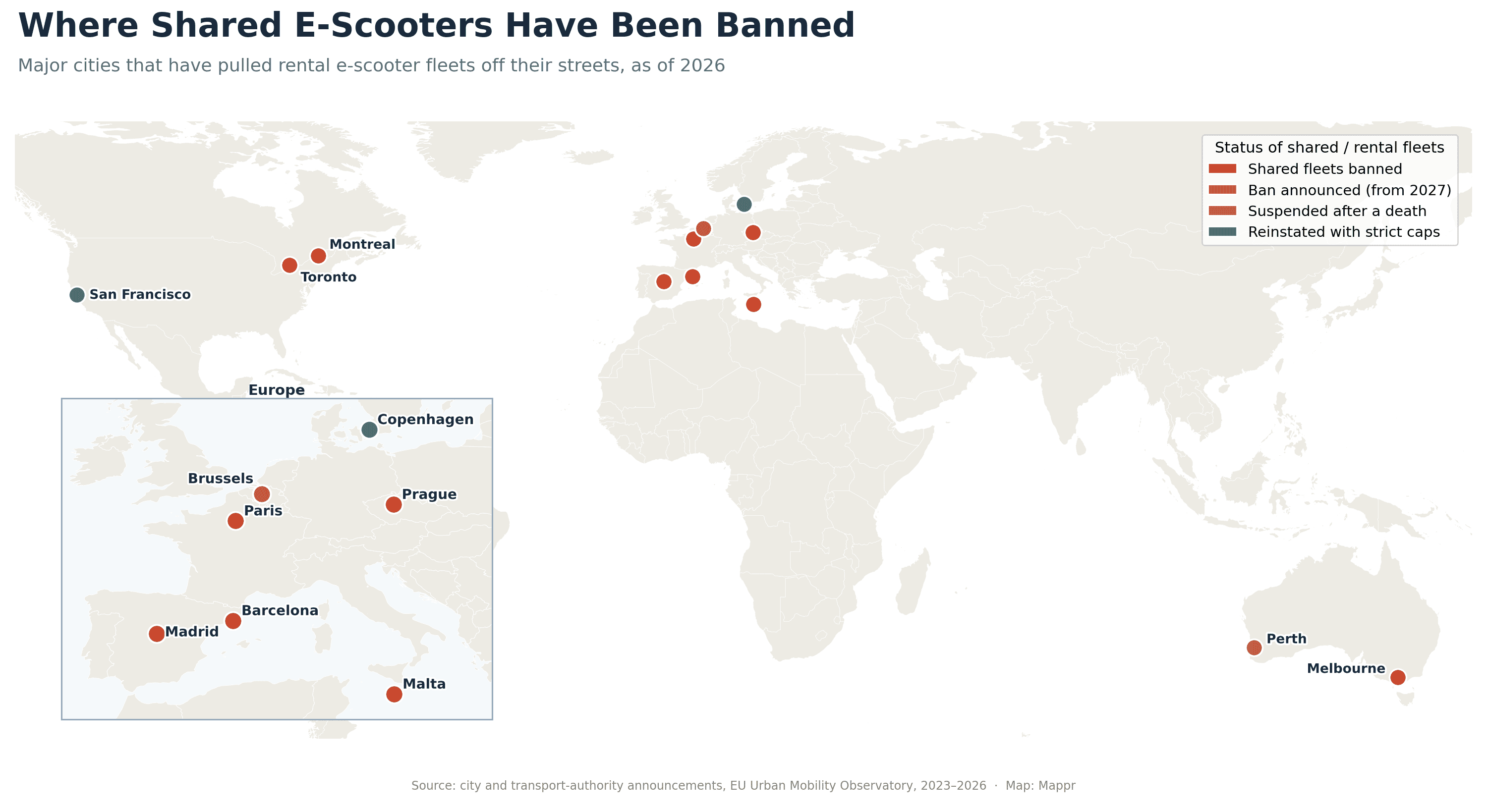
The map below tracks the cities that have banned, suspended or heavily capped shared e-scooter fleets. Note the important distinction: almost all of these rules target the rental business, the free-floating scooters you unlock with an app. Privately owned scooters usually remain legal, if increasingly hemmed in by speed limits and no-go zones.
Key Takeaways
- Prague is the newest capital to pull the plug. From January 2026, Prague bans shared e-scooters across the whole city, blaming clutter and chaos in its narrow, cobbled historic centre.
- Paris started the dominoes. In 2023 Parisians voted in a referendum to scrap rental e-scooters. Around 15,000 devices left the streets on 1 September 2023, and the ban still holds.
- It is a global backlash, not a local quirk. Bans and suspensions now stretch from Madrid, Barcelona and Malta to Montreal, Toronto and Melbourne. Same three complaints everywhere: blocked pavements, injuries and battery fires.
- Perth stopped after a death. Perth suspended its scheme indefinitely in June 2025 after a pedestrian was killed by a hired scooter, the first such death in Western Australia.
- Transit systems fear the batteries. Separately, London, Barcelona and several German cities ban riders from carrying e-scooters onto trains and buses, citing lithium-battery fire risk.
Paris knocked over the first domino
The turning point came in Paris. In April 2023 the city held a public referendum on whether to keep free-floating rental scooters. The result was crushing, roughly 89% voted to ban them, though turnout was only about 7%. Mayor Anne Hidalgo honoured the vote, the three operators (Lime, Dott and Tier) pulled their combined fleet of around 15,000 scooters, and the ban took effect on 1 September 2023. Paris was the first major European capital to reverse course so publicly, and it gave every other city hall political cover to do the same.
Europe leads the backlash
The European list has grown quickly. Madrid revoked the licences of all three of its operators in October 2024 after concluding they had failed to control parking and safety, and refused to issue new ones. Barcelona banned shared rentals back in 2023. Malta went furthest, becoming the first EU member state to ban the public hire of e-scooters nationwide in March 2024. And Brussels has now confirmed that the licences of its last operators will not be renewed, ending shared scooters from 2027, after a year in which 666 people were injured in scooter accidents and the vehicles were repeatedly linked to crime.
Not every European city has gone nuclear. Copenhagen banned shared scooters in 2020, then let them back in 2021 under strict caps, no more than 800 per operator, confined to specific districts, with mandatory parking rules. It is the template for cities that want the convenience without the chaos.
North America: quietly scooter-free
Two of Canada’s biggest cities never made peace with the shared scooter at all. Montreal banned the services in February 2020 after a single pilot season, driven off by illegal parking and riders ignoring helmet rules. Toronto has kept a firm ban in place, opting out of Ontario’s province-wide pilot entirely, so no rental fleets operate there. In the United States, San Francisco has not banned scooters but has steadily tightened the screws, capping the total fleet at 10,000 devices under a permit system.
Australia’s safety reckoning
Australia has seen the sharpest recent turn. Melbourne voted in August 2024 to ban shared e-scooters and gave operators 30 days to clear their devices from the streets. Then, in June 2025, Perth suspended its hire scheme indefinitely after a 51-year-old pedestrian was struck and killed by a hired scooter in the city centre, the first pedestrian death of its kind in Western Australia. When a convenience starts killing bystanders, the political maths changes fast.
It is not just the fleets: the battery-fire bans
There is a second, quieter crackdown that has nothing to do with clutter. Worried about lithium-battery fires in enclosed spaces, several transport networks now ban riders from carrying e-scooters at all. London prohibits private e-scooters across the entire Transport for London network. Barcelona bans them inside public-transport vehicles and stations, and German cities including Dusseldorf and Duisburg, along with the whole region of Bavaria, forbid them on buses and trains. These rules can apply even where riding a scooter on the street is perfectly legal.
The full list
| City | Status | Since | Main reason |
|---|---|---|---|
| 🇫🇷 Paris | Banned | Sep 2023 | Won by public referendum in 2023 |
| 🇨🇿 Prague | Banned | Jan 2026 | Clutter in the narrow historic centre |
| 🇪🇸 Madrid | Banned | Oct 2024 | Operators failed parking and safety rules |
| 🇪🇸 Barcelona | Banned | 2023 | Sidewalk clutter and rider safety |
| 🇲🇹 Malta | Banned | Mar 2024 | First EU country to ban public hire |
| 🇧🇪 Brussels | Ban from 2027 | Announced | 666 injuries in 2025, plus crime links |
| 🇨🇦 Montreal | Banned | Feb 2020 | Illegal parking, riders skipping helmets |
| 🇨🇦 Toronto | Banned | In force | Safety; opted out of Ontario’s pilot |
| 🇦🇺 Melbourne | Banned | Aug 2024 | Pedestrian-safety complaints |
| 🇦🇺 Perth | Suspended | Jun 2025 | First local pedestrian death |
| 🇩🇰 Copenhagen | Capped | 2021 | Banned in 2020, back with strict caps |
| 🇺🇸 San Francisco | Capped | In force | Capped at 10,000 under a permit |
Why cities keep pulling the plug
Strip away the local details and the same three grievances appear in almost every case. First, clutter: dockless scooters dumped across pavements, tram stops and building entrances, a particular menace in dense historic centres and for blind or wheelchair-using pedestrians. Second, injuries, both to riders and to the people they hit, rising fast enough to alarm hospitals and insurers. Third, fire risk from ageing lithium batteries. Shared scooters are not disappearing everywhere, plenty of cities still run tightly regulated schemes, but the era of operators flooding a city first and asking permission later is clearly over.