
Key Takeaways
- 21 World Heritage Sites. Australia now has 21 UNESCO World Heritage properties: 12 natural, 5 cultural and 4 mixed (both natural and cultural value).
- Newest: Murujuga (2025). The Murujuga Cultural Landscape in Western Australia, home to over a million ancient Aboriginal rock engravings, was inscribed in July 2025, Australia's first new site since 2019.
- Oldest: 1981. The Great Barrier Reef, Kakadu National Park and the Willandra Lakes Region were Australia's first sites, all listed in 1981.
- K'gari, not Fraser Island. The world's largest sand island reverted to its traditional Butchulla name, K'gari, which UNESCO now uses on the official list.
- From reefs to opera houses. The list spans natural icons like Uluru and the Great Barrier Reef and cultural landmarks like the Sydney Opera House and the convict-era prison settlements.
Australia is one of the most rewarded countries on the UNESCO World Heritage List. As of 2026 it has 21 World Heritage Sites, ranging from the living coral of the Great Barrier Reef to ancient Aboriginal rock art and a 19th-century opera house. The list breaks down into 12 natural sites, 5 cultural sites and 4 mixed sites that are recognised for both their natural and their cultural value.
The map below plots all 21 properties across the continent. Two of them, Heard and McDonald Islands and Macquarie Island, sit far to the south in the sub-Antarctic and are noted off the map.
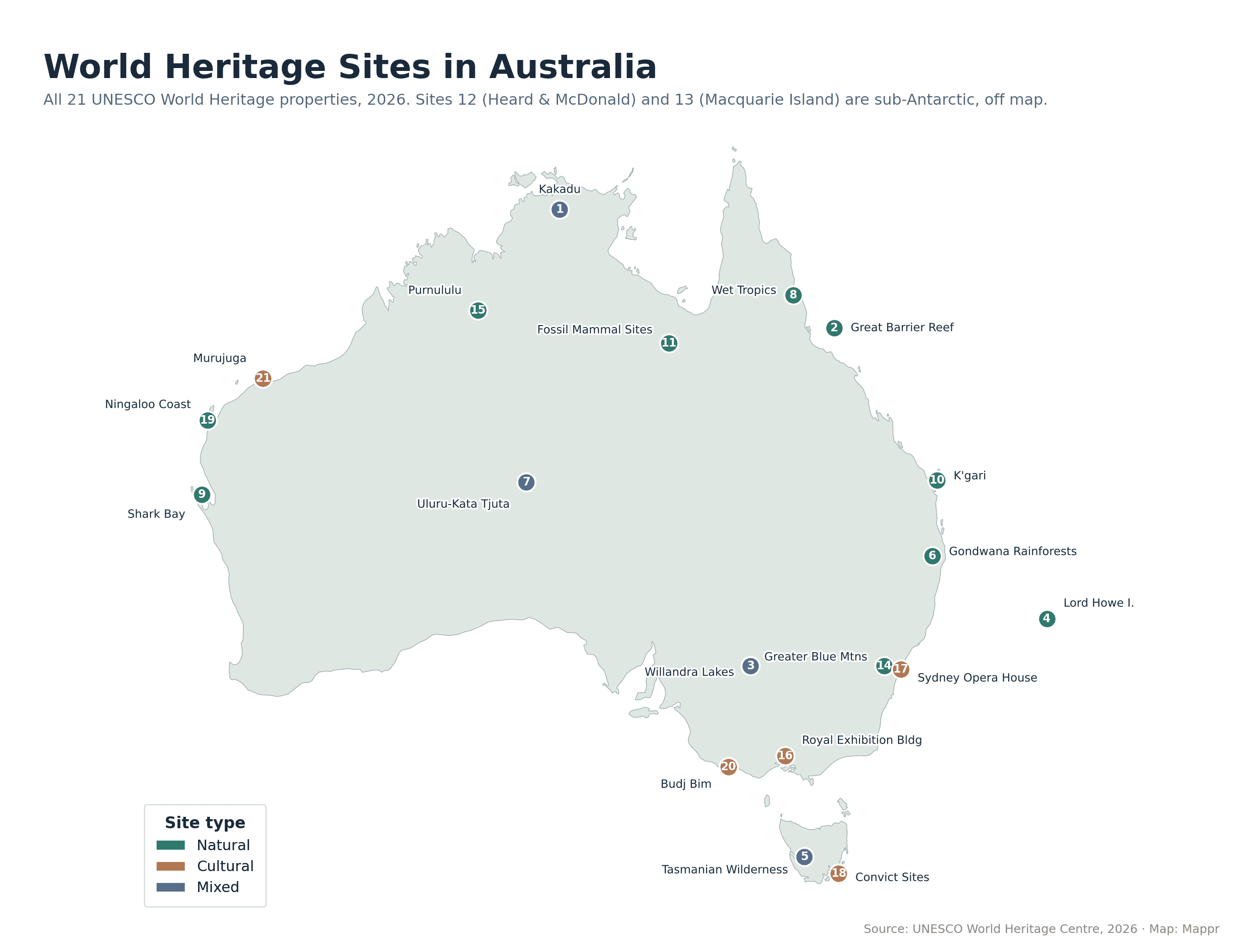
The full list of Australia’s World Heritage Sites
Here are all 21 sites in the order they were added to the list, from the first three in 1981 to the most recent in 2025.
| # | Site | State / Territory | Type | Year listed |
|---|---|---|---|---|
| 1 | Kakadu National Park | Northern Territory | Mixed | 1981 |
| 2 | Great Barrier Reef | Queensland | Natural | 1981 |
| 3 | Willandra Lakes Region | New South Wales | Mixed | 1981 |
| 4 | Lord Howe Island Group | New South Wales | Natural | 1982 |
| 5 | Tasmanian Wilderness | Tasmania | Mixed | 1982 |
| 6 | Gondwana Rainforests of Australia | NSW / Queensland | Natural | 1986 |
| 7 | Uluru-Kata Tjuta National Park | Northern Territory | Mixed | 1987 |
| 8 | Wet Tropics of Queensland | Queensland | Natural | 1988 |
| 9 | Shark Bay | Western Australia | Natural | 1991 |
| 10 | K’gari (formerly Fraser Island) | Queensland | Natural | 1992 |
| 11 | Australian Fossil Mammal Sites (Riversleigh / Naracoorte) | Queensland / South Australia | Natural | 1994 |
| 12 | Heard and McDonald Islands | External Territory | Natural | 1997 |
| 13 | Macquarie Island | Tasmania | Natural | 1997 |
| 14 | Greater Blue Mountains Area | New South Wales | Natural | 2000 |
| 15 | Purnululu National Park | Western Australia | Natural | 2003 |
| 16 | Royal Exhibition Building and Carlton Gardens | Victoria | Cultural | 2004 |
| 17 | Sydney Opera House | New South Wales | Cultural | 2007 |
| 18 | Australian Convict Sites | Multiple states | Cultural | 2010 |
| 19 | Ningaloo Coast | Western Australia | Natural | 2011 |
| 20 | Budj Bim Cultural Landscape | Victoria | Cultural | 2019 |
| 21 | Murujuga Cultural Landscape | Western Australia | Cultural | 2025 |
Australia’s natural wonders
Most of Australia’s World Heritage Sites were listed for their natural value, and several are world-famous. The Great Barrier Reef is the planet’s largest coral reef system, stretching more than 2,300 kilometres along the Queensland coast and visible from space. The Tasmanian Wilderness protects one of the last great expanses of temperate rainforest on Earth, while Shark Bay and the Ningaloo Coast in Western Australia shelter rare seagrass meadows, stromatolites and seasonal gatherings of whale sharks.
Inland, Purnululu National Park is famous for the orange-and-black striped domes of the Bungle Bungle Range, and K’gari (formerly Fraser Island) is the largest sand island in the world. The island reverted to its traditional Butchulla name, K’gari, meaning “paradise,” which UNESCO now uses on the official list.
Cultural and mixed sites
Australia’s cultural and mixed sites tell the story of both the world’s oldest living culture and its modern history. Uluru-Kata Tjuta National Park, sacred to the Anangu people, is listed as a mixed site for its towering desert monolith and its deep cultural significance. Kakadu National Park combines spectacular wetlands with rock art going back tens of thousands of years.
On the cultural side, the Sydney Opera House is one of the great architectural icons of the 20th century. The Australian Convict Sites, a group of 11 penal settlements from Sydney to Tasmania and Fremantle, record the era of British transportation. The Budj Bim Cultural Landscape in Victoria, listed in 2019, preserves one of the world’s oldest known aquaculture systems, built by the Gunditjmara people thousands of years ago.
The newest site: Murujuga (2025)
Australia’s 21st and most recent World Heritage Site is the Murujuga Cultural Landscape on the Burrup Peninsula in Western Australia, inscribed in July 2025. Murujuga holds more than a million petroglyphs, or rock engravings, some thought to be over 40,000 years old, making it one of the densest and oldest collections of rock art anywhere on the planet. Its listing was also a milestone because it was nominated and championed by Aboriginal traditional owners, who continue to care for the landscape today.
How sites make the list
UNESCO assesses each nomination against ten criteria. Sites listed under the cultural criteria (i to vi) recognise human achievement and history, while the natural criteria (vii to x) cover outstanding ecosystems, geology and biodiversity. A site that qualifies under both, like Uluru-Kata Tjuta or Kakadu, is classified as “mixed.” Australia also keeps a tentative list of eight further places that could be nominated in the years ahead, so the country’s total is likely to keep growing.
The bottom line
With 21 World Heritage Sites, Australia offers an extraordinary spread of natural and cultural treasures, from the Great Barrier Reef and Uluru to the ancient rock art of Murujuga. Together they map out both the continent’s natural diversity and the tens of thousands of years of human history written across it.
Data and references (UNESCO and Australian government sources, current as of June 2026):


