
The population density of a city shapes everything about daily life there — from the height of its buildings to the crush of its streets. But which cities pack the most people into the least space? Using the latest figures for cities proper (the official municipal area, not the wider metro), we mapped the world’s most crowded urban centres.
The map below shows the top 16 by population density — people per square kilometre. A quick warning before the rankings: how a country draws its city boundaries matters enormously, which is why this list mixes giant megacities with a few surprisingly tiny municipalities.
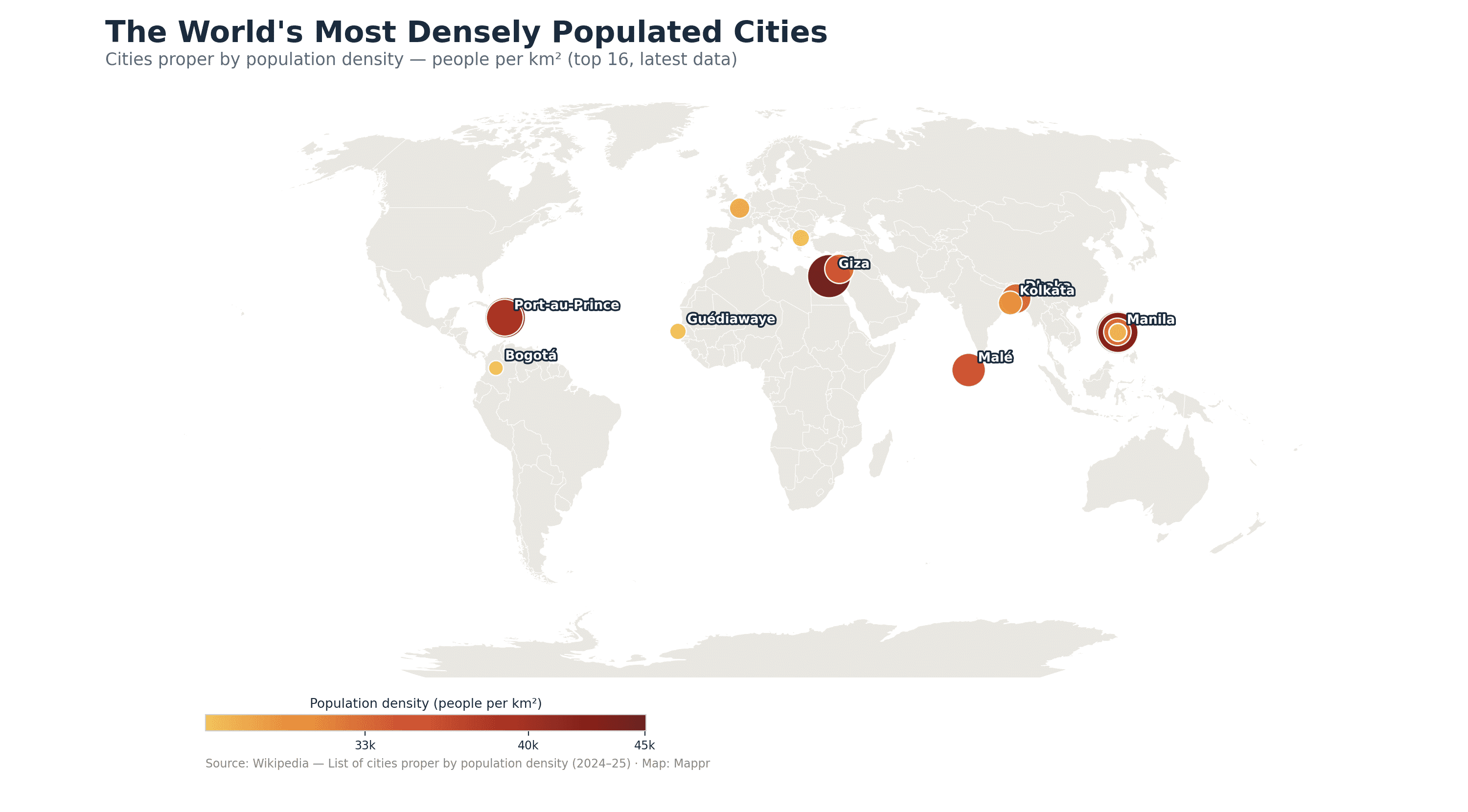
The 16 most densely populated cities in the world
| Rank | City | Country | Density (/km²) | Population |
|---|---|---|---|---|
| 1 | Giza | Egypt | 45,050 | 4,432,915 |
| 2 | Manila | Philippines | 44,370 | 1,902,590 |
| 3 | Croix-des-Bouquets | Haiti | 42,322 | 231,077 |
| 4 | Mandaluyong | Philippines | 42,125 | 465,902 |
| 5 | Port-au-Prince | Haiti | 39,084 | 988,438 |
| 6 | Malé | Maldives | 36,536 | 211,908 |
| 7 | Dhaka | Bangladesh | 33,757 | 10,295,786 |
| 8 | Bnei Brak | Israel | 33,503 | 237,471 |
| 9 | Caloocan | Philippines | 32,198 | 1,712,945 |
| 10 | Kolkata | India | 30,097 | 6,200,000 |
| 11 | Levallois-Perret | France | 28,387 | 68,412 |
| 12 | Taguig | Philippines | 27,320 | 1,308,085 |
| 13 | Pasig | Philippines | 27,115 | 853,050 |
| 14 | Neapoli (Thessaloniki) | Greece | 27,039 | 25,822 |
| 15 | Guédiawaye | Senegal | 26,688 | 373,638 |
| 16 | Bogotá | Colombia | 26,141 | 8,034,649 |
The cities at the very top
Giza, Egypt tops the table at roughly 45,000 people per km² — a city of 4.4 million squeezed against the Nile and the pyramids. Close behind is Manila, Philippines (~44,000/km²), the dense core of one of the world’s most crowded metro areas.
In fact, Metro Manila dominates this list: alongside Manila itself, the neighbouring cities of Mandaluyong, Caloocan, Taguig and Pasig all rank in the global top 13. No other metropolitan area comes close to that concentration of ultra-dense municipalities.
The biggest megacities on the list are Dhaka, Bangladesh (10.3 million people at ~34,000/km²) and Kolkata, India (6.2 million at ~30,000/km²) — vast, crowded South Asian capitals of commerce. Bogotá, Colombia (8 million) is the densest big city in the Americas, while Port-au-Prince, Haiti and the island capital of Malé, Maldives — where 200,000 people live on barely six square kilometres — round out the most extreme cases.
Why some tiny towns rank so high
Look closely and you’ll spot some unexpected names: Croix-des-Bouquets (Haiti), Levallois-Perret (France), Neapoli near Thessaloniki (Greece) and Bnei Brak (Israel). These aren’t huge cities at all — Levallois-Perret has just 68,000 residents — but they’re packed onto two or three square kilometres, which sends their density sky-high.
That’s the catch with any “densest cities” ranking: it depends entirely on the city-proper boundary. A small, tightly drawn municipality (like a Paris suburb or a single Tel Aviv district) can out-rank a sprawling megacity simply because its borders hug the built-up core. Measure by metropolitan area instead and the order changes completely — the likes of Mumbai, Lagos and Cairo climb, while the tiny municipalities drop off. There is no single “correct” answer; it all comes down to where you draw the line.
However you measure it, the pattern is clear: the world’s densest cities cluster in South and Southeast Asia, the Middle East, and fast-growing parts of Africa and Latin America — places where rapid urban growth has collided with limited land. For the people who live there, density brings both extraordinary energy and real strain on housing, transport and services.
Data and references:


All original maps and graphics on this page are © Mappr, free to use under a Creative Commons Attribution–ShareAlike licence (CC BY-SA): use them anywhere, including commercially, as long as you credit Mappr with a link back to Mappr.co. Exception: maps credited to third-party cartographers (for example © Rainer Lesniewski/Shutterstock, noted in the caption) are licensed for display on Mappr only and are not covered by this licence — they may not be downloaded or reused.
- Sunny Day at El Mahalla El Kubra Train Station in Egypt — © Mekky22/Shutterstock
- Traditional Indian Sweet Making at an Outdoor Kitchen in Firozabad, Uttar Pradesh — © Anuja Mukhopadhyay/Shutterstock
- Gathering of People for a Religious Event in Malegaon, India — © Mayur_Mehta/Shutterstock
- Busy Day at Asansol Railway Station Entrance in Kolkata, India — © Ritesh Ranjan Sett/Shutterstock
- Bustling Street Market Crowd in Mumbai, India — © Subhrajit123/Shutterstock
- Festive Procession at Shiv Chowk in Muzaffarnagar, India at Night — © Arpitsinghal65/Wikimedia Commons
- Bustling Street Scene at Dusk with Neon Signage in Hong Kong — © TungCheung/Shutterstock
- Courtyard View of a Traditional Indo-Islamic Architectural Building — © TheAafi/Wikimedia Commons
- Thousands of Pilgrims Crossing Pontoon Bridges at the Kumbh Mela Festival in Allahabad, India — © Vladimir Melnik/Shutterstock
- A Busy Day at Mbuji-Mayi Airport with UN Vehicles and Personnel — © MONUSCO/Myriam Asmani/Wikimedia Commons
- Pedestrians Crossing a Busy Street in Kinshasa, Democratic Republic of Congo — © Alexandra Tyukavina/Shutterstock
- Aerial View of Dense Urban Landscape in Surat, Gujarat, India — © azadjain1/Shutterstock
- Busy Day at a Historic Square in Macau with Modern Skyscrapers in the Background — © kylauf/Shutterstock
- Majestic Mosque El-Badawi in Tanta, Egypt under a Clear Blue Sky — © Ahmed Elfiky/Shutterstock
- Bustling Street Scene with Dense Traffic and Pedestrians in Dhaka, Bangladesh — © Sk Hasan Ali/Shutterstock