Key Takeaways
- Almost 40 million people in the EU can't afford to keep their home warm. That is 8.8% of the population in 2025, according to Eurostat, down from a peak of 10.6% in 2023 but still above the 6.9% recorded in 2019.
- Sunny countries do worse than cold ones. Greece (18.1%), Spain (15.9%) and Portugal (15.6%) have some of the highest rates in the EU, while Finland (2.6%) and Norway (1.7%) have the lowest. Lithuania and Bulgaria are the cold-climate exceptions.
- Spain's rate has more than doubled since 2019. It rose from 7.5% to 15.9%, and France went from 6.2% to 11.5%. Bulgaria, Lithuania and Cyprus moved the other way, with rates falling by nine to fourteen percentage points.
- This winter's energy bills are rising fastest in Belgium, Italy and Greece. Household energy prices in October 2026 were up 41% in Belgium, 35% in Italy and 26% in Greece on a year earlier, against an EU average of 12%. In Germany and Czechia they fell.
Ask where in Europe people struggle most to keep warm in winter and most would point north. The data says otherwise. Eurostat’s latest living-conditions survey shows that 8.8% of people in the EU, about 39.7 million, live in households that cannot afford to keep their home adequately warm, and the highest rates are found around the Mediterranean and in the Balkans, not in Scandinavia.
With household energy prices climbing again this autumn, we mapped who was already cold before this winter began.
The Map: Europe’s Cold Homes
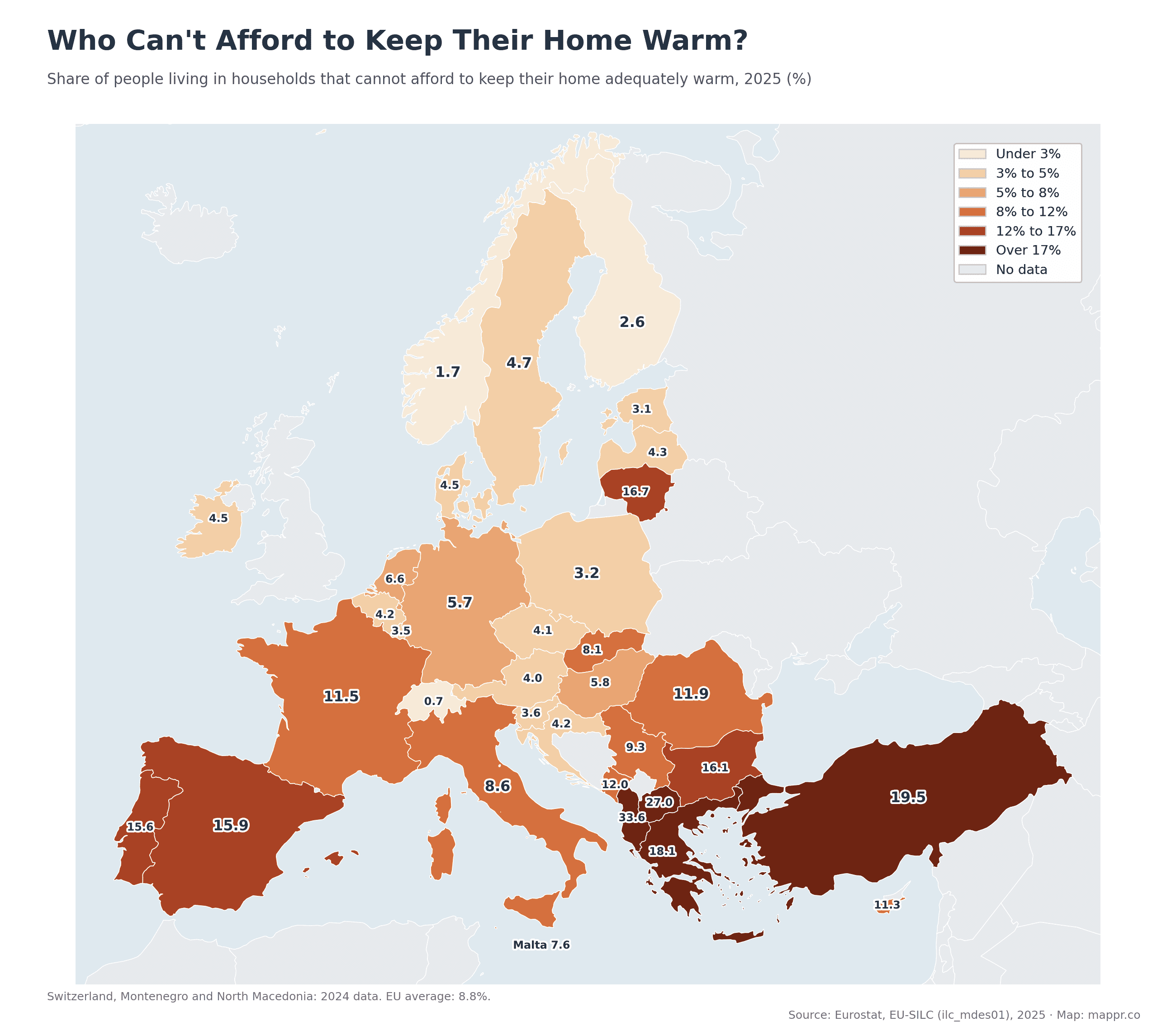
Among EU countries, Greece has the highest rate at 18.1%, followed by Lithuania (16.7%), Bulgaria (16.1%), Spain (15.9%) and Portugal (15.6%). Outside the EU the figures are higher still: 33.6% in Albania and 19.5% in Türkiye.
At the other end, fewer than one person in thirty reports the problem in Finland (2.6%), and the lowest figure anywhere in the data is Norway’s 1.7%. Poland, Estonia, Luxembourg and Slovenia are all below 4%.
In absolute numbers, two countries stand out: about 7.9 million people in France and 7.8 million in Spain cannot keep their homes warm, around 40% of the EU total between them.
The Warm-Country Paradox
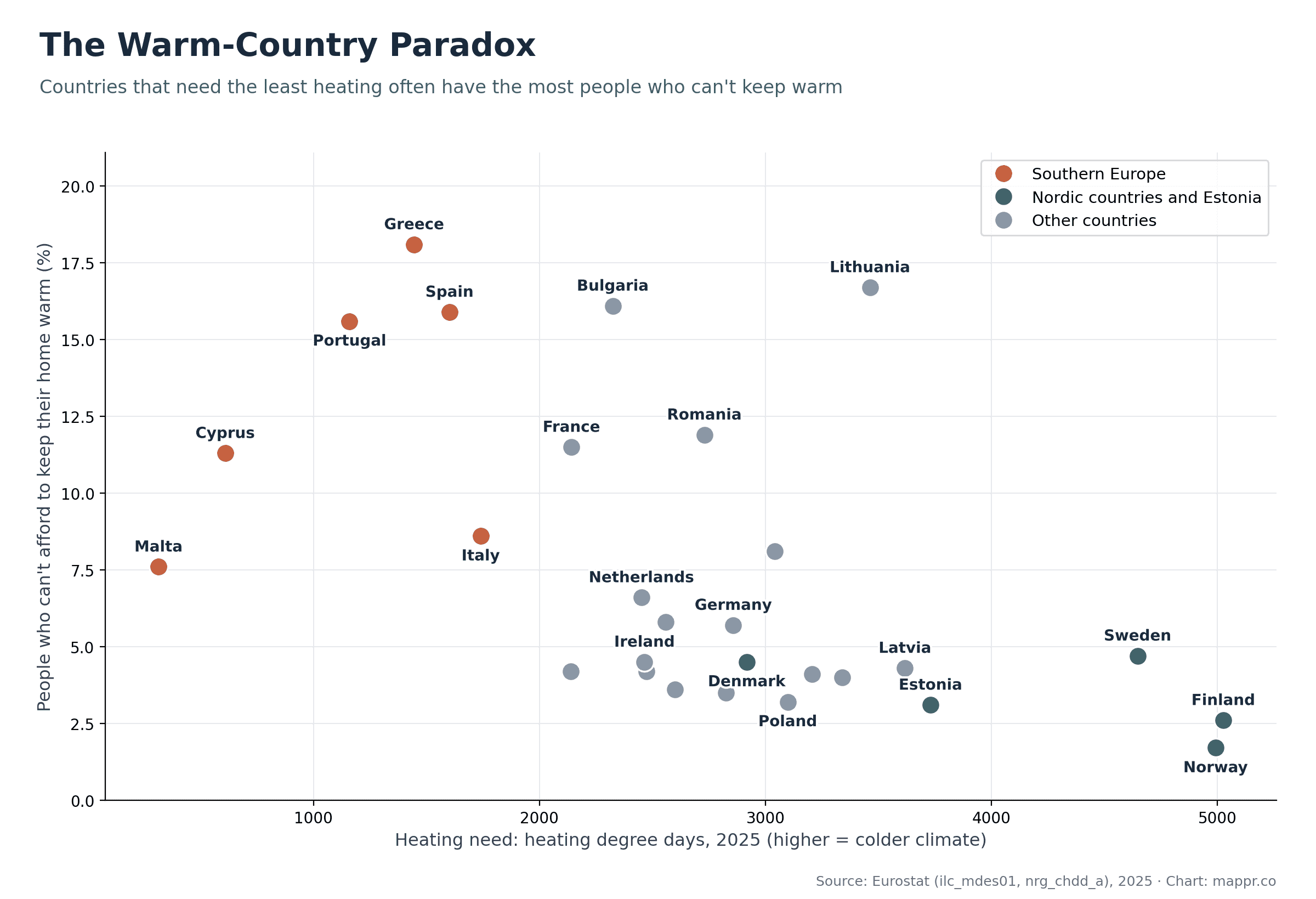
Plot how much heating a country needs against how many of its people cannot keep warm, and the line slopes the wrong way. Portugal needs less than a quarter of Finland’s heating, yet six times as large a share of its population cannot keep warm. Across the 27 EU countries, colder climates go with fewer cold homes.
The reason is not the weather but the buildings and the incomes. Homes in southern Europe are generally built to stay cool in summer, often with little insulation and no central heating, so they are expensive to warm when temperatures drop. Nordic homes are heavily insulated and heating is treated as a basic utility. The survey also measures affordability, not temperature: it asks whether a household can afford to keep its home adequately warm.
The pattern is not perfect. Lithuania and Bulgaria are cold-climate countries with very high rates, although both have improved sharply since 2019.
Who Got Worse, and Who Got Better
The map has shifted since 2019. Western Europe has got worse: Spain’s rate more than doubled, from 7.5% to 15.9%, France rose from 6.2% to 11.5%, the Netherlands from 3.0% to 6.6% and Germany from 2.5% to 5.7%. None has returned to its level before the 2022 energy crisis.
Meanwhile several of the old hotspots have improved: Bulgaria fell from 30.1% to 16.1%, Lithuania from 26.7% to 16.7% and Cyprus from 20.6% to 11.3%.
The full ranking
Who Can't Afford to Keep Their Home Warm, by Country
Share of the population, 2025, with the 2019 figure and this autumn’s change in household energy prices
| Country | 2025 | 2019 | Energy prices, Oct 2026 |
|---|---|---|---|
| Albania | 33.6% | 36.8% | +0.5% |
| Türkiye | 19.5% | 19.2% | +44.5% |
| Greece | 18.1% | 17.9% | +26.3% |
| Lithuania | 16.7% | 26.7% | +22.2% |
| Bulgaria | 16.1% | 30.1% | +5.3% |
| Spain | 15.9% | 7.5% | +14.1% |
| Portugal | 15.6% | 18.9% | +3.6% |
| Romania | 11.9% | 9.3% | +4.3% |
| France | 11.5% | 6.2% | +13.5% |
| Cyprus | 11.3% | 20.6% | +18.9% |
| Serbia | 9.3% | 10.4% | +1.9% |
| Italy | 8.6% | 11.1% | +35.2% |
| Slovakia | 8.1% | 7.8% | +11.1% |
| Malta | 7.6% | 7.8% | 0% |
| Netherlands | 6.6% | 3.0% | +7.0% |
| Hungary | 5.8% | 5.4% | +2.4% |
| Germany | 5.7% | 2.5% | -0.6% |
| Sweden | 4.7% | 1.9% | +11.6% |
| Denmark | 4.5% | 2.8% | +2.9% |
| Ireland | 4.5% | 5.1% | +16.3% |
| Latvia | 4.3% | 8.0% | +8.2% |
| Belgium | 4.2% | 3.9% | +41.4% |
| Croatia | 4.2% | 6.6% | +12.1% |
| Czechia | 4.1% | 2.8% | -5.5% |
| Austria | 4.0% | 1.8% | +7.2% |
| Slovenia | 3.6% | 2.3% | +12.7% |
| Luxembourg | 3.5% | 2.4% | +0.5% |
| Poland | 3.2% | 4.2% | +7.6% |
| Estonia | 3.1% | 2.5% | +7.6% |
| Finland | 2.6% | 1.8% | +6.9% |
| Norway | 1.7% | 1.0% | +11.0% |
This Winter’s Price Shock
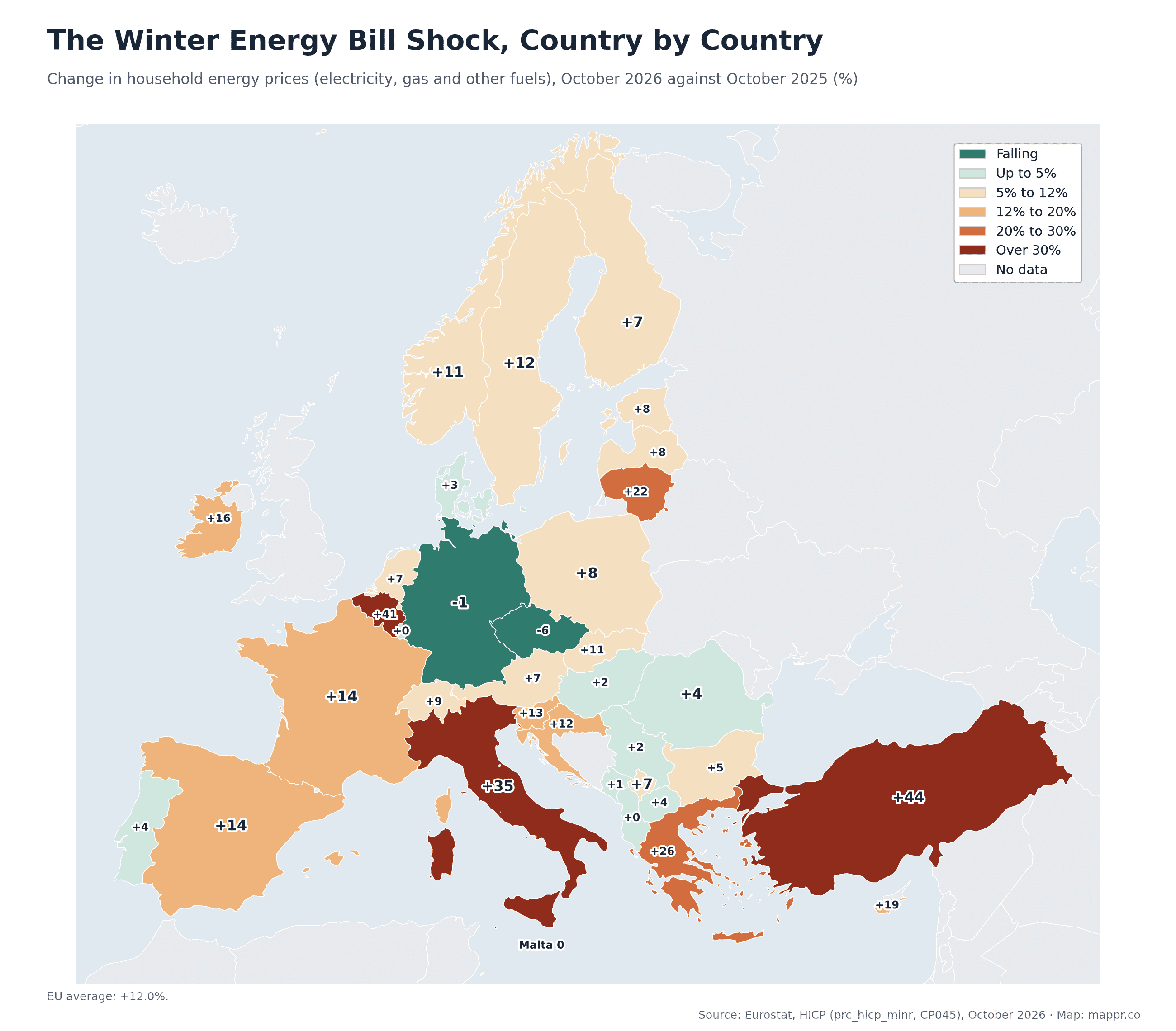
The survey figures above were collected in 2025, before the latest rise in energy prices. Across the EU, household energy cost 12% more in October 2026 than a year earlier, but the increase is very uneven: up 41% in Belgium, 35% in Italy and 26% in Greece, while prices fell in Germany (down 0.6%) and Czechia (down 5.5%).
Some countries are exposed on both counts. Greece, Lithuania, Spain, France and Cyprus all have above-average shares of people who could not keep warm in 2025 and above-average energy price rises this autumn. For them, the 2025 figures are best read as the picture before the squeeze.
About the Data
The main figures come from EU-SILC, the EU’s annual survey of income and living conditions, in which households are asked whether they can afford to keep their home adequately warm. The answers are self-reported, and what counts as adequately warm may differ between countries. Switzerland, Montenegro and North Macedonia are shown with 2024 data, and the United Kingdom has not taken part in the survey since 2019.