Key Takeaways
- About 840 million women have experienced partner or sexual violence. That is nearly 1 in 3 women worldwide, according to WHO's latest estimates, a figure that has barely changed in two decades.
- Pacific islands and parts of Africa and South Asia report the highest rates. In Fiji, the Solomon Islands, Papua New Guinea and Vanuatu, more than half of ever-partnered women have experienced violence from a partner.
- About 1 in 9 ever-partnered women were abused by a partner in the past year. Globally, 11% of ever-partnered women aged 15 and over were abused by a partner in the past 12 months, rising to over a third in Papua New Guinea, Sierra Leone and South Sudan.
- About 50,000 women and girls were killed by partners or relatives in 2024. That is one every 10 minutes, according to UNODC and UN Women. The International Day for the Elimination of Violence against Women is 25 November.
On 25 November, the world marks the International Day for the Elimination of Violence against Women, the start of 16 days of activism that run to Human Rights Day on 10 December. The scale of what it addresses is hard to grasp: according to the World Health Organization, about 840 million women, nearly 1 in 3 worldwide, have experienced physical or sexual violence from a partner, sexual violence from someone else, or both.
WHO’s latest estimates, the most comprehensive ever produced, cover more than 160 countries and areas and draw on surveys carried out between 2000 and 2023. We mapped the most common form of violence they measure: violence by an intimate partner.
The Map: Partner Violence Over a Lifetime
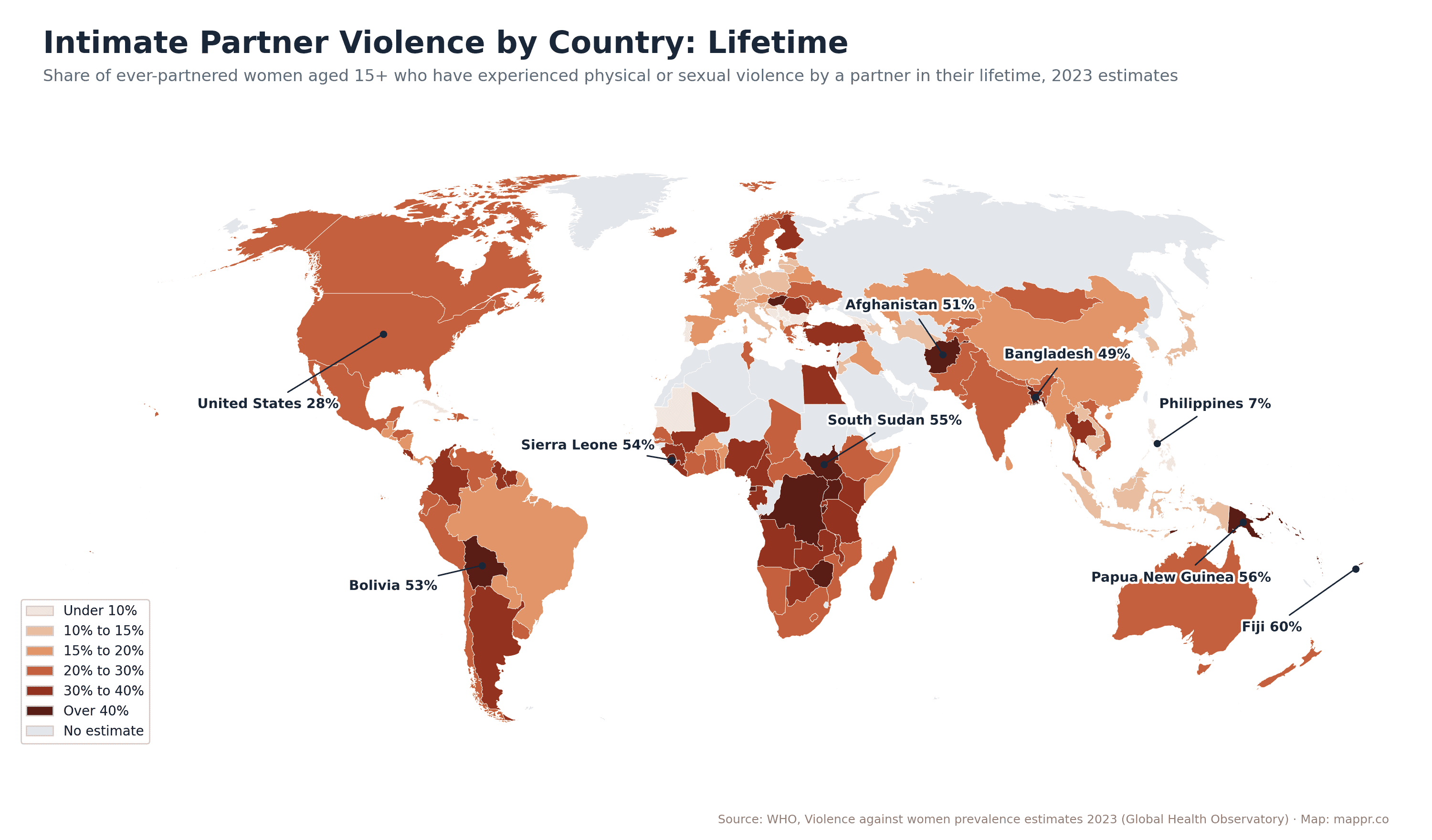
Globally, 24.7% of ever-partnered women aged 15 and over have been physically or sexually abused by a partner at some point in their lives. Rates are highest in the WHO’s Africa (31.8%) and South-East Asia (31.1%) regions and lowest in the Western Pacific (17.8%), although that regional average hides the highest rates anywhere: in the Pacific island nations of Fiji (60%), the Solomon Islands (58%), Papua New Guinea (56%) and Vanuatu (56%), more than half of ever-partnered women have experienced violence from a partner.
Conflict-affected and fragile states also rank high, including South Sudan (55%), Sierra Leone (54%), Afghanistan (51%) and DR Congo (48%). Bolivia (53%) has the highest rate in the Americas.
Highest prevalence
Where the Most Women Have Experienced Partner Violence
Ever-partnered women aged 15+, 2023 estimates
| Country | Lifetime | Past 12 months |
|---|---|---|
| Fiji | 60% | 21% |
| Solomon Islands | 58% | 30% |
| Papua New Guinea | 56% | 40% |
| Vanuatu | 56% | 32% |
| South Sudan | 55% | 36% |
| Sierra Leone | 54% | 37% |
| Kiribati | 54% | 37% |
| Equatorial Guinea | 53% | 35% |
| Bolivia | 53% | 14% |
| Afghanistan | 51% | 35% |
| Bangladesh | 49% | 14% |
| DR Congo | 48% | 31% |
Partner Violence in the Past Year
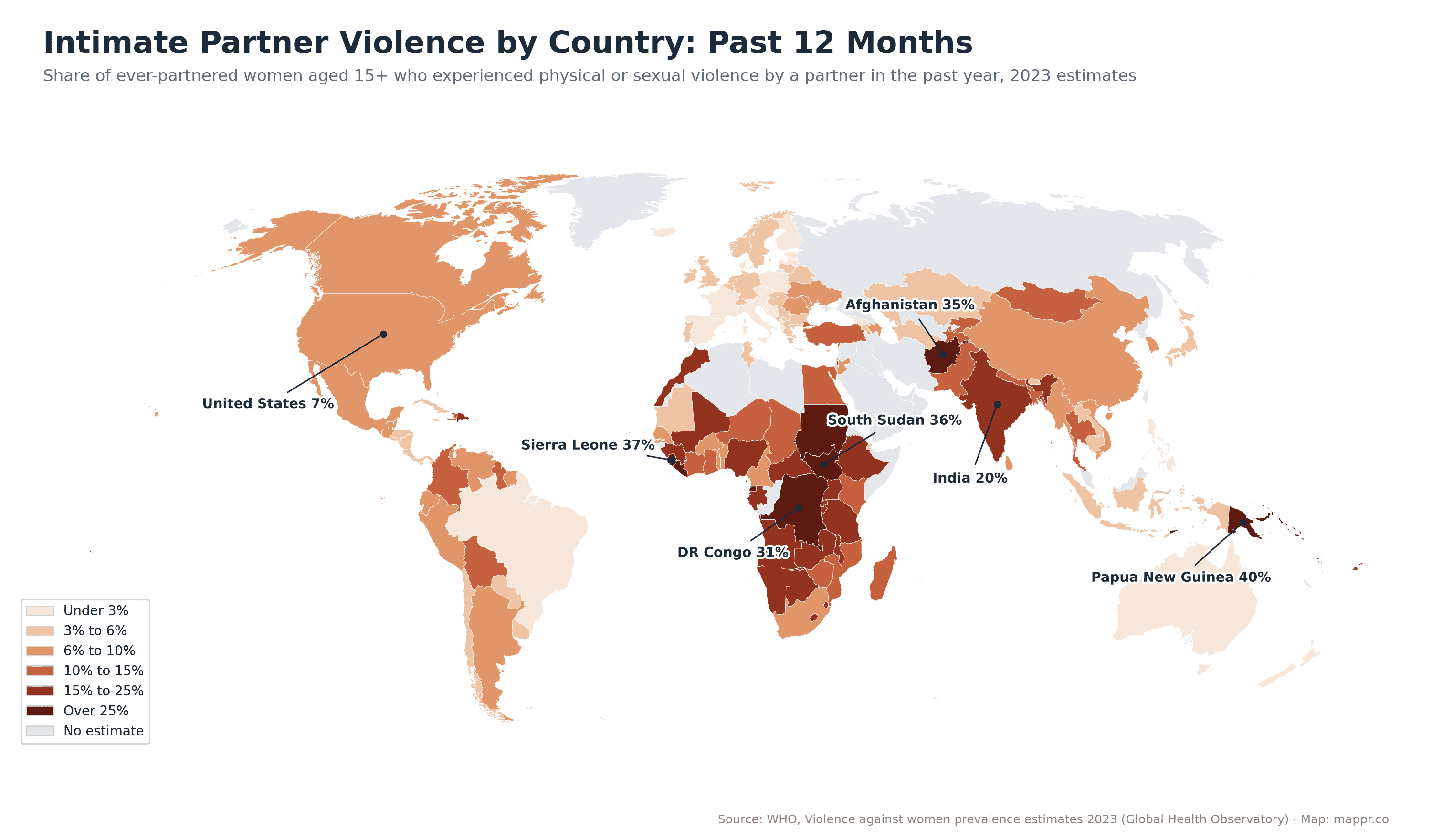
Lifetime figures include violence that may have happened decades ago. The past-year figures show who is at risk now. Globally, 11.4% of ever-partnered women were abused by a partner in the last 12 months. In Papua New Guinea it was 40%, and in Kiribati, Sierra Leone, South Sudan, Equatorial Guinea and Afghanistan more than a third.
Comparing the two maps is revealing. In wealthy countries, lifetime rates are often surprisingly high, 28% in the United States, 25% in the United Kingdom and 36% in Finland, but past-year rates are low, between 2% and 7%. In countries such as India (30% lifetime, 20% past year), the gap is far smaller, a sign that violence remains an ongoing reality for many women rather than something in the past.
Why Low Numbers Do Not Always Mean Less Violence
Lowest reported prevalence
Where Reported Partner Violence Is Lowest
Ever-partnered women aged 15+, 2023 estimates
| Country | Lifetime | Past 12 months |
|---|---|---|
| Kosovo | 5% | 4% |
| Singapore | 7% | 2% |
| Philippines | 7% | 3% |
| Georgia | 7% | 1% |
| Bulgaria | 8% | 3% |
| Comoros | 8% | 6% |
| Montenegro | 8% | 4% |
| Cuba | 8% | 4% |
| Armenia | 9% | 3% |
| Mauritania | 9% | 6% |
Some of the lowest reported rates, in Kosovo, Singapore and the Philippines, may reflect genuinely lower levels of violence. But WHO stresses that these are survey-based estimates, and that violence against women is heavily stigmatised and widely under-reported. Where women fear reprisal, distrust authorities or do not define abuse by a partner as violence, surveys capture less of it. WHO describes its own global figures as likely to be underestimates.
There are also gaps on the map. Several large countries, including Russia and Iran, have no estimate because no suitable national survey was available.
The Deadliest End of the Spectrum: Femicide
The most extreme form of this violence is killing. According to UNODC and UN Women, about 83,000 women and girls were intentionally killed in 2024, and around 50,000 of them, 60%, were killed by a partner or family member: 137 every day, or one every 10 minutes. Africa has the highest rate of such killings, followed by the Americas and Oceania.
The UN Secretary-General’s 2026 report to the General Assembly focuses on femicide, and UN agencies are urging countries to treat it as a distinct crime so that it can be counted and prevented. Many countries still do not record whether a woman was killed by a partner, which is why country-by-country femicide data remains patchy.
What Works
Despite decades of campaigning, WHO finds that intimate partner violence has fallen only slowly since 2000. Programmes that do make a difference include economic support for women, community programmes that challenge harmful gender norms, school-based education about healthy relationships, and health and justice services that respond properly when women report abuse. The 16 Days of Activism are a reminder that the map above is not fixed.
If you or someone you know is affected by domestic violence, help is available. Search for your country’s national domestic violence helpline, or contact local emergency services if you are in immediate danger.
Sources: