
Key Takeaways
- 304 million people live outside their birth country. International migrants reached about 304 million in 2024 — roughly 3.7% of humanity, up from 281 million in 2020. The vast majority still live in the country where they were born.
- The United States is the top destination by far. Around 52 million immigrants live in the US — more than the next three destination countries (Germany, Saudi Arabia and the UK) combined.
- The Gulf states are the most immigrant-heavy on Earth. In the UAE and Qatar, foreign-born residents make up roughly three-quarters of the population — overwhelmingly migrant workers drawn by oil-funded economies.
- India sends the most people abroad. India has the world's largest diaspora — around 18 million people — followed by Mexico, Russia and China. The Mexico-to-US route is the single biggest migration corridor.
- Work, family and safety drive the flows. Most migration is for jobs and family; a smaller share — though a fast-growing one — is people forced to move by conflict and persecution.
Migrants live in almost every country on Earth, but they are spread very unevenly. In 2024 about 304 million people lived outside the country where they were born — roughly 3.7% of the world’s population, and the highest number ever recorded. This guide maps where the world’s immigrants actually live, which countries take in the most, and where newcomers make up the largest share of the population.
The map below shows the share of each country’s population that is foreign-born, using United Nations and World Bank estimates for 2024. The pattern is striking: the oil-rich Gulf states, the classic settler nations of North America and Australia, and much of Western Europe stand out, while the world’s most populous countries — India and China — have very few immigrants relative to their size.
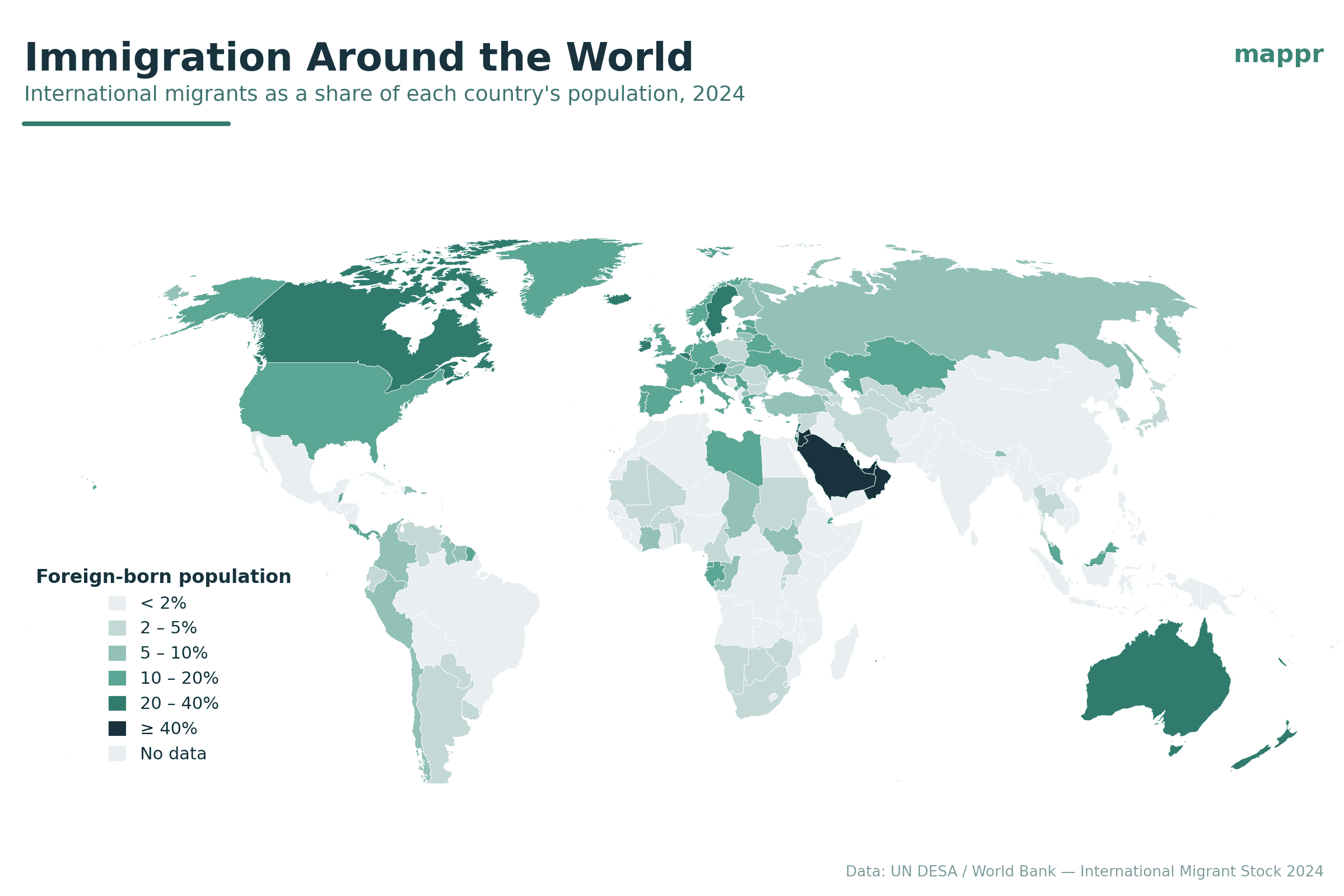
How many immigrants are there in the world?
The United Nations counts an “international migrant” as anyone living in a country other than the one they were born in, whatever their reason for moving or their legal status. By that definition there were about 304 million migrants in 2024, up from 281 million in 2020 and roughly 173 million in 2000. The total has grown faster than the world’s population, but it still means that more than 96% of people live in their country of birth — migration is the exception, not the rule.
Because these figures come from census and survey estimates compiled by the UN Population Division, they capture people living abroad long-term. They do not perfectly capture short-term or irregular movement, so think of them as the best available picture of where the world’s migrants have settled rather than an exact headcount.
Which countries have the most immigrants?
By sheer numbers, the United States is in a league of its own, home to around 52 million immigrants — about one in six US residents, and more than the next three countries combined. Germany (some 17 million) is Europe’s biggest immigrant nation, shaped by post-war labour recruitment, EU free movement and the refugee arrivals of the 2010s. Saudi Arabia (about 14 million) and the United Kingdom (around 12 million) round out the top four, followed by France, Spain, Canada, the UAE and Australia.
Ranked
Countries With the Most Immigrants (2024)
Top destination countries by total international migrant stock.
| Country | Migrants | % of population |
|---|---|---|
| 1. United States | 52.4M | 15% |
| 2. Germany | 16.8M | 20% |
| 3. Saudi Arabia | 13.7M | 40% |
| 4. United Kingdom | 11.8M | 17% |
| 5. France | 9.2M | 14% |
| 6. Spain | 8.9M | 18% |
| 7. Canada | 8.8M | 22% |
| 8. United Arab Emirates | 8.2M | 74% |
| 9. Australia | 8.1M | 30% |
| 10. Russia | 7.6M | 5% |
| 11. Türkiye | 7.1M | 8% |
| 12. Italy | 6.6M | 11% |
| 13. Jordan | 5.3M | 46% |
| 14. Ukraine | 5.1M | 13% |
| 15. India | 4.8M | 0.3% |
| 16. Pakistan | 4.2M | 2% |
| 17. Iran | 3.8M | 4% |
| 18. Malaysia | 3.8M | 11% |
Several patterns stand out. The traditional immigration countries — the US, Canada and Australia — were largely built by migration and still run large permanent-residence programmes. The Gulf states such as Saudi Arabia and the UAE rely on huge temporary workforces. And countries like Russia, Türkiye, Jordan and Ukraine appear high on the list partly because of regional movement and refugee flows from neighbouring crises.
Where immigrants make up the biggest share
Counting heads tells only half the story. As a share of the population, the most immigrant-heavy countries are the small, wealthy Gulf monarchies. In Qatar and the United Arab Emirates, foreign-born residents make up roughly three-quarters of everyone living there; in Kuwait it is about two-thirds. These are overwhelmingly migrant workers — from South Asia, the Philippines, Egypt and beyond — who power construction, services and the oil economy, usually without a path to citizenship.
Ranked
Where Immigrants Make Up the Biggest Share
Countries where the foreign-born are the largest percentage of the population (population over 300,000 migrants).
| Country | Foreign-born share | Migrants |
|---|---|---|
| 1. Qatar | 77% | 2.3M |
| 2. United Arab Emirates | 74% | 8.2M |
| 3. Kuwait | 67% | 3.3M |
| 4. Macao | 59% | 0.4M |
| 5. Bahrain | 52% | 0.8M |
| 6. Luxembourg | 51% | 0.3M |
| 7. Singapore | 49% | 2.8M |
| 8. Jordan | 46% | 5.3M |
| 9. Oman | 43% | 2.3M |
| 10. Hong Kong | 41% | 3.1M |
| 11. Saudi Arabia | 40% | 13.7M |
| 12. Switzerland | 31% | 2.8M |
Beyond the Gulf, financial and trading hubs like Singapore, Hong Kong and Luxembourg, and high-wage Switzerland, also have very high foreign-born shares. Jordan is a different case again: its high figure reflects decades of hosting Palestinian, Iraqi and Syrian refugees.
Where do the world’s migrants come from?
Migration is not just about destinations. India has the world’s largest diaspora — around 18 million people living abroad, from Gulf labourers to Silicon Valley engineers. Mexico is next, with the Mexico-to-United States route remaining the single largest country-to-country migration corridor on the planet. Russia and China also send millions abroad, a legacy of both economic opportunity and, in Russia’s case, the break-up of the Soviet Union.
Conflict has reshaped the origin map in the last decade. Syria, Afghanistan and, since 2022, Ukraine have produced some of the fastest-growing migrant and refugee populations in the world, while Bangladesh, Pakistan and the Philippines remain major long-term sources of labour migration.
Why do people migrate?
Most migration comes down to a handful of forces. Work and wages pull people toward richer economies — from the Gulf’s labour markets to the tech and healthcare sectors of North America and Europe. Family reunification keeps established corridors flowing once the first generation has settled. Proximity and history matter too: colonial and linguistic ties link France to North and West Africa, Britain to South Asia, and Germany to Türkiye, while neighbours absorb most of the people displaced by any given crisis.
Finally, a smaller but rising share of migrants are forced to move by war, persecution and, increasingly, climate and economic collapse. They make up a minority of the global total, but they dominate the headlines — and they are why several conflict-bordering countries appear so high on the maps above.
Migrant population figures, shares of population and country rankings are drawn from the United Nations Department of Economic and Social Affairs (UN DESA) International Migrant Stock 2024 dataset, accessed via the World Bank's open data API. The map is a Mappr original built from these figures and Natural Earth boundaries.
Primary Data Sources:
- UN DESA — International Migrant Stock 2024 – The United Nations' authoritative estimates of the number of international migrants by country and origin.
- World Bank — International migrant stock (SM.POP.TOTL) – Open-data mirror of the UN migrant-stock figures used to build the map and rankings.
Image Sources:
- Map by Mappr – World immigration map — a Mappr original built from UN DESA / World Bank data and Natural Earth boundaries.


