
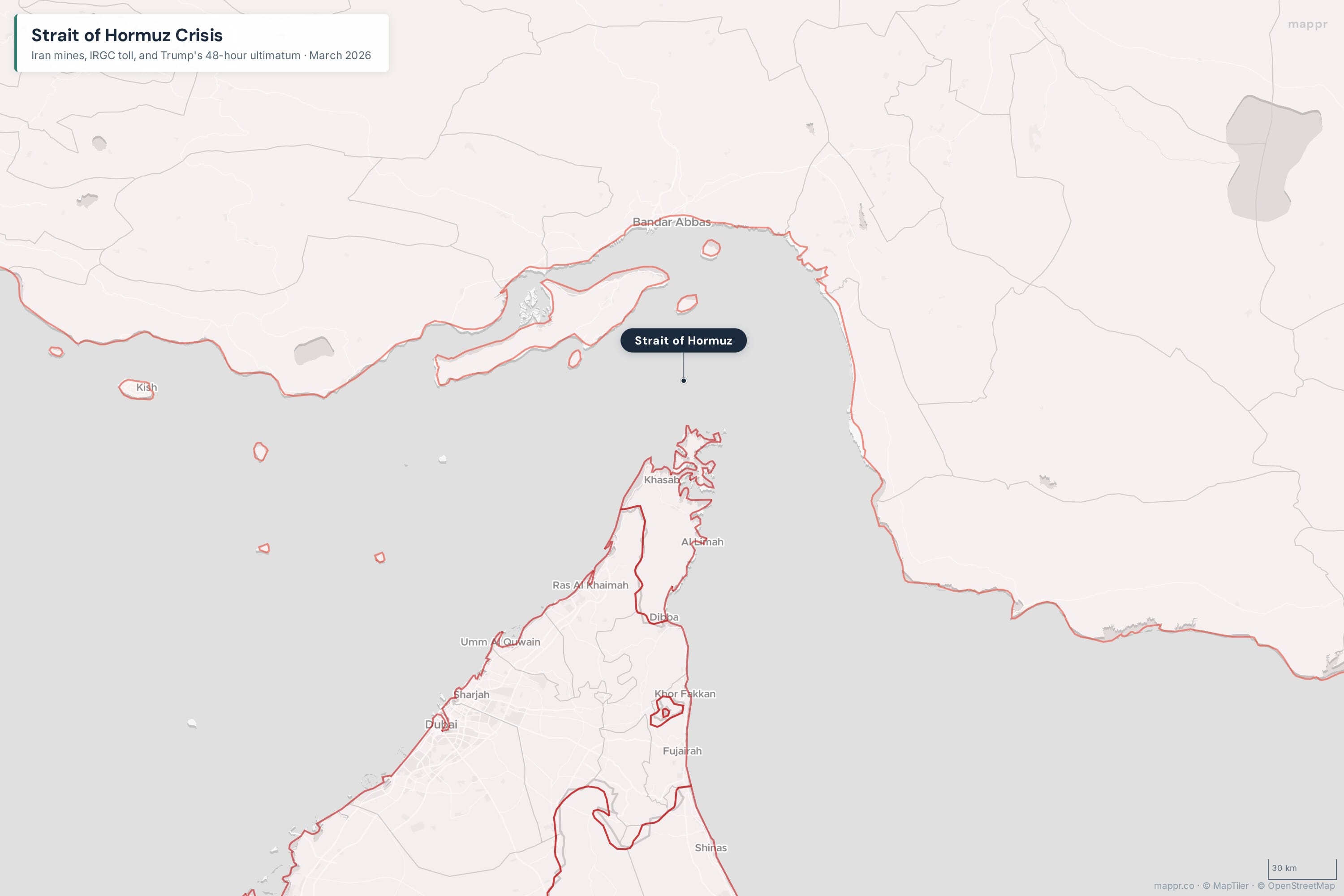
The Strait of Hormuz, the narrow waterway separating Iran from the Arabian Peninsula, has become the epicenter of a global energy crisis. Since the U.S. and Israel began airstrikes on Iran on February 28, 2026, this critical chokepoint — through which roughly 20% of the world’s oil and liquefied natural gas typically flows — has been effectively shut down.
The Crisis in Numbers
- Oil transit disrupted: ~20% of global supply blocked
- Middle East oil exports: Down 60% since Feb 28
- IRGC transit fee: ~$2 million per vessel for “safe passage”
- Sea mines: At least 12 Iranian-manufactured Maham 3 and Maham 7 limpet mines confirmed in the strait
- Energy infrastructure: 40+ assets across 9 countries “severely damaged” (IEA)
- LNG supply: Global supply reduced by ~20%
What’s Happening Right Now
Iran’s Sea Mines
U.S. officials have confirmed that Iran has placed at least a dozen sea mines in the Strait of Hormuz. Identified as Iranian-manufactured Maham 3 and Maham 7 limpet mines, these explosives threaten any unauthorized ship attempting to transit the strait without Iran’s permission.
The IRGC Toll Checkpoint
Iran’s Islamic Revolutionary Guard Corps (IRGC) has established what amounts to a toll checkpoint in the strait. Vessels seeking passage must coordinate with the IRGC Navy and reportedly pay approximately $2 million per ship for transit through a designated “safe corridor.” If multiplied across the 130+ daily transits the strait typically sees, this fee structure could earn Iran tens of billions of dollars per year.
Iranian Parliament Speaker Mohammad Bagher Ghalibaf stated bluntly on March 17: “The Strait of Hormuz situation won’t return to its pre-war status.” Iranian officials have indicated they intend to maintain control of the waterway even after hostilities end, creating a “new regime for the Strait of Hormuz.”
Trump’s 48-Hour Ultimatum
On March 22, President Donald Trump gave Iran 48 hours to “fully open, without threat” the Strait of Hormuz, or face strikes on Iranian power plants. Iran responded by threatening to counterattack water desalination plants and energy targets across the Gulf region. The deadline has since been extended to Friday.
UN Security Council Action
Bahrain has introduced a draft UN Security Council resolution under Chapter VII of the UN Charter that would authorize member states to use “all necessary means” — diplomatic language for military force — to protect commercial shipping in and around the Strait of Hormuz. France has offered an alternative diplomatic approach.
Interactive Map: Strait of Hormuz Crisis Zone
Explore the crisis zone below. Click on markers to see details about mine fields, military positions, IRGC checkpoints, and key energy infrastructure.
Global Impact
The IEA’s Executive Director Fatih Birol described the situation as equivalent to the two major oil crises of the 1970s and the 2022 gas crisis “put together.” The disruption extends far beyond oil:
- Fertilizers: About a third of global fertilizer trade passes through the strait. Nitrogen fertilizer prices have risen 30-40%, threatening food security ahead of spring planting.
- Helium: Qatar’s helium exports (critical for chip manufacturing) are blocked, threatening semiconductor supply chains.
- LNG: With Qatar’s Ras Laffan terminal — the world’s largest LNG export facility — effectively landlocked behind the strait, global LNG supply has dropped ~20%.
What Comes Next
The coming days are critical. Trump’s extended deadline expires Friday. The UN Security Council is debating Bahrain’s resolution. GCC nations are in early-stage talks with Iran, though gaps remain wide. Saudi Arabia is reportedly ratcheting up support for the U.S. side, with the possibility of Saudi forces joining the effort directly.
The IEA’s Birol put it simply: the reopening of the Strait of Hormuz is the “single most important” solution to the global energy crisis.
Sources
- Reuters — Iran says Hormuz open to all but ‘enemy-linked’ ships
- New York Post — Iran has placed deadly sea mines in Strait of Hormuz
- CNBC — More than 40 Middle East energy assets ‘severely damaged’
- The Maritime Executive — Iran’s Strait of Hormuz Checkpoint
- Marine Link — Bahrain Pushes UN Action on Hormuz Shipping